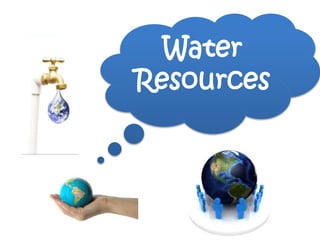



Water
Resources
Are sources of water that are
useful to humans. Uses of water
include agricultural, industrial,
household, recreational and
environmental activities. Virtually
all of these human uses require
fresh water.
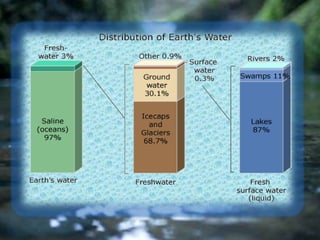
• Fresh water is renewable
resources like soil and air. The
world is supplied by clean and
fresh water and it is decreasing.
Water is one of our most critical
resources, but around the world
it is under threat.
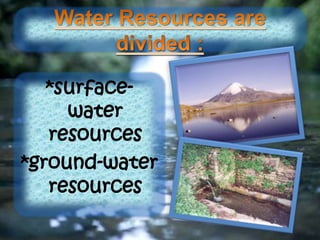
*surface-
water
resources
*ground-water
resources
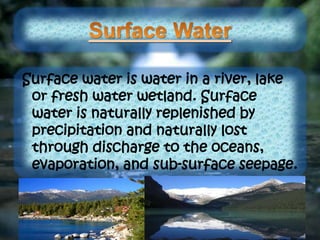
Surface water is water in a river, lake
or fresh water wetland. Surface
water is naturally replenished by
precipitation and naturally lost
through discharge to the oceans,
evaporation, and sub-surface seepage.
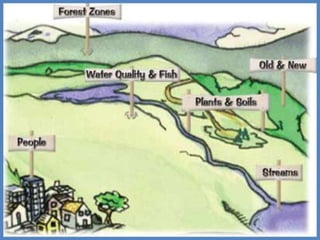
As streams and rivers move
across the land they form
a flowing network called
RIVER SYSTEM
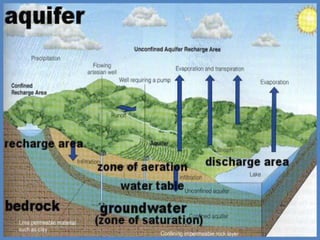
Sub-surface water, or
groundwater, is fresh water
located in the pore space
of soil and rocks. It is also
water that is flowing within
aquifers below the water
table.
A level where the rocks
and soil are saturated
with water underground.
An aquifer is an
underground formation
that contains water.
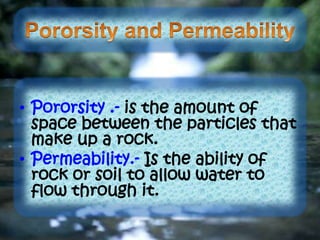
• Pororsity .- is the amount of
space between the particles that
make up a rock.
• Permeability.- Is the ability of
rock or soil to allow water to
flow through it.
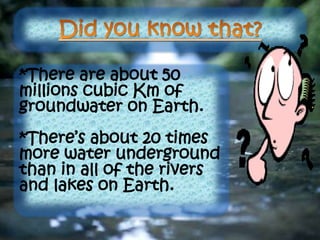
*There are about 50
millions cubic Km of
groundwater on Earth.
*There’s about 20 times
more water underground
than in all of the rivers
and lakes on Earth.
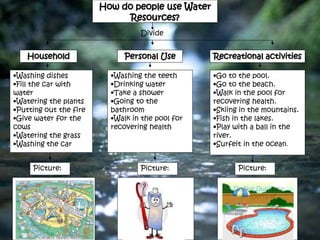
How do people use Water
Resources?
Household Personal Use Recreational activities
•Washing dishes
•Fill the car with
water
•Watering the plants
•Putting out the fire
•Give water for the
cows
•Watering the grass
•Washing the car
•Washing the teeth
•Drinking water
•Take a shower
•Going to the
bathroom
•Walk in the pool for
recovering health
•Go to the pool.
•Go to the beach.
•Walk in the pool for
recovering health.
•Skiing in the mountains.
•Fish in the lakes.
•Play with a ball in the
river.
•Surfeit in the ocean.
Picture:Picture: Picture:
Divide
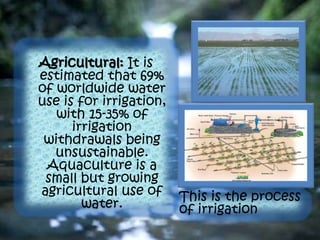
Agricultural: It is
estimated that 69%
of worldwide water
use is for irrigation,
with 15-35% of
irrigation
withdrawals being
unsustainable.
Aquaculture is a
small but growing
agricultural use of
water.
This is the process
of irrigation
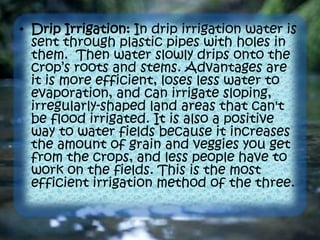
• Drip Irrigation: In drip irrigation water is
sent through plastic pipes with holes in
them. Then water slowly drips onto the
crop’s roots and stems. Advantages are
it is more efficient, loses less water to
evaporation, and can irrigate sloping,
irregularly-shaped land areas that can't
be flood irrigated. It is also a positive
way to water fields because it increases
the amount of grain and veggies you get
from the crops, and less people have to
work on the fields. This is the most
efficient irrigation method of the three.
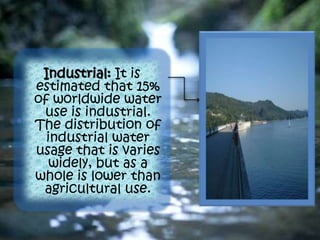
Industrial: It is
estimated that 15%
of worldwide water
use is industrial.
The distribution of
industrial water
usage that is varies
widely, but as a
whole is lower than
agricultural use.
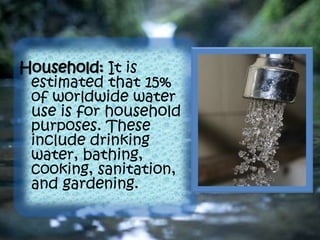
Household: It is
estimated that 15%
of worldwide water
use is for household
purposes. These
include drinking
water, bathing,
cooking, sanitation,
and gardening.
Environmental:
Explicit
environmental
water use is also a
very small but
growing percentage
of total water use.
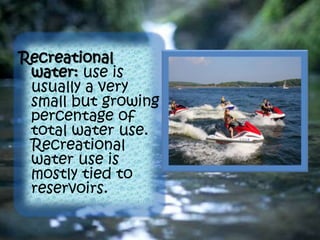
Recreational
water: use is
usually a very
small but growing
percentage of
total water use.
Recreational
water use is
mostly tied to
reservoirs.
Water pollution occurs when a
body of water is adversely
affected due to the addition
of large amounts of materials
to the water. When it is unfit
for its intended use, water is
considered polluted.
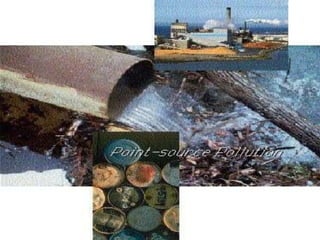
Point pollution is pollution
that is discharged from a
single source, such as a
factory or waste water
treatment plant. (you can
point to it)
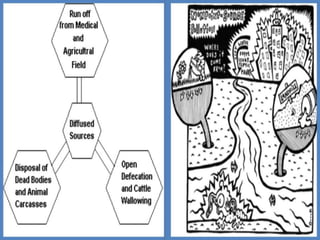
Nonpoint pollution is pollution
that comes from many sources
rather than a single specific site.
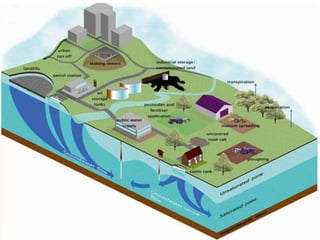
*Septic tank systems
*Storage lagoons for polluted
waste
*Municipal landfills
*Underground storage tanks
containing pollutants such as
gasoline.
*Public and industrial wastewater
treatment plants.
* Highway construction and
maintenance:
eroding soil and toxic chemicals.
*Storm-water runoff from city and
*suburban streets: oil gasoline, dog
feces, litter.
*Pesticides from croplands.
**Fertilizers from croplands.
* Salt on roads for snow and ice control.
•Pathogens
•Organic matter
•Organic chemicals
•Inorganic chemicals
•Toxic chemicals
•Physical agents
•Radioactive waste
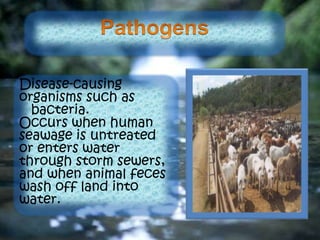
Disease-causing
organisms such as
bacteria.
Occurs when human
seawage is untreated
or enters water
through storm sewers,
and when animal feces
wash off land into
water.
Biodegradable remains of
animals and plants,
including feces.
Generally comes from
nonpoint sources.
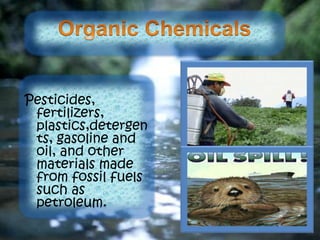
Pesticides,
fertilizers,
plastics,detergen
ts, gasoline and
oil, and other
materials made
from fossil fuels
such as
petroleum.
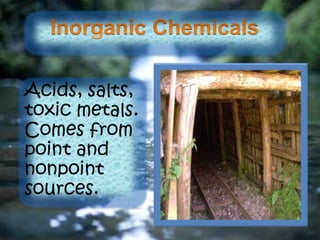
Acids, salts,
toxic metals.
Comes from
point and
nonpoint
sources.
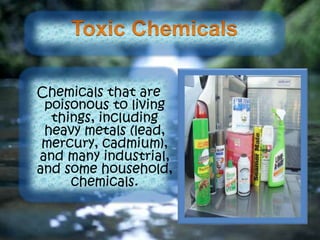
Chemicals that are
poisonous to living
things, including
heavy metals (lead,
mercury, cadmium),
and many industrial,
and some household,
chemicals.
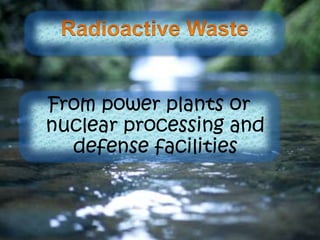
From power plants or
nuclear processing and
defense facilities
Water Resources (Basic Geography)

Water Resources (Basic Geography)

  • 5.
  • 6.
    Are sources ofwater that are useful to humans. Uses of water include agricultural, industrial, household, recreational and environmental activities. Virtually all of these human uses require fresh water.
  • 7.
    • Fresh wateris renewable resources like soil and air. The world is supplied by clean and fresh water and it is decreasing. Water is one of our most critical resources, but around the world it is under threat.
  • 8.
  • 10.
    Surface water iswater in a river, lake or fresh water wetland. Surface water is naturally replenished by precipitation and naturally lost through discharge to the oceans, evaporation, and sub-surface seepage.
  • 11.
    As streams andrivers move across the land they form a flowing network called RIVER SYSTEM
  • 13.
    Sub-surface water, or groundwater,is fresh water located in the pore space of soil and rocks. It is also water that is flowing within aquifers below the water table.
  • 15.
    A level wherethe rocks and soil are saturated with water underground.
  • 16.
    An aquifer isan underground formation that contains water.
  • 18.
    • Pororsity .-is the amount of space between the particles that make up a rock. • Permeability.- Is the ability of rock or soil to allow water to flow through it.
  • 19.
    *There are about50 millions cubic Km of groundwater on Earth. *There’s about 20 times more water underground than in all of the rivers and lakes on Earth.
  • 21.
    How do peopleuse Water Resources? Household Personal Use Recreational activities •Washing dishes •Fill the car with water •Watering the plants •Putting out the fire •Give water for the cows •Watering the grass •Washing the car •Washing the teeth •Drinking water •Take a shower •Going to the bathroom •Walk in the pool for recovering health •Go to the pool. •Go to the beach. •Walk in the pool for recovering health. •Skiing in the mountains. •Fish in the lakes. •Play with a ball in the river. •Surfeit in the ocean. Picture:Picture: Picture: Divide
  • 22.
    Agricultural: It is estimatedthat 69% of worldwide water use is for irrigation, with 15-35% of irrigation withdrawals being unsustainable. Aquaculture is a small but growing agricultural use of water. This is the process of irrigation
  • 23.
    • Drip Irrigation:In drip irrigation water is sent through plastic pipes with holes in them. Then water slowly drips onto the crop’s roots and stems. Advantages are it is more efficient, loses less water to evaporation, and can irrigate sloping, irregularly-shaped land areas that can't be flood irrigated. It is also a positive way to water fields because it increases the amount of grain and veggies you get from the crops, and less people have to work on the fields. This is the most efficient irrigation method of the three.
  • 25.
    Industrial: It is estimatedthat 15% of worldwide water use is industrial. The distribution of industrial water usage that is varies widely, but as a whole is lower than agricultural use.
  • 26.
    Household: It is estimatedthat 15% of worldwide water use is for household purposes. These include drinking water, bathing, cooking, sanitation, and gardening.
  • 27.
    Environmental: Explicit environmental water use isalso a very small but growing percentage of total water use.
  • 28.
    Recreational water: use is usuallya very small but growing percentage of total water use. Recreational water use is mostly tied to reservoirs.
  • 34.
    Water pollution occurswhen a body of water is adversely affected due to the addition of large amounts of materials to the water. When it is unfit for its intended use, water is considered polluted.
  • 38.
    Point pollution ispollution that is discharged from a single source, such as a factory or waste water treatment plant. (you can point to it)
  • 40.
    Nonpoint pollution ispollution that comes from many sources rather than a single specific site.
  • 42.
    *Septic tank systems *Storagelagoons for polluted waste *Municipal landfills *Underground storage tanks containing pollutants such as gasoline. *Public and industrial wastewater treatment plants.
  • 43.
    * Highway constructionand maintenance: eroding soil and toxic chemicals. *Storm-water runoff from city and *suburban streets: oil gasoline, dog feces, litter. *Pesticides from croplands. **Fertilizers from croplands. * Salt on roads for snow and ice control.
  • 44.
    •Pathogens •Organic matter •Organic chemicals •Inorganicchemicals •Toxic chemicals •Physical agents •Radioactive waste
  • 45.
    Disease-causing organisms such as bacteria. Occurswhen human seawage is untreated or enters water through storm sewers, and when animal feces wash off land into water.
  • 46.
    Biodegradable remains of animalsand plants, including feces. Generally comes from nonpoint sources.
  • 47.
    Pesticides, fertilizers, plastics,detergen ts, gasoline and oil,and other materials made from fossil fuels such as petroleum.
  • 48.
    Acids, salts, toxic metals. Comesfrom point and nonpoint sources.
  • 49.
    Chemicals that are poisonousto living things, including heavy metals (lead, mercury, cadmium), and many industrial, and some household, chemicals.
  • 50.
    From power plantsor nuclear processing and defense facilities