Water Resources How do people use water resources?
Your water use Think about the last week. How have you used water? Make a list of your ideas.
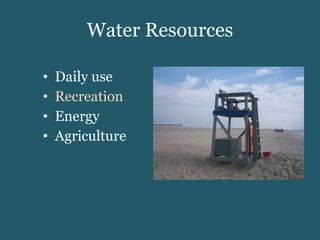
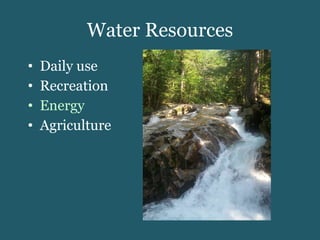
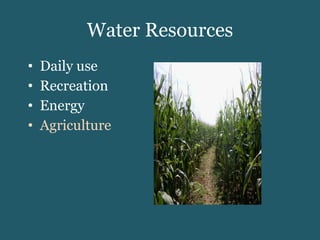
Water Resources Daily use Recreation Energy Agriculture People use water for many purposes! Today, we’ll focus on four main categories:
Water Resources Daily use Recreation Energy Agriculture
Water for daily use Drinking water In rural areas, people get drinking water from underground wells. In larger cities, people use reservoirs to store drinking water.
Water for daily use People use drinking water for many other purposes, including washing and bathing.  In fact, the average person in the United States uses 80-100 gallons of water per day!
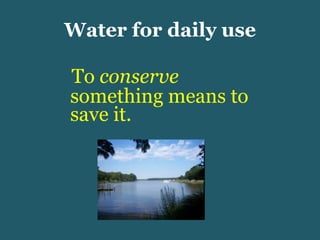
Water for daily use To  conserve  something means to save it.
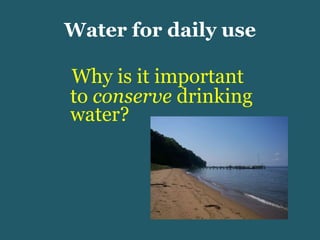
Water for daily use Why is it important to  conserve  drinking water?
Water Resources Daily use Recreation Energy Agriculture
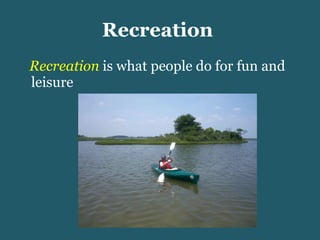
Recreation  Recreation  is what people do for fun and leisure
Recreation What are some recreational uses of water? Swimming Boating Fishing Tourism
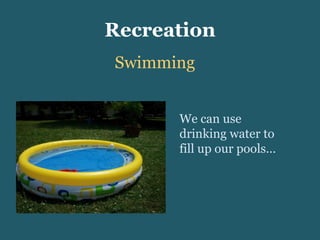
Recreation Swimming We can use drinking water to fill up our pools…
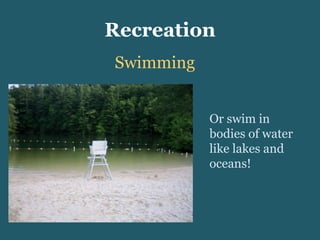
Recreation Swimming Or swim in bodies of water like lakes and oceans!
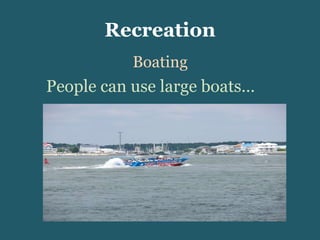
Recreation People can use large boats… Boating
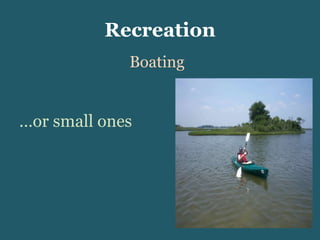
Recreation … or small ones Boating
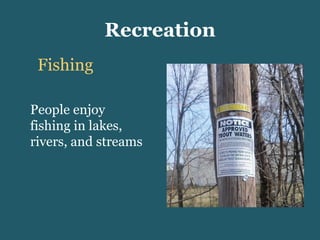
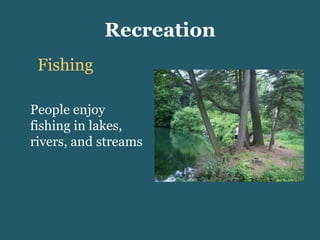
Recreation Fishing People enjoy fishing in lakes, rivers, and streams
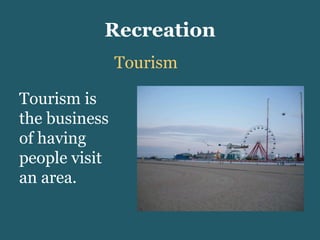
Recreation Tourism Tourism is the business of having people visit an area.
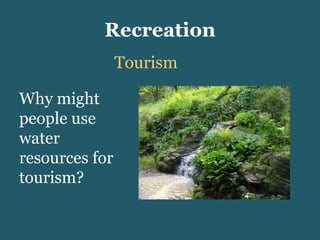
Recreation Tourism Why might people use water resources for tourism?
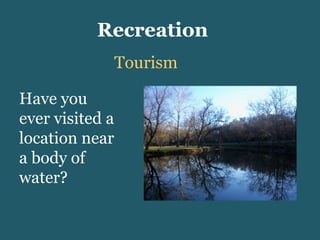
Recreation Tourism Have you ever visited a location near a body of water?
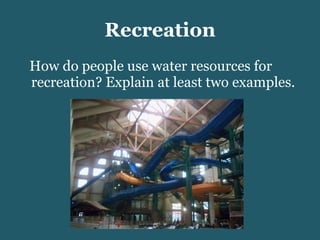
Recreation How do people use water resources for recreation? Explain at least two examples.
Water Resources Daily use Recreation Energy Agriculture
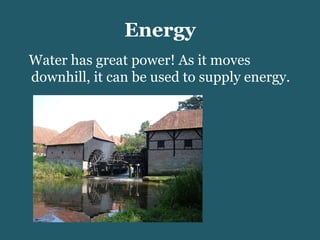
Energy Water has great power! As it moves downhill, it can be used to supply energy.
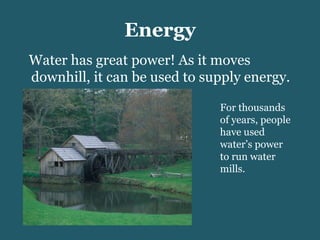
Energy Water has great power! As it moves downhill, it can be used to supply energy. For thousands of years, people have used water’s power to run water mills.
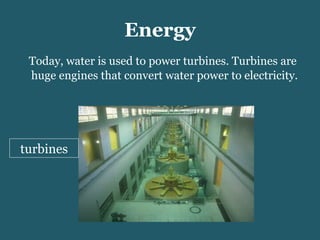
Energy Today, water is used to power turbines. Turbines are huge engines that convert water power to electricity. turbines
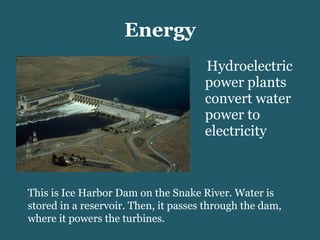
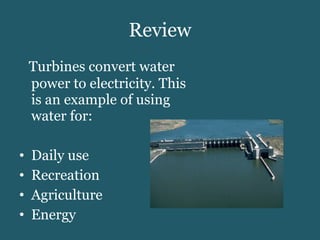
Energy Hydroelectric power plants convert water power to electricity This is Ice Harbor Dam on the Snake River. Water is stored in a reservoir. Then, it passes through the dam, where it powers the turbines.
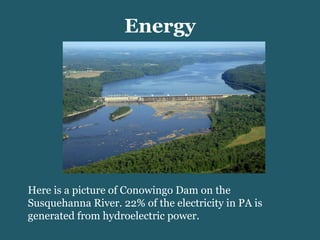
Energy Here is a picture of Conowingo Dam on the Susquehanna River. 22% of the electricity in PA is generated from hydroelectric power.
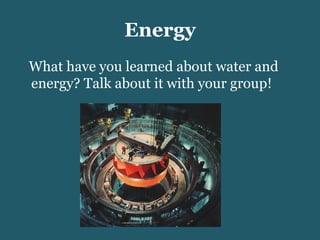
Energy What have you learned about water and energy? Talk about it with your group!
Water Resources Daily use Recreation Energy Agriculture
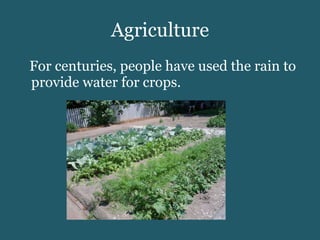
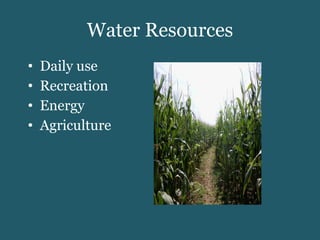
Agriculture For centuries, people have used the rain to provide water for crops.
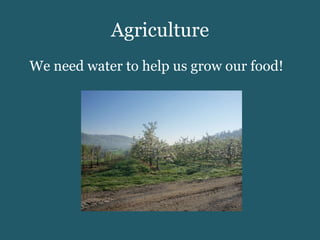
Agriculture We need water to help us grow our food!
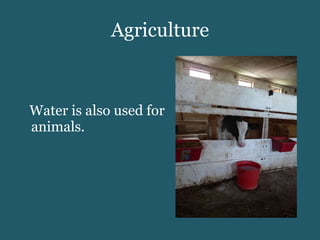
Agriculture Water is also used for animals.
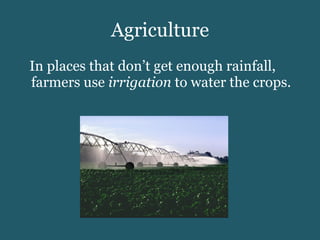
Agriculture In places that don’t get enough rainfall, farmers use  irrigation  to water the crops.
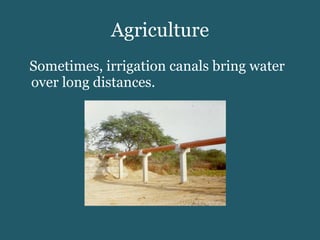
Agriculture Sometimes, irrigation canals bring water over long distances.
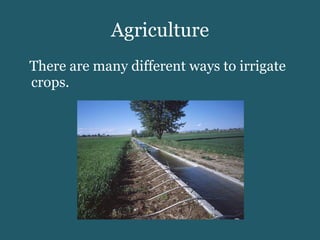
Agriculture There are many different ways to irrigate crops.
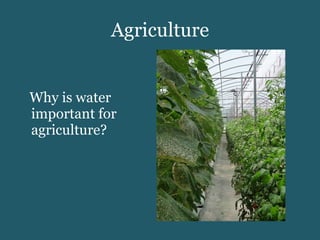
Agriculture Why is water important for agriculture?
Water Resources Daily use Recreation Energy Agriculture
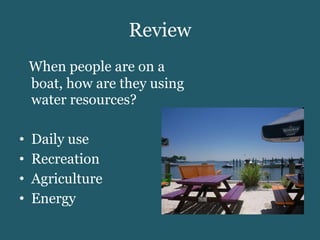
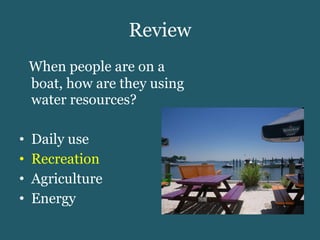
Review When people are on a boat, how are they using water resources? Daily use Recreation Agriculture Energy
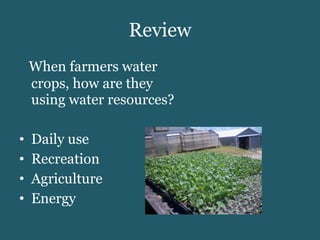
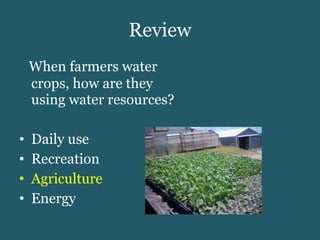
Review When farmers water crops, how are they using water resources? Daily use Recreation Agriculture Energy
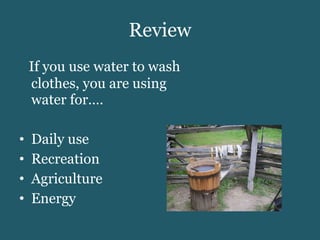
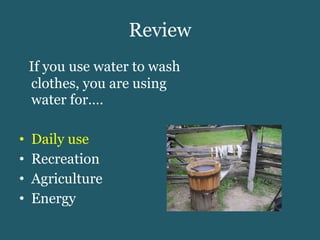
Review If you use water to wash clothes, you are using water for…. Daily use Recreation Agriculture Energy
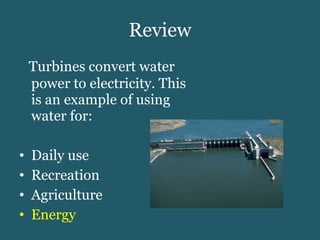
Review Turbines convert water power to electricity. This is an example of using water for: Daily use Recreation Agriculture Energy
Water Resources Go back to your list of how you use water resources. What can you add? What have you learned?

Water resources

Editor's Notes

  • #2 Emily Kissner.
  • #24 Photo: N.L. Kleuske; CCA Share-Alike License 3.0
  • #26 Photo source: USACE Image Library; public domain image
  • #27 Photo source: USACE Digital Visual LIbrary
  • #28 Photo source: Jane Thomas, IAN Image Library (ian.umces.edu/imagelibrary/)
  • #34 Photo: USDA
  • #36 Photo: USDA
  • #45 Photo: USACE
  • #46 Photo: USACE
  • #47 By Emily Kissner