Content
 Introduction
 Sources of Fresh water
 Uses Of Water
 Importance of Water Resources
 Distribution of water on Earth
 Technologies Used to Provide Fresh Water
 How do people use Water Resources?
 Conclusion
 References
About Water
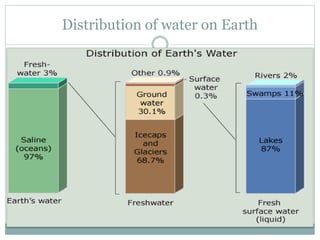
 97% of the water on the Earth is salt water. However,
only 3% percent is fresh water; slightly over 2/3 of
this is frozen in glaciers and polar ice caps.
 The remaining unfrozen freshwater is found mainly
as groundwater, with only a small fraction present
above ground or in the air.
 Fresh water is a renewable resource
Sources of Fresh water
1. Surface water
2. Frozen water
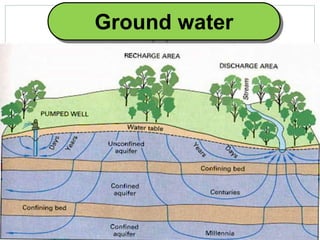
3. Ground water
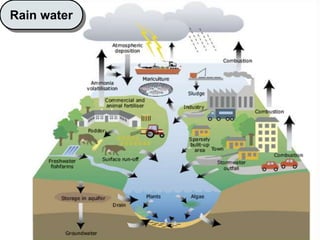
4. Rain water
Surface water
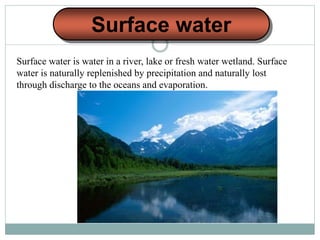
Surface water is water in a river, lake or fresh water wetland. Surface
water is naturally replenished by precipitation and naturally lost
through discharge to the oceans and evaporation.
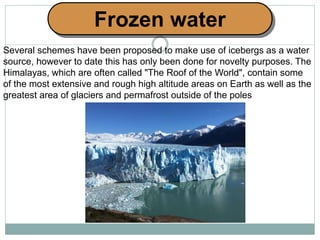
Several schemes have been proposed to make use of icebergs as a water
source, however to date this has only been done for novelty purposes. The
Himalayas, which are often called "The Roof of the World", contain some
of the most extensive and rough high altitude areas on Earth as well as the
greatest area of glaciers and permafrost outside of the poles
Frozen water
Ground water
Rain water
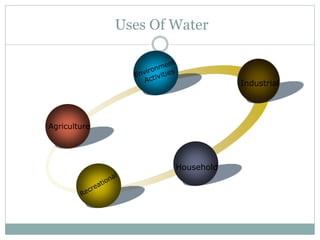
Uses Of Water
Agriculture
Industrial
Household
Importance of Water Resources
Below mentioned is the importance of water resources in points:-
• It is significant since life cannot survive without it.
• Agricultural, commercial, household, leisure, and environmental
activities all use water in some way.
• Almost all of these human uses necessitate the use of freshwater.
• Freshwater makes up just 2.5 percent of the Earth's total water, and
over two-thirds of it is frozen in ice caps and glaciers.
• In several regions of the world, water demand currently exceeds
availability, as well as many other areas, are prepared to face this
deficit in the near future.
• Irrigation in agriculture is expected to account for 70% of global
water consumption.
Distribution of water on Earth
Technologies Used to Provide Fresh Water
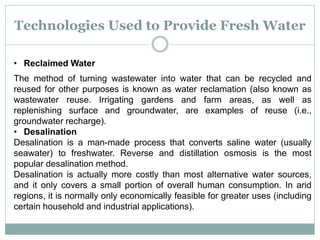
• Reclaimed Water
The method of turning wastewater into water that can be recycled and
reused for other purposes is known as water reclamation (also known as
wastewater reuse. Irrigating gardens and farm areas, as well as
replenishing surface and groundwater, are examples of reuse (i.e.,
groundwater recharge).
• Desalination
Desalination is a man-made process that converts saline water (usually
seawater) to freshwater. Reverse and distillation osmosis is the most
popular desalination method.
Desalination is actually more costly than most alternative water sources,
and it only covers a small portion of overall human consumption. In arid
regions, it is normally only economically feasible for greater uses (including
certain household and industrial applications).
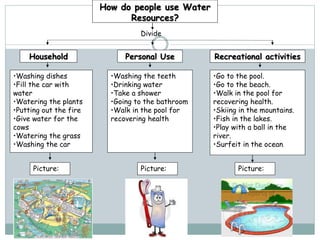
How do people use Water
Resources?
Household Personal Use Recreational activities
•Washing dishes
•Fill the car with
water
•Watering the plants
•Putting out the fire
•Give water for the
cows
•Watering the grass
•Washing the car
•Washing the teeth
•Drinking water
•Take a shower
•Going to the bathroom
•Walk in the pool for
recovering health
•Go to the pool.
•Go to the beach.
•Walk in the pool for
recovering health.
•Skiing in the mountains.
•Fish in the lakes.
•Play with a ball in the
river.
•Surfeit in the ocean.
Picture:
Picture: Picture:
Divide
Proposals: How to conserve water
If you want to learn how to conserver water and protecting the
environment, learning to conserve water is a great way to make
a positive impact. A four-minute shower may not sound like
much, but in reality can cost up to 40 gallons. But don't worry--
there are ways to change water-hogging household habits into
leaner, greener activities.
Water Conservation Tips
 Run your dishwasher for only full loads.
 Turn off the tap when you brush your teeth.
 Check your faucets and toilets for leaks.
 Take shorter showers.
 Water your lawn in the morning.
 Use a cover on your pool.
 Wash your car with a nozzle on the hose.
Conclusion
 Our water resources, irregularly distributed in space
and time, are under pressure due to major
population change and increased demand.
 Access to reliable data on the availability, quality and
quantity of water, and its variability, form the
necessary foundation for sound management of
water resources.
References
 www.google.com
 www.wikipedia.com
 www.studymafia.org
Water-Resources-ppt.pptx

Water-Resources-ppt.pptx

  • 1.
    Content  Introduction  Sourcesof Fresh water  Uses Of Water  Importance of Water Resources  Distribution of water on Earth  Technologies Used to Provide Fresh Water  How do people use Water Resources?  Conclusion  References
  • 2.
    About Water  97%of the water on the Earth is salt water. However, only 3% percent is fresh water; slightly over 2/3 of this is frozen in glaciers and polar ice caps.  The remaining unfrozen freshwater is found mainly as groundwater, with only a small fraction present above ground or in the air.  Fresh water is a renewable resource
  • 3.
    Sources of Freshwater 1. Surface water 2. Frozen water 3. Ground water 4. Rain water
  • 4.
    Surface water Surface wateris water in a river, lake or fresh water wetland. Surface water is naturally replenished by precipitation and naturally lost through discharge to the oceans and evaporation.
  • 5.
    Several schemes havebeen proposed to make use of icebergs as a water source, however to date this has only been done for novelty purposes. The Himalayas, which are often called "The Roof of the World", contain some of the most extensive and rough high altitude areas on Earth as well as the greatest area of glaciers and permafrost outside of the poles Frozen water
  • 6.
  • 7.
  • 8.
  • 9.
    Importance of WaterResources Below mentioned is the importance of water resources in points:- • It is significant since life cannot survive without it. • Agricultural, commercial, household, leisure, and environmental activities all use water in some way. • Almost all of these human uses necessitate the use of freshwater. • Freshwater makes up just 2.5 percent of the Earth's total water, and over two-thirds of it is frozen in ice caps and glaciers. • In several regions of the world, water demand currently exceeds availability, as well as many other areas, are prepared to face this deficit in the near future. • Irrigation in agriculture is expected to account for 70% of global water consumption.
  • 10.
  • 11.
    Technologies Used toProvide Fresh Water • Reclaimed Water The method of turning wastewater into water that can be recycled and reused for other purposes is known as water reclamation (also known as wastewater reuse. Irrigating gardens and farm areas, as well as replenishing surface and groundwater, are examples of reuse (i.e., groundwater recharge). • Desalination Desalination is a man-made process that converts saline water (usually seawater) to freshwater. Reverse and distillation osmosis is the most popular desalination method. Desalination is actually more costly than most alternative water sources, and it only covers a small portion of overall human consumption. In arid regions, it is normally only economically feasible for greater uses (including certain household and industrial applications).
  • 12.
    How do peopleuse Water Resources? Household Personal Use Recreational activities •Washing dishes •Fill the car with water •Watering the plants •Putting out the fire •Give water for the cows •Watering the grass •Washing the car •Washing the teeth •Drinking water •Take a shower •Going to the bathroom •Walk in the pool for recovering health •Go to the pool. •Go to the beach. •Walk in the pool for recovering health. •Skiing in the mountains. •Fish in the lakes. •Play with a ball in the river. •Surfeit in the ocean. Picture: Picture: Picture: Divide
  • 13.
    Proposals: How toconserve water If you want to learn how to conserver water and protecting the environment, learning to conserve water is a great way to make a positive impact. A four-minute shower may not sound like much, but in reality can cost up to 40 gallons. But don't worry-- there are ways to change water-hogging household habits into leaner, greener activities. Water Conservation Tips  Run your dishwasher for only full loads.  Turn off the tap when you brush your teeth.  Check your faucets and toilets for leaks.  Take shorter showers.  Water your lawn in the morning.  Use a cover on your pool.  Wash your car with a nozzle on the hose.
  • 14.
    Conclusion  Our waterresources, irregularly distributed in space and time, are under pressure due to major population change and increased demand.  Access to reliable data on the availability, quality and quantity of water, and its variability, form the necessary foundation for sound management of water resources.
  • 15.