Water Resources
 Virtual Booklet


 By: Krishna Aggarwal ,
 Sumiran Gupta & Vicky
Index
Index:
 Introduction
 Prior knowledge
 General Info.
 Glossary
 Uses of water
 Good and bad uses of the water.
 Proposals- How to conserve water
  resources.
 Conclusion
Introduction
               This is a virtual booklet about water
               resources explaining about how
               people use water, how we should take
               care of it and many things that we
               should learn about water
               conservation this booklet is an
               attempt to make us aware about the
               water problems that we are facing
               and how we should to save this
               beautiful world.
Prior knowledge
                              Water resources is
     Are sour        ces of   important on Earth and
     water            and     without it we
     they are useful from              can’t
     the humans and           do many things
     animals.                 or
                              satisfied      our needs.

     We would have to          Water is a
     take care of the          renewable natural
     water because in          resources also like
             few years         air and       soil.
             there's not
     going to be enough
     water for us.
Water Resources
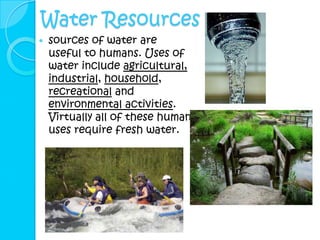
   sources of water are
    useful to humans. Uses of
    water include agricultural,
    industrial, household,
    recreational and
    environmental activities.
    Virtually all of these human
    uses require fresh water.
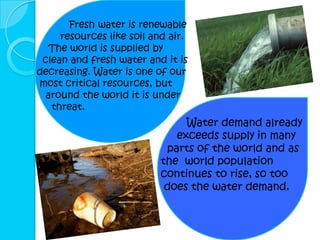
Fresh water is renewable
     resources like soil and air.
  The world is supplied by
 clean and fresh water and it is
decreasing. Water is one of our
most critical resources, but
 around the world it is under
   threat.
                                Water demand already
                              exceeds supply in many
                            parts of the world and as
                           the world population
                           continues to rise, so too
                            does the water demand.
Water resources are divided:
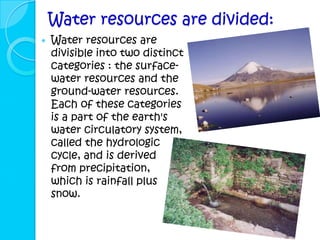
   Water resources are
    divisible into two distinct
    categories : the surface-
    water resources and the
    ground-water resources.
    Each of these categories
    is a part of the earth's
    water circulatory system,
    called the hydrologic
    cycle, and is derived
    from precipitation,
    which is rainfall plus
    snow.
Distribution of water on Earth


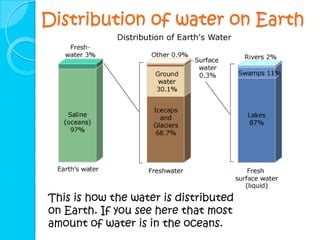
This is how the water is distributed
on Earth. If you see here that most
amount of water is in the oceans.
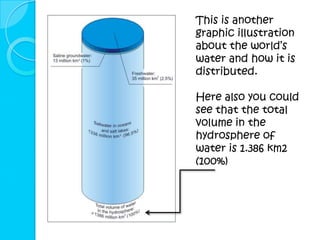
This is another
graphic illustration
about the world’s
water and how it is
distributed.

Here also you could
see that the total
volume in the
hydrosphere of
water is 1.386 km2
(100%)
Sources of Fresh Water
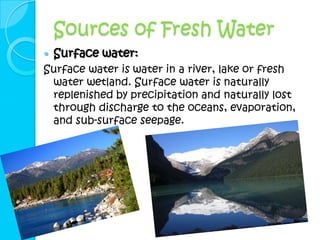
   Surface water:
Surface water is water in a river, lake or fresh
 water wetland. Surface water is naturally
 replenished by precipitation and naturally lost
 through discharge to the oceans, evaporation,
 and sub-surface seepage.
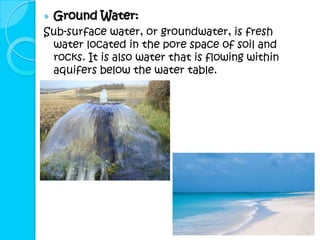
   Ground Water:
Sub-surface water, or groundwater, is fresh
 water located in the pore space of soil and
 rocks. It is also water that is flowing within
 aquifers below the water table.
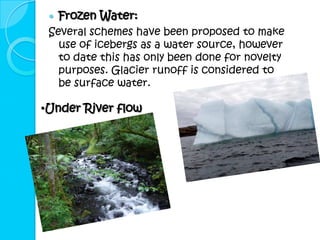
   Frozen Water:
 Several schemes have been proposed to make
   use of icebergs as a water source, however
   to date this has only been done for novelty
   purposes. Glacier runoff is considered to
   be surface water.

•Under River flow
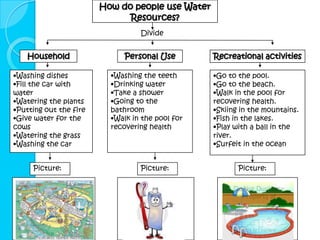
How do people use Water
                              Resources?
                                  Divide


    Household                 Personal Use        Recreational activities

•Washing dishes           •Washing the teeth      •Go to the pool.
•Fill the car with        •Drinking water         •Go to the beach.
water                     •Take a shower          •Walk in the pool for
•Watering the plants      •Going to the           recovering health.
•Putting out the fire     bathroom                •Skiing in the mountains.
•Give water for the       •Walk in the pool for   •Fish in the lakes.
cows                      recovering health       •Play with a ball in the
•Watering the grass                               river.
•Washing the car                                  •Surfeit in the ocean.


     Picture:                     Picture:               Picture:
Uses of water
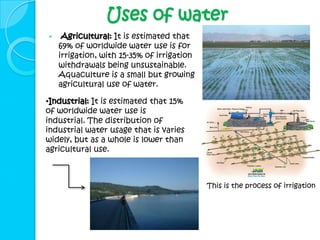
    Agricultural: It is estimated that
    69% of worldwide water use is for
    irrigation, with 15-35% of irrigation
    withdrawals being unsustainable.
    Aquaculture is a small but growing
    agricultural use of water.

•Industrial: It is estimated that 15%
of worldwide water use is
industrial. The distribution of
industrial water usage that is varies
widely, but as a whole is lower than
agricultural use.


                                            This is the process of irrigation
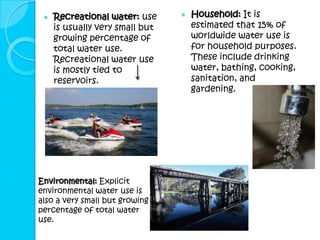
   Recreational water: use        Household: It is
     is usually very small but       estimated that 15% of
     growing percentage of           worldwide water use is
     total water use.                for household purposes.
     Recreational water use          These include drinking
     is mostly tied to               water, bathing, cooking,
     reservoirs.                     sanitation, and
                                     gardening.


Environmental: Explicit
environmental water use is
also a very small but growing
percentage of total water
use.
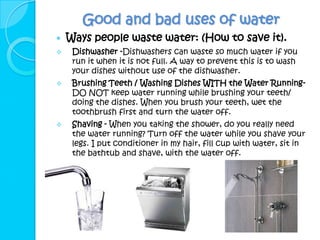
Good and bad uses of water
   Ways people waste water: (How to save it).
    Dishwasher -Dishwashers can waste so much water if you
     run it when it is not full. A way to prevent this is to wash
     your dishes without use of the dishwasher.
    Brushing Teeth / Washing Dishes WITH the Water Running-
     DO NOT keep water running while brushing your teeth/
     doing the dishes. When you brush your teeth, wet the
     toothbrush first and turn the water off.
    Shaving - When you taking the shower, do you really need
     the water running? Turn off the water while you shave your
     legs. I put conditioner in my hair, fill cup with water, sit in
     the bathtub and shave, with the water off.
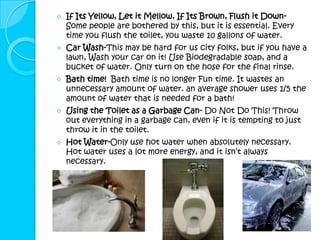
   If Its Yellow, Let it Mellow. If Its Brown, Flush it Down-
    Some people are bothered by this, but it is essential. Every
    time you flush the toilet, you waste 10 gallons of water.
   Car Wash-This may be hard for us city folks, but if you have a
    lawn, Wash your car on it! Use Biodegradable soap, and a
    bucket of water. Only turn on the hose for the final rinse.
   Bath time! Bath time is no longer Fun time. It wastes an
    unnecessary amount of water. an average shower uses 1/5 the
    amount of water that is needed for a bath!
   Using the Toilet as a Garbage Can- Do Not Do This! Throw
    out everything in a garbage can, even if it is tempting to just
    throw it in the toilet.
   Hot Water-Only use hot water when absolutely necessary.
    Hot water uses a lot more energy, and it isn’t always
    necessary.
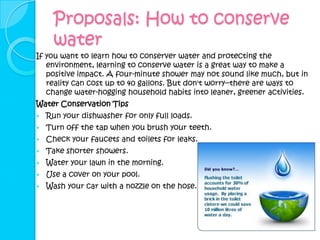
Proposals: How to conserve
      water
If you want to learn how to conserver water and protecting the
   environment, learning to conserve water is a great way to make a
   positive impact. A four-minute shower may not sound like much, but in
   reality can cost up to 40 gallons. But don't worry--there are ways to
   change water-hogging household habits into leaner, greener activities.
Water Conservation Tips
   Run your dishwasher for only full loads.
   Turn off the tap when you brush your teeth.
   Check your faucets and toilets for leaks.
   Take shorter showers.
   Water your lawn in the morning.
   Use a cover on your pool.
   Wash your car with a nozzle on the hose.
   We are fortunate enough to live in a
    place where clean water flows freely
    on demand, it can be easy to take it
    for granted. From your daily
    dishwashing routine to your daily
    shower, every drop of this natural
    resource is precious. Practicing
    conservation is not only good for the
    environment, but can save you money
    in energy bills.
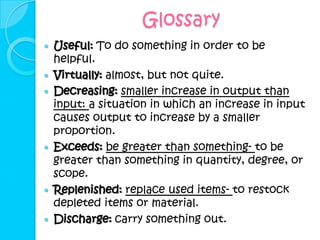
Glossary
   Useful: To do something in order to be
    helpful.
   Virtually: almost, but not quite.
   Decreasing: smaller increase in output than
    input: a situation in which an increase in input
    causes output to increase by a smaller
    proportion.
   Exceeds: be greater than something- to be
    greater than something in quantity, degree, or
    scope.
   Replenished: replace used items- to restock
    depleted items or material.
   Discharge: carry something out.
Conclusion
Finally we have made this
presentation and we hope
you enjoy and like it. I
hope you understood
about this important
topic, for then it would be
easily to talk about it and
share this information to
save the water resources
and more important our
beautiful world.
Water resources

Water resources

  • 1.
    Water Resources VirtualBooklet By: Krishna Aggarwal , Sumiran Gupta & Vicky
  • 2.
    Index Index:  Introduction  Priorknowledge  General Info.  Glossary  Uses of water  Good and bad uses of the water.  Proposals- How to conserve water resources.  Conclusion
  • 3.
    Introduction This is a virtual booklet about water resources explaining about how people use water, how we should take care of it and many things that we should learn about water conservation this booklet is an attempt to make us aware about the water problems that we are facing and how we should to save this beautiful world.
  • 4.
    Prior knowledge Water resources is Are sour ces of important on Earth and water and without it we they are useful from can’t the humans and do many things animals. or satisfied our needs. We would have to Water is a take care of the renewable natural water because in resources also like few years air and soil. there's not going to be enough water for us.
  • 5.
    Water Resources  sources of water are useful to humans. Uses of water include agricultural, industrial, household, recreational and environmental activities. Virtually all of these human uses require fresh water.
  • 6.
    Fresh water isrenewable resources like soil and air. The world is supplied by clean and fresh water and it is decreasing. Water is one of our most critical resources, but around the world it is under threat. Water demand already exceeds supply in many parts of the world and as the world population continues to rise, so too does the water demand.
  • 7.
    Water resources aredivided:  Water resources are divisible into two distinct categories : the surface- water resources and the ground-water resources. Each of these categories is a part of the earth's water circulatory system, called the hydrologic cycle, and is derived from precipitation, which is rainfall plus snow.
  • 8.
    Distribution of wateron Earth This is how the water is distributed on Earth. If you see here that most amount of water is in the oceans.
  • 9.
    This is another graphicillustration about the world’s water and how it is distributed. Here also you could see that the total volume in the hydrosphere of water is 1.386 km2 (100%)
  • 10.
    Sources of FreshWater  Surface water: Surface water is water in a river, lake or fresh water wetland. Surface water is naturally replenished by precipitation and naturally lost through discharge to the oceans, evaporation, and sub-surface seepage.
  • 11.
    Ground Water: Sub-surface water, or groundwater, is fresh water located in the pore space of soil and rocks. It is also water that is flowing within aquifers below the water table.
  • 12.
    Frozen Water: Several schemes have been proposed to make use of icebergs as a water source, however to date this has only been done for novelty purposes. Glacier runoff is considered to be surface water. •Under River flow
  • 13.
    How do peopleuse Water Resources? Divide Household Personal Use Recreational activities •Washing dishes •Washing the teeth •Go to the pool. •Fill the car with •Drinking water •Go to the beach. water •Take a shower •Walk in the pool for •Watering the plants •Going to the recovering health. •Putting out the fire bathroom •Skiing in the mountains. •Give water for the •Walk in the pool for •Fish in the lakes. cows recovering health •Play with a ball in the •Watering the grass river. •Washing the car •Surfeit in the ocean. Picture: Picture: Picture:
  • 14.
    Uses of water  Agricultural: It is estimated that 69% of worldwide water use is for irrigation, with 15-35% of irrigation withdrawals being unsustainable. Aquaculture is a small but growing agricultural use of water. •Industrial: It is estimated that 15% of worldwide water use is industrial. The distribution of industrial water usage that is varies widely, but as a whole is lower than agricultural use. This is the process of irrigation
  • 15.
    Recreational water: use  Household: It is is usually very small but estimated that 15% of growing percentage of worldwide water use is total water use. for household purposes. Recreational water use These include drinking is mostly tied to water, bathing, cooking, reservoirs. sanitation, and gardening. Environmental: Explicit environmental water use is also a very small but growing percentage of total water use.
  • 16.
    Good and baduses of water  Ways people waste water: (How to save it).  Dishwasher -Dishwashers can waste so much water if you run it when it is not full. A way to prevent this is to wash your dishes without use of the dishwasher.  Brushing Teeth / Washing Dishes WITH the Water Running- DO NOT keep water running while brushing your teeth/ doing the dishes. When you brush your teeth, wet the toothbrush first and turn the water off.  Shaving - When you taking the shower, do you really need the water running? Turn off the water while you shave your legs. I put conditioner in my hair, fill cup with water, sit in the bathtub and shave, with the water off.
  • 17.
    If Its Yellow, Let it Mellow. If Its Brown, Flush it Down- Some people are bothered by this, but it is essential. Every time you flush the toilet, you waste 10 gallons of water.  Car Wash-This may be hard for us city folks, but if you have a lawn, Wash your car on it! Use Biodegradable soap, and a bucket of water. Only turn on the hose for the final rinse.  Bath time! Bath time is no longer Fun time. It wastes an unnecessary amount of water. an average shower uses 1/5 the amount of water that is needed for a bath!  Using the Toilet as a Garbage Can- Do Not Do This! Throw out everything in a garbage can, even if it is tempting to just throw it in the toilet.  Hot Water-Only use hot water when absolutely necessary. Hot water uses a lot more energy, and it isn’t always necessary.
  • 18.
    Proposals: How toconserve water If you want to learn how to conserver water and protecting the environment, learning to conserve water is a great way to make a positive impact. A four-minute shower may not sound like much, but in reality can cost up to 40 gallons. But don't worry--there are ways to change water-hogging household habits into leaner, greener activities. Water Conservation Tips  Run your dishwasher for only full loads.  Turn off the tap when you brush your teeth.  Check your faucets and toilets for leaks.  Take shorter showers.  Water your lawn in the morning.  Use a cover on your pool.  Wash your car with a nozzle on the hose.
  • 19.
    We are fortunate enough to live in a place where clean water flows freely on demand, it can be easy to take it for granted. From your daily dishwashing routine to your daily shower, every drop of this natural resource is precious. Practicing conservation is not only good for the environment, but can save you money in energy bills.
  • 22.
    Glossary  Useful: To do something in order to be helpful.  Virtually: almost, but not quite.  Decreasing: smaller increase in output than input: a situation in which an increase in input causes output to increase by a smaller proportion.  Exceeds: be greater than something- to be greater than something in quantity, degree, or scope.  Replenished: replace used items- to restock depleted items or material.  Discharge: carry something out.
  • 23.
    Conclusion Finally we havemade this presentation and we hope you enjoy and like it. I hope you understood about this important topic, for then it would be easily to talk about it and share this information to save the water resources and more important our beautiful world.