•Agriculture, for decades, had been associated with the production of basic food
crops.
•At present, agriculture besides farming includes forestry, fruit cultivation, dairy,
poultry, mushroom, bee keeping, arbitrary, etc. Today, marketing, processing,
distribution of agricultural products etc. are all accepted as a part of modern
agriculture.
•Thus, agriculture may be defined as the production, processing, marketing and
distribution of crops and livestock products.
•Agriculture plays a crucial role in the life of an economy.
•It is the backbone of our economic system.
•Agriculture not only provides food and raw material but also
employment opportunities to a very large proportion of
population.
•The following facts clearly highlight the importance of
agriculture in this country.
Depending upon the geographical conditions,
demand of produce, labour and level of
technology, farming is divided into TWO
main types:
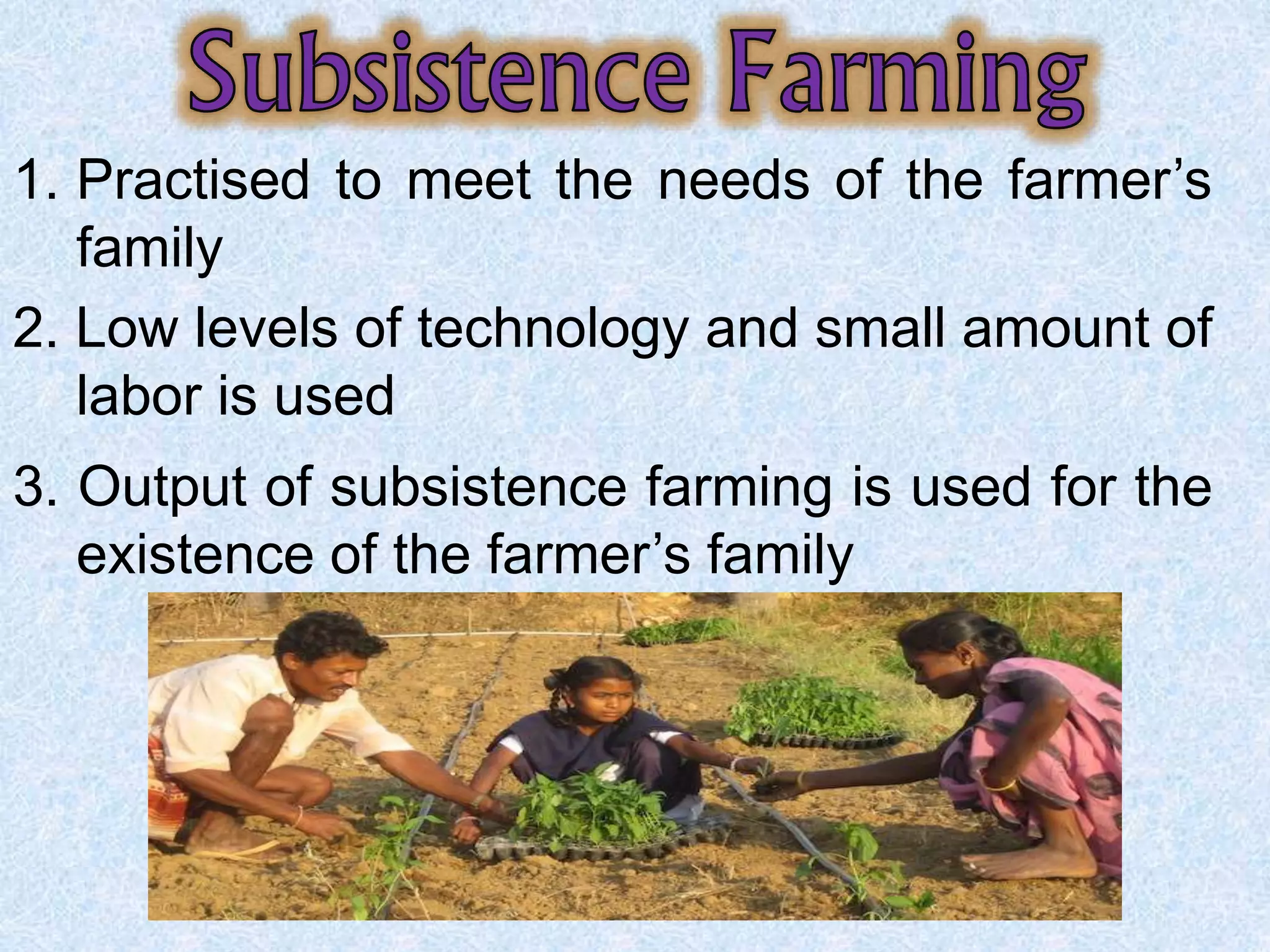
1. Practised to meet the needs of the farmer’s
family
2. Low levels of technology and small amount of
labor is used
3. Output of subsistence farming is used for the
existence of the farmer’s family
Subsistence
Farming
Primitive
subsistence
farming
Intensive
Subsistence
Farming
•In very densely populated countries like India and China, farmers use their
small land holdings to produce enough for their own consumption, while the
little remaining produce is used for exchange against other goods.
•The cultivators use simple tools to produce the crop.
•These farmers try to obtain maximum yield from the available lands by
intensifying cultivation techniques, including the preparation of paddy
fields which can be used year after year.
•Such fields are found in densely populated parts of India. They may also
intensify by using manure, artificial irrigation and animal waste as fertilizer.
Shifting
cultivation
Nomadic
Herding
 A plot of land is cleared by felling the trees and the
trees are burnt.
The ashes are mixed with the soil to make the soil
fertile.
Crops like maize, yarn, potatoes and cassava are
grown.
After one or two times of crop, the soil loses its
fertility.
The land is abandoned and the cultivator moves to
a new plot
Herders move from one placeto another
with their animalsfor fodder andwater.
Sheep, camel,yakand goats are most
commonly reared.
Practisedin the semiarid andaridregionsof Sahara.
Examples are the nomadic Bhotiyas and Gujjarsof the
Himalayas.
• Crops are grown, animals are reared for sale in
market.• The area of cultivation is very large.
• Most of the work is done by machines.
• Amount of human labour is very less.
•Single crop of tea, coffee, sugarcane,
cashew, rubber, banana, cotton are grown.
Plantation Agriculture- Basic Concept
Coffee in Brazil
 Plantations require large amount of labour and capital.
 Product of a plantation is processed in the farm itself or in the
nearby factories.
 A well developed transport system is essential for plantation
type of farming.
Major plantations of the world are found in the tropical regions of
the world.
Examples are-: Rubber in Malaysia,
& Tea in India and Sri Lanka.
agriculture ppt for class 10 cbse gegraphy textbook

agriculture ppt for class 10 cbse gegraphy textbook

  • 2.
    •Agriculture, for decades,had been associated with the production of basic food crops. •At present, agriculture besides farming includes forestry, fruit cultivation, dairy, poultry, mushroom, bee keeping, arbitrary, etc. Today, marketing, processing, distribution of agricultural products etc. are all accepted as a part of modern agriculture. •Thus, agriculture may be defined as the production, processing, marketing and distribution of crops and livestock products.
  • 3.
    •Agriculture plays acrucial role in the life of an economy. •It is the backbone of our economic system. •Agriculture not only provides food and raw material but also employment opportunities to a very large proportion of population. •The following facts clearly highlight the importance of agriculture in this country.
  • 4.
    Depending upon thegeographical conditions, demand of produce, labour and level of technology, farming is divided into TWO main types:
  • 5.
    1. Practised tomeet the needs of the farmer’s family 2. Low levels of technology and small amount of labor is used 3. Output of subsistence farming is used for the existence of the farmer’s family
  • 6.
  • 8.
    •In very denselypopulated countries like India and China, farmers use their small land holdings to produce enough for their own consumption, while the little remaining produce is used for exchange against other goods. •The cultivators use simple tools to produce the crop. •These farmers try to obtain maximum yield from the available lands by intensifying cultivation techniques, including the preparation of paddy fields which can be used year after year. •Such fields are found in densely populated parts of India. They may also intensify by using manure, artificial irrigation and animal waste as fertilizer.
  • 9.
  • 10.
     A plotof land is cleared by felling the trees and the trees are burnt. The ashes are mixed with the soil to make the soil fertile. Crops like maize, yarn, potatoes and cassava are grown. After one or two times of crop, the soil loses its fertility. The land is abandoned and the cultivator moves to a new plot
  • 12.
    Herders move fromone placeto another with their animalsfor fodder andwater. Sheep, camel,yakand goats are most commonly reared. Practisedin the semiarid andaridregionsof Sahara. Examples are the nomadic Bhotiyas and Gujjarsof the Himalayas.
  • 13.
    • Crops aregrown, animals are reared for sale in market.• The area of cultivation is very large. • Most of the work is done by machines. • Amount of human labour is very less.
  • 15.
    •Single crop oftea, coffee, sugarcane, cashew, rubber, banana, cotton are grown.
  • 16.
  • 17.
    Coffee in Brazil Plantations require large amount of labour and capital.  Product of a plantation is processed in the farm itself or in the nearby factories.  A well developed transport system is essential for plantation type of farming. Major plantations of the world are found in the tropical regions of the world. Examples are-: Rubber in Malaysia, & Tea in India and Sri Lanka.