Definition
• Water resources are sources of water that are
useful or potentially useful to humans. Uses of
water include agricultural, industrial, household,
recreational and environmental activities. Virtually
all of these human uses require fresh water.
Water Water Every Where
But Not A Drop To Drink
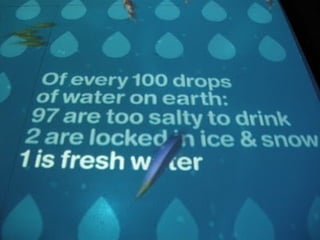
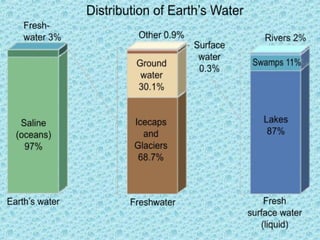
• 97% of the water on the Earth is salt
water, and only 3% is fresh water of
which slightly over two thirds is frozen in
glaciers and polar ice caps. The
remaining unfrozen freshwater is mainly
found as groundwater, with only a small
fraction present above ground or in the
air.
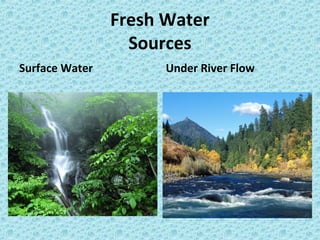
Fresh Water
Sources
Surface Water Under River Flow
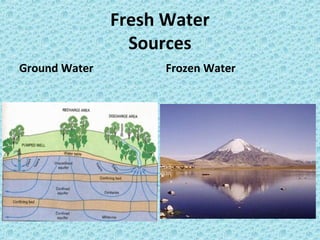
Fresh Water
Sources
Ground Water Frozen Water
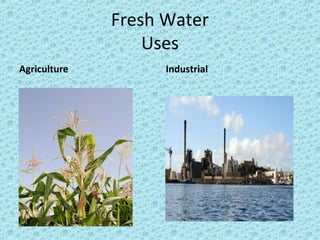
Fresh Water
Uses
Agriculture Industrial
Fresh Water
Uses
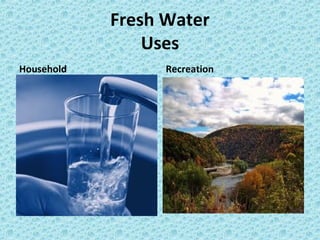
Household Recreation
Increasing water scarcity
• It is caused by over exploitation,
excessive use and unequal access to
water among different social groups.
• Increasing population, intensive
industrialization, deforestation and
mismanagement of water resources have
caused a crisis
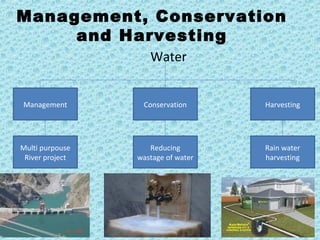
Management, Conservation
and Harvesting
Water
Management HarvestingConservation
Multi purpouse
River project
Reducing
wastage of water
Rain water
harvesting
Multi Purpose River
Project
Multi purpose river project is such a scheme which
serves several purposes at one and the same time
because of their uses they are rightly called the
temples of modern India by Pt. Nehru.
Such projects help in checking floods.
Ample of water is available for irrigation.
These projects help in electricity generation.
They are used for in land navigation and fish-
breeding.
Water conservation
• What you can do to conserve water?
• Use only as much water as you require. Close
the taps well after use. While brushing or
other use, do not leave the tap running, open
it only when you require it. See that there are
no leaking taps.
• Use a washing machine that does not
consume too much water. Do not leave the
taps running while washing dishes and
clothes.
• Install small shower heads to reduce the flow of the
water. Water in which the vegetables & fruits have
been washed - use to water the flowers & plants.
• At the end of the day if you have water left in your
water bottle do not throw it away, pour it over
some plants.
• Re-use water as much as possible
• Change in attitude & habits for water
conservation
• Every drop counts!!!
Rain Water HarvestingRain Water Harvesting
• Rain Water Harvesting (RWH)- It is a
process of collecting, conveying & storing
water from rainfall in an area – for beneficial
use.
• Storage is done in tanks, reservoirs,
underground storage- groundwater
• It is neither energy-intensive nor labour-
intensive
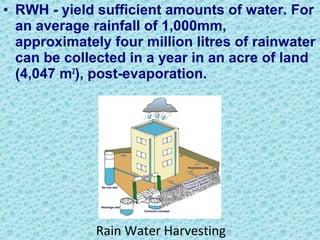
• RWH - yield sufficient amounts of water. For
an average rainfall of 1,000mm,
approximately four million litres of rainwater
can be collected in a year in an acre of land
(4,047 m2
), post-evaporation.
Rain Water Harvesting
Rain Water Harvesting–Rain Water Harvesting–
AdvantagesAdvantages
1.Provides self-sufficiency to water supply.
2.Reduces the cost for pumping of ground
water.
3.Provides high quality water, soft and low in
minerals.
4.Improves the quality of ground water
through dilution when recharged.
5. Reduces soil erosion & flooding in urban
areas.
6.The rooftop rain water harvesting is less
expensive & easy to construct, operate and
maintain.
7. In desert, RWH is the only relief.
8. In saline or coastal areas & Islands, rain water
provides good quality water.
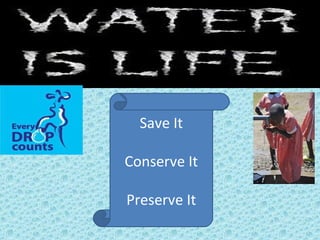
Save It
Conserve It
Preserve It
-By Naman Gupta

slides on Water resourses

  • 2.
    Definition • Water resourcesare sources of water that are useful or potentially useful to humans. Uses of water include agricultural, industrial, household, recreational and environmental activities. Virtually all of these human uses require fresh water.
  • 3.
    Water Water EveryWhere But Not A Drop To Drink • 97% of the water on the Earth is salt water, and only 3% is fresh water of which slightly over two thirds is frozen in glaciers and polar ice caps. The remaining unfrozen freshwater is mainly found as groundwater, with only a small fraction present above ground or in the air.
  • 6.
  • 7.
  • 8.
  • 9.
  • 10.
    Increasing water scarcity •It is caused by over exploitation, excessive use and unequal access to water among different social groups. • Increasing population, intensive industrialization, deforestation and mismanagement of water resources have caused a crisis
  • 11.
    Management, Conservation and Harvesting Water ManagementHarvestingConservation Multi purpouse River project Reducing wastage of water Rain water harvesting
  • 12.
    Multi Purpose River Project Multipurpose river project is such a scheme which serves several purposes at one and the same time because of their uses they are rightly called the temples of modern India by Pt. Nehru. Such projects help in checking floods. Ample of water is available for irrigation. These projects help in electricity generation. They are used for in land navigation and fish- breeding.
  • 13.
    Water conservation • Whatyou can do to conserve water? • Use only as much water as you require. Close the taps well after use. While brushing or other use, do not leave the tap running, open it only when you require it. See that there are no leaking taps. • Use a washing machine that does not consume too much water. Do not leave the taps running while washing dishes and clothes.
  • 14.
    • Install smallshower heads to reduce the flow of the water. Water in which the vegetables & fruits have been washed - use to water the flowers & plants. • At the end of the day if you have water left in your water bottle do not throw it away, pour it over some plants. • Re-use water as much as possible • Change in attitude & habits for water conservation • Every drop counts!!!
  • 15.
    Rain Water HarvestingRainWater Harvesting • Rain Water Harvesting (RWH)- It is a process of collecting, conveying & storing water from rainfall in an area – for beneficial use. • Storage is done in tanks, reservoirs, underground storage- groundwater • It is neither energy-intensive nor labour- intensive
  • 16.
    • RWH -yield sufficient amounts of water. For an average rainfall of 1,000mm, approximately four million litres of rainwater can be collected in a year in an acre of land (4,047 m2 ), post-evaporation. Rain Water Harvesting
  • 17.
    Rain Water Harvesting–RainWater Harvesting– AdvantagesAdvantages 1.Provides self-sufficiency to water supply. 2.Reduces the cost for pumping of ground water. 3.Provides high quality water, soft and low in minerals. 4.Improves the quality of ground water through dilution when recharged.
  • 18.
    5. Reduces soilerosion & flooding in urban areas. 6.The rooftop rain water harvesting is less expensive & easy to construct, operate and maintain. 7. In desert, RWH is the only relief. 8. In saline or coastal areas & Islands, rain water provides good quality water.
  • 19.
  • 20.