Water Jet
Machining
Definition, Principle, Working, Parameters, Advantages,
Applications
WATER JET MACHINING DEFINITION
▪ A Non-conventional machining process In which a
high-velocity water jet is used to remove materials
from the surface of the workpiece.
▪ Water jet machining(WJM) is a mechanical energy based
non-traditional machining process used to cut and machine
soft and non-metallic materials.
▪ It uses the high-velocity water jet to cut a non-metallic
workpiece smoothly.
▪ However, It is just similar to Abrasive jet machining.
PRINCIPLE-
Here is the principle of water jet machining-
▪ It works on the principle of water erosion.
▪ When a high-velocity water jet strikes the surface, the removal of metal takes place.
PARTS AND CONSTRUCTION-
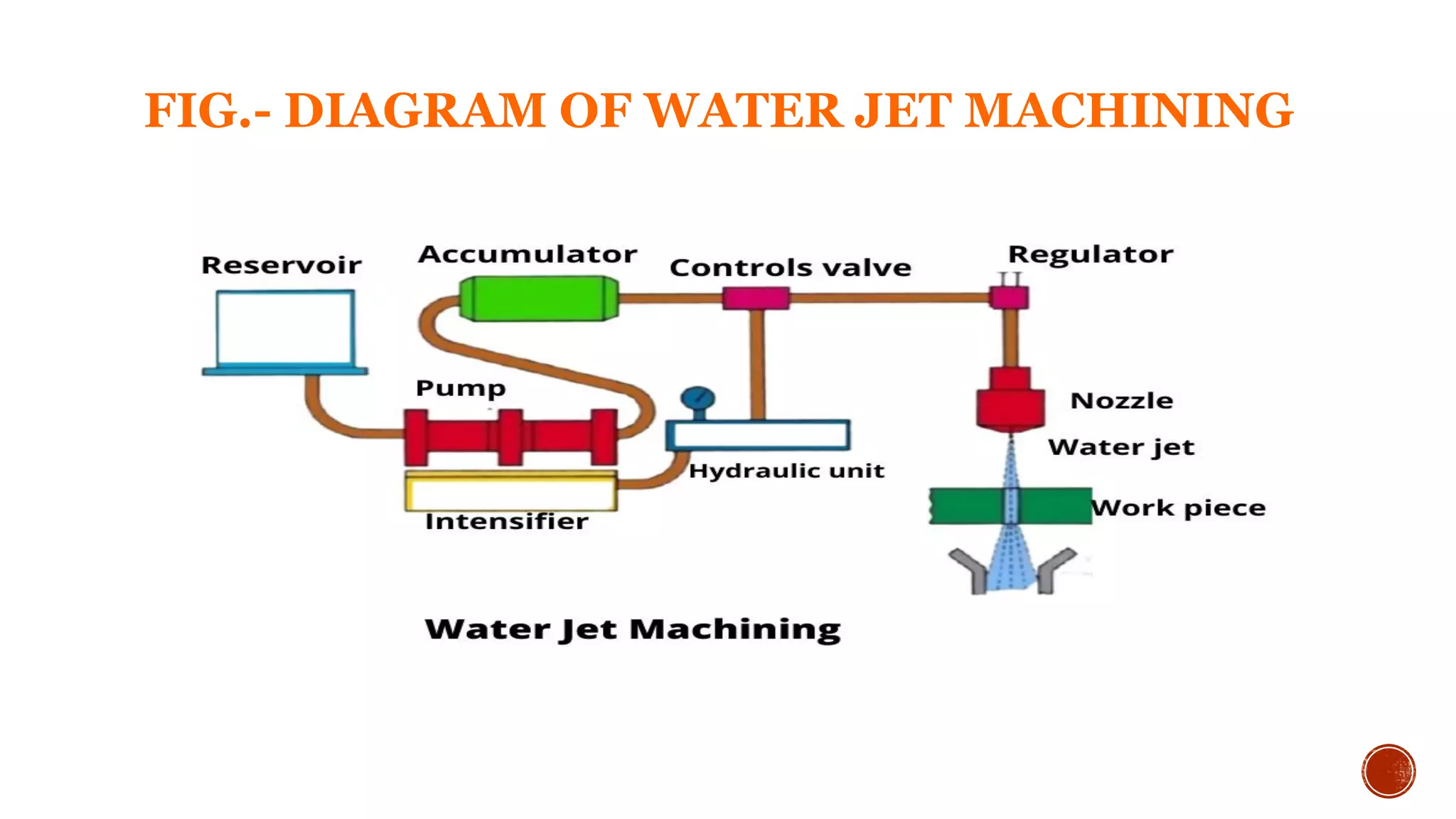
Various part is used to construct the Water jet machine-
• Storage tank
• Pump
• Intensifier
• Tubing
• Accumulator
• Control valve
• Nozzle
• Regulator
• Drain System
Read in-depth about parts and its construction- Water Jet
machining
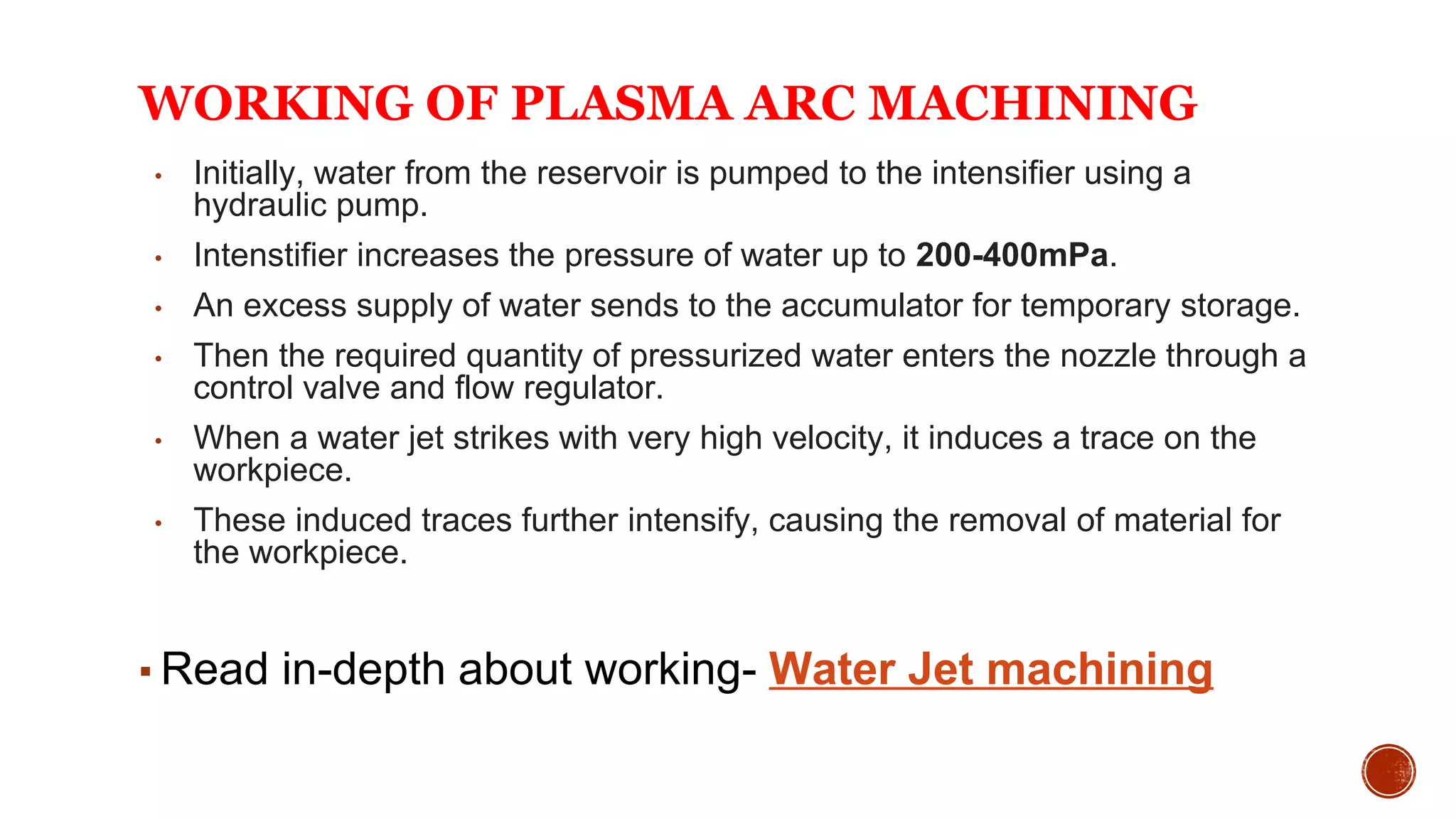
WORKING OF PLASMA ARC MACHINING
• Initially, water from the reservoir is pumped to the intensifier using a
hydraulic pump.
• Intenstifier increases the pressure of water up to 200-400mPa.
• An excess supply of water sends to the accumulator for temporary storage.
• Then the required quantity of pressurized water enters the nozzle through a
control valve and flow regulator.
• When a water jet strikes with very high velocity, it induces a trace on the
workpiece.
• These induced traces further intensify, causing the removal of material for
the workpiece.
▪ Read in-depth about working- Water Jet machining
FIG.- DIAGRAM OF WATER JET MACHINING
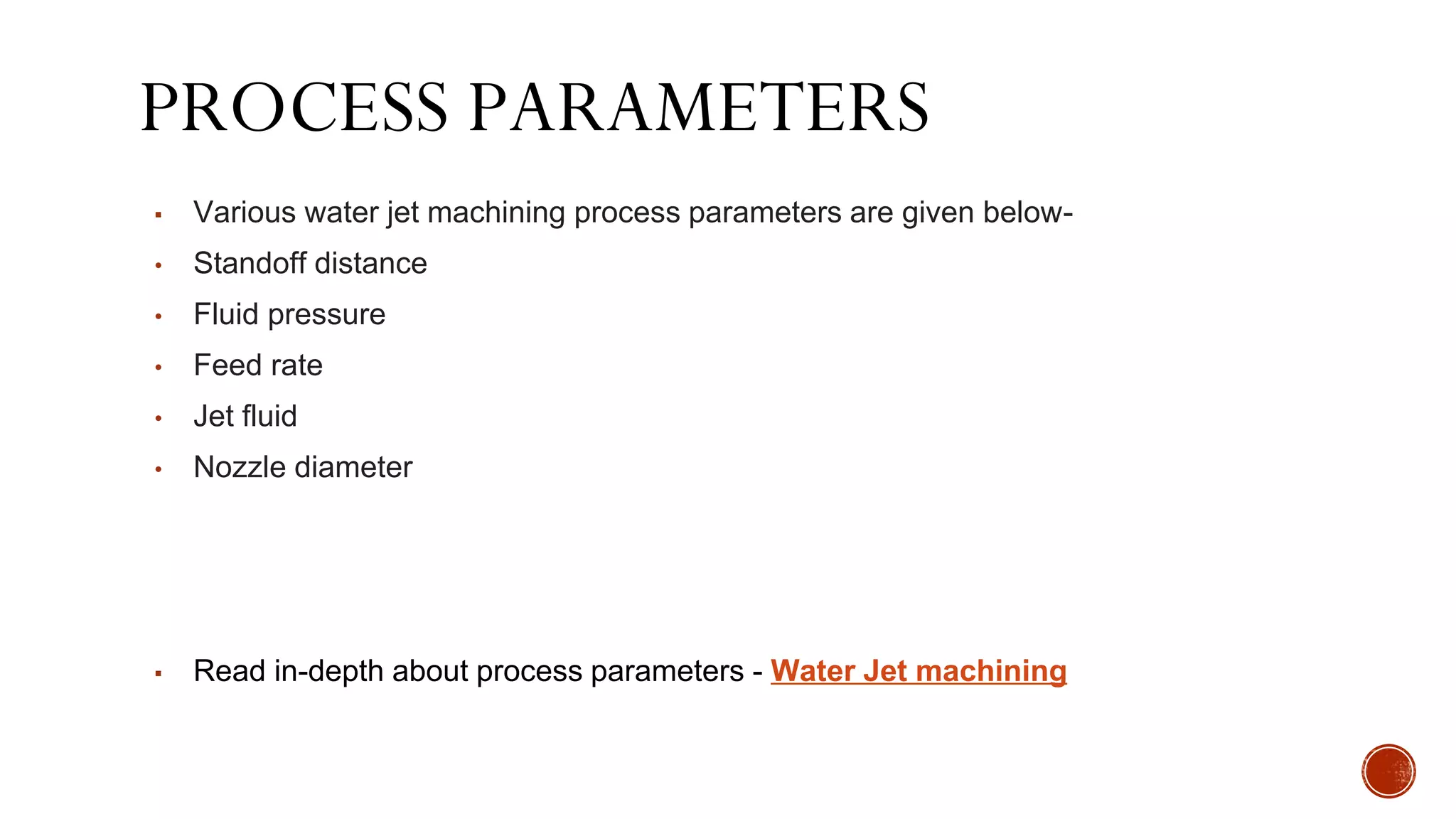
PROCESS PARAMETERS
▪ Various water jet machining process parameters are given below-
• Standoff distance
• Fluid pressure
• Feed rate
• Jet fluid
• Nozzle diameter
▪ Read in-depth about process parameters - Water Jet machining
ADVANTAGES OF PLASMA ARC MACHINING
The various advantages of WJM are-
• Excellent precision
• Water is cheap, non-toxic, readily available and can be easily disposed of.
• Water jet approaches the ideal single point tool.
• The process gives a clean and sharp cut.
• Unlike the conventional machining process, this method does not generate heat.
• Best suited for the explosive environment.
• Noise is minimized as the power units and pumps can be kept away from the
cutting point.
• No moving parts, therefore, less maintenance is required.
• Read more on Advantages - Water Jet machining
DISADVANTAGES OF PLASMA ARC
MACHINING
The various disadvantages of WJM are-
• Only soft materials can be machined.
• Very high thick materials can not be machined easily.
• The initial cost is high
• Not suitable for mass production.
• Read more here - Water Jet machining
APPLICATIONS OF WATER JET MACHINING-
• Useful for cutting materials that are porous, fibrous, granular, or soft.
It includes the materials like corrugated board, rubber, granite,
plywood, glass, aluminum.
• To cut wood, ceramics, composites, leather, foam, wire stripping and
deburring.
• In aerospace and other similar industries, a water jet is cut off asbestos
to minimize airborne dust in the atmosphere.
• Used to cut fiberglass and polyethene automotive parts.
THAT’S IT FOR
NOW
▪Thank you for watching
For more information visit- www.engineersrail.com

Water jet machining

  • 1.
    Water Jet Machining Definition, Principle,Working, Parameters, Advantages, Applications
  • 2.
    WATER JET MACHININGDEFINITION ▪ A Non-conventional machining process In which a high-velocity water jet is used to remove materials from the surface of the workpiece. ▪ Water jet machining(WJM) is a mechanical energy based non-traditional machining process used to cut and machine soft and non-metallic materials. ▪ It uses the high-velocity water jet to cut a non-metallic workpiece smoothly. ▪ However, It is just similar to Abrasive jet machining.
  • 3.
    PRINCIPLE- Here is theprinciple of water jet machining- ▪ It works on the principle of water erosion. ▪ When a high-velocity water jet strikes the surface, the removal of metal takes place.
  • 4.
    PARTS AND CONSTRUCTION- Variouspart is used to construct the Water jet machine- • Storage tank • Pump • Intensifier • Tubing • Accumulator • Control valve • Nozzle • Regulator • Drain System Read in-depth about parts and its construction- Water Jet machining
  • 5.
    WORKING OF PLASMAARC MACHINING • Initially, water from the reservoir is pumped to the intensifier using a hydraulic pump. • Intenstifier increases the pressure of water up to 200-400mPa. • An excess supply of water sends to the accumulator for temporary storage. • Then the required quantity of pressurized water enters the nozzle through a control valve and flow regulator. • When a water jet strikes with very high velocity, it induces a trace on the workpiece. • These induced traces further intensify, causing the removal of material for the workpiece. ▪ Read in-depth about working- Water Jet machining
  • 6.
    FIG.- DIAGRAM OFWATER JET MACHINING
  • 7.
    PROCESS PARAMETERS ▪ Variouswater jet machining process parameters are given below- • Standoff distance • Fluid pressure • Feed rate • Jet fluid • Nozzle diameter ▪ Read in-depth about process parameters - Water Jet machining
  • 8.
    ADVANTAGES OF PLASMAARC MACHINING The various advantages of WJM are- • Excellent precision • Water is cheap, non-toxic, readily available and can be easily disposed of. • Water jet approaches the ideal single point tool. • The process gives a clean and sharp cut. • Unlike the conventional machining process, this method does not generate heat. • Best suited for the explosive environment. • Noise is minimized as the power units and pumps can be kept away from the cutting point. • No moving parts, therefore, less maintenance is required. • Read more on Advantages - Water Jet machining
  • 9.
    DISADVANTAGES OF PLASMAARC MACHINING The various disadvantages of WJM are- • Only soft materials can be machined. • Very high thick materials can not be machined easily. • The initial cost is high • Not suitable for mass production. • Read more here - Water Jet machining
  • 10.
    APPLICATIONS OF WATERJET MACHINING- • Useful for cutting materials that are porous, fibrous, granular, or soft. It includes the materials like corrugated board, rubber, granite, plywood, glass, aluminum. • To cut wood, ceramics, composites, leather, foam, wire stripping and deburring. • In aerospace and other similar industries, a water jet is cut off asbestos to minimize airborne dust in the atmosphere. • Used to cut fiberglass and polyethene automotive parts.
  • 11.
    THAT’S IT FOR NOW ▪Thankyou for watching For more information visit- www.engineersrail.com