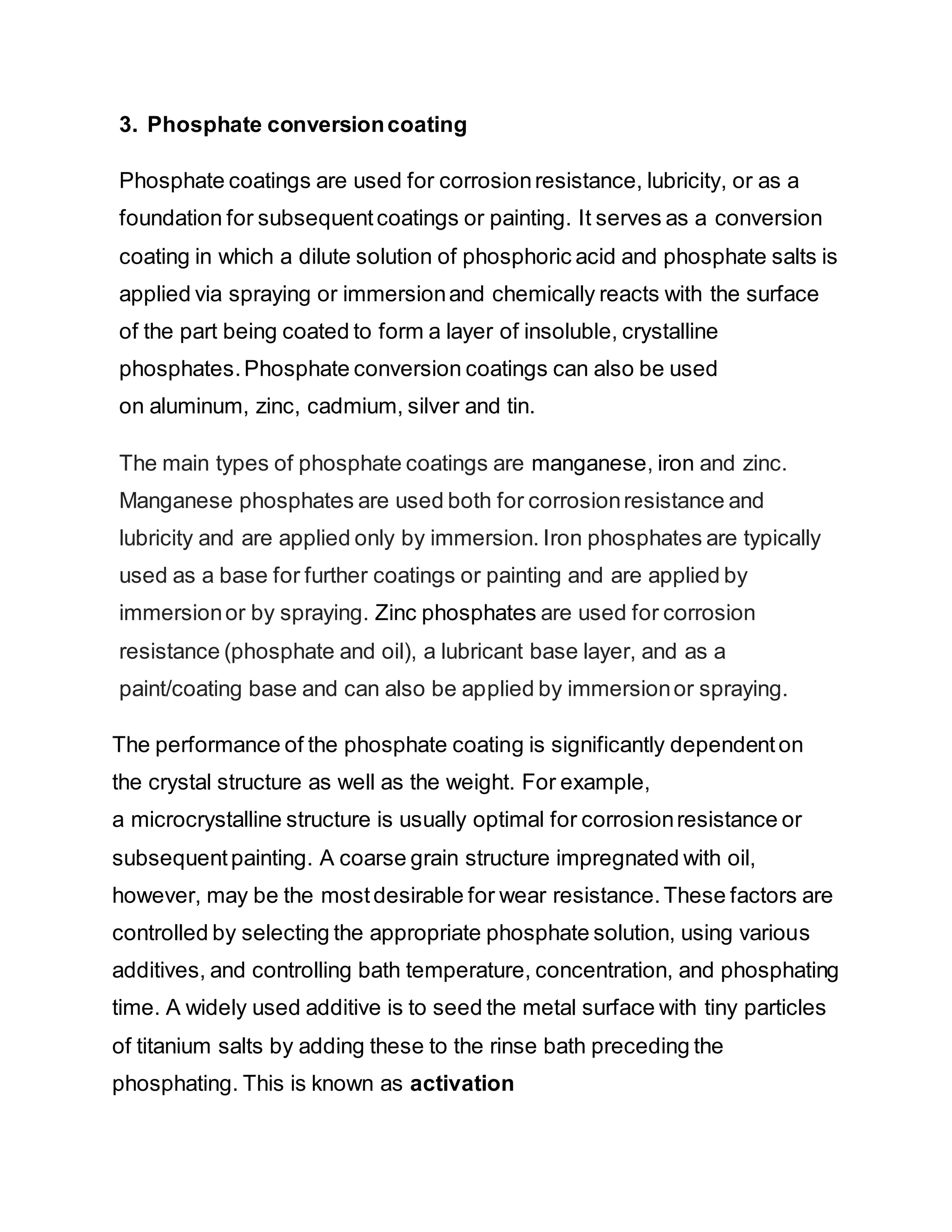
Surface Treatement
Technologies
 ABSTRACT
These processesare sometimesreferred to as post-processing. It plays a
very important role in the appearance, function and life of the product.
Broadly, this is processes that affecteither a thin layer on the surface of the
part itself, or add a thin layer on top of the surface of the part.
There are differentcoating and surface treatments processes,with different
applications, uses, etc. The important uses include: Improving the
hardness, improving the wear resistance, Controlling friction, Reductionof
adhesion, improving the lubrication, etc., improving corrosionresistance,
improving aesthetics
 TECHNIQUES
1. Mechanicalhardeningof the surface
These methods apply mechanical impulses (e.g. light hammering) on the
surface of a metallic part. This hammering action causes tiny amount of
plastic flow on the surface,resulting in the work-hardening of the surface
layer due to the introduction of compressive residual stresses.Examples
of these processes include Shot peening (uses tiny balls of metal or
ceramic), Water-jet peening (uses a jet of water at high pressures,e.g.
400 MPa), or Laser peening (surface is hit by tiny impulses from a laser) –
an expensive process used to improve fatigue strength of jet fan blades
and turbine impellers.Another method is explosive hardening, where a
layer of explosive coated on the surface is blasted – the resulting impact
results in tremendous increase in the surface hardness.
This method is used to harden the surface of train rails.
A. Shot peening
Is a cold work processused to finish metal parts to prevent fatigue and
stress corrosionfailures and prolong product life for the part In shot
peening, small spherical shot bombards the surface of the part to be
finished. The shot acts like a peen hammer, dimpling the surface and
causing compressionstressesunder the dimple.
As the media continues to strike the part, it forms multiple overlapping
dimples throughout the metal surface being treated.
The surface compressionstress strengthens the metal, ensuring that the
finished part will resist fatigue failures, corrosionfatigue and cracking, and
galling and erosionfrom cavitation
B. Case hardening
This is a very commonprocess that is used to harden the outer surface of
parts such as gear teeth, cams, shafts, bearings, fasteners,pins, tools,
molds,dies etc. In mostof these types of components,the use involves
dynamic forces,occasionalimpacts, and constant friction.
Therefore the surface needs to be hard to prevent wear, but the bulk of the
part should be tough (not brittle); this is achieved bestby case hardening.
There are several types of case hardening: in most cases,the chemical
structure of the metal is changed by diffusing atoms of an alternate element
which results in alterations to the micro-structure on the crystals on the
surface. The duration and temperature control the concentration and depth
of the doping.Most of these processes are used to case harden steeland
other iron alloys, including low carbon steels,alloy steels, tool steels.
2. Oxide coating
In vacuum tubes, a hot cathode or thermioniccathodeis
a cathode electrode which is heated to make it emit electrons due to
thermionic. The heating element is usually an electrical filament, heated by
a separate electric current passing through it. Hot cathodes typically
achieve much higher power density than cold cathodes,emitting
significantly more electrons from the same surface area. Cold
cathodes rely on field electronemission or secondaryelectron emission
from positive ion bombardmentand do not require heating. There are two
types of hot cathode. In a directly-heated cathode,the filament is the
cathode and emits the electrons.In an indirectly-heated cathode, the
filament or heater heats a separate metal cathode electrode which emits
the electrons.
 Types
A. Boride cathodes
Cerium boride cathodes have one and half times the lifetime of lanthanum
boride,due to its higher resistance to carbon contamination. Boride
cathodes are about ten times as "bright" as the tungsten ones and have 10-
15 times longer lifetime.They are used e.g. in electron
microscopes,microwave tubes, electronlithography, electron beam
welding, X-Ray tubes, and free electronlasers. However these materials
tend to be expensive.
B. Thoriatedfilaments
The most commontype of directly heated cathode, used in most high
power transmitting tubes, is the thoriated tungsten filament; a small amount
of thorium is added to the tungsten of the filament. The filament is heated
white-hot, at about 2400 °C, and thorium atoms migrate to the surface of
the filament and form the emissive layer. Heating the filament in a
hydrocarbon atmosphere carburizes the surface and stabilizes the emissive
layer. Thoriated filaments can have very long lifetimes and are resistant to
the ion bombardmentthat occurs at high voltages, because fresh thorium
continually diffuses to the surface, renewing the layer. They are used in
nearly all high-power vacuum tubes for radio transmitters, and in some
tubes for hi-fi amplifiers.Their lifetimes tend to be longer than those of
oxide cathodes
C. Thorium alternatives
Due to concerns about thorium radioactivity and toxicity, efforts have been
made to find alternatives. One of them is zirconiated tungsten,
where zirconium dioxide is used instead of thorium dioxide.
3. Phosphate conversioncoating
Phosphate coatings are used for corrosionresistance, lubricity, or as a
foundation for subsequentcoatings or painting. It serves as a conversion
coating in which a dilute solution of phosphoric acid and phosphate salts is
applied via spraying or immersionand chemically reacts with the surface
of the part being coated to form a layer of insoluble, crystalline
phosphates.Phosphate conversion coatings can also be used
on aluminum, zinc, cadmium, silver and tin.
The main types of phosphate coatings are manganese, iron and zinc.
Manganese phosphates are used both for corrosionresistance and
lubricity and are applied only by immersion. Iron phosphates are typically
used as a base for further coatings or painting and are applied by
immersionor by spraying. Zinc phosphates are used for corrosion
resistance (phosphate and oil), a lubricant base layer, and as a
paint/coating base and can also be applied by immersionor spraying.
The performance of the phosphate coating is significantly dependenton
the crystal structure as well as the weight. For example,
a microcrystalline structure is usually optimal for corrosionresistance or
subsequentpainting. A coarse grain structure impregnated with oil,
however, may be the mostdesirable for wear resistance.These factors are
controlled by selecting the appropriate phosphate solution, using various
additives, and controlling bath temperature, concentration, and phosphating
time. A widely used additive is to seed the metal surface with tiny particles
of titanium salts by adding these to the rinse bath preceding the
phosphating. This is known as activation
4. Chromateconversioncoating
Aluminium and aluminium alloys are treated by a corrosionresistant
conversion coating that is called "chromate coating" or "chromating".
General method is to clean the aluminium surface and then apply an acidic
chromium compositionon that clean surface. Chromium conversion
coatings are highly corrosionresistant and provide excellent retention of
subsequentcoatings. Differenttype of subsequentcoatings can be applied
to the chromate conversioncoating to produce an acceptable surface.
Along with providing high corrosionresistance and paint adhesion
properties to aluminium surface.
Quality of surface pre-treatment prior to powder coating is the most
important factor that effectsto stability of paintings. Properlypre-treated
aluminium surfaces become highly protected against corrosioneven if the
surface is exposed to external impacts (damage, high temperature,
humidity…etc.).
Chromating is generally used as under paint protection
Provided by yellow chromating (Cr+6), green chromating (Cr+3),
transparent chromating (Cr+3).
Coating quality will be effected positivelywhen surface treated with
deionized water after chromating. Refinishing of the rinsing baths also
improve the quality of the coating.
Chromated and rinsed aluminium workpieces should be dried in driers or
ovens but it is important not to set drying temperatures above 70°C.After
all these treatment workpieces are painted then cured 10 – 15 minutes at
200°C
5. Thermalspraying
Also commonlyknown as metal spraying is a surface engineering / coating
process where a wide range of metals and ceramics can be sprayed onto
the surface of another material.
Thermal spraying is widely used to provide corrosionprotectionto ferrous
metals or to change the surface properties of the sprayed items, such as
improve the wear resistance or thermal conductivity.
Thermal spraying can provide thick coatings (approx. thickness range is 20
micrometers to several mm, depending on the process and feedstock),
over a large area at high depositionrate as compared to other coating
processessuch as electroplating,physical and chemical vapor deposition.
Several variations of thermal spraying are distinguished:
 Plasma spraying
 Detonation spraying
 Wire arc spraying
 Flame spraying
 High velocity oxy-fuel coating spraying (HVOF)
 Warm spraying
 Cold spraying
Coating quality is usually assessed by measuring its oxide content, macro
and micro-hardness,bond strength and surface roughness.Generally, the
coating quality increases with increasing particle velocities.
6. PhysicalVaporDeposition
Physical Vapor Deposition,or PVD, is a term used to describe a family of
coating processes.The most commonof these PVD coating processes are
evaporation (typically using cathode arc or electron beam sources),and
sputtering (using magnetic enhanced sources or “magnetrons”,cylindrical
or hollow cathode sources).
All of these processesoccurin vacuum at working pressure (typically 10-2
to 10-4 mbar) and generally involve bombardmentof the substrate to be
coated with energetic positively charged ions during the coating process to
promote high density.
Additionally, reactive gases such as nitrogen, acetylene or oxygen may be
introduced into the vacuum chamber during metal depositionto create
various compound coating compositions.
It forms a compound with the metal vapor and is depositedon the tools or
components as a thin, highly adherent coating. In order to obtain a uniform
coating thickness, the parts are rotated at uniform speed about several
axes.
The properties of the coating (such as hardness, structure, chemical and
temperature resistance,adhesion) can be accurately controlled.
7. ChemicalVaporDeposition
Chemical Vapor Deposition(CVD) is an atmosphere controlled process
conducted at elevated temperatures (~1925° F) in a CVD reactor. During
this process,thin-film coatings are formed as the result of reactions
between various gaseous phases and the heated surface of substrates
within the CVD reactor.
As differentgases are transported through the reactor, distinct coating
layers are formed on the tooling substrate. For example, TiN is formed as
a result of the following chemical reaction: Titanium carbide (TiC) is
formed as the result of the following chemical reaction.
The final productof these reactions is a hard, wear-resistant coating that
exhibits a chemical and metallurgical bond to the substrate. CVD coatings
provide excellent resistance to the types of wear and galling typically seen
during many metal-forming applications.
8. Thermo reactiveDiffusion
Thermoreactive Diffusion(TD or TRD) is a high temperature coating
process forproducing metal carbides (typically vanadium carbide) on the
surface of a carbon-containing substrate.
This is a multi-stage coating processwhich utilizes a pre-heat cycle, a
coating segment,ultra-sonic cleaning, heat-treating, and post-coating
polishing. The coating segmentis performed in a molten bath [typically
consisting of a solute (Borax), a metal source,and a reducing agent]:
carbide-forming compounds inthe bath react with carbon in the substrate
and produce metal carbides on the substrate surface.TD coatings exhibit a
diffusiontype bond, thereby providing superb adhesion between the metal
carbide layer and the substrate. This bonding characteristic, combined with
the coating’s high micro-hardness,provides excellentresistance to the
types of wear and galling often seenin many metal-forming processes.

Surface treatment technologies

  • 1.
  • 2.
     ABSTRACT These processesaresometimesreferred to as post-processing. It plays a very important role in the appearance, function and life of the product. Broadly, this is processes that affecteither a thin layer on the surface of the part itself, or add a thin layer on top of the surface of the part. There are differentcoating and surface treatments processes,with different applications, uses, etc. The important uses include: Improving the hardness, improving the wear resistance, Controlling friction, Reductionof adhesion, improving the lubrication, etc., improving corrosionresistance, improving aesthetics  TECHNIQUES 1. Mechanicalhardeningof the surface These methods apply mechanical impulses (e.g. light hammering) on the surface of a metallic part. This hammering action causes tiny amount of plastic flow on the surface,resulting in the work-hardening of the surface layer due to the introduction of compressive residual stresses.Examples of these processes include Shot peening (uses tiny balls of metal or ceramic), Water-jet peening (uses a jet of water at high pressures,e.g. 400 MPa), or Laser peening (surface is hit by tiny impulses from a laser) – an expensive process used to improve fatigue strength of jet fan blades and turbine impellers.Another method is explosive hardening, where a layer of explosive coated on the surface is blasted – the resulting impact results in tremendous increase in the surface hardness. This method is used to harden the surface of train rails.
  • 3.
    A. Shot peening Isa cold work processused to finish metal parts to prevent fatigue and stress corrosionfailures and prolong product life for the part In shot peening, small spherical shot bombards the surface of the part to be finished. The shot acts like a peen hammer, dimpling the surface and causing compressionstressesunder the dimple. As the media continues to strike the part, it forms multiple overlapping dimples throughout the metal surface being treated. The surface compressionstress strengthens the metal, ensuring that the finished part will resist fatigue failures, corrosionfatigue and cracking, and galling and erosionfrom cavitation B. Case hardening This is a very commonprocess that is used to harden the outer surface of parts such as gear teeth, cams, shafts, bearings, fasteners,pins, tools, molds,dies etc. In mostof these types of components,the use involves dynamic forces,occasionalimpacts, and constant friction. Therefore the surface needs to be hard to prevent wear, but the bulk of the part should be tough (not brittle); this is achieved bestby case hardening. There are several types of case hardening: in most cases,the chemical structure of the metal is changed by diffusing atoms of an alternate element which results in alterations to the micro-structure on the crystals on the surface. The duration and temperature control the concentration and depth of the doping.Most of these processes are used to case harden steeland other iron alloys, including low carbon steels,alloy steels, tool steels.
  • 4.
    2. Oxide coating Invacuum tubes, a hot cathode or thermioniccathodeis a cathode electrode which is heated to make it emit electrons due to thermionic. The heating element is usually an electrical filament, heated by a separate electric current passing through it. Hot cathodes typically achieve much higher power density than cold cathodes,emitting significantly more electrons from the same surface area. Cold cathodes rely on field electronemission or secondaryelectron emission from positive ion bombardmentand do not require heating. There are two types of hot cathode. In a directly-heated cathode,the filament is the cathode and emits the electrons.In an indirectly-heated cathode, the filament or heater heats a separate metal cathode electrode which emits the electrons.  Types A. Boride cathodes Cerium boride cathodes have one and half times the lifetime of lanthanum boride,due to its higher resistance to carbon contamination. Boride cathodes are about ten times as "bright" as the tungsten ones and have 10- 15 times longer lifetime.They are used e.g. in electron microscopes,microwave tubes, electronlithography, electron beam welding, X-Ray tubes, and free electronlasers. However these materials tend to be expensive.
  • 5.
    B. Thoriatedfilaments The mostcommontype of directly heated cathode, used in most high power transmitting tubes, is the thoriated tungsten filament; a small amount of thorium is added to the tungsten of the filament. The filament is heated white-hot, at about 2400 °C, and thorium atoms migrate to the surface of the filament and form the emissive layer. Heating the filament in a hydrocarbon atmosphere carburizes the surface and stabilizes the emissive layer. Thoriated filaments can have very long lifetimes and are resistant to the ion bombardmentthat occurs at high voltages, because fresh thorium continually diffuses to the surface, renewing the layer. They are used in nearly all high-power vacuum tubes for radio transmitters, and in some tubes for hi-fi amplifiers.Their lifetimes tend to be longer than those of oxide cathodes C. Thorium alternatives Due to concerns about thorium radioactivity and toxicity, efforts have been made to find alternatives. One of them is zirconiated tungsten, where zirconium dioxide is used instead of thorium dioxide.
  • 6.
    3. Phosphate conversioncoating Phosphatecoatings are used for corrosionresistance, lubricity, or as a foundation for subsequentcoatings or painting. It serves as a conversion coating in which a dilute solution of phosphoric acid and phosphate salts is applied via spraying or immersionand chemically reacts with the surface of the part being coated to form a layer of insoluble, crystalline phosphates.Phosphate conversion coatings can also be used on aluminum, zinc, cadmium, silver and tin. The main types of phosphate coatings are manganese, iron and zinc. Manganese phosphates are used both for corrosionresistance and lubricity and are applied only by immersion. Iron phosphates are typically used as a base for further coatings or painting and are applied by immersionor by spraying. Zinc phosphates are used for corrosion resistance (phosphate and oil), a lubricant base layer, and as a paint/coating base and can also be applied by immersionor spraying. The performance of the phosphate coating is significantly dependenton the crystal structure as well as the weight. For example, a microcrystalline structure is usually optimal for corrosionresistance or subsequentpainting. A coarse grain structure impregnated with oil, however, may be the mostdesirable for wear resistance.These factors are controlled by selecting the appropriate phosphate solution, using various additives, and controlling bath temperature, concentration, and phosphating time. A widely used additive is to seed the metal surface with tiny particles of titanium salts by adding these to the rinse bath preceding the phosphating. This is known as activation
  • 7.
    4. Chromateconversioncoating Aluminium andaluminium alloys are treated by a corrosionresistant conversion coating that is called "chromate coating" or "chromating". General method is to clean the aluminium surface and then apply an acidic chromium compositionon that clean surface. Chromium conversion coatings are highly corrosionresistant and provide excellent retention of subsequentcoatings. Differenttype of subsequentcoatings can be applied to the chromate conversioncoating to produce an acceptable surface. Along with providing high corrosionresistance and paint adhesion properties to aluminium surface. Quality of surface pre-treatment prior to powder coating is the most important factor that effectsto stability of paintings. Properlypre-treated aluminium surfaces become highly protected against corrosioneven if the surface is exposed to external impacts (damage, high temperature, humidity…etc.). Chromating is generally used as under paint protection Provided by yellow chromating (Cr+6), green chromating (Cr+3), transparent chromating (Cr+3). Coating quality will be effected positivelywhen surface treated with deionized water after chromating. Refinishing of the rinsing baths also improve the quality of the coating. Chromated and rinsed aluminium workpieces should be dried in driers or ovens but it is important not to set drying temperatures above 70°C.After all these treatment workpieces are painted then cured 10 – 15 minutes at 200°C
  • 8.
    5. Thermalspraying Also commonlyknownas metal spraying is a surface engineering / coating process where a wide range of metals and ceramics can be sprayed onto the surface of another material. Thermal spraying is widely used to provide corrosionprotectionto ferrous metals or to change the surface properties of the sprayed items, such as improve the wear resistance or thermal conductivity. Thermal spraying can provide thick coatings (approx. thickness range is 20 micrometers to several mm, depending on the process and feedstock), over a large area at high depositionrate as compared to other coating processessuch as electroplating,physical and chemical vapor deposition. Several variations of thermal spraying are distinguished:  Plasma spraying  Detonation spraying  Wire arc spraying  Flame spraying  High velocity oxy-fuel coating spraying (HVOF)  Warm spraying  Cold spraying Coating quality is usually assessed by measuring its oxide content, macro and micro-hardness,bond strength and surface roughness.Generally, the coating quality increases with increasing particle velocities.
  • 9.
    6. PhysicalVaporDeposition Physical VaporDeposition,or PVD, is a term used to describe a family of coating processes.The most commonof these PVD coating processes are evaporation (typically using cathode arc or electron beam sources),and sputtering (using magnetic enhanced sources or “magnetrons”,cylindrical or hollow cathode sources). All of these processesoccurin vacuum at working pressure (typically 10-2 to 10-4 mbar) and generally involve bombardmentof the substrate to be coated with energetic positively charged ions during the coating process to promote high density. Additionally, reactive gases such as nitrogen, acetylene or oxygen may be introduced into the vacuum chamber during metal depositionto create various compound coating compositions. It forms a compound with the metal vapor and is depositedon the tools or components as a thin, highly adherent coating. In order to obtain a uniform coating thickness, the parts are rotated at uniform speed about several axes. The properties of the coating (such as hardness, structure, chemical and temperature resistance,adhesion) can be accurately controlled.
  • 10.
    7. ChemicalVaporDeposition Chemical VaporDeposition(CVD) is an atmosphere controlled process conducted at elevated temperatures (~1925° F) in a CVD reactor. During this process,thin-film coatings are formed as the result of reactions between various gaseous phases and the heated surface of substrates within the CVD reactor. As differentgases are transported through the reactor, distinct coating layers are formed on the tooling substrate. For example, TiN is formed as a result of the following chemical reaction: Titanium carbide (TiC) is formed as the result of the following chemical reaction. The final productof these reactions is a hard, wear-resistant coating that exhibits a chemical and metallurgical bond to the substrate. CVD coatings provide excellent resistance to the types of wear and galling typically seen during many metal-forming applications. 8. Thermo reactiveDiffusion Thermoreactive Diffusion(TD or TRD) is a high temperature coating process forproducing metal carbides (typically vanadium carbide) on the surface of a carbon-containing substrate. This is a multi-stage coating processwhich utilizes a pre-heat cycle, a coating segment,ultra-sonic cleaning, heat-treating, and post-coating polishing. The coating segmentis performed in a molten bath [typically consisting of a solute (Borax), a metal source,and a reducing agent]: carbide-forming compounds inthe bath react with carbon in the substrate
  • 11.
    and produce metalcarbides on the substrate surface.TD coatings exhibit a diffusiontype bond, thereby providing superb adhesion between the metal carbide layer and the substrate. This bonding characteristic, combined with the coating’s high micro-hardness,provides excellentresistance to the types of wear and galling often seenin many metal-forming processes.