1
Water Jet Machining
Introduction
2
 Key element in WJM – a jet of water.
 Water jet travels at velocities as high as 900 m/s (approximately Mach 3).
 When the water stream strikes a workpiece surface, the erosive force of
water removes the material rapidly.
 The water, in this case, acts like a saw and cuts a narrow groove in the
workpiece material.
WJM – Mechanism
3
4
Water Pumping – Animation
WJM – Components & Functions
5
WJM – Components & Functions
6
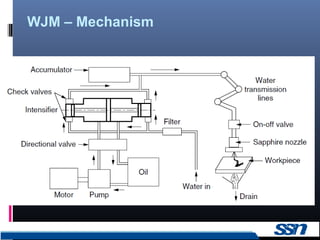
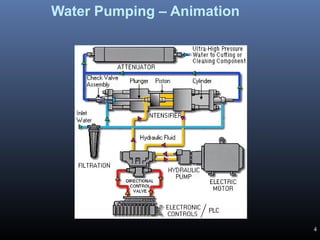
2. Intensifier
 Accepts the water at low pressure(typically 4 bar) and expels it, through an
accumulator, at higher pressures of 3800 bar.
 The intensifier converts the energy from the low-pressure hydraulic fluid into
ultrahigh-pressure water.
 The hydraulic system provides fluid power to a reciprocating piston in the
intensifier center section.
 A limit switch, located at each end of the piston travel, signals the electronic
controls to shift the directional control valve and reverses the piston direction.
 The intensifier assembly, with a plunger on each side of the piston, generates
pressure in both directions.
 As one side of the intensifier is in the inlet stroke, the opposite side is generating
ultrahigh-pressure output.
 During the plunger inlet stroke, filtered water enters the high-pressure cylinder
through the check value assembly.
 After the plunger reverses direction, the water is compressed and exits at
ultrahigh pressure.
WJM – Components & Functions
7
3. Accumulator
 Maintains the continuous flow of the high-pressure water and eliminates pressure
fluctuations.
 It relies on the compressibility of water (12 percent at 3800 bar) in order to
maintain a uniform discharge pressure and water jet velocity, when the intensifier
piston changes its direction.
4. High Pressure Tubing
 Transports pressurized water to the cutting head.
 Typical tube diameters are 6 to 14 mm.
 The equipment allows for flexible movement of the cutting head.
 The cutting action is controlled either manually or through a remote-control valve
specially designed for this purpose.
WJM – Components & Functions
8
5. Jet Cutting Nozzle
 Nozzle provides a coherent water jet stream for optimum cutting of low-density,
soft material that is considered unmachinable by conventional methods.
 Nozzles are normally made from synthetic sapphire.
 About 200 h of operation are expected from a nozzle, which becomes damaged by
particles of dirt and the accumulation of mineral deposits on the orifice due to
erosive water hardness.
 A longer nozzle life can be obtained through multistage filtration, which removes
undesired solids of size greater than 0.45 μm.
 The compact design of the water jet cutting head promotes integration with
motion control systems ranging from two-axis (XY) tables to sophisticated multiaxis
robotic installations.
6. Catcher
 Acts as a reservoir for collecting the machining debris entrained in the water jet.
 Moreover, it reduces the noise levels [105 decibels (dB)] associated with the
reduction in the velocity of the water jet from Mach 3 to subsonic levels.
WJM – Process Parameters
9
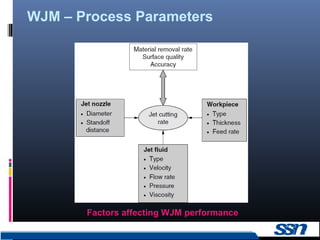
Factors affecting WJM performance
WJM – Process Parameters – Contd.
10
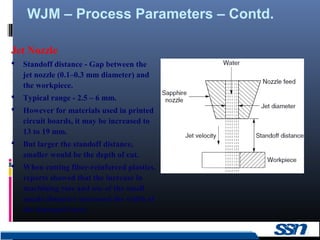
Jet Nozzle
 Standoff distance - Gap between the
jet nozzle (0.1–0.3 mm diameter) and
the workpiece.
 Typical range - 2.5 – 6 mm.
 However for materials used in printed
circuit boards, it may be increased to
13 to 19 mm.
 But larger the standoff distance,
smaller would be the depth of cut.
 When cutting fiber-reinforced plastics,
reports showed that the increase in
machining rate and use of the small
nozzle diameter increased the width of
the damaged layer.
WJM – Process Parameters – Contd.
11
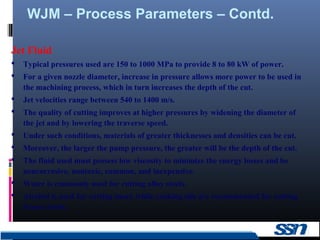
Jet Fluid
 Typical pressures used are 150 to 1000 MPa to provide 8 to 80 kW of power.
 For a given nozzle diameter, increase in pressure allows more power to be used in
the machining process, which in turn increases the depth of the cut.
 Jet velocities range between 540 to 1400 m/s.
 The quality of cutting improves at higher pressures by widening the diameter of
the jet and by lowering the traverse speed.
 Under such conditions, materials of greater thicknesses and densities can be cut.
 Moreover, the larger the pump pressure, the greater will be the depth of the cut.
 The fluid used must possess low viscosity to minimize the energy losses and be
noncorrosive, nontoxic, common, and inexpensive.
 Water is commonly used for cutting alloy steels.
 Alcohol is used for cutting meat, while cooking oils are recommended for cutting
frozen foods.
WJM – Process Parameters – Contd.
12
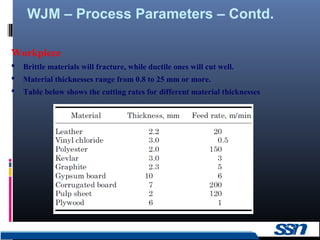
Workpiece
 Brittle materials will fracture, while ductile ones will cut well.
 Material thicknesses range from 0.8 to 25 mm or more.
 Table below shows the cutting rates for different material thicknesses
WJM – Applications
13
 WJM is used on metals, paper, cloth, leather, rubber, plastics, food, and ceramics.
 It is a versatile and cost-effective cutting process that can be used as an alternative
to traditional machining methods.
 It completely eliminates heat-affected zones, toxic fumes, recast layers, work
hardening and thermal stresses.
 It is the most flexible and effective cleaning solution available for a variety of
industrial needs.
 In general the cut surface has a sandblast appearance.
 Moreover, harder materials exhibit a better edge finish.
 Typical surface finishes ranges from 1.6 μm root mean square (RMS) to very
coarse depending on the application.
 Tolerances are in the range of ± 25 µm on thin material.
 Both the produced surface roughness and tolerance depend on the machining
speed.
WJM – Applications – Contd.
14
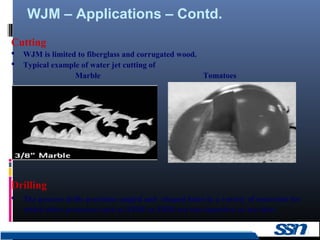
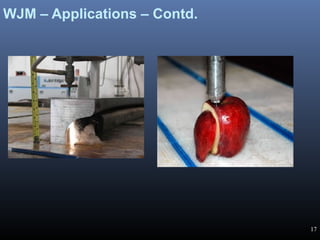
Cutting
 WJM is limited to fiberglass and corrugated wood.
 Typical example of water jet cutting of
Marble Tomatoes
Drilling
 The process drills precision-angled and -shaped holes in a variety of materials for
which other processes such as EDM or EBM are too expensive or too slow.
WJM – Applications – Contd.
15
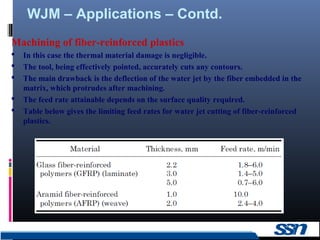
Machining of fiber-reinforced plastics
 In this case the thermal material damage is negligible.
 The tool, being effectively pointed, accurately cuts any contours.
 The main drawback is the deflection of the water jet by the fiber embedded in the
matrix, which protrudes after machining.
 The feed rate attainable depends on the surface quality required.
 Table below gives the limiting feed rates for water jet cutting of fiber-reinforced
plastics.
WJM – Applications – Contd.
16
Cutting of rocks
 Water jet cutting of a 51 mm deep slot in granite using two oscillating jets at 275
MPa during 14 passes at a 25.4 mm/s feed rate has been reported by McGeough
(1988).
 Moreover an oscillating nozzle system operating at the same feed rate and
pressure of 172 MPa, with the standoff distance adjusted every pass was used to
cut a 178 mm deep slot in sandstone.
Deburring
 The method uses large pressures to remove large burrs (3 mm height) in 12 mm
diameter drilled holes in a hollow molybdenum-chromium steel shaft at 15 s using
700 bar pressure and a flow rate of 27 L/min.
 In this method burrs are broken off by the impact of water.
 A higher pressure (4000 bar) and a lower flow rate (2.5 L/min) are used to remove
burrs from nonmetallic materials.
17
WJM – Applications – Contd.
18
Cutting of PCBs
 Using a small-diameter water jet, a printed circuit board (PCB) can be cut at a
speed that exceeds 8 m/min, to the accuracy of ± 0.13 mm.
 Boards of various shapes for use in portable radios and cassette players can be cut
using computer numerical control (CNC) technology.
Surface Treatment
 Removing deposits and residues without toxic chemicals, which eliminates costly
cleanup and disposal problems.
 Surface cleaning of pipes and castings, decorative finishing, nuclear
decontamination, food utensil cleaning, degreasing, polishing, preparation for
precise inspection, and surface texturing.
 Economical surface preparation and coating removal.
 Removing corrosion, spray residue, soluble salts, chemicals, and surface damage
prior to recoating or painting.
Wire Stripping
 Can remove the wire insulating material without damaging the metal or removing
the tinning on the copper wire.
 Processing time can be decreased to about 20 % of the manual stripping method.
WJM – Advantages
19
 It has multidirectional cutting capacity.
 No heat is produced.
 Cuts can be started at any location without the need for predrilled holes.
 Wetting of the workpiece material is minimal.
 There is no deflection to the rest of the workpiece.
 The burr produced is minimal.
 The tool does not wear and, therefore, does not need sharpening.
 The process is environmentally safe.
 Hazardous airborne dust contamination and waste disposal problems that are
common when using other cleaning methods are eliminated.
 There is multiple head processing.
 Simple fixturing eliminates costly and complicated tooling, which reduces
turnaround time and lowers the cost.
 Grinding and polishing are eliminated, reducing secondary operation costs.
 The narrow kerf allows tight nesting when multiple parts are cut from a single
blank.
WJM – Advantages
20
 It is ideal for roughing out material for near net shape.
 It is ideal for laser reflective materials such as copper and aluminum.
 It allows for more accurate cutting of soft material.
 It cuts through very thick material such as 383 mm in titanium and 307 mm in
Inconel.
 Hourly rates are relatively high.
 It is not suitable for mass production because of high maintenance requirements.
WJM – Disadvantages

Water jet machining

  • 1.
  • 2.
    Introduction 2  Key elementin WJM – a jet of water.  Water jet travels at velocities as high as 900 m/s (approximately Mach 3).  When the water stream strikes a workpiece surface, the erosive force of water removes the material rapidly.  The water, in this case, acts like a saw and cuts a narrow groove in the workpiece material.
  • 3.
  • 4.
  • 5.
    WJM – Components& Functions 5
  • 6.
    WJM – Components& Functions 6 2. Intensifier  Accepts the water at low pressure(typically 4 bar) and expels it, through an accumulator, at higher pressures of 3800 bar.  The intensifier converts the energy from the low-pressure hydraulic fluid into ultrahigh-pressure water.  The hydraulic system provides fluid power to a reciprocating piston in the intensifier center section.  A limit switch, located at each end of the piston travel, signals the electronic controls to shift the directional control valve and reverses the piston direction.  The intensifier assembly, with a plunger on each side of the piston, generates pressure in both directions.  As one side of the intensifier is in the inlet stroke, the opposite side is generating ultrahigh-pressure output.  During the plunger inlet stroke, filtered water enters the high-pressure cylinder through the check value assembly.  After the plunger reverses direction, the water is compressed and exits at ultrahigh pressure.
  • 7.
    WJM – Components& Functions 7 3. Accumulator  Maintains the continuous flow of the high-pressure water and eliminates pressure fluctuations.  It relies on the compressibility of water (12 percent at 3800 bar) in order to maintain a uniform discharge pressure and water jet velocity, when the intensifier piston changes its direction. 4. High Pressure Tubing  Transports pressurized water to the cutting head.  Typical tube diameters are 6 to 14 mm.  The equipment allows for flexible movement of the cutting head.  The cutting action is controlled either manually or through a remote-control valve specially designed for this purpose.
  • 8.
    WJM – Components& Functions 8 5. Jet Cutting Nozzle  Nozzle provides a coherent water jet stream for optimum cutting of low-density, soft material that is considered unmachinable by conventional methods.  Nozzles are normally made from synthetic sapphire.  About 200 h of operation are expected from a nozzle, which becomes damaged by particles of dirt and the accumulation of mineral deposits on the orifice due to erosive water hardness.  A longer nozzle life can be obtained through multistage filtration, which removes undesired solids of size greater than 0.45 μm.  The compact design of the water jet cutting head promotes integration with motion control systems ranging from two-axis (XY) tables to sophisticated multiaxis robotic installations. 6. Catcher  Acts as a reservoir for collecting the machining debris entrained in the water jet.  Moreover, it reduces the noise levels [105 decibels (dB)] associated with the reduction in the velocity of the water jet from Mach 3 to subsonic levels.
  • 9.
    WJM – ProcessParameters 9 Factors affecting WJM performance
  • 10.
    WJM – ProcessParameters – Contd. 10 Jet Nozzle  Standoff distance - Gap between the jet nozzle (0.1–0.3 mm diameter) and the workpiece.  Typical range - 2.5 – 6 mm.  However for materials used in printed circuit boards, it may be increased to 13 to 19 mm.  But larger the standoff distance, smaller would be the depth of cut.  When cutting fiber-reinforced plastics, reports showed that the increase in machining rate and use of the small nozzle diameter increased the width of the damaged layer.
  • 11.
    WJM – ProcessParameters – Contd. 11 Jet Fluid  Typical pressures used are 150 to 1000 MPa to provide 8 to 80 kW of power.  For a given nozzle diameter, increase in pressure allows more power to be used in the machining process, which in turn increases the depth of the cut.  Jet velocities range between 540 to 1400 m/s.  The quality of cutting improves at higher pressures by widening the diameter of the jet and by lowering the traverse speed.  Under such conditions, materials of greater thicknesses and densities can be cut.  Moreover, the larger the pump pressure, the greater will be the depth of the cut.  The fluid used must possess low viscosity to minimize the energy losses and be noncorrosive, nontoxic, common, and inexpensive.  Water is commonly used for cutting alloy steels.  Alcohol is used for cutting meat, while cooking oils are recommended for cutting frozen foods.
  • 12.
    WJM – ProcessParameters – Contd. 12 Workpiece  Brittle materials will fracture, while ductile ones will cut well.  Material thicknesses range from 0.8 to 25 mm or more.  Table below shows the cutting rates for different material thicknesses
  • 13.
    WJM – Applications 13 WJM is used on metals, paper, cloth, leather, rubber, plastics, food, and ceramics.  It is a versatile and cost-effective cutting process that can be used as an alternative to traditional machining methods.  It completely eliminates heat-affected zones, toxic fumes, recast layers, work hardening and thermal stresses.  It is the most flexible and effective cleaning solution available for a variety of industrial needs.  In general the cut surface has a sandblast appearance.  Moreover, harder materials exhibit a better edge finish.  Typical surface finishes ranges from 1.6 μm root mean square (RMS) to very coarse depending on the application.  Tolerances are in the range of ± 25 µm on thin material.  Both the produced surface roughness and tolerance depend on the machining speed.
  • 14.
    WJM – Applications– Contd. 14 Cutting  WJM is limited to fiberglass and corrugated wood.  Typical example of water jet cutting of Marble Tomatoes Drilling  The process drills precision-angled and -shaped holes in a variety of materials for which other processes such as EDM or EBM are too expensive or too slow.
  • 15.
    WJM – Applications– Contd. 15 Machining of fiber-reinforced plastics  In this case the thermal material damage is negligible.  The tool, being effectively pointed, accurately cuts any contours.  The main drawback is the deflection of the water jet by the fiber embedded in the matrix, which protrudes after machining.  The feed rate attainable depends on the surface quality required.  Table below gives the limiting feed rates for water jet cutting of fiber-reinforced plastics.
  • 16.
    WJM – Applications– Contd. 16 Cutting of rocks  Water jet cutting of a 51 mm deep slot in granite using two oscillating jets at 275 MPa during 14 passes at a 25.4 mm/s feed rate has been reported by McGeough (1988).  Moreover an oscillating nozzle system operating at the same feed rate and pressure of 172 MPa, with the standoff distance adjusted every pass was used to cut a 178 mm deep slot in sandstone. Deburring  The method uses large pressures to remove large burrs (3 mm height) in 12 mm diameter drilled holes in a hollow molybdenum-chromium steel shaft at 15 s using 700 bar pressure and a flow rate of 27 L/min.  In this method burrs are broken off by the impact of water.  A higher pressure (4000 bar) and a lower flow rate (2.5 L/min) are used to remove burrs from nonmetallic materials.
  • 17.
  • 18.
    WJM – Applications– Contd. 18 Cutting of PCBs  Using a small-diameter water jet, a printed circuit board (PCB) can be cut at a speed that exceeds 8 m/min, to the accuracy of ± 0.13 mm.  Boards of various shapes for use in portable radios and cassette players can be cut using computer numerical control (CNC) technology. Surface Treatment  Removing deposits and residues without toxic chemicals, which eliminates costly cleanup and disposal problems.  Surface cleaning of pipes and castings, decorative finishing, nuclear decontamination, food utensil cleaning, degreasing, polishing, preparation for precise inspection, and surface texturing.  Economical surface preparation and coating removal.  Removing corrosion, spray residue, soluble salts, chemicals, and surface damage prior to recoating or painting. Wire Stripping  Can remove the wire insulating material without damaging the metal or removing the tinning on the copper wire.  Processing time can be decreased to about 20 % of the manual stripping method.
  • 19.
    WJM – Advantages 19 It has multidirectional cutting capacity.  No heat is produced.  Cuts can be started at any location without the need for predrilled holes.  Wetting of the workpiece material is minimal.  There is no deflection to the rest of the workpiece.  The burr produced is minimal.  The tool does not wear and, therefore, does not need sharpening.  The process is environmentally safe.  Hazardous airborne dust contamination and waste disposal problems that are common when using other cleaning methods are eliminated.  There is multiple head processing.  Simple fixturing eliminates costly and complicated tooling, which reduces turnaround time and lowers the cost.  Grinding and polishing are eliminated, reducing secondary operation costs.  The narrow kerf allows tight nesting when multiple parts are cut from a single blank.
  • 20.
    WJM – Advantages 20 It is ideal for roughing out material for near net shape.  It is ideal for laser reflective materials such as copper and aluminum.  It allows for more accurate cutting of soft material.  It cuts through very thick material such as 383 mm in titanium and 307 mm in Inconel.  Hourly rates are relatively high.  It is not suitable for mass production because of high maintenance requirements. WJM – Disadvantages