ACID-BASE BALANCE..
Acid–base homeostasis…
• The Proper Balance Between Acids
And Bases.
• In Other Words, The PH.
• The body has three major
Mechanism To Regulate The
Physiological Acid Base Balance Or
PH Balance As Follows..
Three major Mechanism…
1.Acid-base buffer systems.
a)Bicarbonate-carbonic acid buffer
system.
b)Phosphate buffer system.
c)Protein buffer system.
2.Respiratory mechanism.
3.Renal mechanism
1.Acid-base buffer systems.
a)Bicarbonate-
carbonic acid buffer
system.
• The main job of the
carbonic acid/bicarbonate
system is to regulate body
pH.
.The PH the blood is
dependent only on the
ratio of the amount of
CO2 present in the blood
to the amount of HCO3
-
(bicarbonate ion) present
THE NORMAL
BLOOD PH IS
7.4
This ratio remains relatively
constant, because the
concentrations of both buffer
components (HCO3
-
and CO2)
are very large, compared to
the amount of H+
added to the
blood during normal activities
and moderate exercise.
If acid is added, the PH
decreases and the
buffer shifts toward
greater H2CO3 and CO2
concentration. (less
than 7.4)
As base is added, the PH
increases and the buffer
shifts toward greater
HCO3
-
concentration
(above 7.4)
b) The phosphate buffer system
consists of two ions:
• 1.Dihydrogen Phosphate Ions .
• 2.Hydrogen Phosphate Ions.
• When The Number Of Hydrogen Ions In A
Body's Bloodstream Increases (PH Drops),
Hydrogen Phosphate Ions Accept
Hydrogen Ions In Order To Maintain The
Equilibrium Between The Concentration
Of Hydrogen And Hydroxide Ions Within
The Bloodstream.
When The Number Of Hydrogen
Ions In The Bloodstream Decreases
(PH Increases), The Resulting
Dihydrogen Phosphate Ions
Release Hydrogen Ions In Order To
Increase The Number Of Hydrogen
Ions In The Blood.
C.PROTEIN BUFFER SYSTEM
• Hemoglobin (Hb) is an excellent
buffer because of it's ability to bind
with Hydrogen ions forming a weak
acid and carbon dioxide (CO2). After
oxygen is released in the peripheral
tissues, hemoglobin binds with CO2
and H+ ions.
As the blood reaches
the lungs these actions
reverse themselves.
Hemoglobin binds with
oxygen, releasing the
CO2 .
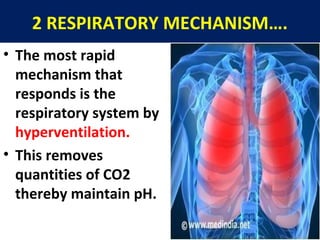
2 RESPIRATORY MECHANISM….
• The most rapid
mechanism that
responds is the
respiratory system by
hyperventilation.
• This removes
quantities of CO2
thereby maintain pH.
The hyperventilation
controlled by the
"Respiratory Center"
which is located largely in
the medulla oblongata of
the brain stem..
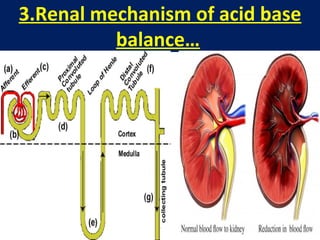
3.Renal mechanism of acid base
balance…
• If acid is excreted in the
urine, its is in effect
removed from the blood
when an equal quantity
of bicarbonate is added
to the blood.
• If the blood is too acidic
more hydrogen ions are
excreted, if the blood is
too basic, then less
hydrogen ions are
excreted.
HCO3
-
+ H+ <===> H2CO3<===>
CO2+H2O
Formation of ammonia……
• Ammonia is obtained from urea
cycle which is reacts with
hydrogen ion and forms
ammonium ion which is excreted
through urine.
• Na+-H+ exchanger, the Na+-K+-2Cl-
transporter and on Na+-K+-ATPase
All buffer systems are depends each other…..
Acid base balance

Acid base balance

  • 1.
  • 4.
    Acid–base homeostasis… • TheProper Balance Between Acids And Bases. • In Other Words, The PH. • The body has three major Mechanism To Regulate The Physiological Acid Base Balance Or PH Balance As Follows..
  • 5.
    Three major Mechanism… 1.Acid-basebuffer systems. a)Bicarbonate-carbonic acid buffer system. b)Phosphate buffer system. c)Protein buffer system. 2.Respiratory mechanism. 3.Renal mechanism
  • 6.
    1.Acid-base buffer systems. a)Bicarbonate- carbonicacid buffer system. • The main job of the carbonic acid/bicarbonate system is to regulate body pH.
  • 7.
    .The PH theblood is dependent only on the ratio of the amount of CO2 present in the blood to the amount of HCO3 - (bicarbonate ion) present
  • 8.
  • 9.
    This ratio remainsrelatively constant, because the concentrations of both buffer components (HCO3 - and CO2) are very large, compared to the amount of H+ added to the blood during normal activities and moderate exercise.
  • 10.
    If acid isadded, the PH decreases and the buffer shifts toward greater H2CO3 and CO2 concentration. (less than 7.4)
  • 11.
    As base isadded, the PH increases and the buffer shifts toward greater HCO3 - concentration (above 7.4)
  • 12.
    b) The phosphatebuffer system consists of two ions: • 1.Dihydrogen Phosphate Ions . • 2.Hydrogen Phosphate Ions. • When The Number Of Hydrogen Ions In A Body's Bloodstream Increases (PH Drops), Hydrogen Phosphate Ions Accept Hydrogen Ions In Order To Maintain The Equilibrium Between The Concentration Of Hydrogen And Hydroxide Ions Within The Bloodstream.
  • 13.
    When The NumberOf Hydrogen Ions In The Bloodstream Decreases (PH Increases), The Resulting Dihydrogen Phosphate Ions Release Hydrogen Ions In Order To Increase The Number Of Hydrogen Ions In The Blood.
  • 14.
    C.PROTEIN BUFFER SYSTEM •Hemoglobin (Hb) is an excellent buffer because of it's ability to bind with Hydrogen ions forming a weak acid and carbon dioxide (CO2). After oxygen is released in the peripheral tissues, hemoglobin binds with CO2 and H+ ions.
  • 15.
    As the bloodreaches the lungs these actions reverse themselves. Hemoglobin binds with oxygen, releasing the CO2 .
  • 16.
    2 RESPIRATORY MECHANISM…. •The most rapid mechanism that responds is the respiratory system by hyperventilation. • This removes quantities of CO2 thereby maintain pH.
  • 17.
    The hyperventilation controlled bythe "Respiratory Center" which is located largely in the medulla oblongata of the brain stem..
  • 18.
    3.Renal mechanism ofacid base balance…
  • 19.
    • If acidis excreted in the urine, its is in effect removed from the blood when an equal quantity of bicarbonate is added to the blood. • If the blood is too acidic more hydrogen ions are excreted, if the blood is too basic, then less hydrogen ions are excreted. HCO3 - + H+ <===> H2CO3<===> CO2+H2O
  • 20.
    Formation of ammonia…… •Ammonia is obtained from urea cycle which is reacts with hydrogen ion and forms ammonium ion which is excreted through urine. • Na+-H+ exchanger, the Na+-K+-2Cl- transporter and on Na+-K+-ATPase
  • 21.
    All buffer systemsare depends each other…..