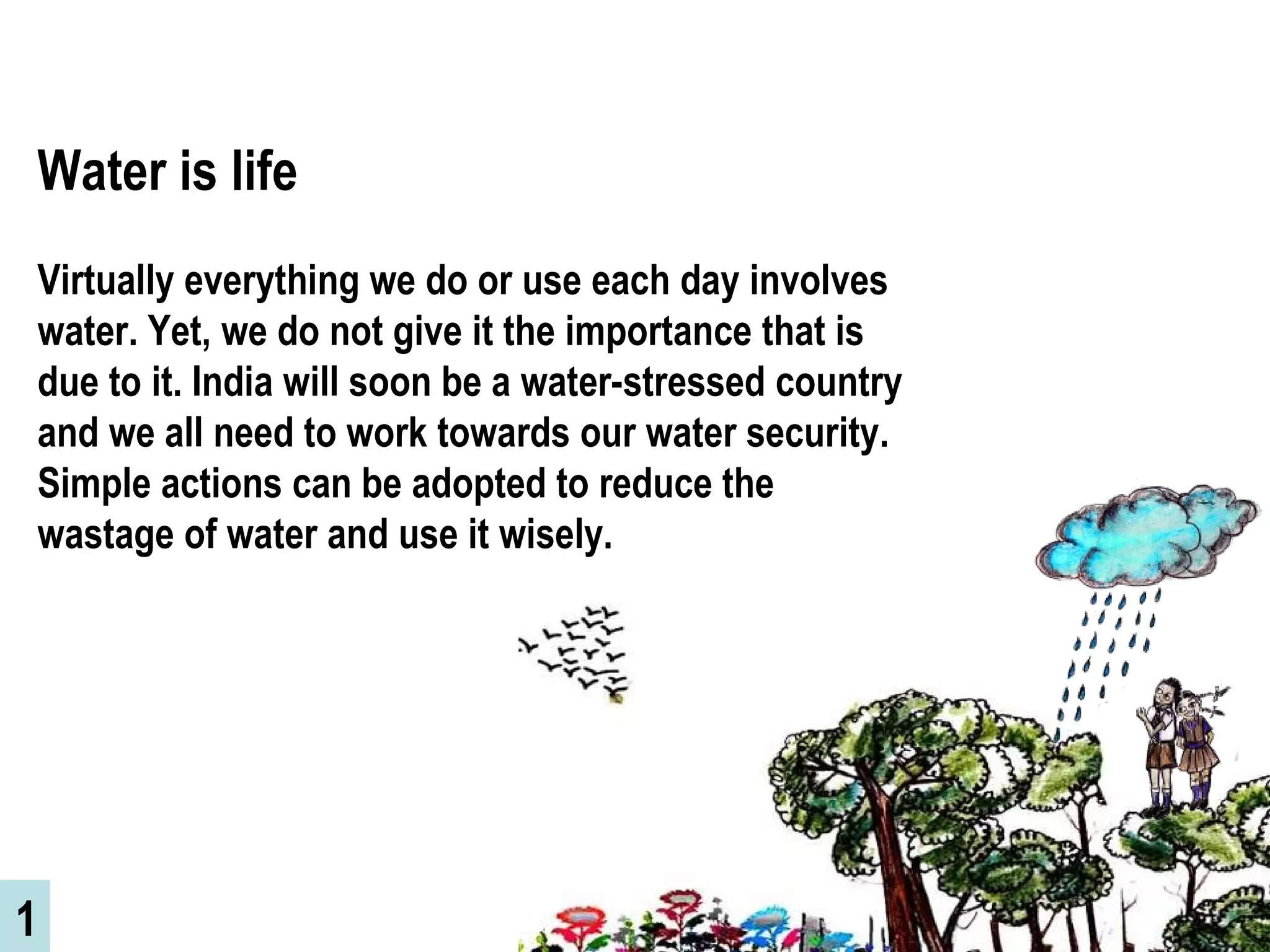
Water is life   Virtually everything we do or use each day involves water. Yet, we do not give it the importance that is due to it. India will soon be a water-stressed country and we all need to work towards our water security. Simple actions can be adopted to reduce the wastage of water and use it wisely.  1
Water audit for  a school 2
INTRODUCTION What is a Water Audit?  How does it help? Importance of Water Audit  Myths Audit types AUDIT PROCESS Conducting Audits – First Steps Measurements, Water Consumption Water consumption Pattern MOVING AHEAD Identifying and Fixing the Problem Water Conservation Awareness CONTENTS 3
Definition :  Water Audit is a qualitative and quantitative analysis of water consumption to identify means of   Reducing, Reusing and Recycling of water.  INTRODUCTION AUDIT PROCESS MOVING AHEAD 4
HOW DOES IT HELP? A water audit can help  save money  by reducing school water bills Water conservation  helps our cities  – Cities are stressed for water resources.  A water audit will help  reduce wastage and unnecessary use. It makes the  students more aware and responsible. A water audit can be a  student project  that encompasses a number of subjects INTRODUCTION AUDIT PROCESS MOVING AHEAD 5
It is possible to  cut your water usage  by 10-30% by implementing simple conservation measures DID YOU KNOW? INTRODUCTION AUDIT PROCESS MOVING AHEAD 6
IMPORTANCE OF WATER AUDIT  Systematic process  May yield some surprising results Easier to work on solutions when the problems are identified A tracking mechanism can be put into place INTRODUCTION AUDIT PROCESS MOVING AHEAD 7
MYTHS Doesn’t compromise on quality of water Doesn’t make water a priority over studies Doesn't require the student to stay beyond school hours INTRODUCTION AUDIT PROCESS MOVING AHEAD 8
AUDIT PROCESS 9
AUDIT PROCESS Planning and process finalization Measurements  Calculations Audit observations Report Discussions Zeroing in on conservation  steps that can be taken Implementation INTRODUCTION AUDIT PROCESS MOVING AHEAD 10
Decide the time period of your water audit 1 day/yr,  1 wk/yr,  1 month/yr,  1 day/Season   INTRODUCTION AUDIT PROCESS MOVING AHEAD 11
FIRST STEPS   MEASUREMENTS INTRODUCTION AUDIT PROCESS MOVING AHEAD 12
What are the sources of water for the school  ? Municipal supply Bore well Dug well Tankers  Others INTRODUCTION AUDIT PROCESS MOVING AHEAD MEASUREMENTS- SUPPLY 13
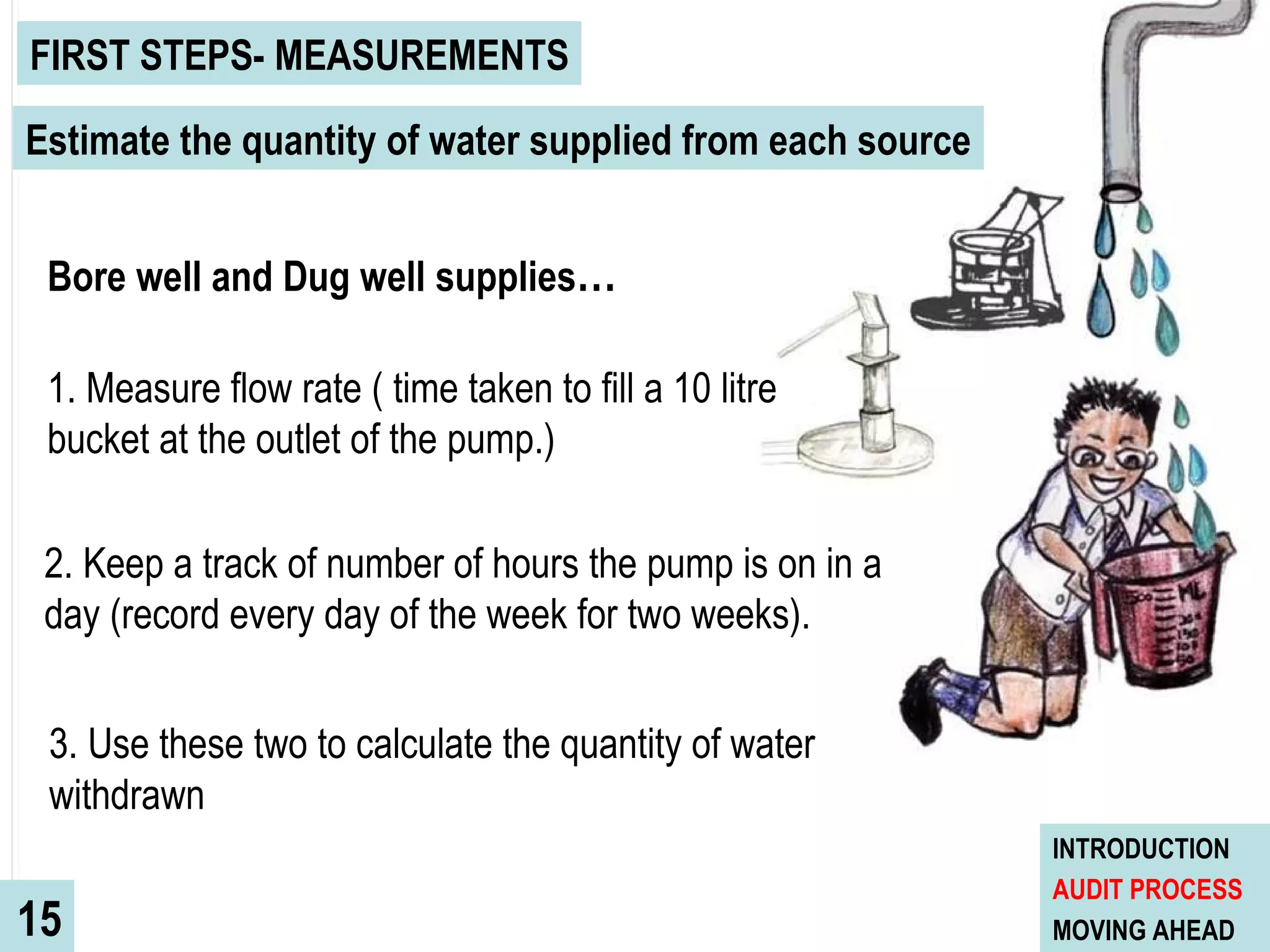
Bore well and Dug well supplies … 1. Measure flow rate ( time taken to fill a 10 litre bucket at the outlet of the pump.)  3. Use these two to calculate the quantity of water  withdrawn 2. Keep a track of number of hours the pump is on in a day (record every day of the week for two weeks).  FIRST STEPS- MEASUREMENTS INTRODUCTION AUDIT PROCESS MOVING AHEAD Estimate the quantity of water supplied from each source 15
Estimate the quantity of water supplied from each source  MEASUREMENTS- SUPPLY Municipal Supply Tabulate monthly municipal water supply (from bills)  for the past three years in the supply tracking sheet For tankers…. Using bills, tabulate the amount of water received  on a monthly basis  using the supply tracking sheet   INTRODUCTION AUDIT PROCESS MOVING AHEAD 14 Tabulate consumption patterns and depict  using graphical tools
Map the water points and usage areas Draw a plan of the school premises showing the building and main features .  Mark the water supply inlets and storage tanks INTRODUCTION AUDIT PROCESS MOVING AHEAD FIRST STEPS- MEASUREMENTS 16 Municipal supply Bore well Dug well Tankers
Mark all water points (toilets, hand wash points, Sinks in labs, drinking water fountains, canteen, irrigation taps, water meters, pumps etc. Identify each point with an alphanumeric code Colour code freshwater and waste water lines   Mark where the waste water goes. Mark the storm water drain system in the  premises, if any. INTRODUCTION AUDIT PROCESS MOVING AHEAD 17 FIRST STEPS- MEASUREMENTS
L1 L2 L3 L4 L5 GT1 GT2 GT3 GT4 BT1 BT2 BT3 BT4 L- INLET L- OUTLET GT- INLET GT- OUTLET BT- INLET BT- OUTLET CT1 CT2 CT3 C- INLET C- OUTLET WASH BOYS TOILET GARDEN WATER TANK PUMP HOUSE WATER INLET DRAIN PIPE MUNCIPALITY SEWER DRINKING  TAP GIRLS TOILET WASH LAB KITCHEN WATER TANK DRAIN PIPE Municipal supply Bore well Dug well Tankers DN1 INTRODUCTION AUDIT PROCESS MOVING AHEAD 18 UNDERGROUND SUMP
DRAW A WATER FLOW CHART Supply Washing W1  W2  Wn Gardening G1  G2  Gn Drinking D1  D2  Dn Underground Sump Toilets T1  T2  Tn Sewage Overhead Tank 19 INTRODUCTION AUDIT PROCESS MOVING AHEAD FIRST STEPS- MEASUREMENTS 19
Calculations : water  consumption Can you meter water consumption at various  inlet points? Meters are expensive. Can you purchase one meter and use it in rotation to monitor water use at different locations? If you cannot afford a meter, use surveys, observations and calculations INTRODUCTION AUDIT PROCESS MOVING AHEAD 20
Estimating Water use without a meter Calculate the flow of water using a measuring jar and a stop watch. Monitor / survey the time for which the tap is open in a day. Fill this data in the  consumption   tracking sheet.  Calculations:  water consumption   INTRODUCTION AUDIT PROCESS MOVING AHEAD Calculate the quantity of water that flows  out through each tap.  21
To calculate flow of toilets, turn off the water supply to the toilet, mark the water line on the inside of the tank, flush and then fill the tank with water from mug.  Measure the volume of one mug and record number of mugs required to fill water back up to the water line mark. Monitor / survey the number of times each toilet is used. Fill this data in the  consumption   tracking sheet.   INTRODUCTION AUDIT PROCESS MOVING AHEAD Calculations: Water Consumption 22
Estimating Water use without a meter Follow similar procedures to estimate water use at each water outlet.  The  consumption tracking sheet  will help you calculate the total quantity of water used in a day .  Calculations:  water consumption INTRODUCTION AUDIT PROCESS MOVING AHEAD 23
AUDIT OBSERVATIONS 24
Speak to the person in charge of the  water valves and pumps. Is water usage planned or is pump switched on when water  levels in the tank are low? What monitoring mechanisms are in place to check tank overflow? How often does the tank overflow? How much water is wasted each time the tank overflows? SUPPLY INPUT INTRODUCTION AUDIT PROCESS MOVING AHEAD 25
FIXTURES AND FITTINGS At each water outlet point  make a note of: Type of fixture (dual flush toilet, capacity  of flush tank, type of tap spring-loaded /  screw type / lever, etc.) Notice condition of fixtures – dirty,  stuck, leaking, broken etc. INTRODUCTION AUDIT PROCESS MOVING AHEAD 26
ANALYSIS  AND REPORT 27
WATER  CONSUMPTION  PATTERN When tabulating the consumption patterns, you may come across varied results from the normal. INTRODUCTION AUDIT PROCESS MOVING AHEAD 28
Consumption of water in winter   may be less Consumption of water in summer just before the holidays may be high Rainy season – you might not consume water for gardening purpose Exams, Weekends and Holidays – water consumption  is likely to be less 28 INTRODUCTION AUDIT PROCESS MOVING AHEAD Allow for variations due to the above reasons when you are analysing the tabulated results 29
Supply Overhead Tank Washing Toilets Gardening Drinking X Y = ?X 0.4Y 0.25Y 0.3Y 0.05Y Sewage Underground Sump Leaks Leaks Quantify water use in a  Flowchart  INTRODUCTION AUDIT PROCESS MOVING AHEAD 30
IS THERE A PROBLEM? Ideal scenario : no losses   There is a problem : losses > 30% Average scenario : 15 – 30% losses 31 INTRODUCTION AUDIT PROCESS MOVING AHEAD
DISCUSSIONS AND TAKING THE RIGHT STEPS  MOVING AHEAD 32
FIRST, FIX THE PROBLEMS Identify the points where there are losses Identify the solutions Assign the responsibility for implementation. Implement the solutions Prepare a Monitoring schedule Assign a person for monitoring. Leaks and overflow INTRODUCTION AUDIT PROCESS MOVING AHEAD 33
4. List down your  Suggestions  for each area where water is used 1. Represent water  usage graphically WAYS TO  CONSERVE WATER 2. Identify areas where water can be conserved 3. Conduct  Group discussions  and brainstorming sessions INTRODUCTION AUDIT PROCESS MOVING AHEAD 34
WAYS TO CONSERVE WATER Keep a check on hoses in the garden Try out efficient devices like the spray nozzles  Drip Irrigation Plant native plants that require less water Change the ground surfaces and vegetation to control run  off in the school grounds Water the roots of the plant and don't splash water all around Garden INTRODUCTION AUDIT PROCESS MOVING AHEAD 35
Toilets and washing points Reduce the flush water volume in toilets.  Replace single flush cisterns with dual flush  Install low flow fixtures for taps.  WAYS TO CONSERVE WATER Install a  rainwater harvesting system  and use the water for toilets, cleaning floors and gardening.  INTRODUCTION AUDIT PROCESS MOVING AHEAD 36
Suggest solutions for these  spaces. Can the water from the wash area be diverted to the garden area for watering the plants ? TOILET WASH LAB INTRODUCTION AUDIT PROCESS MOVING AHEAD 37
1. Create interesting awareness programmes. 2. Praise the water audit and water conservation teams during assembly. 3. Request students not to play with water taps. AWARENESS INTRODUCTION AUDIT PROCESS MOVING AHEAD 38
DARWIN ADVISES Everything evolves, including water conservation programs. Learn from other schools what works and what doesn’t. Analyze your situation for the pieces that fit. Document….document…. to disseminate it to others. 39 INTRODUCTION AUDIT PROCESS MOVING AHEAD

Water Audit

  • 1.
    Water is life Virtually everything we do or use each day involves water. Yet, we do not give it the importance that is due to it. India will soon be a water-stressed country and we all need to work towards our water security. Simple actions can be adopted to reduce the wastage of water and use it wisely. 1
  • 2.
    Water audit for a school 2
  • 3.
    INTRODUCTION What isa Water Audit? How does it help? Importance of Water Audit Myths Audit types AUDIT PROCESS Conducting Audits – First Steps Measurements, Water Consumption Water consumption Pattern MOVING AHEAD Identifying and Fixing the Problem Water Conservation Awareness CONTENTS 3
  • 4.
    Definition : Water Audit is a qualitative and quantitative analysis of water consumption to identify means of Reducing, Reusing and Recycling of water. INTRODUCTION AUDIT PROCESS MOVING AHEAD 4
  • 5.
    HOW DOES ITHELP? A water audit can help save money by reducing school water bills Water conservation helps our cities – Cities are stressed for water resources. A water audit will help reduce wastage and unnecessary use. It makes the students more aware and responsible. A water audit can be a student project that encompasses a number of subjects INTRODUCTION AUDIT PROCESS MOVING AHEAD 5
  • 6.
    It is possibleto cut your water usage by 10-30% by implementing simple conservation measures DID YOU KNOW? INTRODUCTION AUDIT PROCESS MOVING AHEAD 6
  • 7.
    IMPORTANCE OF WATERAUDIT Systematic process May yield some surprising results Easier to work on solutions when the problems are identified A tracking mechanism can be put into place INTRODUCTION AUDIT PROCESS MOVING AHEAD 7
  • 8.
    MYTHS Doesn’t compromiseon quality of water Doesn’t make water a priority over studies Doesn't require the student to stay beyond school hours INTRODUCTION AUDIT PROCESS MOVING AHEAD 8
  • 9.
  • 10.
    AUDIT PROCESS Planningand process finalization Measurements Calculations Audit observations Report Discussions Zeroing in on conservation steps that can be taken Implementation INTRODUCTION AUDIT PROCESS MOVING AHEAD 10
  • 11.
    Decide the timeperiod of your water audit 1 day/yr, 1 wk/yr, 1 month/yr, 1 day/Season INTRODUCTION AUDIT PROCESS MOVING AHEAD 11
  • 12.
    FIRST STEPS MEASUREMENTS INTRODUCTION AUDIT PROCESS MOVING AHEAD 12
  • 13.
    What are thesources of water for the school ? Municipal supply Bore well Dug well Tankers Others INTRODUCTION AUDIT PROCESS MOVING AHEAD MEASUREMENTS- SUPPLY 13
  • 14.
    Bore well andDug well supplies … 1. Measure flow rate ( time taken to fill a 10 litre bucket at the outlet of the pump.) 3. Use these two to calculate the quantity of water withdrawn 2. Keep a track of number of hours the pump is on in a day (record every day of the week for two weeks). FIRST STEPS- MEASUREMENTS INTRODUCTION AUDIT PROCESS MOVING AHEAD Estimate the quantity of water supplied from each source 15
  • 15.
    Estimate the quantityof water supplied from each source MEASUREMENTS- SUPPLY Municipal Supply Tabulate monthly municipal water supply (from bills) for the past three years in the supply tracking sheet For tankers…. Using bills, tabulate the amount of water received on a monthly basis using the supply tracking sheet INTRODUCTION AUDIT PROCESS MOVING AHEAD 14 Tabulate consumption patterns and depict using graphical tools
  • 16.
    Map the waterpoints and usage areas Draw a plan of the school premises showing the building and main features . Mark the water supply inlets and storage tanks INTRODUCTION AUDIT PROCESS MOVING AHEAD FIRST STEPS- MEASUREMENTS 16 Municipal supply Bore well Dug well Tankers
  • 17.
    Mark all waterpoints (toilets, hand wash points, Sinks in labs, drinking water fountains, canteen, irrigation taps, water meters, pumps etc. Identify each point with an alphanumeric code Colour code freshwater and waste water lines Mark where the waste water goes. Mark the storm water drain system in the premises, if any. INTRODUCTION AUDIT PROCESS MOVING AHEAD 17 FIRST STEPS- MEASUREMENTS
  • 18.
    L1 L2 L3L4 L5 GT1 GT2 GT3 GT4 BT1 BT2 BT3 BT4 L- INLET L- OUTLET GT- INLET GT- OUTLET BT- INLET BT- OUTLET CT1 CT2 CT3 C- INLET C- OUTLET WASH BOYS TOILET GARDEN WATER TANK PUMP HOUSE WATER INLET DRAIN PIPE MUNCIPALITY SEWER DRINKING TAP GIRLS TOILET WASH LAB KITCHEN WATER TANK DRAIN PIPE Municipal supply Bore well Dug well Tankers DN1 INTRODUCTION AUDIT PROCESS MOVING AHEAD 18 UNDERGROUND SUMP
  • 19.
    DRAW A WATERFLOW CHART Supply Washing W1 W2 Wn Gardening G1 G2 Gn Drinking D1 D2 Dn Underground Sump Toilets T1 T2 Tn Sewage Overhead Tank 19 INTRODUCTION AUDIT PROCESS MOVING AHEAD FIRST STEPS- MEASUREMENTS 19
  • 20.
    Calculations : water consumption Can you meter water consumption at various inlet points? Meters are expensive. Can you purchase one meter and use it in rotation to monitor water use at different locations? If you cannot afford a meter, use surveys, observations and calculations INTRODUCTION AUDIT PROCESS MOVING AHEAD 20
  • 21.
    Estimating Water usewithout a meter Calculate the flow of water using a measuring jar and a stop watch. Monitor / survey the time for which the tap is open in a day. Fill this data in the consumption tracking sheet. Calculations: water consumption INTRODUCTION AUDIT PROCESS MOVING AHEAD Calculate the quantity of water that flows out through each tap. 21
  • 22.
    To calculate flowof toilets, turn off the water supply to the toilet, mark the water line on the inside of the tank, flush and then fill the tank with water from mug. Measure the volume of one mug and record number of mugs required to fill water back up to the water line mark. Monitor / survey the number of times each toilet is used. Fill this data in the consumption tracking sheet. INTRODUCTION AUDIT PROCESS MOVING AHEAD Calculations: Water Consumption 22
  • 23.
    Estimating Water usewithout a meter Follow similar procedures to estimate water use at each water outlet. The consumption tracking sheet will help you calculate the total quantity of water used in a day . Calculations: water consumption INTRODUCTION AUDIT PROCESS MOVING AHEAD 23
  • 24.
  • 25.
    Speak to theperson in charge of the water valves and pumps. Is water usage planned or is pump switched on when water levels in the tank are low? What monitoring mechanisms are in place to check tank overflow? How often does the tank overflow? How much water is wasted each time the tank overflows? SUPPLY INPUT INTRODUCTION AUDIT PROCESS MOVING AHEAD 25
  • 26.
    FIXTURES AND FITTINGSAt each water outlet point make a note of: Type of fixture (dual flush toilet, capacity of flush tank, type of tap spring-loaded / screw type / lever, etc.) Notice condition of fixtures – dirty, stuck, leaking, broken etc. INTRODUCTION AUDIT PROCESS MOVING AHEAD 26
  • 27.
    ANALYSIS ANDREPORT 27
  • 28.
    WATER CONSUMPTION PATTERN When tabulating the consumption patterns, you may come across varied results from the normal. INTRODUCTION AUDIT PROCESS MOVING AHEAD 28
  • 29.
    Consumption of waterin winter may be less Consumption of water in summer just before the holidays may be high Rainy season – you might not consume water for gardening purpose Exams, Weekends and Holidays – water consumption is likely to be less 28 INTRODUCTION AUDIT PROCESS MOVING AHEAD Allow for variations due to the above reasons when you are analysing the tabulated results 29
  • 30.
    Supply Overhead TankWashing Toilets Gardening Drinking X Y = ?X 0.4Y 0.25Y 0.3Y 0.05Y Sewage Underground Sump Leaks Leaks Quantify water use in a Flowchart INTRODUCTION AUDIT PROCESS MOVING AHEAD 30
  • 31.
    IS THERE APROBLEM? Ideal scenario : no losses There is a problem : losses > 30% Average scenario : 15 – 30% losses 31 INTRODUCTION AUDIT PROCESS MOVING AHEAD
  • 32.
    DISCUSSIONS AND TAKINGTHE RIGHT STEPS MOVING AHEAD 32
  • 33.
    FIRST, FIX THEPROBLEMS Identify the points where there are losses Identify the solutions Assign the responsibility for implementation. Implement the solutions Prepare a Monitoring schedule Assign a person for monitoring. Leaks and overflow INTRODUCTION AUDIT PROCESS MOVING AHEAD 33
  • 34.
    4. List downyour Suggestions for each area where water is used 1. Represent water usage graphically WAYS TO CONSERVE WATER 2. Identify areas where water can be conserved 3. Conduct Group discussions and brainstorming sessions INTRODUCTION AUDIT PROCESS MOVING AHEAD 34
  • 35.
    WAYS TO CONSERVEWATER Keep a check on hoses in the garden Try out efficient devices like the spray nozzles Drip Irrigation Plant native plants that require less water Change the ground surfaces and vegetation to control run off in the school grounds Water the roots of the plant and don't splash water all around Garden INTRODUCTION AUDIT PROCESS MOVING AHEAD 35
  • 36.
    Toilets and washingpoints Reduce the flush water volume in toilets. Replace single flush cisterns with dual flush Install low flow fixtures for taps. WAYS TO CONSERVE WATER Install a rainwater harvesting system and use the water for toilets, cleaning floors and gardening. INTRODUCTION AUDIT PROCESS MOVING AHEAD 36
  • 37.
    Suggest solutions forthese spaces. Can the water from the wash area be diverted to the garden area for watering the plants ? TOILET WASH LAB INTRODUCTION AUDIT PROCESS MOVING AHEAD 37
  • 38.
    1. Create interestingawareness programmes. 2. Praise the water audit and water conservation teams during assembly. 3. Request students not to play with water taps. AWARENESS INTRODUCTION AUDIT PROCESS MOVING AHEAD 38
  • 39.
    DARWIN ADVISES Everythingevolves, including water conservation programs. Learn from other schools what works and what doesn’t. Analyze your situation for the pieces that fit. Document….document…. to disseminate it to others. 39 INTRODUCTION AUDIT PROCESS MOVING AHEAD