Module - 1
Quality Of Water
Dhaval S. Shah
Asstt. Professor
AIKTC
Contents
• Wholesomeness, palatibility, Physical,
Chemical, Biological/microscopical
constants. Standard units, permissible &
desirable values, different measuring
instruments/apparatus, BIS standards, etc
Contents
• Wholesomeness, palatibility, Physical,
Chemical, Biological/microscopical
constants. Standard units, permissible &
desirable values, different measuring
instruments/apparatus, BIS standards, etc
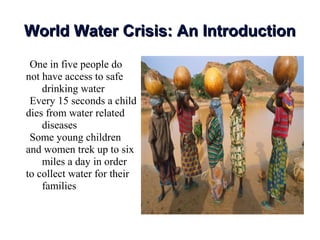
World Water Crisis: An IntroductionWorld Water Crisis: An Introduction
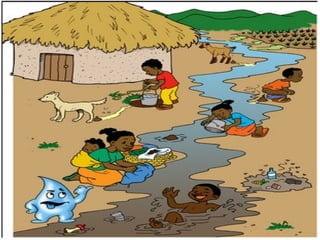
•One in five people do
not have access to safe
drinking water
•Every 15 seconds a child
dies from water related
diseases
•Some young children
and women trek up to six
miles a day in order
to collect water for their
families
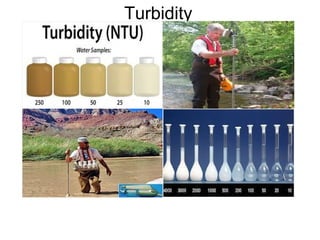
Turbidity
Turbidity
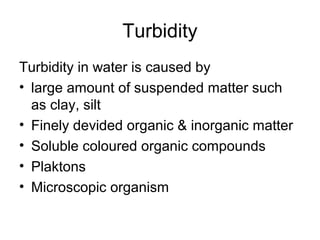
Turbidity in water is caused by
• large amount of suspended matter such
as clay, silt
• Finely devided organic & inorganic matter
• Soluble coloured organic compounds
• Plaktons
• Microscopic organism
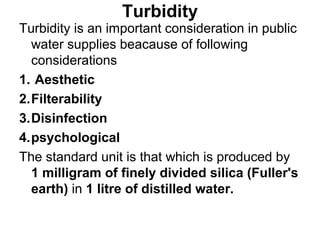
Turbidity
Turbidity is an important consideration in public
water supplies beacause of following
considerations
1. Aesthetic
2.Filterability
3.Disinfection
4.psychological
The standard unit is that which is produced by
1 milligram of finely divided silica (Fuller's
earth) in 1 litre of distilled water.
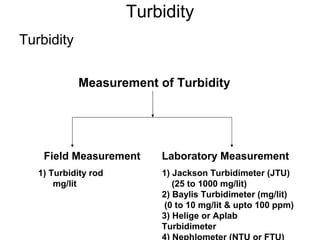
Turbidity
Turbidity
Measurement of Turbidity
Field Measurement Laboratory Measurement
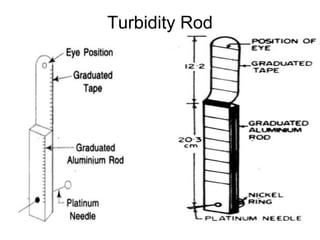
1) Turbidity rod
mg/lit
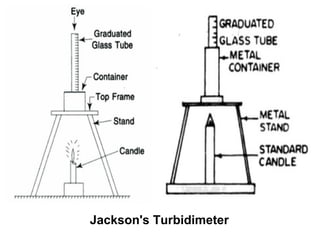
1) Jackson Turbidimeter (JTU)
(25 to 1000 mg/lit)
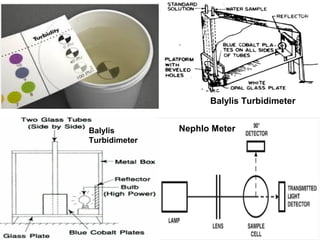
2) Baylis Turbidimeter (mg/lit)
(0 to 10 mg/lit & upto 100 ppm)
3) Helige or Aplab
Turbidimeter
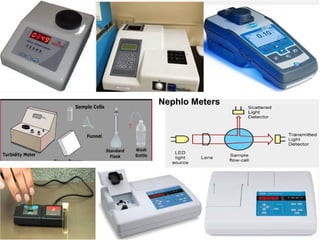
4) Nephlometer (NTU or FTU)
Turbidity Rod
Jackson's Turbidimeter
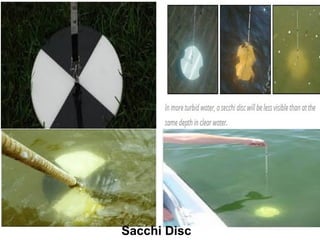
Sacchi Disc
Balylis Turbidimeter
Balylis
Turbidimeter
Nephlo Meter
Nephlo Meters
COLOUR
Colour
Colour may be imparted to water by
• Dossolved organic matter, peat from
decaying vegetation
• Inorganic materials such as coloured soils
• Presence of natural metallic ions (Fe& Mn)
• Weeds, Humus, Plakton
• Industrial waste
• Excessive growth of alge & micro-organisms
Colour
Effects of colour:-
1.Spoil the colour of cloths being washed
2.Aesthetic
3.Psychological
4.Affect various industrial process
The standard unit of colour is that which is
produced by 1 mg of platinum cobalt dissolved
in 1 liter of distilled water
The maximum permissible limit for domestic
supplies should not exceed 20 ppm on
platinum cobalt scale & should be preferably
less than 5-10 ppm & should never exceed
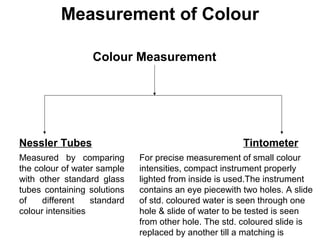
Measurement of Colour
Colour Measurement
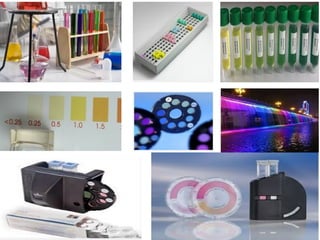
Nessler Tubes Tintometer
Measured by comparing
the colour of water sample
with other standard glass
tubes containing solutions
of different standard
colour intensities
For precise measurement of small colour
intensities, compact instrument properly
lighted from inside is used.The instrument
contains an eye piecewith two holes. A slide
of std. coloured water is seen through one
hole & slide of water to be tested is seen
from other hole. The std. coloured slide is
replaced by another till a matching is
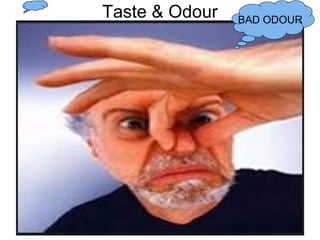
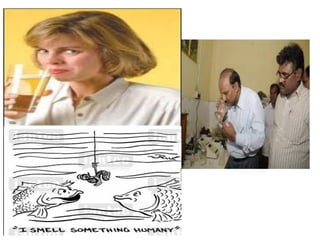
Taste & Odour BAD ODOUR
Taste & Odour
Taste of water:- bitter, salty, sour & sweet
Odour:- unpleasant, earthy, fishy, grassy,
mouldy, peaty & sweetish
Taste & odour are closely related are
generally occured together
• Dissolved organic materials
• Dissolved inorganic salts
• Dissolved gases (H2S, CH4, CO2, O2,etc)
• Mineral substances like NaCl, iron
compounds, carbonates & sulphates of
other elements, phenols & other tarry or
oily matter
Taste & Odour
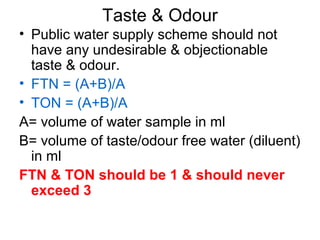
• Public water supply scheme should not
have any undesirable & objectionable
taste & odour.
• FTN = (A+B)/A
• TON = (A+B)/A
A= volume of water sample in ml
B= volume of taste/odour free water (diluent)
in ml
FTN & TON should be 1 & should never
exceed 3
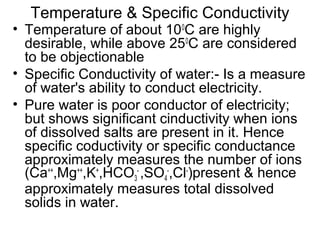
Temperature & Specific Conductivity
• Temperature of about 100
C are highly
desirable, while above 250
C are considered
to be objectionable
• Specific Conductivity of water:- Is a measure
of water's ability to conduct electricity.
• Pure water is poor conductor of electricity;
but shows significant cinductivity when ions
of dissolved salts are present in it. Hence
specific coductivity or specific conductance
approximately measures the number of ions
(Ca++
,Mg++
,K+
,HCO3
-
,SO4
-
,Cl-
)present & hence
approximately measures total dissolved
solids in water.
Specific Conductivity
• Sp. Conductivity is measured by portable
ionic water tester called conductivity
sensor. It measures as to how much
electricity is being conducted through a
centimeter of water. Expressed as
mhos/cm but as per ISO as Siemens/cm
or µS/cm
• Conversion of specific conductivity in to
TDS
• TDS in mg/lit = (Conductivity in µS/cm) X 0.67
• Conductivity factor vary between 0.54 to 0.96
Chemical Characteristic
1) Total Solids & Suspended Solids
2) pH valu of water
3) Hardness of water
4) Chloride Content
5) Nitrogen Content
6) Metals & other Chemical Substances
7) Dissolved Gases
8) Biochemical Oxygen Demand ( BOD )
Total Solids
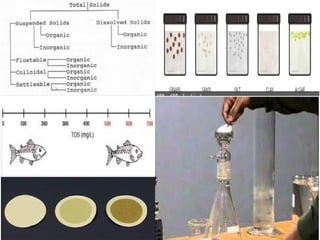
1).Total Solids mg/lit or ppm =
Wt. residue after evaporation (mg) X 1000
Volume of water ( ml)
2).Total dissolved solids in mg/lit or ppm =
Wt.of residue (mg) after evaporating filtered water X 1000
Volume of water ( ml)
3).Suspended solids = Total solids - Total dissolved solids
(mg/lit or ppm) (mg/lit or ppm) (mg/lit or ppm)
4).Suspended solids =
Wt. of residue on filter paper (mg/lit ) X
1000
Volume of water ( ml)
Permissible amount of total solids in water = 500ppm but
1000 ppm are also permitted sometimes.
Hardness
• Hardness in water is that characteristic
which prevents formation of sufficient
leather or foam, when such hard waters
are mixed with soap.
Effects of Hard water
1.Greater soap consumption
2. Scaling of boilers
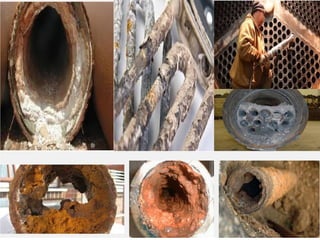
3. Corrosion & incrustation of pipes
4. Making food tasteless, etc
Hardness
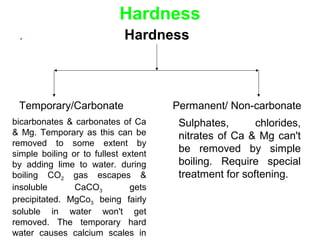
. Hardness
Temporary/Carbonate Permanent/ Non-carbonate
bicarbonates & carbonates of Ca
& Mg. Temporary as this can be
removed to some extent by
simple boiling or to fullest extent
by adding lime to water. during
boiling CO2 gas escapes &
insoluble CaCO3 gets
precipitated. MgCo3 being fairly
soluble in water won't get
removed. The temporary hard
water causes calcium scales in
Sulphates, chlorides,
nitrates of Ca & Mg can't
be removed by simple
boiling. Require special
treatment for softening.
Hardness
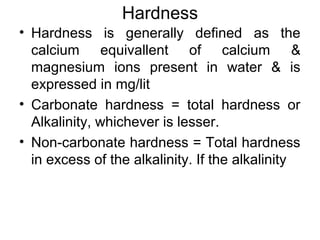
• Hardness is generally defined as the
calcium equivallent of calcium &
magnesium ions present in water & is
expressed in mg/lit
• Carbonate hardness = total hardness or
Alkalinity, whichever is lesser.
• Non-carbonate hardness = Total hardness
in excess of the alkalinity. If the alkalinity
Hardness
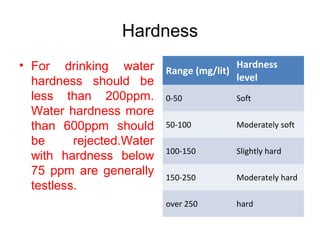
• For drinking water
hardness should be
less than 200ppm.
Water hardness more
than 600ppm should
be rejected.Water
with hardness below
75 ppm are generally
testless.
Range (mg/lit)
Hardness
level
0-50 Soft
50-100 Moderately soft
100-150 Slightly hard
150-250 Moderately hard
over 250 hard
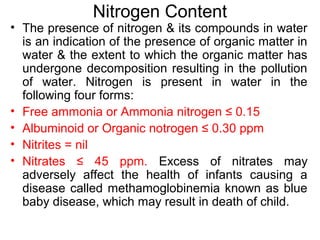
Nitrogen Content
• The presence of nitrogen & its compounds in water
is an indication of the presence of organic matter in
water & the extent to which the organic matter has
undergone decomposition resulting in the pollution
of water. Nitrogen is present in water in the
following four forms:
• Free ammonia or Ammonia nitrogen ≤ 0.15
• Albuminoid or Organic notrogen ≤ 0.30 ppm
• Nitrites = nil
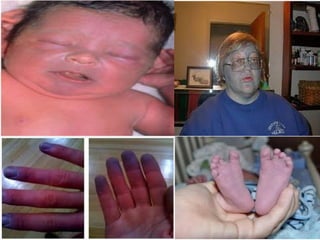
• Nitrates ≤ 45 ppm. Excess of nitrates may
adversely affect the health of infants causing a
disease called methamoglobinemia known as blue
baby disease, which may result in death of child.
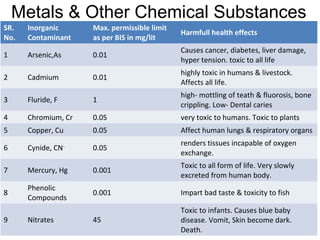
Metals & Other Chemical Substances
SR.
No.
Inorganic
Contaminant
Max. permissible limit
as per BIS in mg/lit
Harmfull health effects
1 Arsenic,As 0.01
Causes cancer, diabetes, liver damage,
hyper tension. toxic to all life
2 Cadmium 0.01
highly toxic in humans & livestock.
Affects all life.
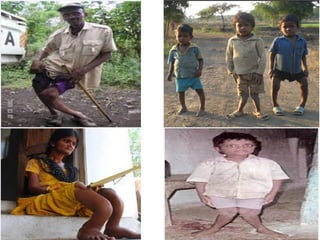
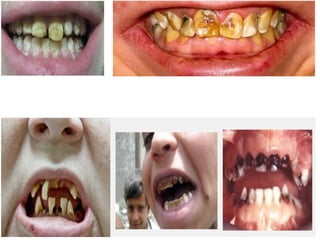
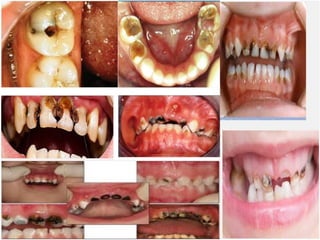
3 Fluride, F 1
high- mottling of teath & fluorosis, bone
crippling. Low- Dental caries
4 Chromium, Cr 0.05 very toxic to humans. Toxic to plants
5 Copper, Cu 0.05 Affect human lungs & respiratory organs
6 Cynide, CN-
0.05
renders tissues incapable of oxygen
exchange.
7 Mercury, Hg 0.001
Toxic to all form of life. Very slowly
excreted from human body.
8
Phenolic
Compounds
0.001 Impart bad taste & toxicity to fish
9 Nitrates 45
Toxic to infants. Causes blue baby
disease. Vomit, Skin become dark.
Death.
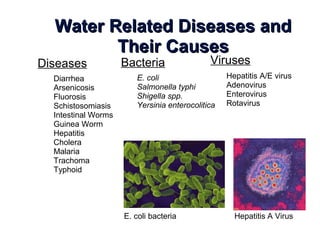
Water Related Diseases andWater Related Diseases and
Their CausesTheir Causes
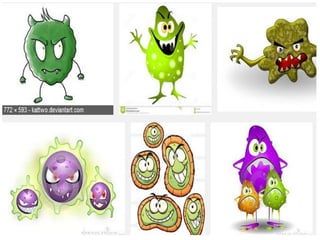
Bacteria
• E. coli
• Salmonella typhi
• Shigella spp.
• Yersinia enterocolitica
Viruses
• Hepatitis A/E virus
• Adenovirus
• Enterovirus
• Rotavirus
E. coli bacteria Hepatitis A Virus
Diseases
• Diarrhea
• Arsenicosis
• Fluorosis
• Schistosomiasis
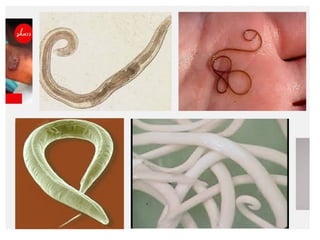
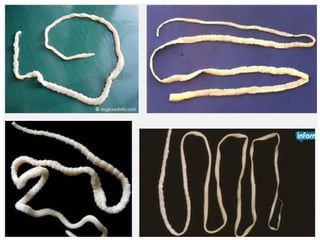
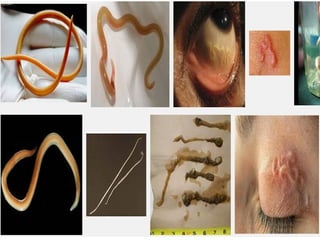
• Intestinal Worms
• Guinea Worm
• Hepatitis
• Cholera
• Malaria
• Trachoma
• Typhoid
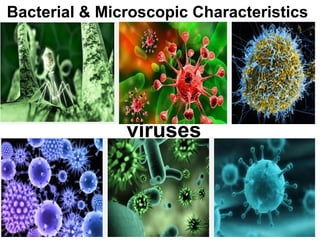
Bacterial & Microscopic Characteristics
viruses
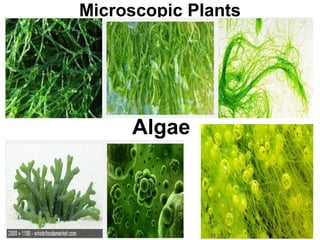
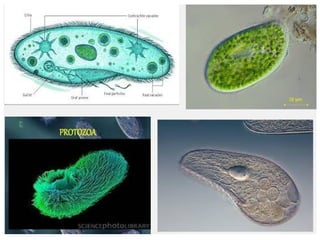
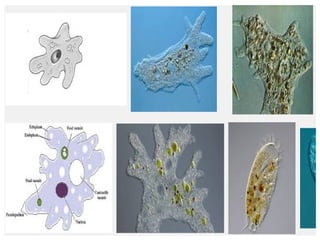
Microscopic Plants
Algae
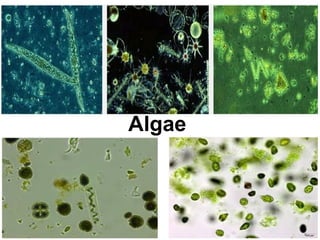
Algae
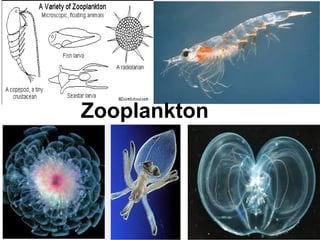
Zooplankton
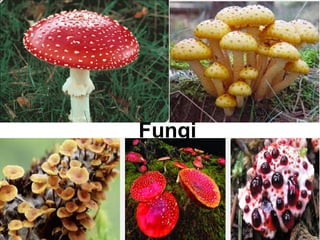
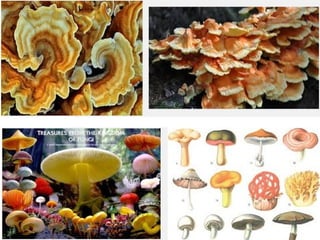
Fungi
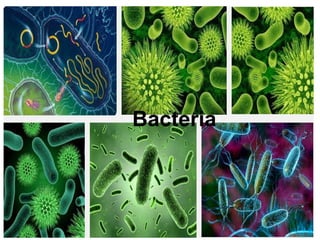
Bacteria
Important Qualities or Requirements of Water for Domestic Use
• Colourless, good to taste, free from odour
& sparkling clear
• free from pathogenic bacteria or
organisms
• soft & free from harmful salts
• sufficient amount of Oxygen & free from
objectionable gases like H2S.
• free from redioactive matter, phenolic
compounds, iodine , excess fluoride &
chlorine
• non-corrosive, free from scale forming
compounds
• Free from heavy metals like arsenic ,lead
& other poisonous metals.
Objects of Water Analysis
• To classify the quality of raw water by
analysing various impurities present,
which helps in the selection of a raw
watersource
• to decide outline of purification process
• determine Chemical & bacteriological
pollution of water
• to determine level of organic impurities
• optimum dose of chemicals to be used for
treatment
• Check & compare with given standards.
• determine nature of matter in suspension.
Collection of samples
Methods
of
Collection
of sample
Grab or
Catch
Sample
Composi-
te
Sample
• Generally 2-5 lit. of sample is required for
analysis. Polythene Sterile bottles are
generally used.
Time for Assignment
Assignment No.4
1) Write a short note on: water borne diseases. (MU- MAY-09,
DEC.-10, DEC.-12)
2) What is E. Coli? Why is their presence tested in water that is
supplied for Domestic consumption. Describe briefly the
procedure followed in Conducting such a test. (MU-DEC.-10)
3) Explain the physical, chemical & biological characteristics of
water. Write the standards for potable water. (MU-DEC.-11)
4) Explain the significance of of the following from point the point
of view of water Quality criteria:
I) Turbidity II) Chlorides III) Nitrates IV) Sulphates V) Iron.
5) What are the common impurities found in natural sources of
water, & explain their effects upon its quality. (MU-MAY-14)

Quality of water - analysis

  • 1.
    Module - 1 QualityOf Water Dhaval S. Shah Asstt. Professor AIKTC
  • 2.
    Contents • Wholesomeness, palatibility,Physical, Chemical, Biological/microscopical constants. Standard units, permissible & desirable values, different measuring instruments/apparatus, BIS standards, etc
  • 20.
    Contents • Wholesomeness, palatibility,Physical, Chemical, Biological/microscopical constants. Standard units, permissible & desirable values, different measuring instruments/apparatus, BIS standards, etc
  • 21.
    World Water Crisis:An IntroductionWorld Water Crisis: An Introduction •One in five people do not have access to safe drinking water •Every 15 seconds a child dies from water related diseases •Some young children and women trek up to six miles a day in order to collect water for their families
  • 22.
  • 23.
    Turbidity Turbidity in wateris caused by • large amount of suspended matter such as clay, silt • Finely devided organic & inorganic matter • Soluble coloured organic compounds • Plaktons • Microscopic organism
  • 24.
    Turbidity Turbidity is animportant consideration in public water supplies beacause of following considerations 1. Aesthetic 2.Filterability 3.Disinfection 4.psychological The standard unit is that which is produced by 1 milligram of finely divided silica (Fuller's earth) in 1 litre of distilled water.
  • 25.
    Turbidity Turbidity Measurement of Turbidity FieldMeasurement Laboratory Measurement 1) Turbidity rod mg/lit 1) Jackson Turbidimeter (JTU) (25 to 1000 mg/lit) 2) Baylis Turbidimeter (mg/lit) (0 to 10 mg/lit & upto 100 ppm) 3) Helige or Aplab Turbidimeter 4) Nephlometer (NTU or FTU)
  • 26.
  • 27.
  • 28.
  • 29.
  • 30.
  • 31.
  • 32.
    Colour Colour may beimparted to water by • Dossolved organic matter, peat from decaying vegetation • Inorganic materials such as coloured soils • Presence of natural metallic ions (Fe& Mn) • Weeds, Humus, Plakton • Industrial waste • Excessive growth of alge & micro-organisms
  • 33.
    Colour Effects of colour:- 1.Spoilthe colour of cloths being washed 2.Aesthetic 3.Psychological 4.Affect various industrial process The standard unit of colour is that which is produced by 1 mg of platinum cobalt dissolved in 1 liter of distilled water The maximum permissible limit for domestic supplies should not exceed 20 ppm on platinum cobalt scale & should be preferably less than 5-10 ppm & should never exceed
  • 34.
    Measurement of Colour ColourMeasurement Nessler Tubes Tintometer Measured by comparing the colour of water sample with other standard glass tubes containing solutions of different standard colour intensities For precise measurement of small colour intensities, compact instrument properly lighted from inside is used.The instrument contains an eye piecewith two holes. A slide of std. coloured water is seen through one hole & slide of water to be tested is seen from other hole. The std. coloured slide is replaced by another till a matching is
  • 36.
    Taste & OdourBAD ODOUR
  • 39.
    Taste & Odour Tasteof water:- bitter, salty, sour & sweet Odour:- unpleasant, earthy, fishy, grassy, mouldy, peaty & sweetish Taste & odour are closely related are generally occured together • Dissolved organic materials • Dissolved inorganic salts • Dissolved gases (H2S, CH4, CO2, O2,etc) • Mineral substances like NaCl, iron compounds, carbonates & sulphates of other elements, phenols & other tarry or oily matter
  • 40.
    Taste & Odour •Public water supply scheme should not have any undesirable & objectionable taste & odour. • FTN = (A+B)/A • TON = (A+B)/A A= volume of water sample in ml B= volume of taste/odour free water (diluent) in ml FTN & TON should be 1 & should never exceed 3
  • 41.
    Temperature & SpecificConductivity • Temperature of about 100 C are highly desirable, while above 250 C are considered to be objectionable • Specific Conductivity of water:- Is a measure of water's ability to conduct electricity. • Pure water is poor conductor of electricity; but shows significant cinductivity when ions of dissolved salts are present in it. Hence specific coductivity or specific conductance approximately measures the number of ions (Ca++ ,Mg++ ,K+ ,HCO3 - ,SO4 - ,Cl- )present & hence approximately measures total dissolved solids in water.
  • 42.
    Specific Conductivity • Sp.Conductivity is measured by portable ionic water tester called conductivity sensor. It measures as to how much electricity is being conducted through a centimeter of water. Expressed as mhos/cm but as per ISO as Siemens/cm or µS/cm • Conversion of specific conductivity in to TDS • TDS in mg/lit = (Conductivity in µS/cm) X 0.67 • Conductivity factor vary between 0.54 to 0.96
  • 43.
    Chemical Characteristic 1) TotalSolids & Suspended Solids 2) pH valu of water 3) Hardness of water 4) Chloride Content 5) Nitrogen Content 6) Metals & other Chemical Substances 7) Dissolved Gases 8) Biochemical Oxygen Demand ( BOD )
  • 44.
    Total Solids 1).Total Solidsmg/lit or ppm = Wt. residue after evaporation (mg) X 1000 Volume of water ( ml) 2).Total dissolved solids in mg/lit or ppm = Wt.of residue (mg) after evaporating filtered water X 1000 Volume of water ( ml) 3).Suspended solids = Total solids - Total dissolved solids (mg/lit or ppm) (mg/lit or ppm) (mg/lit or ppm) 4).Suspended solids = Wt. of residue on filter paper (mg/lit ) X 1000 Volume of water ( ml) Permissible amount of total solids in water = 500ppm but 1000 ppm are also permitted sometimes.
  • 46.
    Hardness • Hardness inwater is that characteristic which prevents formation of sufficient leather or foam, when such hard waters are mixed with soap. Effects of Hard water 1.Greater soap consumption 2. Scaling of boilers 3. Corrosion & incrustation of pipes 4. Making food tasteless, etc
  • 48.
    Hardness . Hardness Temporary/Carbonate Permanent/Non-carbonate bicarbonates & carbonates of Ca & Mg. Temporary as this can be removed to some extent by simple boiling or to fullest extent by adding lime to water. during boiling CO2 gas escapes & insoluble CaCO3 gets precipitated. MgCo3 being fairly soluble in water won't get removed. The temporary hard water causes calcium scales in Sulphates, chlorides, nitrates of Ca & Mg can't be removed by simple boiling. Require special treatment for softening.
  • 49.
    Hardness • Hardness isgenerally defined as the calcium equivallent of calcium & magnesium ions present in water & is expressed in mg/lit • Carbonate hardness = total hardness or Alkalinity, whichever is lesser. • Non-carbonate hardness = Total hardness in excess of the alkalinity. If the alkalinity
  • 50.
    Hardness • For drinkingwater hardness should be less than 200ppm. Water hardness more than 600ppm should be rejected.Water with hardness below 75 ppm are generally testless. Range (mg/lit) Hardness level 0-50 Soft 50-100 Moderately soft 100-150 Slightly hard 150-250 Moderately hard over 250 hard
  • 51.
    Nitrogen Content • Thepresence of nitrogen & its compounds in water is an indication of the presence of organic matter in water & the extent to which the organic matter has undergone decomposition resulting in the pollution of water. Nitrogen is present in water in the following four forms: • Free ammonia or Ammonia nitrogen ≤ 0.15 • Albuminoid or Organic notrogen ≤ 0.30 ppm • Nitrites = nil • Nitrates ≤ 45 ppm. Excess of nitrates may adversely affect the health of infants causing a disease called methamoglobinemia known as blue baby disease, which may result in death of child.
  • 52.
    Metals & OtherChemical Substances SR. No. Inorganic Contaminant Max. permissible limit as per BIS in mg/lit Harmfull health effects 1 Arsenic,As 0.01 Causes cancer, diabetes, liver damage, hyper tension. toxic to all life 2 Cadmium 0.01 highly toxic in humans & livestock. Affects all life. 3 Fluride, F 1 high- mottling of teath & fluorosis, bone crippling. Low- Dental caries 4 Chromium, Cr 0.05 very toxic to humans. Toxic to plants 5 Copper, Cu 0.05 Affect human lungs & respiratory organs 6 Cynide, CN- 0.05 renders tissues incapable of oxygen exchange. 7 Mercury, Hg 0.001 Toxic to all form of life. Very slowly excreted from human body. 8 Phenolic Compounds 0.001 Impart bad taste & toxicity to fish 9 Nitrates 45 Toxic to infants. Causes blue baby disease. Vomit, Skin become dark. Death.
  • 57.
    Water Related DiseasesandWater Related Diseases and Their CausesTheir Causes Bacteria • E. coli • Salmonella typhi • Shigella spp. • Yersinia enterocolitica Viruses • Hepatitis A/E virus • Adenovirus • Enterovirus • Rotavirus E. coli bacteria Hepatitis A Virus Diseases • Diarrhea • Arsenicosis • Fluorosis • Schistosomiasis • Intestinal Worms • Guinea Worm • Hepatitis • Cholera • Malaria • Trachoma • Typhoid
  • 58.
    Bacterial & MicroscopicCharacteristics viruses
  • 59.
  • 60.
  • 61.
  • 62.
  • 65.
  • 71.
    Important Qualities orRequirements of Water for Domestic Use • Colourless, good to taste, free from odour & sparkling clear • free from pathogenic bacteria or organisms • soft & free from harmful salts • sufficient amount of Oxygen & free from objectionable gases like H2S. • free from redioactive matter, phenolic compounds, iodine , excess fluoride & chlorine • non-corrosive, free from scale forming compounds • Free from heavy metals like arsenic ,lead & other poisonous metals.
  • 72.
    Objects of WaterAnalysis • To classify the quality of raw water by analysing various impurities present, which helps in the selection of a raw watersource • to decide outline of purification process • determine Chemical & bacteriological pollution of water • to determine level of organic impurities • optimum dose of chemicals to be used for treatment • Check & compare with given standards. • determine nature of matter in suspension.
  • 73.
    Collection of samples Methods of Collection ofsample Grab or Catch Sample Composi- te Sample • Generally 2-5 lit. of sample is required for analysis. Polythene Sterile bottles are generally used.
  • 81.
  • 82.
    Assignment No.4 1) Writea short note on: water borne diseases. (MU- MAY-09, DEC.-10, DEC.-12) 2) What is E. Coli? Why is their presence tested in water that is supplied for Domestic consumption. Describe briefly the procedure followed in Conducting such a test. (MU-DEC.-10) 3) Explain the physical, chemical & biological characteristics of water. Write the standards for potable water. (MU-DEC.-11) 4) Explain the significance of of the following from point the point of view of water Quality criteria: I) Turbidity II) Chlorides III) Nitrates IV) Sulphates V) Iron. 5) What are the common impurities found in natural sources of water, & explain their effects upon its quality. (MU-MAY-14)