
Guided by: Dr.Laxmikant .L
AWAIS MAHALDAR
REG NO.10M0169
 Water quality is the physical, chemical and
biological characteristics of water
 The vast majority of surface water on the
planet is neither potable (fit for drinking) nor
toxic
 Approximately 25% of the world’s population
has no access to potable water
 Free from pathogenic organisms
 Clear
 Not saline
 Free from offensive taste or smell
 Free from compounds that may have adverse
effect on human health
 Free from chemicals that cause corrosion of
water supply systems
 Contaminants that may be in untreated
water include:
◦ microorganisms (viruses and bacteria)
◦ inorganic contaminants (salts and metals)
◦ pesticides and herbicides
◦ sediments
◦ organic chemical contaminants from industrial
processes and petroleum use
◦ radioactive contaminants.
 Water quality depends on the local geology
and ecosystem, as well as human uses
(sewage dispersion, industrial pollution, use
of water bodies as a heat sink)
 Physical parameters
 Chemical
 Biological
COLOUR:
 May be due to the Presence of organic matter,
metals(iron, manganese) or highly coloured
industrial waste
 Desirable that drinking water be colorless
 The Guideline value is up to 15 true color
units(TCU)
 Mainly due to organic substances, ,Biological
activity, industrial pollution
 Taste buds in the oral cavity specially detect
inorganic compounds of metals like
magnesium, calcium, sodium, copper, iron
and zinc
 Water should be free from objectionable taste
and odour.
 Caused by suspended matter
 High level turbidity shield and protect
bacteria from the action of disinfecting
agents
 Desirable limit-5NTU(Nephlometric turbidity unit)
Should be below 1 NTU when disinfection is
practiced
Permissible limit-10NTU
 It is the measure of hydrogen ion
concentration
 pH<7 cause corrosion of distribution pipes
and elevates the level of lead
 pH>8 cause decrease in efficiency of
chlorination disinfection process
 Desirable limit 6.5-8.5. Beyond this limit the
water will affect the mucous membrane and
water supply system
 Determine types of organisms that can live
in water
 Affects how much oxygen water can hold
◦ Warm water holds less oxygen
 Thermal Pollution (increased water
temperature)
◦ decreasing oxygen supply
◦ killing fish juveniles which are vulnerable to small
increases in temperature
◦ affecting ecosystem composition.
CHLORIDES
 Causes
o Dissolution of salt deposit
o Discharge of effluents
o Intrusion of sea water
 Acceptable limit - 250 mg/litre
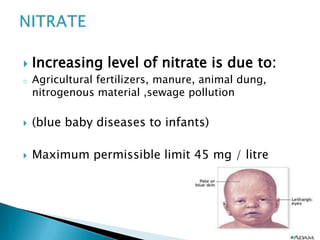
 Increasing level of nitrate is due to:
o Agricultural fertilizers, manure, animal dung,
nitrogenous material ,sewage pollution
 (blue baby diseases to infants)
 Maximum permissible limit 45 mg / litre
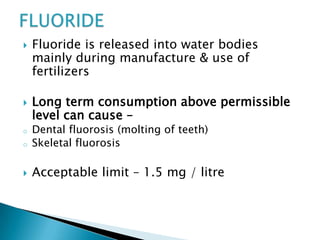
 Fluoride is released into water bodies
mainly during manufacture & use of
fertilizers
 Long term consumption above permissible
level can cause –
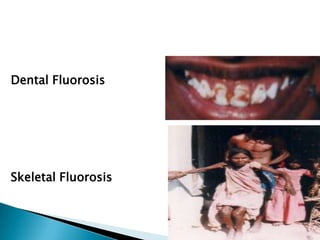
o Dental fluorosis (molting of teeth)
o Skeletal fluorosis
 Acceptable limit – 1.5 mg / litre
Dental Fluorosis
Skeletal Fluorosis
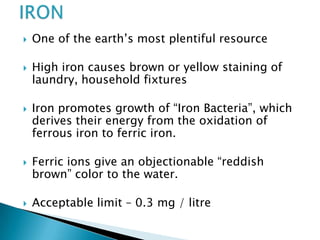
 One of the earth’s most plentiful resource
 High iron causes brown or yellow staining of
laundry, household fixtures
 Iron promotes growth of “Iron Bacteria”, which
derives their energy from the oxidation of
ferrous iron to ferric iron.
 Ferric ions give an objectionable “reddish
brown” color to the water.
 Acceptable limit – 0.3 mg / litre
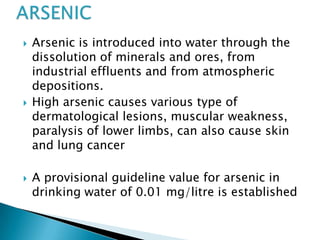
 Arsenic is introduced into water through the
dissolution of minerals and ores, from
industrial effluents and from atmospheric
depositions.
 High arsenic causes various type of
dermatological lesions, muscular weakness,
paralysis of lower limbs, can also cause skin
and lung cancer
 A provisional guideline value for arsenic in
drinking water of 0.01 mg/litre is established
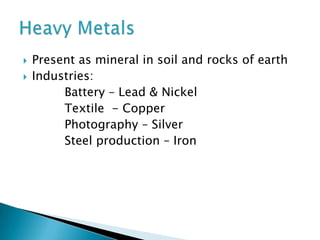
 Present as mineral in soil and rocks of earth
 Industries:
Battery – Lead & Nickel
Textile - Copper
Photography – Silver
Steel production – Iron
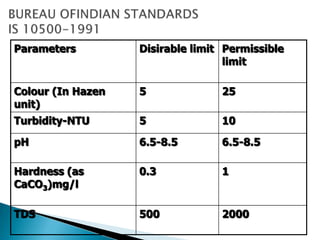
Parameters Disirable limit Permissible
limit
Colour (In Hazen
unit)
5 25
Turbidity-NTU 5 10
pH 6.5-8.5 6.5-8.5
Hardness (as
CaCO3)mg/l
0.3 1
TDS 500 2000
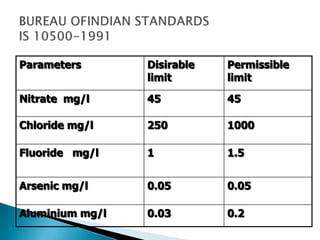
Parameters Disirable
limit
Permissible
limit
Nitrate mg/l 45 45
Chloride mg/l 250 1000
Fluoride mg/l 1 1.5
Arsenic mg/l 0.05 0.05
Aluminium mg/l 0.03 0.2
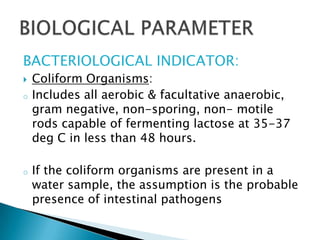
BACTERIOLOGICAL INDICATOR:
 Coliform Organisms:
o Includes all aerobic & facultative anaerobic,
gram negative, non-sporing, non- motile
rods capable of fermenting lactose at 35-37
deg C in less than 48 hours.
o If the coliform organisms are present in a
water sample, the assumption is the probable
presence of intestinal pathogens
 Faecal streptococci:
o Finding of faecal streptococci in water is
regarded as important confirmatory evidence of
recent faecal pollution of water
 Clostridium perfringes:
o The presence of spores of Cl.perfringes in a
natural water suggests that faecal contamination
has occurred, and their presence, in the absence
of coliform group, suggests that faecal
contamination has occurred at remote time.
 Species of protozoa known to have been
transmitted by the ingestion of contaminated
drinking water include Entamoeba histolytica,
Giardia spp. And rarely, Balantandium coli.
 These organisms can be introduced into
water supply by human or animal faecal
contamination
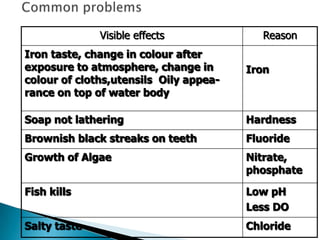
Visible effects Reason
Iron taste, change in colour after
exposure to atmosphere, change in
colour of cloths,utensils Oily appea-
rance on top of water body
Iron
Soap not lathering Hardness
Brownish black streaks on teeth Fluoride
Growth of Algae Nitrate,
phosphate
Fish kills Low pH
Less DO
Salty taste Chloride
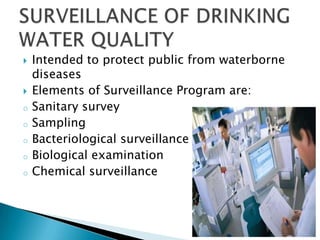
 Intended to protect public from waterborne
diseases
 Elements of Surveillance Program are:
o Sanitary survey
o Sampling
o Bacteriological surveillance
o Biological examination
o Chemical surveillance
 On the spot inspection & evaluation by a
qualified person of entire water supply
 Purpose – detection & correction of faults
&deficiencies.
 It is essential for adequate interpretation of
laboratory results
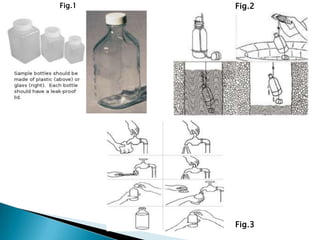
 Samples for physical & chemical examination:
o Collected in a clean glass stoppered bottle made of neutral glass of
capacity not less than 2 litres
 Samples for bacteriological examination:
o Collected in clean sterilized 200-250ml bottle made of neutral
glass provided with a ground glass stopper having an overlapping
rim
o When samples is to be collected from a TAP in regular use , the
water is first run to waste for 2 min & then water is collected
o In case of TAPS not in regular use, it is first sterilized with a blow
lamp or with an ignited piece of cotton soaked in methylated spirit
o For collecting samples directly from rivers, lakes, tanks
etc. a bottle with a string attached to the neck which is
fully wrapped in paper and sterilized should be used.
 TRANSPORT AND STORAGE OF SAMPLES
o Where immediate commencement of examination is not
feasible samples should be kept in ice until it is taken for
analysis
o Particulars regarding the date and time of collection and
dispatch, source of water, particulars of recent rainfall and
findings of the sanitary survey should be also be supplied
with the sample.
Fig.1 Fig.2
Fig.3
 Presumptive Coliform test:
 Multiple tube method:
o Based on estimating most probable number(MPN) of
coliform organisms in 100ml of water.
o The test is carried out by inoculating measured
quantities of the sample water(0.1,1.0,10,50ml)onto
tubes of McConkey`s Lactose Bile Salt Broth with
bromcresol purple as an indicator.
o The tubes are incubated for 48 hours. From the
number of tubes showing acid and gas, an estimate
of the MPN obtained from statistical table
 Membrane filtration technique:
o Measured Vol. of the sample is filtered through a
membrane specially made of cellulose ester.
o All bacteria present in water are retained on the surface of
membrane and by inoculating the membrane face upwards
on suitable media, it is possible to count the colonies
 COLONY COUNT:
o Colony counts on nutrient agar at 37 deg C and 22 deg C
are frequently used in bacteriological examination of water
o Colony count provide an estimate of general bacterial
purity of water.
 “Planktons” produce objectionable tastes & odours in
water.
 Degree of pollution is assessed qualitatively &
quantitatively by noting the type & number of organisms
prevailing in water
CHEMICAL EXAMINATION:
 Basic tests for pH, turbidity, chlorides, ammonia etc are
performed
 Complete chemical analysis would also include analysis for
toxic metals, pesticide, persistent organic chemicals and
radioactivity.
 TEXTBOOK OF PREVENTIVE AND SOCIAL
MEDICINE(22nd edition)- K.PARK
 WATER QUALITY PARAMETERS-
ABDUNNASAR,UK
 WATER QUALITY-JAMES M.EBELING
 INTERNET:
 WIKIPEDIA
 www.authorstream.com
 www.slideshare.com
Water quality- Awais

Water quality- Awais

  • 1.
    Guided by: Dr.Laxmikant.L AWAIS MAHALDAR REG NO.10M0169
  • 2.
     Water qualityis the physical, chemical and biological characteristics of water  The vast majority of surface water on the planet is neither potable (fit for drinking) nor toxic  Approximately 25% of the world’s population has no access to potable water
  • 3.
     Free frompathogenic organisms  Clear  Not saline  Free from offensive taste or smell  Free from compounds that may have adverse effect on human health  Free from chemicals that cause corrosion of water supply systems
  • 4.
     Contaminants thatmay be in untreated water include: ◦ microorganisms (viruses and bacteria) ◦ inorganic contaminants (salts and metals) ◦ pesticides and herbicides ◦ sediments ◦ organic chemical contaminants from industrial processes and petroleum use ◦ radioactive contaminants.  Water quality depends on the local geology and ecosystem, as well as human uses (sewage dispersion, industrial pollution, use of water bodies as a heat sink)
  • 5.
     Physical parameters Chemical  Biological
  • 6.
    COLOUR:  May bedue to the Presence of organic matter, metals(iron, manganese) or highly coloured industrial waste  Desirable that drinking water be colorless  The Guideline value is up to 15 true color units(TCU)
  • 7.
     Mainly dueto organic substances, ,Biological activity, industrial pollution  Taste buds in the oral cavity specially detect inorganic compounds of metals like magnesium, calcium, sodium, copper, iron and zinc  Water should be free from objectionable taste and odour.
  • 8.
     Caused bysuspended matter  High level turbidity shield and protect bacteria from the action of disinfecting agents  Desirable limit-5NTU(Nephlometric turbidity unit) Should be below 1 NTU when disinfection is practiced Permissible limit-10NTU
  • 9.
     It isthe measure of hydrogen ion concentration  pH<7 cause corrosion of distribution pipes and elevates the level of lead  pH>8 cause decrease in efficiency of chlorination disinfection process  Desirable limit 6.5-8.5. Beyond this limit the water will affect the mucous membrane and water supply system
  • 10.
     Determine typesof organisms that can live in water  Affects how much oxygen water can hold ◦ Warm water holds less oxygen  Thermal Pollution (increased water temperature) ◦ decreasing oxygen supply ◦ killing fish juveniles which are vulnerable to small increases in temperature ◦ affecting ecosystem composition.
  • 11.
    CHLORIDES  Causes o Dissolutionof salt deposit o Discharge of effluents o Intrusion of sea water  Acceptable limit - 250 mg/litre
  • 12.
     Increasing levelof nitrate is due to: o Agricultural fertilizers, manure, animal dung, nitrogenous material ,sewage pollution  (blue baby diseases to infants)  Maximum permissible limit 45 mg / litre
  • 13.
     Fluoride isreleased into water bodies mainly during manufacture & use of fertilizers  Long term consumption above permissible level can cause – o Dental fluorosis (molting of teeth) o Skeletal fluorosis  Acceptable limit – 1.5 mg / litre
  • 14.
  • 15.
     One ofthe earth’s most plentiful resource  High iron causes brown or yellow staining of laundry, household fixtures  Iron promotes growth of “Iron Bacteria”, which derives their energy from the oxidation of ferrous iron to ferric iron.  Ferric ions give an objectionable “reddish brown” color to the water.  Acceptable limit – 0.3 mg / litre
  • 16.
     Arsenic isintroduced into water through the dissolution of minerals and ores, from industrial effluents and from atmospheric depositions.  High arsenic causes various type of dermatological lesions, muscular weakness, paralysis of lower limbs, can also cause skin and lung cancer  A provisional guideline value for arsenic in drinking water of 0.01 mg/litre is established
  • 17.
     Present asmineral in soil and rocks of earth  Industries: Battery – Lead & Nickel Textile - Copper Photography – Silver Steel production – Iron
  • 18.
    Parameters Disirable limitPermissible limit Colour (In Hazen unit) 5 25 Turbidity-NTU 5 10 pH 6.5-8.5 6.5-8.5 Hardness (as CaCO3)mg/l 0.3 1 TDS 500 2000
  • 19.
    Parameters Disirable limit Permissible limit Nitrate mg/l45 45 Chloride mg/l 250 1000 Fluoride mg/l 1 1.5 Arsenic mg/l 0.05 0.05 Aluminium mg/l 0.03 0.2
  • 20.
    BACTERIOLOGICAL INDICATOR:  ColiformOrganisms: o Includes all aerobic & facultative anaerobic, gram negative, non-sporing, non- motile rods capable of fermenting lactose at 35-37 deg C in less than 48 hours. o If the coliform organisms are present in a water sample, the assumption is the probable presence of intestinal pathogens
  • 21.
     Faecal streptococci: oFinding of faecal streptococci in water is regarded as important confirmatory evidence of recent faecal pollution of water  Clostridium perfringes: o The presence of spores of Cl.perfringes in a natural water suggests that faecal contamination has occurred, and their presence, in the absence of coliform group, suggests that faecal contamination has occurred at remote time.
  • 22.
     Species ofprotozoa known to have been transmitted by the ingestion of contaminated drinking water include Entamoeba histolytica, Giardia spp. And rarely, Balantandium coli.  These organisms can be introduced into water supply by human or animal faecal contamination
  • 23.
    Visible effects Reason Irontaste, change in colour after exposure to atmosphere, change in colour of cloths,utensils Oily appea- rance on top of water body Iron Soap not lathering Hardness Brownish black streaks on teeth Fluoride Growth of Algae Nitrate, phosphate Fish kills Low pH Less DO Salty taste Chloride
  • 24.
     Intended toprotect public from waterborne diseases  Elements of Surveillance Program are: o Sanitary survey o Sampling o Bacteriological surveillance o Biological examination o Chemical surveillance
  • 25.
     On thespot inspection & evaluation by a qualified person of entire water supply  Purpose – detection & correction of faults &deficiencies.  It is essential for adequate interpretation of laboratory results
  • 26.
     Samples forphysical & chemical examination: o Collected in a clean glass stoppered bottle made of neutral glass of capacity not less than 2 litres  Samples for bacteriological examination: o Collected in clean sterilized 200-250ml bottle made of neutral glass provided with a ground glass stopper having an overlapping rim o When samples is to be collected from a TAP in regular use , the water is first run to waste for 2 min & then water is collected o In case of TAPS not in regular use, it is first sterilized with a blow lamp or with an ignited piece of cotton soaked in methylated spirit
  • 27.
    o For collectingsamples directly from rivers, lakes, tanks etc. a bottle with a string attached to the neck which is fully wrapped in paper and sterilized should be used.  TRANSPORT AND STORAGE OF SAMPLES o Where immediate commencement of examination is not feasible samples should be kept in ice until it is taken for analysis o Particulars regarding the date and time of collection and dispatch, source of water, particulars of recent rainfall and findings of the sanitary survey should be also be supplied with the sample.
  • 28.
  • 29.
     Presumptive Coliformtest:  Multiple tube method: o Based on estimating most probable number(MPN) of coliform organisms in 100ml of water. o The test is carried out by inoculating measured quantities of the sample water(0.1,1.0,10,50ml)onto tubes of McConkey`s Lactose Bile Salt Broth with bromcresol purple as an indicator. o The tubes are incubated for 48 hours. From the number of tubes showing acid and gas, an estimate of the MPN obtained from statistical table
  • 30.
     Membrane filtrationtechnique: o Measured Vol. of the sample is filtered through a membrane specially made of cellulose ester. o All bacteria present in water are retained on the surface of membrane and by inoculating the membrane face upwards on suitable media, it is possible to count the colonies  COLONY COUNT: o Colony counts on nutrient agar at 37 deg C and 22 deg C are frequently used in bacteriological examination of water o Colony count provide an estimate of general bacterial purity of water.
  • 31.
     “Planktons” produceobjectionable tastes & odours in water.  Degree of pollution is assessed qualitatively & quantitatively by noting the type & number of organisms prevailing in water CHEMICAL EXAMINATION:  Basic tests for pH, turbidity, chlorides, ammonia etc are performed  Complete chemical analysis would also include analysis for toxic metals, pesticide, persistent organic chemicals and radioactivity.
  • 32.
     TEXTBOOK OFPREVENTIVE AND SOCIAL MEDICINE(22nd edition)- K.PARK  WATER QUALITY PARAMETERS- ABDUNNASAR,UK  WATER QUALITY-JAMES M.EBELING  INTERNET:  WIKIPEDIA  www.authorstream.com  www.slideshare.com