WATER QUALITYWATER QUALITY
PARAMETERSPARAMETERS
By
Prof.A. Balasubramanian
Centre for Advanced Studies in Earth Science
University of Mysore, India
Importance of Water:Importance of Water:
Water is an essential commodity
to all life
Without water, there can be no
life.
Every living thing--plants, animals,
and people--must have water to
live.
Water is used in almost all
activities of life support systems
Water is a major abiotic factor in
the environment
Natural water:Natural water:
The endless circulation of water
between atmosphere, lithosphere,
hydrosphere and biosphere is
known as hydrologic cycle.
We get water from Precipitation of
water vapor in the atmosphere
World’s Water Distribution:World’s Water Distribution:
Earth has tremendous amount of
water
Three fourth’s of the earth surface is
covered by water
97% of World’s water is in the seas and
oceans. This water is saline.
Only 3% is present on the continents.
This water is fresh.
The distribution of water over land is
uneven.
Water is everywhere:Water is everywhere:
Water is a common substance.
It fills the oceans, rivers, and
lakes.
It is in the ground and also in
the air we breathe.
Water is used for drinking, all
domestic purposes, agriculture,
industrial applications, cleaning
and recreation.
Quality determines its Usage:Quality determines its Usage:
Water has its own taste, color,
smell and constituents.
Not all water can be used for all
purposes.
Eg. Sea water can not be used
by us for drinking.
The suitability of water for
different purposes is
determined by its quality
parameters.
Quantity and quality:Quantity and quality:
On an average, each person in a
developed country uses about
260 litres of water a day in the
home.
The Quality of water is equally
important than quantity.
Even if present in huge
amounts, we can not use salt
water in many life support
activities.
Characteristics ofCharacteristics of
Water:Water:
Water is a good solvent
Water never occurs in its pure
form
All waters contain some dissolved
substances
The quality of water is determined
by these substances.
It has the ability to dissolve many
inorganic and organic substances.
Water Quality Parameters:Water Quality Parameters:
Water has its own
Physical properties
Chemical composition and
Biological Properties
Physical Properties:Physical Properties:
Temperature
Colour
Odor
Turbidity
Electrical Conductivity
Temperature (T) of Water:Temperature (T) of Water:
Essential for all environmental
studies
Controls many ecological
processes including chemical
reactions.
T of surface water varies from
space and time
T of groundwater varies not only
with reference to space and time
but also with reference to depth.
Temperature of Water:Temperature of Water:
Measured using Thermometers
It ranges from 0 to 100 degree Celsius
Unit of measurement is degree
Celsius
The temperature of Surface water is
influenced by the atmospheric
conditions
The temperature of groundwater is
controlled by the thermal
characteristics of bedrocks and the
depth.
Color of water:Color of water:
The color of water is due to the
suspended particles and organic
matter
Ranges form light to dark
brown
Brownish color in water comes
due to the presence of iron
Greenish color in pond water is
seen due to the presence of
organic substances including
algae
OdorOdor::
Pure water is odorless
When water dissolves other
substances, the odor is
determined by them
Mostly decayed organic
substances give fouling smell
Inorganic substances give earthy
smell
Turbidity:Turbidity:
Muddiness in water
Comes due to suspended
particles from clay, silt and
organic matter
Controls the transparency of
water
Transparency is measured using
Secchi Disc
Water Turbidity is measured
using Nephelometer
Electrical Conductivity(EC):Electrical Conductivity(EC):
Ability of a substance to conduct an
electrical current.
The presence of charged ionic
species makes water conductive.
It is measured using EC meters.
Directly related to temperature of
water.
Unit of measurement is mmhos/cm
at std temperatures. Ranges from
100-1,00,000
Pure water is less conductive
Chemical properties:Chemical properties:
pH
Total Dissolved Solids(TDS)
Major ions
Minor or trace elements
Hardness
Salinity
Alkalinity
pH of water:pH of water:
Refers to the effective
concentration of hydrogen ions in
water
It ranges from 0 to 14. Measured
using pH meters
Water is said to be acidic( less than
7)
or alkaline ( above 7) depending on
the relative concentration of
hydrogen ions from the neutral
value which is 7.
Total DissolvedTotal Dissolved
Solids(TDS):Solids(TDS):
Concentration of non-volatile
substances present in colloidal or
molecular state
Total of all ions present in water,
expressed in ppm or mg/L
Increases due to dissolution of more
mineral substances by water on its
path
TDS determines the suitability of
water for our use and consumption.
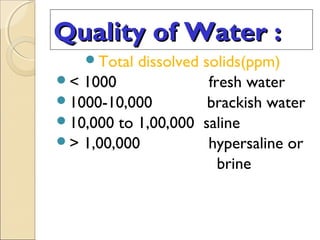
Quality of Water :Quality of Water :
Total dissolved solids(ppm)
< 1000 fresh water
1000-10,000 brackish water
10,000 to 1,00,000 saline
> 1,00,000 hypersaline or
brine
Classification of DissolvedClassification of Dissolved
constituents:constituents:
Basis of concentrations-
mg/L
Charges( positive or
negative)
Level of Toxicity ( toxic or
non-toxic)
Based on Concentrations:Based on Concentrations:
Major ions( > 10 mg/L)
◦ Mostly Bicarbonate, calcium, Magnesium,
Chloride, sodium, sulphate and silicon
Minor ions ( 0.1-10 mg/L)
◦ Mostly Carbonate, fluoride, nitrate, potassium,
iron, strontium, boron.
Trace elements( < 0.1 mg/L)
◦ Mostly Aluminium, Arsenic, Barium, Bromide,
Cadmium, Chromium, Cobalt, Copper, Lead,
Zinc, Nickel, Phosphate, Silver, Tin and
Vanadium.
Based on ionic Charges:Based on ionic Charges:
Major ions
Positively charged = Cations
Negatively charged = anions
Major Cations in water:Major Cations in water:
Calcium
Magnesium
Sodium
Potassium
( Source: lithosphere)
Major Anions in Water:Major Anions in Water:
Bicarbonate
Carbonate
Chloride
Sulphate
Nitrate
Phosphate
Trace elements in water:Trace elements in water:
Play a significant role in the use
of water
Some are essential elements for
health & growth
Some are injurious to health
and toxic also.
Deficiency or excess intake of
some of these elements may
cause serious health problems
to life.
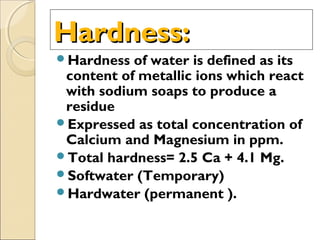
Hardness:Hardness:
Hardness of water is defined as its
content of metallic ions which react
with sodium soaps to produce a
residue
Expressed as total concentration of
Calcium and Magnesium in ppm.
Total hardness= 2.5 Ca + 4.1 Mg.
Softwater (Temporary)
Hardwater (permanent ).
Salinity of Water:Salinity of Water:
Comes due to sodium
and chloride
Sea water contains
35,000 ppm or mg/L of
dissolved salts
Alkalinity of water:Alkalinity of water:
Combined effect of Bicarbonates
and Carbonates with calcium
ions
It has a direct relationships with
pH.
Carbonates will be noticeable
for water having a pH of more
than 8.2
Biological Properties:Biological Properties:
Dissolved Oxygen (DO)
Biochemical Oxygen
Demand(BOD)
Chemical oxygen
Demand(COD)
Microorganisms-Bacterial
counts
Dissolved Oxygen(DO):Dissolved Oxygen(DO):
Is related to the solubility of air in water
at 0 deg. C
Solubility of oxygen in water decreases
with high temperatures
Important property for aquatic
organisms
Surface water bodies should have enough
DO
If DO depletes, it will be difficult to many
aquatic organisms for their survival.
Biochemical OxygenBiochemical Oxygen
Demand(BOD):Demand(BOD):
Is a measure of the biodegradable
material
It is determined by incubating a water
sample and measuring the decrease in
dissolved oxygen as bacteria decompose
these materials.
Chemical OxygenChemical Oxygen
Demand(COD):Demand(COD):
Is determined by chemical
oxidation of water with
dichromate
Water Quality Parameters:Water Quality Parameters:
Limits the suitability of water
for different purposes
Drinking
Domestic consumption
Agriculture
Industrial Processes
Cleaning and Recreation.
Water QualityWater Quality
StandardsStandards
Permissible limits
United States Public Health Drinking
Water Standards(USPH)
Indian Standards Institution (ISI)
World Health Organization (WHO)
Thank You

Water quality parameters

  • 1.
    WATER QUALITYWATER QUALITY PARAMETERSPARAMETERS By Prof.A.Balasubramanian Centre for Advanced Studies in Earth Science University of Mysore, India
  • 2.
    Importance of Water:Importanceof Water: Water is an essential commodity to all life Without water, there can be no life. Every living thing--plants, animals, and people--must have water to live. Water is used in almost all activities of life support systems Water is a major abiotic factor in the environment
  • 3.
    Natural water:Natural water: Theendless circulation of water between atmosphere, lithosphere, hydrosphere and biosphere is known as hydrologic cycle. We get water from Precipitation of water vapor in the atmosphere
  • 4.
    World’s Water Distribution:World’sWater Distribution: Earth has tremendous amount of water Three fourth’s of the earth surface is covered by water 97% of World’s water is in the seas and oceans. This water is saline. Only 3% is present on the continents. This water is fresh. The distribution of water over land is uneven.
  • 5.
    Water is everywhere:Wateris everywhere: Water is a common substance. It fills the oceans, rivers, and lakes. It is in the ground and also in the air we breathe. Water is used for drinking, all domestic purposes, agriculture, industrial applications, cleaning and recreation.
  • 6.
    Quality determines itsUsage:Quality determines its Usage: Water has its own taste, color, smell and constituents. Not all water can be used for all purposes. Eg. Sea water can not be used by us for drinking. The suitability of water for different purposes is determined by its quality parameters.
  • 7.
    Quantity and quality:Quantityand quality: On an average, each person in a developed country uses about 260 litres of water a day in the home. The Quality of water is equally important than quantity. Even if present in huge amounts, we can not use salt water in many life support activities.
  • 8.
    Characteristics ofCharacteristics of Water:Water: Wateris a good solvent Water never occurs in its pure form All waters contain some dissolved substances The quality of water is determined by these substances. It has the ability to dissolve many inorganic and organic substances.
  • 9.
    Water Quality Parameters:WaterQuality Parameters: Water has its own Physical properties Chemical composition and Biological Properties
  • 10.
  • 11.
    Temperature (T) ofWater:Temperature (T) of Water: Essential for all environmental studies Controls many ecological processes including chemical reactions. T of surface water varies from space and time T of groundwater varies not only with reference to space and time but also with reference to depth.
  • 12.
    Temperature of Water:Temperatureof Water: Measured using Thermometers It ranges from 0 to 100 degree Celsius Unit of measurement is degree Celsius The temperature of Surface water is influenced by the atmospheric conditions The temperature of groundwater is controlled by the thermal characteristics of bedrocks and the depth.
  • 13.
    Color of water:Colorof water: The color of water is due to the suspended particles and organic matter Ranges form light to dark brown Brownish color in water comes due to the presence of iron Greenish color in pond water is seen due to the presence of organic substances including algae
  • 14.
    OdorOdor:: Pure water isodorless When water dissolves other substances, the odor is determined by them Mostly decayed organic substances give fouling smell Inorganic substances give earthy smell
  • 15.
    Turbidity:Turbidity: Muddiness in water Comesdue to suspended particles from clay, silt and organic matter Controls the transparency of water Transparency is measured using Secchi Disc Water Turbidity is measured using Nephelometer
  • 16.
    Electrical Conductivity(EC):Electrical Conductivity(EC): Abilityof a substance to conduct an electrical current. The presence of charged ionic species makes water conductive. It is measured using EC meters. Directly related to temperature of water. Unit of measurement is mmhos/cm at std temperatures. Ranges from 100-1,00,000 Pure water is less conductive
  • 17.
    Chemical properties:Chemical properties: pH TotalDissolved Solids(TDS) Major ions Minor or trace elements Hardness Salinity Alkalinity
  • 18.
    pH of water:pHof water: Refers to the effective concentration of hydrogen ions in water It ranges from 0 to 14. Measured using pH meters Water is said to be acidic( less than 7) or alkaline ( above 7) depending on the relative concentration of hydrogen ions from the neutral value which is 7.
  • 19.
    Total DissolvedTotal Dissolved Solids(TDS):Solids(TDS): Concentrationof non-volatile substances present in colloidal or molecular state Total of all ions present in water, expressed in ppm or mg/L Increases due to dissolution of more mineral substances by water on its path TDS determines the suitability of water for our use and consumption.
  • 20.
    Quality of Water:Quality of Water : Total dissolved solids(ppm) < 1000 fresh water 1000-10,000 brackish water 10,000 to 1,00,000 saline > 1,00,000 hypersaline or brine
  • 21.
    Classification of DissolvedClassificationof Dissolved constituents:constituents: Basis of concentrations- mg/L Charges( positive or negative) Level of Toxicity ( toxic or non-toxic)
  • 22.
    Based on Concentrations:Basedon Concentrations: Major ions( > 10 mg/L) ◦ Mostly Bicarbonate, calcium, Magnesium, Chloride, sodium, sulphate and silicon Minor ions ( 0.1-10 mg/L) ◦ Mostly Carbonate, fluoride, nitrate, potassium, iron, strontium, boron. Trace elements( < 0.1 mg/L) ◦ Mostly Aluminium, Arsenic, Barium, Bromide, Cadmium, Chromium, Cobalt, Copper, Lead, Zinc, Nickel, Phosphate, Silver, Tin and Vanadium.
  • 23.
    Based on ionicCharges:Based on ionic Charges: Major ions Positively charged = Cations Negatively charged = anions
  • 24.
    Major Cations inwater:Major Cations in water: Calcium Magnesium Sodium Potassium ( Source: lithosphere)
  • 25.
    Major Anions inWater:Major Anions in Water: Bicarbonate Carbonate Chloride Sulphate Nitrate Phosphate
  • 26.
    Trace elements inwater:Trace elements in water: Play a significant role in the use of water Some are essential elements for health & growth Some are injurious to health and toxic also. Deficiency or excess intake of some of these elements may cause serious health problems to life.
  • 27.
    Hardness:Hardness: Hardness of wateris defined as its content of metallic ions which react with sodium soaps to produce a residue Expressed as total concentration of Calcium and Magnesium in ppm. Total hardness= 2.5 Ca + 4.1 Mg. Softwater (Temporary) Hardwater (permanent ).
  • 28.
    Salinity of Water:Salinityof Water: Comes due to sodium and chloride Sea water contains 35,000 ppm or mg/L of dissolved salts
  • 29.
    Alkalinity of water:Alkalinityof water: Combined effect of Bicarbonates and Carbonates with calcium ions It has a direct relationships with pH. Carbonates will be noticeable for water having a pH of more than 8.2
  • 30.
    Biological Properties:Biological Properties: DissolvedOxygen (DO) Biochemical Oxygen Demand(BOD) Chemical oxygen Demand(COD) Microorganisms-Bacterial counts
  • 31.
    Dissolved Oxygen(DO):Dissolved Oxygen(DO): Isrelated to the solubility of air in water at 0 deg. C Solubility of oxygen in water decreases with high temperatures Important property for aquatic organisms Surface water bodies should have enough DO If DO depletes, it will be difficult to many aquatic organisms for their survival.
  • 32.
    Biochemical OxygenBiochemical Oxygen Demand(BOD):Demand(BOD): Isa measure of the biodegradable material It is determined by incubating a water sample and measuring the decrease in dissolved oxygen as bacteria decompose these materials.
  • 33.
    Chemical OxygenChemical Oxygen Demand(COD):Demand(COD): Isdetermined by chemical oxidation of water with dichromate
  • 34.
    Water Quality Parameters:WaterQuality Parameters: Limits the suitability of water for different purposes Drinking Domestic consumption Agriculture Industrial Processes Cleaning and Recreation.
  • 35.
    Water QualityWater Quality StandardsStandards Permissiblelimits United States Public Health Drinking Water Standards(USPH) Indian Standards Institution (ISI) World Health Organization (WHO)
  • 36.