WASTE WATER SAMPLING
AND ANALYSIS
SUBMITTED TO
Dr. POONAM SYAL
Associate Prof.
EE Dept. NITTTR CHD
SUBMITTED BY
Vinod Srivastava
M.E. Modular I & C(NITTTR CHD)
CONTENTS
 INTRODUCTION
 GROUNDWATER QUALITY
 DYNAMIC GROUND WATER RESOURCES OF INDIA
 WATER SAMPLING
 SAMPLING METHODS
 LOCATION
 WATER DISTRIBUTION SYSTEMS
 TYPICAL SAMPLING EQUIPMENT
 RECORDING
 CHAIN OF CUSTODY
 CHECKING EQUIPMENT
INTRODUCTION
• Water is the most important in shaping the land and regulating
the climate. It is one of the most important compounds that
profoundly influence life.
• In the last few decades, there has been a tremendous increase
in the demand for fresh water due to rapid growth of
population and the accelerated pace of industrialization.
• Groundwater is used for domestic and industrial water supply
and also for irrigation purposes in all over the world.
• According to WHO organization, about 80% of all the diseases
in human beings are caused by water.
CONTD…
• Once the groundwater is contaminated, its quality cannot be
restored back easily and to device ways and means to protect
it.
Groundwater Quality
• Helps us understand the hydrogeologic system
• Delineates groundwater contamination
• Water quality index is one of the most effective tools to
communicate information on the quality of water to the
concerned citizens and policy makers.
• It, thus, becomes an important parameter for the assessment
and management of groundwater.
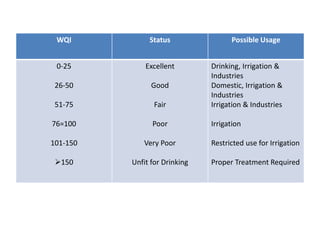
WQI Status Possible Usage
0-25
26-50
51-75
76=100
101-150
150
Excellent
Good
Fair
Poor
Very Poor
Unfit for Drinking
Drinking, Irrigation &
Industries
Domestic, Irrigation &
Industries
Irrigation & Industries
Irrigation
Restricted use for Irrigation
Proper Treatment Required
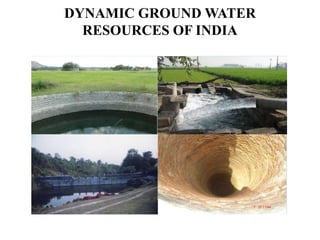
DYNAMIC GROUND WATER
RESOURCES OF INDIA
WATER SAMPLING
• Water Sampling and Analysis involves the collection of water
samples and measurement for chemical and biological
characteristics to determine its quality.
• These results are compared against water quality standards in
regulations and guidelines to determine its use and/or the
treatment required to make the water suitable for its intended
use (e.g. drinking water).
• These standards are defined by legislation and guidelines that
govern acceptable levels of components in water that can
cause health or aesthetic problems
CONTD….
• The accuracy of water analysis is dependent on the sampling
method used, the time elapsed between sampling and analysis,
the techniques used in laboratory analysis and interpretation of
the results.
• Water samples are used to carry out a number of different tests
for water quality.
SAMPLING METHODS
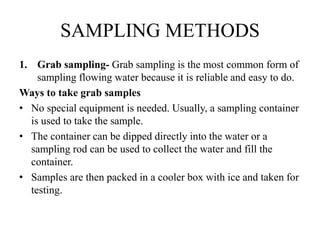
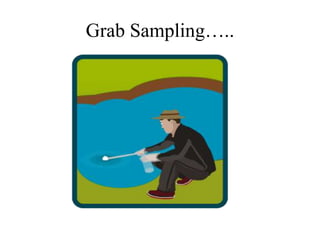
1. Grab sampling- Grab sampling is the most common form of
sampling flowing water because it is reliable and easy to do.
Ways to take grab samples
• No special equipment is needed. Usually, a sampling container
is used to take the sample.
• The container can be dipped directly into the water or a
sampling rod can be used to collect the water and fill the
container.
• Samples are then packed in a cooler box with ice and taken for
testing.
Grab Sampling…..
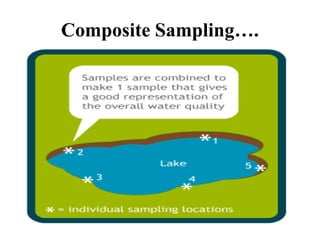
Composite Sampling
• Composite sampling involves taking a number of small
samples, called sub-samples, over a period of time.
• These are then combined to reflect the overall condition
of a water body, like a lake.
• These sub-samples are often referred to as aliquots. In the
field, aliquots of 200 ml are used to make up an overall sample
of 1 000 ml.
• Composite sampling is used frequently.
Composite Sampling….
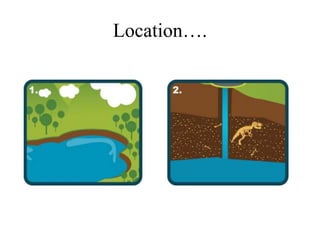
Location
• Surface water is what is seen on the Earth's surface. It can be
either flowing water, like oceans, rivers and streams, or stored
in natural depressions, like lakes and water holes.
• Surface water can be:
• permanent: flowing or held in natural depressions throughout
the year,
• semi–permanent: flowing or held for only part of the year, or
• constructed: held in structures ranging from dams to a water
tank that catches rain.
Location….
Water Distribution Systems
• Water distribution systems are ways of controlling the flow
and direction of both surface water and groundwater. They are
the link between the water supply source and the consumer.
• They include:
• Irrigation systems – used in agriculture
• Bore lines – used to deliver bore water
• scheme water systems – used to deliver water to households.
• Some of these systems have been in use for decades, so
sampling and testing is used to determine the health of the
pipes and water.
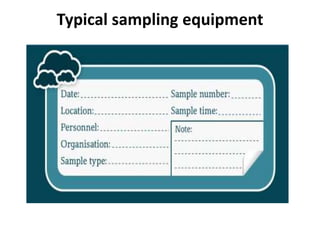
Typical sampling equipment
Recording
• You must always keep a record of your activity when sampling
water.
• This is done using field sheets. Field sheets are forms used to
record data relating to each sample.
• It will have all the information relating to a single sample.
Chain of custody
• If the samples you take need to be sent to a laboratory for
testing or if they need to be stored, a Chain of Custody (COC)
must also be used.
• A Chain of Custody is a legal document used to trace who has
been in control of the samples from the time of collection
through analysis, reporting and disposal.
Checking equipment
• All equipment needs to be properly checked before sampling
takes place.
• Are all sampling bottles prepared and labelled?
• Do you have what you need to transport the samples in the
right environment?
• Do you have the necessary testing equipment?
• Do you have communication equipment?
• Do you have the maps you need?
• Have you checked that all equipment is functioning properly?
Referrences
• https://www.dlsweb.rmit.edu.au/toolbox/spla
sh/toolbo
• https://www.dlsweb.rmit.edu.au/toolbox/spla
sh/toolbox_11_04/uoc4/html/p1samp_types.
htm
THANK YOU

Waste water sampling and analysis

  • 1.
    WASTE WATER SAMPLING ANDANALYSIS SUBMITTED TO Dr. POONAM SYAL Associate Prof. EE Dept. NITTTR CHD SUBMITTED BY Vinod Srivastava M.E. Modular I & C(NITTTR CHD)
  • 2.
    CONTENTS  INTRODUCTION  GROUNDWATERQUALITY  DYNAMIC GROUND WATER RESOURCES OF INDIA  WATER SAMPLING  SAMPLING METHODS  LOCATION  WATER DISTRIBUTION SYSTEMS  TYPICAL SAMPLING EQUIPMENT  RECORDING  CHAIN OF CUSTODY  CHECKING EQUIPMENT
  • 3.
    INTRODUCTION • Water isthe most important in shaping the land and regulating the climate. It is one of the most important compounds that profoundly influence life. • In the last few decades, there has been a tremendous increase in the demand for fresh water due to rapid growth of population and the accelerated pace of industrialization. • Groundwater is used for domestic and industrial water supply and also for irrigation purposes in all over the world. • According to WHO organization, about 80% of all the diseases in human beings are caused by water.
  • 4.
    CONTD… • Once thegroundwater is contaminated, its quality cannot be restored back easily and to device ways and means to protect it.
  • 5.
    Groundwater Quality • Helpsus understand the hydrogeologic system • Delineates groundwater contamination • Water quality index is one of the most effective tools to communicate information on the quality of water to the concerned citizens and policy makers. • It, thus, becomes an important parameter for the assessment and management of groundwater.
  • 6.
    WQI Status PossibleUsage 0-25 26-50 51-75 76=100 101-150 150 Excellent Good Fair Poor Very Poor Unfit for Drinking Drinking, Irrigation & Industries Domestic, Irrigation & Industries Irrigation & Industries Irrigation Restricted use for Irrigation Proper Treatment Required
  • 7.
  • 8.
    WATER SAMPLING • WaterSampling and Analysis involves the collection of water samples and measurement for chemical and biological characteristics to determine its quality. • These results are compared against water quality standards in regulations and guidelines to determine its use and/or the treatment required to make the water suitable for its intended use (e.g. drinking water). • These standards are defined by legislation and guidelines that govern acceptable levels of components in water that can cause health or aesthetic problems
  • 9.
    CONTD…. • The accuracyof water analysis is dependent on the sampling method used, the time elapsed between sampling and analysis, the techniques used in laboratory analysis and interpretation of the results. • Water samples are used to carry out a number of different tests for water quality.
  • 10.
    SAMPLING METHODS 1. Grabsampling- Grab sampling is the most common form of sampling flowing water because it is reliable and easy to do. Ways to take grab samples • No special equipment is needed. Usually, a sampling container is used to take the sample. • The container can be dipped directly into the water or a sampling rod can be used to collect the water and fill the container. • Samples are then packed in a cooler box with ice and taken for testing.
  • 11.
  • 12.
    Composite Sampling • Compositesampling involves taking a number of small samples, called sub-samples, over a period of time. • These are then combined to reflect the overall condition of a water body, like a lake. • These sub-samples are often referred to as aliquots. In the field, aliquots of 200 ml are used to make up an overall sample of 1 000 ml. • Composite sampling is used frequently.
  • 13.
  • 14.
    Location • Surface wateris what is seen on the Earth's surface. It can be either flowing water, like oceans, rivers and streams, or stored in natural depressions, like lakes and water holes. • Surface water can be: • permanent: flowing or held in natural depressions throughout the year, • semi–permanent: flowing or held for only part of the year, or • constructed: held in structures ranging from dams to a water tank that catches rain.
  • 15.
  • 16.
    Water Distribution Systems •Water distribution systems are ways of controlling the flow and direction of both surface water and groundwater. They are the link between the water supply source and the consumer. • They include: • Irrigation systems – used in agriculture • Bore lines – used to deliver bore water • scheme water systems – used to deliver water to households. • Some of these systems have been in use for decades, so sampling and testing is used to determine the health of the pipes and water.
  • 17.
  • 18.
    Recording • You mustalways keep a record of your activity when sampling water. • This is done using field sheets. Field sheets are forms used to record data relating to each sample. • It will have all the information relating to a single sample.
  • 19.
    Chain of custody •If the samples you take need to be sent to a laboratory for testing or if they need to be stored, a Chain of Custody (COC) must also be used. • A Chain of Custody is a legal document used to trace who has been in control of the samples from the time of collection through analysis, reporting and disposal.
  • 20.
    Checking equipment • Allequipment needs to be properly checked before sampling takes place. • Are all sampling bottles prepared and labelled? • Do you have what you need to transport the samples in the right environment? • Do you have the necessary testing equipment? • Do you have communication equipment? • Do you have the maps you need? • Have you checked that all equipment is functioning properly?
  • 22.
  • 23.