BIOCHEMICAL REACTIONS
TESTS
• INDOLE TEST
• UREASE TEST
• CITRATE TEST
• METHYL RED(MR) TEST
• VOGES – PROSKAUER(VP) TEST
• TRIPLE SUGAR IRON(TSI) TEST
• OXIDASE TEST
• CATALASE TEST
CATALASE TEST
EFFERVESENCE -POSITIVE
Catalase Test
Principle:-
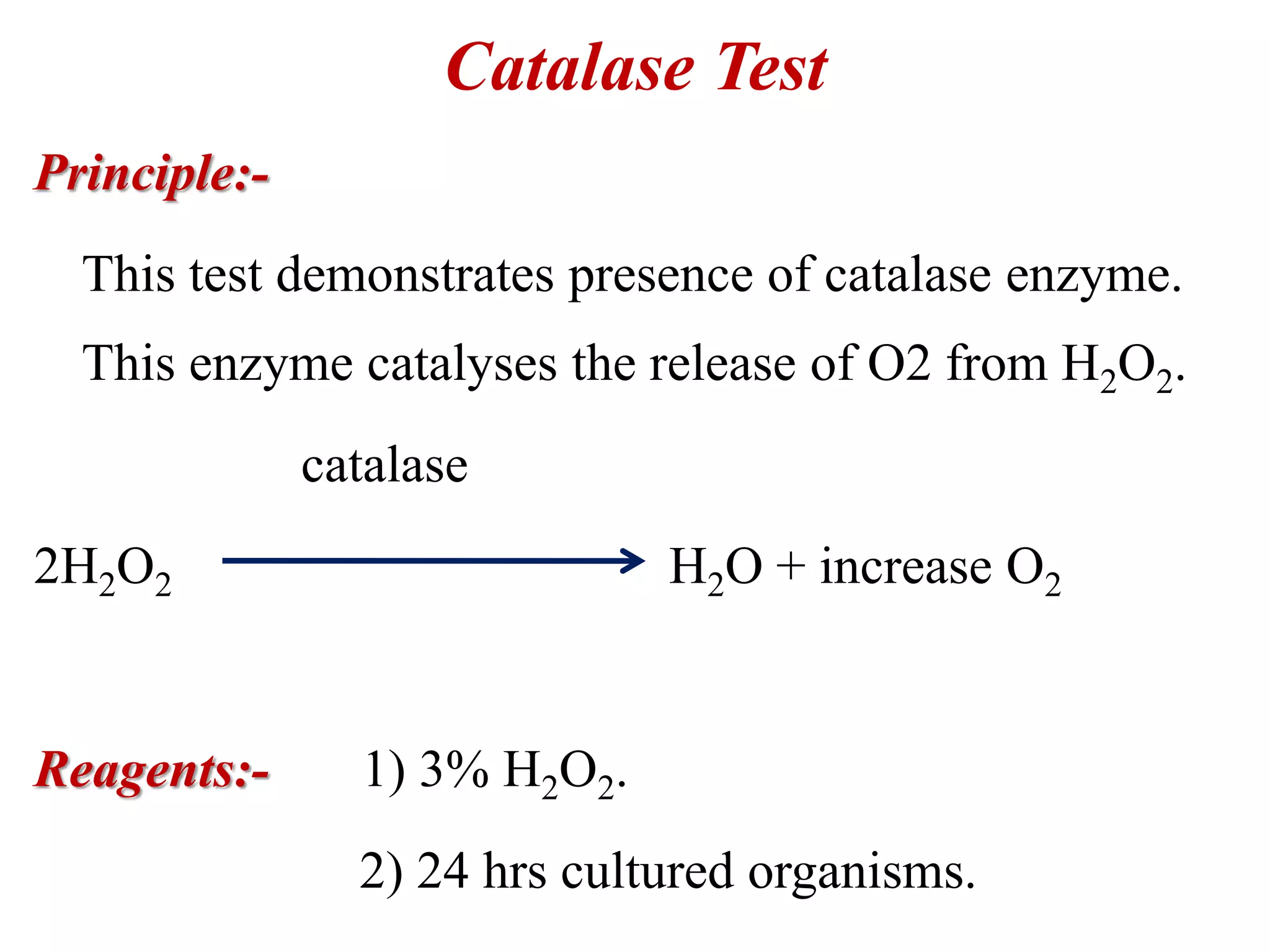
This test demonstrates presence of catalase enzyme.
This enzyme catalyses the release of O2 from H2O2.
catalase
2H2O2 H2O + increase O2
Reagents:- 1) 3% H2O2.
2) 24 hrs cultured organisms.
Procedure:-
• With sterile wooden stick transfer culture
organisms to test tube containing 3% H2O2 and
observe for production of effervescence.
• It can also be tested directly on growth plate.
Positive Control: Staphylococci.
Negative Control: Streptococci.
False positive reactions:
• If culture medium contains catalase enzyme e.g.,
blood agar, chocolate agar.
• If iron wire loop is used
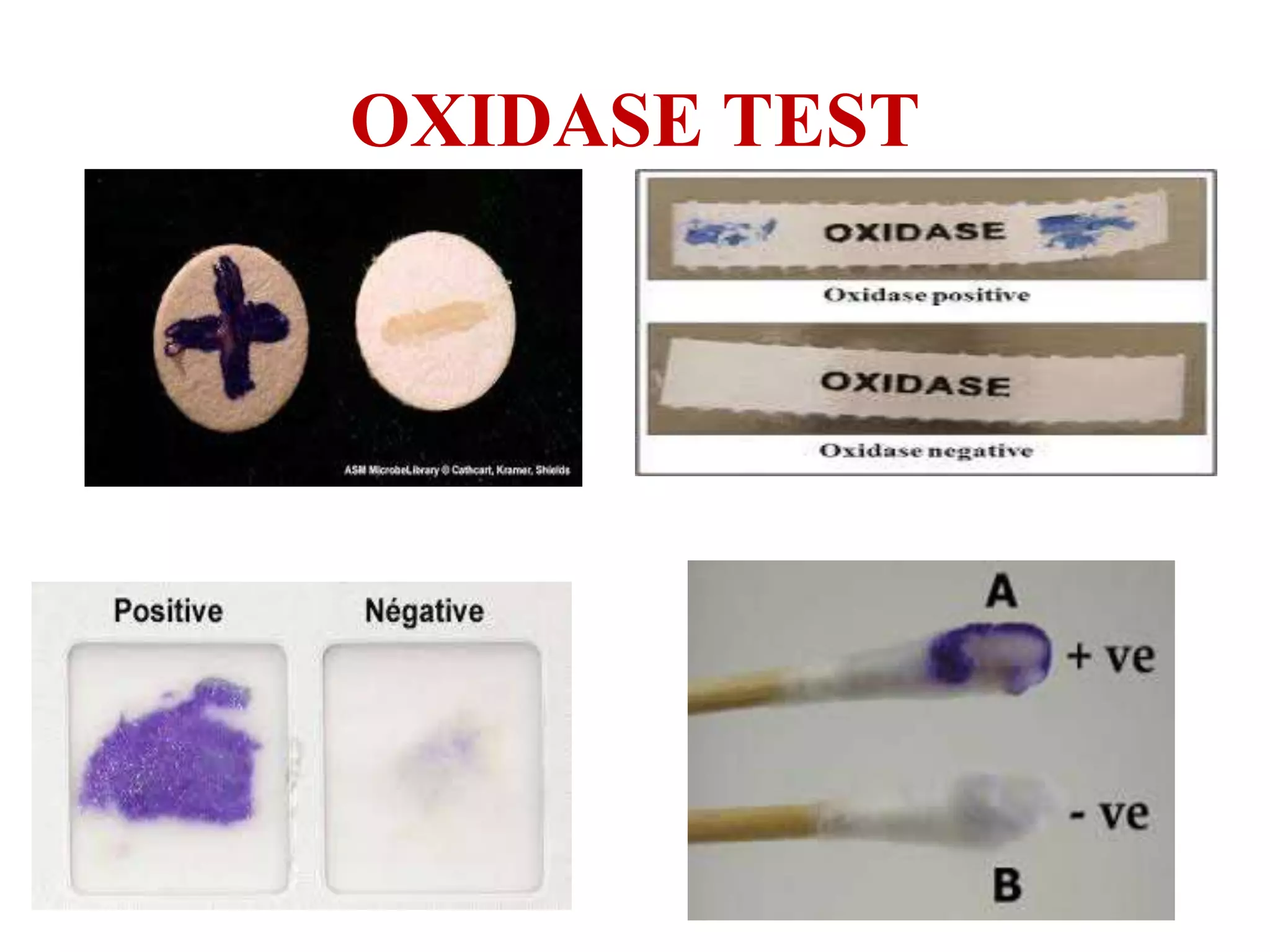
OXIDASE TEST
Oxidase test
Principle:
• To detect the presence of cytochrome oxidase enzyme.
• Some bacteria possess enzyme oxidase that will catalyze the
transport of electrons between electron donors in bacteria
and redox dye tetramethyl-P-Phenylene-diamine.
• This dye reduces to a deep purple colour.
Procedures:
• 3 methods 1) Plate method
2) Dry filter method
3) Wet filter method
• Moist the filter paper with the substrate of 1% Tetramethyl
- P - Phenylamine dihydrochloride (oxidase reagent).
• Take pure colony to be tested on a wooden stick and rub
over filter paper.
• See for purple colour development within 10 seconds.
Positive controls:-
Pseudomonas, Aeromonas,
, V.cholera,
N. gonorrhoea, Pasteurella spp,
Alcaligenes and Campylobacter spp
Negative Controls:-
all species of Enterobacteriacae.
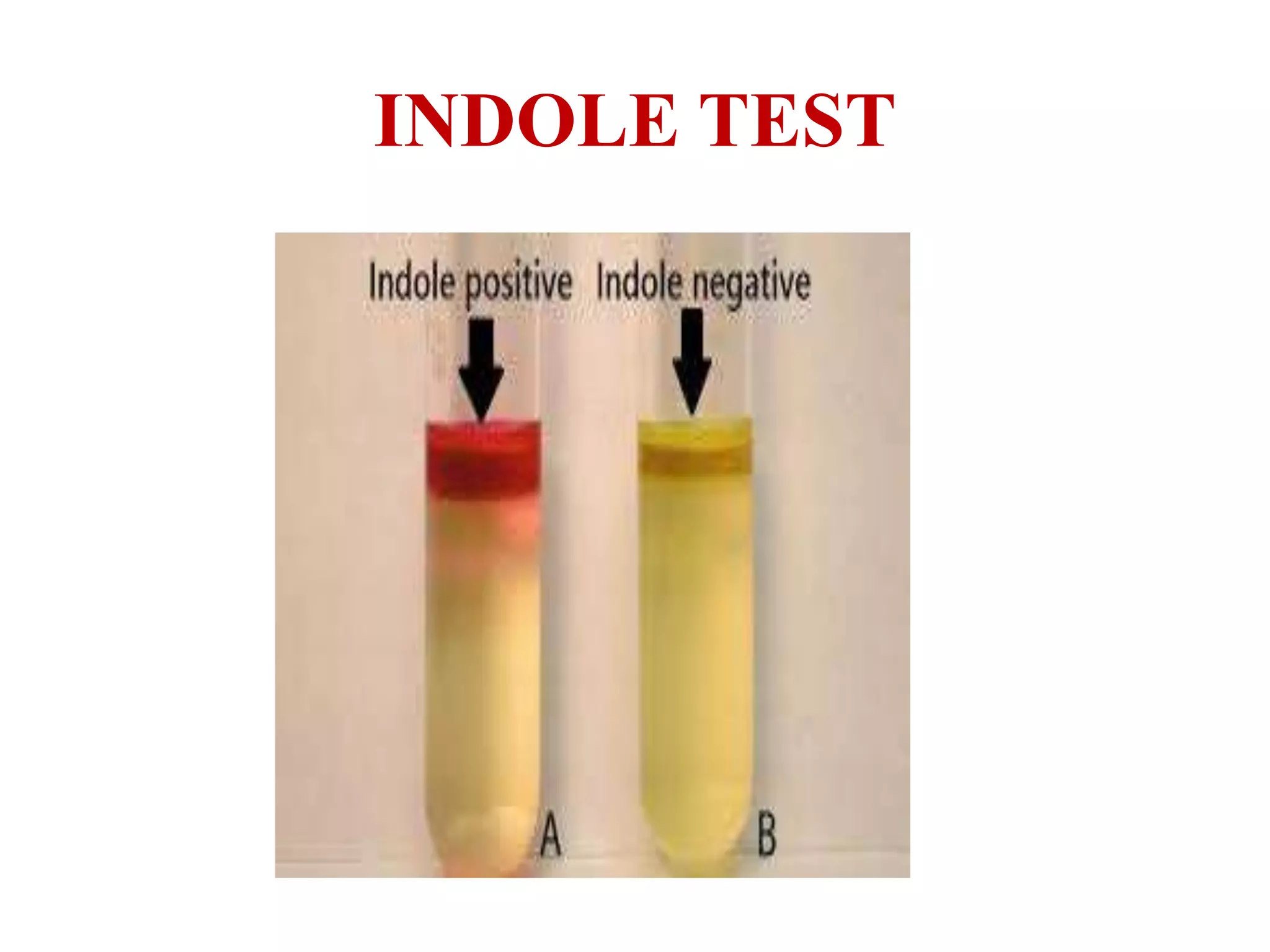
INDOLE TEST
Indole test
Principle :
• Indole is one of metabolic degradation products of amino
acid tryptophan.
• So bacteria that possess the enzyme “tryptophanase” are
capable of hydrolyzing & de-aminating tryptophan with
production of Indole, pyruvic acid & ammonia.
• Indole tested by colorimetric reaction with P-dimethyl
amino benzyldehyde (Kovac’s reagent) to form red
complex.
Tryptophanase
• Tryptophan Indole +pyruvic
acid + Ammonia
• Indole + P-diamethyl amino benzyldehyde
Red compound
Kovac’s reagent: -P-diamethylamino benzyldehyde
- Amyl alcohol
- Hydrochloric acid
Reagents : 1) Peptone water broth
2) Kovac’s reagent / Ehrilich reagent
Procedure : Inoculate peptone water with test
organism at 35o for 18-24hrs and add 15 drops of
Kovac’s reagent & see for the red colour ring at
the interface.
Positive control : E.coli. Klebsiella oxytoca
Negative control : Kl.pneumonia, Enterobacter,
Serratia, Hafnia (KESH)
Methyl Red test
Methyl Red test
Principle : Methyl red is a PH indicator with a range between
6.0(yellow) – 4.4(Red).
• Methyl red test is a quantitative test for acid production.
• Positive organisms produce strong acids (lactic, acetic,
formic) from glucose through E-M pathway(Embden
Meyerhof Parnas Pathway).
• The organisms that can maintain the low pH(4.5) persistently
for >48 hrs, overcoming the pH-buffering system of medium,
be called as “positive organisms”
Reagents: 1) MR / VP broth
2) Methyl red
Procedure : Inoculate the test organisms in MR/VP
broth & incubate at 35oC for 48hrs & add 5 drops of
methyl red.
Interpretation : Red colour is positive,
Yellow is negative
• Positive control : E.coli
• Negative control : Enterobacter aerogens
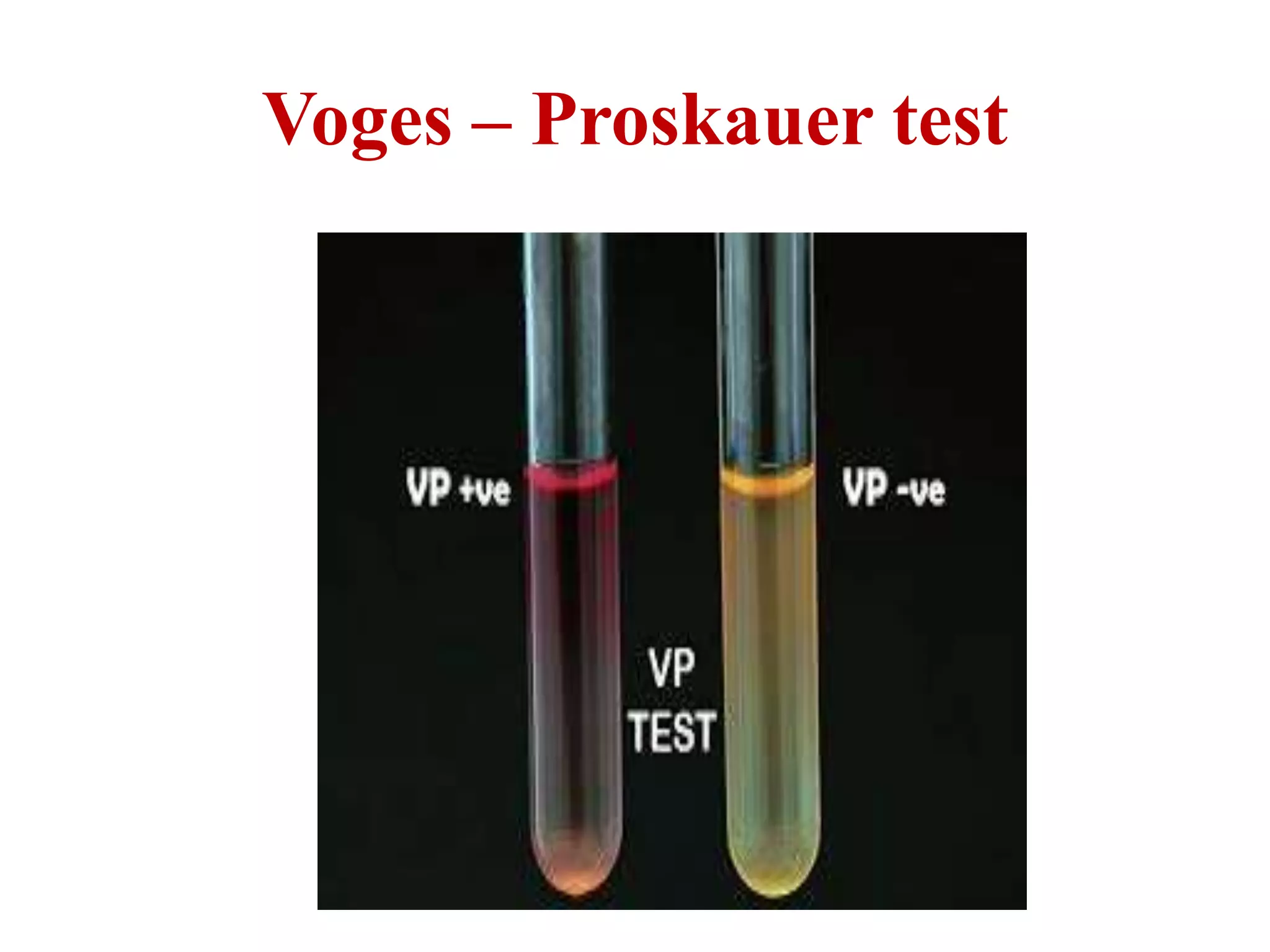
Voges – Proskauer test
Principle :
• Some organisms produce acetoin (acetyl methyl
carbinol ) as the chief end product of glucose
metabolism through E-M pathway.
• In the presence of oxygen and 40% KOH, acetoin is
converted to diacetyl.
• This diacetyl combines with α-naphthol to form
pink-red complex.
Voges – Proskauer test
Reagents : 1) MR/VP broth
2) A- 5% α-naphthol
B-40% KoH
Procedure :
• Inoculate MR/VP broth with test organisms and
incubate at 35oC for 48 to72hrs.
• Add 0.6ml of 5% α-naphthol followed by 0.2ml
40% KOH.
• Shake the tube gently to expose the medium to
atm.02 & allow the tube to remain undisturbed for
10-15 min.
Interpretation : Red colour in 2-5min becoming
crimson red in 30 min or more.
• Positive control :
KESH (Klebsiella,Enterobacter,Serratia,Hafnia)
• Negative control : E.coli
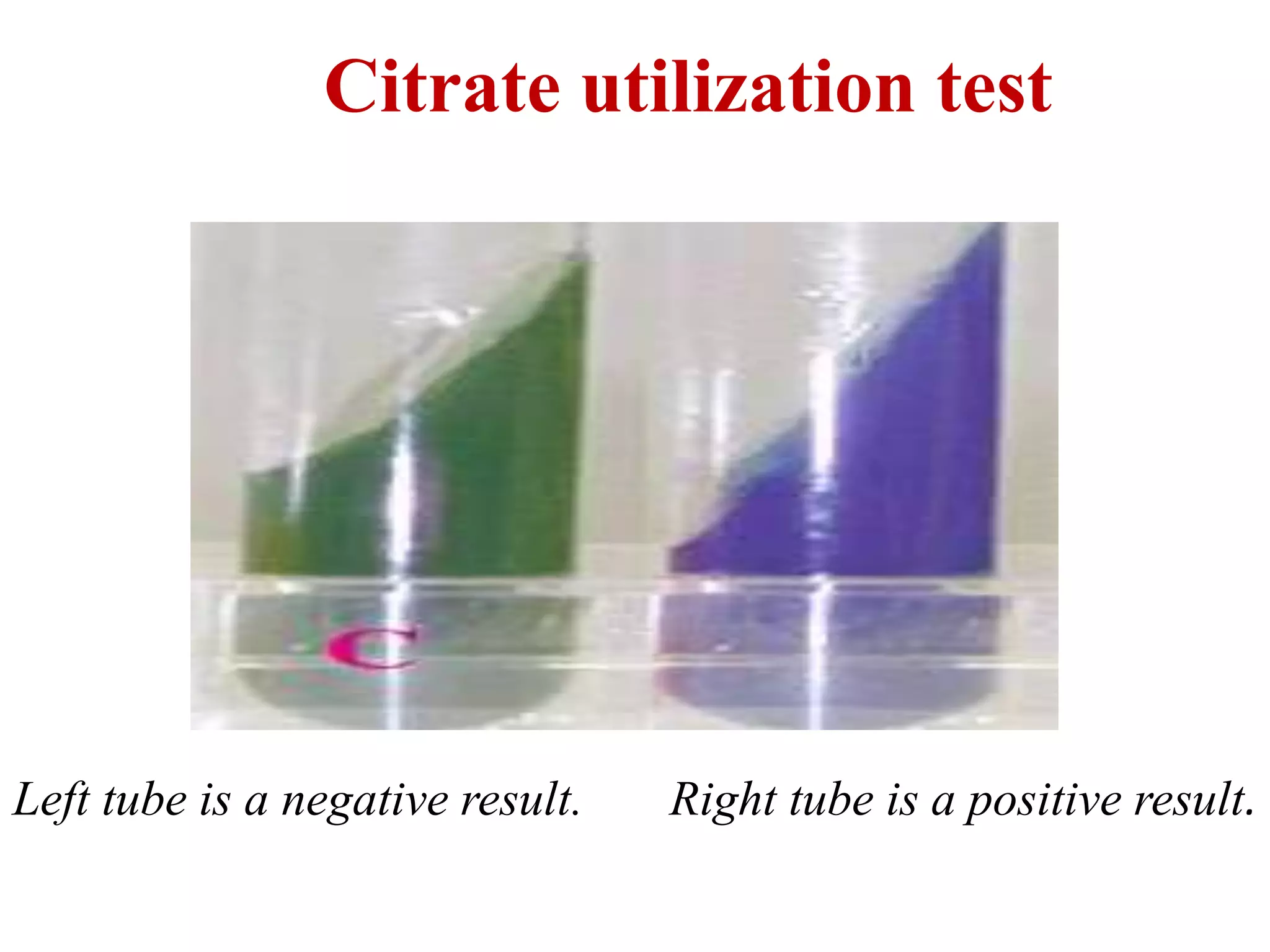
Left tube is a negative result. Right tube is a positive result.
Citrate utilization test
Principle : Some bacteria obtain energy in manner other
than by the fermentation of carbohydrates by using
citrate as the sole source of carbon.
• Any medium used to detect citrate utilization must be
devoid of carbohydrates & protein.
• These bacterias use the citrate with production of
ammonia --------later on ammonium hydroxide.
• This leads to conversion of alkaline medium.
Sodium citrate alkaline metabolic
products,increase PH
Bromothymol blue Bromothymol blue
[green-6.9PH] [Blue – PH: 7.6]
Reagents : 1. Simmon’s citrate media.
Procedure : Inoculate the citrate media with test organisms and
incubate at 35oC for 24-48hrs
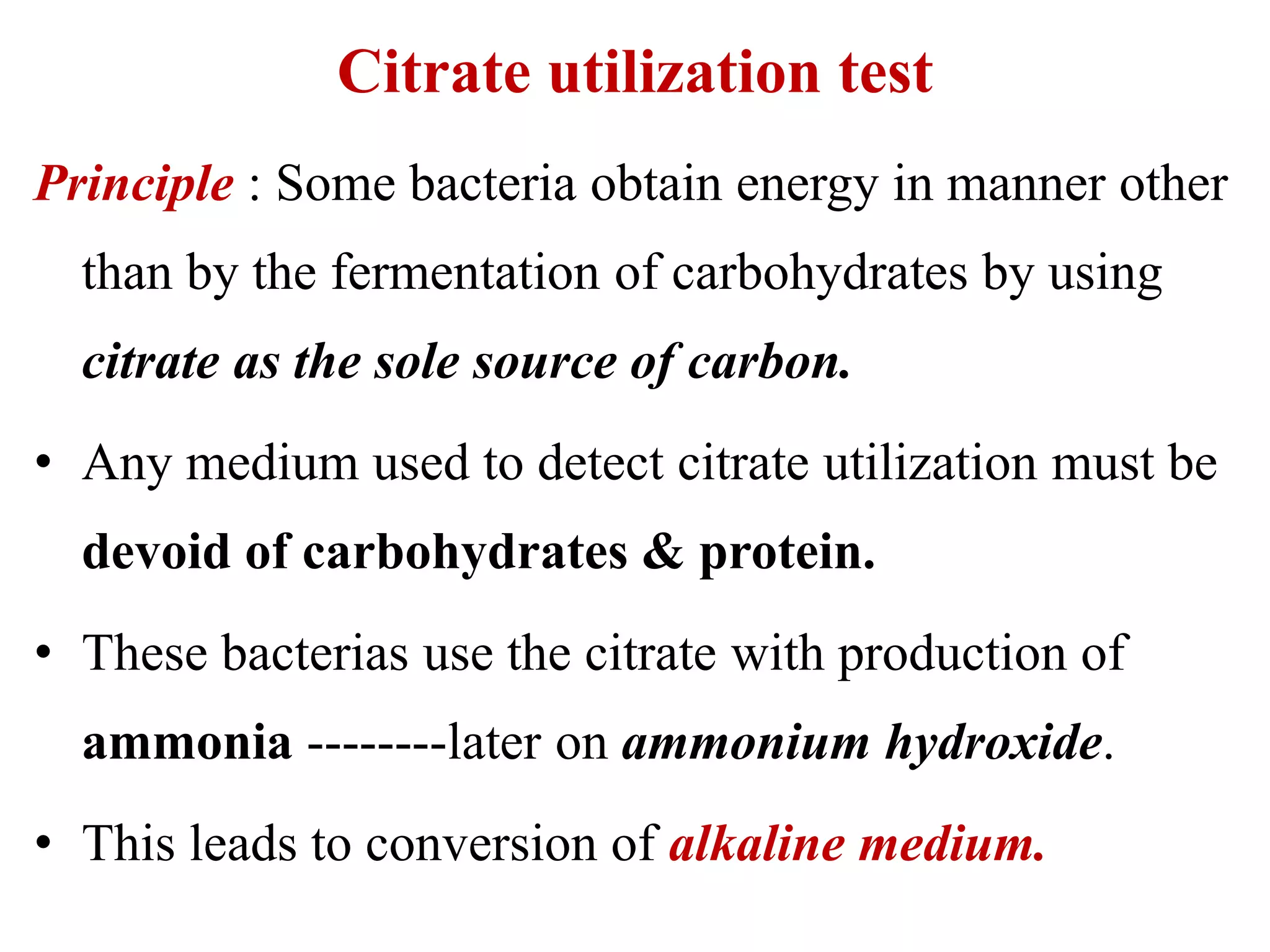
Interpretation : Blue colour is positive, green is negative
• Positive control : Enterobacter aerogenes. Klebsiella spp.
• Negative control : E.coli
Left tube is a negative result. Right tube is a positive result.
Urease Test
Principle:
• Urease is an enzyme produced by certain micro-
organisms which converts the urea to ammonia &
CO2.
• Development of ammonia will increase the PH of
the media and converts colorless phenolphthalein
to pink color.
Urease
Urea + H20 ammonia + CO2
Phenolphthalein Phenolphthalein
(colourless) (Pink)
PH < 8.1 PH > 8.1
Requirements:
1. Christensen’s urease medium.
Procedure:
Inoculate the test organism from pure culture in to
christensen’s medium, incubate at 35oC for 18 to
24hrs.
Interpretation:
• Rapid Urease Producers:
pink through out medium eg: Proteus
• Slow Urease Producers:
colourless initially and gradually entire tube
turns pink.eg: Klebsiella.
• Positive Control: Proteus, Klebsiella
• Negative Control: E.coli
Triple sugar Iron test
It is a composite media used to demonstrate several
properties of bacteria.
• Fermentation of glucose, lactose and sucrose.
• Production of gas with fermentation.
• H2S Production.
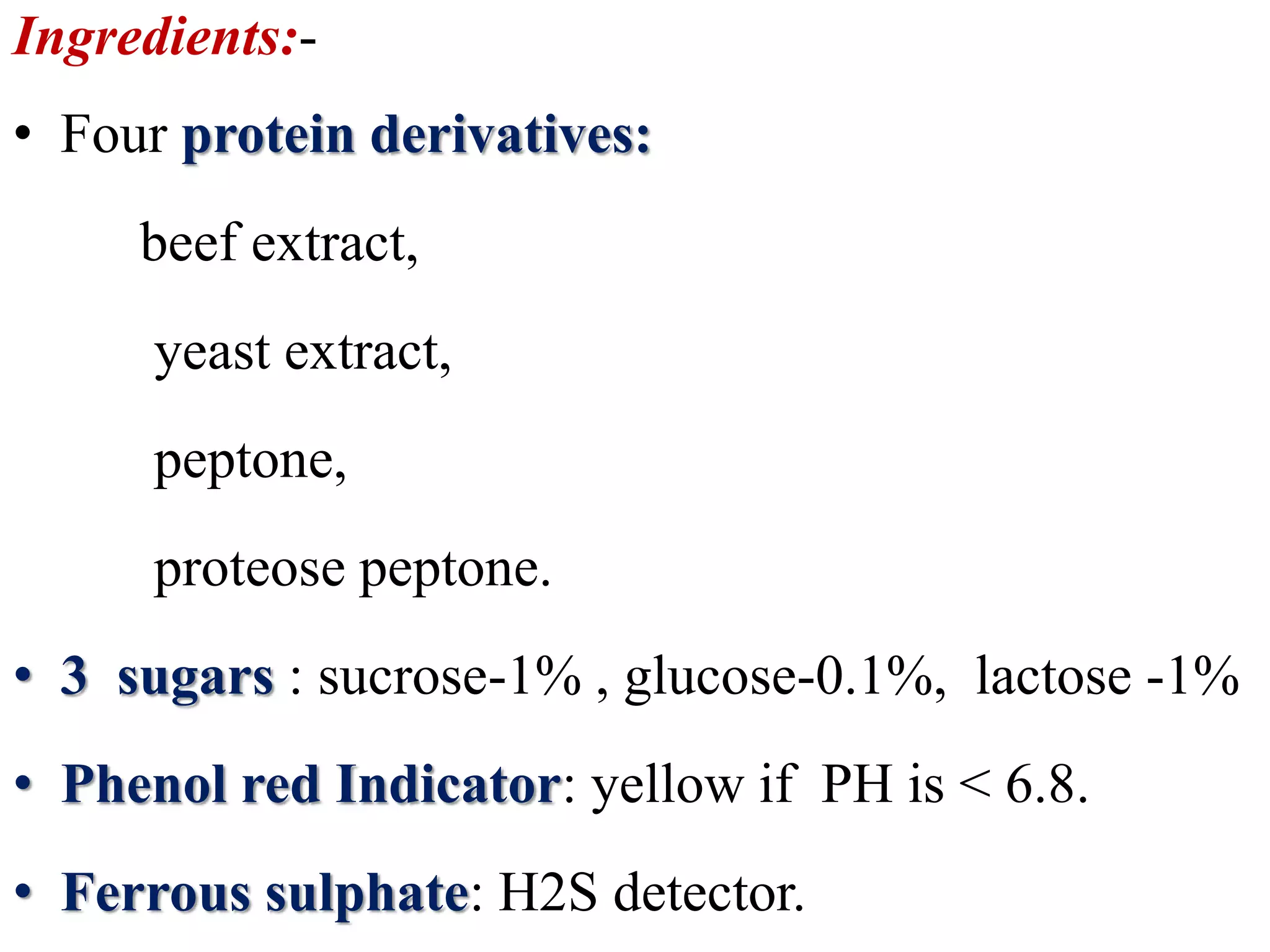
Ingredients:-
• Four protein derivatives:
beef extract,
yeast extract,
peptone,
proteose peptone.
• 3 sugars : sucrose-1% , glucose-0.1%, lactose -1%
• Phenol red Indicator: yellow if PH is < 6.8.
• Ferrous sulphate: H2S detector.
Principle:
• The tube has got “slant” portion exposed to
atm.O2, is aerobic and lower portion is called
“Butt” or ‘deep’, it is anaerobic.
1.Non fermentors: eg: Pseudomonas
Non fermenters unable to utilize none of
sugars, so bacterias utilize peptides. Peptides are
converted into amines which increase PH (7.4)
of media. So both slant/Butt are K/K
Alkaline slant / Alkaline butt
No fermentation of
sugars
PH
7.4
O2
NON FERMENTERS
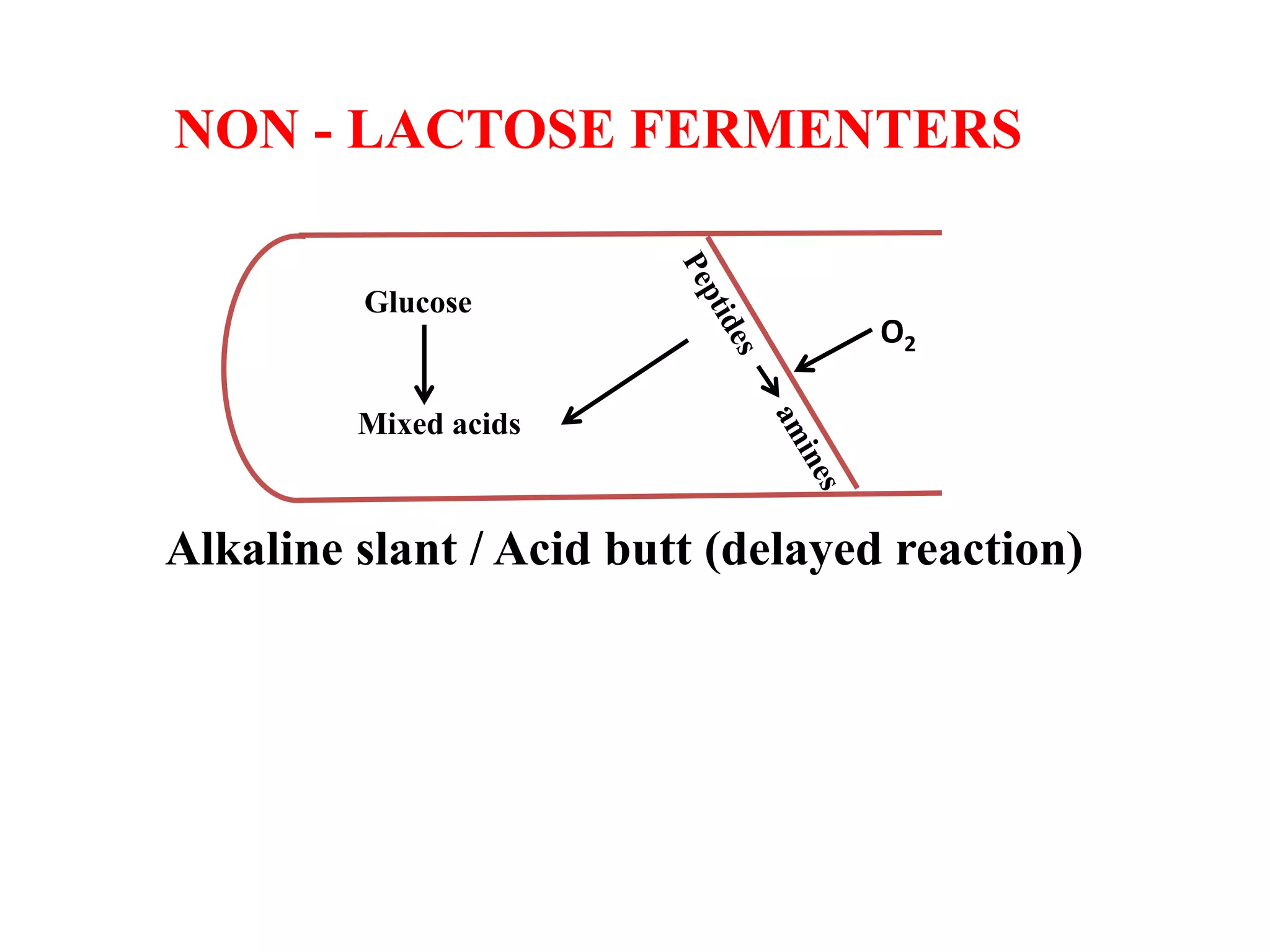
2.Non Lactose fermentors:-
Initial acidification of both slant and deep due
to fermentation of glucose by bacteria. After that
bacteria starts utilizing peptides and converts them
into amines which will increase the PH near slant.
Eg: Shigella, salmonella, Citrobacter, Proteus
Acid slant / Acid butt (Initial reaction)
Glucose
O2
Mixed acids
Alkaline slant / Acid butt (delayed reaction)
Glucose
O2
Mixed acids
NON - LACTOSE FERMENTERS
3.Lactose fermentors:-
Complete, permanent acidification of both
deep and slant by LF Eg: E-coli, Klebsiella.
Acid slant / Acid butt
Glucose
+
Sucrose
+
Lactose
O2
Mixed acids
H2S PRODUCERS
• If organisms are hydrogen sulphide producers (H2S),
the newly-formed hydrogen sulfide (H2S) reacts
with ferrous sulfate in the medium to form ferrous
sulfide, which is visible as a black precipitate. The
blackening of the medium is almost always observed
in the butt (bottom) of the medium.
TSI test
Interpretation:-
• A/A with gas :E.coli, Klebsiella.
• K/A : Salmonella paratyphi A, Shigella.
• K/A with H2S : S.typhi, proteus.
• K/no change :Ps aeruginosa.
• A/A with H2S : citrobacter fruendi.
Principle:
• The capability of an organism to reduce
nitrates(NO3) - nitrites (NO2)will be detected.
• The organisms which has got enzyme known as
“Nitrate reductase”, have the capability of
extracting O2 from Nitrates to form Nitrites.
Nitrate reduction
Nitrate reductase
• Nitrates Nitrites.
• This nitrites can be detected by adding
α-naphthalamine and sulfanilic acid which forms
red complex.
• Nitrites + α-naphalamine + sulfanilic acid
red complex
Procedure:-
• Inoculate nitrate medium with test organism.
• Incubate at 35oC for 18 to 24 hrs and add 1 ml
each of α-naphthalamine and sulfanilic acid
• Positive Control:- All enterobactericae,
Haemophilus, Neisseria, Moraxella species
• Negative Control: Acinetobacter baumannii.
Sugar fermentation test
• Bacteria produce acidic products when they
ferment certain carbohydrates.
• The carbohydrate utilization tests are designed to
detect the change in pH, which would occur if
fermentation of the given carbohydrate occurred.
• Acids lower the pH of the medium which will
cause the pH indicator (phenol red) to turn yellow.
• If the bacteria do not ferment the carbohydrate
then the media remains red or pink.
• If gas is produced as a by product of fermentation,
then the Durham tube will have a bubble in it.
• Different sugars can be tested are as follows.
glucose, sucrose, fructose, lactose, maltose,
mannitol,arabinose, inositol, etc.
Ingradients:
1. sugar solution -1%.
2. pH indicator: a. Phenol red
b. Andrade’s indicator
Procedure:
Inoculate the test organism into particular sugar
solution and incubate for 12 -24 hrs.
Interpretation:
change in colour from pink to yellow and with or
without production of gas which is noted in
inverted Durham’s tube is considered as positive.
•Left tube shows less acid formation than far right tube, but gas is still made
•Center shows no carbohydrate utilization to produce acid or gas.
•Right tube shows acid was produced as evidenced by the yellow color, and
gas was made (look at the bubble in the Durham tube)
MacConkey agar
BLOOD AGAR
CHOCALATE AGAR
TCBS medium
WILSON BLAIR MEDIUM
CATALASE TEST
EFFERVESENCE -POSITIVE
OXIDASE TEST
INDOLE TEST
Left tube is a negative result. Right tube is a positive result.
Citrate utilization test
UREASE TEST
TSI test
Thank you

Biochemical reactions new

  • 1.
  • 2.
    TESTS • INDOLE TEST •UREASE TEST • CITRATE TEST • METHYL RED(MR) TEST • VOGES – PROSKAUER(VP) TEST • TRIPLE SUGAR IRON(TSI) TEST • OXIDASE TEST • CATALASE TEST
  • 3.
  • 4.
    Catalase Test Principle:- This testdemonstrates presence of catalase enzyme. This enzyme catalyses the release of O2 from H2O2. catalase 2H2O2 H2O + increase O2 Reagents:- 1) 3% H2O2. 2) 24 hrs cultured organisms.
  • 5.
    Procedure:- • With sterilewooden stick transfer culture organisms to test tube containing 3% H2O2 and observe for production of effervescence. • It can also be tested directly on growth plate. Positive Control: Staphylococci. Negative Control: Streptococci.
  • 6.
    False positive reactions: •If culture medium contains catalase enzyme e.g., blood agar, chocolate agar. • If iron wire loop is used
  • 8.
  • 9.
    Oxidase test Principle: • Todetect the presence of cytochrome oxidase enzyme. • Some bacteria possess enzyme oxidase that will catalyze the transport of electrons between electron donors in bacteria and redox dye tetramethyl-P-Phenylene-diamine. • This dye reduces to a deep purple colour.
  • 10.
    Procedures: • 3 methods1) Plate method 2) Dry filter method 3) Wet filter method • Moist the filter paper with the substrate of 1% Tetramethyl - P - Phenylamine dihydrochloride (oxidase reagent). • Take pure colony to be tested on a wooden stick and rub over filter paper. • See for purple colour development within 10 seconds.
  • 11.
    Positive controls:- Pseudomonas, Aeromonas, ,V.cholera, N. gonorrhoea, Pasteurella spp, Alcaligenes and Campylobacter spp Negative Controls:- all species of Enterobacteriacae.
  • 13.
  • 14.
    Indole test Principle : •Indole is one of metabolic degradation products of amino acid tryptophan. • So bacteria that possess the enzyme “tryptophanase” are capable of hydrolyzing & de-aminating tryptophan with production of Indole, pyruvic acid & ammonia. • Indole tested by colorimetric reaction with P-dimethyl amino benzyldehyde (Kovac’s reagent) to form red complex.
  • 15.
    Tryptophanase • Tryptophan Indole+pyruvic acid + Ammonia • Indole + P-diamethyl amino benzyldehyde Red compound Kovac’s reagent: -P-diamethylamino benzyldehyde - Amyl alcohol - Hydrochloric acid
  • 16.
    Reagents : 1)Peptone water broth 2) Kovac’s reagent / Ehrilich reagent Procedure : Inoculate peptone water with test organism at 35o for 18-24hrs and add 15 drops of Kovac’s reagent & see for the red colour ring at the interface. Positive control : E.coli. Klebsiella oxytoca Negative control : Kl.pneumonia, Enterobacter, Serratia, Hafnia (KESH)
  • 18.
  • 19.
    Methyl Red test Principle: Methyl red is a PH indicator with a range between 6.0(yellow) – 4.4(Red). • Methyl red test is a quantitative test for acid production. • Positive organisms produce strong acids (lactic, acetic, formic) from glucose through E-M pathway(Embden Meyerhof Parnas Pathway). • The organisms that can maintain the low pH(4.5) persistently for >48 hrs, overcoming the pH-buffering system of medium, be called as “positive organisms”
  • 20.
    Reagents: 1) MR/ VP broth 2) Methyl red Procedure : Inoculate the test organisms in MR/VP broth & incubate at 35oC for 48hrs & add 5 drops of methyl red. Interpretation : Red colour is positive, Yellow is negative • Positive control : E.coli • Negative control : Enterobacter aerogens
  • 22.
    Voges – Proskauertest Principle : • Some organisms produce acetoin (acetyl methyl carbinol ) as the chief end product of glucose metabolism through E-M pathway. • In the presence of oxygen and 40% KOH, acetoin is converted to diacetyl. • This diacetyl combines with α-naphthol to form pink-red complex.
  • 23.
  • 24.
    Reagents : 1)MR/VP broth 2) A- 5% α-naphthol B-40% KoH
  • 25.
    Procedure : • InoculateMR/VP broth with test organisms and incubate at 35oC for 48 to72hrs. • Add 0.6ml of 5% α-naphthol followed by 0.2ml 40% KOH. • Shake the tube gently to expose the medium to atm.02 & allow the tube to remain undisturbed for 10-15 min.
  • 26.
    Interpretation : Redcolour in 2-5min becoming crimson red in 30 min or more. • Positive control : KESH (Klebsiella,Enterobacter,Serratia,Hafnia) • Negative control : E.coli
  • 28.
    Left tube isa negative result. Right tube is a positive result. Citrate utilization test
  • 29.
    Citrate utilization test Principle: Some bacteria obtain energy in manner other than by the fermentation of carbohydrates by using citrate as the sole source of carbon. • Any medium used to detect citrate utilization must be devoid of carbohydrates & protein. • These bacterias use the citrate with production of ammonia --------later on ammonium hydroxide. • This leads to conversion of alkaline medium.
  • 30.
    Sodium citrate alkalinemetabolic products,increase PH Bromothymol blue Bromothymol blue [green-6.9PH] [Blue – PH: 7.6] Reagents : 1. Simmon’s citrate media. Procedure : Inoculate the citrate media with test organisms and incubate at 35oC for 24-48hrs Interpretation : Blue colour is positive, green is negative • Positive control : Enterobacter aerogenes. Klebsiella spp. • Negative control : E.coli
  • 31.
    Left tube isa negative result. Right tube is a positive result.
  • 33.
    Urease Test Principle: • Ureaseis an enzyme produced by certain micro- organisms which converts the urea to ammonia & CO2. • Development of ammonia will increase the PH of the media and converts colorless phenolphthalein to pink color.
  • 34.
    Urease Urea + H20ammonia + CO2 Phenolphthalein Phenolphthalein (colourless) (Pink) PH < 8.1 PH > 8.1 Requirements: 1. Christensen’s urease medium. Procedure: Inoculate the test organism from pure culture in to christensen’s medium, incubate at 35oC for 18 to 24hrs.
  • 35.
    Interpretation: • Rapid UreaseProducers: pink through out medium eg: Proteus • Slow Urease Producers: colourless initially and gradually entire tube turns pink.eg: Klebsiella. • Positive Control: Proteus, Klebsiella • Negative Control: E.coli
  • 37.
    Triple sugar Irontest It is a composite media used to demonstrate several properties of bacteria. • Fermentation of glucose, lactose and sucrose. • Production of gas with fermentation. • H2S Production.
  • 38.
    Ingredients:- • Four proteinderivatives: beef extract, yeast extract, peptone, proteose peptone. • 3 sugars : sucrose-1% , glucose-0.1%, lactose -1% • Phenol red Indicator: yellow if PH is < 6.8. • Ferrous sulphate: H2S detector.
  • 39.
    Principle: • The tubehas got “slant” portion exposed to atm.O2, is aerobic and lower portion is called “Butt” or ‘deep’, it is anaerobic. 1.Non fermentors: eg: Pseudomonas Non fermenters unable to utilize none of sugars, so bacterias utilize peptides. Peptides are converted into amines which increase PH (7.4) of media. So both slant/Butt are K/K
  • 40.
    Alkaline slant /Alkaline butt No fermentation of sugars PH 7.4 O2 NON FERMENTERS
  • 41.
    2.Non Lactose fermentors:- Initialacidification of both slant and deep due to fermentation of glucose by bacteria. After that bacteria starts utilizing peptides and converts them into amines which will increase the PH near slant. Eg: Shigella, salmonella, Citrobacter, Proteus Acid slant / Acid butt (Initial reaction) Glucose O2 Mixed acids
  • 42.
    Alkaline slant /Acid butt (delayed reaction) Glucose O2 Mixed acids NON - LACTOSE FERMENTERS
  • 43.
    3.Lactose fermentors:- Complete, permanentacidification of both deep and slant by LF Eg: E-coli, Klebsiella. Acid slant / Acid butt Glucose + Sucrose + Lactose O2 Mixed acids
  • 44.
    H2S PRODUCERS • Iforganisms are hydrogen sulphide producers (H2S), the newly-formed hydrogen sulfide (H2S) reacts with ferrous sulfate in the medium to form ferrous sulfide, which is visible as a black precipitate. The blackening of the medium is almost always observed in the butt (bottom) of the medium.
  • 45.
  • 46.
    Interpretation:- • A/A withgas :E.coli, Klebsiella. • K/A : Salmonella paratyphi A, Shigella. • K/A with H2S : S.typhi, proteus. • K/no change :Ps aeruginosa. • A/A with H2S : citrobacter fruendi.
  • 48.
    Principle: • The capabilityof an organism to reduce nitrates(NO3) - nitrites (NO2)will be detected. • The organisms which has got enzyme known as “Nitrate reductase”, have the capability of extracting O2 from Nitrates to form Nitrites. Nitrate reduction
  • 49.
    Nitrate reductase • NitratesNitrites. • This nitrites can be detected by adding α-naphthalamine and sulfanilic acid which forms red complex. • Nitrites + α-naphalamine + sulfanilic acid red complex
  • 50.
    Procedure:- • Inoculate nitratemedium with test organism. • Incubate at 35oC for 18 to 24 hrs and add 1 ml each of α-naphthalamine and sulfanilic acid • Positive Control:- All enterobactericae, Haemophilus, Neisseria, Moraxella species • Negative Control: Acinetobacter baumannii.
  • 51.
    Sugar fermentation test •Bacteria produce acidic products when they ferment certain carbohydrates. • The carbohydrate utilization tests are designed to detect the change in pH, which would occur if fermentation of the given carbohydrate occurred. • Acids lower the pH of the medium which will cause the pH indicator (phenol red) to turn yellow.
  • 52.
    • If thebacteria do not ferment the carbohydrate then the media remains red or pink. • If gas is produced as a by product of fermentation, then the Durham tube will have a bubble in it. • Different sugars can be tested are as follows. glucose, sucrose, fructose, lactose, maltose, mannitol,arabinose, inositol, etc.
  • 53.
    Ingradients: 1. sugar solution-1%. 2. pH indicator: a. Phenol red b. Andrade’s indicator Procedure: Inoculate the test organism into particular sugar solution and incubate for 12 -24 hrs. Interpretation: change in colour from pink to yellow and with or without production of gas which is noted in inverted Durham’s tube is considered as positive.
  • 54.
    •Left tube showsless acid formation than far right tube, but gas is still made •Center shows no carbohydrate utilization to produce acid or gas. •Right tube shows acid was produced as evidenced by the yellow color, and gas was made (look at the bubble in the Durham tube)
  • 55.
  • 56.
  • 57.
  • 58.
  • 59.
  • 60.
  • 61.
  • 62.
  • 63.
    Left tube isa negative result. Right tube is a positive result. Citrate utilization test
  • 64.
  • 65.
  • 66.