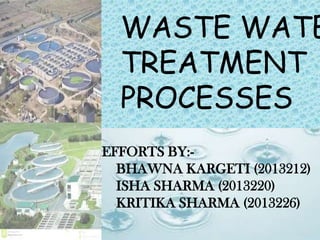
WASTE WATE
TREATMENT
PROCESSES
EFFORTS BY:-
BHAWNA KARGETI (2013212)
ISHA SHARMA (2013220)
KRITIKA SHARMA (2013226)
Water
Hardness•Hard water is water that has high
mineral content
•Contains a high concentration of calcium
and magnesium ions.
•Generally not harmful to one's health.
•Can pose serious problems in industrial
settings.
•Water softening is commonly used to
reduce hard water's adverse effects.
Biological Oxygen
Demand
• Biological oxygen demand is a measure of the
quantity of oxygen used by microorganisms (e.g.,
aerobic bacteria) in the oxidation of organic matter.
• BOD can be used as a gauge of the effectiveness of
wastewater treatment plants.
• Higher the BOD values, the more difficult and
costly are waste treatment and disposal practices.
• When the BOD of waste discharged into a stream is
excessive, depletion of the stream’s oxygen to
satisfy this BOD causes problems in stream’s
ecology.
Chemical Oxygen
Demand
• It determines the amount of organic pollutants found in
surface water (e.g. lakes and rivers) or wastewater.
• Oxidizing agents such as ceric sulphate, potassium iodate,
and Potassium Dichromate have been used to determine
COD.
• COD is expressed in mg/L, which indicates the mass of
oxygen consumed per litre of solution.
• The COD test only requires 2-3 hours.
• The COD test can be used to measure the strength of
wastes that are too toxic for the BOD test.
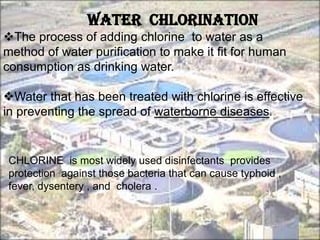
Water chlorination
The process of adding chlorine to water as a
method of water purification to make it fit for human
consumption as drinking water.
Water that has been treated with chlorine is effective
in preventing the spread of waterborne diseases.
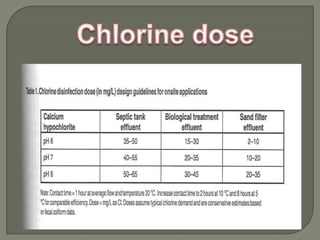
CHLORINE is most widely used disinfectants provides
protection against those bacteria that can cause typhoid ,
fever, dysentery , and cholera .
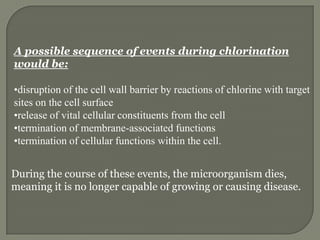
During the course of these events, the microorganism dies,
meaning it is no longer capable of growing or causing disease.
A possible sequence of events during chlorination
would be:
•disruption of the cell wall barrier by reactions of chlorine with target
sites on the cell surface
•release of vital cellular constituents from the cell
•termination of membrane-associated functions
•termination of cellular functions within the cell.
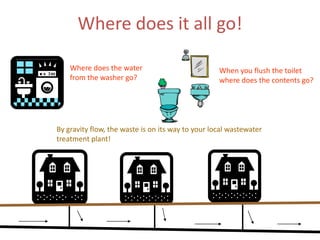
Where does it all go!
Where does the water
from the washer go?
By gravity flow, the waste is on its way to your local wastewater
treatment plant!
When you flush the toilet
where does the contents go?
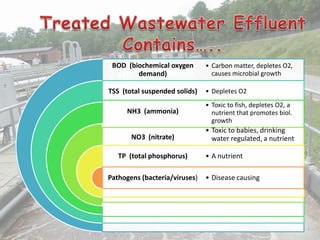
BOD (biochemical oxygen
demand)
TSS (total suspended solids)
NH3 (ammonia)
NO3 (nitrate)
TP (total phosphorus)
Pathogens (bacteria/viruses)
• Carbon matter, depletes O2,
causes microbial growth
• Depletes O2
• Toxic to fish, depletes O2, a
nutrient that promotes biol.
growth
• Toxic to babies, drinking
water regulated, a nutrient
• A nutrient
• Disease causing
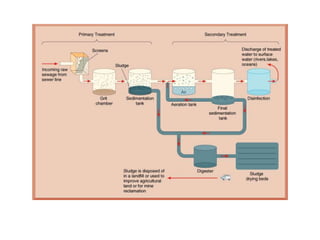
Primary treatment
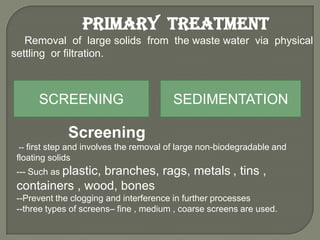
Removal of large solids from the waste water via physical
settling or filtration.
Screening
-- first step and involves the removal of large non-biodegradable and
floating solids
--- Such as plastic, branches, rags, metals , tins ,
containers , wood, bones
--Prevent the clogging and interference in further processes
--three types of screens– fine , medium , coarse screens are used.
SEDIMENTATIONSCREENING
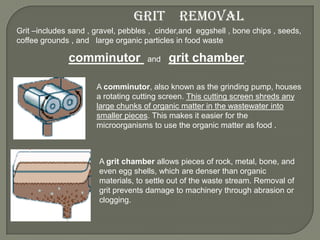
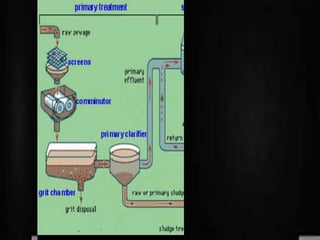
A comminutor, also known as the grinding pump, houses
a rotating cutting screen. This cutting screen shreds any
large chunks of organic matter in the wastewater into
smaller pieces. This makes it easier for the
microorganisms to use the organic matter as food .
A grit chamber allows pieces of rock, metal, bone, and
even egg shells, which are denser than organic
materials, to settle out of the waste stream. Removal of
grit prevents damage to machinery through abrasion or
clogging.
comminutor and grit chamber.
GRIT REMOVAL
Grit –includes sand , gravel, pebbles , cinder,and eggshell , bone chips , seeds,
coffee grounds , and large organic particles in food waste
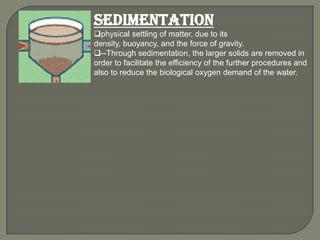
Sedimentation
physical settling of matter, due to its
density, buoyancy, and the force of gravity.
--Through sedimentation, the larger solids are removed in
order to facilitate the efficiency of the further procedures and
also to reduce the biological oxygen demand of the water.
SECONDARY
TREATMENT
• The second stage of wastewater treatment.
• Usually biological treatment is used to treat wastewater in
this step.
• It involves the removal of biodegradable dissolved and
colloidal organic matter using aerobic biological
treatment processes.
• This step mainly includes:
 Trickling filters
 Activated sludge tanks
 Lagoons
 Anaerobic digesters
Trickling Filters
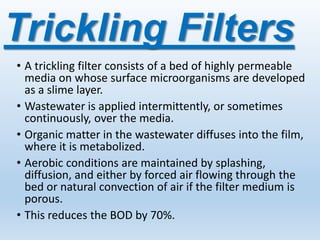
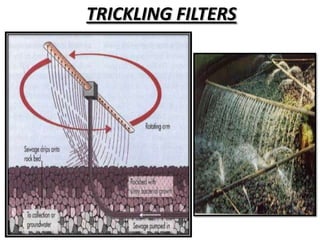
• A trickling filter consists of a bed of highly permeable
media on whose surface microorganisms are developed
as a slime layer.
• Wastewater is applied intermittently, or sometimes
continuously, over the media.
• Organic matter in the wastewater diffuses into the film,
where it is metabolized.
• Aerobic conditions are maintained by splashing,
diffusion, and either by forced air flowing through the
bed or natural convection of air if the filter medium is
porous.
• This reduces the BOD by 70%.
TRICKLING FILTERS
Activated Sludge
Tanks
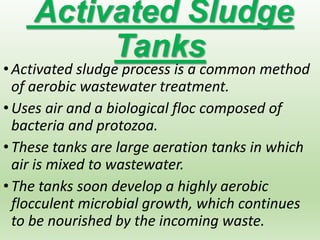
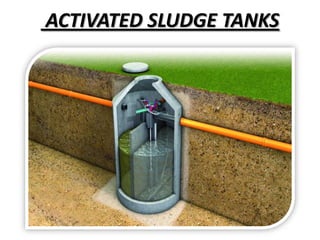
•Activated sludge process is a common method
of aerobic wastewater treatment.
•Uses air and a biological floc composed of
bacteria and protozoa.
•These tanks are large aeration tanks in which
air is mixed to wastewater.
•The tanks soon develop a highly aerobic
flocculent microbial growth, which continues
to be nourished by the incoming waste.
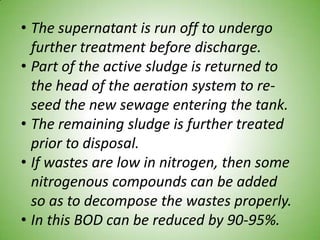
• The supernatant is run off to undergo
further treatment before discharge.
• Part of the active sludge is returned to
the head of the aeration system to re-
seed the new sewage entering the tank.
• The remaining sludge is further treated
prior to disposal.
• If wastes are low in nitrogen, then some
nitrogenous compounds can be added
so as to decompose the wastes properly.
• In this BOD can be reduced by 90-95%.
ACTIVATED SLUDGE TANKS
Lagoons
• An aerated lagoon is a treatment pond provided with
artificial aeration to promote the biological oxidation of
wastewaters.
• Water from Trickling Filters and Activated Sludge Tanks
frequently are pumped into concrete tanks or man made
ponds and lagoons.
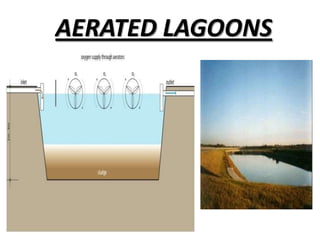
• These are shallow to maintain an aerobic condition.
• In these further microbial degradation of remaining BOD
occurs as well as additional settling of traces of solids.
• Water when clarified of solids is sufficiently low in BOD for
approved discharge into lakes and rivers.
AERATED LAGOONS
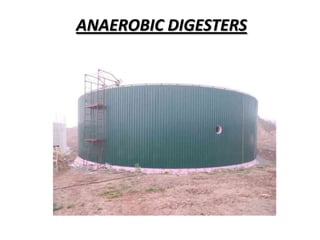
ANAEROBIC
DIGESTERS• Anaerobic digesters digest organic waste in a
machine that limits access to oxygen, encouraging
the generation of methane and carbon dioxide by
microbes in the waste.
• This digester gas is then burned as fuel to make
electricity.
• Digesters aren't widely used yet, but tend to be used
for sewage sludge at sewage treatment plants and
for animal waste on farms.
• Digesters are only marginally effective at reducing
problems with odours, pathogens and greenhouse
gas emissions.
ANAEROBIC DIGESTERS
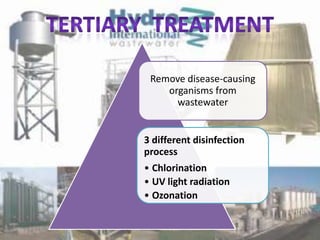
Remove disease-causing
organisms from
wastewater
3 different disinfection
process
• Chlorination
• UV light radiation
• Ozonation
Most common
Two forms: 1. Liquid chlorine
2. Sodium hypochlorite tablets
Advantages: low cost & effective
Disadvantages: Chlorine residue
could be harmful to
environment
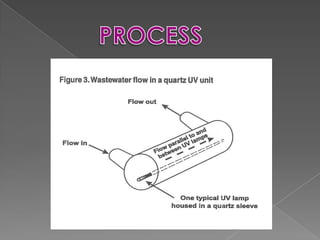
• Damage the genetic
structure of bacteria,
viruses and other
pathogens.
• Wavelength-254nm
• Advantages: no chemicals
are used
• water taste more natural
• Disadvantages: high
maintenance of the UV-
lamp
UV light radiation
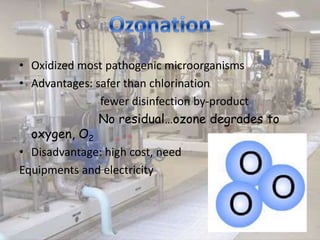
• Oxidized most pathogenic microorganisms
• Advantages: safer than chlorination
fewer disinfection by-product
No residual…ozone degrades to
oxygen, O2
• Disadvantage: high cost, need
Equipments and electricity
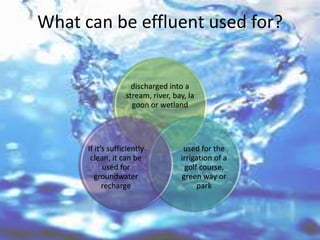
What can be effluent used for?
discharged into a
stream, river, bay, la
goon or wetland
used for the
irrigation of a
golf course,
green way or
park
If it’s sufficiently
clean, it can be
used for
groundwater
recharge
waste water treatment

waste water treatment

  • 1.
    WASTE WATE TREATMENT PROCESSES EFFORTS BY:- BHAWNAKARGETI (2013212) ISHA SHARMA (2013220) KRITIKA SHARMA (2013226)
  • 2.
    Water Hardness•Hard water iswater that has high mineral content •Contains a high concentration of calcium and magnesium ions. •Generally not harmful to one's health. •Can pose serious problems in industrial settings. •Water softening is commonly used to reduce hard water's adverse effects.
  • 3.
    Biological Oxygen Demand • Biologicaloxygen demand is a measure of the quantity of oxygen used by microorganisms (e.g., aerobic bacteria) in the oxidation of organic matter. • BOD can be used as a gauge of the effectiveness of wastewater treatment plants. • Higher the BOD values, the more difficult and costly are waste treatment and disposal practices. • When the BOD of waste discharged into a stream is excessive, depletion of the stream’s oxygen to satisfy this BOD causes problems in stream’s ecology.
  • 4.
    Chemical Oxygen Demand • Itdetermines the amount of organic pollutants found in surface water (e.g. lakes and rivers) or wastewater. • Oxidizing agents such as ceric sulphate, potassium iodate, and Potassium Dichromate have been used to determine COD. • COD is expressed in mg/L, which indicates the mass of oxygen consumed per litre of solution. • The COD test only requires 2-3 hours. • The COD test can be used to measure the strength of wastes that are too toxic for the BOD test.
  • 5.
    Water chlorination The processof adding chlorine to water as a method of water purification to make it fit for human consumption as drinking water. Water that has been treated with chlorine is effective in preventing the spread of waterborne diseases. CHLORINE is most widely used disinfectants provides protection against those bacteria that can cause typhoid , fever, dysentery , and cholera .
  • 6.
    During the courseof these events, the microorganism dies, meaning it is no longer capable of growing or causing disease. A possible sequence of events during chlorination would be: •disruption of the cell wall barrier by reactions of chlorine with target sites on the cell surface •release of vital cellular constituents from the cell •termination of membrane-associated functions •termination of cellular functions within the cell.
  • 7.
    Where does itall go! Where does the water from the washer go? By gravity flow, the waste is on its way to your local wastewater treatment plant! When you flush the toilet where does the contents go?
  • 8.
    BOD (biochemical oxygen demand) TSS(total suspended solids) NH3 (ammonia) NO3 (nitrate) TP (total phosphorus) Pathogens (bacteria/viruses) • Carbon matter, depletes O2, causes microbial growth • Depletes O2 • Toxic to fish, depletes O2, a nutrient that promotes biol. growth • Toxic to babies, drinking water regulated, a nutrient • A nutrient • Disease causing
  • 9.
    Primary treatment Removal oflarge solids from the waste water via physical settling or filtration. Screening -- first step and involves the removal of large non-biodegradable and floating solids --- Such as plastic, branches, rags, metals , tins , containers , wood, bones --Prevent the clogging and interference in further processes --three types of screens– fine , medium , coarse screens are used. SEDIMENTATIONSCREENING
  • 10.
    A comminutor, alsoknown as the grinding pump, houses a rotating cutting screen. This cutting screen shreds any large chunks of organic matter in the wastewater into smaller pieces. This makes it easier for the microorganisms to use the organic matter as food . A grit chamber allows pieces of rock, metal, bone, and even egg shells, which are denser than organic materials, to settle out of the waste stream. Removal of grit prevents damage to machinery through abrasion or clogging. comminutor and grit chamber. GRIT REMOVAL Grit –includes sand , gravel, pebbles , cinder,and eggshell , bone chips , seeds, coffee grounds , and large organic particles in food waste
  • 11.
    Sedimentation physical settling ofmatter, due to its density, buoyancy, and the force of gravity. --Through sedimentation, the larger solids are removed in order to facilitate the efficiency of the further procedures and also to reduce the biological oxygen demand of the water.
  • 13.
    SECONDARY TREATMENT • The secondstage of wastewater treatment. • Usually biological treatment is used to treat wastewater in this step. • It involves the removal of biodegradable dissolved and colloidal organic matter using aerobic biological treatment processes. • This step mainly includes:  Trickling filters  Activated sludge tanks  Lagoons  Anaerobic digesters
  • 14.
    Trickling Filters • Atrickling filter consists of a bed of highly permeable media on whose surface microorganisms are developed as a slime layer. • Wastewater is applied intermittently, or sometimes continuously, over the media. • Organic matter in the wastewater diffuses into the film, where it is metabolized. • Aerobic conditions are maintained by splashing, diffusion, and either by forced air flowing through the bed or natural convection of air if the filter medium is porous. • This reduces the BOD by 70%.
  • 15.
  • 16.
    Activated Sludge Tanks •Activated sludgeprocess is a common method of aerobic wastewater treatment. •Uses air and a biological floc composed of bacteria and protozoa. •These tanks are large aeration tanks in which air is mixed to wastewater. •The tanks soon develop a highly aerobic flocculent microbial growth, which continues to be nourished by the incoming waste.
  • 17.
    • The supernatantis run off to undergo further treatment before discharge. • Part of the active sludge is returned to the head of the aeration system to re- seed the new sewage entering the tank. • The remaining sludge is further treated prior to disposal. • If wastes are low in nitrogen, then some nitrogenous compounds can be added so as to decompose the wastes properly. • In this BOD can be reduced by 90-95%.
  • 18.
  • 19.
    Lagoons • An aeratedlagoon is a treatment pond provided with artificial aeration to promote the biological oxidation of wastewaters. • Water from Trickling Filters and Activated Sludge Tanks frequently are pumped into concrete tanks or man made ponds and lagoons. • These are shallow to maintain an aerobic condition. • In these further microbial degradation of remaining BOD occurs as well as additional settling of traces of solids. • Water when clarified of solids is sufficiently low in BOD for approved discharge into lakes and rivers.
  • 20.
  • 21.
    ANAEROBIC DIGESTERS• Anaerobic digestersdigest organic waste in a machine that limits access to oxygen, encouraging the generation of methane and carbon dioxide by microbes in the waste. • This digester gas is then burned as fuel to make electricity. • Digesters aren't widely used yet, but tend to be used for sewage sludge at sewage treatment plants and for animal waste on farms. • Digesters are only marginally effective at reducing problems with odours, pathogens and greenhouse gas emissions.
  • 22.
  • 24.
    Remove disease-causing organisms from wastewater 3different disinfection process • Chlorination • UV light radiation • Ozonation
  • 25.
    Most common Two forms:1. Liquid chlorine 2. Sodium hypochlorite tablets Advantages: low cost & effective Disadvantages: Chlorine residue could be harmful to environment
  • 27.
    • Damage thegenetic structure of bacteria, viruses and other pathogens. • Wavelength-254nm • Advantages: no chemicals are used • water taste more natural • Disadvantages: high maintenance of the UV- lamp UV light radiation
  • 29.
    • Oxidized mostpathogenic microorganisms • Advantages: safer than chlorination fewer disinfection by-product No residual…ozone degrades to oxygen, O2 • Disadvantage: high cost, need Equipments and electricity
  • 30.
    What can beeffluent used for? discharged into a stream, river, bay, la goon or wetland used for the irrigation of a golf course, green way or park If it’s sufficiently clean, it can be used for groundwater recharge