Lecture No 3
Industrial waste water
 Wastewater is water whose physical, chemical or
biological properties have been changed as
a result of the introduction of certain substances
which render it unsafe for some purposes such as
drinking.
 Wastewater treatment is the process and
technology that is used to remove most of the
contaminants that are found in wastewater to
ensure a sound environment and good public
health.
Objectives of wastewater
treatment
 Reduction of biodegradable organic
substances in the environment: organic
substances such as carbon, nitrogen,
phosphorus, sulphur in organic matter needs
to be broken down by oxidation into gases
which is either released or remains in
solution.
 Reduction of nutrient concentration in the
environment:
Elimination of pathogens
 Recycling and Reuse of water
Definition of concepts and
terminology
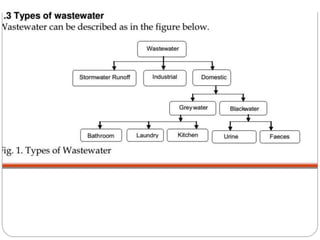
 Stormwater Runoff is water from streets, open yard etc
after a rainfall event which run through drains or sewers.
Industrial wastewater is liquid waste from industrial
establishments such as factories, production units etc.
Domestic wastewater also known as municipal wastewater
is basically wastewater from residences (homes), business
buildings (e.g. hotels) and institutions (e.g. university). It
can be categorized into grey water and black water.
Grey water also known as sullage is liquid waste from
washrooms, laundries, kitchens which does not contain
human or animal excreta.
Black water is wastewater generated in toilets. Black water
may also contain some flush water besides urine and
faeces (excreta).
 Urine and faeces together is sometimes referred to as
night soil.
Sewage is the term used for black water if it ends up in a
sewerage system.
Septage is the term used for black water if it ends up in a
septic tank.
Sewerage system is the arrangement of pipes laid for
conveying sewage.
Influent is wastewater which is yet to enter in a wastewater
treatment plant or liquid waste that is yet to undergo a unit
process or operation.
Effluent is the liquid stream which is discharged from a
wastewater treatment plant or discharge from a unit process
or operation.
Sludge is the semi-solid slurry from a wastewater treatment
plant.
On-Site System: this is wastewater disposal method
which takes place at the point of waste production
like within individual houses without transportation.
On- site methods include dry methods (pit latrines,
composting toilets), water saving methods
(pourflush latrine and aqua privy with soakage pits
and methods with high water rise (flush toilet with
septic tanks and soakage pit, which are not
emptied).
Off-Site System:, wastewater is transported to a
place either than the point ofproduction.
Off- site methods are bucket latrines, pour-flush
toilets with vault and tanker removal and
conventional sewerage system.
Conventional sewerage systems can be combined
sewers (where wastewater is carried with storm
Septic Tank is an on-site system designed to hold
black water for sufficiently long period to allow
sedimentation. It is usually a water tight single storey
tank.
Faecal sludge refers to all sludge collected and
transported from on-site sanitation systems by
vacuum trucks for disposal or treatment.
Unit Operation: this involves removal of contaminants
by physical forces.
Unit Process: this involves biological and/or chemical
removal of contaminants.
Wastewater Treatment Plant is a plant with a series of
designed unit operations and processes that aims at
reducing certain constituents of wastewater to
Characteristics of wastewater
 Physical
• Electrical Conductivity (EC) indicates the salt
content
• Total Dissolved Solids (TDS) comprise inorganic
salts and small amounts of organic
matter dissolved in water
• Suspended solids (SS) comprises solid particles
suspended (but not dissolved)in water
Chemical
• Dissolved Oxygen (DO) indicates the amount of
oxygen in water
• Biochemical oxygen demand (BOD) indicates the
amount of oxygen required by aerobic microorganisms
to decompose the organic matter in a sample of water
in a defined time period.
• Chemical oxygen demand (COD) indicates the
oxygen equivalent of the organic matter content of a
sample that is susceptible to oxidation by a strong
chemical oxidant
• Total Organic Compound (TOC)
• NH4-N and NO3-N show dissolved nitrogen
(Ammonium and Nitrate, respectively).
• Total Kjeldhal Nitrogen is a measurement of
organically-bound ammonia nitrogen.
• Total-P reflects the amount of all forms of
Biological
• Total coliforms (TC) is encompassing faecal
coliforms as well as common soil
microorganisms, and is a broad indicator of
possible water contamination.
• Faecal coliforms (FC) is an indicator of
water contamination with faecal matter. The
common lead indicator is the bacteria
Escherichia coli or E. coli.
• Helminth analysis looks for worm eggs in
the water
Process of wastewater treatment
 Physical unit operations
• Screening
• Comminution
• Flow equalization
• Sedimentation
• Flotation
• Granular-medium filtration
Chemical unit operations
• Chemical precipitation
• Adsorption
• Disinfection
• Dechlorination
Biological unit operations
 • Activated sludge process
• Aerated lagoon
• Trickling filters
• Rotating biological contactors
• Pond stabilization
• Anaerobic digestion
Levels of wastewater treatment
Pre-treatment
 Preliminary treatment
 Primary treatment
 Secondary treatment
 Sludge (biosolids) disposal
Pre-treatment
 Occurs in business or industry prior to discharge
Prevention of toxic chemicals or excess nutrients
being discharged in wastewater
Pretreatment removes the large solids (such as
rags and sticks) that are carried in with the
wastewater. These are removed by screens
consisting of metal bars spaced at 19 mm
intervals which are placed across the influent
channels. Tines (metal combs) rake the collected
matter off these, and heavy objects such as
rocks (which would otherwise damage the
equipment)
Physical
 · Screening is removal of coarse solids by use of
a straining device.
· Sedimentation is gravity settling of pollutants out
of the wastewater.
· Flotation is the use of small gas bubbles
injected into the wastewater which causes
pollutant particles in the wastewater to rise to the
surface for subsequent removal.
· Air stripping is removal of volatile and semi-
volatile organic compounds from wastewater by
use of air flow.
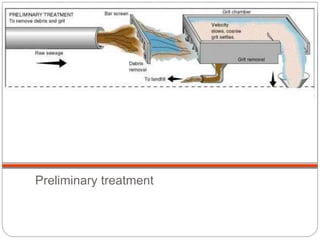
Preliminary treatment
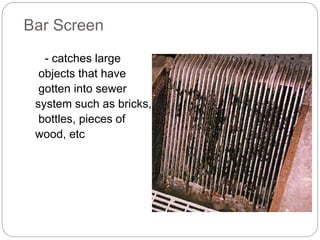
Bar Screen
- catches large
objects that have
gotten into sewer
system such as bricks,
bottles, pieces of
wood, etc
 Bar racks, often the first treatment devices to
be encountered by wastewaters en route to
renovation, protect pumps and other equipment
from damage. These devices remove objects
such as pieces of product or raw material, broken
or dropped items of maintenance equipment,
gloves, plastic wrapper material, or other
foreign objects that inadvertently gain access to
the industry’s system of drains and sewers
Grit Chamber
- removes rocks, gravel, broken glass, etc.
Mesh Screen
- removes diapers, combs, towels, plastic bags,
syringes, etc.
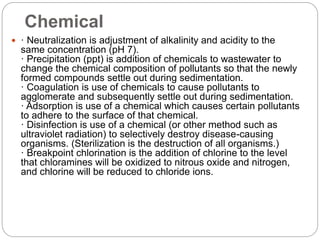
Chemical
 · Neutralization is adjustment of alkalinity and acidity to the
same concentration (pH 7).
· Precipitation (ppt) is addition of chemicals to wastewater to
change the chemical composition of pollutants so that the newly
formed compounds settle out during sedimentation.
· Coagulation is use of chemicals to cause pollutants to
agglomerate and subsequently settle out during sedimentation.
· Adsorption is use of a chemical which causes certain pollutants
to adhere to the surface of that chemical.
· Disinfection is use of a chemical (or other method such as
ultraviolet radiation) to selectively destroy disease-causing
organisms. (Sterilization is the destruction of all organisms.)
· Breakpoint chlorination is the addition of chlorine to the level
that chloramines will be oxidized to nitrous oxide and nitrogen,
and chlorine will be reduced to chloride ions.
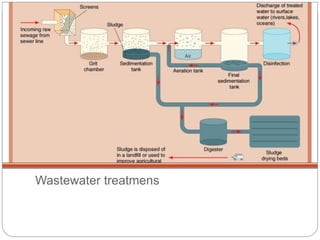
Wastewater treatmens
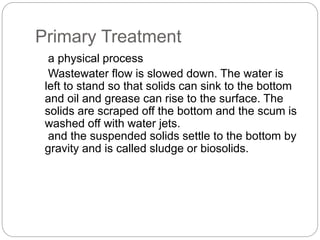
Primary Treatment
a physical process
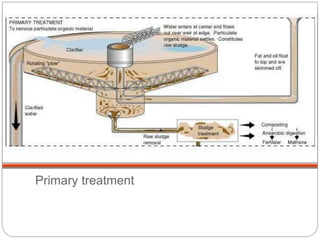
Wastewater flow is slowed down. The water is
left to stand so that solids can sink to the bottom
and oil and grease can rise to the surface. The
solids are scraped off the bottom and the scum is
washed off with water jets.
and the suspended solids settle to the bottom by
gravity and is called sludge or biosolids.
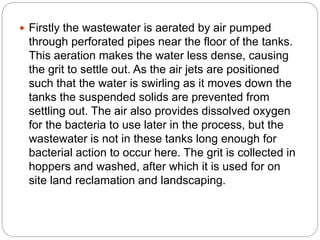
 Firstly the wastewater is aerated by air pumped
through perforated pipes near the floor of the tanks.
This aeration makes the water less dense, causing
the grit to settle out. As the air jets are positioned
such that the water is swirling as it moves down the
tanks the suspended solids are prevented from
settling out. The air also provides dissolved oxygen
for the bacteria to use later in the process, but the
wastewater is not in these tanks long enough for
bacterial action to occur here. The grit is collected in
hoppers and washed, after which it is used for on
site land reclamation and landscaping.
Sedimentation
 The water then flows slowly and smoothly
through the sedimentation tanks, where the
suspended solids fall to the bottom and scum
rises to the surface, while clarified effluent passes
on. The solids are removed from the bottom of
the tanks by scrapers, and scum is washed off
with water jets. The scum and solids are brought
to a common collection point where they are
combined to form 'sludge' and sent off for
secondary treatment.
Sludge from the primary sedimentation tanks is
pumped to the sludge thickener.
- more settling occurs to concentrate the sludge prior
to disposal
Primary treatment reduces the suspended solids and
the B.O.D. of the wastewater.
From the primary treatment tanks water is pumped
to the trickling filter for secondary treatment.
Secondary treatment will further reduce the
suspended solids and B.O.D. of the wastewater
Primary treatment
Secondary Treatment
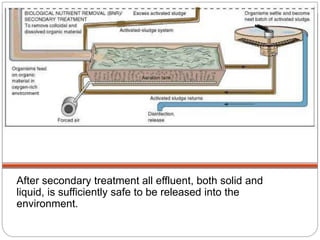
After secondary treatment all effluent, both solid and
liquid, is sufficiently safe to be released into the
environment.
Secondary treatment
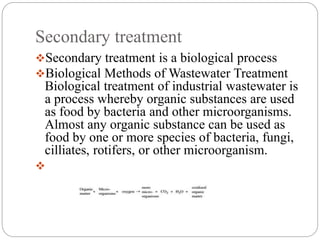
Secondary treatment is a biological process
Biological Methods of Wastewater Treatment
Biological treatment of industrial wastewater is
a process whereby organic substances are used
as food by bacteria and other microorganisms.
Almost any organic substance can be used as
food by one or more species of bacteria, fungi,
cilliates, rotifers, or other microorganism.

It requires control of:
• Temperature moisture pH level of aeration inhibitors
such as metals nutrients
 Biological treatment processes must be conducted within
the correct temperature range, with an appropriate
moisture level and acidity or alkalinity, and with the right
level of aeration.
• Temperature limits – for the appropriate bacteria to live,
the temperature must be within the appropriate range.
These are usually referred to as mesophilic (30-40oC)
and thermophilic (45-55oC) ranges.
• Minimum moisture is always necessary, but other
influences, such as aeration, influence the level of
moisture needed. For wastewater treatment, which is the
most common application for biological treatment,
minimum moisture levels are not a concern.
• The capability of the different microbial species to
break down organic wastes depends to a large
extent on the pH of the medium. Methanogens
operate between pH 6 and pH 8. When there is a
risk of changes to the acidity, it is advisable to
regularly measure and control the pH.
• Aerobic processes can only take place in presence
of free oxygen, generally oxygen from the air. For
anaerobic breakdown, oxygen is an inhibitor. The
most well-known bacteria inhibited by oxygen is the
pathogenic agent of tetanus, hence the reason why
wounds must always be aerated.
• Biological processes can be adversely affected by
the presence of inhibitors such as metals (copper,
silver) or chemicals such as pesticides which may be
Solids Sludge
 Solids Sludge from the sedimentation tanks is
digested anaerobically in large tanks, and then
further digested in lagoons before being dried in
dewatering beds. In the sludge digesters the
sludge is kept at 37oC and mechanically mixed to
ensure optimum operation. During this time the
organic compounds within the sludge are
converted to carboxylic acids and then finally to
methane and carbon dioxide. This gaseous mix is
known as "biogas", and is a valuable source of
fuel.
From secondary treatment on the trickling filter water
flows to the final clarifiers for further removal of
sludge.
The final clarifiers are another set of primary
sedimentation tanks.
From the final clarifiers the water is discharged back
to the River.

Industrial waste water

  • 1.
  • 2.
     Wastewater iswater whose physical, chemical or biological properties have been changed as a result of the introduction of certain substances which render it unsafe for some purposes such as drinking.  Wastewater treatment is the process and technology that is used to remove most of the contaminants that are found in wastewater to ensure a sound environment and good public health.
  • 3.
    Objectives of wastewater treatment Reduction of biodegradable organic substances in the environment: organic substances such as carbon, nitrogen, phosphorus, sulphur in organic matter needs to be broken down by oxidation into gases which is either released or remains in solution.  Reduction of nutrient concentration in the environment: Elimination of pathogens  Recycling and Reuse of water
  • 5.
    Definition of conceptsand terminology  Stormwater Runoff is water from streets, open yard etc after a rainfall event which run through drains or sewers. Industrial wastewater is liquid waste from industrial establishments such as factories, production units etc. Domestic wastewater also known as municipal wastewater is basically wastewater from residences (homes), business buildings (e.g. hotels) and institutions (e.g. university). It can be categorized into grey water and black water. Grey water also known as sullage is liquid waste from washrooms, laundries, kitchens which does not contain human or animal excreta. Black water is wastewater generated in toilets. Black water may also contain some flush water besides urine and faeces (excreta).  Urine and faeces together is sometimes referred to as night soil.
  • 6.
    Sewage is theterm used for black water if it ends up in a sewerage system. Septage is the term used for black water if it ends up in a septic tank. Sewerage system is the arrangement of pipes laid for conveying sewage. Influent is wastewater which is yet to enter in a wastewater treatment plant or liquid waste that is yet to undergo a unit process or operation. Effluent is the liquid stream which is discharged from a wastewater treatment plant or discharge from a unit process or operation. Sludge is the semi-solid slurry from a wastewater treatment plant.
  • 7.
    On-Site System: thisis wastewater disposal method which takes place at the point of waste production like within individual houses without transportation. On- site methods include dry methods (pit latrines, composting toilets), water saving methods (pourflush latrine and aqua privy with soakage pits and methods with high water rise (flush toilet with septic tanks and soakage pit, which are not emptied). Off-Site System:, wastewater is transported to a place either than the point ofproduction. Off- site methods are bucket latrines, pour-flush toilets with vault and tanker removal and conventional sewerage system. Conventional sewerage systems can be combined sewers (where wastewater is carried with storm
  • 8.
    Septic Tank isan on-site system designed to hold black water for sufficiently long period to allow sedimentation. It is usually a water tight single storey tank. Faecal sludge refers to all sludge collected and transported from on-site sanitation systems by vacuum trucks for disposal or treatment. Unit Operation: this involves removal of contaminants by physical forces. Unit Process: this involves biological and/or chemical removal of contaminants. Wastewater Treatment Plant is a plant with a series of designed unit operations and processes that aims at reducing certain constituents of wastewater to
  • 9.
    Characteristics of wastewater Physical • Electrical Conductivity (EC) indicates the salt content • Total Dissolved Solids (TDS) comprise inorganic salts and small amounts of organic matter dissolved in water • Suspended solids (SS) comprises solid particles suspended (but not dissolved)in water
  • 10.
    Chemical • Dissolved Oxygen(DO) indicates the amount of oxygen in water • Biochemical oxygen demand (BOD) indicates the amount of oxygen required by aerobic microorganisms to decompose the organic matter in a sample of water in a defined time period. • Chemical oxygen demand (COD) indicates the oxygen equivalent of the organic matter content of a sample that is susceptible to oxidation by a strong chemical oxidant • Total Organic Compound (TOC) • NH4-N and NO3-N show dissolved nitrogen (Ammonium and Nitrate, respectively). • Total Kjeldhal Nitrogen is a measurement of organically-bound ammonia nitrogen. • Total-P reflects the amount of all forms of
  • 11.
    Biological • Total coliforms(TC) is encompassing faecal coliforms as well as common soil microorganisms, and is a broad indicator of possible water contamination. • Faecal coliforms (FC) is an indicator of water contamination with faecal matter. The common lead indicator is the bacteria Escherichia coli or E. coli. • Helminth analysis looks for worm eggs in the water
  • 12.
    Process of wastewatertreatment  Physical unit operations • Screening • Comminution • Flow equalization • Sedimentation • Flotation • Granular-medium filtration Chemical unit operations • Chemical precipitation • Adsorption • Disinfection • Dechlorination
  • 13.
    Biological unit operations • Activated sludge process • Aerated lagoon • Trickling filters • Rotating biological contactors • Pond stabilization • Anaerobic digestion
  • 14.
    Levels of wastewatertreatment Pre-treatment  Preliminary treatment  Primary treatment  Secondary treatment  Sludge (biosolids) disposal
  • 15.
    Pre-treatment  Occurs inbusiness or industry prior to discharge Prevention of toxic chemicals or excess nutrients being discharged in wastewater Pretreatment removes the large solids (such as rags and sticks) that are carried in with the wastewater. These are removed by screens consisting of metal bars spaced at 19 mm intervals which are placed across the influent channels. Tines (metal combs) rake the collected matter off these, and heavy objects such as rocks (which would otherwise damage the equipment)
  • 16.
    Physical  · Screeningis removal of coarse solids by use of a straining device. · Sedimentation is gravity settling of pollutants out of the wastewater. · Flotation is the use of small gas bubbles injected into the wastewater which causes pollutant particles in the wastewater to rise to the surface for subsequent removal. · Air stripping is removal of volatile and semi- volatile organic compounds from wastewater by use of air flow.
  • 17.
  • 18.
    Bar Screen - catcheslarge objects that have gotten into sewer system such as bricks, bottles, pieces of wood, etc
  • 19.
     Bar racks,often the first treatment devices to be encountered by wastewaters en route to renovation, protect pumps and other equipment from damage. These devices remove objects such as pieces of product or raw material, broken or dropped items of maintenance equipment, gloves, plastic wrapper material, or other foreign objects that inadvertently gain access to the industry’s system of drains and sewers
  • 20.
    Grit Chamber - removesrocks, gravel, broken glass, etc. Mesh Screen - removes diapers, combs, towels, plastic bags, syringes, etc.
  • 21.
    Chemical  · Neutralizationis adjustment of alkalinity and acidity to the same concentration (pH 7). · Precipitation (ppt) is addition of chemicals to wastewater to change the chemical composition of pollutants so that the newly formed compounds settle out during sedimentation. · Coagulation is use of chemicals to cause pollutants to agglomerate and subsequently settle out during sedimentation. · Adsorption is use of a chemical which causes certain pollutants to adhere to the surface of that chemical. · Disinfection is use of a chemical (or other method such as ultraviolet radiation) to selectively destroy disease-causing organisms. (Sterilization is the destruction of all organisms.) · Breakpoint chlorination is the addition of chlorine to the level that chloramines will be oxidized to nitrous oxide and nitrogen, and chlorine will be reduced to chloride ions.
  • 22.
  • 23.
    Primary Treatment a physicalprocess Wastewater flow is slowed down. The water is left to stand so that solids can sink to the bottom and oil and grease can rise to the surface. The solids are scraped off the bottom and the scum is washed off with water jets. and the suspended solids settle to the bottom by gravity and is called sludge or biosolids.
  • 24.
     Firstly thewastewater is aerated by air pumped through perforated pipes near the floor of the tanks. This aeration makes the water less dense, causing the grit to settle out. As the air jets are positioned such that the water is swirling as it moves down the tanks the suspended solids are prevented from settling out. The air also provides dissolved oxygen for the bacteria to use later in the process, but the wastewater is not in these tanks long enough for bacterial action to occur here. The grit is collected in hoppers and washed, after which it is used for on site land reclamation and landscaping.
  • 25.
    Sedimentation  The waterthen flows slowly and smoothly through the sedimentation tanks, where the suspended solids fall to the bottom and scum rises to the surface, while clarified effluent passes on. The solids are removed from the bottom of the tanks by scrapers, and scum is washed off with water jets. The scum and solids are brought to a common collection point where they are combined to form 'sludge' and sent off for secondary treatment.
  • 26.
    Sludge from theprimary sedimentation tanks is pumped to the sludge thickener. - more settling occurs to concentrate the sludge prior to disposal Primary treatment reduces the suspended solids and the B.O.D. of the wastewater. From the primary treatment tanks water is pumped to the trickling filter for secondary treatment. Secondary treatment will further reduce the suspended solids and B.O.D. of the wastewater
  • 27.
  • 28.
    Secondary Treatment After secondarytreatment all effluent, both solid and liquid, is sufficiently safe to be released into the environment.
  • 29.
    Secondary treatment Secondary treatmentis a biological process Biological Methods of Wastewater Treatment Biological treatment of industrial wastewater is a process whereby organic substances are used as food by bacteria and other microorganisms. Almost any organic substance can be used as food by one or more species of bacteria, fungi, cilliates, rotifers, or other microorganism. 
  • 30.
    It requires controlof: • Temperature moisture pH level of aeration inhibitors such as metals nutrients  Biological treatment processes must be conducted within the correct temperature range, with an appropriate moisture level and acidity or alkalinity, and with the right level of aeration. • Temperature limits – for the appropriate bacteria to live, the temperature must be within the appropriate range. These are usually referred to as mesophilic (30-40oC) and thermophilic (45-55oC) ranges. • Minimum moisture is always necessary, but other influences, such as aeration, influence the level of moisture needed. For wastewater treatment, which is the most common application for biological treatment, minimum moisture levels are not a concern.
  • 31.
    • The capabilityof the different microbial species to break down organic wastes depends to a large extent on the pH of the medium. Methanogens operate between pH 6 and pH 8. When there is a risk of changes to the acidity, it is advisable to regularly measure and control the pH. • Aerobic processes can only take place in presence of free oxygen, generally oxygen from the air. For anaerobic breakdown, oxygen is an inhibitor. The most well-known bacteria inhibited by oxygen is the pathogenic agent of tetanus, hence the reason why wounds must always be aerated. • Biological processes can be adversely affected by the presence of inhibitors such as metals (copper, silver) or chemicals such as pesticides which may be
  • 32.
    Solids Sludge  SolidsSludge from the sedimentation tanks is digested anaerobically in large tanks, and then further digested in lagoons before being dried in dewatering beds. In the sludge digesters the sludge is kept at 37oC and mechanically mixed to ensure optimum operation. During this time the organic compounds within the sludge are converted to carboxylic acids and then finally to methane and carbon dioxide. This gaseous mix is known as "biogas", and is a valuable source of fuel.
  • 33.
    From secondary treatmenton the trickling filter water flows to the final clarifiers for further removal of sludge. The final clarifiers are another set of primary sedimentation tanks. From the final clarifiers the water is discharged back to the River.