Wastewater TreatmentWastewater Treatment
By Samuel LamBy Samuel Lam
What is wastewater treatmentWhat is wastewater treatment
• Usually refer to sewage treatment, or
domestic wastewater treatment
• process of removing contaminants from
wastewater, both runoff and domestic
GoalsGoals
• To produce waste stream (effluent)
• To produce solid waste (sludge)
• To discharge or reuse them back into the
environment
Where does wastewater comeWhere does wastewater come
from?from?
• Residences (kitchen, bathroom)
• Commercial institution
• Industrial institution (usually require
specialized treatment process)
How can it be treated?How can it be treated?
• collected and transported via a network of
pipes and pump stations to a municipal
treatment plant
3 stages of water treatment3 stages of water treatment
• Primary
– solids are separated
• Secondary
– dissolved biological matter is converted into a solid
mass by using water-borne bacteria
– 95% of the suspended molecules should be removed
• Tertiary
– biological solids are neutralized then disposed, and
treated water may be disinfected chemically or
physically
Types of treatmentTypes of treatment
• Mechanical treatment
– Influx (Influent)
– Removal of large objects
– Removal of sand and grit
– Primary Sedimentation
• Biological treatment
– Trickling bed filter
– Activated sludge
• Chemical treatment
– Disinfection
Preliminary treatmentPreliminary treatment
• Remove large objects
• Ex: sticks, rags, toilet paper, tampons
• Raked screen
• Clog equipment in sewage treatment plant
Treatment stages - PrimaryTreatment stages - Primary
treatmenttreatment
• typical materials that are removed during
primary treatment include
– fats, oils, and greases (aka FOG)
– sand, gravels and rocks (aka grit)
– larger settleable solids including human
waste, and
– floating materials
Methods used in primary treatmentMethods used in primary treatment
• Sand catcher
– Remove sand and grit
– Control wastewater velocity
• Sand grit and stone settle
• Keep suspended organic matter in water
– Damage equipments in the remaining
treatment stage
– Landfill
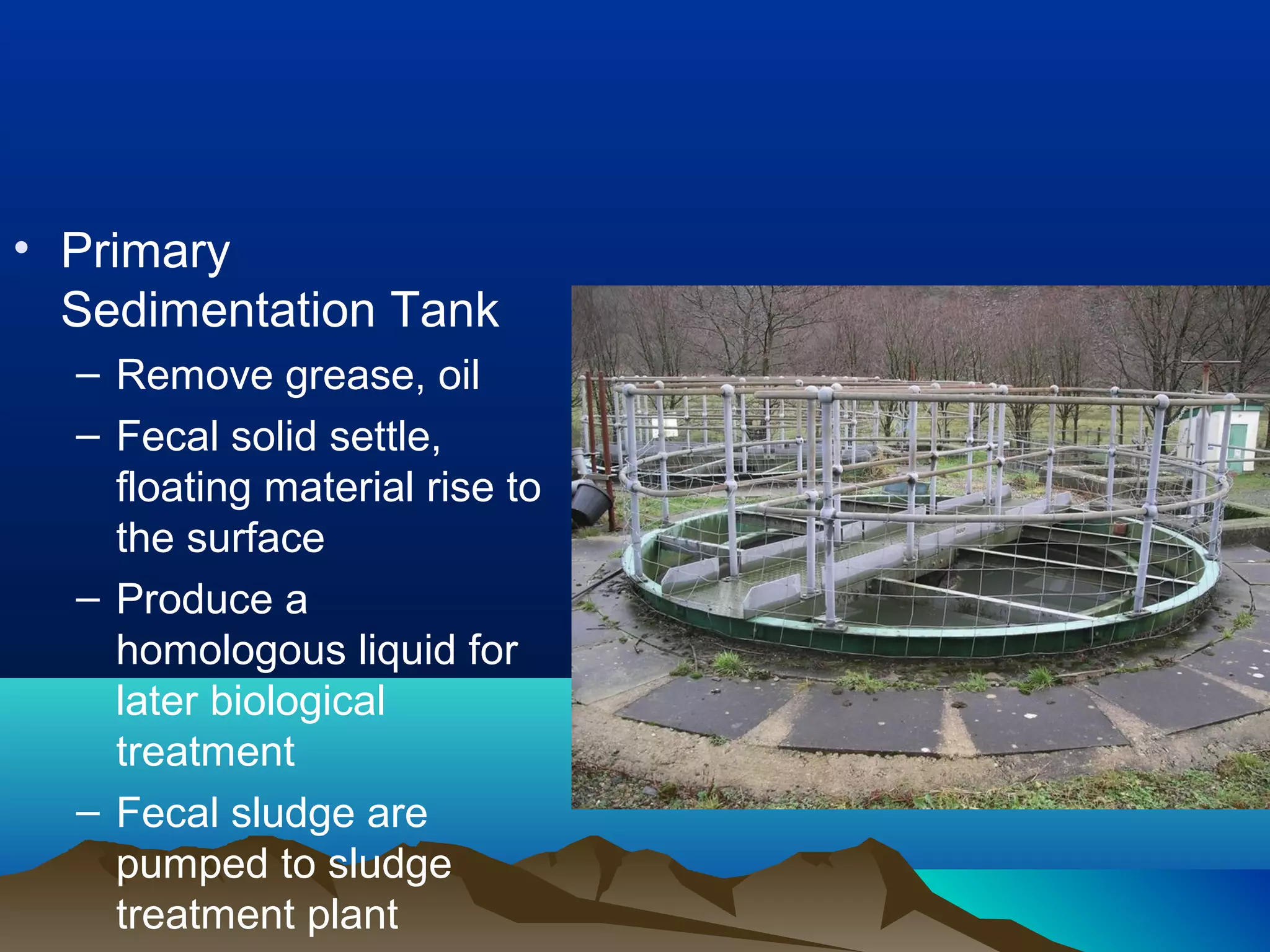
• Primary
Sedimentation Tank
– Remove grease, oil
– Fecal solid settle,
floating material rise to
the surface
– Produce a
homologous liquid for
later biological
treatment
– Fecal sludge are
pumped to sludge
treatment plant
Treatment stages - SecondaryTreatment stages - Secondary
treatmenttreatment
• Degrade biological content (dissolved
organic matter) of the sewage
– Ex: human waste, food waste, soaps,
detergent
• Added bacteria and protozoa into sewage
• 3 different approaches
– Fixed film system
– Suspended film system
– Lagoon system
Three approachesThree approaches
• Fixed Film Systems
– grow microorganisms on substrates such as
rocks, sand or plastic
– wastewater is spread over the substrate
– Ex: Trickling filters, rotating biological
contactors
Trickling filters bedTrickling filters bed
• Spread wastewater
over microorganism
• made of coke
(carbonised coal),
limestone chips or
specially fabricated
plastic media
• Optimize their
thickness by insect or
worm grazing
• Suspended Film Systems
– stir and suspend microorganisms in
wastewater
– settled out as a sludge
– pumped back into the incoming wastewater
– Ex: Activated sludge, extended aeration
Activated sludgeActivated sludge
• mixed community of microorganisms
• Both aerobic and anaerobic bacteria may
exist
• Biological floc is formed
5 physical components of activated5 physical components of activated
sludge processsludge process
• aeration tank
– oxygen is introduced into the system
• aeration source
– ensure that adequate oxygen is fed into the tank
– provided pure oxygen or compressed air
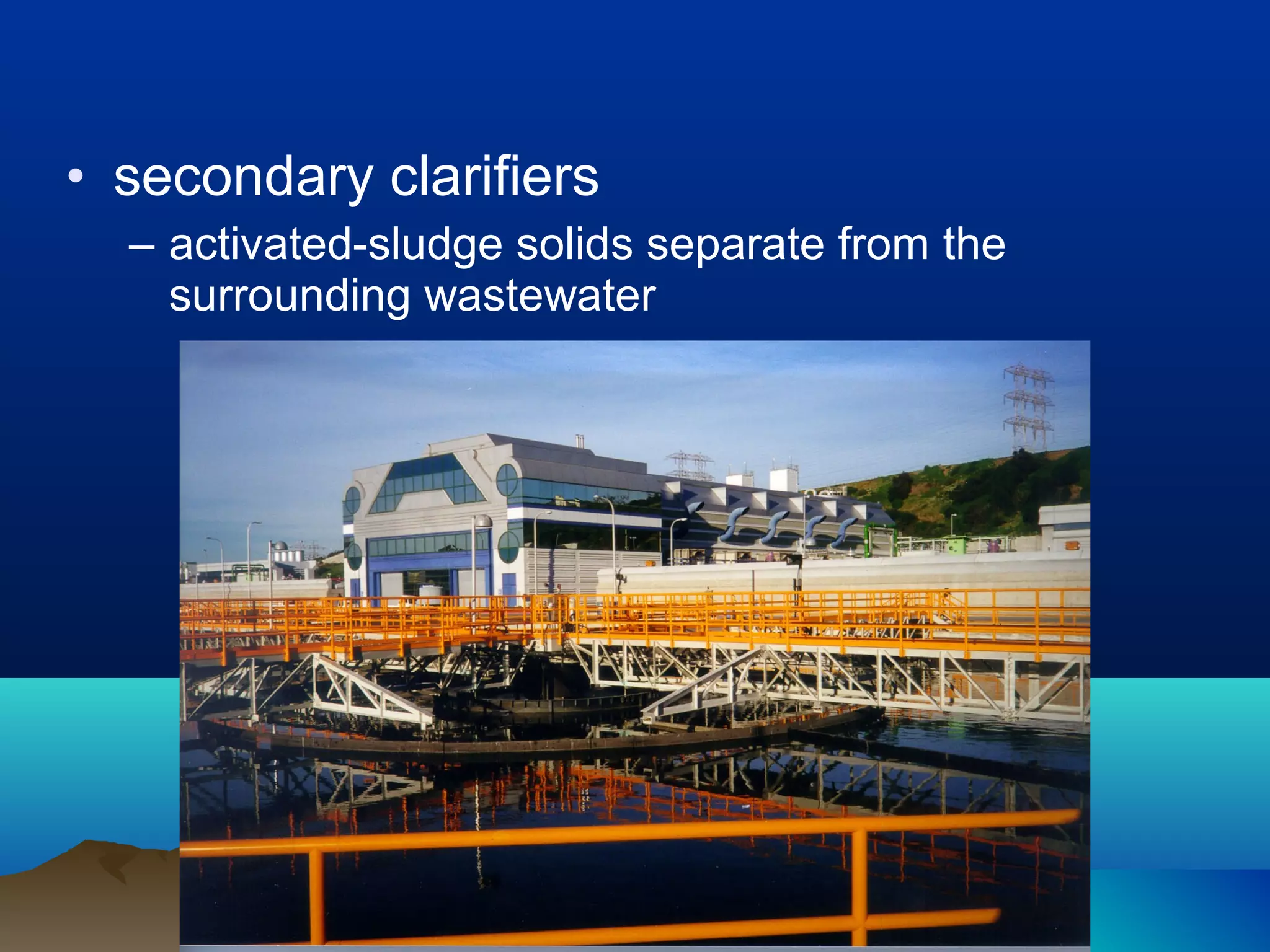
• secondary clarifiers
– activated-sludge solids separate from the
surrounding wastewater
• Activated sludge
outflow line
– Pump activated sludge
back to the aeration
tank
• Effluent outflow line
– discharged effluent
into bay or tertiary
treatment plant
• Lagoon Systems
– hold the waste-water for several months
– natural degradation of sewage
– Usually reeds are preferred
Treatment stages – TertiaryTreatment stages – Tertiary
treatmenttreatment
• remove disease-causing organisms from
wastewater
• 3 different disinfection process
– Chlorination
– UV light radiation
– Ozonation
ChlorinationChlorination
• Most common
• Advantages: low
cost & effective
• Disadvantages:
chlorine residue
could be harmful to
environment
UV light radiationUV light radiation
• Damage the genetic
structure of bacteria,
viruses and other
pathogens.
• Advantages: no
chemicals are used
• water taste more
natural
• Disadvantages: high
maintenance of the UV-
lamp
OzonationOzonation
• Oxidized most pathogenic microorganisms
• Advantages: safer than chlorination
fewer disinfection by-product
• Disadvantage: high cost
What can effluent use for?What can effluent use for?
• discharged into a stream, river, bay,
lagoon or wetland
• used for the irrigation of a golf course,
green way or park
• If it’s sufficiently clean, it can be used for
groundwater recharge
Advanced TreatmentAdvanced Treatment
• Nitrogen removal
– Ammonia (NH3) → nitrite (NO2
-
)→ nitrate (NO3
-
)
• Phosphorous removal
– Precipitation with iron or aluminums salt
• Lead to eutrophication
• May cause algae bloom
Sludge treatmentSludge treatment
• Primary sludge usually have strong odors
• Secondary sludge have high
concentration of microorganism
• Goals of treatments are:
– Reduce odors
– Remove water reduce volume
– Decompose organic matter
• Untreated sludge are about 97 percent water
• Settling can reduce about 92 to 96 percent of
water
• dried sludge is called a sludge cake
3 different sludge treatments3 different sludge treatments
• Aerobic digestion
• Anaerobic digestion
• composting
Aerobic digestionAerobic digestion
• Bacterial process
• Need oxygen
• Consume organic matter
• Convert into carbon dioxide (CO2)
Anaerobic digestionAnaerobic digestion
• Bacterial process
• Do not require oxygen
• Consume organic matter
• Produce biogas, which can be used in
generators for electricity
CompostingComposting
• aerobic process
• requires the correct
mix of carbon,
nitrogen, oxygen
and water with
sludge
• Generate large
amount of heat
Sludge disposalSludge disposal
• Superheat sludge and convert into small
granules that are rich in nitrogen
– Sell it to local farmer as fertilizer
• Spread sludge cake on the field
• Save landfill space
SummarySummary
QuestionsQuestions

Waste water treatment

  • 1.
  • 2.
    What is wastewatertreatmentWhat is wastewater treatment • Usually refer to sewage treatment, or domestic wastewater treatment • process of removing contaminants from wastewater, both runoff and domestic
  • 3.
    GoalsGoals • To producewaste stream (effluent) • To produce solid waste (sludge) • To discharge or reuse them back into the environment
  • 4.
    Where does wastewatercomeWhere does wastewater come from?from? • Residences (kitchen, bathroom) • Commercial institution • Industrial institution (usually require specialized treatment process)
  • 5.
    How can itbe treated?How can it be treated? • collected and transported via a network of pipes and pump stations to a municipal treatment plant
  • 6.
    3 stages ofwater treatment3 stages of water treatment • Primary – solids are separated • Secondary – dissolved biological matter is converted into a solid mass by using water-borne bacteria – 95% of the suspended molecules should be removed • Tertiary – biological solids are neutralized then disposed, and treated water may be disinfected chemically or physically
  • 7.
    Types of treatmentTypesof treatment • Mechanical treatment – Influx (Influent) – Removal of large objects – Removal of sand and grit – Primary Sedimentation • Biological treatment – Trickling bed filter – Activated sludge • Chemical treatment – Disinfection
  • 8.
    Preliminary treatmentPreliminary treatment •Remove large objects • Ex: sticks, rags, toilet paper, tampons • Raked screen • Clog equipment in sewage treatment plant
  • 9.
    Treatment stages -PrimaryTreatment stages - Primary treatmenttreatment • typical materials that are removed during primary treatment include – fats, oils, and greases (aka FOG) – sand, gravels and rocks (aka grit) – larger settleable solids including human waste, and – floating materials
  • 10.
    Methods used inprimary treatmentMethods used in primary treatment • Sand catcher – Remove sand and grit – Control wastewater velocity • Sand grit and stone settle • Keep suspended organic matter in water – Damage equipments in the remaining treatment stage – Landfill
  • 11.
    • Primary Sedimentation Tank –Remove grease, oil – Fecal solid settle, floating material rise to the surface – Produce a homologous liquid for later biological treatment – Fecal sludge are pumped to sludge treatment plant
  • 12.
    Treatment stages -SecondaryTreatment stages - Secondary treatmenttreatment • Degrade biological content (dissolved organic matter) of the sewage – Ex: human waste, food waste, soaps, detergent • Added bacteria and protozoa into sewage • 3 different approaches – Fixed film system – Suspended film system – Lagoon system
  • 13.
    Three approachesThree approaches •Fixed Film Systems – grow microorganisms on substrates such as rocks, sand or plastic – wastewater is spread over the substrate – Ex: Trickling filters, rotating biological contactors
  • 14.
    Trickling filters bedTricklingfilters bed • Spread wastewater over microorganism • made of coke (carbonised coal), limestone chips or specially fabricated plastic media • Optimize their thickness by insect or worm grazing
  • 15.
    • Suspended FilmSystems – stir and suspend microorganisms in wastewater – settled out as a sludge – pumped back into the incoming wastewater – Ex: Activated sludge, extended aeration
  • 16.
    Activated sludgeActivated sludge •mixed community of microorganisms • Both aerobic and anaerobic bacteria may exist • Biological floc is formed
  • 17.
    5 physical componentsof activated5 physical components of activated sludge processsludge process • aeration tank – oxygen is introduced into the system
  • 18.
    • aeration source –ensure that adequate oxygen is fed into the tank – provided pure oxygen or compressed air
  • 19.
    • secondary clarifiers –activated-sludge solids separate from the surrounding wastewater
  • 20.
    • Activated sludge outflowline – Pump activated sludge back to the aeration tank • Effluent outflow line – discharged effluent into bay or tertiary treatment plant
  • 22.
    • Lagoon Systems –hold the waste-water for several months – natural degradation of sewage – Usually reeds are preferred
  • 23.
    Treatment stages –TertiaryTreatment stages – Tertiary treatmenttreatment • remove disease-causing organisms from wastewater • 3 different disinfection process – Chlorination – UV light radiation – Ozonation
  • 24.
    ChlorinationChlorination • Most common •Advantages: low cost & effective • Disadvantages: chlorine residue could be harmful to environment
  • 25.
    UV light radiationUVlight radiation • Damage the genetic structure of bacteria, viruses and other pathogens. • Advantages: no chemicals are used • water taste more natural • Disadvantages: high maintenance of the UV- lamp
  • 26.
    OzonationOzonation • Oxidized mostpathogenic microorganisms • Advantages: safer than chlorination fewer disinfection by-product • Disadvantage: high cost
  • 27.
    What can effluentuse for?What can effluent use for? • discharged into a stream, river, bay, lagoon or wetland • used for the irrigation of a golf course, green way or park • If it’s sufficiently clean, it can be used for groundwater recharge
  • 28.
    Advanced TreatmentAdvanced Treatment •Nitrogen removal – Ammonia (NH3) → nitrite (NO2 - )→ nitrate (NO3 - ) • Phosphorous removal – Precipitation with iron or aluminums salt • Lead to eutrophication • May cause algae bloom
  • 29.
    Sludge treatmentSludge treatment •Primary sludge usually have strong odors • Secondary sludge have high concentration of microorganism • Goals of treatments are: – Reduce odors – Remove water reduce volume – Decompose organic matter
  • 30.
    • Untreated sludgeare about 97 percent water • Settling can reduce about 92 to 96 percent of water • dried sludge is called a sludge cake
  • 31.
    3 different sludgetreatments3 different sludge treatments • Aerobic digestion • Anaerobic digestion • composting
  • 32.
    Aerobic digestionAerobic digestion •Bacterial process • Need oxygen • Consume organic matter • Convert into carbon dioxide (CO2)
  • 33.
    Anaerobic digestionAnaerobic digestion •Bacterial process • Do not require oxygen • Consume organic matter • Produce biogas, which can be used in generators for electricity
  • 34.
    CompostingComposting • aerobic process •requires the correct mix of carbon, nitrogen, oxygen and water with sludge • Generate large amount of heat
  • 35.
    Sludge disposalSludge disposal •Superheat sludge and convert into small granules that are rich in nitrogen – Sell it to local farmer as fertilizer • Spread sludge cake on the field • Save landfill space
  • 36.
  • 37.