By,
DAMARIS BENNY DANIEL
II MSc. Zoology
INTRODUCTION
• Physical, chemical or biological change in the water quality that
adversely affects the living organisms or makes water unsuitable for
desired uses is water pollution.
• Water pollution abatement technologies are used to reduce the
harmful effects of polluted water.
• It mainly includes wastewater treatment that uses physical, chemical
and biological methods to remove contaminants.
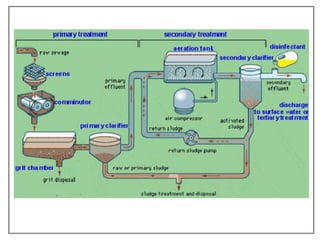
• The treatment of wastewater is mainly carried out in 3 stages
– Primary treatment
– Secondary treatment
– Tertiary treatment
PRIMARY TREATMENT
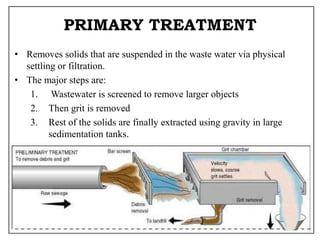
• Removes solids that are suspended in the waste water via physical
settling or filtration.
• The major steps are:
1. Wastewater is screened to remove larger objects
2. Then grit is removed
3. Rest of the solids are finally extracted using gravity in large
sedimentation tanks.
BAR SCREEN
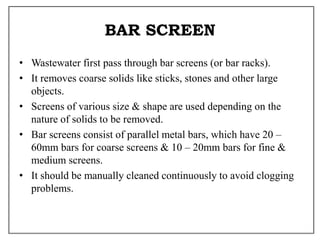
• Wastewater first pass through bar screens (or bar racks).
• It removes coarse solids like sticks, stones and other large
objects.
• Screens of various size & shape are used depending on the
nature of solids to be removed.
• Bar screens consist of parallel metal bars, which have 20 –
60mm bars for coarse screens & 10 – 20mm bars for fine &
medium screens.
• It should be manually cleaned continuously to avoid clogging
problems.
GRIT CHAMBER
• Grit – small & dense materials like sand, dirt or broken glass.
• It is usually removed in grit chamber.
• It is a chamber in which the velocity of waste water flow is
reduced to a point where the denser grit will settle out, but the
organic solids will remain in suspension.
• Usually the velocity of flow will be b/w 0.15 – 0.3m/s
SEDIMENTATION TANK
• From grit chamber the effluent is passed into a primary settling tank
(Sedimentation tank).
• Here the suspended solids are removed by gravitational settling
under motionless conditions.
• Flocculants ( chemicals used to precipitate insoluble substances) are
added to water to promote sedimentation.
• The purpose of flocculation is to cause small pollutant particles to
aggregate and form large enough floc so that they settle down fast.
• Wastewater is let to stand for 2 – 3 hrs and it results in the removal
of 50% - 65% of suspended solids
• The settled solids is called primary sludge or raw sludge.
SEDIMENTATION TANK
• It usually have
– Inlet zone
– Settling zone
– Sludge zone
– Outlet zone
SECONDARY TREATMENT
• After primary treatment the effluent undergoes a secondary
treatment which degrades the biological content of the sewage.
• This usually uses biological processes.
• Microorganisms are introduced to the wastewater and consume the
organic matter, oxygen is delivered to the system ensuring
microorganism survival.
• This biological process occurs naturally in nature, but is accelerated
in secondary treatment systems.
• This is mainly done by activated sludge process, trickling filters,
aerated lagoons and oxidation ponds.
ACTIVATED SLUDGE PROCESS
• Activated Sludge Process uses micro organisms to feed on organic
contaminants in waste water.
• Basic principle
– When micro organisms grow, they form particles that clump
together
– These particles ( floc) are allowed to settle to the bottom of the
tank, leaving a relatively clear liquid free of organic material and
suspended solids.
• Thus, the settled organic matter that consist of several activated micro
organisms are called activated sludge.
ACTIVATED SLUDGE PROCESS
Process
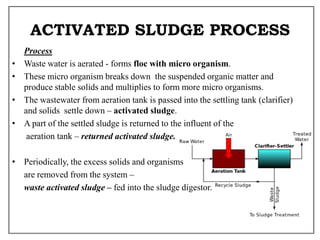
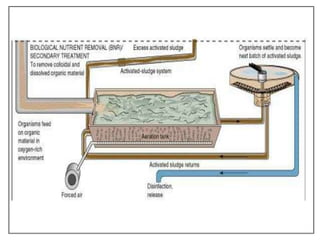
• Waste water is aerated - forms floc with micro organism.
• These micro organism breaks down the suspended organic matter and
produce stable solids and multiplies to form more micro organisms.
• The wastewater from aeration tank is passed into the settling tank (clarifier)
and solids settle down – activated sludge.
• A part of the settled sludge is returned to the influent of the
aeration tank – returned activated sludge.
• Periodically, the excess solids and organisms
are removed from the system –
waste activated sludge – fed into the sludge digestor.
SLUDGE DIGESTION
• The sludge which settles in the sedimentation basin is pumped
to the sludge digestors where a temperature of 30–35ºC is
maintained.
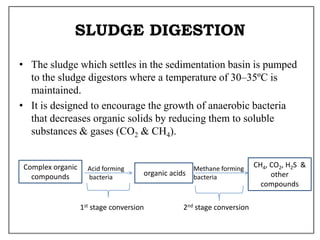
• It is designed to encourage the growth of anaerobic bacteria
that decreases organic solids by reducing them to soluble
substances & gases (CO2 & CH4).
Complex organic
compounds
Acid forming
bacteria
organic acids
Methane forming
bacteria
CH4, CO2, H2S &
other
compounds
1st stage conversion 2nd stage conversion
OXIDATION POND
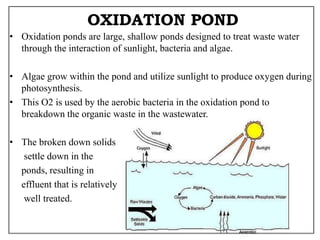
• Oxidation ponds are large, shallow ponds designed to treat waste water
through the interaction of sunlight, bacteria and algae.
• Algae grow within the pond and utilize sunlight to produce oxygen during
photosynthesis.
• This O2 is used by the aerobic bacteria in the oxidation pond to
breakdown the organic waste in the wastewater.
• The broken down solids
settle down in the
ponds, resulting in
effluent that is relatively
well treated.
AERATED LAGOON
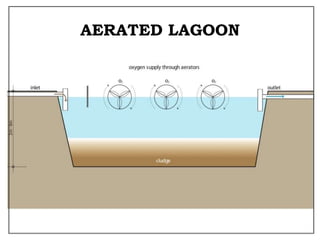
• It is a treatment pond with artificial aeration to promote the
biological oxidation of waste water.
• Natural lagoons are made up of three layers an aerobic (layer with
oxygen), an anaerobic (layer with no oxygen) and a facultative
(mixed layer).
• In a constructed aerated lagoon air is pumped into the lagoon to turn
the whole pond into an aerobic zone.
• Adding air to the water speeds up the natural processes that break
down organic waste.
• Mechanical aeration device is present which supply the oxygen
needed by bacteria for stabilization
AERATED LAGOON
TRICKLING FILTERS
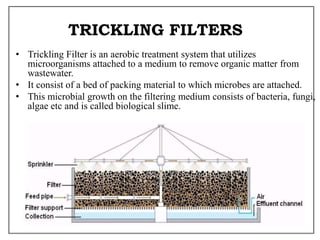
• Trickling Filter is an aerobic treatment system that utilizes
microorganisms attached to a medium to remove organic matter from
wastewater.
• It consist of a bed of packing material to which microbes are attached.
• This microbial growth on the filtering medium consists of bacteria, fungi,
algae etc and is called biological slime.
PROCESS
• Wastewater is sprayed into the air, then allowed to trickle through the
media.
• Microorganisms, attached to the media, break down organic material in
the wastewater.
• When more & more wastewater is passed, the slime layer thickens and
eventually gets detatched from the surface. This is called sloughing.
• A settling tank after the trickling filter, removes the detatched bacterial
film and some suspended matters.
TERTIARY TREATMENT
• It is the final treatment the waste water undergoes before it is
discharged into the environment.
• Also referred to as effluent polishing.
• The purpose of 30 treatment is to improve the 20 treated waste
by removing the nutrients and dissolved solids.
• The major processes done are:
– Filteration
– Nutrient removal
– Disinfection
• FILTERATION
• Either sand or activated charcoal is used to filter treated
effluent.
• NUTRIENT REMOVAL
• High levels of nutrients such as N2 & P must be removed –
otherwise eutrophication.
• Phosphorous removal
• Phosphorous can be removed by Polyphosphate accumulating
organisms (PAOs).
• It can also be removed by chemical precipitation, usually with
salts of Fe, Al or lime.
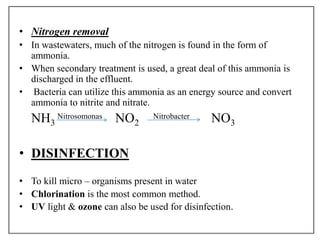
• Nitrogen removal
• In wastewaters, much of the nitrogen is found in the form of
ammonia.
• When secondary treatment is used, a great deal of this ammonia is
discharged in the effluent.
• Bacteria can utilize this ammonia as an energy source and convert
ammonia to nitrite and nitrate.
NH3 NO2 NO3
• DISINFECTION
• To kill micro – organisms present in water
• Chlorination is the most common method.
• UV light & ozone can also be used for disinfection.
Nitrosomonas Nitrobacter
RECENT DEVELOPMENTS
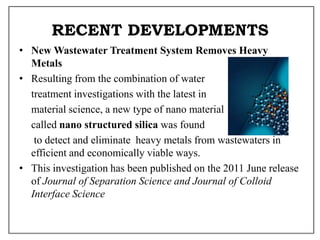
• New Wastewater Treatment System Removes Heavy
Metals
• Resulting from the combination of water
treatment investigations with the latest in
material science, a new type of nano material
called nano structured silica was found
to detect and eliminate heavy metals from wastewaters in
efficient and economically viable ways.
• This investigation has been published on the 2011 June release
of Journal of Separation Science and Journal of Colloid
Interface Science
CONCLUSION
• Waste water treatment is done to remove contaminants from
water.
• It is broadly classified into primary, secondary and tertiary
treatments.
• After going through all these processes, the water obtained
will be hygenic & safe for discharging into the environment.
BIBLIOGRAPHY
• Aloka Debi, Environmental Sience and Engineering (2008),
University Press, Hyderabad
• Chaudary D.S and Sundaravadivel M, Environmental management
(2004), Scitech Publications, Chennai.
• Madhab Chandra Dash and Satya Prakash Dash, Fundamentals of
Ecology, 3rd edition, McGraw Hill Companies, New Delhi.
• http://water.me.vccs.edu/courses/ENV108/lesson1_2.htm
• http://www.fao.org/docrep/t0551e/t0551e05.htm

Water pollution abatement technology

  • 1.
  • 2.
    INTRODUCTION • Physical, chemicalor biological change in the water quality that adversely affects the living organisms or makes water unsuitable for desired uses is water pollution. • Water pollution abatement technologies are used to reduce the harmful effects of polluted water. • It mainly includes wastewater treatment that uses physical, chemical and biological methods to remove contaminants. • The treatment of wastewater is mainly carried out in 3 stages – Primary treatment – Secondary treatment – Tertiary treatment
  • 3.
    PRIMARY TREATMENT • Removessolids that are suspended in the waste water via physical settling or filtration. • The major steps are: 1. Wastewater is screened to remove larger objects 2. Then grit is removed 3. Rest of the solids are finally extracted using gravity in large sedimentation tanks.
  • 4.
    BAR SCREEN • Wastewaterfirst pass through bar screens (or bar racks). • It removes coarse solids like sticks, stones and other large objects. • Screens of various size & shape are used depending on the nature of solids to be removed. • Bar screens consist of parallel metal bars, which have 20 – 60mm bars for coarse screens & 10 – 20mm bars for fine & medium screens. • It should be manually cleaned continuously to avoid clogging problems.
  • 5.
    GRIT CHAMBER • Grit– small & dense materials like sand, dirt or broken glass. • It is usually removed in grit chamber. • It is a chamber in which the velocity of waste water flow is reduced to a point where the denser grit will settle out, but the organic solids will remain in suspension. • Usually the velocity of flow will be b/w 0.15 – 0.3m/s
  • 6.
    SEDIMENTATION TANK • Fromgrit chamber the effluent is passed into a primary settling tank (Sedimentation tank). • Here the suspended solids are removed by gravitational settling under motionless conditions. • Flocculants ( chemicals used to precipitate insoluble substances) are added to water to promote sedimentation. • The purpose of flocculation is to cause small pollutant particles to aggregate and form large enough floc so that they settle down fast. • Wastewater is let to stand for 2 – 3 hrs and it results in the removal of 50% - 65% of suspended solids • The settled solids is called primary sludge or raw sludge.
  • 7.
    SEDIMENTATION TANK • Itusually have – Inlet zone – Settling zone – Sludge zone – Outlet zone
  • 8.
    SECONDARY TREATMENT • Afterprimary treatment the effluent undergoes a secondary treatment which degrades the biological content of the sewage. • This usually uses biological processes. • Microorganisms are introduced to the wastewater and consume the organic matter, oxygen is delivered to the system ensuring microorganism survival. • This biological process occurs naturally in nature, but is accelerated in secondary treatment systems. • This is mainly done by activated sludge process, trickling filters, aerated lagoons and oxidation ponds.
  • 9.
    ACTIVATED SLUDGE PROCESS •Activated Sludge Process uses micro organisms to feed on organic contaminants in waste water. • Basic principle – When micro organisms grow, they form particles that clump together – These particles ( floc) are allowed to settle to the bottom of the tank, leaving a relatively clear liquid free of organic material and suspended solids. • Thus, the settled organic matter that consist of several activated micro organisms are called activated sludge.
  • 10.
    ACTIVATED SLUDGE PROCESS Process •Waste water is aerated - forms floc with micro organism. • These micro organism breaks down the suspended organic matter and produce stable solids and multiplies to form more micro organisms. • The wastewater from aeration tank is passed into the settling tank (clarifier) and solids settle down – activated sludge. • A part of the settled sludge is returned to the influent of the aeration tank – returned activated sludge. • Periodically, the excess solids and organisms are removed from the system – waste activated sludge – fed into the sludge digestor.
  • 12.
    SLUDGE DIGESTION • Thesludge which settles in the sedimentation basin is pumped to the sludge digestors where a temperature of 30–35ºC is maintained. • It is designed to encourage the growth of anaerobic bacteria that decreases organic solids by reducing them to soluble substances & gases (CO2 & CH4). Complex organic compounds Acid forming bacteria organic acids Methane forming bacteria CH4, CO2, H2S & other compounds 1st stage conversion 2nd stage conversion
  • 13.
    OXIDATION POND • Oxidationponds are large, shallow ponds designed to treat waste water through the interaction of sunlight, bacteria and algae. • Algae grow within the pond and utilize sunlight to produce oxygen during photosynthesis. • This O2 is used by the aerobic bacteria in the oxidation pond to breakdown the organic waste in the wastewater. • The broken down solids settle down in the ponds, resulting in effluent that is relatively well treated.
  • 14.
    AERATED LAGOON • Itis a treatment pond with artificial aeration to promote the biological oxidation of waste water. • Natural lagoons are made up of three layers an aerobic (layer with oxygen), an anaerobic (layer with no oxygen) and a facultative (mixed layer). • In a constructed aerated lagoon air is pumped into the lagoon to turn the whole pond into an aerobic zone. • Adding air to the water speeds up the natural processes that break down organic waste. • Mechanical aeration device is present which supply the oxygen needed by bacteria for stabilization
  • 15.
  • 16.
    TRICKLING FILTERS • TricklingFilter is an aerobic treatment system that utilizes microorganisms attached to a medium to remove organic matter from wastewater. • It consist of a bed of packing material to which microbes are attached. • This microbial growth on the filtering medium consists of bacteria, fungi, algae etc and is called biological slime.
  • 17.
    PROCESS • Wastewater issprayed into the air, then allowed to trickle through the media. • Microorganisms, attached to the media, break down organic material in the wastewater. • When more & more wastewater is passed, the slime layer thickens and eventually gets detatched from the surface. This is called sloughing. • A settling tank after the trickling filter, removes the detatched bacterial film and some suspended matters.
  • 18.
    TERTIARY TREATMENT • Itis the final treatment the waste water undergoes before it is discharged into the environment. • Also referred to as effluent polishing. • The purpose of 30 treatment is to improve the 20 treated waste by removing the nutrients and dissolved solids. • The major processes done are: – Filteration – Nutrient removal – Disinfection
  • 19.
    • FILTERATION • Eithersand or activated charcoal is used to filter treated effluent. • NUTRIENT REMOVAL • High levels of nutrients such as N2 & P must be removed – otherwise eutrophication. • Phosphorous removal • Phosphorous can be removed by Polyphosphate accumulating organisms (PAOs). • It can also be removed by chemical precipitation, usually with salts of Fe, Al or lime.
  • 20.
    • Nitrogen removal •In wastewaters, much of the nitrogen is found in the form of ammonia. • When secondary treatment is used, a great deal of this ammonia is discharged in the effluent. • Bacteria can utilize this ammonia as an energy source and convert ammonia to nitrite and nitrate. NH3 NO2 NO3 • DISINFECTION • To kill micro – organisms present in water • Chlorination is the most common method. • UV light & ozone can also be used for disinfection. Nitrosomonas Nitrobacter
  • 22.
    RECENT DEVELOPMENTS • NewWastewater Treatment System Removes Heavy Metals • Resulting from the combination of water treatment investigations with the latest in material science, a new type of nano material called nano structured silica was found to detect and eliminate heavy metals from wastewaters in efficient and economically viable ways. • This investigation has been published on the 2011 June release of Journal of Separation Science and Journal of Colloid Interface Science
  • 23.
    CONCLUSION • Waste watertreatment is done to remove contaminants from water. • It is broadly classified into primary, secondary and tertiary treatments. • After going through all these processes, the water obtained will be hygenic & safe for discharging into the environment.
  • 24.
    BIBLIOGRAPHY • Aloka Debi,Environmental Sience and Engineering (2008), University Press, Hyderabad • Chaudary D.S and Sundaravadivel M, Environmental management (2004), Scitech Publications, Chennai. • Madhab Chandra Dash and Satya Prakash Dash, Fundamentals of Ecology, 3rd edition, McGraw Hill Companies, New Delhi. • http://water.me.vccs.edu/courses/ENV108/lesson1_2.htm • http://www.fao.org/docrep/t0551e/t0551e05.htm