WASTE MANAGEMENT
&
MICROBIAL DEGRADATION
GUIDED BY- PRESENTED BY-
OVERVIEW
• What is Waste? Types of Waste
• What is untreated waste?
• Why do we need to treat waste?
• Effects of untreated waste on environment
• Methods of waste treatment
• What is Microbial Degradation?
• Types of microbial degradation
• Role of microbial degradation in waste management
WHAT IS WASTE ?
• Waste and wastes are unwanted or unusable materials. Waste is any
substance which is discarded after primary use, or it is worthless,
defective and of no use.
• Usually waste is the outcome of the activity of man when he utilizes a
resource.
• Type of waste produced
depends on the activity
from which it was produced.
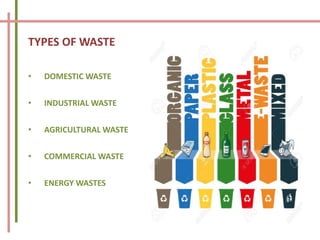
TYPES OF WASTE
• DOMESTIC WASTE
• INDUSTRIAL WASTE
• AGRICULTURAL WASTE
• COMMERCIAL WASTE
• ENERGY WASTES
IMPORTANCE OF WASTE TREATMENT
Over 1.8 billion tonnes of waste are generated each year. This equals to 3.5 tonnes
per person.
With such vast quantities of waste being produced, it is of vital importance that it
is managed in such a way that it does not cause any harm to either human health
or to the environment.
There are a number of different options available for the treatment and
management of waste including prevention, minimisation, re-use, recycling,
energy recovery and disposal.
Under EU policy, landfilling is seen as the last resort and should only be used when
all the other options have been exhausted , i.e., only material that cannot be
prevented, re-used, recycled or otherwise treated should be landfilled.
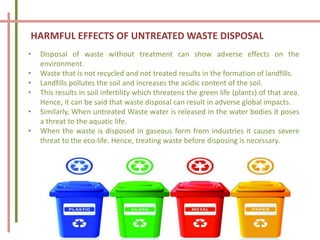
HARMFUL EFFECTS OF UNTREATED WASTE DISPOSAL
• Disposal of waste without treatment can show adverse effects on the
environment.
• Waste that is not recycled and not treated results in the formation of landfills.
• Landfills pollutes the soil and increases the acidic content of the soil.
• This results in soil infertility which threatens the green life (plants) of that area.
Hence, it can be said that waste disposal can result in adverse global impacts.
• Similarly, When untreated Waste water is released in the water bodies it poses
a threat to the aquatic life.
• When the waste is disposed in gaseous form from industries it causes severe
threat to the eco-life. Hence, treating waste before disposing is necessary.
METHODS OF SOLID WASTE TREATMENT
Methods of treatment depends
on the kind of waste that has to
be disposed.
Established treatments
• Composting
• Incineration
• Landfill
• Recycling
• Windrow composting
• Anaerobic digestion
• Bio drying
• Gasification
• Gas Plasma
• Land farming
• In-vessel composting
• Mechanical biological treatment
• Mechanical heat treatment
• Plasma
• Pyrolysis
• Refuse-derived fuel
• Sewage treatment
• Tunnel composting
• UASB (applied to solid wastes)
• Waste autoclave
Advanced methods
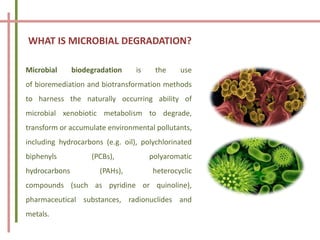
WHAT IS MICROBIAL DEGRADATION?
Microbial biodegradation is the use
of bioremediation and biotransformation methods
to harness the naturally occurring ability of
microbial xenobiotic metabolism to degrade,
transform or accumulate environmental pollutants,
including hydrocarbons (e.g. oil), polychlorinated
biphenyls (PCBs), polyaromatic
hydrocarbons (PAHs), heterocyclic
compounds (such as pyridine or quinoline),
pharmaceutical substances, radionuclides and
metals.
• Interest in the microbial biodegradation of pollutants has intensified in recent
years.
• And recent major methodological breakthroughs have enabled detailed genomic,
met genomic, proteomic, bioinformatics and other high-throughput analyses of
environmentally relevant microorganisms.
• Biological processes play a major role in the removal of contaminants and take
advantage of the catabolic versatility of microorganisms to degrade or convert such
compounds.
• In environmental microbiology, genome-based global studies are increasing the
understanding of metabolic and regulatory networks, as well as providing new
information on the evolution of degradation pathways and molecular adaptation
strategies to changing environmental conditions.
MICROBES ARE USED IN THE FOLLOWING PROCESSES
• Aerobic biodegradation of pollutants
• Anaerobic biodegradation of pollutants
• Bioavailability, chemotaxis, and transport of
pollutants
• Oil biodegradation
• Cholesterol biodegradation
• Analysis of waste biotreatment
• Metabolic engineering and biocatalytic applications
• Fungal biodegradation
TYPES OF MICROBIAL DEGRADATION
• microbial degradation of lube oil
• microbial degradation of pesticides
• microbial degradation of heavy metals
• microbial degradation of xenobiotic
• microbial degradation of pesticides
• microbial degradation of hydrocarbons
in the environment
• microbial degradation of lignin

microbial degradation in waste management

  • 1.
  • 2.
    OVERVIEW • What isWaste? Types of Waste • What is untreated waste? • Why do we need to treat waste? • Effects of untreated waste on environment • Methods of waste treatment • What is Microbial Degradation? • Types of microbial degradation • Role of microbial degradation in waste management
  • 3.
    WHAT IS WASTE? • Waste and wastes are unwanted or unusable materials. Waste is any substance which is discarded after primary use, or it is worthless, defective and of no use. • Usually waste is the outcome of the activity of man when he utilizes a resource. • Type of waste produced depends on the activity from which it was produced.
  • 4.
    TYPES OF WASTE •DOMESTIC WASTE • INDUSTRIAL WASTE • AGRICULTURAL WASTE • COMMERCIAL WASTE • ENERGY WASTES
  • 5.
    IMPORTANCE OF WASTETREATMENT Over 1.8 billion tonnes of waste are generated each year. This equals to 3.5 tonnes per person. With such vast quantities of waste being produced, it is of vital importance that it is managed in such a way that it does not cause any harm to either human health or to the environment. There are a number of different options available for the treatment and management of waste including prevention, minimisation, re-use, recycling, energy recovery and disposal. Under EU policy, landfilling is seen as the last resort and should only be used when all the other options have been exhausted , i.e., only material that cannot be prevented, re-used, recycled or otherwise treated should be landfilled.
  • 6.
    HARMFUL EFFECTS OFUNTREATED WASTE DISPOSAL • Disposal of waste without treatment can show adverse effects on the environment. • Waste that is not recycled and not treated results in the formation of landfills. • Landfills pollutes the soil and increases the acidic content of the soil. • This results in soil infertility which threatens the green life (plants) of that area. Hence, it can be said that waste disposal can result in adverse global impacts. • Similarly, When untreated Waste water is released in the water bodies it poses a threat to the aquatic life. • When the waste is disposed in gaseous form from industries it causes severe threat to the eco-life. Hence, treating waste before disposing is necessary.
  • 7.
    METHODS OF SOLIDWASTE TREATMENT Methods of treatment depends on the kind of waste that has to be disposed. Established treatments • Composting • Incineration • Landfill • Recycling • Windrow composting • Anaerobic digestion • Bio drying • Gasification • Gas Plasma • Land farming • In-vessel composting • Mechanical biological treatment • Mechanical heat treatment • Plasma • Pyrolysis • Refuse-derived fuel • Sewage treatment • Tunnel composting • UASB (applied to solid wastes) • Waste autoclave Advanced methods
  • 8.
    WHAT IS MICROBIALDEGRADATION? Microbial biodegradation is the use of bioremediation and biotransformation methods to harness the naturally occurring ability of microbial xenobiotic metabolism to degrade, transform or accumulate environmental pollutants, including hydrocarbons (e.g. oil), polychlorinated biphenyls (PCBs), polyaromatic hydrocarbons (PAHs), heterocyclic compounds (such as pyridine or quinoline), pharmaceutical substances, radionuclides and metals.
  • 9.
    • Interest inthe microbial biodegradation of pollutants has intensified in recent years. • And recent major methodological breakthroughs have enabled detailed genomic, met genomic, proteomic, bioinformatics and other high-throughput analyses of environmentally relevant microorganisms. • Biological processes play a major role in the removal of contaminants and take advantage of the catabolic versatility of microorganisms to degrade or convert such compounds. • In environmental microbiology, genome-based global studies are increasing the understanding of metabolic and regulatory networks, as well as providing new information on the evolution of degradation pathways and molecular adaptation strategies to changing environmental conditions.
  • 10.
    MICROBES ARE USEDIN THE FOLLOWING PROCESSES • Aerobic biodegradation of pollutants • Anaerobic biodegradation of pollutants • Bioavailability, chemotaxis, and transport of pollutants • Oil biodegradation • Cholesterol biodegradation • Analysis of waste biotreatment • Metabolic engineering and biocatalytic applications • Fungal biodegradation
  • 11.
    TYPES OF MICROBIALDEGRADATION • microbial degradation of lube oil • microbial degradation of pesticides • microbial degradation of heavy metals • microbial degradation of xenobiotic • microbial degradation of pesticides • microbial degradation of hydrocarbons in the environment • microbial degradation of lignin