403 Assignment
on Sewage Treatment
Submitted To: Ms. Anita
Submitted By: Vandana
M. Sc. (F) Microbiology
08
Contents
 Introduction
 Importance of sewage treatment
 Sources of waste water
 Types of contaminant
 Septic tank
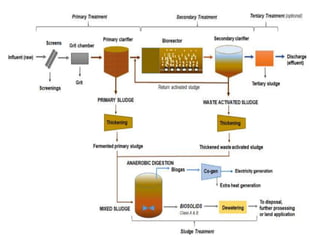
 Primary treatment
 Secondary treatment
 Tertiary treatment
 Solids processing
 Composting
 Landfills
 Oxidation ponds
 References
Introduction
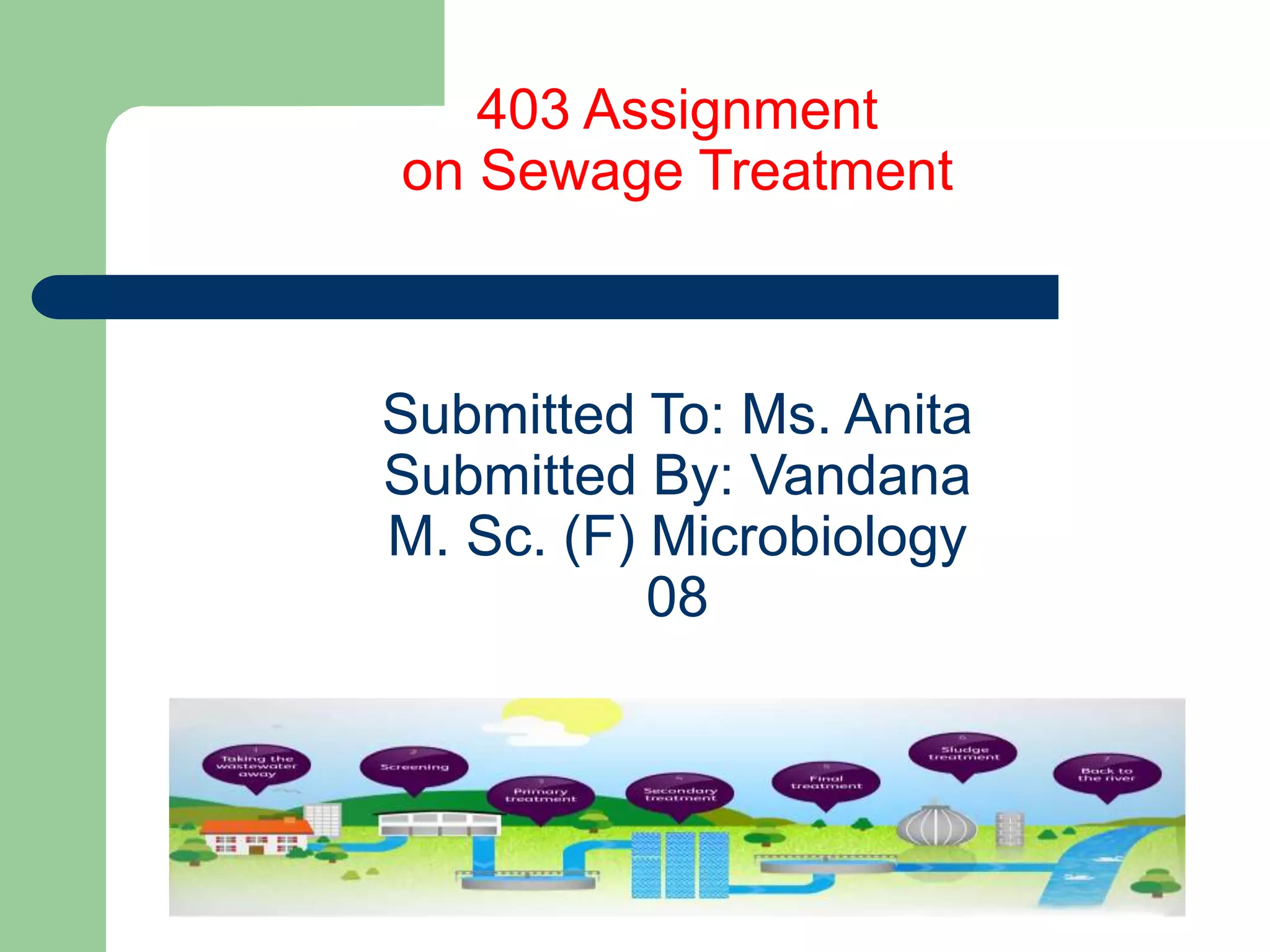
 Sewage treatment is the process of removing contaminants from
municipal wastewater, containing mainly household sewage plus
some industrial wastewater.
 Physical, chemical, and biological processes are used to remove
contaminants and produce treated wastewater that is safe enough
for release into the environment.
 Reuse is often for agricultural purposes, but more recently, sludge is
being used as a fuel source.
 Its aim is to produce an environmentally safe sewage water, called
effluent, and a solid waste, called sludge or biosolids, suitable for
disposal or reuse.
 Water from the mains, used by manufacturing, farming, houses
(toilets, baths, showers, kitchens, sinks), hospitals, commercial and
industrial sites, is reduced in quality as a result of the introduction
of contaminating constituents.
 Organic wastes, suspended solids, bacteria, nitrates, and
phosphates are pollutants that must be removed.
Importance of sewage water treatment
plant
 It is very important to provide some degree of
treatment to waste water before it can be used for
agricultural or landscape irrigation or for aquaculture.
 The principal objective of sewage treatment is generally
to allow human effluents to be disposed of without
danger to human health or unacceptable damage to
the natural environment.
 According to a research, a large number of people die
from water born disease in most of the developing
countries. Therefore , it is very important to get the
proper treatment of water for a healthy living.
 Worldwide, 1,2 billion people do not have access to
clean and safe drinking water, and 2,4 billion people lack
sanitation. Every year, 5 million people die of waterborne
diseases.
The amount of organic compounds in wastewater is
generally evaluated by three test
 1.chemical oxygen demand (COD) test,
 2.biological oxygen demand (BOD) test, and
 3.(TOC) test.
 The basis for the COD test is that nearly all organic compounds can
be fully oxidized to carbon dioxide with a strong oxidizing agent
under acidic conditions. The COD value is always measured by the
acidic potassium permanganate method and potassium dichromate
method, and could reflect the pollution degree of reducing matter in
water, including ammonia and reducing sulfide, so in wastewater
with high quantity of reducing matter, the COD value will
overestimate the organic pollutants in the water.
•BOD value is the amount of dissolved oxygen needed by aerobic
biological organisms in a body of water to break down organic material
present in a given water sample at certain temperature over a specific
time period. The BOD value is most commonly expressed in milligrams
of oxygen consumed per liter of sample during 5 days of incubation at
20 °C and is often used as a robust surrogate of the degree of organic
pollution of water. This is not a precise quantitative test, although it is
widely used as an indication of the organic quality of water.
•TOC value is the amount of total carbon (water soluble and suspended
in water) in the water. Using combustion during the assessment, this
method could oxidize all the organic pollutants, and value reflects the
amount of organic matter more directly than BOD or COD.
•The COD, BOD and TOC test could quickly reflect the organic
pollution in the wastewater, however, they can't reflect the kinds of
organic matter and composition of the water, and therefore cannot
reflect the total amount of the same total organic carbon pollution
caused by different consequences.
Sewage treatment plant process fall
in two basic types:
Sewage treatment plant process fall in
two basic types:
 1. Anaerobic Sewage Treatment:
 Sewage is partly decomposed by anaerobic bacteria in a
tank without the introduction of air, containing oxygen.
This leads to a reduction of Organic Matter into Methane,
Hydrogen Sulphide, Carbon Dioxide etc.
 It is widely used to treat wastewater sludge and organic
waste because it provides volume and mass reduction of
the input material to a large extent..
 The methane produced by large-scale municipal
anaerobic sludge treatment is currently being examined
for use in homes and industry, for heating purposes.
 Septic tanks are an example of an anaerobic process.
2. Aerobic Sewage Treatment
 In this process, aerobic bacteria digest the pollutants and air
must be provide for the bacteria to breathe.
 In a sewage treatment plant, air is continuously supplied to the
Biozone either by direct Surface Aeration using Impellers
propelled by pumps which whisk the surface of the liquid with air,
or by Submerged Diffused Aeration using blowers for air supply
through bubble diffusers at the bottom of the tank.
 Aerobic conditions lead to an aerobic bacterial colony being
established. These achieve almost complete oxidation and
digestion of organic matter and organic pollutants to Carbon
Dioxide, Water and Nitrogen, thus eliminating the odour and
pollution problem.
 The effluent produced by this process is non-polluting and can be
discharged to a watercourse.
Waste water treatment process are
applicable to two separate situations
 1. Isolate dwelling or
unit structure:
Waste water and sewage
treatment from individual
dwellings or household can be
accomplished by anaerobic
digestion and /or by aerobic
metabolic processes.
Example is septic tank.
 2. A municipality or
community structure.
Complete municipal waste
water treatment consists of a
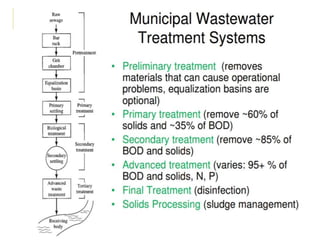
series of steps: preliminary,
primary, secondary, tertiary,
and final treatments and solids
processing.
SEPTIC TANKS
 Septic tanks serve as repositories where solids are separated
from incoming wastewater, and biological digestion of the waste
organic matter can take place under anaerobic conditions.
 tank made of concrete, metal or fiberglass.
 Grease and oils rise to the top as scum, and solids settle to the
bottom.
 The wastewater and sewage then undergo anaerobic bacterial
decomposition, resulting in the production of a sludge.
 The wastewater usually remains in the septic tank for just 24 to
72 hours, after which it is channeled out to a drain field.
 This drain field or leach field is composed of small perforated
pipes that are embedded in gravel below the surface of the soil.
Periodically, the residual sludge in the septic tank known as
septage is pumped out into a tank truck, and taken to a treatment
plant for disposal.
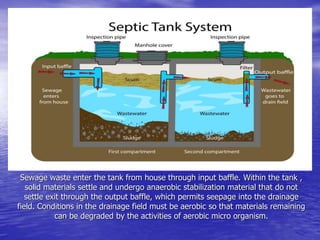
Sewage waste enter the tank from house through input baffle. Within the tank ,
solid materials settle and undergo anaerobic stabilization material that do not
settle exit through the output baffle, which permits seepage into the drainage
field. Conditions in the drainage field must be aerobic so that materials remaining
can be degraded by the activities of aerobic micro organism.
1. Preliminary Treatment
 The purpose of preliminary treatment is to protect the
operation of the wastewater treatment plant. This is
achieved by removing from the wastewater any
constituents which can clog or damage pumps, or
interfere with subsequent treatment processes.
 The objective of preliminary treatment is the removal of
coarse solids and other large materials often found in
raw wastewater. Removal of these materials is
necessary to enhance the operation and maintenance of
subsequent treatment units.
 Preliminary treatment operations done by Comminuting
Devices which Grinders, cutters and shredders. These
are devices to break or cut up solids to such size that
they can be returned to the wastewater without danger of
clogging pumps or piping or affecting subsequent
treatment devices.
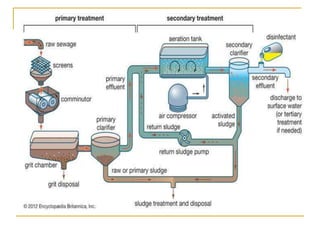
2 Primary treatment
 Physical means are used to remove solid wastes from
wastewater.
 Primary treatment is designed to remove organic and
inorganic solids by the physical processes of
sedimentation and flotation.
 Primary treatment devices reduce the velocity and
disperse the flow of wastewater. In primary treatment the
velocity of flow is reduced to 1 to 2 feet per minute to
maintain a quiescent condition so that the material
denser than water will settle out and material less dense
than water will float to the surface.
 Approximately 25 to 50% of the incoming biochemical
oxygen demand (BOD), 50 to 70% of the total
suspended solids (SS), and 65% of the oil and grease
are removed during primary treatment.
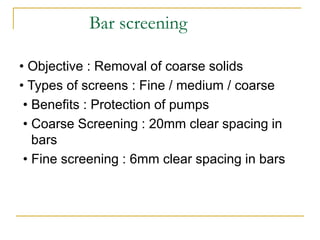
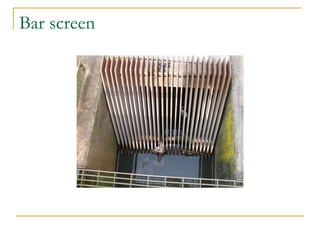
Bar screening
• Objective : Removal of coarse solids
• Types of screens : Fine / medium / coarse
• Benefits : Protection of pumps
• Coarse Screening : 20mm clear spacing in
bars
• Fine screening : 6mm clear spacing in bars
Bar screen
Grit chamber
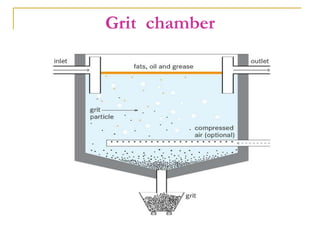
 •Grit chamber is a long narrow or circular
tank in the primary sewage treatment plant
that is designed to reduce the velocity of the
flow of sewage to eliminate the girt materials
such as sand, ash and clinkers, eggshells,
bone chips and many inert materials
inorganic in nature.
 • Types : Manual grit removal - Rectangular
channel Mechanical grit removal - Circular
tank
Grit chamber
Settling tank
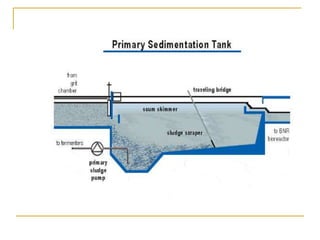
 Primary sedimentation tanks or clarifiers may be round
or rectangular basins, typically 3 to 5 m deep, with
hydraulic retention time between 2 and 3 hours.
 Principle: sedimentation during sedimentation,
suspended solids under the influence of force of gravity
star settling down to the bottom of the tank.
 Settled solids (primary sludge) are normally removed
from the bottom of tanks by sludge rakes that scrape the
sludge to a central well from which it is pumped to
sludge processing units.
 Scum is swept across the tank surface by water jets or
mechanical means from which it is also pumped to
sludge processing units.
Secondary treatment
 Objective: treatment of the effluent from primary
treatment to remove the residual organics and
suspended solids.
 Involves the removal of biodegradable dissolved and
colloidal organic matter using aerobic biological
treatment processes.
 Aerobic biological treatment is performed in the
presence of oxygen by aerobic microorganisms
(principally bacteria) that metabolize the organic
matter in the wastewater, thereby producing more
microorganisms and inorganic end-products
(principally CO2, NH3, and H2O).
 Consist of trickling filters and activated sludge
process.
Trickling filter
 It consists of a fixed bed of rocks, coke, gravel, slag,
polyurethane foam, sphagnum peat moss, ceramic,
or plastic media over which sewage or
other wastewater flows downward and causes a
layer of microbial slime (biofilm) to grow, covering
the bed of media.
 Spraying oxygenates the sewage so that the
aerobes can decompose organic matter in it.
 Microbial film consists of bacteria (Pseudomonas,
Beggiota, Alcaligenes, Nitrobacter), fungi
(Penicillium, Fusarium, Mucor, Geotrichum),
protozoa( Opercularia, Amoeba, Paramecium,
Treponema) and algae ( Phormidium, Chlorella and
Ulothrix).
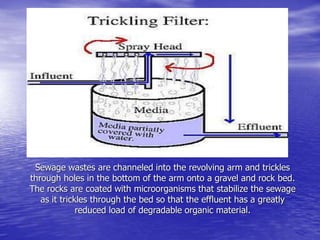
Sewage wastes are channeled into the revolving arm and trickles
through holes in the bottom of the arm onto a gravel and rock bed.
The rocks are coated with microorganisms that stabilize the sewage
as it trickles through the bed so that the effluent has a greatly
reduced load of degradable organic material.
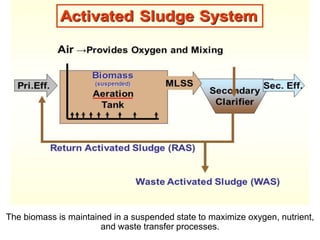
Activated sludge process
 Aeration-tank digestion is also known as the
activated sludge process .
 Effluent from primary treatment is pumped into a
tank and mixed with a bacteria-rich slurry known as
activated sludge.
 Air or pure oxygen pumped through the mixture
encourages bacterial growth and decomposition of
the organic material.
 Sewage serve as a nutrient source for mixed
populations of aerobic organisms like bacteria
,yeasts , molds and protozoa adapted to grow in it.
The biomass is maintained in a suspended state to maximize oxygen, nutrient,
and waste transfer processes.
Tertiary Treatment
 It is a physicochemical or biological process involving
bioreactors, precipitation, filtration, or chlorination
procedures similar to those employed for drinking water
purification.
 It involves a series of additional steps after secondary
treatment to further reduce organics, turbidity, nitrogen,
phosphorus, metals and pathogens.
 Tertiary treatment of wastewater is practiced for
additional protection of wildlife after discharge into rivers
or lakes. Even more commonly, it is performed when the
wastewater is to be reused for irrigation (e.g., food crops,
golf courses), for recreational purposes (e.g., lakes,
estuaries) or for drinking water.
Chlorination
is a water treatment that destroys disease – causing bacteria, nuisance
bacteria, parasite and other organism. Chlorination also oxidizes iron,
manganese and hydrogen and hydrogen sulfide so they can be filtered
out.
Filtration
Sand filtration removes much of the residual suspended matter.
Filtration over activated carbon adsorption, removes residual toxins.
Precipitation
The effluent received after the secondary treatment is mixed with
calcium oxide. The lime then react with phosphorus compound in waste
to form insoluble calcium phosphate, which then settle down at the
bottom of settling tank.
Final treatment
 Liquid effluent is disinfected and usually
discharged into a body of water upon
completion of other treatments.
 Disinfection of w.w. is necessary to protect
public health when receiving waters are used
for purposes such as downstream water
supply, recreation, or for irrigation.
 Chlorination, ozone and ultraviolet light is
often used for disinfection purpose.
Solids processing
 Solids are processed during the 1º, 2º and 3º stages of
the treatment.
 It involve thickening, stabilization, dewatering and
disposal of sludge.
 Thickening is used to further concentrate the solids or
sludge prior to stabilization. Achieved by gravity
thickening or by dissolved air floatation.
 Stabilization achieved by aerobic and anaerobic
digestion, composting, chemical addition, and heat
treatment, the most common being anaerobic digestion.
 Dewatering achieved by employing physical methods,
and the equipments used for dewatering includes
vacuum filters, belt filter presses, plate and frame
presses and centrifuges.
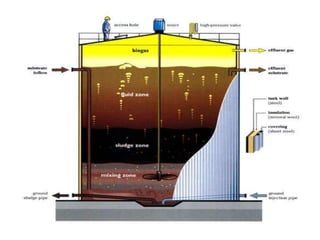
Anaerobic sludge digestion
 It involves series of digestive and fermentive reactions
carried out by a no. of bacteria and archaeal species
under anaerobic condition carried out in large tanks
called sludge digestors or bioreactors.
 Within digestor, anaerobic organisms act on the solids
remaining in sewage after its aerobic treatment. It
provide anaerobic stabilization and remove water from
sewage so that a minimum of solid matter remains in it.
 It takes 3 to 4 weeks or more.
 Anaerobic methane-forming bacteria convert the simple
organic acid into methane gas which is used as a biogas
for various purposes like heating and lightning.
 Undigested matter dries into cakes, which are carried by
conveyer belts to incinerators and it reduces the sludge
cake to ash for final disposal in a landfill.
Composting
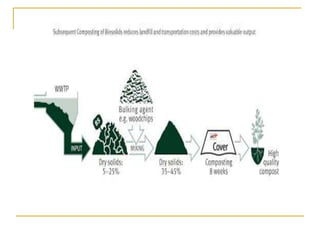
 It is the natural decomposition of organic solid
material. Dewatered sludge is mixed with a bulking
agent such as wood chips. The bulking material is
added to enhance circulation of air throughout the
sludge to improve the stabilization process. The
mixture of sludge and bulking material is placed in
aerated piles and allows to decompose biologically
for a period of time. The stabilization is achieved in
21 days. The bulking agent is separated thereafter
from the sludge and the sludge is allowed to
decompose further. The end result of composting is
the formation of humus type material and is used as
a soil conditioner.
Landfills
 Landfills are used to dispose off solid wastes
near towns and cities. The area of land
chosen for this purpose is generally not
valuable. Since piling up the solid wastes on
the ground attracts insects and rodents
causing health and aesthetic problems,
sanitary landfills are used in which a layer of
dirt is put over the wastes at the end of each
day. When the landfill is over, it can be used
for recreation and for construction purposes.
Oxidation ponds
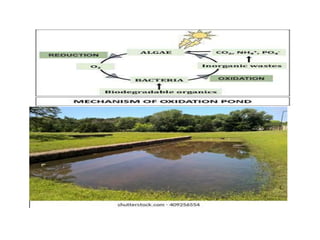
 Also known as waste stabilization pond, redox pond,
sewage lagoons. And are used for treating sewage
on a small scale.
 Open shallow pool 1 to 1.4 m deep with inlet and
outlet.
 Algae, certain type of bacteria which feed on
decaying organic matter.
 Sewage material is stabilized by aerobic/anaerobic
m.o.. They are mainly aerobic during sunshine hours
and some hours of night and in remaining hours of
the night, bottom layers are mainly anaerobic
References
 https://www.crystaltanks.com/sewage_treatment_explain
ed.html
 https://www.arviatechnology.com/what-are-the-three-
stages-of-wastewater-treatment/
 Environmental microbiology Third edition by Ian L.
Pepper Charles P. Gerba Terry J. Gentry. chapter No- 25
, page no-583.
 A textbook of basic and applied microbiology by K R
Aneja , Pranay Jain and Raman Aneja chapter no.20
page no.413
Sewage treatment

Sewage treatment

  • 1.
    403 Assignment on SewageTreatment Submitted To: Ms. Anita Submitted By: Vandana M. Sc. (F) Microbiology 08
  • 2.
    Contents  Introduction  Importanceof sewage treatment  Sources of waste water  Types of contaminant  Septic tank  Primary treatment  Secondary treatment  Tertiary treatment  Solids processing  Composting  Landfills  Oxidation ponds  References
  • 3.
    Introduction  Sewage treatmentis the process of removing contaminants from municipal wastewater, containing mainly household sewage plus some industrial wastewater.  Physical, chemical, and biological processes are used to remove contaminants and produce treated wastewater that is safe enough for release into the environment.  Reuse is often for agricultural purposes, but more recently, sludge is being used as a fuel source.  Its aim is to produce an environmentally safe sewage water, called effluent, and a solid waste, called sludge or biosolids, suitable for disposal or reuse.  Water from the mains, used by manufacturing, farming, houses (toilets, baths, showers, kitchens, sinks), hospitals, commercial and industrial sites, is reduced in quality as a result of the introduction of contaminating constituents.  Organic wastes, suspended solids, bacteria, nitrates, and phosphates are pollutants that must be removed.
  • 4.
    Importance of sewagewater treatment plant  It is very important to provide some degree of treatment to waste water before it can be used for agricultural or landscape irrigation or for aquaculture.  The principal objective of sewage treatment is generally to allow human effluents to be disposed of without danger to human health or unacceptable damage to the natural environment.  According to a research, a large number of people die from water born disease in most of the developing countries. Therefore , it is very important to get the proper treatment of water for a healthy living.  Worldwide, 1,2 billion people do not have access to clean and safe drinking water, and 2,4 billion people lack sanitation. Every year, 5 million people die of waterborne diseases.
  • 6.
    The amount oforganic compounds in wastewater is generally evaluated by three test  1.chemical oxygen demand (COD) test,  2.biological oxygen demand (BOD) test, and  3.(TOC) test.  The basis for the COD test is that nearly all organic compounds can be fully oxidized to carbon dioxide with a strong oxidizing agent under acidic conditions. The COD value is always measured by the acidic potassium permanganate method and potassium dichromate method, and could reflect the pollution degree of reducing matter in water, including ammonia and reducing sulfide, so in wastewater with high quantity of reducing matter, the COD value will overestimate the organic pollutants in the water.
  • 7.
    •BOD value isthe amount of dissolved oxygen needed by aerobic biological organisms in a body of water to break down organic material present in a given water sample at certain temperature over a specific time period. The BOD value is most commonly expressed in milligrams of oxygen consumed per liter of sample during 5 days of incubation at 20 °C and is often used as a robust surrogate of the degree of organic pollution of water. This is not a precise quantitative test, although it is widely used as an indication of the organic quality of water. •TOC value is the amount of total carbon (water soluble and suspended in water) in the water. Using combustion during the assessment, this method could oxidize all the organic pollutants, and value reflects the amount of organic matter more directly than BOD or COD. •The COD, BOD and TOC test could quickly reflect the organic pollution in the wastewater, however, they can't reflect the kinds of organic matter and composition of the water, and therefore cannot reflect the total amount of the same total organic carbon pollution caused by different consequences.
  • 8.
    Sewage treatment plantprocess fall in two basic types:
  • 9.
    Sewage treatment plantprocess fall in two basic types:  1. Anaerobic Sewage Treatment:  Sewage is partly decomposed by anaerobic bacteria in a tank without the introduction of air, containing oxygen. This leads to a reduction of Organic Matter into Methane, Hydrogen Sulphide, Carbon Dioxide etc.  It is widely used to treat wastewater sludge and organic waste because it provides volume and mass reduction of the input material to a large extent..  The methane produced by large-scale municipal anaerobic sludge treatment is currently being examined for use in homes and industry, for heating purposes.  Septic tanks are an example of an anaerobic process.
  • 10.
    2. Aerobic SewageTreatment  In this process, aerobic bacteria digest the pollutants and air must be provide for the bacteria to breathe.  In a sewage treatment plant, air is continuously supplied to the Biozone either by direct Surface Aeration using Impellers propelled by pumps which whisk the surface of the liquid with air, or by Submerged Diffused Aeration using blowers for air supply through bubble diffusers at the bottom of the tank.  Aerobic conditions lead to an aerobic bacterial colony being established. These achieve almost complete oxidation and digestion of organic matter and organic pollutants to Carbon Dioxide, Water and Nitrogen, thus eliminating the odour and pollution problem.  The effluent produced by this process is non-polluting and can be discharged to a watercourse.
  • 11.
    Waste water treatmentprocess are applicable to two separate situations  1. Isolate dwelling or unit structure: Waste water and sewage treatment from individual dwellings or household can be accomplished by anaerobic digestion and /or by aerobic metabolic processes. Example is septic tank.  2. A municipality or community structure. Complete municipal waste water treatment consists of a series of steps: preliminary, primary, secondary, tertiary, and final treatments and solids processing.
  • 12.
    SEPTIC TANKS  Septictanks serve as repositories where solids are separated from incoming wastewater, and biological digestion of the waste organic matter can take place under anaerobic conditions.  tank made of concrete, metal or fiberglass.  Grease and oils rise to the top as scum, and solids settle to the bottom.  The wastewater and sewage then undergo anaerobic bacterial decomposition, resulting in the production of a sludge.  The wastewater usually remains in the septic tank for just 24 to 72 hours, after which it is channeled out to a drain field.  This drain field or leach field is composed of small perforated pipes that are embedded in gravel below the surface of the soil. Periodically, the residual sludge in the septic tank known as septage is pumped out into a tank truck, and taken to a treatment plant for disposal.
  • 13.
    Sewage waste enterthe tank from house through input baffle. Within the tank , solid materials settle and undergo anaerobic stabilization material that do not settle exit through the output baffle, which permits seepage into the drainage field. Conditions in the drainage field must be aerobic so that materials remaining can be degraded by the activities of aerobic micro organism.
  • 15.
    1. Preliminary Treatment The purpose of preliminary treatment is to protect the operation of the wastewater treatment plant. This is achieved by removing from the wastewater any constituents which can clog or damage pumps, or interfere with subsequent treatment processes.  The objective of preliminary treatment is the removal of coarse solids and other large materials often found in raw wastewater. Removal of these materials is necessary to enhance the operation and maintenance of subsequent treatment units.  Preliminary treatment operations done by Comminuting Devices which Grinders, cutters and shredders. These are devices to break or cut up solids to such size that they can be returned to the wastewater without danger of clogging pumps or piping or affecting subsequent treatment devices.
  • 16.
    2 Primary treatment Physical means are used to remove solid wastes from wastewater.  Primary treatment is designed to remove organic and inorganic solids by the physical processes of sedimentation and flotation.  Primary treatment devices reduce the velocity and disperse the flow of wastewater. In primary treatment the velocity of flow is reduced to 1 to 2 feet per minute to maintain a quiescent condition so that the material denser than water will settle out and material less dense than water will float to the surface.  Approximately 25 to 50% of the incoming biochemical oxygen demand (BOD), 50 to 70% of the total suspended solids (SS), and 65% of the oil and grease are removed during primary treatment.
  • 18.
    Bar screening • Objective: Removal of coarse solids • Types of screens : Fine / medium / coarse • Benefits : Protection of pumps • Coarse Screening : 20mm clear spacing in bars • Fine screening : 6mm clear spacing in bars
  • 19.
  • 20.
    Grit chamber  •Gritchamber is a long narrow or circular tank in the primary sewage treatment plant that is designed to reduce the velocity of the flow of sewage to eliminate the girt materials such as sand, ash and clinkers, eggshells, bone chips and many inert materials inorganic in nature.  • Types : Manual grit removal - Rectangular channel Mechanical grit removal - Circular tank
  • 21.
  • 22.
    Settling tank  Primarysedimentation tanks or clarifiers may be round or rectangular basins, typically 3 to 5 m deep, with hydraulic retention time between 2 and 3 hours.  Principle: sedimentation during sedimentation, suspended solids under the influence of force of gravity star settling down to the bottom of the tank.  Settled solids (primary sludge) are normally removed from the bottom of tanks by sludge rakes that scrape the sludge to a central well from which it is pumped to sludge processing units.  Scum is swept across the tank surface by water jets or mechanical means from which it is also pumped to sludge processing units.
  • 24.
    Secondary treatment  Objective:treatment of the effluent from primary treatment to remove the residual organics and suspended solids.  Involves the removal of biodegradable dissolved and colloidal organic matter using aerobic biological treatment processes.  Aerobic biological treatment is performed in the presence of oxygen by aerobic microorganisms (principally bacteria) that metabolize the organic matter in the wastewater, thereby producing more microorganisms and inorganic end-products (principally CO2, NH3, and H2O).  Consist of trickling filters and activated sludge process.
  • 25.
    Trickling filter  Itconsists of a fixed bed of rocks, coke, gravel, slag, polyurethane foam, sphagnum peat moss, ceramic, or plastic media over which sewage or other wastewater flows downward and causes a layer of microbial slime (biofilm) to grow, covering the bed of media.  Spraying oxygenates the sewage so that the aerobes can decompose organic matter in it.  Microbial film consists of bacteria (Pseudomonas, Beggiota, Alcaligenes, Nitrobacter), fungi (Penicillium, Fusarium, Mucor, Geotrichum), protozoa( Opercularia, Amoeba, Paramecium, Treponema) and algae ( Phormidium, Chlorella and Ulothrix).
  • 26.
    Sewage wastes arechanneled into the revolving arm and trickles through holes in the bottom of the arm onto a gravel and rock bed. The rocks are coated with microorganisms that stabilize the sewage as it trickles through the bed so that the effluent has a greatly reduced load of degradable organic material.
  • 27.
    Activated sludge process Aeration-tank digestion is also known as the activated sludge process .  Effluent from primary treatment is pumped into a tank and mixed with a bacteria-rich slurry known as activated sludge.  Air or pure oxygen pumped through the mixture encourages bacterial growth and decomposition of the organic material.  Sewage serve as a nutrient source for mixed populations of aerobic organisms like bacteria ,yeasts , molds and protozoa adapted to grow in it.
  • 28.
    The biomass ismaintained in a suspended state to maximize oxygen, nutrient, and waste transfer processes.
  • 29.
    Tertiary Treatment  Itis a physicochemical or biological process involving bioreactors, precipitation, filtration, or chlorination procedures similar to those employed for drinking water purification.  It involves a series of additional steps after secondary treatment to further reduce organics, turbidity, nitrogen, phosphorus, metals and pathogens.  Tertiary treatment of wastewater is practiced for additional protection of wildlife after discharge into rivers or lakes. Even more commonly, it is performed when the wastewater is to be reused for irrigation (e.g., food crops, golf courses), for recreational purposes (e.g., lakes, estuaries) or for drinking water.
  • 30.
    Chlorination is a watertreatment that destroys disease – causing bacteria, nuisance bacteria, parasite and other organism. Chlorination also oxidizes iron, manganese and hydrogen and hydrogen sulfide so they can be filtered out. Filtration Sand filtration removes much of the residual suspended matter. Filtration over activated carbon adsorption, removes residual toxins. Precipitation The effluent received after the secondary treatment is mixed with calcium oxide. The lime then react with phosphorus compound in waste to form insoluble calcium phosphate, which then settle down at the bottom of settling tank.
  • 31.
    Final treatment  Liquideffluent is disinfected and usually discharged into a body of water upon completion of other treatments.  Disinfection of w.w. is necessary to protect public health when receiving waters are used for purposes such as downstream water supply, recreation, or for irrigation.  Chlorination, ozone and ultraviolet light is often used for disinfection purpose.
  • 32.
    Solids processing  Solidsare processed during the 1º, 2º and 3º stages of the treatment.  It involve thickening, stabilization, dewatering and disposal of sludge.  Thickening is used to further concentrate the solids or sludge prior to stabilization. Achieved by gravity thickening or by dissolved air floatation.  Stabilization achieved by aerobic and anaerobic digestion, composting, chemical addition, and heat treatment, the most common being anaerobic digestion.  Dewatering achieved by employing physical methods, and the equipments used for dewatering includes vacuum filters, belt filter presses, plate and frame presses and centrifuges.
  • 33.
    Anaerobic sludge digestion It involves series of digestive and fermentive reactions carried out by a no. of bacteria and archaeal species under anaerobic condition carried out in large tanks called sludge digestors or bioreactors.  Within digestor, anaerobic organisms act on the solids remaining in sewage after its aerobic treatment. It provide anaerobic stabilization and remove water from sewage so that a minimum of solid matter remains in it.  It takes 3 to 4 weeks or more.  Anaerobic methane-forming bacteria convert the simple organic acid into methane gas which is used as a biogas for various purposes like heating and lightning.  Undigested matter dries into cakes, which are carried by conveyer belts to incinerators and it reduces the sludge cake to ash for final disposal in a landfill.
  • 35.
    Composting  It isthe natural decomposition of organic solid material. Dewatered sludge is mixed with a bulking agent such as wood chips. The bulking material is added to enhance circulation of air throughout the sludge to improve the stabilization process. The mixture of sludge and bulking material is placed in aerated piles and allows to decompose biologically for a period of time. The stabilization is achieved in 21 days. The bulking agent is separated thereafter from the sludge and the sludge is allowed to decompose further. The end result of composting is the formation of humus type material and is used as a soil conditioner.
  • 38.
    Landfills  Landfills areused to dispose off solid wastes near towns and cities. The area of land chosen for this purpose is generally not valuable. Since piling up the solid wastes on the ground attracts insects and rodents causing health and aesthetic problems, sanitary landfills are used in which a layer of dirt is put over the wastes at the end of each day. When the landfill is over, it can be used for recreation and for construction purposes.
  • 39.
    Oxidation ponds  Alsoknown as waste stabilization pond, redox pond, sewage lagoons. And are used for treating sewage on a small scale.  Open shallow pool 1 to 1.4 m deep with inlet and outlet.  Algae, certain type of bacteria which feed on decaying organic matter.  Sewage material is stabilized by aerobic/anaerobic m.o.. They are mainly aerobic during sunshine hours and some hours of night and in remaining hours of the night, bottom layers are mainly anaerobic
  • 41.
    References  https://www.crystaltanks.com/sewage_treatment_explain ed.html  https://www.arviatechnology.com/what-are-the-three- stages-of-wastewater-treatment/ Environmental microbiology Third edition by Ian L. Pepper Charles P. Gerba Terry J. Gentry. chapter No- 25 , page no-583.  A textbook of basic and applied microbiology by K R Aneja , Pranay Jain and Raman Aneja chapter no.20 page no.413