Effluent Treatment Process
- Dr. Pratik Patel
Assistant Professor
Shree Ramkrishna Institute of Computer Education
& Applied Sciences, Surat
Types of Pollution
WATER POLLUTION
AIR POLLUTION
LAND POLLUTION
NOISE POLLUTION
▪ Wastewater can be defined as any water or liquid which has impurities
or pollutants in the form of solids, liquids or gases or their combination
in such concentration that is harmful if disposed in environment.
▪ Depending upon the source of generation wastewater is classified as
▪ 1. Domestic/Municipal/Sanitary wastewater discharged from residential, commercial and
industrial zones or towns of a city or collected by a sewerage system.
▪ Organic+Inorganic+Solids, (99.9%water and 0.1%)
▪ 2. Industrial wastewater generated by large and medium scale industries, it characteristics
vary from industry to industry and from process to process.
▪ Fresh Water present on the earth surface is put to many uses. It is
used for drinking, domestic and municipal uses, agricultural,
irrigation, industries, navigation, recreation. The used water
becomes contaminated and is called wastewater.
▪ Water Pollution alters the physical, chemical, or biological
characteristics of water through natural or human activities and
making it unsuitable for its designated use.
Treatment Methods
● Physical, Chemical and Biological means are applied for wastewater
treatment and the treatment units are designed to carry out specific
functions. Based on the techniques treatment methods are classified as
○ 1. Unit Operation are Screening, Mixing, Sedimentation, Floatation, Heat Drying
○ 2. Unit Process are,
Chemical Process
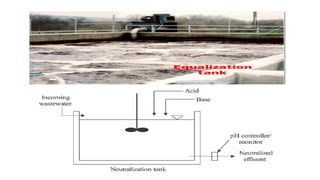
Neutralization,
Coagulation, Precipitation,
Oxidation, Disinfection
Biological Process
Attached Suspended
Trickling Filter ASP
RBC Lagoon
Biotower Pond
Upflow Filter SBR
Contact Beds
Layout of Treatment Plants
Primary Treatment
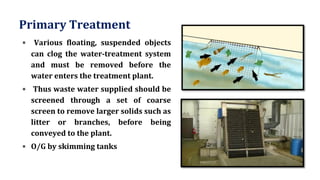
▪ Various floating, suspended objects
can clog the water-treatment system
and must be removed before the
water enters the treatment plant.
▪ Thus waste water supplied should be
screened through a set of coarse
screen to remove larger solids such as
litter or branches, before being
conveyed to the plant.
▪ O/G by skimming tanks
● SCREENINGis the first treatment.
● Used to remove floating solids which may clog pumps. Used to remove
solids which may form ugly sludge banks at the site of disposal. Used
to remove solids which will clog the trickling filters and will interfere
in aeration of ASP.
● Screens are classified as Coarse, medium or fine
○ Disc, band, drum, wings, cage
○ Hand or Mechanical cleaned
○ Fixed, moving or moveable Screens
● Screens are classified as Racks or Bar
Perforated or Fine / Communiters or Cutting
Flotation if water is allowed to remain still light
or if air bubbles are passed through it very fine
matter will easily come up and starts floating
which can be easily removed or skimmed off.
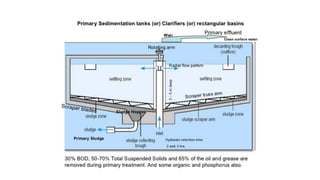
Sedimentation
▪ Screening and skimming tanks can remove large suspended matters and
O/G, but cannot remove fine suspended solids, such is removed by keeping
the effluent QUIESCENT in sedimentation basin. CHEMICAL PPT-MOSTLY
DONE IN PST
▪ Necessary to prevent sludge banks, Prevent excess organic loading if used
for agriculture, Reduces organic load on secondary treatment.
▪ Settable solids are mostly organic, dispersed or flocculated.
▪ In PST the bulk of solids reaching is subjected to flocculation due to fluid
motion in the tank, hence the laws of sedimentation governing discrete and
non-flocculant particles cannot be applied hence detention time is must.
● Discrete (S,S,W) Particles settle down due to gravity but also frictional
force acts in opposite direction hence when this two forces balances
particles settle down with Uniform Velocity. V = 1/18 * g/µ (Sx - S) d2
(Stokes Equation)
● Settling of particles depends on Specific gravity, Size, Temperature.
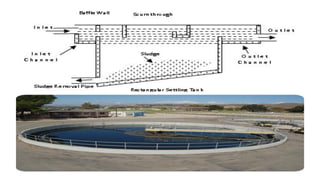
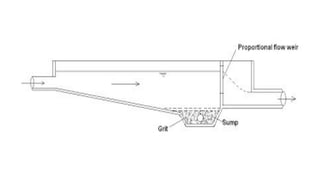
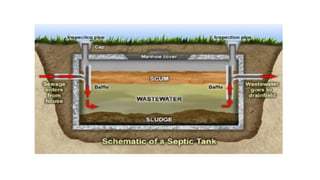
● Grit Chamber, Plain Sedementation, Chemical PPT, Septic Tank, Imhoff
Tank, SST, detritus tank.
● Rectangular Tank, Circular Tank - Hopper Tank (Sp.Gr.<1).
● Horizontal Flow, Vertical Flow, Radial flow – depth of 2.3 to 5m –
diameter of circular tank is 40m – side of square tank is 25m.
● Detention period between 1 to 3 hour – cost, size, anaerobic, gas.
● Settling efficiency is reduced by Eddy, Surface, Vertical Convection,
Density.
▪ To remove very fine particles of size 0.02 to 0.06 mm, charged particles
(colloids) Sedimentation with Coagulation is done.
▪ Chemicals are added which forms insoluble, gelatinous, floc which
precipitates easily.
▪ Coagulants: Aluminium Sulphate or Alum, FeCl, Ferric/Ferrous Sulphate &
Lime.
▪ The chemicals are feeded using Dry or Wet Method.
▪ They are mixed using Baffle, Flash Mixer or Deflector Plate Mixer.
Secondary Treatment
▪ Effluent can remain in aerobic or anaerobic condition depending on the
availability of oxygen.
▪ In aerobic condition the bacteria consumes oxygen and remains active
without causing any foul smell. Hence to avoid foul smell availability of
oxygen should be there.
▪ Also there should be large porous surface where the bacteria can grow
and perform their function.
▪ When effluent is passed through such contact beds(media) the coarser
particles get filtered out.
▪ Practically it is observed that major action takes place on the surface
where a film of aerobic bacteria is formed. Organic matter is first
absorbed on this film and than acted by bacteria, algae, protozoa etc.
▪ 1. The colloidal and dissolved putrescible organic matter is first absorbed.
▪ 2. The bacteria feeds the organic matter for their life.
▪ 3. The bacteria converts the organic matter into stable inorganic forms by oxidizing
them.
▪ 4. Finally Nitrates, CO2, Sulpahtes etc. remains and gases escapes.
All the materials separated or precipitated in biological unit is removed in
secondary settling tank. The sludge of this tank contains Colloids, organics,
B.O.D. This sludge is very putrescible and hence is treated before disposal.
1. Activated Sludge Process
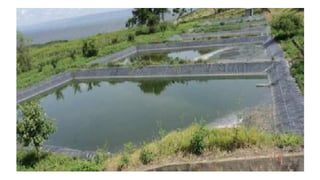
2. Oxidation Pond
3. Aerated Lagoons
4. Trickling Filter
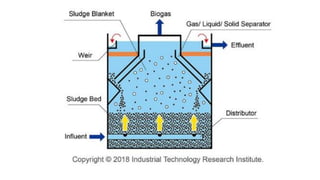
5. Anaerobic Digestion
6. Rotating Biological Contractor
7. Sequential Batch Reactor: Fill, React, Settle, Decant, Idle
Tertiary Treatment
1. Chlorination
2. Disinfection
3. Reverse Osmosis
4. Electro Dialysis
5. Distillation
6. Filtration
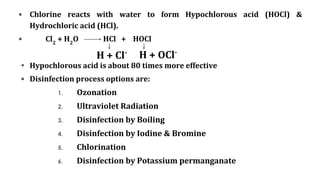
▪ Chlorine reacts with water to form Hypochlorous acid (HOCl) &
Hydrochloric acid (HCl).
▪ Cl2
+ H2
O HCl + HOCl
• Hypochlorous acid is about 80 times more effective
▪ Disinfection process options are:
1. Ozonation
2. Ultraviolet Radiation
3. Disinfection by Boiling
4. Disinfection by Iodine & Bromine
5. Chlorination
6. Disinfection by Potassium permanganate
H + OCl-
H + Cl-
Filtration is to be done to remove bacteria, colour,
odour. This process of passing the water through beds
of sand or other granular materials, is known as
filtration. Generally, two types of filters used in water
works - Slow sand filter & Rapid sand filter
Sludge Treatment
The main process involved in sludge treatment are:
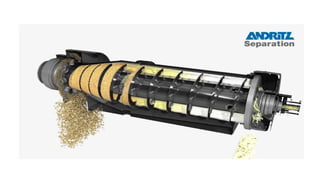
1. Dewatering : Centrifugation, Filter Press.
2. Drying : Sun Drying.
3. Incineration
4. Sludge Disposal : Landfill, Farming.
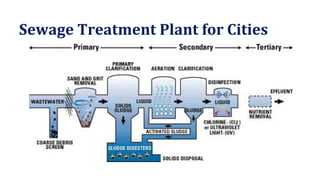
Sewage Treatment Plant for Cities
Thank You All…!!!

Effluent treatment process

  • 1.
    Effluent Treatment Process -Dr. Pratik Patel Assistant Professor Shree Ramkrishna Institute of Computer Education & Applied Sciences, Surat
  • 2.
    Types of Pollution WATERPOLLUTION AIR POLLUTION LAND POLLUTION NOISE POLLUTION
  • 3.
    ▪ Wastewater canbe defined as any water or liquid which has impurities or pollutants in the form of solids, liquids or gases or their combination in such concentration that is harmful if disposed in environment. ▪ Depending upon the source of generation wastewater is classified as ▪ 1. Domestic/Municipal/Sanitary wastewater discharged from residential, commercial and industrial zones or towns of a city or collected by a sewerage system. ▪ Organic+Inorganic+Solids, (99.9%water and 0.1%) ▪ 2. Industrial wastewater generated by large and medium scale industries, it characteristics vary from industry to industry and from process to process.
  • 4.
    ▪ Fresh Waterpresent on the earth surface is put to many uses. It is used for drinking, domestic and municipal uses, agricultural, irrigation, industries, navigation, recreation. The used water becomes contaminated and is called wastewater. ▪ Water Pollution alters the physical, chemical, or biological characteristics of water through natural or human activities and making it unsuitable for its designated use.
  • 6.
    Treatment Methods ● Physical,Chemical and Biological means are applied for wastewater treatment and the treatment units are designed to carry out specific functions. Based on the techniques treatment methods are classified as ○ 1. Unit Operation are Screening, Mixing, Sedimentation, Floatation, Heat Drying ○ 2. Unit Process are, Chemical Process Neutralization, Coagulation, Precipitation, Oxidation, Disinfection Biological Process Attached Suspended Trickling Filter ASP RBC Lagoon Biotower Pond Upflow Filter SBR Contact Beds
  • 7.
  • 8.
    Primary Treatment ▪ Variousfloating, suspended objects can clog the water-treatment system and must be removed before the water enters the treatment plant. ▪ Thus waste water supplied should be screened through a set of coarse screen to remove larger solids such as litter or branches, before being conveyed to the plant. ▪ O/G by skimming tanks
  • 9.
    ● SCREENINGis thefirst treatment. ● Used to remove floating solids which may clog pumps. Used to remove solids which may form ugly sludge banks at the site of disposal. Used to remove solids which will clog the trickling filters and will interfere in aeration of ASP. ● Screens are classified as Coarse, medium or fine ○ Disc, band, drum, wings, cage ○ Hand or Mechanical cleaned ○ Fixed, moving or moveable Screens ● Screens are classified as Racks or Bar Perforated or Fine / Communiters or Cutting
  • 10.
    Flotation if wateris allowed to remain still light or if air bubbles are passed through it very fine matter will easily come up and starts floating which can be easily removed or skimmed off.
  • 12.
    Sedimentation ▪ Screening andskimming tanks can remove large suspended matters and O/G, but cannot remove fine suspended solids, such is removed by keeping the effluent QUIESCENT in sedimentation basin. CHEMICAL PPT-MOSTLY DONE IN PST ▪ Necessary to prevent sludge banks, Prevent excess organic loading if used for agriculture, Reduces organic load on secondary treatment. ▪ Settable solids are mostly organic, dispersed or flocculated. ▪ In PST the bulk of solids reaching is subjected to flocculation due to fluid motion in the tank, hence the laws of sedimentation governing discrete and non-flocculant particles cannot be applied hence detention time is must.
  • 13.
    ● Discrete (S,S,W)Particles settle down due to gravity but also frictional force acts in opposite direction hence when this two forces balances particles settle down with Uniform Velocity. V = 1/18 * g/µ (Sx - S) d2 (Stokes Equation) ● Settling of particles depends on Specific gravity, Size, Temperature. ● Grit Chamber, Plain Sedementation, Chemical PPT, Septic Tank, Imhoff Tank, SST, detritus tank. ● Rectangular Tank, Circular Tank - Hopper Tank (Sp.Gr.<1). ● Horizontal Flow, Vertical Flow, Radial flow – depth of 2.3 to 5m – diameter of circular tank is 40m – side of square tank is 25m. ● Detention period between 1 to 3 hour – cost, size, anaerobic, gas. ● Settling efficiency is reduced by Eddy, Surface, Vertical Convection, Density.
  • 18.
    ▪ To removevery fine particles of size 0.02 to 0.06 mm, charged particles (colloids) Sedimentation with Coagulation is done. ▪ Chemicals are added which forms insoluble, gelatinous, floc which precipitates easily. ▪ Coagulants: Aluminium Sulphate or Alum, FeCl, Ferric/Ferrous Sulphate & Lime. ▪ The chemicals are feeded using Dry or Wet Method. ▪ They are mixed using Baffle, Flash Mixer or Deflector Plate Mixer.
  • 19.
    Secondary Treatment ▪ Effluentcan remain in aerobic or anaerobic condition depending on the availability of oxygen. ▪ In aerobic condition the bacteria consumes oxygen and remains active without causing any foul smell. Hence to avoid foul smell availability of oxygen should be there. ▪ Also there should be large porous surface where the bacteria can grow and perform their function. ▪ When effluent is passed through such contact beds(media) the coarser particles get filtered out.
  • 20.
    ▪ Practically itis observed that major action takes place on the surface where a film of aerobic bacteria is formed. Organic matter is first absorbed on this film and than acted by bacteria, algae, protozoa etc. ▪ 1. The colloidal and dissolved putrescible organic matter is first absorbed. ▪ 2. The bacteria feeds the organic matter for their life. ▪ 3. The bacteria converts the organic matter into stable inorganic forms by oxidizing them. ▪ 4. Finally Nitrates, CO2, Sulpahtes etc. remains and gases escapes.
  • 21.
    All the materialsseparated or precipitated in biological unit is removed in secondary settling tank. The sludge of this tank contains Colloids, organics, B.O.D. This sludge is very putrescible and hence is treated before disposal. 1. Activated Sludge Process 2. Oxidation Pond 3. Aerated Lagoons 4. Trickling Filter 5. Anaerobic Digestion 6. Rotating Biological Contractor 7. Sequential Batch Reactor: Fill, React, Settle, Decant, Idle
  • 32.
    Tertiary Treatment 1. Chlorination 2.Disinfection 3. Reverse Osmosis 4. Electro Dialysis 5. Distillation 6. Filtration
  • 33.
    ▪ Chlorine reactswith water to form Hypochlorous acid (HOCl) & Hydrochloric acid (HCl). ▪ Cl2 + H2 O HCl + HOCl • Hypochlorous acid is about 80 times more effective ▪ Disinfection process options are: 1. Ozonation 2. Ultraviolet Radiation 3. Disinfection by Boiling 4. Disinfection by Iodine & Bromine 5. Chlorination 6. Disinfection by Potassium permanganate H + OCl- H + Cl-
  • 35.
    Filtration is tobe done to remove bacteria, colour, odour. This process of passing the water through beds of sand or other granular materials, is known as filtration. Generally, two types of filters used in water works - Slow sand filter & Rapid sand filter
  • 36.
    Sludge Treatment The mainprocess involved in sludge treatment are: 1. Dewatering : Centrifugation, Filter Press. 2. Drying : Sun Drying. 3. Incineration 4. Sludge Disposal : Landfill, Farming.
  • 40.
  • 41.