Waste Water
Treatment
Strategies
Dr Sushovan Sarkar
Professor and HOD (Civil)
Budge Budge Institute of Technology
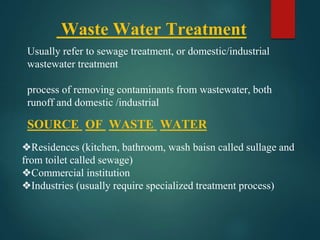
Waste Water Treatment
Usually refer to sewage treatment, or domestic/industrial
wastewater treatment
process of removing contaminants from wastewater, both
runoff and domestic /industrial
❖Residences (kitchen, bathroom, wash baisn called sullage and
from toilet called sewage)
❖Commercial institution
❖Industries (usually require specialized treatment process)
SOURCE OF WASTE WATER
❖Purpose:
• To Provide a good sanitary environmental condition of
city protecting public health.
• Disposal of wastewater to a proper place to prevent a
favorable condition for mosquito breeding , fly
developing or bacteria growing.
• To treat wastewater as per needs so as not to
endanger the body of water or groundwater or land to
get polluted where it is finally disposed off thereby
protect human health and environment.
• To recycle the treated wastewater for domestic ,
industrial and miscellaneous uses.
4
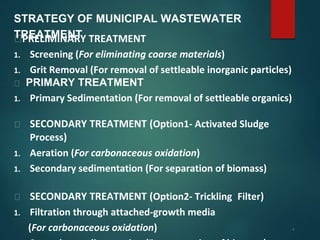
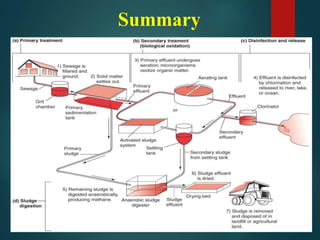
STRATEGY OF MUNICIPAL WASTEWATER
TREATMENT
⮚PRELIMINARY TREATMENT
1. Screening (For eliminating coarse materials)
1. Grit Removal (For removal of settleable inorganic particles)
⮚ PRIMARY TREATMENT
1. Primary Sedimentation (For removal of settleable organics)
⮚ SECONDARY TREATMENT (Option1- Activated Sludge
Process)
1. Aeration (For carbonaceous oxidation)
1. Secondary sedimentation (For separation of biomass)
⮚ SECONDARY TREATMENT (Option2- Trickling Filter)
1. Filtration through attached-growth media
(For carbonaceous oxidation)
5
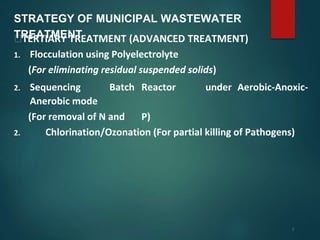
STRATEGY OF MUNICIPAL WASTEWATER
TREATMENT
⮚TERTIARY TREATMENT (ADVANCED TREATMENT)
1. Flocculation using Polyelectrolyte
(For eliminating residual suspended solids)
2. Sequencing Batch Reactor under Aerobic-Anoxic-
Anerobic mode
(For removal of N and P)
2. Chlorination/Ozonation (For partial killing of Pathogens)
How can it be treated?
Collected and transported via a network of pipes and
pump stations to a municipal treatment plant
Stages of water treatment
❖Primary
solids are separated
❖Secondary
dissolved organic matter is converted into a solid
mass by using water-borne bacteria
95% of the suspended molecules should be
removed
❖Tertiary
biological solids are neutralized then disposed,
and treated water may be disinfected chemically
or physically
Types of
Treatment
❑Mechanical treatment
•Influx (Influent)
•Removal of large objects
•Removal of sand and grit
•Primary Sedimentation
❑Biological treatment
•Trickling bed filter
•Activated sludge
❑Chemical treatment
•Disinfection
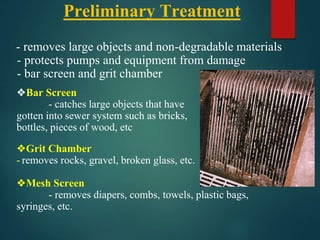
Preliminary Treatment
- removes large objects and non-degradable materials
- protects pumps and equipment from damage
- bar screen and grit chamber
❖Bar Screen
- catches large objects that have
gotten into sewer system such as bricks,
bottles, pieces of wood, etc
❖Grit Chamber
- removes rocks, gravel, broken glass, etc.
❖Mesh Screen
- removes diapers, combs, towels, plastic bags,
syringes, etc.
Treatment stages - Primary
Treatment
typical materials that are removed during primary treatment include
fats, oils, and greases (eg. FOG)
sand, gravels and rocks (eg. grit)
larger settleable solids including human waste, and floating
materials
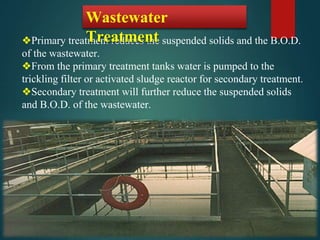
❖Primary treatment reduces the suspended solids and the B.O.D.
of the wastewater.
❖From the primary treatment tanks water is pumped to the
trickling filter or activated sludge reactor for secondary treatment.
❖Secondary treatment will further reduce the suspended solids
and B.O.D. of the wastewater.
Wastewater
Treatment
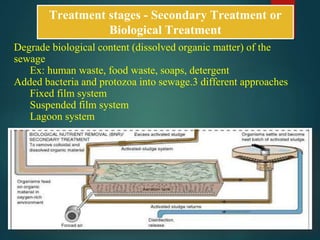
Treatment stages - Secondary Treatment or
Biological Treatment
Degrade biological content (dissolved organic matter) of the
sewage
Ex: human waste, food waste, soaps, detergent
Added bacteria and protozoa into sewage.3 different approaches
Fixed film system
Suspended film system
Lagoon system
Three approaches
❑ Fixed Film Systems
grow microorganisms on substrates such as rocks, sand or plastic
wastewater is spread over the substrate
Ex: Trickling filters, rotating biological contactors
Spread wastewater over
microorganism
made of coke (carbonised coal),
limestone chips or specially
fabricated plastic media
Optimize their thickness by insect
or worm grazing
❑Trickling filters bed
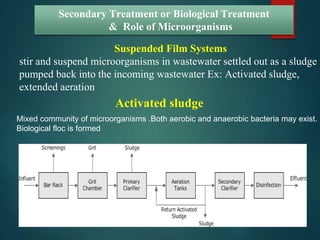
Suspended Film Systems
stir and suspend microorganisms in wastewater settled out as a sludge
pumped back into the incoming wastewater Ex: Activated sludge,
extended aeration
Secondary Treatment or Biological Treatment
& Role of Microorganisms
Activated sludge
Mixed community of microorganisms .Both aerobic and anaerobic bacteria may exist.
Biological floc is formed
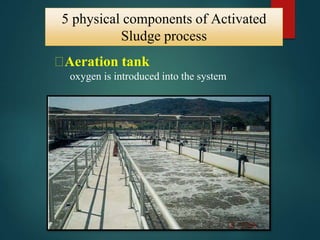
5 physical components of Activated
Sludge process
⮚Aeration tank
oxygen is introduced into the system
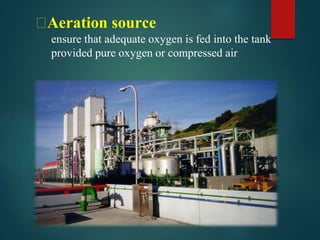
⮚Aeration source
ensure that adequate oxygen is fed into the tank
provided pure oxygen or compressed air
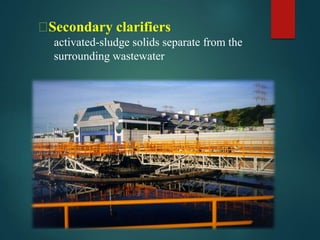
⮚Secondary clarifiers
activated-sludge solids separate from the
surrounding wastewater
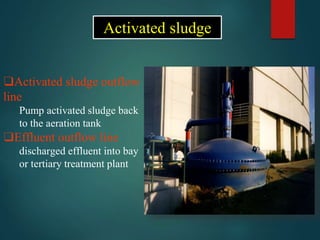
❑Activated sludge outflow
line
Pump activated sludge back
to the aeration tank
❑Effluent outflow line
discharged effluent into bay
or tertiary treatment plant
Activated sludge
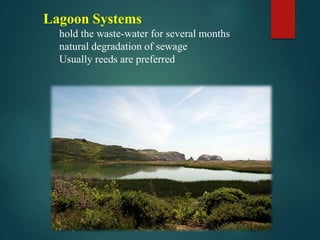
Lagoon Systems
hold the waste-water for several months
natural degradation of sewage
Usually reeds are preferred
1. a
2. Methanogenic Bacteria : These
bacteria, also refered to as
methanogens
Or methane formers are responsible for the
conversion of acetic acid and
Hydrogen to methane and
carbondioxide.The most important
methanogens
belong to the genera Methanobacterium,
Methanobacillus, Methanococcus
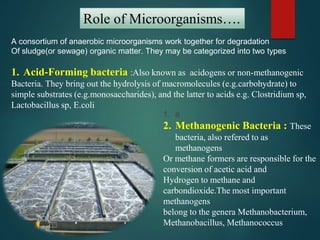
Role of Microorganisms….
A consortium of anaerobic microorganisms work together for degradation
Of sludge(or sewage) organic matter. They may be categorized into two types
1. Acid-Forming bacteria :Also known as acidogens or non-methanogenic
Bacteria. They bring out the hydrolysis of macromolecules (e.g.carbohydrate) to
simple substrates (e.g.monosaccharides), and the latter to acids e.g. Clostridium sp,
Lactobacillus sp, E.coli
Tertiary
Treatment
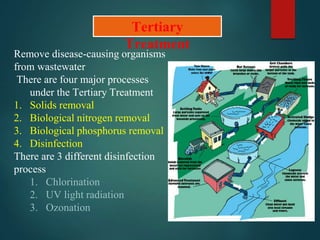
Remove disease-causing organisms
from wastewater
There are four major processes
under the Tertiary Treatment
1. Solids removal
2. Biological nitrogen removal
3. Biological phosphorus removal
4. Disinfection
There are 3 different disinfection
process
1. Chlorination
2. UV light radiation
3. Ozonation
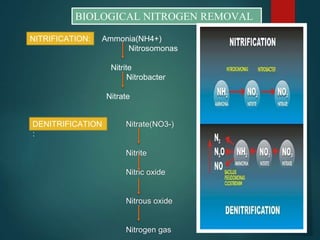
BIOLOGICAL NITROGEN REMOVAL
NITRIFICATION: Ammonia(NH4+)
Nitrosomonas
Nitrite
Nitrobacter
Nitrate
DENITRIFICATION
:
Nitrate(NO3-)
Nitrite
Nitric oxide
Nitrous oxide
Nitrogen gas
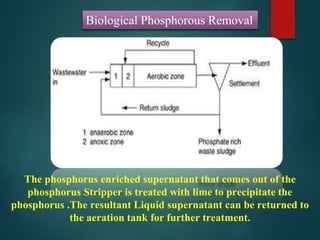
Biological Phosphorous Removal
The phosphorus enriched supernatant that comes out of the
phosphorus Stripper is treated with lime to precipitate the
phosphorus .The resultant Liquid supernatant can be returned to
the aeration tank for further treatment.
Chlorination
Most common
Advantages: low
cost & effective
Disadvantages:
chlorine residue
could be harmful to
environment
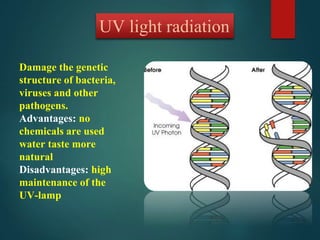
UV light radiation
Damage the genetic
structure of bacteria,
viruses and other
pathogens.
Advantages: no
chemicals are used
water taste more
natural
Disadvantages: high
maintenance of the
UV-lamp
Ozonation
Oxidized most pathogenic microorganisms
Advantages: safer than chlorination fewer disinfection
by-product
Disadvantage: high cost
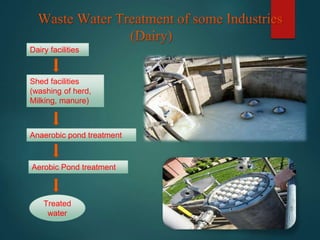
Dairy facilities
Shed facilities
(washing of herd,
Milking, manure)
Anaerobic pond treatment
Aerobic Pond treatment
Treated
water
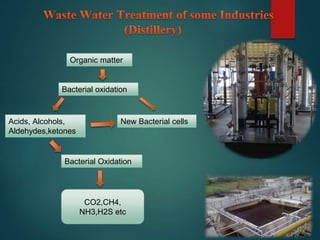
Organic matter
Bacterial oxidation
Acids, Alcohols,
Aldehydes,ketones
New Bacterial cells
Bacterial Oxidation
CO2,CH4,
NH3,H2S etc
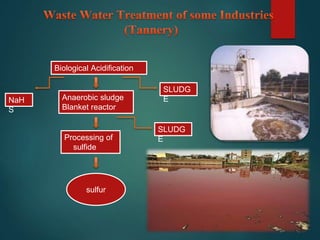
Biological Acidification
Anaerobic sludge
Blanket reactor
Processing of
sulfide
sulfur
SLUDG
E
SLUDG
E
NaH
S
Summary
Disposal of wastewaters from an industrial plant is a difficult and
costly problem. Most petroleum refineries, chemical and Nuclear
plants ,Dairy and Tannery plants have onsite facilities to treat their
wastewaters so that the pollutant concentrations in the treated
wastewater comply with the local and/or national regulations
regarding disposal of wastewaters into community treatment plants
or into rivers, lakes or oceans. Constructed wetlands are being used
in an increasing number of cases as they provided high quality and
productive on-site treatment. Other Industrial processes that
produce a lot of waste-waters such as paper and pulp production has
created environmental concern leading to development of processes
to recycle water use within plants before they have to be cleaned
and disposed of. Treated wastewater can be reused as drinking
water, in industry (cooling towers), in artificial recharge of aquifers,
in agriculture and in the rehabilitation of natural ecosystems.
Conclusion

Waste_Water_Treatment.pptx

  • 1.
    Waste Water Treatment Strategies Dr SushovanSarkar Professor and HOD (Civil) Budge Budge Institute of Technology
  • 2.
    Waste Water Treatment Usuallyrefer to sewage treatment, or domestic/industrial wastewater treatment process of removing contaminants from wastewater, both runoff and domestic /industrial ❖Residences (kitchen, bathroom, wash baisn called sullage and from toilet called sewage) ❖Commercial institution ❖Industries (usually require specialized treatment process) SOURCE OF WASTE WATER
  • 3.
    ❖Purpose: • To Providea good sanitary environmental condition of city protecting public health. • Disposal of wastewater to a proper place to prevent a favorable condition for mosquito breeding , fly developing or bacteria growing. • To treat wastewater as per needs so as not to endanger the body of water or groundwater or land to get polluted where it is finally disposed off thereby protect human health and environment. • To recycle the treated wastewater for domestic , industrial and miscellaneous uses.
  • 4.
    4 STRATEGY OF MUNICIPALWASTEWATER TREATMENT ⮚PRELIMINARY TREATMENT 1. Screening (For eliminating coarse materials) 1. Grit Removal (For removal of settleable inorganic particles) ⮚ PRIMARY TREATMENT 1. Primary Sedimentation (For removal of settleable organics) ⮚ SECONDARY TREATMENT (Option1- Activated Sludge Process) 1. Aeration (For carbonaceous oxidation) 1. Secondary sedimentation (For separation of biomass) ⮚ SECONDARY TREATMENT (Option2- Trickling Filter) 1. Filtration through attached-growth media (For carbonaceous oxidation)
  • 5.
    5 STRATEGY OF MUNICIPALWASTEWATER TREATMENT ⮚TERTIARY TREATMENT (ADVANCED TREATMENT) 1. Flocculation using Polyelectrolyte (For eliminating residual suspended solids) 2. Sequencing Batch Reactor under Aerobic-Anoxic- Anerobic mode (For removal of N and P) 2. Chlorination/Ozonation (For partial killing of Pathogens)
  • 6.
    How can itbe treated? Collected and transported via a network of pipes and pump stations to a municipal treatment plant
  • 7.
    Stages of watertreatment ❖Primary solids are separated ❖Secondary dissolved organic matter is converted into a solid mass by using water-borne bacteria 95% of the suspended molecules should be removed ❖Tertiary biological solids are neutralized then disposed, and treated water may be disinfected chemically or physically
  • 8.
    Types of Treatment ❑Mechanical treatment •Influx(Influent) •Removal of large objects •Removal of sand and grit •Primary Sedimentation ❑Biological treatment •Trickling bed filter •Activated sludge ❑Chemical treatment •Disinfection
  • 9.
    Preliminary Treatment - removeslarge objects and non-degradable materials - protects pumps and equipment from damage - bar screen and grit chamber ❖Bar Screen - catches large objects that have gotten into sewer system such as bricks, bottles, pieces of wood, etc ❖Grit Chamber - removes rocks, gravel, broken glass, etc. ❖Mesh Screen - removes diapers, combs, towels, plastic bags, syringes, etc.
  • 10.
    Treatment stages -Primary Treatment typical materials that are removed during primary treatment include fats, oils, and greases (eg. FOG) sand, gravels and rocks (eg. grit) larger settleable solids including human waste, and floating materials
  • 11.
    ❖Primary treatment reducesthe suspended solids and the B.O.D. of the wastewater. ❖From the primary treatment tanks water is pumped to the trickling filter or activated sludge reactor for secondary treatment. ❖Secondary treatment will further reduce the suspended solids and B.O.D. of the wastewater. Wastewater Treatment
  • 12.
    Treatment stages -Secondary Treatment or Biological Treatment Degrade biological content (dissolved organic matter) of the sewage Ex: human waste, food waste, soaps, detergent Added bacteria and protozoa into sewage.3 different approaches Fixed film system Suspended film system Lagoon system
  • 13.
    Three approaches ❑ FixedFilm Systems grow microorganisms on substrates such as rocks, sand or plastic wastewater is spread over the substrate Ex: Trickling filters, rotating biological contactors Spread wastewater over microorganism made of coke (carbonised coal), limestone chips or specially fabricated plastic media Optimize their thickness by insect or worm grazing ❑Trickling filters bed
  • 14.
    Suspended Film Systems stirand suspend microorganisms in wastewater settled out as a sludge pumped back into the incoming wastewater Ex: Activated sludge, extended aeration Secondary Treatment or Biological Treatment & Role of Microorganisms Activated sludge Mixed community of microorganisms .Both aerobic and anaerobic bacteria may exist. Biological floc is formed
  • 15.
    5 physical componentsof Activated Sludge process ⮚Aeration tank oxygen is introduced into the system
  • 16.
    ⮚Aeration source ensure thatadequate oxygen is fed into the tank provided pure oxygen or compressed air
  • 17.
    ⮚Secondary clarifiers activated-sludge solidsseparate from the surrounding wastewater
  • 18.
    ❑Activated sludge outflow line Pumpactivated sludge back to the aeration tank ❑Effluent outflow line discharged effluent into bay or tertiary treatment plant Activated sludge
  • 19.
    Lagoon Systems hold thewaste-water for several months natural degradation of sewage Usually reeds are preferred
  • 20.
    1. a 2. MethanogenicBacteria : These bacteria, also refered to as methanogens Or methane formers are responsible for the conversion of acetic acid and Hydrogen to methane and carbondioxide.The most important methanogens belong to the genera Methanobacterium, Methanobacillus, Methanococcus Role of Microorganisms…. A consortium of anaerobic microorganisms work together for degradation Of sludge(or sewage) organic matter. They may be categorized into two types 1. Acid-Forming bacteria :Also known as acidogens or non-methanogenic Bacteria. They bring out the hydrolysis of macromolecules (e.g.carbohydrate) to simple substrates (e.g.monosaccharides), and the latter to acids e.g. Clostridium sp, Lactobacillus sp, E.coli
  • 21.
    Tertiary Treatment Remove disease-causing organisms fromwastewater There are four major processes under the Tertiary Treatment 1. Solids removal 2. Biological nitrogen removal 3. Biological phosphorus removal 4. Disinfection There are 3 different disinfection process 1. Chlorination 2. UV light radiation 3. Ozonation
  • 22.
    BIOLOGICAL NITROGEN REMOVAL NITRIFICATION:Ammonia(NH4+) Nitrosomonas Nitrite Nitrobacter Nitrate DENITRIFICATION : Nitrate(NO3-) Nitrite Nitric oxide Nitrous oxide Nitrogen gas
  • 23.
    Biological Phosphorous Removal Thephosphorus enriched supernatant that comes out of the phosphorus Stripper is treated with lime to precipitate the phosphorus .The resultant Liquid supernatant can be returned to the aeration tank for further treatment.
  • 24.
    Chlorination Most common Advantages: low cost& effective Disadvantages: chlorine residue could be harmful to environment
  • 25.
    UV light radiation Damagethe genetic structure of bacteria, viruses and other pathogens. Advantages: no chemicals are used water taste more natural Disadvantages: high maintenance of the UV-lamp
  • 26.
    Ozonation Oxidized most pathogenicmicroorganisms Advantages: safer than chlorination fewer disinfection by-product Disadvantage: high cost
  • 27.
    Dairy facilities Shed facilities (washingof herd, Milking, manure) Anaerobic pond treatment Aerobic Pond treatment Treated water
  • 28.
    Organic matter Bacterial oxidation Acids,Alcohols, Aldehydes,ketones New Bacterial cells Bacterial Oxidation CO2,CH4, NH3,H2S etc
  • 29.
    Biological Acidification Anaerobic sludge Blanketreactor Processing of sulfide sulfur SLUDG E SLUDG E NaH S
  • 30.
  • 31.
    Disposal of wastewatersfrom an industrial plant is a difficult and costly problem. Most petroleum refineries, chemical and Nuclear plants ,Dairy and Tannery plants have onsite facilities to treat their wastewaters so that the pollutant concentrations in the treated wastewater comply with the local and/or national regulations regarding disposal of wastewaters into community treatment plants or into rivers, lakes or oceans. Constructed wetlands are being used in an increasing number of cases as they provided high quality and productive on-site treatment. Other Industrial processes that produce a lot of waste-waters such as paper and pulp production has created environmental concern leading to development of processes to recycle water use within plants before they have to be cleaned and disposed of. Treated wastewater can be reused as drinking water, in industry (cooling towers), in artificial recharge of aquifers, in agriculture and in the rehabilitation of natural ecosystems. Conclusion