Lecture 2:
MIPS
Processor
Example
CMOS VLSI Design
CMOS VLSI Design 4th Ed.
2: MIPS Processor Example 2
Outline
 Design Partitioning
 MIPS Processor Example
– Architecture
– Microarchitecture
– Logic Design
– Circuit Design
– Physical Design
 Fabrication, Packaging, Testing
CMOS VLSI Design
CMOS VLSI Design 4th Ed.
2: MIPS Processor Example 3
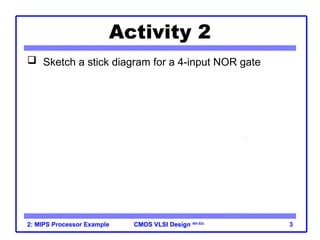
Activity 2
 Sketch a stick diagram for a 4-input NOR gate
A
VDD
GND
B C
Y
D
CMOS VLSI Design
CMOS VLSI Design 4th Ed.
2: MIPS Processor Example 4
Coping with Complexity
 How to design System-on-Chip?
– Many millions (even billions!) of transistors
– Tens to hundreds of engineers
 Structured Design
 Design Partitioning
CMOS VLSI Design
CMOS VLSI Design 4th Ed.
2: MIPS Processor Example 5
Structured Design
 Hierarchy: Divide and Conquer
– Recursively system into modules
 Regularity
– Reuse modules wherever possible
– Ex: Standard cell library
 Modularity: well-formed interfaces
– Allows modules to be treated as black boxes
 Locality
– Physical and temporal
CMOS VLSI Design
CMOS VLSI Design 4th Ed.
2: MIPS Processor Example 6
Design Partitioning
 Architecture: User’s perspective, what does it do?
– Instruction set, registers
– MIPS, x86, Alpha, PIC, ARM, …
 Microarchitecture
– Single cycle, multcycle, pipelined, superscalar?
 Logic: how are functional blocks constructed
– Ripple carry, carry lookahead, carry select adders
 Circuit: how are transistors used
– Complementary CMOS, pass transistors, domino
 Physical: chip layout
– Datapaths, memories, random logic
CMOS VLSI Design
CMOS VLSI Design 4th Ed.
2: MIPS Processor Example 7
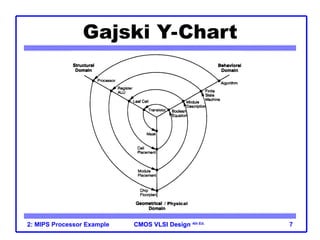
Gajski Y-Chart
CMOS VLSI Design
CMOS VLSI Design 4th Ed.
2: MIPS Processor Example 8
MIPS Architecture
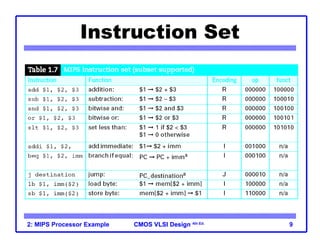
 Example: subset of MIPS processor architecture
– Drawn from Patterson & Hennessy
 MIPS is a 32-bit architecture with 32 registers
– Consider 8-bit subset using 8-bit datapath
– Only implement 8 registers ($0 - $7)
– $0 hardwired to 00000000
– 8-bit program counter
 You’ll build this processor in the labs
– Illustrate the key concepts in VLSI design
CMOS VLSI Design
CMOS VLSI Design 4th Ed.
2: MIPS Processor Example 9
Instruction Set
CMOS VLSI Design
CMOS VLSI Design 4th Ed.
2: MIPS Processor Example 10
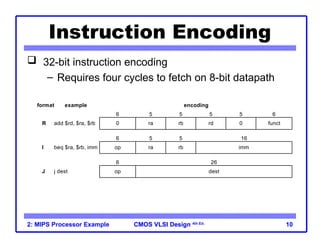
Instruction Encoding
 32-bit instruction encoding
– Requires four cycles to fetch on 8-bit datapath
format example encoding
R
I
J
0 ra rb rd 0 funct
op
op
ra rb imm
6
6
6
6
5 5 5 5
5 5 16
26
add $rd, $ra, $rb
beq $ra, $rb, imm
j dest dest
CMOS VLSI Design
CMOS VLSI Design 4th Ed.
2: MIPS Processor Example 11
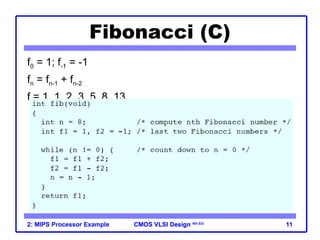
Fibonacci (C)
f0 = 1; f-1 = -1
fn = fn-1 + fn-2
f = 1, 1, 2, 3, 5, 8, 13, …
CMOS VLSI Design
CMOS VLSI Design 4th Ed.
2: MIPS Processor Example 12
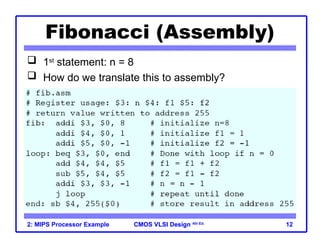
Fibonacci (Assembly)
 1st
statement: n = 8
 How do we translate this to assembly?
CMOS VLSI Design
CMOS VLSI Design 4th Ed.
2: MIPS Processor Example 13
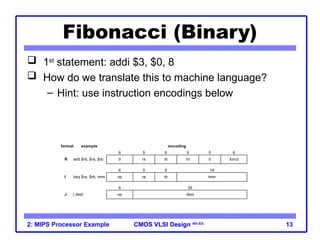
Fibonacci (Binary)
 1st
statement: addi $3, $0, 8
 How do we translate this to machine language?
– Hint: use instruction encodings below
format example encoding
R
I
J
0 ra rb rd 0 funct
op
op
ra rb imm
6
6
6
6
5 5 5 5
5 5 16
26
add $rd, $ra, $rb
beq $ra, $rb, imm
j dest dest
CMOS VLSI Design
CMOS VLSI Design 4th Ed.
2: MIPS Processor Example 14
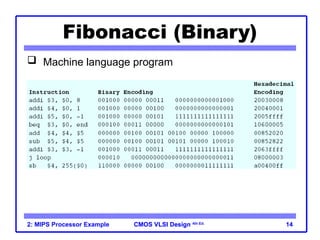
Fibonacci (Binary)
 Machine language program
CMOS VLSI Design
CMOS VLSI Design 4th Ed.
2: MIPS Processor Example 15
MIPS Microarchitecture
 Multicycle architecture ( [Paterson04], [Harris07] )
CMOS VLSI Design
CMOS VLSI Design 4th Ed.
2: MIPS Processor Example 16
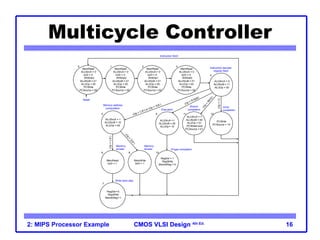
Multicycle Controller
PCWrite
PCSource = 10
ALUSrcA = 1
ALUSrcB = 00
ALUOp = 01
PCWriteCond
PCSource = 01
ALUSrcA =1
ALUSrcB = 00
ALUOp= 10
RegDst = 1
RegWrite
MemtoReg = 0
MemWrite
IorD = 1
MemRead
IorD = 1
ALUSrcA = 1
ALUSrcB = 10
ALUOp = 00
RegDst=0
RegWrite
MemtoReg=1
ALUSrcA = 0
ALUSrcB = 11
ALUOp = 00
MemRead
ALUSrcA = 0
IorD = 0
IRWrite3
ALUSrcB = 01
ALUOp = 00
PCWrite
PCSource = 00
Instruction fetch
Instruction decode/
register fetch
Jump
completion
Branch
completion
Execution
Memory address
computation
Memory
access
Memory
access R-type completion
Write-back step
(Op = 'LB') or (Op = 'SB') (Op = R-type)
(
O
p
=
'
B
E
Q
'
)
(Op
=
'J')
(
O
p
=
'
S
B
'
)
(Op
=
'L
B
')
7
0
4
12
11
9
5
10
8
6
Reset
MemRead
ALUSrcA = 0
IorD = 0
IRWrite2
ALUSrcB = 01
ALUOp = 00
PCWrite
PCSource = 00
1
MemRead
ALUSrcA = 0
IorD = 0
IRWrite1
ALUSrcB = 01
ALUOp = 00
PCWrite
PCSource = 00
2
MemRead
ALUSrcA = 0
IorD = 0
IRWrite0
ALUSrcB = 01
ALUOp = 00
PCWrite
PCSource = 00
3
CMOS VLSI Design
CMOS VLSI Design 4th Ed.
2: MIPS Processor Example 17
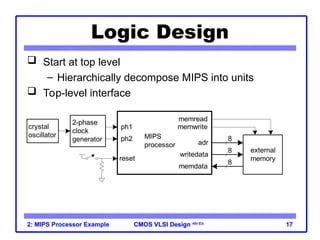
Logic Design
 Start at top level
– Hierarchically decompose MIPS into units
 Top-level interface
reset
ph1
ph2
crystal
oscillator
2-phase
clock
generator MIPS
processor adr
writedata
memdata
external
memory
memread
memwrite
8
8
8
CMOS VLSI Design
CMOS VLSI Design 4th Ed.
2: MIPS Processor Example 18
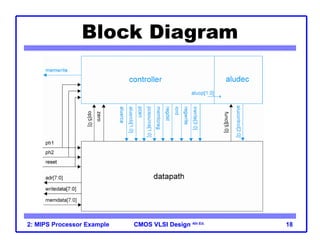
Block Diagram
CMOS VLSI Design
CMOS VLSI Design 4th Ed.
2: MIPS Processor Example 19
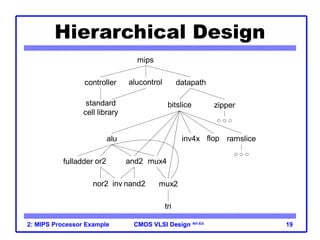
Hierarchical Design
mips
controller alucontrol datapath
standard
cell library
bitslice zipper
alu
and2
flop
inv4x
mux2
mux4
ramslice
fulladder
nand2
nor2
or2
inv
tri
CMOS VLSI Design
CMOS VLSI Design 4th Ed.
2: MIPS Processor Example 20
HDLs
 Hardware Description Languages
– Widely used in logic design
– Verilog and VHDL
 Describe hardware using code
– Document logic functions
– Simulate logic before building
– Synthesize code into gates and layout
• Requires a library of standard cells
CMOS VLSI Design
CMOS VLSI Design 4th Ed.
2: MIPS Processor Example 21
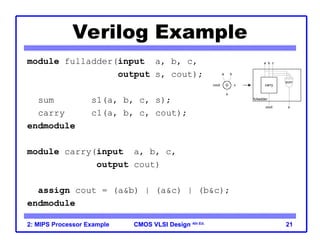
Verilog Example
module fulladder(input a, b, c,
output s, cout);
sum s1(a, b, c, s);
carry c1(a, b, c, cout);
endmodule
module carry(input a, b, c,
output cout)
assign cout = (a&b) | (a&c) | (b&c);
endmodule
a b
c
s
cout carry
sum
s
a b c
cout
fulladder
CMOS VLSI Design
CMOS VLSI Design 4th Ed.
2: MIPS Processor Example 22
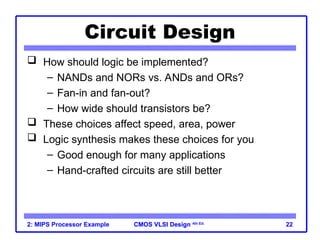
Circuit Design
 How should logic be implemented?
– NANDs and NORs vs. ANDs and ORs?
– Fan-in and fan-out?
– How wide should transistors be?
 These choices affect speed, area, power
 Logic synthesis makes these choices for you
– Good enough for many applications
– Hand-crafted circuits are still better
CMOS VLSI Design
CMOS VLSI Design 4th Ed.
2: MIPS Processor Example 23
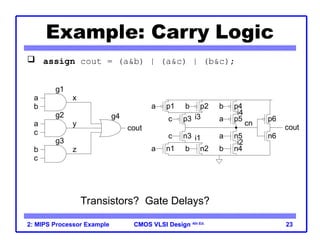
Example: Carry Logic
 assign cout = (a&b) | (a&c) | (b&c);
a
b
a
c
b
c
cout
x
y
z
g1
g2
g3
g4
Transistors? Gate Delays?
a b
c
c
a b
b
a
a
b
cout
cn
n1 n2
n3
n4
n5 n6
p6
p5
p4
p3
p2
p1
i1
i3
i2
i4
CMOS VLSI Design
CMOS VLSI Design 4th Ed.
2: MIPS Processor Example 24
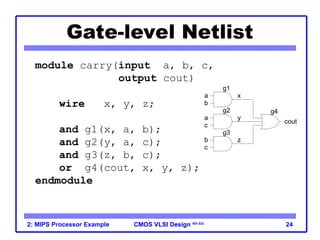
Gate-level Netlist
module carry(input a, b, c,
output cout)
wire x, y, z;
and g1(x, a, b);
and g2(y, a, c);
and g3(z, b, c);
or g4(cout, x, y, z);
endmodule
a
b
a
c
b
c
cout
x
y
z
g1
g2
g3
g4
CMOS VLSI Design
CMOS VLSI Design 4th Ed.
2: MIPS Processor Example 25
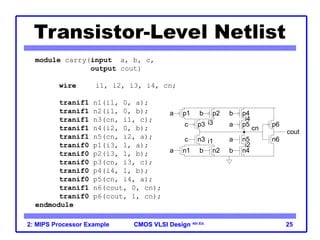
Transistor-Level Netlist
a b
c
c
a b
b
a
a
b
cout
cn
n1 n2
n3
n4
n5 n6
p6
p5
p4
p3
p2
p1
i1
i3
i2
i4
module carry(input a, b, c,
output cout)
wire i1, i2, i3, i4, cn;
tranif1 n1(i1, 0, a);
tranif1 n2(i1, 0, b);
tranif1 n3(cn, i1, c);
tranif1 n4(i2, 0, b);
tranif1 n5(cn, i2, a);
tranif0 p1(i3, 1, a);
tranif0 p2(i3, 1, b);
tranif0 p3(cn, i3, c);
tranif0 p4(i4, 1, b);
tranif0 p5(cn, i4, a);
tranif1 n6(cout, 0, cn);
tranif0 p6(cout, 1, cn);
endmodule
CMOS VLSI Design
CMOS VLSI Design 4th Ed.
2: MIPS Processor Example 26
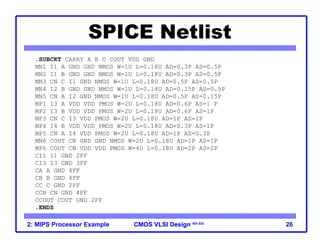
SPICE Netlist
.SUBCKT CARRY A B C COUT VDD GND
MN1 I1 A GND GND NMOS W=1U L=0.18U AD=0.3P AS=0.5P
MN2 I1 B GND GND NMOS W=1U L=0.18U AD=0.3P AS=0.5P
MN3 CN C I1 GND NMOS W=1U L=0.18U AD=0.5P AS=0.5P
MN4 I2 B GND GND NMOS W=1U L=0.18U AD=0.15P AS=0.5P
MN5 CN A I2 GND NMOS W=1U L=0.18U AD=0.5P AS=0.15P
MP1 I3 A VDD VDD PMOS W=2U L=0.18U AD=0.6P AS=1 P
MP2 I3 B VDD VDD PMOS W=2U L=0.18U AD=0.6P AS=1P
MP3 CN C I3 VDD PMOS W=2U L=0.18U AD=1P AS=1P
MP4 I4 B VDD VDD PMOS W=2U L=0.18U AD=0.3P AS=1P
MP5 CN A I4 VDD PMOS W=2U L=0.18U AD=1P AS=0.3P
MN6 COUT CN GND GND NMOS W=2U L=0.18U AD=1P AS=1P
MP6 COUT CN VDD VDD PMOS W=4U L=0.18U AD=2P AS=2P
CI1 I1 GND 2FF
CI3 I3 GND 3FF
CA A GND 4FF
CB B GND 4FF
CC C GND 2FF
CCN CN GND 4FF
CCOUT COUT GND 2FF
.ENDS
CMOS VLSI Design
CMOS VLSI Design 4th Ed.
2: MIPS Processor Example 27
Physical Design
 Floorplan
 Standard cells
– Place & route
 Datapaths
– Slice planning
 Area estimation
CMOS VLSI Design
CMOS VLSI Design 4th Ed.
2: MIPS Processor Example 28
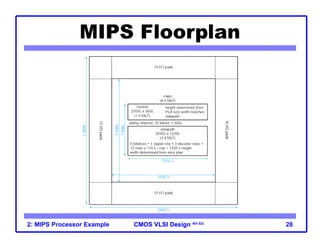
MIPS Floorplan
CMOS VLSI Design
CMOS VLSI Design 4th Ed.
2: MIPS Processor Example 29
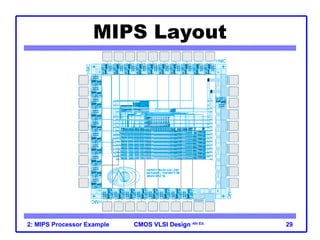
MIPS Layout
CMOS VLSI Design
CMOS VLSI Design 4th Ed.
2: MIPS Processor Example 30
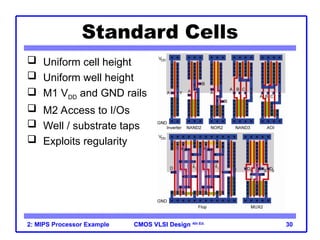
Standard Cells
 Uniform cell height
 Uniform well height
 M1 VDD and GND rails
 M2 Access to I/Os
 Well / substrate taps
 Exploits regularity
CMOS VLSI Design
CMOS VLSI Design 4th Ed.
2: MIPS Processor Example 31
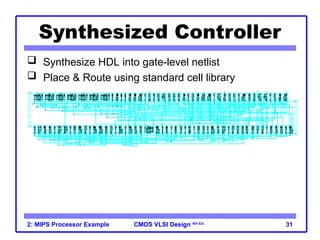
Synthesized Controller
 Synthesize HDL into gate-level netlist
 Place & Route using standard cell library
CMOS VLSI Design
CMOS VLSI Design 4th Ed.
2: MIPS Processor Example 32
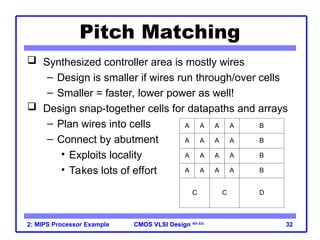
Pitch Matching
 Synthesized controller area is mostly wires
– Design is smaller if wires run through/over cells
– Smaller = faster, lower power as well!
 Design snap-together cells for datapaths and arrays
– Plan wires into cells
– Connect by abutment
• Exploits locality
• Takes lots of effort
A A A A
A A A A
A A A A
A A A A
B
B
B
B
C C D
CMOS VLSI Design
CMOS VLSI Design 4th Ed.
2: MIPS Processor Example 33
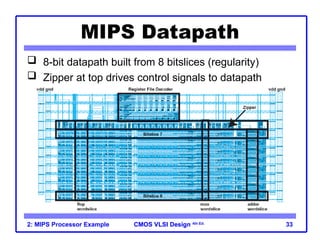
MIPS Datapath
 8-bit datapath built from 8 bitslices (regularity)
 Zipper at top drives control signals to datapath
CMOS VLSI Design
CMOS VLSI Design 4th Ed.
2: MIPS Processor Example 34
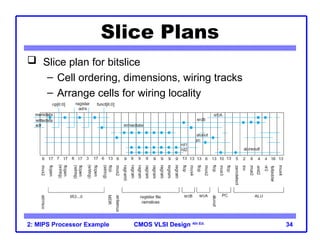
Slice Plans
 Slice plan for bitslice
– Cell ordering, dimensions, wiring tracks
– Arrange cells for wiring locality
CMOS VLSI Design
CMOS VLSI Design 4th Ed.
2: MIPS Processor Example 35
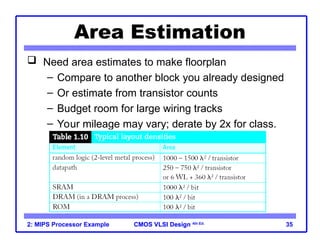
Area Estimation
 Need area estimates to make floorplan
– Compare to another block you already designed
– Or estimate from transistor counts
– Budget room for large wiring tracks
– Your mileage may vary; derate by 2x for class.
CMOS VLSI Design
CMOS VLSI Design 4th Ed.
2: MIPS Processor Example 36
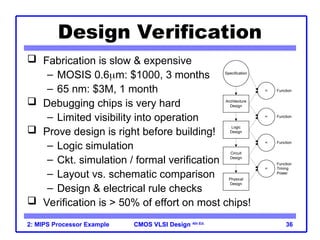
Design Verification
 Fabrication is slow & expensive
– MOSIS 0.6m: $1000, 3 months
– 65 nm: $3M, 1 month
 Debugging chips is very hard
– Limited visibility into operation
 Prove design is right before building!
– Logic simulation
– Ckt. simulation / formal verification
– Layout vs. schematic comparison
– Design & electrical rule checks
 Verification is > 50% of effort on most chips!
Specification
Architecture
Design
Logic
Design
Circuit
Design
Physical
Design
=
=
=
=
Function
Function
Function
Function
Timing
Power
CMOS VLSI Design
CMOS VLSI Design 4th Ed.
2: MIPS Processor Example 37
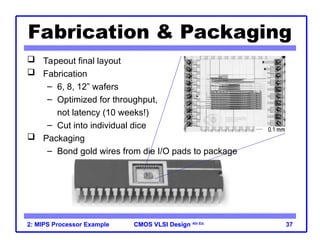
Fabrication & Packaging
 Tapeout final layout
 Fabrication
– 6, 8, 12” wafers
– Optimized for throughput,
not latency (10 weeks!)
– Cut into individual dice
 Packaging
– Bond gold wires from die I/O pads to package
CMOS VLSI Design
CMOS VLSI Design 4th Ed.
2: MIPS Processor Example 38
Testing
 Test that chip operates
– Design errors
– Manufacturing errors
 A single dust particle or wafer defect kills a die
– Yields from 90% to < 10%
– Depends on die size, maturity of process
– Test each part before shipping to customer
CMOS VLSI Design
CMOS VLSI Design 4th Ed.
2: MIPS Processor Example 39
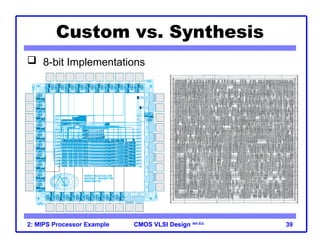
Custom vs. Synthesis
 8-bit Implementations
CMOS VLSI Design
CMOS VLSI Design 4th Ed.
2: MIPS Processor Example 40
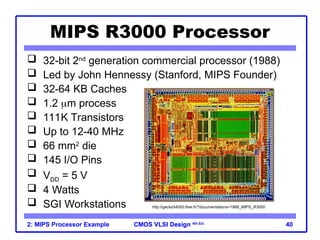
MIPS R3000 Processor
 32-bit 2nd
generation commercial processor (1988)
 Led by John Hennessy (Stanford, MIPS Founder)
 32-64 KB Caches
 1.2 m process
 111K Transistors
 Up to 12-40 MHz
 66 mm2
die
 145 I/O Pins
 VDD = 5 V
 4 Watts
 SGI Workstations http://gecko54000.free.fr/?documentations=1988_MIPS_R3000

MIPS processor in VLSI design. Processor design

  • 1.
  • 2.
    CMOS VLSI Design CMOSVLSI Design 4th Ed. 2: MIPS Processor Example 2 Outline  Design Partitioning  MIPS Processor Example – Architecture – Microarchitecture – Logic Design – Circuit Design – Physical Design  Fabrication, Packaging, Testing
  • 3.
    CMOS VLSI Design CMOSVLSI Design 4th Ed. 2: MIPS Processor Example 3 Activity 2  Sketch a stick diagram for a 4-input NOR gate A VDD GND B C Y D
  • 4.
    CMOS VLSI Design CMOSVLSI Design 4th Ed. 2: MIPS Processor Example 4 Coping with Complexity  How to design System-on-Chip? – Many millions (even billions!) of transistors – Tens to hundreds of engineers  Structured Design  Design Partitioning
  • 5.
    CMOS VLSI Design CMOSVLSI Design 4th Ed. 2: MIPS Processor Example 5 Structured Design  Hierarchy: Divide and Conquer – Recursively system into modules  Regularity – Reuse modules wherever possible – Ex: Standard cell library  Modularity: well-formed interfaces – Allows modules to be treated as black boxes  Locality – Physical and temporal
  • 6.
    CMOS VLSI Design CMOSVLSI Design 4th Ed. 2: MIPS Processor Example 6 Design Partitioning  Architecture: User’s perspective, what does it do? – Instruction set, registers – MIPS, x86, Alpha, PIC, ARM, …  Microarchitecture – Single cycle, multcycle, pipelined, superscalar?  Logic: how are functional blocks constructed – Ripple carry, carry lookahead, carry select adders  Circuit: how are transistors used – Complementary CMOS, pass transistors, domino  Physical: chip layout – Datapaths, memories, random logic
  • 7.
    CMOS VLSI Design CMOSVLSI Design 4th Ed. 2: MIPS Processor Example 7 Gajski Y-Chart
  • 8.
    CMOS VLSI Design CMOSVLSI Design 4th Ed. 2: MIPS Processor Example 8 MIPS Architecture  Example: subset of MIPS processor architecture – Drawn from Patterson & Hennessy  MIPS is a 32-bit architecture with 32 registers – Consider 8-bit subset using 8-bit datapath – Only implement 8 registers ($0 - $7) – $0 hardwired to 00000000 – 8-bit program counter  You’ll build this processor in the labs – Illustrate the key concepts in VLSI design
  • 9.
    CMOS VLSI Design CMOSVLSI Design 4th Ed. 2: MIPS Processor Example 9 Instruction Set
  • 10.
    CMOS VLSI Design CMOSVLSI Design 4th Ed. 2: MIPS Processor Example 10 Instruction Encoding  32-bit instruction encoding – Requires four cycles to fetch on 8-bit datapath format example encoding R I J 0 ra rb rd 0 funct op op ra rb imm 6 6 6 6 5 5 5 5 5 5 16 26 add $rd, $ra, $rb beq $ra, $rb, imm j dest dest
  • 11.
    CMOS VLSI Design CMOSVLSI Design 4th Ed. 2: MIPS Processor Example 11 Fibonacci (C) f0 = 1; f-1 = -1 fn = fn-1 + fn-2 f = 1, 1, 2, 3, 5, 8, 13, …
  • 12.
    CMOS VLSI Design CMOSVLSI Design 4th Ed. 2: MIPS Processor Example 12 Fibonacci (Assembly)  1st statement: n = 8  How do we translate this to assembly?
  • 13.
    CMOS VLSI Design CMOSVLSI Design 4th Ed. 2: MIPS Processor Example 13 Fibonacci (Binary)  1st statement: addi $3, $0, 8  How do we translate this to machine language? – Hint: use instruction encodings below format example encoding R I J 0 ra rb rd 0 funct op op ra rb imm 6 6 6 6 5 5 5 5 5 5 16 26 add $rd, $ra, $rb beq $ra, $rb, imm j dest dest
  • 14.
    CMOS VLSI Design CMOSVLSI Design 4th Ed. 2: MIPS Processor Example 14 Fibonacci (Binary)  Machine language program
  • 15.
    CMOS VLSI Design CMOSVLSI Design 4th Ed. 2: MIPS Processor Example 15 MIPS Microarchitecture  Multicycle architecture ( [Paterson04], [Harris07] )
  • 16.
    CMOS VLSI Design CMOSVLSI Design 4th Ed. 2: MIPS Processor Example 16 Multicycle Controller PCWrite PCSource = 10 ALUSrcA = 1 ALUSrcB = 00 ALUOp = 01 PCWriteCond PCSource = 01 ALUSrcA =1 ALUSrcB = 00 ALUOp= 10 RegDst = 1 RegWrite MemtoReg = 0 MemWrite IorD = 1 MemRead IorD = 1 ALUSrcA = 1 ALUSrcB = 10 ALUOp = 00 RegDst=0 RegWrite MemtoReg=1 ALUSrcA = 0 ALUSrcB = 11 ALUOp = 00 MemRead ALUSrcA = 0 IorD = 0 IRWrite3 ALUSrcB = 01 ALUOp = 00 PCWrite PCSource = 00 Instruction fetch Instruction decode/ register fetch Jump completion Branch completion Execution Memory address computation Memory access Memory access R-type completion Write-back step (Op = 'LB') or (Op = 'SB') (Op = R-type) ( O p = ' B E Q ' ) (Op = 'J') ( O p = ' S B ' ) (Op = 'L B ') 7 0 4 12 11 9 5 10 8 6 Reset MemRead ALUSrcA = 0 IorD = 0 IRWrite2 ALUSrcB = 01 ALUOp = 00 PCWrite PCSource = 00 1 MemRead ALUSrcA = 0 IorD = 0 IRWrite1 ALUSrcB = 01 ALUOp = 00 PCWrite PCSource = 00 2 MemRead ALUSrcA = 0 IorD = 0 IRWrite0 ALUSrcB = 01 ALUOp = 00 PCWrite PCSource = 00 3
  • 17.
    CMOS VLSI Design CMOSVLSI Design 4th Ed. 2: MIPS Processor Example 17 Logic Design  Start at top level – Hierarchically decompose MIPS into units  Top-level interface reset ph1 ph2 crystal oscillator 2-phase clock generator MIPS processor adr writedata memdata external memory memread memwrite 8 8 8
  • 18.
    CMOS VLSI Design CMOSVLSI Design 4th Ed. 2: MIPS Processor Example 18 Block Diagram
  • 19.
    CMOS VLSI Design CMOSVLSI Design 4th Ed. 2: MIPS Processor Example 19 Hierarchical Design mips controller alucontrol datapath standard cell library bitslice zipper alu and2 flop inv4x mux2 mux4 ramslice fulladder nand2 nor2 or2 inv tri
  • 20.
    CMOS VLSI Design CMOSVLSI Design 4th Ed. 2: MIPS Processor Example 20 HDLs  Hardware Description Languages – Widely used in logic design – Verilog and VHDL  Describe hardware using code – Document logic functions – Simulate logic before building – Synthesize code into gates and layout • Requires a library of standard cells
  • 21.
    CMOS VLSI Design CMOSVLSI Design 4th Ed. 2: MIPS Processor Example 21 Verilog Example module fulladder(input a, b, c, output s, cout); sum s1(a, b, c, s); carry c1(a, b, c, cout); endmodule module carry(input a, b, c, output cout) assign cout = (a&b) | (a&c) | (b&c); endmodule a b c s cout carry sum s a b c cout fulladder
  • 22.
    CMOS VLSI Design CMOSVLSI Design 4th Ed. 2: MIPS Processor Example 22 Circuit Design  How should logic be implemented? – NANDs and NORs vs. ANDs and ORs? – Fan-in and fan-out? – How wide should transistors be?  These choices affect speed, area, power  Logic synthesis makes these choices for you – Good enough for many applications – Hand-crafted circuits are still better
  • 23.
    CMOS VLSI Design CMOSVLSI Design 4th Ed. 2: MIPS Processor Example 23 Example: Carry Logic  assign cout = (a&b) | (a&c) | (b&c); a b a c b c cout x y z g1 g2 g3 g4 Transistors? Gate Delays? a b c c a b b a a b cout cn n1 n2 n3 n4 n5 n6 p6 p5 p4 p3 p2 p1 i1 i3 i2 i4
  • 24.
    CMOS VLSI Design CMOSVLSI Design 4th Ed. 2: MIPS Processor Example 24 Gate-level Netlist module carry(input a, b, c, output cout) wire x, y, z; and g1(x, a, b); and g2(y, a, c); and g3(z, b, c); or g4(cout, x, y, z); endmodule a b a c b c cout x y z g1 g2 g3 g4
  • 25.
    CMOS VLSI Design CMOSVLSI Design 4th Ed. 2: MIPS Processor Example 25 Transistor-Level Netlist a b c c a b b a a b cout cn n1 n2 n3 n4 n5 n6 p6 p5 p4 p3 p2 p1 i1 i3 i2 i4 module carry(input a, b, c, output cout) wire i1, i2, i3, i4, cn; tranif1 n1(i1, 0, a); tranif1 n2(i1, 0, b); tranif1 n3(cn, i1, c); tranif1 n4(i2, 0, b); tranif1 n5(cn, i2, a); tranif0 p1(i3, 1, a); tranif0 p2(i3, 1, b); tranif0 p3(cn, i3, c); tranif0 p4(i4, 1, b); tranif0 p5(cn, i4, a); tranif1 n6(cout, 0, cn); tranif0 p6(cout, 1, cn); endmodule
  • 26.
    CMOS VLSI Design CMOSVLSI Design 4th Ed. 2: MIPS Processor Example 26 SPICE Netlist .SUBCKT CARRY A B C COUT VDD GND MN1 I1 A GND GND NMOS W=1U L=0.18U AD=0.3P AS=0.5P MN2 I1 B GND GND NMOS W=1U L=0.18U AD=0.3P AS=0.5P MN3 CN C I1 GND NMOS W=1U L=0.18U AD=0.5P AS=0.5P MN4 I2 B GND GND NMOS W=1U L=0.18U AD=0.15P AS=0.5P MN5 CN A I2 GND NMOS W=1U L=0.18U AD=0.5P AS=0.15P MP1 I3 A VDD VDD PMOS W=2U L=0.18U AD=0.6P AS=1 P MP2 I3 B VDD VDD PMOS W=2U L=0.18U AD=0.6P AS=1P MP3 CN C I3 VDD PMOS W=2U L=0.18U AD=1P AS=1P MP4 I4 B VDD VDD PMOS W=2U L=0.18U AD=0.3P AS=1P MP5 CN A I4 VDD PMOS W=2U L=0.18U AD=1P AS=0.3P MN6 COUT CN GND GND NMOS W=2U L=0.18U AD=1P AS=1P MP6 COUT CN VDD VDD PMOS W=4U L=0.18U AD=2P AS=2P CI1 I1 GND 2FF CI3 I3 GND 3FF CA A GND 4FF CB B GND 4FF CC C GND 2FF CCN CN GND 4FF CCOUT COUT GND 2FF .ENDS
  • 27.
    CMOS VLSI Design CMOSVLSI Design 4th Ed. 2: MIPS Processor Example 27 Physical Design  Floorplan  Standard cells – Place & route  Datapaths – Slice planning  Area estimation
  • 28.
    CMOS VLSI Design CMOSVLSI Design 4th Ed. 2: MIPS Processor Example 28 MIPS Floorplan
  • 29.
    CMOS VLSI Design CMOSVLSI Design 4th Ed. 2: MIPS Processor Example 29 MIPS Layout
  • 30.
    CMOS VLSI Design CMOSVLSI Design 4th Ed. 2: MIPS Processor Example 30 Standard Cells  Uniform cell height  Uniform well height  M1 VDD and GND rails  M2 Access to I/Os  Well / substrate taps  Exploits regularity
  • 31.
    CMOS VLSI Design CMOSVLSI Design 4th Ed. 2: MIPS Processor Example 31 Synthesized Controller  Synthesize HDL into gate-level netlist  Place & Route using standard cell library
  • 32.
    CMOS VLSI Design CMOSVLSI Design 4th Ed. 2: MIPS Processor Example 32 Pitch Matching  Synthesized controller area is mostly wires – Design is smaller if wires run through/over cells – Smaller = faster, lower power as well!  Design snap-together cells for datapaths and arrays – Plan wires into cells – Connect by abutment • Exploits locality • Takes lots of effort A A A A A A A A A A A A A A A A B B B B C C D
  • 33.
    CMOS VLSI Design CMOSVLSI Design 4th Ed. 2: MIPS Processor Example 33 MIPS Datapath  8-bit datapath built from 8 bitslices (regularity)  Zipper at top drives control signals to datapath
  • 34.
    CMOS VLSI Design CMOSVLSI Design 4th Ed. 2: MIPS Processor Example 34 Slice Plans  Slice plan for bitslice – Cell ordering, dimensions, wiring tracks – Arrange cells for wiring locality
  • 35.
    CMOS VLSI Design CMOSVLSI Design 4th Ed. 2: MIPS Processor Example 35 Area Estimation  Need area estimates to make floorplan – Compare to another block you already designed – Or estimate from transistor counts – Budget room for large wiring tracks – Your mileage may vary; derate by 2x for class.
  • 36.
    CMOS VLSI Design CMOSVLSI Design 4th Ed. 2: MIPS Processor Example 36 Design Verification  Fabrication is slow & expensive – MOSIS 0.6m: $1000, 3 months – 65 nm: $3M, 1 month  Debugging chips is very hard – Limited visibility into operation  Prove design is right before building! – Logic simulation – Ckt. simulation / formal verification – Layout vs. schematic comparison – Design & electrical rule checks  Verification is > 50% of effort on most chips! Specification Architecture Design Logic Design Circuit Design Physical Design = = = = Function Function Function Function Timing Power
  • 37.
    CMOS VLSI Design CMOSVLSI Design 4th Ed. 2: MIPS Processor Example 37 Fabrication & Packaging  Tapeout final layout  Fabrication – 6, 8, 12” wafers – Optimized for throughput, not latency (10 weeks!) – Cut into individual dice  Packaging – Bond gold wires from die I/O pads to package
  • 38.
    CMOS VLSI Design CMOSVLSI Design 4th Ed. 2: MIPS Processor Example 38 Testing  Test that chip operates – Design errors – Manufacturing errors  A single dust particle or wafer defect kills a die – Yields from 90% to < 10% – Depends on die size, maturity of process – Test each part before shipping to customer
  • 39.
    CMOS VLSI Design CMOSVLSI Design 4th Ed. 2: MIPS Processor Example 39 Custom vs. Synthesis  8-bit Implementations
  • 40.
    CMOS VLSI Design CMOSVLSI Design 4th Ed. 2: MIPS Processor Example 40 MIPS R3000 Processor  32-bit 2nd generation commercial processor (1988)  Led by John Hennessy (Stanford, MIPS Founder)  32-64 KB Caches  1.2 m process  111K Transistors  Up to 12-40 MHz  66 mm2 die  145 I/O Pins  VDD = 5 V  4 Watts  SGI Workstations http://gecko54000.free.fr/?documentations=1988_MIPS_R3000