Draft commitee
 Draft committee is submitted their law format on 26
November 1949.
 But came in to action on 26 January 1950.This day is
celebrated as our republic day.
Introduction
 Indian law is in written format
Indian constitution
 Indian constitution is divided in to 25 parts (22parts
+3new parts by amendment)
 Every parts is divided in to articles
 Every articles inside rules ,regulation ,duties are given.
 The original text of the Constitution contained 395
articles in 22 parts and eight schedules.
 It came into effect on January 26, 1950, the day that
India celebrates each year as the Republic Day.
 The number of articles has since increased to 448 due
to 100 amendments
Part -1(article 1-4)
 Article 1: India the name should be used as
combination of states and union territories .should
not say one state or union as India
 Article 2:parliament has the authority to
Estabilish a new state inside India .
 Article 3:parliament has the authority to contract or
expand the state or union boundaries .(as on 2.6.14
,there is a 29 states + 7 union territories )
 Article 4:new estabilishment of state bill introduction
be done in lok or rajya sabha after president approval.
 Before giving approval to the parliament ,that bill
should be sent to the respective state government for
their opinion
 This opinon should not control the president
Part -2(article 5-11)(citizenship)
 Article 5:when a person born in India betn 26.1.1950 -
1986 means “birth as reference he /she is a citizen of
India .after 1986 some correction in law says that
children parents any one should born in India .then
only as birth he is a citizen of india.
Article 6(citizenship by birth)
 If a person born outside india betn 26.1.1950 – 1992
,then according if his /her father belongs to indian
citizen ,then he /she can apply for a indian citizen and
get through.
Article 7
 This Article Say About The Peoples Who Shifted From
India To Pakistan .
Article 8
 The people belong to the category can get citizen by
registration
 1.after of separation of india they are living out side india
they can apply and get citizen ship by registration
 2.marry indian citizen and get citizen ship by
registration
Article 9(citizenship cancel)
 If a person has dual citizen ship ,if he/she declare that
I can quit indian citizen ship by application then he
/she can end the citizen of india
 If a indian citizen settles outside india for a long time
automatically his /her citizen ship will go out.
 If a person is doing crime business ie.,) against law
then his /her citizen ship will cancelled.
Article 10
 If a person gets citizenship via article 5– article 8 then
they can be a citizen of india with no objection.
Article 11
 Parliament only can regulate the citizenship by
bringing law
 Below shown 4 years parlinment bringing the changes
in citizen ship laws
 1.1986
 2.1992
 3.2003
 4.2005
Part -3(article 12-35)( fundamental
rights )
Article 13:
if any govt. brings law against fundamental rights of
citizen then automatically that law is converted in to
null and void. With the announcement of supreme
court.
Article 14
 Infront of law any person should be treated as same
.(this line is taken from england constitution)
 Law is higher than any one .
 No one is higher than law
Article 15
 Govt .should not separate the citizen by religion ,caste
,sex , birth place .
 Any citizen should not bar the other citizen by
religion ,caste ,sex,birth place ,when he/she enter a
public place ex ., hotels
Article -16
 Same opportunity should be given to all citizens of
india while announcing a govt .job. For public service
.should not separate by religion ,caste , sex ,birth place
.
 If the govt. job related to particular religion ,then that
job should be given to that religion members only
Article -17
 if the person is unqualified for a position/job by
untouchability then he /she is under crime and also
punished
 Govt .brings two laws for abolishing untouchability.
 1955 ,untouchability law
 1976,by amendment ,name changed to rights protection
law
Article -18
 Govt should not give title (pattam) to any citizen or
non citizen ,other than military or education sectors .
 Any citizen should not get any title from any foreign
countries with govt.permission
Article -19
19(1)(a): citizen has rights to comment
19(2)(b):with out weapon people can gather any
where
19(3)(c):permission to start a association
19(4)(d):all have the rights to go anywher in india
without permission
19(5)(e):all have the rights to live anywher in india
19(6)(f):all have the rights to do business ,job any
where in India
Article 20
 If a person committed to a crime ,then he /she is
punished only with the help of current law
 Person is punished one time for one crime .
Article 21 a
 State government should give free education
compulsary for childrens between 6-14
Article 22
Before arresting the person , that person should know
the reason for arrresting .
Article -23
 A person should not be forced for work with less
money.
 If the person is committed to forced work for less
money then employer is punishable.
Article -24
 Childrens age below 14 should not be appointed for
work in industries ,mining etc.,
Article 25
 No bar for spreading the spiritual words of religion.
Article 26
 Any religion has the rights to keep fixed asset and
moving asset by law
Article 27
 No people should be forced to pay religious tax for
developing their religion
Article -28
 Childrens especially school childrens should not be
forced to hear spiritual words by prayer
 If the religion getting subsidy from government then
the religion should not spread their spiritual words in
educational sector .
Article -29
 People can protect their language ,culture by law .
Article -30
 If the person belongs to sc/st then they a set up a
own institute and maintain.for doing this they a
permission granted by law.
Article -32
 If a person rights is treated wrongly then they can with
stand the rights with the help of supreme court .
Part -4(article 36-51)(principles )
 Article :36
 Some directive principles explaination is shown in the
articles
Article-37
 Citizens rights to follow directive principles or not .
 Not follow ,this is not a complaint to register to where
.(not taken by law)
Article -39
Government should take measure on reducing the
gender gap in wages , caring of childrens ,abolishment
for forcement work with less money.
Article -39-a
 Government should give free legal services to peoples
Article -40
 Govt should estabilish autonomous body and local
bodies (muncipalities) for servicing peoples
Article -41
 Government should give money support to disease
people , handicapped people , unemploymed people
Article 42
 Ladies should be treated with leave & money at the
time of pregancy
Article -43
 Govt should take measure on improving and
participation on bidis works et.,and save that workers
Article -43a
 Govt .should help employee hands to join the
administration of the employers.
Article 45
 Childrens below 14 should get free education.
Article 46
 Special eye to the people’s education and protection
who are under sc /st.
Article47
 Abolish the medicines which are negative effect to the
people
Article 48
 High level cows protection, animal s harassment
abolishment steps should be taken by govt.
 Govt. ask people to “No insert of high level technology
in agri “.
Article 48a
 Govt .should take measures to protect environment
and wild life
Article 49
 Govt .should take measures on protecting memorial
place ,statues from death.
Article 50
 This article give the information that how the
administration dept. is separated from financial dept.
Article 51
 This article tells that “ international agreement should
be respected , international problems should be solved
by speech”. This should be followed by government
Part –iv a(article 51a- k)
fundamental duties to citizen
 51(a): respect national anthem and national flag
 51(b):inducement policy for our independence should
be protected
 51(c):india ‘s unity is to be maintained by govt.
 51(d):protect indian nation and so do social service
 51(e):women should be respected
 51(f):protect our culture
 51(g):indians should develop research activities
,humanity ,scientific view
 51(h):lakes ,pond ,wild life should be protected
 51(i):eradicate violence
 51(j):it is the duty of indian citizen to achieve
indigineous in all fields
 51(k):parents and guardian should give education
opportunity to childrens below 14 years of age .
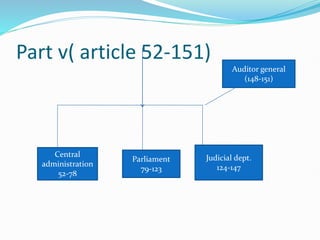
Part v( article 52-151)
Central
administration
52-78
Parliament
79-123
Judicial dept.
124-147
Auditor general
(148-151)
Article -52-62(president)
 Article :52
 India compulsary should have one president.
Article-53
 President should be a head of administration of states
,head of army
 President can do his duty by straight or by officials
 President has the rights to announce war and peace in
india
 Presidents power in the army is regulate by parliament
Article -54
 President is selected by indirect election conducted by
electoral college.
 Indirect election voters : m.p of two sabhas , Mla Of
States And Unionterritories
Article-56
 Term period of president -5 years
 President give his resignation to vice president
 He can serve as president up to new president arrival
 If president give his resignation ,then that matter
should be informed to lok sabha speaker by vice
president
Article-57
 N ‘no. of times citizen can participate in the president
election
Article -58(qualification of
president)
 Should be a citizen of india
 completed 35 years of age
 Qualified to become a member of lok sabha
 Should not hold office in the state or central
government .(be a m.p ,mla ,v.p,governor is not
considered)
Article -59
 If he elected as a president then if he a member of lok
sabha ,rajya sabha ,mla ,mlc means his service will go
from the date of joining as president
 president salary should not be reduced in his service
period
Article -60
 Supreme court judge should appoint the president
Article -61
 President Is Taken Out From The Position By Impeachment(against Law).
 First The Problem Bring In To Loksabha Or Rajyasabha
 With Support Of ¼ Resolution Is Passed Against Problem
 Resolution Copy Send To President Before 14 Days Of next discussion
 Then Discussion Takes Place Against Resolution ,At That minute , If 2/3
Majority Support Means problem Is accepted .
 Then it goes to other sabha 3/2 majority support should be there.but
president has the right to explain the reason why this happened.
 From that date he is taken out.
presentation_indian_constitution_1454931215_14887 (1).pptx

presentation_indian_constitution_1454931215_14887 (1).pptx

  • 2.
    Draft commitee  Draftcommittee is submitted their law format on 26 November 1949.  But came in to action on 26 January 1950.This day is celebrated as our republic day.
  • 3.
    Introduction  Indian lawis in written format
  • 4.
    Indian constitution  Indianconstitution is divided in to 25 parts (22parts +3new parts by amendment)  Every parts is divided in to articles  Every articles inside rules ,regulation ,duties are given.
  • 5.
     The originaltext of the Constitution contained 395 articles in 22 parts and eight schedules.  It came into effect on January 26, 1950, the day that India celebrates each year as the Republic Day.  The number of articles has since increased to 448 due to 100 amendments
  • 6.
    Part -1(article 1-4) Article 1: India the name should be used as combination of states and union territories .should not say one state or union as India  Article 2:parliament has the authority to Estabilish a new state inside India .  Article 3:parliament has the authority to contract or expand the state or union boundaries .(as on 2.6.14 ,there is a 29 states + 7 union territories )
  • 7.
     Article 4:newestabilishment of state bill introduction be done in lok or rajya sabha after president approval.  Before giving approval to the parliament ,that bill should be sent to the respective state government for their opinion  This opinon should not control the president
  • 8.
    Part -2(article 5-11)(citizenship) Article 5:when a person born in India betn 26.1.1950 - 1986 means “birth as reference he /she is a citizen of India .after 1986 some correction in law says that children parents any one should born in India .then only as birth he is a citizen of india.
  • 9.
    Article 6(citizenship bybirth)  If a person born outside india betn 26.1.1950 – 1992 ,then according if his /her father belongs to indian citizen ,then he /she can apply for a indian citizen and get through.
  • 10.
    Article 7  ThisArticle Say About The Peoples Who Shifted From India To Pakistan .
  • 11.
    Article 8  Thepeople belong to the category can get citizen by registration  1.after of separation of india they are living out side india they can apply and get citizen ship by registration  2.marry indian citizen and get citizen ship by registration
  • 12.
    Article 9(citizenship cancel) If a person has dual citizen ship ,if he/she declare that I can quit indian citizen ship by application then he /she can end the citizen of india  If a indian citizen settles outside india for a long time automatically his /her citizen ship will go out.  If a person is doing crime business ie.,) against law then his /her citizen ship will cancelled.
  • 13.
    Article 10  Ifa person gets citizenship via article 5– article 8 then they can be a citizen of india with no objection.
  • 14.
    Article 11  Parliamentonly can regulate the citizenship by bringing law  Below shown 4 years parlinment bringing the changes in citizen ship laws  1.1986  2.1992  3.2003  4.2005
  • 15.
    Part -3(article 12-35)(fundamental rights ) Article 13: if any govt. brings law against fundamental rights of citizen then automatically that law is converted in to null and void. With the announcement of supreme court.
  • 16.
    Article 14  Infrontof law any person should be treated as same .(this line is taken from england constitution)  Law is higher than any one .  No one is higher than law
  • 17.
    Article 15  Govt.should not separate the citizen by religion ,caste ,sex , birth place .  Any citizen should not bar the other citizen by religion ,caste ,sex,birth place ,when he/she enter a public place ex ., hotels
  • 18.
    Article -16  Sameopportunity should be given to all citizens of india while announcing a govt .job. For public service .should not separate by religion ,caste , sex ,birth place .  If the govt. job related to particular religion ,then that job should be given to that religion members only
  • 19.
    Article -17  ifthe person is unqualified for a position/job by untouchability then he /she is under crime and also punished  Govt .brings two laws for abolishing untouchability.  1955 ,untouchability law  1976,by amendment ,name changed to rights protection law
  • 20.
    Article -18  Govtshould not give title (pattam) to any citizen or non citizen ,other than military or education sectors .  Any citizen should not get any title from any foreign countries with govt.permission
  • 21.
    Article -19 19(1)(a): citizenhas rights to comment 19(2)(b):with out weapon people can gather any where 19(3)(c):permission to start a association 19(4)(d):all have the rights to go anywher in india without permission 19(5)(e):all have the rights to live anywher in india 19(6)(f):all have the rights to do business ,job any where in India
  • 22.
    Article 20  Ifa person committed to a crime ,then he /she is punished only with the help of current law  Person is punished one time for one crime .
  • 23.
    Article 21 a State government should give free education compulsary for childrens between 6-14
  • 24.
    Article 22 Before arrestingthe person , that person should know the reason for arrresting .
  • 25.
    Article -23  Aperson should not be forced for work with less money.  If the person is committed to forced work for less money then employer is punishable.
  • 26.
    Article -24  Childrensage below 14 should not be appointed for work in industries ,mining etc.,
  • 27.
    Article 25  Nobar for spreading the spiritual words of religion.
  • 28.
    Article 26  Anyreligion has the rights to keep fixed asset and moving asset by law
  • 29.
    Article 27  Nopeople should be forced to pay religious tax for developing their religion
  • 30.
    Article -28  Childrensespecially school childrens should not be forced to hear spiritual words by prayer  If the religion getting subsidy from government then the religion should not spread their spiritual words in educational sector .
  • 31.
    Article -29  Peoplecan protect their language ,culture by law .
  • 32.
    Article -30  Ifthe person belongs to sc/st then they a set up a own institute and maintain.for doing this they a permission granted by law.
  • 33.
    Article -32  Ifa person rights is treated wrongly then they can with stand the rights with the help of supreme court .
  • 34.
    Part -4(article 36-51)(principles)  Article :36  Some directive principles explaination is shown in the articles
  • 35.
    Article-37  Citizens rightsto follow directive principles or not .  Not follow ,this is not a complaint to register to where .(not taken by law)
  • 36.
    Article -39 Government shouldtake measure on reducing the gender gap in wages , caring of childrens ,abolishment for forcement work with less money.
  • 37.
    Article -39-a  Governmentshould give free legal services to peoples
  • 38.
    Article -40  Govtshould estabilish autonomous body and local bodies (muncipalities) for servicing peoples
  • 39.
    Article -41  Governmentshould give money support to disease people , handicapped people , unemploymed people
  • 40.
    Article 42  Ladiesshould be treated with leave & money at the time of pregancy
  • 41.
    Article -43  Govtshould take measure on improving and participation on bidis works et.,and save that workers
  • 42.
    Article -43a  Govt.should help employee hands to join the administration of the employers.
  • 43.
    Article 45  Childrensbelow 14 should get free education.
  • 44.
    Article 46  Specialeye to the people’s education and protection who are under sc /st.
  • 45.
    Article47  Abolish themedicines which are negative effect to the people
  • 46.
    Article 48  Highlevel cows protection, animal s harassment abolishment steps should be taken by govt.  Govt. ask people to “No insert of high level technology in agri “.
  • 47.
    Article 48a  Govt.should take measures to protect environment and wild life
  • 48.
    Article 49  Govt.should take measures on protecting memorial place ,statues from death.
  • 49.
    Article 50  Thisarticle give the information that how the administration dept. is separated from financial dept.
  • 50.
    Article 51  Thisarticle tells that “ international agreement should be respected , international problems should be solved by speech”. This should be followed by government
  • 51.
    Part –iv a(article51a- k) fundamental duties to citizen  51(a): respect national anthem and national flag  51(b):inducement policy for our independence should be protected  51(c):india ‘s unity is to be maintained by govt.  51(d):protect indian nation and so do social service
  • 52.
     51(e):women shouldbe respected  51(f):protect our culture  51(g):indians should develop research activities ,humanity ,scientific view  51(h):lakes ,pond ,wild life should be protected  51(i):eradicate violence  51(j):it is the duty of indian citizen to achieve indigineous in all fields  51(k):parents and guardian should give education opportunity to childrens below 14 years of age .
  • 53.
    Part v( article52-151) Central administration 52-78 Parliament 79-123 Judicial dept. 124-147 Auditor general (148-151)
  • 54.
    Article -52-62(president)  Article:52  India compulsary should have one president.
  • 55.
    Article-53  President shouldbe a head of administration of states ,head of army  President can do his duty by straight or by officials  President has the rights to announce war and peace in india  Presidents power in the army is regulate by parliament
  • 56.
    Article -54  Presidentis selected by indirect election conducted by electoral college.  Indirect election voters : m.p of two sabhas , Mla Of States And Unionterritories
  • 57.
    Article-56  Term periodof president -5 years  President give his resignation to vice president  He can serve as president up to new president arrival  If president give his resignation ,then that matter should be informed to lok sabha speaker by vice president
  • 58.
    Article-57  N ‘no.of times citizen can participate in the president election
  • 59.
    Article -58(qualification of president) Should be a citizen of india  completed 35 years of age  Qualified to become a member of lok sabha  Should not hold office in the state or central government .(be a m.p ,mla ,v.p,governor is not considered)
  • 60.
    Article -59  Ifhe elected as a president then if he a member of lok sabha ,rajya sabha ,mla ,mlc means his service will go from the date of joining as president  president salary should not be reduced in his service period
  • 61.
    Article -60  Supremecourt judge should appoint the president
  • 62.
    Article -61  PresidentIs Taken Out From The Position By Impeachment(against Law).  First The Problem Bring In To Loksabha Or Rajyasabha  With Support Of ¼ Resolution Is Passed Against Problem  Resolution Copy Send To President Before 14 Days Of next discussion  Then Discussion Takes Place Against Resolution ,At That minute , If 2/3 Majority Support Means problem Is accepted .  Then it goes to other sabha 3/2 majority support should be there.but president has the right to explain the reason why this happened.  From that date he is taken out.