Waste Management from
Fermentation Industries
Presented by
Maya Sharma
Processing and Food Engineering
Department
College of Technology and Engineering
(Maharana Pratap University of Agriculture
and Technology , Udaipur)
Udaipur- 313001
Submitted to:
Prof. N.K.Jain
Head
Dept. of Dairy and Food
Engineering
CDFST, Udaipur
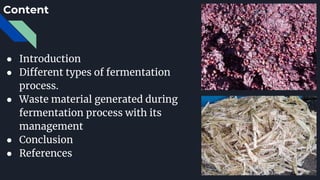
Content
● Introduction
● Different types of fermentation
process.
● Waste material generated during
fermentation process with its
management
● Conclusion
● References
Introduction
Fermentation
General Definition: An anaerobic cellular process in which bacteria, yeasts or
other microorganisms convert organic material into simpler compounds and
chemical energy (ATP) is produced.
Fermentation in food industries: The conversion of carbohydrates into
alcohol and carbon dioxide or organic acid by yeasts, bacteria or combination
of both in the absence of air.
French chemist and microbiologist Louis Pasteur in the 19th century used the
term fermentation in a narrow sense to describe the changes brought about by
yeasts and other microorganisms growing in the absence of air
(anaerobically); he also recognized that ethyl alcohol and carbon dioxide are
not the only products of fermentation.
fermentation is used for preservation in a process that produces lactic acid found in such sour
foods as pickled cucumbers, kimchi, and yogurt, as well as for producing alcoholic beverages
such as wine and beer.
Mammalian muscle carries out the fermentation that occurs during periods of intense
exercise where oxygen supply becomes limited, resulting in the creation of lactic acid.
There are two types of fermentation:
Lactic acid fermentation
Alcoholic fermention.
● lactic acid fermentation: In lactic acid
fermentation, pyruvic acid from glycolysis
changes to lactic acid.
● Lactic acid fermentation occurs in mammals
during exercise when cell run out of oxygen .
● Occurs in cytoplasm of cell.
Different products:
● Pickle
● Fermented fish
● Kimchi
● Sauerkraut
● Sour beer
● Yogurt
Alcoholic Fermentation
Alcoholic fermentation is a complex biochemical process during which yeasts
convert sugars to ethanol, carbon dioxide, and other metabolic byproducts
that contribute to the chemical composition and sensorial properties of the
fermented foodstuffs.
The products of fermentation are many: alcohol, glycerol, and carbon dioxide are
obtained from yeast fermentation of various sugars. Butyl alcohol, acetone, lactic
acid, monosodium glutamate, and acetic acid are products of bacteria action; citric
acid, gluconic acid, antibiotics, vitamin B12, and riboflavin are some of the products
obtained from mold fermentation. (https://www.ncbi.nlm.nih.gov/books/NBK234683/)
Alcoholic
beverages
General Raw material General Alcohol
content
Beer Barley 4-6%
Wine Grapes 9-16%
Vodka Potato or cereal grains 35%–95%
Feni Cashew 42.5%
Whiskey Barley, Corn and Wheat 40%–68% (usually
40%, 43% or 46%)
Brandy Grapes (distilled wine) 35-60%(usually
40%, minimum of
37.5% in the
European Union)
Rum byproducts of
sugarcane or sugarcane
juice
37.5%–80% (usually
40%)
● India’s alcohol industry is the Fifth largest in the world with a value of $35
billion. (2018)
● India has the largest whiskey industry in the world.
● India is the largest consumer of whiskey in the world and it constitutes about
60% of the IMFL market.
● Though India is one of the largest consumers of alcohol in the world owing to
its huge population,The per capita consumption of alcohol per week for the
year 2016 was estimated at 147.3 ml
● The states of Andhra Pradesh, Telangana, Kerala, Karnataka, Sikkim Haryana
and Himachal Pradesh are amongst the largest consumers of alcohol in India.
India 2009-11 2010-11 2011-12 2012-13
Alcohol
production
in MT
2016.00 2633.04 3066.96 2587.20
World ethanol production by country, in percent.
Credit: Renewable Fuels Association
Alcoholic fermentation based waste and its management:
Corn or cereal fermentation
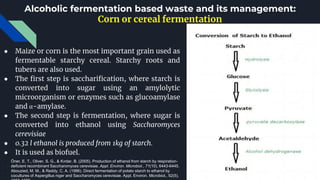
● Maize or corn is the most important grain used as
fermentable starchy cereal. Starchy roots and
tubers are also used.
● The first step is saccharification, where starch is
converted into sugar using an amylolytic
microorganism or enzymes such as glucoamylase
and α-amylase.
● The second step is fermentation, where sugar is
converted into ethanol using Saccharomyces
cerevisiae
● 0.32 l ethanol is produced from 1kg of starch.
● It is used as biofuel.
• Öner, E. T., Oliver, S. G., & Kırdar, B. (2005). Production of ethanol from starch by respiration-
deficient recombinant Saccharomyces cerevisiae. Appl. Environ. Microbiol., 71(10), 6443-6445.
• Abouzied, M. M., & Reddy, C. A. (1986). Direct fermentation of potato starch to ethanol by
cocultures of Aspergillus niger and Saccharomyces cerevisiae. Appl. Environ. Microbiol., 52(5),
Waste product from cereal fermentation:
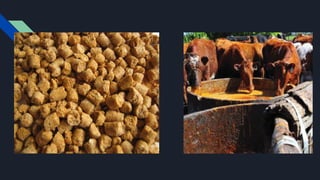
● Distillers grain: Distillers grains are a cereal byproduct of the distillation process
● Is used as a feed product or dietary supplement for cattle, hens, fish, poultry, swine,
broiler etc. For every 56 pound bushel of corn, 17 pounds of ethanol waste are produced
● Distillers dried grains with solubles is the most common form of ethanol waste that is
marketed to the animal feed industry.
● Ethanol waste is considered highly nutritious feed for cattle, poultry, and swine.
● It contains nutrients in concentrations up to three times higher than corn, and is seen as a
valuable high-protein and high-energy supplement.
● The conversion rate of corn to distillers grains is: One tonne of corn produces 378 L of
ethanol and 479 kg WDG (70% moisture content), or 309 kg of DDGS (10% moisture
content).
● The conversion rate of wheat to distillers grains is: One tonne of wheat produces 372 L of
ethanol and 457 kg WDG (70% moisture content), or 295 kg of DDGS (10% moisture
content)
Sugarcane fermentation
● Grown throughout the tropics and semitropics,
sugarcane and its products, including cane juices,
molasses, and sugar are used to make rum and an alcohol
derived from rum.
● Pressed juice from sugarcane can be used as the base raw
material for fermentation, or the juice can be
concentrated for sugar production with the molasses
residue from sugar crystallization used as a base for
alcohol fermentation.
● Molasses contains about 35 percent sucrose. This gives
molasses its principal value as an industrial raw material
for fermentation to produce rum. Two or 3 liters of
molasses produces 1 liter of rum.
● Bagasse composition: Cellulose (45–55 %) Hemicellulose
(20–25 %) Lignin (18–24 %) Ash (1–4 %) and Waxes <1
percent
Waste from sugarcane fermentation industry:
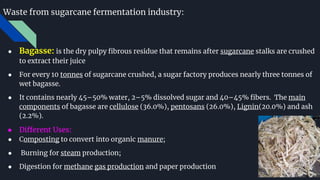
● Bagasse: is the dry pulpy fibrous residue that remains after sugarcane stalks are crushed
to extract their juice
● For every 10 tonnes of sugarcane crushed, a sugar factory produces nearly three tonnes of
wet bagasse.
● It contains nearly 45–50% water, 2–5% dissolved sugar and 40–45% fibers. The main
components of bagasse are cellulose (36.0%), pentosans (26.0%), Lignin(20.0%) and ash
(2.2%).
● Different Uses:
● Composting to convert into organic manure;
● Burning for steam production;
● Digestion for methane gas production and paper production
● Including pulp and paper production, it has been also used for hardboard and packing
material.
● Solvent for refining lubricants,
● Wood resin,
● Baggase ash (0.4–0.5%) left after incineration that used in soil fertilizer (potassium
and phosphate) and glass (silica 70–75%) manufacturing and for building material.
● It is used as a biofuel for the production of heat, energy, and electricity.
● As A Sustainable Acoustic Absorber: Can absorb 650 Hz of frequency.
http://best-organic-farming-tips.blogspot.com/2016/01/making-compost-from-sugarcane-fiber.html
Burning of bagasse:
● It produces sufficient heat energy to supply all the needs of a typical sugar mill
● the use of a fuel source to provide both heat energy, used in the mill, and electricity,
which is typically sold on to the consumer electrical grid.
● The lower calorific value (LCV) of bagasse in kJ/kg may be estimated using the formula:
LCV = 18260
● he higher calorific value (HCV) of bagasse may be estimated using: HCV = 19605 - 196.05
× Moisture - 31.14 × Brix - 196.05 × Ash
● CO2 emissions are less than the amount of CO2 that the sugarcane plant absorbed from
the atmosphere during its growing phase
● Wienese, Arnoud (2001). "Boilers, boiler fuel and boiler efficiency" (PDF). Proceedings of the
South African Sugar Technologists' Association. 75: 275–281.
● https://en.wikipedia.org/wiki/Bagasse
Anaerobic Digestion of Bagasse
Ground Bagasse
Breakdown of
fiber material into
powdered form so
that breakage of
long polymaeric
chain can occure.
Pretreatment
Ground bagasse is
treated with
• Thermal
autoclaving
• Dilute HCl
autoclaving
• Dilute NaOH
autoclaving
• Alkaline
autoclaving
Anaerobic Digestion
• Hydrolysis
• Acidogenesis
• Acetogenesis
• Methanogenesis
Biogas and
Biomethannation
Approx 275 mL
CH4/g VS biogas is
produced from
Sugarcane
bagasse
Adarme, O. F. H., Baêta, B. E. L., Lima, D. R. S., Gurgel, L. V.
A., & de Aquino, S. F. (2017). Methane and hydrogen production
from anaerobic digestion of soluble fraction obtained by
sugarcane bagasse ozonation. Industrial crops and
products, 109, 288-299.
Alcoholic fermentation of Fruits
● Fruit wines are undistilled alcoholic beverages usually made from
grapes or other fruits such as peaches, plums or apricots, banana,
elderberry, or black current which are nutritive, more tasty, and
mild stimulants
● Fruit wines contain 8-11% alcohol and 2-3% sugar with energy
value ranging between 70 and 90 kcal per 100 ml
● The alcohol content in distilled alcoholic beverage ranges between
40% to 60%.
● Grapes are usually preferred because of the natural chemical
balance of the grape juice which aids their fermentation process
without the addition of sugars, acids, enzymes, or other nutrients
Waste from fruit fermentation
Pomace:
● Is the solid remains of grapes, olives, or other fruit after pressing for juice or oil. It
contains the skins, pulp, seeds, and stems of the fruit.
● It is mostly used as fodder, as fertilizer, or to extract bioactive compounds
like polyphenols from it.
● Biogas rw material for generation of renewable energy.
● Polyphenols from red wine pomace may be beneficial for dental hygiene
● Grape pomace is also used in the oil and gas industry as a lost circulation material in oil-
based drilling muds due to the pomace being fibrous and tannin-rich.
● Pomace can also act as a natural food preservative that interferes with E.
coli, Salmonella and Staphylococcus bacteria
● Oenocyanin, a natural red dye and food-coloring agent, is produced from grape pomace
● Apple pomace has been a traditional feed for all kinds of livestock
Conclusion:
References
● Cundy, V. A., Maples, D., & Tauzin, C. (1983). Combustion of bagasse: Use of an agricultural-derived
waste. Fuel, 62(7), 775-780.
● Sahu, O. (2018). Assessment of sugarcane industry: Suitability for production, consumption, and
utilization. Annals of Agrarian Science, 16(4), 389-395.
● https://en.wikipedia.org/wiki/Ethanol_fermentation
● https://www.businesswire.com/news/home/20181112005505/en/Indian-Alcohol-Consumption-Report-
2018---Changing
● https://www.e-education.psu.edu/egee439/node/646
● https://www.youtube.com/watch?v=u8ecewiptI8
● http://www.factfish.com/statistic-country/india/bagasse%2C%20production
● https://amritt.com/industries/india-consumer-packaged-goods-market/alcohol-industry-in-india/
● https://en.wikipedia.org/wiki/Distillers_grains
● https://corn-ethanol.weebly.com/efficiency-and-waste-disposal.html
● https://www.niir.org/information/content.phtml?content=266
● Haryono, A. P., Ubaidillah, & Diharjo, K. (2018, February). The noise absorption performance of
sugarcane-bagasse-polyvinyl acetate glue based absorber. In AIP Conference Proceedings(Vol. 1931, No.
1, p. 030065). AIP Publishing.
● Saranraj, P., Sivasakthivelan, P., & Naveen, M. (2017). Fermentation of fruit wine and its quality
analysis: a review. Aust J Sci Technol, 1(2), 85-97.
Thank you

Waste management from fermentation industries

  • 1.
    Waste Management from FermentationIndustries Presented by Maya Sharma Processing and Food Engineering Department College of Technology and Engineering (Maharana Pratap University of Agriculture and Technology , Udaipur) Udaipur- 313001 Submitted to: Prof. N.K.Jain Head Dept. of Dairy and Food Engineering CDFST, Udaipur
  • 2.
    Content ● Introduction ● Differenttypes of fermentation process. ● Waste material generated during fermentation process with its management ● Conclusion ● References
  • 3.
    Introduction Fermentation General Definition: Ananaerobic cellular process in which bacteria, yeasts or other microorganisms convert organic material into simpler compounds and chemical energy (ATP) is produced. Fermentation in food industries: The conversion of carbohydrates into alcohol and carbon dioxide or organic acid by yeasts, bacteria or combination of both in the absence of air. French chemist and microbiologist Louis Pasteur in the 19th century used the term fermentation in a narrow sense to describe the changes brought about by yeasts and other microorganisms growing in the absence of air (anaerobically); he also recognized that ethyl alcohol and carbon dioxide are not the only products of fermentation.
  • 4.
    fermentation is usedfor preservation in a process that produces lactic acid found in such sour foods as pickled cucumbers, kimchi, and yogurt, as well as for producing alcoholic beverages such as wine and beer. Mammalian muscle carries out the fermentation that occurs during periods of intense exercise where oxygen supply becomes limited, resulting in the creation of lactic acid.
  • 5.
    There are twotypes of fermentation: Lactic acid fermentation Alcoholic fermention. ● lactic acid fermentation: In lactic acid fermentation, pyruvic acid from glycolysis changes to lactic acid. ● Lactic acid fermentation occurs in mammals during exercise when cell run out of oxygen . ● Occurs in cytoplasm of cell. Different products: ● Pickle ● Fermented fish ● Kimchi ● Sauerkraut ● Sour beer ● Yogurt
  • 6.
    Alcoholic Fermentation Alcoholic fermentationis a complex biochemical process during which yeasts convert sugars to ethanol, carbon dioxide, and other metabolic byproducts that contribute to the chemical composition and sensorial properties of the fermented foodstuffs. The products of fermentation are many: alcohol, glycerol, and carbon dioxide are obtained from yeast fermentation of various sugars. Butyl alcohol, acetone, lactic acid, monosodium glutamate, and acetic acid are products of bacteria action; citric acid, gluconic acid, antibiotics, vitamin B12, and riboflavin are some of the products obtained from mold fermentation. (https://www.ncbi.nlm.nih.gov/books/NBK234683/)
  • 7.
    Alcoholic beverages General Raw materialGeneral Alcohol content Beer Barley 4-6% Wine Grapes 9-16% Vodka Potato or cereal grains 35%–95% Feni Cashew 42.5% Whiskey Barley, Corn and Wheat 40%–68% (usually 40%, 43% or 46%) Brandy Grapes (distilled wine) 35-60%(usually 40%, minimum of 37.5% in the European Union) Rum byproducts of sugarcane or sugarcane juice 37.5%–80% (usually 40%)
  • 8.
    ● India’s alcoholindustry is the Fifth largest in the world with a value of $35 billion. (2018) ● India has the largest whiskey industry in the world. ● India is the largest consumer of whiskey in the world and it constitutes about 60% of the IMFL market. ● Though India is one of the largest consumers of alcohol in the world owing to its huge population,The per capita consumption of alcohol per week for the year 2016 was estimated at 147.3 ml ● The states of Andhra Pradesh, Telangana, Kerala, Karnataka, Sikkim Haryana and Himachal Pradesh are amongst the largest consumers of alcohol in India. India 2009-11 2010-11 2011-12 2012-13 Alcohol production in MT 2016.00 2633.04 3066.96 2587.20
  • 9.
    World ethanol productionby country, in percent. Credit: Renewable Fuels Association
  • 10.
    Alcoholic fermentation basedwaste and its management: Corn or cereal fermentation ● Maize or corn is the most important grain used as fermentable starchy cereal. Starchy roots and tubers are also used. ● The first step is saccharification, where starch is converted into sugar using an amylolytic microorganism or enzymes such as glucoamylase and α-amylase. ● The second step is fermentation, where sugar is converted into ethanol using Saccharomyces cerevisiae ● 0.32 l ethanol is produced from 1kg of starch. ● It is used as biofuel. • Öner, E. T., Oliver, S. G., & Kırdar, B. (2005). Production of ethanol from starch by respiration- deficient recombinant Saccharomyces cerevisiae. Appl. Environ. Microbiol., 71(10), 6443-6445. • Abouzied, M. M., & Reddy, C. A. (1986). Direct fermentation of potato starch to ethanol by cocultures of Aspergillus niger and Saccharomyces cerevisiae. Appl. Environ. Microbiol., 52(5),
  • 12.
    Waste product fromcereal fermentation: ● Distillers grain: Distillers grains are a cereal byproduct of the distillation process ● Is used as a feed product or dietary supplement for cattle, hens, fish, poultry, swine, broiler etc. For every 56 pound bushel of corn, 17 pounds of ethanol waste are produced ● Distillers dried grains with solubles is the most common form of ethanol waste that is marketed to the animal feed industry. ● Ethanol waste is considered highly nutritious feed for cattle, poultry, and swine. ● It contains nutrients in concentrations up to three times higher than corn, and is seen as a valuable high-protein and high-energy supplement. ● The conversion rate of corn to distillers grains is: One tonne of corn produces 378 L of ethanol and 479 kg WDG (70% moisture content), or 309 kg of DDGS (10% moisture content). ● The conversion rate of wheat to distillers grains is: One tonne of wheat produces 372 L of ethanol and 457 kg WDG (70% moisture content), or 295 kg of DDGS (10% moisture content)
  • 14.
    Sugarcane fermentation ● Grownthroughout the tropics and semitropics, sugarcane and its products, including cane juices, molasses, and sugar are used to make rum and an alcohol derived from rum. ● Pressed juice from sugarcane can be used as the base raw material for fermentation, or the juice can be concentrated for sugar production with the molasses residue from sugar crystallization used as a base for alcohol fermentation. ● Molasses contains about 35 percent sucrose. This gives molasses its principal value as an industrial raw material for fermentation to produce rum. Two or 3 liters of molasses produces 1 liter of rum. ● Bagasse composition: Cellulose (45–55 %) Hemicellulose (20–25 %) Lignin (18–24 %) Ash (1–4 %) and Waxes <1 percent
  • 15.
    Waste from sugarcanefermentation industry: ● Bagasse: is the dry pulpy fibrous residue that remains after sugarcane stalks are crushed to extract their juice ● For every 10 tonnes of sugarcane crushed, a sugar factory produces nearly three tonnes of wet bagasse. ● It contains nearly 45–50% water, 2–5% dissolved sugar and 40–45% fibers. The main components of bagasse are cellulose (36.0%), pentosans (26.0%), Lignin(20.0%) and ash (2.2%). ● Different Uses: ● Composting to convert into organic manure; ● Burning for steam production; ● Digestion for methane gas production and paper production
  • 16.
    ● Including pulpand paper production, it has been also used for hardboard and packing material. ● Solvent for refining lubricants, ● Wood resin, ● Baggase ash (0.4–0.5%) left after incineration that used in soil fertilizer (potassium and phosphate) and glass (silica 70–75%) manufacturing and for building material. ● It is used as a biofuel for the production of heat, energy, and electricity. ● As A Sustainable Acoustic Absorber: Can absorb 650 Hz of frequency.
  • 17.
  • 18.
    Burning of bagasse: ●It produces sufficient heat energy to supply all the needs of a typical sugar mill ● the use of a fuel source to provide both heat energy, used in the mill, and electricity, which is typically sold on to the consumer electrical grid. ● The lower calorific value (LCV) of bagasse in kJ/kg may be estimated using the formula: LCV = 18260 ● he higher calorific value (HCV) of bagasse may be estimated using: HCV = 19605 - 196.05 × Moisture - 31.14 × Brix - 196.05 × Ash ● CO2 emissions are less than the amount of CO2 that the sugarcane plant absorbed from the atmosphere during its growing phase ● Wienese, Arnoud (2001). "Boilers, boiler fuel and boiler efficiency" (PDF). Proceedings of the South African Sugar Technologists' Association. 75: 275–281. ● https://en.wikipedia.org/wiki/Bagasse
  • 19.
    Anaerobic Digestion ofBagasse Ground Bagasse Breakdown of fiber material into powdered form so that breakage of long polymaeric chain can occure. Pretreatment Ground bagasse is treated with • Thermal autoclaving • Dilute HCl autoclaving • Dilute NaOH autoclaving • Alkaline autoclaving Anaerobic Digestion • Hydrolysis • Acidogenesis • Acetogenesis • Methanogenesis Biogas and Biomethannation Approx 275 mL CH4/g VS biogas is produced from Sugarcane bagasse Adarme, O. F. H., Baêta, B. E. L., Lima, D. R. S., Gurgel, L. V. A., & de Aquino, S. F. (2017). Methane and hydrogen production from anaerobic digestion of soluble fraction obtained by sugarcane bagasse ozonation. Industrial crops and products, 109, 288-299.
  • 20.
    Alcoholic fermentation ofFruits ● Fruit wines are undistilled alcoholic beverages usually made from grapes or other fruits such as peaches, plums or apricots, banana, elderberry, or black current which are nutritive, more tasty, and mild stimulants ● Fruit wines contain 8-11% alcohol and 2-3% sugar with energy value ranging between 70 and 90 kcal per 100 ml ● The alcohol content in distilled alcoholic beverage ranges between 40% to 60%. ● Grapes are usually preferred because of the natural chemical balance of the grape juice which aids their fermentation process without the addition of sugars, acids, enzymes, or other nutrients
  • 21.
    Waste from fruitfermentation Pomace: ● Is the solid remains of grapes, olives, or other fruit after pressing for juice or oil. It contains the skins, pulp, seeds, and stems of the fruit. ● It is mostly used as fodder, as fertilizer, or to extract bioactive compounds like polyphenols from it. ● Biogas rw material for generation of renewable energy. ● Polyphenols from red wine pomace may be beneficial for dental hygiene ● Grape pomace is also used in the oil and gas industry as a lost circulation material in oil- based drilling muds due to the pomace being fibrous and tannin-rich. ● Pomace can also act as a natural food preservative that interferes with E. coli, Salmonella and Staphylococcus bacteria ● Oenocyanin, a natural red dye and food-coloring agent, is produced from grape pomace ● Apple pomace has been a traditional feed for all kinds of livestock
  • 22.
  • 23.
    References ● Cundy, V.A., Maples, D., & Tauzin, C. (1983). Combustion of bagasse: Use of an agricultural-derived waste. Fuel, 62(7), 775-780. ● Sahu, O. (2018). Assessment of sugarcane industry: Suitability for production, consumption, and utilization. Annals of Agrarian Science, 16(4), 389-395. ● https://en.wikipedia.org/wiki/Ethanol_fermentation ● https://www.businesswire.com/news/home/20181112005505/en/Indian-Alcohol-Consumption-Report- 2018---Changing ● https://www.e-education.psu.edu/egee439/node/646 ● https://www.youtube.com/watch?v=u8ecewiptI8 ● http://www.factfish.com/statistic-country/india/bagasse%2C%20production
  • 24.
    ● https://amritt.com/industries/india-consumer-packaged-goods-market/alcohol-industry-in-india/ ● https://en.wikipedia.org/wiki/Distillers_grains ●https://corn-ethanol.weebly.com/efficiency-and-waste-disposal.html ● https://www.niir.org/information/content.phtml?content=266 ● Haryono, A. P., Ubaidillah, & Diharjo, K. (2018, February). The noise absorption performance of sugarcane-bagasse-polyvinyl acetate glue based absorber. In AIP Conference Proceedings(Vol. 1931, No. 1, p. 030065). AIP Publishing. ● Saranraj, P., Sivasakthivelan, P., & Naveen, M. (2017). Fermentation of fruit wine and its quality analysis: a review. Aust J Sci Technol, 1(2), 85-97.
  • 25.