
Drying process for grains
Submitted by
Maya Sharma
Submitted to:
Prof. P.S.Champawat
Dept. of PFE
CTAE, Udaipur
Processing and Food Engineering Department
College of Technology and Engineering
(Maharana Pratap University of Agriculture and Technology ,
Udaipur)
Udaipur- 313001
Content
• Introduction
• Importance of drying
• Moisture content
• Determination of moisture content
• Equilibrium moisture content
• Mode of heat transfer
• Types of drying methods
• Different dryers
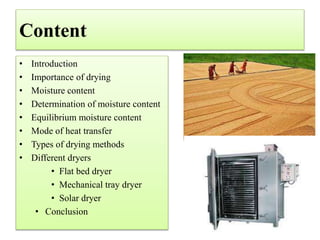
• Flat bed dryer
• Mechanical tray dryer
• Solar dryer
• Conclusion
Introduction
• Dehydration is termed as removal of moisture from grain
to very low levels usually to bone dry condition.
• Drying refers to removal of moisture from grains and other
products to a predetermined level which provides a safe
level to store the grain for longer time period.
• The predetermine level of moisture removal retains the
nutritional quality of food material otherwise over drying
may deteriorate the nutritional composition of food
material.
• Drying is one of the oldest methods of food preservation.
• Drying is a thermo-physical and physio-chemical operation
by which excess moisture from a product is removed.
• Drying makes the food grains and other products suitable
for safe storage and protects them against attack of insects,
mold and other micro-organisms during storage.
Importance of drying process
• It minimizes microbial spoilage and chemical deteriorative
reactions greatly which provides safe storage facility for
long time.
• It Permits continuous supply of product thro’out the year
• Permits early harvest which reduces field damage and
shattering loss
• Permits the farmers to have better quality product
• Makes products available during off season
• The reduced weight of dried products decreases packaging,
handling and transportation costs.
• Most food products are dried for improved milling or
mixing characteristics in further processing.
• It helps in preparing different food product development.
Moisture migration during drying process
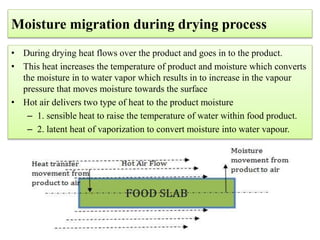
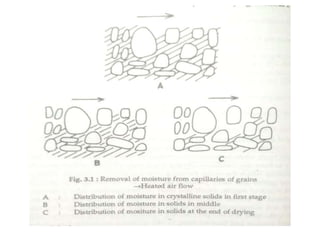
• During drying heat flows over the product and goes in to the product.
• This heat increases the temperature of product and moisture which converts
the moisture in to water vapor which results in to increase in the vapour
pressure that moves moisture towards the surface
• Hot air delivers two type of heat to the product moisture
– 1. sensible heat to raise the temperature of water within food product.
– 2. latent heat of vaporization to convert moisture into water vapour.
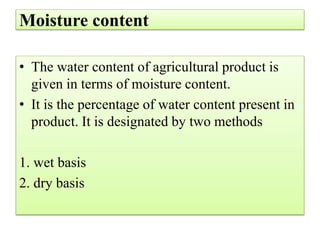
Moisture content
• The water content of agricultural product is
given in terms of moisture content.
• It is the percentage of water content present in
product. It is designated by two methods
1. wet basis
2. dry basis
Wet and dry basis moisture content and their
relation
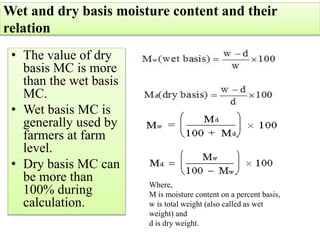
• The value of dry
basis MC is more
than the wet basis
MC.
• Wet basis MC is
generally used by
farmers at farm
level.
• Dry basis MC can
be more than
100% during
calculation.
Where,
M is moisture content on a percent basis,
w is total weight (also called as wet
weight) and
d is dry weight.
Determination of moisture content
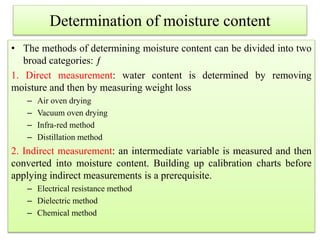
• The methods of determining moisture content can be divided into two
broad categories: ƒ
1. Direct measurement: water content is determined by removing
moisture and then by measuring weight loss
– Air oven drying
– Vacuum oven drying
– Infra-red method
– Distillation method
2. Indirect measurement: an intermediate variable is measured and then
converted into moisture content. Building up calibration charts before
applying indirect measurements is a prerequisite.
– Electrical resistance method
– Dielectric method
– Chemical method
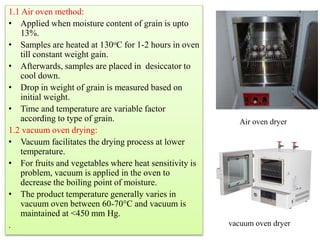
1.1 Air oven method:
• Applied when moisture content of grain is upto
13%.
• Samples are heated at 130oC for 1-2 hours in oven
till constant weight gain.
• Afterwards, samples are placed in desiccator to
cool down.
• Drop in weight of grain is measured based on
initial weight.
• Time and temperature are variable factor
according to type of grain.
1.2 vacuum oven drying:
• Vacuum facilitates the drying process at lower
temperature.
• For fruits and vegetables where heat sensitivity is
problem, vacuum is applied in the oven to
decrease the boiling point of moisture.
• The product temperature generally varies in
vacuum oven between 60-70°C and vacuum is
maintained at <450 mm Hg.
.
Air oven dryer
vacuum oven dryer
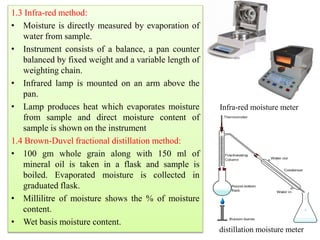
1.3 Infra-red method:
• Moisture is directly measured by evaporation of
water from sample.
• Instrument consists of a balance, a pan counter
balanced by fixed weight and a variable length of
weighting chain.
• Infrared lamp is mounted on an arm above the
pan.
• Lamp produces heat which evaporates moisture
from sample and direct moisture content of
sample is shown on the instrument
1.4 Brown-Duvel fractional distillation method:
• 100 gm whole grain along with 150 ml of
mineral oil is taken in a flask and sample is
boiled. Evaporated moisture is collected in
graduated flask.
• Millilitre of moisture shows the % of moisture
content.
• Wet basis moisture content.
Infra-red moisture meter
distillation moisture meter
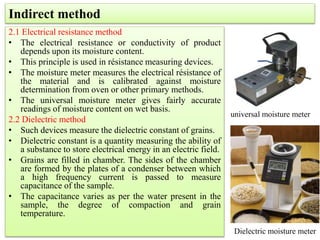
2.1 Electrical resistance method
• The electrical resistance or conductivity of product
depends upon its moisture content.
• This principle is used in résistance measuring devices.
• The moisture meter measures the electrical résistance of
the material and is calibrated against moisture
determination from oven or other primary methods.
• The universal moisture meter gives fairly accurate
readings of moisture content on wet basis.
2.2 Dielectric method
• Such devices measure the dielectric constant of grains.
• Dielectric constant is a quantity measuring the ability of
a substance to store electrical energy in an electric field.
• Grains are filled in chamber. The sides of the chamber
are formed by the plates of a condenser between which
a high frequency current is passed to measure
capacitance of the sample.
• The capacitance varies as per the water present in the
sample, the degree of compaction and grain
temperature.
Indirect method
universal moisture meter
Dielectric moisture meter
2.3 Chemical method
• In this method, the water is removed by adding a
chemical, which decompose or combines with water.
• From the chemical reaction a gas is produced which
can be measured volumetrically or which decreases the
original weight of sample.
• This method is used for determining the m. c. of
forages and grains by shaking an excess of calcium
carbide (Ca C2) with 30 grams of material.
• About 10 to 25 minutes are required to reaction.
Equilibrium moisture content
• It is the moisture content of a product in
equilibrium with the surrounding air at given
temperature and humidity conditions.
• It is the minimum moisture content to which a
material can be dried under given conditions.
• The equilibrium moisture content for
biological materials generally increases rapidly
with a relative humidity above 60 to 80%
because of capillary and dissolution effects.
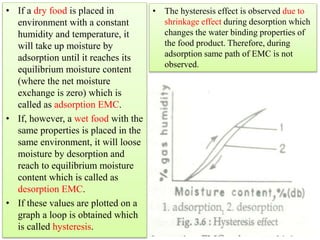
• If a dry food is placed in
environment with a constant
humidity and temperature, it
will take up moisture by
adsorption until it reaches its
equilibrium moisture content
(where the net moisture
exchange is zero) which is
called as adsorption EMC.
• If, however, a wet food with the
same properties is placed in the
same environment, it will loose
moisture by desorption and
reach to equilibrium moisture
content which is called as
desorption EMC.
• If these values are plotted on a
graph a loop is obtained which
is called hysteresis.
• The hysteresis effect is observed due to
shrinkage effect during desorption which
changes the water binding properties of
the food product. Therefore, during
adsorption same path of EMC is not
observed.
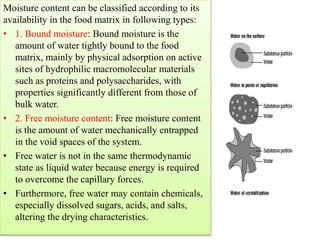
Moisture content can be classified according to its
availability in the food matrix in following types:
• 1. Bound moisture: Bound moisture is the
amount of water tightly bound to the food
matrix, mainly by physical adsorption on active
sites of hydrophilic macromolecular materials
such as proteins and polysaccharides, with
properties significantly different from those of
bulk water.
• 2. Free moisture content: Free moisture content
is the amount of water mechanically entrapped
in the void spaces of the system.
• Free water is not in the same thermodynamic
state as liquid water because energy is required
to overcome the capillary forces.
• Furthermore, free water may contain chemicals,
especially dissolved sugars, acids, and salts,
altering the drying characteristics.
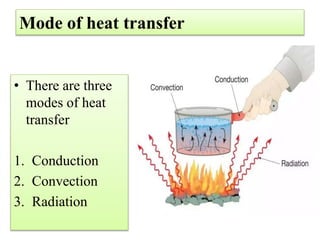
Mode of heat transfer
• There are three
modes of heat
transfer
1. Conduction
2. Convection
3. Radiation
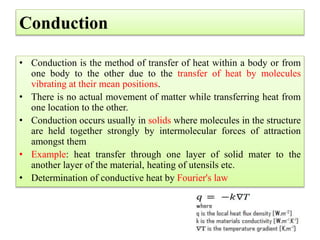
Conduction
• Conduction is the method of transfer of heat within a body or from
one body to the other due to the transfer of heat by molecules
vibrating at their mean positions.
• There is no actual movement of matter while transferring heat from
one location to the other.
• Conduction occurs usually in solids where molecules in the structure
are held together strongly by intermolecular forces of attraction
amongst them
• Example: heat transfer through one layer of solid mater to the
another layer of the material, heating of utensils etc.
• Determination of conductive heat by Fourier's law
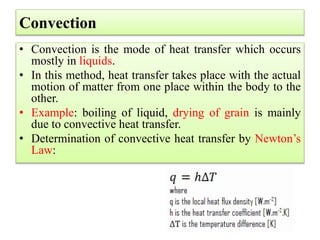
Convection
• Convection is the mode of heat transfer which occurs
mostly in liquids.
• In this method, heat transfer takes place with the actual
motion of matter from one place within the body to the
other.
• Example: boiling of liquid, drying of grain is mainly
due to convective heat transfer.
• Determination of convective heat transfer by Newton’s
Law:
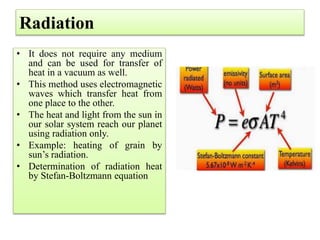
Radiation
• It does not require any medium
and can be used for transfer of
heat in a vacuum as well.
• This method uses electromagnetic
waves which transfer heat from
one place to the other.
• The heat and light from the sun in
our solar system reach our planet
using radiation only.
• Example: heating of grain by
sun’s radiation.
• Determination of radiation heat
by Stefan-Boltzmann equation
Drying methods
• Sun drying
• Conduction drying
• Convection drying
• Radiation drying
• Freeze drying
• Osmotic drying
• Fluidized bed drying
• Dielectric drying
• Thin layer drying
• Deep bed drying
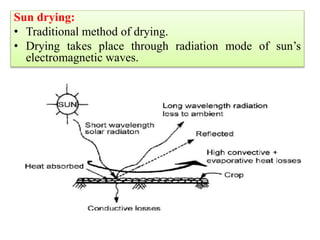
Sun drying:
• Traditional method of drying.
• Drying takes place through radiation mode of sun’s
electromagnetic waves.
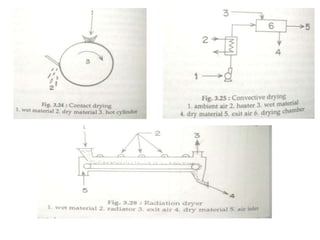
Conduction or contact drying:
• Heat is transferred to wet material mainly by conduction mode
through solid surface.
• Surface temperatures may vary widely.
• Dryers can be operated under low pressure and in inert atmosphere.
• Dust and dusty material can be removed easily.
Convection drying:
• Drying agent is hot gas or hot air and supplies heat to the wet grain.
• Steam heated air, direct flue gases of agricultural waste etc. can be
used as drying agents.
• Drying temperature varies widely.
• If atmospheric humidity is high, natural air drying needs
dehumidification.
• Fuel consumption is high as compare to conduction drying for same
capacity.
• Ex: fluidized bed dryer, hot air oven dryer
Radiation drying:
• Based on absorption of radiant energy of sun and
transformation into heat energy by grain.
• Moisture movement and evaporation is caused by temperature
difference and partial pressure of water vapor b/w surrounding
air.
• Ex: sun drying
Freeze drying:
• Drying is based on the sublimation (solid to gas) of frozen
moisture from wet product placed in a drying chamber.
• Works at low pressure.
• Heat is supplied by radiation or conduction mode.
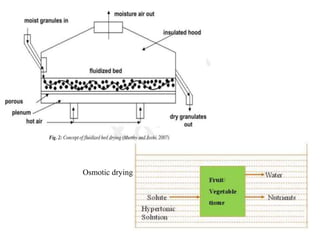
Osmotic drying:
• Moisture is removed using osmo-active substance like, 60%
aqueous solution of saccharose or 25% aqueous NaCl.
• Concentration difference generated on both sides of the semi
permeable membrane.
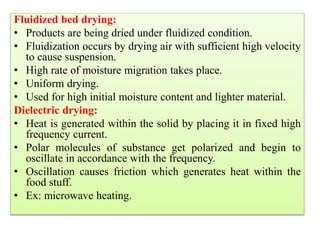
Fluidized bed drying:
• Products are being dried under fluidized condition.
• Fluidization occurs by drying air with sufficient high velocity
to cause suspension.
• High rate of moisture migration takes place.
• Uniform drying.
• Used for high initial moisture content and lighter material.
Dielectric drying:
• Heat is generated within the solid by placing it in fixed high
frequency current.
• Polar molecules of substance get polarized and begin to
oscillate in accordance with the frequency.
• Oscillation causes friction which generates heat within the
food stuff.
• Ex: microwave heating.
Osmotic drying
Thin layer drying
• Process in which all grains are fully exposed to
the drying air under constant drying conditions
i.e. at constant air temp. & humidity.
• Drying rate is independent of air velocity.
• Up to 20 cm thickness of grain bed is taken as
thin layer
• All commercial dryers are designed based on
thin layer drying principles.
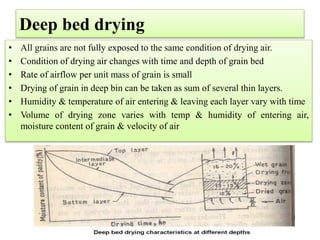
Deep bed drying
• All grains are not fully exposed to the same condition of drying air.
• Condition of drying air changes with time and depth of grain bed
• Rate of airflow per unit mass of grain is small
• Drying of grain in deep bin can be taken as sum of several thin layers.
• Humidity & temperature of air entering & leaving each layer vary with time
• Volume of drying zone varies with temp & humidity of entering air,
moisture content of grain & velocity of air
Type of dryers
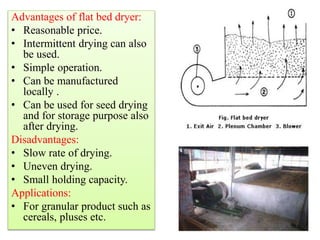
Flat bed type batch dryer
• This is a static, deep bed, batch dryer.
• Simple in design and most popular on farm.
Construction:
• It is a rectangular box type dryer.
• Size of dryer depends on area of the supporting perforated screen on
which grain is placed.
• Holding capacity- 0.25-1 tonn/batch.
• Motor capacity- 0.25-1 hp.
Operation:
• Grain is placed on supporting screen and heated air is forced through
the deep bed of grain.
• After desired moisture content observed, grain is discharged mannualy.
• Temperature of heated air should be limited upto 45oC.
• Air flow rate- 20 to 40 m3/min/1000kg of raw paddy on initial moisture
content.
Advantages of flat bed dryer:
• Reasonable price.
• Intermittent drying can also
be used.
• Simple operation.
• Can be manufactured
locally .
• Can be used for seed drying
and for storage purpose also
after drying.
Disadvantages:
• Slow rate of drying.
• Uneven drying.
• Small holding capacity.
Applications:
• For granular product such as
cereals, pluses etc.
Tray dryer
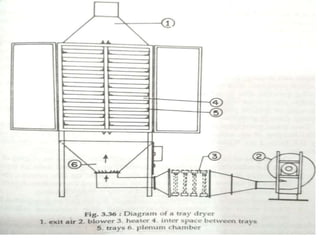
• In tray dryers, the food is spread out, generally quite
thinly, on trays in which the drying takes place.
• Heating may be by an air current sweeping across the
trays, or heated shelves on which the trays lie, or by
radiation from heated surfaces.
• Most tray dryers are heated by air, which also removes
the moist vapors.
• Many shallow trays are kept one above other with a gap
between.
• Tray may or may not have perforated bottoms.
• Generally used for vegetables and similar perishables.
Advantages of tray dryer
• No loss of substance during handling.
• It is a batch dryer so that small amount of wet solid
mixture can also be dried.
• Easier to operate and repair.
• Good control on heat and humidity.
• It may be operated under vacuum.
Disadvantages of tray dryer:
• It is not suitable for large scale production.
• High labor requirement.
• Time consuming method.
Application of tray dryer:
• For drying of sticky material, granular material or
crystalline material, precipitates and pastes can be
dried.
• This is traditional method of drying of crops and
grains.
• Using the energy of the sun to remove moisture from
the product.
• Traditional sun drying
• Mechanical solar drying
Solar drying
Advantages of traditional sun drying:
• No fuel or mechanical energy is required.
• Unskillful labor requirement.
• No pollution.
Disadvantages of traditional sun drying
• uncontrolled, and non uniform drying, results in sun cracks in
kernels.
• Completely weather dependent, not possible round the clock
and round the year.
• More losses occur due to shattering, birds, rodents.
• Require large drying floor and large number of labor.
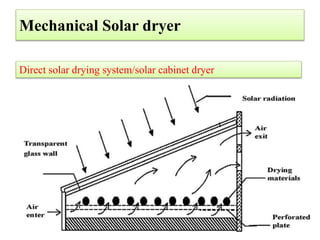
Mechanical Solar dryer
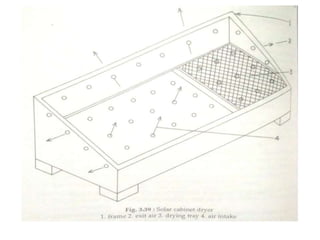
Direct solar drying system/solar cabinet dryer
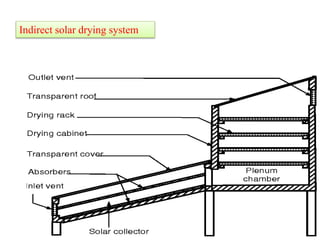
Indirect solar drying system
CONCLUSION
• As shown different food products should be
stored at different moisture contents.
• If moisture content is more than the optimum
deterioration increases resulting in great loss.
• Therefore, dryers play an important role in
these days where food security is one of the
major problem.
Drying process for grain

Drying process for grain

  • 1.
    Drying process forgrains Submitted by Maya Sharma Submitted to: Prof. P.S.Champawat Dept. of PFE CTAE, Udaipur Processing and Food Engineering Department College of Technology and Engineering (Maharana Pratap University of Agriculture and Technology , Udaipur) Udaipur- 313001
  • 2.
    Content • Introduction • Importanceof drying • Moisture content • Determination of moisture content • Equilibrium moisture content • Mode of heat transfer • Types of drying methods • Different dryers • Flat bed dryer • Mechanical tray dryer • Solar dryer • Conclusion
  • 3.
    Introduction • Dehydration istermed as removal of moisture from grain to very low levels usually to bone dry condition. • Drying refers to removal of moisture from grains and other products to a predetermined level which provides a safe level to store the grain for longer time period. • The predetermine level of moisture removal retains the nutritional quality of food material otherwise over drying may deteriorate the nutritional composition of food material. • Drying is one of the oldest methods of food preservation. • Drying is a thermo-physical and physio-chemical operation by which excess moisture from a product is removed. • Drying makes the food grains and other products suitable for safe storage and protects them against attack of insects, mold and other micro-organisms during storage.
  • 4.
    Importance of dryingprocess • It minimizes microbial spoilage and chemical deteriorative reactions greatly which provides safe storage facility for long time. • It Permits continuous supply of product thro’out the year • Permits early harvest which reduces field damage and shattering loss • Permits the farmers to have better quality product • Makes products available during off season • The reduced weight of dried products decreases packaging, handling and transportation costs. • Most food products are dried for improved milling or mixing characteristics in further processing. • It helps in preparing different food product development.
  • 5.
    Moisture migration duringdrying process • During drying heat flows over the product and goes in to the product. • This heat increases the temperature of product and moisture which converts the moisture in to water vapor which results in to increase in the vapour pressure that moves moisture towards the surface • Hot air delivers two type of heat to the product moisture – 1. sensible heat to raise the temperature of water within food product. – 2. latent heat of vaporization to convert moisture into water vapour.
  • 7.
    Moisture content • Thewater content of agricultural product is given in terms of moisture content. • It is the percentage of water content present in product. It is designated by two methods 1. wet basis 2. dry basis
  • 8.
    Wet and drybasis moisture content and their relation • The value of dry basis MC is more than the wet basis MC. • Wet basis MC is generally used by farmers at farm level. • Dry basis MC can be more than 100% during calculation. Where, M is moisture content on a percent basis, w is total weight (also called as wet weight) and d is dry weight.
  • 9.
    Determination of moisturecontent • The methods of determining moisture content can be divided into two broad categories: ƒ 1. Direct measurement: water content is determined by removing moisture and then by measuring weight loss – Air oven drying – Vacuum oven drying – Infra-red method – Distillation method 2. Indirect measurement: an intermediate variable is measured and then converted into moisture content. Building up calibration charts before applying indirect measurements is a prerequisite. – Electrical resistance method – Dielectric method – Chemical method
  • 10.
    1.1 Air ovenmethod: • Applied when moisture content of grain is upto 13%. • Samples are heated at 130oC for 1-2 hours in oven till constant weight gain. • Afterwards, samples are placed in desiccator to cool down. • Drop in weight of grain is measured based on initial weight. • Time and temperature are variable factor according to type of grain. 1.2 vacuum oven drying: • Vacuum facilitates the drying process at lower temperature. • For fruits and vegetables where heat sensitivity is problem, vacuum is applied in the oven to decrease the boiling point of moisture. • The product temperature generally varies in vacuum oven between 60-70°C and vacuum is maintained at <450 mm Hg. . Air oven dryer vacuum oven dryer
  • 11.
    1.3 Infra-red method: •Moisture is directly measured by evaporation of water from sample. • Instrument consists of a balance, a pan counter balanced by fixed weight and a variable length of weighting chain. • Infrared lamp is mounted on an arm above the pan. • Lamp produces heat which evaporates moisture from sample and direct moisture content of sample is shown on the instrument 1.4 Brown-Duvel fractional distillation method: • 100 gm whole grain along with 150 ml of mineral oil is taken in a flask and sample is boiled. Evaporated moisture is collected in graduated flask. • Millilitre of moisture shows the % of moisture content. • Wet basis moisture content. Infra-red moisture meter distillation moisture meter
  • 12.
    2.1 Electrical resistancemethod • The electrical resistance or conductivity of product depends upon its moisture content. • This principle is used in résistance measuring devices. • The moisture meter measures the electrical résistance of the material and is calibrated against moisture determination from oven or other primary methods. • The universal moisture meter gives fairly accurate readings of moisture content on wet basis. 2.2 Dielectric method • Such devices measure the dielectric constant of grains. • Dielectric constant is a quantity measuring the ability of a substance to store electrical energy in an electric field. • Grains are filled in chamber. The sides of the chamber are formed by the plates of a condenser between which a high frequency current is passed to measure capacitance of the sample. • The capacitance varies as per the water present in the sample, the degree of compaction and grain temperature. Indirect method universal moisture meter Dielectric moisture meter
  • 13.
    2.3 Chemical method •In this method, the water is removed by adding a chemical, which decompose or combines with water. • From the chemical reaction a gas is produced which can be measured volumetrically or which decreases the original weight of sample. • This method is used for determining the m. c. of forages and grains by shaking an excess of calcium carbide (Ca C2) with 30 grams of material. • About 10 to 25 minutes are required to reaction.
  • 14.
    Equilibrium moisture content •It is the moisture content of a product in equilibrium with the surrounding air at given temperature and humidity conditions. • It is the minimum moisture content to which a material can be dried under given conditions. • The equilibrium moisture content for biological materials generally increases rapidly with a relative humidity above 60 to 80% because of capillary and dissolution effects.
  • 15.
    • If adry food is placed in environment with a constant humidity and temperature, it will take up moisture by adsorption until it reaches its equilibrium moisture content (where the net moisture exchange is zero) which is called as adsorption EMC. • If, however, a wet food with the same properties is placed in the same environment, it will loose moisture by desorption and reach to equilibrium moisture content which is called as desorption EMC. • If these values are plotted on a graph a loop is obtained which is called hysteresis. • The hysteresis effect is observed due to shrinkage effect during desorption which changes the water binding properties of the food product. Therefore, during adsorption same path of EMC is not observed.
  • 16.
    Moisture content canbe classified according to its availability in the food matrix in following types: • 1. Bound moisture: Bound moisture is the amount of water tightly bound to the food matrix, mainly by physical adsorption on active sites of hydrophilic macromolecular materials such as proteins and polysaccharides, with properties significantly different from those of bulk water. • 2. Free moisture content: Free moisture content is the amount of water mechanically entrapped in the void spaces of the system. • Free water is not in the same thermodynamic state as liquid water because energy is required to overcome the capillary forces. • Furthermore, free water may contain chemicals, especially dissolved sugars, acids, and salts, altering the drying characteristics.
  • 17.
    Mode of heattransfer • There are three modes of heat transfer 1. Conduction 2. Convection 3. Radiation
  • 18.
    Conduction • Conduction isthe method of transfer of heat within a body or from one body to the other due to the transfer of heat by molecules vibrating at their mean positions. • There is no actual movement of matter while transferring heat from one location to the other. • Conduction occurs usually in solids where molecules in the structure are held together strongly by intermolecular forces of attraction amongst them • Example: heat transfer through one layer of solid mater to the another layer of the material, heating of utensils etc. • Determination of conductive heat by Fourier's law
  • 19.
    Convection • Convection isthe mode of heat transfer which occurs mostly in liquids. • In this method, heat transfer takes place with the actual motion of matter from one place within the body to the other. • Example: boiling of liquid, drying of grain is mainly due to convective heat transfer. • Determination of convective heat transfer by Newton’s Law:
  • 20.
    Radiation • It doesnot require any medium and can be used for transfer of heat in a vacuum as well. • This method uses electromagnetic waves which transfer heat from one place to the other. • The heat and light from the sun in our solar system reach our planet using radiation only. • Example: heating of grain by sun’s radiation. • Determination of radiation heat by Stefan-Boltzmann equation
  • 21.
    Drying methods • Sundrying • Conduction drying • Convection drying • Radiation drying • Freeze drying • Osmotic drying • Fluidized bed drying • Dielectric drying • Thin layer drying • Deep bed drying
  • 22.
    Sun drying: • Traditionalmethod of drying. • Drying takes place through radiation mode of sun’s electromagnetic waves.
  • 23.
    Conduction or contactdrying: • Heat is transferred to wet material mainly by conduction mode through solid surface. • Surface temperatures may vary widely. • Dryers can be operated under low pressure and in inert atmosphere. • Dust and dusty material can be removed easily. Convection drying: • Drying agent is hot gas or hot air and supplies heat to the wet grain. • Steam heated air, direct flue gases of agricultural waste etc. can be used as drying agents. • Drying temperature varies widely. • If atmospheric humidity is high, natural air drying needs dehumidification. • Fuel consumption is high as compare to conduction drying for same capacity. • Ex: fluidized bed dryer, hot air oven dryer
  • 24.
    Radiation drying: • Basedon absorption of radiant energy of sun and transformation into heat energy by grain. • Moisture movement and evaporation is caused by temperature difference and partial pressure of water vapor b/w surrounding air. • Ex: sun drying Freeze drying: • Drying is based on the sublimation (solid to gas) of frozen moisture from wet product placed in a drying chamber. • Works at low pressure. • Heat is supplied by radiation or conduction mode. Osmotic drying: • Moisture is removed using osmo-active substance like, 60% aqueous solution of saccharose or 25% aqueous NaCl. • Concentration difference generated on both sides of the semi permeable membrane.
  • 25.
    Fluidized bed drying: •Products are being dried under fluidized condition. • Fluidization occurs by drying air with sufficient high velocity to cause suspension. • High rate of moisture migration takes place. • Uniform drying. • Used for high initial moisture content and lighter material. Dielectric drying: • Heat is generated within the solid by placing it in fixed high frequency current. • Polar molecules of substance get polarized and begin to oscillate in accordance with the frequency. • Oscillation causes friction which generates heat within the food stuff. • Ex: microwave heating.
  • 27.
  • 28.
    Thin layer drying •Process in which all grains are fully exposed to the drying air under constant drying conditions i.e. at constant air temp. & humidity. • Drying rate is independent of air velocity. • Up to 20 cm thickness of grain bed is taken as thin layer • All commercial dryers are designed based on thin layer drying principles.
  • 29.
    Deep bed drying •All grains are not fully exposed to the same condition of drying air. • Condition of drying air changes with time and depth of grain bed • Rate of airflow per unit mass of grain is small • Drying of grain in deep bin can be taken as sum of several thin layers. • Humidity & temperature of air entering & leaving each layer vary with time • Volume of drying zone varies with temp & humidity of entering air, moisture content of grain & velocity of air
  • 30.
  • 31.
    Flat bed typebatch dryer • This is a static, deep bed, batch dryer. • Simple in design and most popular on farm. Construction: • It is a rectangular box type dryer. • Size of dryer depends on area of the supporting perforated screen on which grain is placed. • Holding capacity- 0.25-1 tonn/batch. • Motor capacity- 0.25-1 hp. Operation: • Grain is placed on supporting screen and heated air is forced through the deep bed of grain. • After desired moisture content observed, grain is discharged mannualy. • Temperature of heated air should be limited upto 45oC. • Air flow rate- 20 to 40 m3/min/1000kg of raw paddy on initial moisture content.
  • 32.
    Advantages of flatbed dryer: • Reasonable price. • Intermittent drying can also be used. • Simple operation. • Can be manufactured locally . • Can be used for seed drying and for storage purpose also after drying. Disadvantages: • Slow rate of drying. • Uneven drying. • Small holding capacity. Applications: • For granular product such as cereals, pluses etc.
  • 33.
    Tray dryer • Intray dryers, the food is spread out, generally quite thinly, on trays in which the drying takes place. • Heating may be by an air current sweeping across the trays, or heated shelves on which the trays lie, or by radiation from heated surfaces. • Most tray dryers are heated by air, which also removes the moist vapors. • Many shallow trays are kept one above other with a gap between. • Tray may or may not have perforated bottoms. • Generally used for vegetables and similar perishables.
  • 35.
    Advantages of traydryer • No loss of substance during handling. • It is a batch dryer so that small amount of wet solid mixture can also be dried. • Easier to operate and repair. • Good control on heat and humidity. • It may be operated under vacuum. Disadvantages of tray dryer: • It is not suitable for large scale production. • High labor requirement. • Time consuming method. Application of tray dryer: • For drying of sticky material, granular material or crystalline material, precipitates and pastes can be dried.
  • 36.
    • This istraditional method of drying of crops and grains. • Using the energy of the sun to remove moisture from the product. • Traditional sun drying • Mechanical solar drying Solar drying
  • 37.
    Advantages of traditionalsun drying: • No fuel or mechanical energy is required. • Unskillful labor requirement. • No pollution. Disadvantages of traditional sun drying • uncontrolled, and non uniform drying, results in sun cracks in kernels. • Completely weather dependent, not possible round the clock and round the year. • More losses occur due to shattering, birds, rodents. • Require large drying floor and large number of labor.
  • 38.
    Mechanical Solar dryer Directsolar drying system/solar cabinet dryer
  • 40.
  • 41.
    CONCLUSION • As showndifferent food products should be stored at different moisture contents. • If moisture content is more than the optimum deterioration increases resulting in great loss. • Therefore, dryers play an important role in these days where food security is one of the major problem.