Department Of Agricultural And Food Engineering
IIT Kharagpur
Presented By
Shilpi
 Introduction
 Combination with high hydrostatic pressure
 Combination with ultrasound
 Combination with pulse electric field
 Combination with irradiation
 Conclusions
 Non thermal preservation techniques are
highly effective in inactivating vegetative
cells of bacteria, yeast, and molds.
 However, bacterial spores and most
enzymes remain difficult to inactivate with
these procedures.
 To extend the use of non thermal processing
in the food industry, combinations of these
technologies with traditional or emerging
food preservation techniques are being
studied.
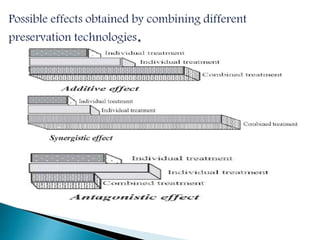
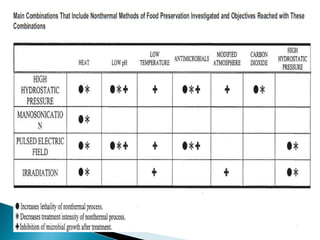
Combining non thermal methods with other food
preservation techniques can
 Enhance the lethal effects of non thermal processing,
 Reduce the severity of non thermal treatment needed
to obtain a given level of microbial inactivation, and
 Prevent the proliferation of survivors following
treatment
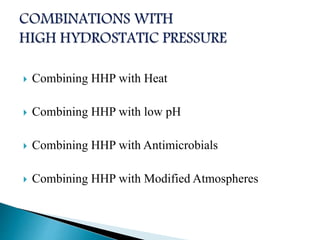
 Combining HHP with Heat
 Combining HHP with low pH
 Combining HHP with Antimicrobials
 Combining HHP with Modified Atmospheres
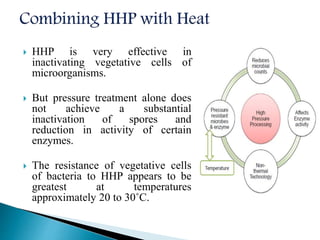
 HHP is very effective in
inactivating vegetative cells of
microorganisms.
 But pressure treatment alone does
not achieve a substantial
inactivation of spores and
reduction in activity of certain
enzymes.
 The resistance of vegetative cells
of bacteria to HHP appears to be
greatest at temperatures
approximately 20 to 30˚C.
 At higher and lower temperatures, microorganisms are
more sensitive to HHP.
 The resistance to HHP by vegetative cells of bacteria
decreases even when pressure is combined with heat at
nonlethal temperatures.
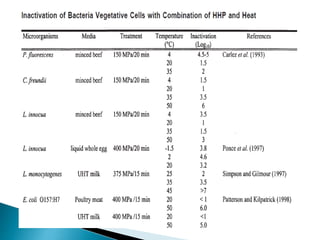
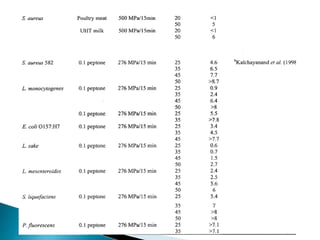
 This combination allows substantial inactivation (>6 log10
cycles) of spoilage and pathogenic microorganisms at
lower pressures and/or shorter times than that required
when pressurization is carried out at room temperature.
 Example; the inactivation of Listeria monocytogenes in
UHT milk
 Another benefit of this combination is that variation in
pressure resistance among strains is much lower when HHP is
combined with moderate temperature.
 Combining mild temperatures and pressure allows the
pasteurization/sterilization of foods at lower temperatures.
 Inactivation of microorganisms at moderate pressures, which is
economically feasible and does not induce quality loss in the
treated product.
 In general, the kinetics of inactivation of mostvegetative cells
by HHP at low temperatures shows an initial exponential rate,
followed by pronounced tailing .
 This tail tends to disappear when HHP is combined with heat.
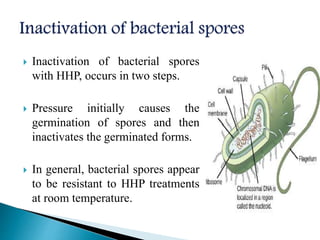
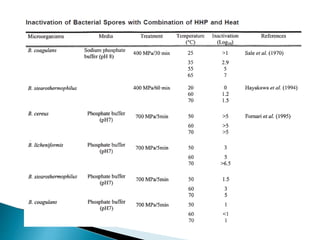
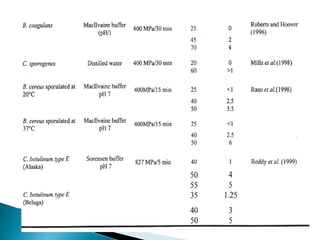
 Inactivation of bacterial spores
with HHP, occurs in two steps.
 Pressure initially causes the
germination of spores and then
inactivates the germinated forms.
 In general, bacterial spores appear
to be resistant to HHP treatments
at room temperature.
 Pressures as low as 10 MPa can initiate germination
of bacterial spores.
 Thus sensitizing them to heat, radiation, chemical
agents, and even HHP treatments.
 In general the pressure is insufficient to cause
appreciable inactivation of germinated forms.
 Combined HHP and heat is especially effective at
temperatures allowing inactivation of germinated
spores (>60˚C), suggesting that spores germinated by
HHP are directly inactivated by heat.
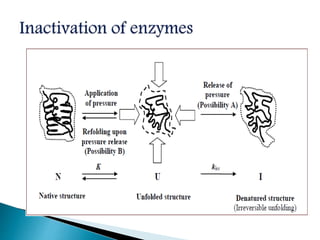
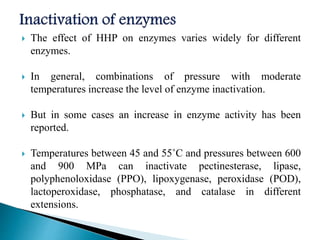
 The effect of HHP on enzymes varies widely for different
enzymes.
 In general, combinations of pressure with moderate
temperatures increase the level of enzyme inactivation.
 But in some cases an increase in enzyme activity has been
reported.
 Temperatures between 45 and 55˚C and pressures between 600
and 900 MPa can inactivate pectinesterase, lipase,
polyphenoloxidase (PPO), lipoxygenase, peroxidase (POD),
lactoperoxidase, phosphatase, and catalase in different
extensions.
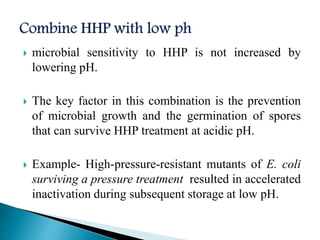
 microbial sensitivity to HHP is not increased by
lowering pH.
 The key factor in this combination is the prevention
of microbial growth and the germination of spores
that can survive HHP treatment at acidic pH.
 Example- High-pressure-resistant mutants of E. coli
surviving a pressure treatment resulted in accelerated
inactivation during subsequent storage at low pH.
 HHP inflicts sublethal injury on microorganisms,
even at lower pressures required for their death.
 Sublethally injured cells are more susceptible to
antimicrobial components.
 Combining antimicrobials with HHP can enhance the
effectiveness of pressurization with advantages in
product quality and safety.
 Used to extend the shelf-life of salmon and prawns.
 The best treatment for salmon shelf-life extension
and quality retention was a pressurization treatment
of 150 MPa for 10 min followed by MAP extended
the shelf life 5days.
 Again, for prawns a pressurization treatment of 200
Mpa and 400 Mpa for 10 min followed by MAP
extended the shelf life 7days and 14 days.
 Combine MS with pH
 Combine MS with water activity
 Combine MS with heat
*MS-Application of ultrasound with small amount of pressure.
 The DMS value of L. monocytogenes studied by
Pagan et al.didnot change when pH decreased
from 7 to 4.
 Similar results on the influence of pH on MS
resistance were obtained for Aeromonas
hydrophila and Yersinia enterocolitica.
 Adding 57% sucrose to the decreased aw in the
treatment medium, until 0.94, increased the heat
resistance at 62°C of L. monocytogenes 25 times.
 While its MS (117 mm, 200 kPa, 40°C) resistance
increased only two times.
 Therefore, MS could be a very useful alternative to heat
treatment for the inactivation of microorganisms in
food with low water activity.
 Application of MS treatment simultaneously with
heat treatment (Manothermosonication) led to higher
microbial inactivation.
 MTS treatments have also been very effective in the
inactivation of different enzymes related to food
quality, such as POD, lipoxigenase, PPO, lipase,
protease, or PME.
 The same inactivation level is achieved over a shorter
treatment period or at lower temperature.
 Consequently, this combination could be
advantageous, due to the minimization of heat-
induced damage in product quality.
 Example-simultaneous applications of heat (72°C)
and ultrasound (20 kHz, 117 μm) under moderate
pressure (200 kPa) increased the inactivation rate of
orange juice PME 25 times in buffer, and more than
400 times in orange juice.
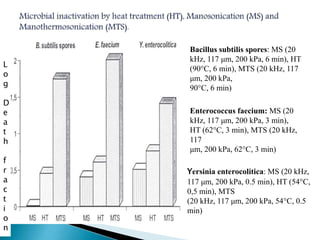
Bacillus subtilis spores: MS (20
kHz, 117 μm, 200 kPa, 6 min), HT
(90°C, 6 min), MTS (20 kHz, 117
μm, 200 kPa,
90°C, 6 min)
Enterococcus faecium: MS (20
kHz, 117 μm, 200 kPa, 3 min),
HT (62°C, 3 min), MTS (20 kHz,
117
μm, 200 kPa, 62°C, 3 min)
Yersinia enterocolitica: MS (20 kHz,
117 μm, 200 kPa, 0.5 min), HT (54°C,
0,5 min), MTS
(20 kHz, 117 μm, 200 kPa, 54°C, 0.5
min)
L
o
g
D
e
a
t
h
f
r
a
c
t
i
o
n
 Combine PEF with heat
 Combine PEF with low pH
 Combine PEF with antimicrobials
 In general, the heat generated during PEF treatment
resulting from the sample’s resistance to current flow is
removed.
 However, it has been observed that lethality of PEF
treatments increases with an increase in processing
temperature.
 For example, inactivation of E. coli by PEF, with a field
strength of 36 kV/cm and pulse duration of 2 μs,
increased from 2 to 3 log cycles when temperature was
increased from 7 to 40˚C.
 The higher susceptibility of microorganisms to PEF has
been related to the temperature effect on membrane
fluidity properties.
 Phospholipids are closely packed in a rigid gel structure
at low temperatures, at high temperatures they are less
ordered, the membrane has a liquid-crystalline
structure, and its thickness is reduced.
 Further studies are necessary to determine an optimal
heat-PEF combination that can inactivate the maximum
level of PEF-resistant microbial species possible with a
minimal effect on food.
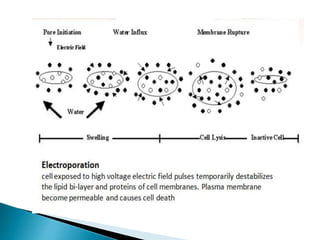
 PEF induces reversible or irreversible structural
changes in cell membranes.
 Resulting in pore formation and loss of selective
permeability properties.
 Antimicrobials such as lysozyme or nisin act on cell
membranes such as organic acids cross the microbial
membranes and access the cytoplasm where they act.
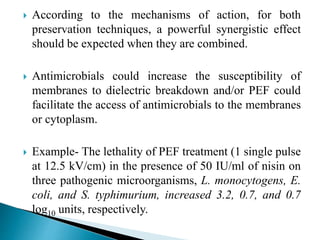
 According to the mechanisms of action, for both
preservation techniques, a powerful synergistic effect
should be expected when they are combined.
 Antimicrobials could increase the susceptibility of
membranes to dielectric breakdown and/or PEF could
facilitate the access of antimicrobials to the membranes
or cytoplasm.
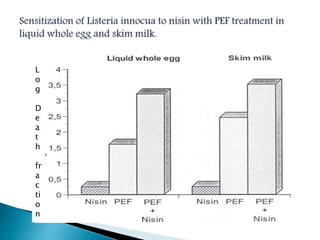
 Example- The lethality of PEF treatment (1 single pulse
at 12.5 kV/cm) in the presence of 50 IU/ml of nisin on
three pathogenic microorganisms, L. monocytogens, E.
coli, and S. typhimurium, increased 3.2, 0.7, and 0.7
log10 units, respectively.
L
o
g
D
e
a
t
h
fr
a
c
ti
o
n
 Combine irradiation with low temp. and
modified atmosphere
 Combine irradiation with heat
 Combine irradiation with HPP
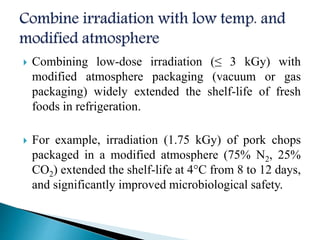
 Combining low-dose irradiation (≤ 3 kGy) with
modified atmosphere packaging (vacuum or gas
packaging) widely extended the shelf-life of fresh
foods in refrigeration.
 For example, irradiation (1.75 kGy) of pork chops
packaged in a modified atmosphere (75% N2, 25%
CO2) extended the shelf-life at 4°C from 8 to 12 days,
and significantly improved microbiological safety.
 Irradiation sensitizes vegetative cells and bacterial
spores to a subsequent heat treatment.
 This heat-sensitizing effect has been observed in both
vegetative cells and bacterial spores suspended in
aqueous or lipid systems or foods.
 For example, in minced roast beef, the D70 value of a
strain of L. monocytogenes decreased from 22.4 s to
5.5 s after a preirradiation treatment (0.8 kGy).
 A synergistic effect on the inactivation of vegetative
bacteria and bacterial spores can be achieved with
thermoradiation.
 For example, Dose value (dose inactivating 90% of
population) of S. aureus decreased from 0.098 to
0.053 kGy . while the irradiation temperature
increased from 35 to 45°C.
 Thermoradiation caused greater inactivation of
Salmonella enteritidis in liquid whole egg than either
heat or radiation alone.
 Hydrostatic pressure greater than 500 atm decreased
the resistance of Bacillus pumilus spores to gamma-
irradiation.
 This decrease in resistance was associated with the
initial germination of bacterial spores by HHP.
 Combinations of HHP and irradiation can lower the
intensity of treatment required for any process.
 And as a consequence can improve the sensorial
quality and microbial safety of meat.
 Example-Staphylococcal counts in lamb meat were
reduced by 1 log cycle in samples subjected to
irradiation (1 kGy) or HHP (200 MPa, 30 min).
 When both treatments combined were applied, an
inactivation of more than 4 log cycles was achieved.
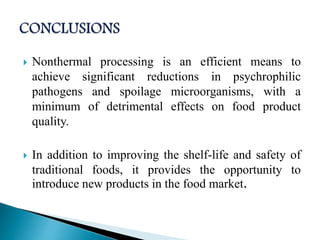
 Nonthermal processing is an efficient means to
achieve significant reductions in psychrophilic
pathogens and spoilage microorganisms, with a
minimum of detrimental effects on food product
quality.
 In addition to improving the shelf-life and safety of
traditional foods, it provides the opportunity to
introduce new products in the food market.
 The use of nonthermal processes in combination with
other preservation technologies presents a number of
potential benefits to food preservation.
 While use of irradiation or HHP has already been
established in the industry, others such as ultrasound
or PEF must continue to be developed and evaluated
for commercial application.
 Amanatidou, A., Schluter, O., Lemkau, K., Gorris, L.G.M., Smid, E.J., and
Knorr, D. (2000) Effect of combined application of high pressure treatment
and modified atmosphere on the shelf-life of fresh Atlantic salmon.
Innovative Food Science and Emerging Technologies, 1, 87–98.
 Clouston, J.G. and Wills, P.A. (1969). Initiation of germination and
inactivation of Bacillus pumillus spores by hydrostatic pressure. J.
Bacteriol., 97, 684–690.
 Heinz, V. and Knorr, D. (2000). Effect of pH, ethanol addition and high
hydrostatic pressure on the inactivation of Bacillus subtilis by pulsed
electric fields. Innovat. Food Sci. Emerg. Technol. 1, 151–161.
 Murano, P.S., Murano, E.A., and Olson, D.G. (1998). Irradiated ground
beef: sensory and quality changes during storage under various packaging
conditions. J. Food Sci., 63, 548–551.
 Schaffner, D.F., Hamdy, M.K., Toledo, R.T., and Tift, M.L. (1989).
Salmonella inactivation in liquid whole egg by thermoradiation. J. Food
Sci., 54, 902–905.

Non thermal processing by combined techniques

  • 1.
    Department Of AgriculturalAnd Food Engineering IIT Kharagpur Presented By Shilpi
  • 2.
     Introduction  Combinationwith high hydrostatic pressure  Combination with ultrasound  Combination with pulse electric field  Combination with irradiation  Conclusions
  • 3.
     Non thermalpreservation techniques are highly effective in inactivating vegetative cells of bacteria, yeast, and molds.  However, bacterial spores and most enzymes remain difficult to inactivate with these procedures.  To extend the use of non thermal processing in the food industry, combinations of these technologies with traditional or emerging food preservation techniques are being studied.
  • 4.
    Combining non thermalmethods with other food preservation techniques can  Enhance the lethal effects of non thermal processing,  Reduce the severity of non thermal treatment needed to obtain a given level of microbial inactivation, and  Prevent the proliferation of survivors following treatment
  • 6.
     Combining HHPwith Heat  Combining HHP with low pH  Combining HHP with Antimicrobials  Combining HHP with Modified Atmospheres
  • 7.
     HHP isvery effective in inactivating vegetative cells of microorganisms.  But pressure treatment alone does not achieve a substantial inactivation of spores and reduction in activity of certain enzymes.  The resistance of vegetative cells of bacteria to HHP appears to be greatest at temperatures approximately 20 to 30˚C.
  • 8.
     At higherand lower temperatures, microorganisms are more sensitive to HHP.  The resistance to HHP by vegetative cells of bacteria decreases even when pressure is combined with heat at nonlethal temperatures.  This combination allows substantial inactivation (>6 log10 cycles) of spoilage and pathogenic microorganisms at lower pressures and/or shorter times than that required when pressurization is carried out at room temperature.  Example; the inactivation of Listeria monocytogenes in UHT milk
  • 9.
     Another benefitof this combination is that variation in pressure resistance among strains is much lower when HHP is combined with moderate temperature.  Combining mild temperatures and pressure allows the pasteurization/sterilization of foods at lower temperatures.  Inactivation of microorganisms at moderate pressures, which is economically feasible and does not induce quality loss in the treated product.  In general, the kinetics of inactivation of mostvegetative cells by HHP at low temperatures shows an initial exponential rate, followed by pronounced tailing .  This tail tends to disappear when HHP is combined with heat.
  • 10.
     Inactivation ofbacterial spores with HHP, occurs in two steps.  Pressure initially causes the germination of spores and then inactivates the germinated forms.  In general, bacterial spores appear to be resistant to HHP treatments at room temperature.
  • 11.
     Pressures aslow as 10 MPa can initiate germination of bacterial spores.  Thus sensitizing them to heat, radiation, chemical agents, and even HHP treatments.  In general the pressure is insufficient to cause appreciable inactivation of germinated forms.  Combined HHP and heat is especially effective at temperatures allowing inactivation of germinated spores (>60˚C), suggesting that spores germinated by HHP are directly inactivated by heat.
  • 13.
     The effectof HHP on enzymes varies widely for different enzymes.  In general, combinations of pressure with moderate temperatures increase the level of enzyme inactivation.  But in some cases an increase in enzyme activity has been reported.  Temperatures between 45 and 55˚C and pressures between 600 and 900 MPa can inactivate pectinesterase, lipase, polyphenoloxidase (PPO), lipoxygenase, peroxidase (POD), lactoperoxidase, phosphatase, and catalase in different extensions.
  • 18.
     microbial sensitivityto HHP is not increased by lowering pH.  The key factor in this combination is the prevention of microbial growth and the germination of spores that can survive HHP treatment at acidic pH.  Example- High-pressure-resistant mutants of E. coli surviving a pressure treatment resulted in accelerated inactivation during subsequent storage at low pH.
  • 19.
     HHP inflictssublethal injury on microorganisms, even at lower pressures required for their death.  Sublethally injured cells are more susceptible to antimicrobial components.  Combining antimicrobials with HHP can enhance the effectiveness of pressurization with advantages in product quality and safety.
  • 20.
     Used toextend the shelf-life of salmon and prawns.  The best treatment for salmon shelf-life extension and quality retention was a pressurization treatment of 150 MPa for 10 min followed by MAP extended the shelf life 5days.  Again, for prawns a pressurization treatment of 200 Mpa and 400 Mpa for 10 min followed by MAP extended the shelf life 7days and 14 days.
  • 21.
     Combine MSwith pH  Combine MS with water activity  Combine MS with heat *MS-Application of ultrasound with small amount of pressure.
  • 22.
     The DMSvalue of L. monocytogenes studied by Pagan et al.didnot change when pH decreased from 7 to 4.  Similar results on the influence of pH on MS resistance were obtained for Aeromonas hydrophila and Yersinia enterocolitica.
  • 23.
     Adding 57%sucrose to the decreased aw in the treatment medium, until 0.94, increased the heat resistance at 62°C of L. monocytogenes 25 times.  While its MS (117 mm, 200 kPa, 40°C) resistance increased only two times.  Therefore, MS could be a very useful alternative to heat treatment for the inactivation of microorganisms in food with low water activity.
  • 24.
     Application ofMS treatment simultaneously with heat treatment (Manothermosonication) led to higher microbial inactivation.  MTS treatments have also been very effective in the inactivation of different enzymes related to food quality, such as POD, lipoxigenase, PPO, lipase, protease, or PME.  The same inactivation level is achieved over a shorter treatment period or at lower temperature.
  • 25.
     Consequently, thiscombination could be advantageous, due to the minimization of heat- induced damage in product quality.  Example-simultaneous applications of heat (72°C) and ultrasound (20 kHz, 117 μm) under moderate pressure (200 kPa) increased the inactivation rate of orange juice PME 25 times in buffer, and more than 400 times in orange juice.
  • 26.
    Bacillus subtilis spores:MS (20 kHz, 117 μm, 200 kPa, 6 min), HT (90°C, 6 min), MTS (20 kHz, 117 μm, 200 kPa, 90°C, 6 min) Enterococcus faecium: MS (20 kHz, 117 μm, 200 kPa, 3 min), HT (62°C, 3 min), MTS (20 kHz, 117 μm, 200 kPa, 62°C, 3 min) Yersinia enterocolitica: MS (20 kHz, 117 μm, 200 kPa, 0.5 min), HT (54°C, 0,5 min), MTS (20 kHz, 117 μm, 200 kPa, 54°C, 0.5 min) L o g D e a t h f r a c t i o n
  • 27.
     Combine PEFwith heat  Combine PEF with low pH  Combine PEF with antimicrobials
  • 28.
     In general,the heat generated during PEF treatment resulting from the sample’s resistance to current flow is removed.  However, it has been observed that lethality of PEF treatments increases with an increase in processing temperature.  For example, inactivation of E. coli by PEF, with a field strength of 36 kV/cm and pulse duration of 2 μs, increased from 2 to 3 log cycles when temperature was increased from 7 to 40˚C.
  • 29.
     The highersusceptibility of microorganisms to PEF has been related to the temperature effect on membrane fluidity properties.  Phospholipids are closely packed in a rigid gel structure at low temperatures, at high temperatures they are less ordered, the membrane has a liquid-crystalline structure, and its thickness is reduced.  Further studies are necessary to determine an optimal heat-PEF combination that can inactivate the maximum level of PEF-resistant microbial species possible with a minimal effect on food.
  • 31.
     PEF inducesreversible or irreversible structural changes in cell membranes.  Resulting in pore formation and loss of selective permeability properties.  Antimicrobials such as lysozyme or nisin act on cell membranes such as organic acids cross the microbial membranes and access the cytoplasm where they act.
  • 32.
     According tothe mechanisms of action, for both preservation techniques, a powerful synergistic effect should be expected when they are combined.  Antimicrobials could increase the susceptibility of membranes to dielectric breakdown and/or PEF could facilitate the access of antimicrobials to the membranes or cytoplasm.  Example- The lethality of PEF treatment (1 single pulse at 12.5 kV/cm) in the presence of 50 IU/ml of nisin on three pathogenic microorganisms, L. monocytogens, E. coli, and S. typhimurium, increased 3.2, 0.7, and 0.7 log10 units, respectively.
  • 33.
  • 34.
     Combine irradiationwith low temp. and modified atmosphere  Combine irradiation with heat  Combine irradiation with HPP
  • 35.
     Combining low-doseirradiation (≤ 3 kGy) with modified atmosphere packaging (vacuum or gas packaging) widely extended the shelf-life of fresh foods in refrigeration.  For example, irradiation (1.75 kGy) of pork chops packaged in a modified atmosphere (75% N2, 25% CO2) extended the shelf-life at 4°C from 8 to 12 days, and significantly improved microbiological safety.
  • 36.
     Irradiation sensitizesvegetative cells and bacterial spores to a subsequent heat treatment.  This heat-sensitizing effect has been observed in both vegetative cells and bacterial spores suspended in aqueous or lipid systems or foods.  For example, in minced roast beef, the D70 value of a strain of L. monocytogenes decreased from 22.4 s to 5.5 s after a preirradiation treatment (0.8 kGy).
  • 37.
     A synergisticeffect on the inactivation of vegetative bacteria and bacterial spores can be achieved with thermoradiation.  For example, Dose value (dose inactivating 90% of population) of S. aureus decreased from 0.098 to 0.053 kGy . while the irradiation temperature increased from 35 to 45°C.  Thermoradiation caused greater inactivation of Salmonella enteritidis in liquid whole egg than either heat or radiation alone.
  • 38.
     Hydrostatic pressuregreater than 500 atm decreased the resistance of Bacillus pumilus spores to gamma- irradiation.  This decrease in resistance was associated with the initial germination of bacterial spores by HHP.  Combinations of HHP and irradiation can lower the intensity of treatment required for any process.
  • 39.
     And asa consequence can improve the sensorial quality and microbial safety of meat.  Example-Staphylococcal counts in lamb meat were reduced by 1 log cycle in samples subjected to irradiation (1 kGy) or HHP (200 MPa, 30 min).  When both treatments combined were applied, an inactivation of more than 4 log cycles was achieved.
  • 41.
     Nonthermal processingis an efficient means to achieve significant reductions in psychrophilic pathogens and spoilage microorganisms, with a minimum of detrimental effects on food product quality.  In addition to improving the shelf-life and safety of traditional foods, it provides the opportunity to introduce new products in the food market.
  • 42.
     The useof nonthermal processes in combination with other preservation technologies presents a number of potential benefits to food preservation.  While use of irradiation or HHP has already been established in the industry, others such as ultrasound or PEF must continue to be developed and evaluated for commercial application.
  • 43.
     Amanatidou, A.,Schluter, O., Lemkau, K., Gorris, L.G.M., Smid, E.J., and Knorr, D. (2000) Effect of combined application of high pressure treatment and modified atmosphere on the shelf-life of fresh Atlantic salmon. Innovative Food Science and Emerging Technologies, 1, 87–98.  Clouston, J.G. and Wills, P.A. (1969). Initiation of germination and inactivation of Bacillus pumillus spores by hydrostatic pressure. J. Bacteriol., 97, 684–690.  Heinz, V. and Knorr, D. (2000). Effect of pH, ethanol addition and high hydrostatic pressure on the inactivation of Bacillus subtilis by pulsed electric fields. Innovat. Food Sci. Emerg. Technol. 1, 151–161.  Murano, P.S., Murano, E.A., and Olson, D.G. (1998). Irradiated ground beef: sensory and quality changes during storage under various packaging conditions. J. Food Sci., 63, 548–551.  Schaffner, D.F., Hamdy, M.K., Toledo, R.T., and Tift, M.L. (1989). Salmonella inactivation in liquid whole egg by thermoradiation. J. Food Sci., 54, 902–905.