Protected cultivation: Green
House Technology
Submitted by
Maya Sharma
Submitted to:
Prof. P.S.Champawat
Dept. of PFE
CTAE, Udaipur
Processing and Food Engineering Department
College of Technology and Engineering
(Maharana Pratap University of Agriculture and Technology , Udaipur)
Udaipur- 313001
Content
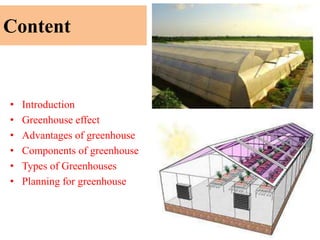
• Introduction
• Greenhouse effect
• Advantages of greenhouse
• Components of greenhouse
• Types of Greenhouses
• Planning for greenhouse
Introduction
• The need to protect the crops against unfavorable environmental
conditions led to the development of protected agriculture.
• Greenhouse is the most practical method of achieving the objectives
of protected agriculture, where the natural environment is modified by
using sound engineering principles to achieve optimum plant growth
and yields.
• It is a system of controlled environment agriculture (CEA), with a
precise control of air, temperature, humidity, light, carbon dioxide,
water and plant nutrition.
• Greenhouse Technology is the technique of providing favourable
environment condition to the plants.
• The main purpose of greenhouse technology is to provide a good
growing environment for successfully growing high quality plants
round the year.
Continue
• Of all agricultural production activities, the
greenhouse industry is worldwide the fastest
growing sector. The greenhouse is goldmines that
offer the most profitable business opportunities
• The use of the greenhouse is mainly for the
production of seasonal and non- seasonal crops,
for the production of high-quality flower,
vegetable and the preparation of nursery prepared
by tissue culture.
• At present even at households, individual pots of
plant can be given the greenhouse protection
Greenhouse effect
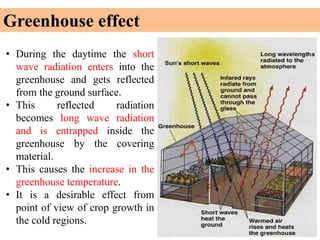
• During the daytime the short
wave radiation enters into the
greenhouse and gets reflected
from the ground surface.
• This reflected radiation
becomes long wave radiation
and is entrapped inside the
greenhouse by the covering
material.
• This causes the increase in the
greenhouse temperature.
• It is a desirable effect from
point of view of crop growth in
the cold regions.
• Throughout the year four to five crops can be grown in a greenhouse
due to the availability of required plant environmental conditions.
• The productivity of the crop is increased considerably.
• Superior quality produce can be obtained as they are grown under
suitably controlled environment.
• Gadgets for efficient use of various inputs like water, fertilizers, seeds
and plant protection chemicals can be well maintained in a
greenhouse.
• Effective control of pests and diseases is possible as the growing area
is enclosed.
• Percentage of germination of seeds is high in greenhouses.
• Different types of growing medium like peat mass, vermiculate, rice
hulls and compost that are used in intensive agriculture can be
effectively utilized in the greenhouse.
Advantages of Greenhouse:
Advantages (continue)
• Export quality produce meeting international
standards can be produced in a greenhouse.
• When the crops are not grown, drying and related
operations of the harvested produce can be taken
up utilizing the entrapped heat.
• Greenhouses are suitable for automation of
irrigation, application of other inputs, and
environmental controls by using computers and
artificial intelligence techniques.
• Self-employment for educated youth on farm can
be increased.
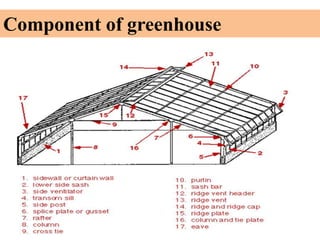
Component of greenhouse
• Roof: transparent cover of a green house.
• Gable: transparent wall of a green house
• Cladding material: transparent material mounted on the walls and
roof of a green house.
• Rigid cladding material: cladding material with such a degree of
rigidity that any deformation of the structure may result in damage to
it. Ex. Glass
• Flexible cladding material: cladding material with such a degree of
flexibility that any deformation of the structure will not result in
damage to it. Ex. Plastic film
• Gutter: collects and drains rain water and snow which is place at an
elevated level between two spans.
• Column: vertical structure member carrying the green house
structure
continue
continue
• Purlin: a member who connects cladding supporting bars to the
columns
• Ridge: highest horizontal section in top of the roof
• Girder: horizontal structure member, connecting columns on
gutter height
• Bracings: To support the structure against wind
• Arches: Member supporting covering materials
• Foundation pipe: Connection between the structure and ground
• Span width: Center to center distance of the gutters in
multispan houses
• Green house length: dimension of the green house in the
direction of gable
• Green house width: dimension of the green house in the
direction of the gutter
Types of Greenhouse:
• Different types of the greenhouse are designed to
according to match specific needs.
• There are different types of greenhouses available
– based on shape
– Based on construction
– Based on covering material
A) Greenhouse type based on Shape
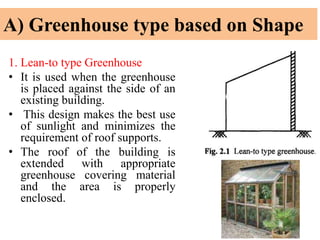
1. Lean-to type Greenhouse
• It is used when the greenhouse
is placed against the side of an
existing building.
• This design makes the best use
of sunlight and minimizes the
requirement of roof supports.
• The roof of the building is
extended with appropriate
greenhouse covering material
and the area is properly
enclosed.
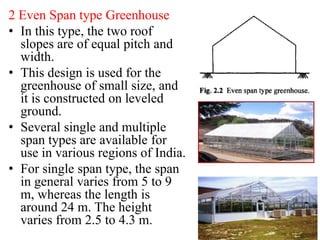
2 Even Span type Greenhouse
• In this type, the two roof
slopes are of equal pitch and
width.
• This design is used for the
greenhouse of small size, and
it is constructed on leveled
ground.
• Several single and multiple
span types are available for
use in various regions of India.
• For single span type, the span
in general varies from 5 to 9
m, whereas the length is
around 24 m. The height
varies from 2.5 to 4.3 m.
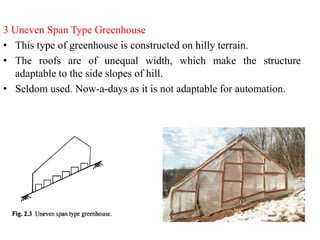
3 Uneven Span Type Greenhouse
• This type of greenhouse is constructed on hilly terrain.
• The roofs are of unequal width, which make the structure
adaptable to the side slopes of hill.
• Seldom used. Now-a-days as it is not adaptable for automation.
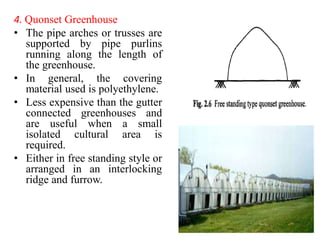
4. Quonset Greenhouse
• The pipe arches or trusses are
supported by pipe purlins
running along the length of
the greenhouse.
• In general, the covering
material used is polyethylene.
• Less expensive than the gutter
connected greenhouses and
are useful when a small
isolated cultural area is
required.
• Either in free standing style or
arranged in an interlocking
ridge and furrow.
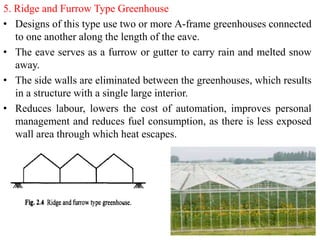
5. Ridge and Furrow Type Greenhouse
• Designs of this type use two or more A-frame greenhouses connected
to one another along the length of the eave.
• The eave serves as a furrow or gutter to carry rain and melted snow
away.
• The side walls are eliminated between the greenhouses, which results
in a structure with a single large interior.
• Reduces labour, lowers the cost of automation, improves personal
management and reduces fuel consumption, as there is less exposed
wall area through which heat escapes.
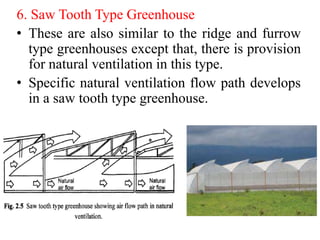
6. Saw Tooth Type Greenhouse
• These are also similar to the ridge and furrow
type greenhouses except that, there is provision
for natural ventilation in this type.
• Specific natural ventilation flow path develops
in a saw tooth type greenhouse.
B) Greenhouse type based on construction
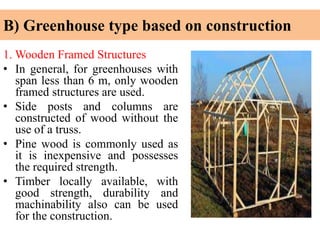
1. Wooden Framed Structures
• In general, for greenhouses with
span less than 6 m, only wooden
framed structures are used.
• Side posts and columns are
constructed of wood without the
use of a truss.
• Pine wood is commonly used as
it is inexpensive and possesses
the required strength.
• Timber locally available, with
good strength, durability and
machinability also can be used
for the construction.
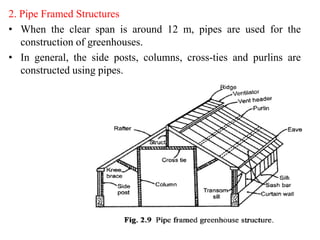
2. Pipe Framed Structures
• When the clear span is around 12 m, pipes are used for the
construction of greenhouses.
• In general, the side posts, columns, cross-ties and purlins are
constructed using pipes.
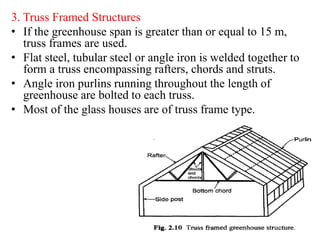
3. Truss Framed Structures
• If the greenhouse span is greater than or equal to 15 m,
truss frames are used.
• Flat steel, tubular steel or angle iron is welded together to
form a truss encompassing rafters, chords and struts.
• Angle iron purlins running throughout the length of
greenhouse are bolted to each truss.
• Most of the glass houses are of truss frame type.
C) Greenhouse type based on covering materials
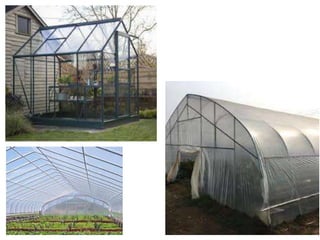
1. Glass Greenhouses
• Only glass greenhouses with glass as the covering material existed prior to 1950.
• Glass as covering material has the advantage of greater interior light intensity.
• These greenhouses have higher air infIltration rate, which leads to lower interior
humidity and better disease prevention.
• Lean-to type, even span, ridge and furrow type of designs are used for construction of
glass greenhouse.
2. Plastic Film Greenhouses
• Flexible plastic films including polyethylene, polyester and polyvinyl chloride are
used as covering material in this type of greenhouses.
• become popular, as they are cheap and the cost of heating is less when compared to
glass greenhouses.
• The main disadvantage with plastic films is its short life as the covering material.
• For example, the best quality ultraviolet (UY) stabilized film can last for four years
only.
• Quonset design as well as gutter-connected design is suitable for using this covering
material.
Planning for green house
1. Site Selection and Orientation
• The building site should be as level as possible to reduce the cost of
grading
• The site should be well aerated and should receive good solar radiation.
• Provision of a drainage system is always advisable, because of the
extensive use of water in greenhouse operations.
• It is also advisable to select a site with a natural windbreak such as a tree
line or hill, on the north and northwest sides.
• In regions where snow is expected, trees should be 30.5 m away in order
to keep drifts back from the greenhouses.
• To prevent shadows on the crop, trees located on the east, south, or west
sides should be at a distance of 2.5 times their height. Owing to thee
limited availability of the agricultural labourers, high wages are to be paid
to attract them.
Planning for green house (continue)
2. Selection of structural design:
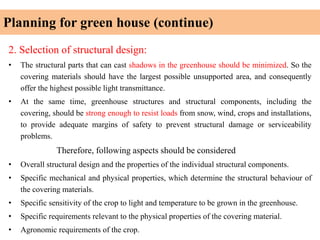
• The structural parts that can cast shadows in the greenhouse should be minimized. So the
covering materials should have the largest possible unsupported area, and consequently
offer the highest possible light transmittance.
• At the same time, greenhouse structures and structural components, including the
covering, should be strong enough to resist loads from snow, wind, crops and installations,
to provide adequate margins of safety to prevent structural damage or serviceability
problems.
Therefore, following aspects should be considered
• Overall structural design and the properties of the individual structural components.
• Specific mechanical and physical properties, which determine the structural behaviour of
the covering materials.
• Specific sensitivity of the crop to light and temperature to be grown in the greenhouse.
• Specific requirements relevant to the physical properties of the covering material.
• Agronomic requirements of the crop.
Planning for green house (continue)
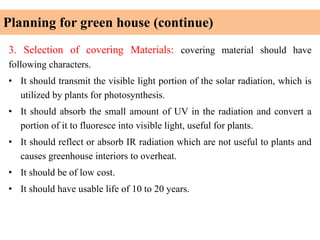
3. Selection of covering Materials: covering material should have
following characters.
• It should transmit the visible light portion of the solar radiation, which is
utilized by plants for photosynthesis.
• It should absorb the small amount of UV in the radiation and convert a
portion of it to fluoresce into visible light, useful for plants.
• It should reflect or absorb IR radiation which are not useful to plants and
causes greenhouse interiors to overheat.
• It should be of low cost.
• It should have usable life of 10 to 20 years.

Protected cultivation:Green house

  • 1.
    Protected cultivation: Green HouseTechnology Submitted by Maya Sharma Submitted to: Prof. P.S.Champawat Dept. of PFE CTAE, Udaipur Processing and Food Engineering Department College of Technology and Engineering (Maharana Pratap University of Agriculture and Technology , Udaipur) Udaipur- 313001
  • 2.
    Content • Introduction • Greenhouseeffect • Advantages of greenhouse • Components of greenhouse • Types of Greenhouses • Planning for greenhouse
  • 3.
    Introduction • The needto protect the crops against unfavorable environmental conditions led to the development of protected agriculture. • Greenhouse is the most practical method of achieving the objectives of protected agriculture, where the natural environment is modified by using sound engineering principles to achieve optimum plant growth and yields. • It is a system of controlled environment agriculture (CEA), with a precise control of air, temperature, humidity, light, carbon dioxide, water and plant nutrition. • Greenhouse Technology is the technique of providing favourable environment condition to the plants. • The main purpose of greenhouse technology is to provide a good growing environment for successfully growing high quality plants round the year.
  • 4.
    Continue • Of allagricultural production activities, the greenhouse industry is worldwide the fastest growing sector. The greenhouse is goldmines that offer the most profitable business opportunities • The use of the greenhouse is mainly for the production of seasonal and non- seasonal crops, for the production of high-quality flower, vegetable and the preparation of nursery prepared by tissue culture. • At present even at households, individual pots of plant can be given the greenhouse protection
  • 5.
    Greenhouse effect • Duringthe daytime the short wave radiation enters into the greenhouse and gets reflected from the ground surface. • This reflected radiation becomes long wave radiation and is entrapped inside the greenhouse by the covering material. • This causes the increase in the greenhouse temperature. • It is a desirable effect from point of view of crop growth in the cold regions.
  • 6.
    • Throughout theyear four to five crops can be grown in a greenhouse due to the availability of required plant environmental conditions. • The productivity of the crop is increased considerably. • Superior quality produce can be obtained as they are grown under suitably controlled environment. • Gadgets for efficient use of various inputs like water, fertilizers, seeds and plant protection chemicals can be well maintained in a greenhouse. • Effective control of pests and diseases is possible as the growing area is enclosed. • Percentage of germination of seeds is high in greenhouses. • Different types of growing medium like peat mass, vermiculate, rice hulls and compost that are used in intensive agriculture can be effectively utilized in the greenhouse. Advantages of Greenhouse:
  • 7.
    Advantages (continue) • Exportquality produce meeting international standards can be produced in a greenhouse. • When the crops are not grown, drying and related operations of the harvested produce can be taken up utilizing the entrapped heat. • Greenhouses are suitable for automation of irrigation, application of other inputs, and environmental controls by using computers and artificial intelligence techniques. • Self-employment for educated youth on farm can be increased.
  • 8.
  • 9.
    • Roof: transparentcover of a green house. • Gable: transparent wall of a green house • Cladding material: transparent material mounted on the walls and roof of a green house. • Rigid cladding material: cladding material with such a degree of rigidity that any deformation of the structure may result in damage to it. Ex. Glass • Flexible cladding material: cladding material with such a degree of flexibility that any deformation of the structure will not result in damage to it. Ex. Plastic film • Gutter: collects and drains rain water and snow which is place at an elevated level between two spans. • Column: vertical structure member carrying the green house structure continue
  • 10.
    continue • Purlin: amember who connects cladding supporting bars to the columns • Ridge: highest horizontal section in top of the roof • Girder: horizontal structure member, connecting columns on gutter height • Bracings: To support the structure against wind • Arches: Member supporting covering materials • Foundation pipe: Connection between the structure and ground • Span width: Center to center distance of the gutters in multispan houses • Green house length: dimension of the green house in the direction of gable • Green house width: dimension of the green house in the direction of the gutter
  • 11.
    Types of Greenhouse: •Different types of the greenhouse are designed to according to match specific needs. • There are different types of greenhouses available – based on shape – Based on construction – Based on covering material
  • 12.
    A) Greenhouse typebased on Shape 1. Lean-to type Greenhouse • It is used when the greenhouse is placed against the side of an existing building. • This design makes the best use of sunlight and minimizes the requirement of roof supports. • The roof of the building is extended with appropriate greenhouse covering material and the area is properly enclosed.
  • 13.
    2 Even Spantype Greenhouse • In this type, the two roof slopes are of equal pitch and width. • This design is used for the greenhouse of small size, and it is constructed on leveled ground. • Several single and multiple span types are available for use in various regions of India. • For single span type, the span in general varies from 5 to 9 m, whereas the length is around 24 m. The height varies from 2.5 to 4.3 m.
  • 14.
    3 Uneven SpanType Greenhouse • This type of greenhouse is constructed on hilly terrain. • The roofs are of unequal width, which make the structure adaptable to the side slopes of hill. • Seldom used. Now-a-days as it is not adaptable for automation.
  • 15.
    4. Quonset Greenhouse •The pipe arches or trusses are supported by pipe purlins running along the length of the greenhouse. • In general, the covering material used is polyethylene. • Less expensive than the gutter connected greenhouses and are useful when a small isolated cultural area is required. • Either in free standing style or arranged in an interlocking ridge and furrow.
  • 16.
    5. Ridge andFurrow Type Greenhouse • Designs of this type use two or more A-frame greenhouses connected to one another along the length of the eave. • The eave serves as a furrow or gutter to carry rain and melted snow away. • The side walls are eliminated between the greenhouses, which results in a structure with a single large interior. • Reduces labour, lowers the cost of automation, improves personal management and reduces fuel consumption, as there is less exposed wall area through which heat escapes.
  • 17.
    6. Saw ToothType Greenhouse • These are also similar to the ridge and furrow type greenhouses except that, there is provision for natural ventilation in this type. • Specific natural ventilation flow path develops in a saw tooth type greenhouse.
  • 18.
    B) Greenhouse typebased on construction 1. Wooden Framed Structures • In general, for greenhouses with span less than 6 m, only wooden framed structures are used. • Side posts and columns are constructed of wood without the use of a truss. • Pine wood is commonly used as it is inexpensive and possesses the required strength. • Timber locally available, with good strength, durability and machinability also can be used for the construction.
  • 19.
    2. Pipe FramedStructures • When the clear span is around 12 m, pipes are used for the construction of greenhouses. • In general, the side posts, columns, cross-ties and purlins are constructed using pipes.
  • 20.
    3. Truss FramedStructures • If the greenhouse span is greater than or equal to 15 m, truss frames are used. • Flat steel, tubular steel or angle iron is welded together to form a truss encompassing rafters, chords and struts. • Angle iron purlins running throughout the length of greenhouse are bolted to each truss. • Most of the glass houses are of truss frame type.
  • 21.
    C) Greenhouse typebased on covering materials 1. Glass Greenhouses • Only glass greenhouses with glass as the covering material existed prior to 1950. • Glass as covering material has the advantage of greater interior light intensity. • These greenhouses have higher air infIltration rate, which leads to lower interior humidity and better disease prevention. • Lean-to type, even span, ridge and furrow type of designs are used for construction of glass greenhouse. 2. Plastic Film Greenhouses • Flexible plastic films including polyethylene, polyester and polyvinyl chloride are used as covering material in this type of greenhouses. • become popular, as they are cheap and the cost of heating is less when compared to glass greenhouses. • The main disadvantage with plastic films is its short life as the covering material. • For example, the best quality ultraviolet (UY) stabilized film can last for four years only. • Quonset design as well as gutter-connected design is suitable for using this covering material.
  • 23.
    Planning for greenhouse 1. Site Selection and Orientation • The building site should be as level as possible to reduce the cost of grading • The site should be well aerated and should receive good solar radiation. • Provision of a drainage system is always advisable, because of the extensive use of water in greenhouse operations. • It is also advisable to select a site with a natural windbreak such as a tree line or hill, on the north and northwest sides. • In regions where snow is expected, trees should be 30.5 m away in order to keep drifts back from the greenhouses. • To prevent shadows on the crop, trees located on the east, south, or west sides should be at a distance of 2.5 times their height. Owing to thee limited availability of the agricultural labourers, high wages are to be paid to attract them.
  • 24.
    Planning for greenhouse (continue) 2. Selection of structural design: • The structural parts that can cast shadows in the greenhouse should be minimized. So the covering materials should have the largest possible unsupported area, and consequently offer the highest possible light transmittance. • At the same time, greenhouse structures and structural components, including the covering, should be strong enough to resist loads from snow, wind, crops and installations, to provide adequate margins of safety to prevent structural damage or serviceability problems. Therefore, following aspects should be considered • Overall structural design and the properties of the individual structural components. • Specific mechanical and physical properties, which determine the structural behaviour of the covering materials. • Specific sensitivity of the crop to light and temperature to be grown in the greenhouse. • Specific requirements relevant to the physical properties of the covering material. • Agronomic requirements of the crop.
  • 25.
    Planning for greenhouse (continue) 3. Selection of covering Materials: covering material should have following characters. • It should transmit the visible light portion of the solar radiation, which is utilized by plants for photosynthesis. • It should absorb the small amount of UV in the radiation and convert a portion of it to fluoresce into visible light, useful for plants. • It should reflect or absorb IR radiation which are not useful to plants and causes greenhouse interiors to overheat. • It should be of low cost. • It should have usable life of 10 to 20 years.