Image Analysis
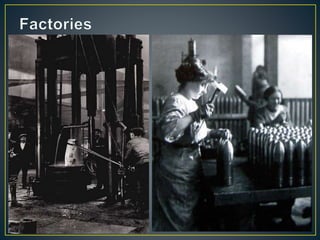
• World War I soon became a total war. This meant that countries
devoted all their resources to the war effort. In Britain, Germany,
Austria, Russia, and France, the entire force of government was
dedicated to winning the conflict. In each country, the wartime
government took control of the economy. Governments told factories
what to produce and how much. Numerous facilities were converted
to munitions factories. Nearly every able-bodied civilian was put to
work. Unemployment in many European countries all but
disappeared.
• When WWI first broke out, there were shortages of essential goods.
Britain faced a shortage of munitions shells. They had to form the
Ministry of Munitions to control production and had considerable
success. Factories produce more war supplies faster and a year's
worth of pre-war production of light munitions could be completed in
just four days by 1918. Aircraft production in 1914 provided
employment for 60,000 men and women; and by 1918 British
companies employed over 347,000.
• When Europe’s production was falling because of the fighting, the
US’s industry was booming. Factories had to increase production to
keep up with the pace of the war. New technologies help increase
production and women and African-Americans were able to gain jobs
of the men that were off fighting. After the war, when soldiers
returned home, many women stopped working.
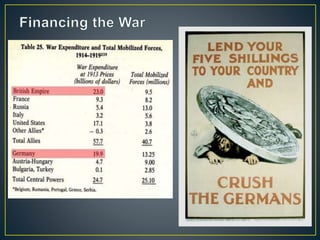
Total
Mobilized
Troops
(in
millions)
British Empire 9.5
France 8.2
Russia 13
Italy 5.6
United States 3.8
Other Allies* 2.6
Total Allied Forces 40.7
Germany 13.25
Austria-Hungary 9
Bulgaria, Turkey 2.85
Total Central 25.10
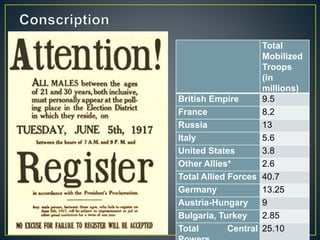
• When World War I began, many citizens were enthusiastic about
joining the war and volunteered for military service. The British Army
gained 2.67 million soldiers as a result of volunteers. But as the war
went on and the devastation from the front led to more and more
casualties, governments found it harder to find more volunteers to
join the army. As a result, governments of the Allies and Central
Powers passed conscription laws to draft citizens into the army.
• These conscription laws required people to join the army if their
names were selected. Men from the ages of 18-50 were required to
register with the draft board and were assigned a draft number.
When the government needed soldiers, numbers were randomly
drawn and men were called upon to fight in the war. In addition,
imperial powers called upon their colonies to help in the struggle.
Fighting troops as well as laborers came from India, South Africa,
Senegal, Egypt, Algeria, and Indochina. Many fought and died on the
battlefield. Others worked to keep the front lines supplied.
• Some people objected to their conscription. Some men refused to
participate in military service and were sent to prison. Others
refused to fight because they thought that war was wrong but they
were willing to go to the Western Front and act as stretcher-bearers.
Many of these objectors were killed doing this job.
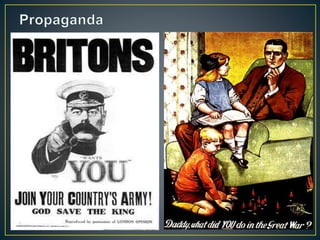
• During World War I, governments also used propaganda,
one-sided information designed to persuade, to keep up
morale and support for the war.
• Propaganda was used to explaining to their own people why
the nation was involved in the war. Emotional and patriotic
posters were used to recruit men to fight and to convince
citizens to buy war bonds (loans to the government) in order to
raise enough money to fight the war. Posters commonly urged
wartime savings and conservation in order to guarantee that
the military would have enough resources to fight the war.
• Propaganda increased feelings of nationalism and patriotism
during the war, but governments also censored the media.
They suppressed negative news about the war. Many leaders
feared that honest reporting of the war would turn people
against it. Governments suppressed anti war activity,
sometimes forcibly by arresting anti-war protestors and
keeping them jailed during the course of the war.
• Interestingly, even though the U.S.A. joined the war relatively
late in April 1917, she produced many more propaganda
posters than any other single nation. Because governments
need the help and support of ALL people, propaganda helped
• One challenge that governments faced was how to handle the
distribution of resources, food in particular. So many goods
were in short supply that governments turned to rationing.
Under this system, people could buy only small amounts of
those items that were also needed for the war effort.
Eventually, rationing covered a wide range of goods, from
butter to shoe leather.
• Germany begun rationing early in 1915, first with bread and
then extended in the same year to potatoes and meat and
finally to nearly every essential food product. The rationed
items could be obtained only on tickets, in specified amounts
and at prices fixed by the government. This also later applies
to important resources that were needed for the soldiers or the
production of weapons and supplies, such as gasoline, iron,
and glass.
• Throughout the war, civilians were being asked to “do your
part” to help out in the war effort. Most citizens supporting
government rationing programs and began growing “victory
gardens” so they could produce their own vegetables. These
victory gardens helped governments divert needed food to the
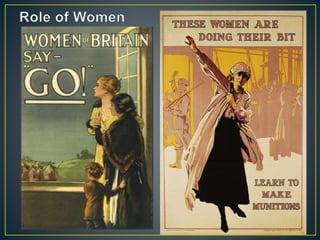
• Total war meant that governments turned to help from women
as never before. Before the war, women were employed in
traditionally female jobs including domestic servants, teaching,
nursing, office work, textile factories. When war broke out in
August 1914, thousands of women replaced men in factories,
offices, and shops. Women built tanks and munitions, plowed
fields, paved streets, and ran hospitals. They also kept troops
supplied with food, clothing, and weapons. Many women were
paid good wages, especially in munitions factories, but in most
cases they were paid less than men.
• Women gained jobs in the military as well, where they worked
as clerks, secretaries, drivers, and typists. Women were in
great demand for the ‘caring’ side of employment and became
nurses in the First Aid Nursing Yeomanry and the Red Cross.
In addition, propaganda posters encouraged women to
support their husbands and fathers when they were drafted or
volunteer for military service.
• Women were seen as temporary workers that would be used
for the ‘duration of the war’. Although most women left the
work force when the war ended, they changed many people’s
views of what women were capable of doing. Women also saw
the horrors of war firsthand, working on or near the front lines
• World War I changed the role of the government dramatically
because so much effort was needed to win the war. Governments
became more involved as a way of supporting the war and they
needed money to be able to pay for the war. The size of government
of the nations at war grew in order to meet the demands of the war.
For example, the United States created over 5,000 new bureaucratic
agencies such as the War Industries Board which oversaw the
production of military equipment and the Food and Fuel
Administrations to oversee rationing programs that provided
resources to the military. The government signed expensive military
contracts with factories to create new munitions and weapons. The
millions of soldiers who volunteered or were drafted were given
service pay for their war duty. These programs were very expensive.
• One movement that raised a large amount of money was the sale of
war bonds. These certificates are investments that people can buy
that the government will pay back later. For example, the cost for the
United States was $32 billion. To raise money to pay for the war, the
U.S. government sold war bonds which generated $23 billion. An
additional $10 billion was generated by raising income taxes on
citizens and companies.
• One of the impacts of the war was the cost involved, in terms of
human lives and money. The long term impact of the war on all
nations that became involved had a tremendous impact on the world.

War on the homefront pictures

  • 1.
  • 3.
    • World WarI soon became a total war. This meant that countries devoted all their resources to the war effort. In Britain, Germany, Austria, Russia, and France, the entire force of government was dedicated to winning the conflict. In each country, the wartime government took control of the economy. Governments told factories what to produce and how much. Numerous facilities were converted to munitions factories. Nearly every able-bodied civilian was put to work. Unemployment in many European countries all but disappeared. • When WWI first broke out, there were shortages of essential goods. Britain faced a shortage of munitions shells. They had to form the Ministry of Munitions to control production and had considerable success. Factories produce more war supplies faster and a year's worth of pre-war production of light munitions could be completed in just four days by 1918. Aircraft production in 1914 provided employment for 60,000 men and women; and by 1918 British companies employed over 347,000. • When Europe’s production was falling because of the fighting, the US’s industry was booming. Factories had to increase production to keep up with the pace of the war. New technologies help increase production and women and African-Americans were able to gain jobs of the men that were off fighting. After the war, when soldiers returned home, many women stopped working.
  • 4.
    Total Mobilized Troops (in millions) British Empire 9.5 France8.2 Russia 13 Italy 5.6 United States 3.8 Other Allies* 2.6 Total Allied Forces 40.7 Germany 13.25 Austria-Hungary 9 Bulgaria, Turkey 2.85 Total Central 25.10
  • 5.
    • When WorldWar I began, many citizens were enthusiastic about joining the war and volunteered for military service. The British Army gained 2.67 million soldiers as a result of volunteers. But as the war went on and the devastation from the front led to more and more casualties, governments found it harder to find more volunteers to join the army. As a result, governments of the Allies and Central Powers passed conscription laws to draft citizens into the army. • These conscription laws required people to join the army if their names were selected. Men from the ages of 18-50 were required to register with the draft board and were assigned a draft number. When the government needed soldiers, numbers were randomly drawn and men were called upon to fight in the war. In addition, imperial powers called upon their colonies to help in the struggle. Fighting troops as well as laborers came from India, South Africa, Senegal, Egypt, Algeria, and Indochina. Many fought and died on the battlefield. Others worked to keep the front lines supplied. • Some people objected to their conscription. Some men refused to participate in military service and were sent to prison. Others refused to fight because they thought that war was wrong but they were willing to go to the Western Front and act as stretcher-bearers. Many of these objectors were killed doing this job.
  • 7.
    • During WorldWar I, governments also used propaganda, one-sided information designed to persuade, to keep up morale and support for the war. • Propaganda was used to explaining to their own people why the nation was involved in the war. Emotional and patriotic posters were used to recruit men to fight and to convince citizens to buy war bonds (loans to the government) in order to raise enough money to fight the war. Posters commonly urged wartime savings and conservation in order to guarantee that the military would have enough resources to fight the war. • Propaganda increased feelings of nationalism and patriotism during the war, but governments also censored the media. They suppressed negative news about the war. Many leaders feared that honest reporting of the war would turn people against it. Governments suppressed anti war activity, sometimes forcibly by arresting anti-war protestors and keeping them jailed during the course of the war. • Interestingly, even though the U.S.A. joined the war relatively late in April 1917, she produced many more propaganda posters than any other single nation. Because governments need the help and support of ALL people, propaganda helped
  • 9.
    • One challengethat governments faced was how to handle the distribution of resources, food in particular. So many goods were in short supply that governments turned to rationing. Under this system, people could buy only small amounts of those items that were also needed for the war effort. Eventually, rationing covered a wide range of goods, from butter to shoe leather. • Germany begun rationing early in 1915, first with bread and then extended in the same year to potatoes and meat and finally to nearly every essential food product. The rationed items could be obtained only on tickets, in specified amounts and at prices fixed by the government. This also later applies to important resources that were needed for the soldiers or the production of weapons and supplies, such as gasoline, iron, and glass. • Throughout the war, civilians were being asked to “do your part” to help out in the war effort. Most citizens supporting government rationing programs and began growing “victory gardens” so they could produce their own vegetables. These victory gardens helped governments divert needed food to the
  • 11.
    • Total warmeant that governments turned to help from women as never before. Before the war, women were employed in traditionally female jobs including domestic servants, teaching, nursing, office work, textile factories. When war broke out in August 1914, thousands of women replaced men in factories, offices, and shops. Women built tanks and munitions, plowed fields, paved streets, and ran hospitals. They also kept troops supplied with food, clothing, and weapons. Many women were paid good wages, especially in munitions factories, but in most cases they were paid less than men. • Women gained jobs in the military as well, where they worked as clerks, secretaries, drivers, and typists. Women were in great demand for the ‘caring’ side of employment and became nurses in the First Aid Nursing Yeomanry and the Red Cross. In addition, propaganda posters encouraged women to support their husbands and fathers when they were drafted or volunteer for military service. • Women were seen as temporary workers that would be used for the ‘duration of the war’. Although most women left the work force when the war ended, they changed many people’s views of what women were capable of doing. Women also saw the horrors of war firsthand, working on or near the front lines
  • 13.
    • World WarI changed the role of the government dramatically because so much effort was needed to win the war. Governments became more involved as a way of supporting the war and they needed money to be able to pay for the war. The size of government of the nations at war grew in order to meet the demands of the war. For example, the United States created over 5,000 new bureaucratic agencies such as the War Industries Board which oversaw the production of military equipment and the Food and Fuel Administrations to oversee rationing programs that provided resources to the military. The government signed expensive military contracts with factories to create new munitions and weapons. The millions of soldiers who volunteered or were drafted were given service pay for their war duty. These programs were very expensive. • One movement that raised a large amount of money was the sale of war bonds. These certificates are investments that people can buy that the government will pay back later. For example, the cost for the United States was $32 billion. To raise money to pay for the war, the U.S. government sold war bonds which generated $23 billion. An additional $10 billion was generated by raising income taxes on citizens and companies. • One of the impacts of the war was the cost involved, in terms of human lives and money. The long term impact of the war on all nations that became involved had a tremendous impact on the world.