#’s 1 – 41
• Obtain land and become rich by
making money off of the products
and raw materials the land
produced.
• John Rolfe saved the colony when
he discovered tobacco
• It became the colony’s chief source
of income
• Was profitable for growers; produced
large revenues from taxes
• Attracted more settlers with the
“headright system” – 50 acres
• Hostile at first; Powhatan led 200
followers in an attack on Jamestown
• Powhatan hoped to est. trade; helped
settlers survive the first winter
• March 1622, 300 colonists killed by
Native American attack
• 1644, colonists turned back an attack
and from then on was clear colonists
had control of the land and colony
• Virginia’s first elected legislative
body
• Selected directly by the people.
• Helped lay the foundation for
ideas about representative
government that would develop in
the colonies.
• The settlement of VA kept pushing westward
with more conflict with Native Americans
• Colonists became irritated b/c they were not
receiving protection from the Governor.
• Nathaniel Bacon raised an army to fight the
N.A.’s and his actions were condemned by
the Governor
• Bacon then turned his troops on the
Governor and burned Jamestown
• It showed that the colonists expected a
government that served more than just the
wealthy few
• Slavery helped est. the plantation
system which raised cash crops
on huge farms that was
completely dependent on slavery
• Slavery and the plantation system
became the backbone of the
Southern economy
• Religious dissent – disagreement
with the Church of England
• To est. a community built on “pure”
biblical teachings rather than the
traditions of the Church of England
• Est. a colony at Plymouth,
Massachusetts
• Mayflower Compact – est. a
legislature and the gov’t derived its
power from the people of the colony
• A series of wars broke out at settlers
moved further west, pushing Native
Americans off their lands
• King Philip (Metacom) united NA’s in
an unsuccessful attempt to drive out
the English settlers
• NA’s killed more than 2,000 colonists
but were eventually defeated
• The wars resulted in the English
gaining firmer control over New
England
• Roger Williams and Anne
Hutchinson
• Dissenters left Massachusetts b/c
of a disagreement with the Puritan
church
• Partial membership to Puritan church
for children and grandchildren of full
members, regardless of any
conversion experience.
• So long as they were baptized, they
were considered a church member.
• Its purpose was to attract the Puritan
youth to eventually see the value in
full membership and forsake
secularism.
• In 1692, commitment to protect the
Puritan faith resulted in one of the
darkest episodes in American history.
• Claiming they had been possessed by
the devil, several young girls in Salem,
Mass., accused various townspeople of
being witches.
• Colonial authorities brought the accused
to trial and condemned a number of
them to death
• Religious unrest eventually took its
toll and the colony lost its charter in
1684
• In 1691, Massachusetts became a
royal colony under the leadership of
the king’s appointed governor
• The Crown est. a new representative
legislature and abolished the
requirement that every colonist must
be a member of the Puritan church
• The area we know now as New York
was originally settled by the Dutch.
• They named their colony “New
Amsterdam” and est. it as a diverse,
wealthy, key trading post on the
mouth of the Hudson River.
• England noticed its prosperity and
took it in 1664; it was immediately
renamed New York.
• Under the leadership of William
Penn, Pennsylvania became a
religious haven for the Quakers.
• They did not recognize class
differences, promoted equality of the
sexes, practiced non-violence, and
sought to deal fairly with the Native
Americans.
• They made Pennsylvania a place of
religious tolerance.
• France’s most successful early
North American colony was
established at Quebec, along the
shores of the St. Lawrence River,
in 1608 by Samuel de Champlain.
• France made great amounts of
money from their fur trade.
• They obtained fur, either by trapping
animals or trading with Native
Americans, then sold their products
for great profits in Europe.
• As a result, Native Americans and
French traders came to rely on one
another for commerce.
• Southern Colonies: slaves and the
plantation system; cash crops –
tobacco, rice, indigo, cotton
• Middle Colonies: farming and
commerce; large, diverse
populations in the port cities – New
York, Philadelphia
• New England Colonies: shipbuilding
and lumber, trade with Europe and
other colonies, fishing in the Atlantic
Ocean
• Countries grow wealthier and maintain
their national security by consistently
exporting (sell) more than they import
(buy).
• American colonists began a profitable
“Transatlantic Trade” in which they
shipped many of the colonies’ products
and raw materials to England.
• The Navigation Acts required the
colonies to sell certain goods only to
England who would then use them or
trade them to other nations.
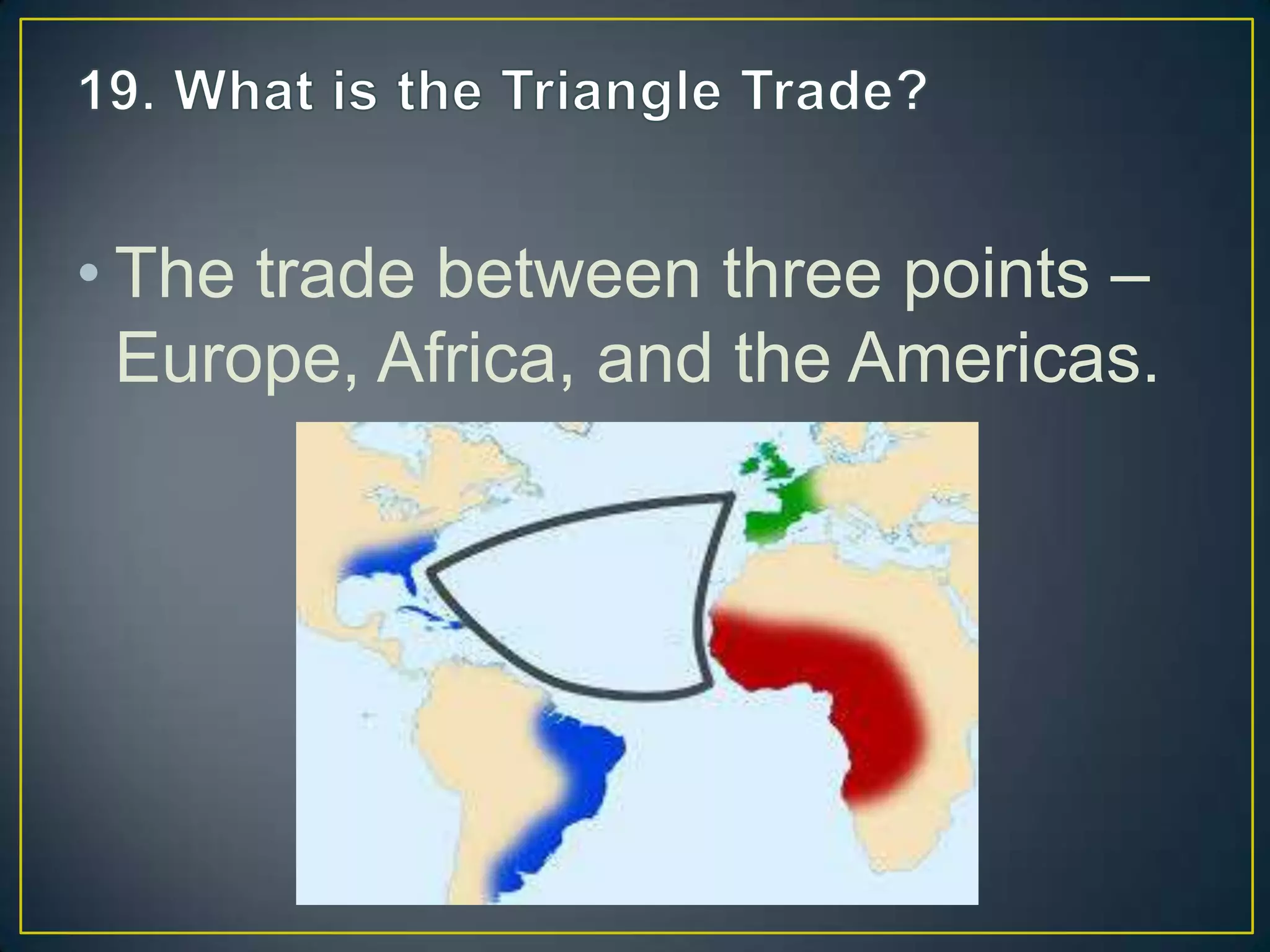
• The trade between three points –
Europe, Africa, and the Americas.
• The Middle Passage was the route
taken by ships carrying slaves from
Africa to North America – the middle leg
of the Triangular Trade.
• The captives were forced to live in
cramped quarters aboard the ships and
suffered inhumane treatment.
• Due mostly to poor sanitation and
disease, many died before reaching the
Americas.
• Mixed African traditions with the
English language (Gullah) and
Christianity.
• Because they shared the burden
of slavery, they developed tight
knit communities over time.
• Inventor, scientist, writer,
ambassador to France, and a
founding father of the United
States.
• He was the example of
individualism and social mobility in
the colonies.
• Social mobility is the ability to move up from one
social status to another; this was usually based
on land ownership and was difficult to achieve in
Europe.
• This was different in the colonies b/c land was
abundant – even those who came to the colonies
as indentured servants often eventually became
property owners and obtained the right to vote.
• If the colonists worked hard and be successful,
they could advance their economic status.
• A belief in the ability of each individual to achieve
success if they will simply apply themselves and
work hard is called individualism.
• A religious movement in the 1730s that
featured passionate evangelical
preachers. These ministers believed the
colonists had forsaken God and called
them back to a “sincere Christian
commitment”.
• It encourage colonists to think for
themselves on religious matters and
helped ensure the principles of freedom
of religion and separation of church and
state.
• French and Native Americans vs.
British
• Desire for resources and territory b/c
of mercantilism – Ohio River Valley
• The war began in 1754 as British
colonists moved west and clashed
with the French and their Native
American allies.
• Ended the French and Indian War
• France gave up its claims to Canada and all lands east
of the Mississippi River.
• In addition, Spain ceded Florida to the British as well.
• Britain stood alone as the one, true colonial power in
eastern North America.
• The American colonists lost respect for Britain’s military
b/c it was viewed as ill prepared for fighting on
American terrain.
• Great Britain was heavily in debt after fighting to
defend its colonies and felt that Americans should help
pay for the expense.
• Relations between England and its colonies
deteriorated after the war.
• The British gained a vast territory after
the French & Indian War they needed to
control and the first step was King
George III’s Proclamation of 1763.
• It forbade colonists from settling west of
the Appalachian Mtns., and put the
territory under military control – why
have all this land if you aren’t going to
use it!?!?!
• It was resented and ignored by the
• Proclamation of 1763
• Stamp Act – “no taxation without
representation”; boycott of British
goods
• Declaratory Act
• Tea Act – Boston Tea Party by
Massachusetts’ committee of
correspondence
• Intolerable Acts
• Groups that sprang up throughout
the colonies to support and enforce
the boycott of British goods b/c of the
Stamp Act.
• They often used violence to
intimidate any merchant or royal
official who might otherwise use the
stamps.
• Boycotts along with violent
responses to the Stamp Act caused
Parliament to repeal the law.
• Many colonies organized these groups
dedicated to organizing resistance
against British laws; they made sure
colonists remained discontented with
British rule.
• December 1773: Massachusetts’s
committee of correspondence led a
group of radicals, dressed as Mohawk
Indians, to Boston Harbor; they raided
British ships hauling tea and dumped
them overboard – known as the “Boston
Tea Party”.
• January 1776: Paine published
“Common Sense” after fighting broke
out the previous April.
• In it, he made a compelling case for
independence that won many to the
cause.
• Due to the influence of Paine and
others, the 2nd Continental Congress
eventually stopped seeking resolution
with England and chose, instead, to
• Drafted by Thomas Jefferson.
• He was influenced by the ideas of the
Enlightenment and asserted the principles
of egalitarianism (all men are created equal)
and proclaimed that men are born with
certain inalienable rights (John Locke &
natural rights governments cannot take
away) – “life, liberty, and the pursuit of
happiness”.
• Formally adopted by the Continental
Congress, July 4th, 1776.
• Formally adopted by the
Continental Congress, July 4th,
1776.
• An Enlightenment philosopher that influenced Thomas
Jefferson’s draft of the Declaration of Independence
• He challenged the idea monarchs possess a God-
given right to rule with citizens obligated to obey.
• He believed that people are born with certain natural
rights that no government can take away – life, liberty,
property.
• He also advocated the social contract theory – an
implied contract b/t a gov’t and its citizens: citizens are
born with freedom and rights, but for the good of
society, give up certain freedoms and empower gov’t to
maintain order for the betterment of society rather than
for its own interests.
• He also taught citizens have the right to replace any
government that fails to serve the public good.
• After the victory at Saratoga, the French
finally allied with the Americans;
promised money, troops, and the
support of the French Navy that
prompted the surrender of Cornwallis at
Yorktown b/c of the blockade.
• Even before the official treaty, Marquis
de Lafayette fought for the Revolution;
he rose through the ranks and Congress
eventually gave him his own command.
• Shortly after the signing of the
Declaration of Independence, the
Continental Congress sent
Benjamin Franklin to Paris to try to
convince the French to form an
open alliance with the United
States.
• Prussian Baron Friedrich Von
Steuben helped Washington train his
undisciplined and poorly supplied
troops at Valley Forge during the
winter of 1777-1778.
• Once the warm weather returned,
Washington’s army returned to
combat, more determined and better
prepared to meet the British in battle.
• Following the victory at Saratoga, the
Continental Army endured a harsh
winter at Valley Forge, Pennsylvania.
• Poorly supplied and lacking warm
clothing, many of Washington’s men
proved too sick to serve. A number of
them even died.
• With the efforts of Von Steuben and
Washington, the army effectively used
their time at Valley Forge to become
better trained and prepared to fight the
British.
• In retreat, after a humiliating defeat by the
British at New York, Washington was
plagued by a lack of supplies, undisciplined
soldiers, and the desertion of many of his
troops – the Continental Army was on the
brink of defeat.
• In December 1776, Washington surprised
his enemy by crossing the Delaware River
on Christmas night and attacked the
Hessians at Trenton, then Princeton, NJ.
• The victories greatly lifted American morale
and gave hope that the Revolution could
actually succeed.
• Southern British commander who
fought the American army in the
Carolinas and ultimately
surrendered to Washington at
Yorktown.
• Lexington and Concord: where the first shots of the
American Revolution were fired.
• Bunker Hill: after Lexington/Concord, 20,000 Patriots
surrounded British held Boston. June 1775, British
troops launched a series of attacks on American held
positions – Bunker and Breed’s Hill; although a British
victory, they suffered far greater casualties than the
Americans.
• Saratoga: Sept. 1777, Gen. Horatio Gates’ victories at
Saratoga, NY that convinced the French that victory
was possible and formed an alliance with the
Americans.
• Trenton: Washington’s surprise attack on Hessians;
boosted morale and confidence of an American victory.
• Yorktown: site of Corwallis’ surrender to Washington
which effectively ended the American Revolution.
• Treaty of Paris 1783: treaty ending the American

Eoct review questions gps 1 – 4

  • 1.
  • 2.
    • Obtain landand become rich by making money off of the products and raw materials the land produced.
  • 3.
    • John Rolfesaved the colony when he discovered tobacco • It became the colony’s chief source of income • Was profitable for growers; produced large revenues from taxes • Attracted more settlers with the “headright system” – 50 acres
  • 4.
    • Hostile atfirst; Powhatan led 200 followers in an attack on Jamestown • Powhatan hoped to est. trade; helped settlers survive the first winter • March 1622, 300 colonists killed by Native American attack • 1644, colonists turned back an attack and from then on was clear colonists had control of the land and colony
  • 5.
    • Virginia’s firstelected legislative body • Selected directly by the people. • Helped lay the foundation for ideas about representative government that would develop in the colonies.
  • 6.
    • The settlementof VA kept pushing westward with more conflict with Native Americans • Colonists became irritated b/c they were not receiving protection from the Governor. • Nathaniel Bacon raised an army to fight the N.A.’s and his actions were condemned by the Governor • Bacon then turned his troops on the Governor and burned Jamestown • It showed that the colonists expected a government that served more than just the wealthy few
  • 7.
    • Slavery helpedest. the plantation system which raised cash crops on huge farms that was completely dependent on slavery • Slavery and the plantation system became the backbone of the Southern economy
  • 8.
    • Religious dissent– disagreement with the Church of England • To est. a community built on “pure” biblical teachings rather than the traditions of the Church of England • Est. a colony at Plymouth, Massachusetts • Mayflower Compact – est. a legislature and the gov’t derived its power from the people of the colony
  • 9.
    • A seriesof wars broke out at settlers moved further west, pushing Native Americans off their lands • King Philip (Metacom) united NA’s in an unsuccessful attempt to drive out the English settlers • NA’s killed more than 2,000 colonists but were eventually defeated • The wars resulted in the English gaining firmer control over New England
  • 10.
    • Roger Williamsand Anne Hutchinson • Dissenters left Massachusetts b/c of a disagreement with the Puritan church
  • 11.
    • Partial membershipto Puritan church for children and grandchildren of full members, regardless of any conversion experience. • So long as they were baptized, they were considered a church member. • Its purpose was to attract the Puritan youth to eventually see the value in full membership and forsake secularism.
  • 12.
    • In 1692,commitment to protect the Puritan faith resulted in one of the darkest episodes in American history. • Claiming they had been possessed by the devil, several young girls in Salem, Mass., accused various townspeople of being witches. • Colonial authorities brought the accused to trial and condemned a number of them to death
  • 13.
    • Religious unresteventually took its toll and the colony lost its charter in 1684 • In 1691, Massachusetts became a royal colony under the leadership of the king’s appointed governor • The Crown est. a new representative legislature and abolished the requirement that every colonist must be a member of the Puritan church
  • 14.
    • The areawe know now as New York was originally settled by the Dutch. • They named their colony “New Amsterdam” and est. it as a diverse, wealthy, key trading post on the mouth of the Hudson River. • England noticed its prosperity and took it in 1664; it was immediately renamed New York.
  • 15.
    • Under theleadership of William Penn, Pennsylvania became a religious haven for the Quakers. • They did not recognize class differences, promoted equality of the sexes, practiced non-violence, and sought to deal fairly with the Native Americans. • They made Pennsylvania a place of religious tolerance.
  • 16.
    • France’s mostsuccessful early North American colony was established at Quebec, along the shores of the St. Lawrence River, in 1608 by Samuel de Champlain.
  • 17.
    • France madegreat amounts of money from their fur trade. • They obtained fur, either by trapping animals or trading with Native Americans, then sold their products for great profits in Europe. • As a result, Native Americans and French traders came to rely on one another for commerce.
  • 18.
    • Southern Colonies:slaves and the plantation system; cash crops – tobacco, rice, indigo, cotton • Middle Colonies: farming and commerce; large, diverse populations in the port cities – New York, Philadelphia • New England Colonies: shipbuilding and lumber, trade with Europe and other colonies, fishing in the Atlantic Ocean
  • 19.
    • Countries growwealthier and maintain their national security by consistently exporting (sell) more than they import (buy). • American colonists began a profitable “Transatlantic Trade” in which they shipped many of the colonies’ products and raw materials to England. • The Navigation Acts required the colonies to sell certain goods only to England who would then use them or trade them to other nations.
  • 20.
    • The tradebetween three points – Europe, Africa, and the Americas.
  • 21.
    • The MiddlePassage was the route taken by ships carrying slaves from Africa to North America – the middle leg of the Triangular Trade. • The captives were forced to live in cramped quarters aboard the ships and suffered inhumane treatment. • Due mostly to poor sanitation and disease, many died before reaching the Americas.
  • 22.
    • Mixed Africantraditions with the English language (Gullah) and Christianity. • Because they shared the burden of slavery, they developed tight knit communities over time.
  • 23.
    • Inventor, scientist,writer, ambassador to France, and a founding father of the United States. • He was the example of individualism and social mobility in the colonies.
  • 24.
    • Social mobilityis the ability to move up from one social status to another; this was usually based on land ownership and was difficult to achieve in Europe. • This was different in the colonies b/c land was abundant – even those who came to the colonies as indentured servants often eventually became property owners and obtained the right to vote. • If the colonists worked hard and be successful, they could advance their economic status. • A belief in the ability of each individual to achieve success if they will simply apply themselves and work hard is called individualism.
  • 25.
    • A religiousmovement in the 1730s that featured passionate evangelical preachers. These ministers believed the colonists had forsaken God and called them back to a “sincere Christian commitment”. • It encourage colonists to think for themselves on religious matters and helped ensure the principles of freedom of religion and separation of church and state.
  • 26.
    • French andNative Americans vs. British • Desire for resources and territory b/c of mercantilism – Ohio River Valley • The war began in 1754 as British colonists moved west and clashed with the French and their Native American allies.
  • 27.
    • Ended theFrench and Indian War • France gave up its claims to Canada and all lands east of the Mississippi River. • In addition, Spain ceded Florida to the British as well. • Britain stood alone as the one, true colonial power in eastern North America. • The American colonists lost respect for Britain’s military b/c it was viewed as ill prepared for fighting on American terrain. • Great Britain was heavily in debt after fighting to defend its colonies and felt that Americans should help pay for the expense. • Relations between England and its colonies deteriorated after the war.
  • 28.
    • The Britishgained a vast territory after the French & Indian War they needed to control and the first step was King George III’s Proclamation of 1763. • It forbade colonists from settling west of the Appalachian Mtns., and put the territory under military control – why have all this land if you aren’t going to use it!?!?! • It was resented and ignored by the
  • 29.
    • Proclamation of1763 • Stamp Act – “no taxation without representation”; boycott of British goods • Declaratory Act • Tea Act – Boston Tea Party by Massachusetts’ committee of correspondence • Intolerable Acts
  • 30.
    • Groups thatsprang up throughout the colonies to support and enforce the boycott of British goods b/c of the Stamp Act. • They often used violence to intimidate any merchant or royal official who might otherwise use the stamps. • Boycotts along with violent responses to the Stamp Act caused Parliament to repeal the law.
  • 31.
    • Many coloniesorganized these groups dedicated to organizing resistance against British laws; they made sure colonists remained discontented with British rule. • December 1773: Massachusetts’s committee of correspondence led a group of radicals, dressed as Mohawk Indians, to Boston Harbor; they raided British ships hauling tea and dumped them overboard – known as the “Boston Tea Party”.
  • 32.
    • January 1776:Paine published “Common Sense” after fighting broke out the previous April. • In it, he made a compelling case for independence that won many to the cause. • Due to the influence of Paine and others, the 2nd Continental Congress eventually stopped seeking resolution with England and chose, instead, to
  • 33.
    • Drafted byThomas Jefferson. • He was influenced by the ideas of the Enlightenment and asserted the principles of egalitarianism (all men are created equal) and proclaimed that men are born with certain inalienable rights (John Locke & natural rights governments cannot take away) – “life, liberty, and the pursuit of happiness”. • Formally adopted by the Continental Congress, July 4th, 1776.
  • 34.
    • Formally adoptedby the Continental Congress, July 4th, 1776.
  • 35.
    • An Enlightenmentphilosopher that influenced Thomas Jefferson’s draft of the Declaration of Independence • He challenged the idea monarchs possess a God- given right to rule with citizens obligated to obey. • He believed that people are born with certain natural rights that no government can take away – life, liberty, property. • He also advocated the social contract theory – an implied contract b/t a gov’t and its citizens: citizens are born with freedom and rights, but for the good of society, give up certain freedoms and empower gov’t to maintain order for the betterment of society rather than for its own interests. • He also taught citizens have the right to replace any government that fails to serve the public good.
  • 36.
    • After thevictory at Saratoga, the French finally allied with the Americans; promised money, troops, and the support of the French Navy that prompted the surrender of Cornwallis at Yorktown b/c of the blockade. • Even before the official treaty, Marquis de Lafayette fought for the Revolution; he rose through the ranks and Congress eventually gave him his own command.
  • 37.
    • Shortly afterthe signing of the Declaration of Independence, the Continental Congress sent Benjamin Franklin to Paris to try to convince the French to form an open alliance with the United States.
  • 38.
    • Prussian BaronFriedrich Von Steuben helped Washington train his undisciplined and poorly supplied troops at Valley Forge during the winter of 1777-1778. • Once the warm weather returned, Washington’s army returned to combat, more determined and better prepared to meet the British in battle.
  • 39.
    • Following thevictory at Saratoga, the Continental Army endured a harsh winter at Valley Forge, Pennsylvania. • Poorly supplied and lacking warm clothing, many of Washington’s men proved too sick to serve. A number of them even died. • With the efforts of Von Steuben and Washington, the army effectively used their time at Valley Forge to become better trained and prepared to fight the British.
  • 40.
    • In retreat,after a humiliating defeat by the British at New York, Washington was plagued by a lack of supplies, undisciplined soldiers, and the desertion of many of his troops – the Continental Army was on the brink of defeat. • In December 1776, Washington surprised his enemy by crossing the Delaware River on Christmas night and attacked the Hessians at Trenton, then Princeton, NJ. • The victories greatly lifted American morale and gave hope that the Revolution could actually succeed.
  • 41.
    • Southern Britishcommander who fought the American army in the Carolinas and ultimately surrendered to Washington at Yorktown.
  • 42.
    • Lexington andConcord: where the first shots of the American Revolution were fired. • Bunker Hill: after Lexington/Concord, 20,000 Patriots surrounded British held Boston. June 1775, British troops launched a series of attacks on American held positions – Bunker and Breed’s Hill; although a British victory, they suffered far greater casualties than the Americans. • Saratoga: Sept. 1777, Gen. Horatio Gates’ victories at Saratoga, NY that convinced the French that victory was possible and formed an alliance with the Americans. • Trenton: Washington’s surprise attack on Hessians; boosted morale and confidence of an American victory. • Yorktown: site of Corwallis’ surrender to Washington which effectively ended the American Revolution. • Treaty of Paris 1783: treaty ending the American