World War II
SSUSH19 – EXAMINE THE ORIGINS, MAJOR DEVELOPMENTS, AND THE
DOMESTIC IMPACT OF WWII, INCLUDING THE GROWTH OF THE FEDERAL
GOVERNMENT.
World War II (SSUSH19a)
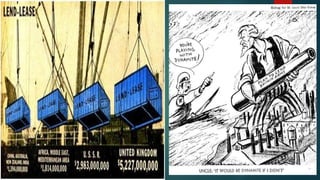
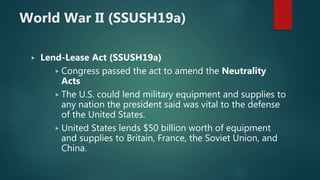
▶ Lend-Lease Act (SSUSH19a)
▶ Congress passed the act to amend the Neutrality
Acts
▶ The U.S. could lend military equipment and supplies to
any nation the president said was vital to the defense
of the United States.
▶ United States lends $50 billion worth of equipment
and supplies to Britain, France, the Soviet Union, and
China.
Document Analysis
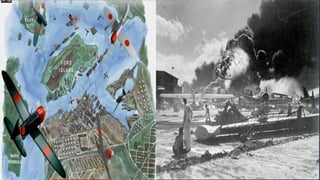
Yesterday, Dec. 7, 1941 - a date which will live in infamy - the United
States of America was suddenly and deliberately attacked by naval and
air forces of the Empire of Japan… The attack yesterday on the Hawaiian
Islands has caused severe damage to American naval and military forces.
Very many American lives have been lost. In addition, American ships
have been reported torpedoed on the high seas between San Francisco
and Honolulu…
Source: President Franklin D. Roosevelt’s Pearl Harbor Speech December
8, 1941, To the Congress of the United States
World War II (SSUSH19a)
▶ Japanese Attack on Pearl Harbor (SSUSH19a)
▶ Japanese surprise attack on the United States
▶ Over 2,400 Americans were killed
▶ Result: United States officially enters World War II
The Pacific Theater (SSUSH19b)
▶ The Battle of Midway (SSUSH19b)
▶ Major turning point in the Pacific Theater
▶ The U.S. Navy win sea battle against Japanese Navy
▶ Results
▶ U.S. destroyed Japan’s offensive power and they never
recovered.
▶ American wins control of refueling station (Island of
Midway) for ships and airplanes
▶ U.S. gains geographic control of the Pacific Ocean.
The Pacific Theater (SSUSH19b)
▶ The Manhattan Project (SSUSH19b)
▶ Code name for building the bomb was “The
Manhattan Project”
▶ U.S. assembles two atomic bombs in a secret
laboratory in Los Alamos, New Mexico
The Pacific Theater (SSUSH19b)
▶ The Dropping of the Atomic Bombs (SSUSH19b)
▶ The U.S. had defeated the Japanese navy in the
Pacific Ocean
▶ The U.S. feared they would lose millions of people
in an invasion of Japan
▶ President Truman decides to drop the Atomic
bomb on Japan (August 1945)
▶ Result: V-J Day and end of the World War II (Sept.
2, 1945)
Review Questions
1. What was the significance of the Lend-Lease Act?
2. What was the significance of the Japanese attack on Pearl Harbor?
3. List 3 difficulties U.S. troops faced during World War II
4. In the Pacific Theater, what was the significance of the Battle of
Midway?
5. In the Pacific Theater, what was the significances of dropping the
atomic bomb on Hiroshima and Nagasaki?
6. What was the significance of the Manhattan Project?
The European Theater (SSUSH19c)
▶ D-Day (SSUSH19c)
▶ Major turning point in the European Theater
▶ The code name for the first day of Operation Overlord, the
mass Allied invasion of Nazi-occupied France
▶ Allies met heavy resistance in small areas, the invasion went
almost exactly according to plan
▶ U.S. and Allies gains geographic control of part of Europe, so
they could resupply their forces and push east to Germany
The European Theater (SSUSH19c)
▶ The Fall of Berlin (SSUSH19c)
▶ One of the final battles of the European theater
during WWII
▶ Soviet army groups attacked Berlin from the east
and west
▶ Historically one of the bloodiest battles of all time
▶ German leader Adolf Hitler committed suicide
during battle
▶ Result: V-E Day and end of WWII in Europe
Domestic Impact of World War II
(SSUSH19d)
▶ After Pearl Harbor, the War at Home begins
▶ 5 million men volunteered for military service
▶ The Selective Service System expanded the draft,
and 10 million more men joined the ranks of the
American armed forces.
Domestic Impact of World War II
(SSUSH19d)
▶ The Women’s Auxiliary Army Corps was formed to
fill noncombat positions otherwise filled by men.
▶ Women at home volunteered to work in plants and
factors to build tanks, planes, ships, guns, bullets and
boots.
Domestic Impact of World War II
(SSUSH19d)
▶ Wartime conservation leads people to carpool to
work and a nation-wide collection of resources (scrap
iron, newspapers, cooking grease)
▶ The government rationing system was created. Each
household received a “c book” with coupons that
were used to buy scarce items such as meat, sugar,
coffee and gasoline.
▶ Eventually, it was the hard work at home that helped
America win World War II.
The Call to Negro America to March on Washington (1941), A. Philip Randolph
we propose that ten thousand Negroes MARCH ON WASHINGTON FOR JOBS IN NATIONAL
DEFENSE AND EQUAL INTEGRATION IN THE FIGHTING FORCES OF THE UNITED STATES.
An "all-out" thundering march on Washington, ending in a monster and huge demonstration
at Lincoln's Monument will shake up white America. It will shake up official Washington. It
will give encouragement to our white friends to fight all the harder by our side, with us, for
our righteous cause. It will gain respect for the Negro people. It will create a new sense of
self-respect among Negroes. But what of national unity? We believe in national unity which
recognizes equal opportunity of black and white citizens to jobs in national defense and the
armed forces, and in all other institutions and endeavors in America. We condemn all
dictatorships, Fascist, Nazi and Communist. We are loyal, patriotic Americans all.
Source: From A. Philip Randolph, "Call to Negro America to March on Washington for Jobs
and Equal Participation in National Defense," Black Worker 14 (May 1941):n.p.],
Roosevelt’s use of Executive Powers
(SSUSH19e)
▶ In 1941, A. Philip Randolph, the founder of the Brotherhood
of Sleeping Car Porters, proposed a march on Washington,
D.C., to protest discrimination in the military and in industry.
▶ He called on African Americans from all over the United States
to come to Washington and join him.
▶ President Roosevelt, afraid the march might cause unrest among
whites, summoned Randolph to the White House and asked him
to call off the march.
Roosevelt’s use of Executive Powers
(SSUSH19e)
▶ When Randolph refused, Roosevelt issued Executive
Order 8802 that called on employers and labor
unions to cease discrimination in hiring practices in
industries related to defense.
▶ As a result of Roosevelt’s actions, the march was
canceled.
Roosevelt’s use of Executive Powers
(SSUSH19e)
▶ Internment of Japanese-Americans (SSUSH19e)
▶ The Japanese attack on Pearl Harbor fueled suspicion and fear
among US citizens.
▶ Many suspected that Japanese, German, and Italian Americans
would end up supporting the Axis Powers.
▶ Roosevelt then issued Executive Order 9066, this US military
order forced more than 100,000 Japanese Americans from their
homes and businesses during the war and placed them in one
of the various camps

Unit 7B World War II

  • 1.
    World War II SSUSH19– EXAMINE THE ORIGINS, MAJOR DEVELOPMENTS, AND THE DOMESTIC IMPACT OF WWII, INCLUDING THE GROWTH OF THE FEDERAL GOVERNMENT.
  • 4.
    World War II(SSUSH19a) ▶ Lend-Lease Act (SSUSH19a) ▶ Congress passed the act to amend the Neutrality Acts ▶ The U.S. could lend military equipment and supplies to any nation the president said was vital to the defense of the United States. ▶ United States lends $50 billion worth of equipment and supplies to Britain, France, the Soviet Union, and China.
  • 8.
    Document Analysis Yesterday, Dec.7, 1941 - a date which will live in infamy - the United States of America was suddenly and deliberately attacked by naval and air forces of the Empire of Japan… The attack yesterday on the Hawaiian Islands has caused severe damage to American naval and military forces. Very many American lives have been lost. In addition, American ships have been reported torpedoed on the high seas between San Francisco and Honolulu… Source: President Franklin D. Roosevelt’s Pearl Harbor Speech December 8, 1941, To the Congress of the United States
  • 9.
    World War II(SSUSH19a) ▶ Japanese Attack on Pearl Harbor (SSUSH19a) ▶ Japanese surprise attack on the United States ▶ Over 2,400 Americans were killed ▶ Result: United States officially enters World War II
  • 12.
    The Pacific Theater(SSUSH19b) ▶ The Battle of Midway (SSUSH19b) ▶ Major turning point in the Pacific Theater ▶ The U.S. Navy win sea battle against Japanese Navy ▶ Results ▶ U.S. destroyed Japan’s offensive power and they never recovered. ▶ American wins control of refueling station (Island of Midway) for ships and airplanes ▶ U.S. gains geographic control of the Pacific Ocean.
  • 18.
    The Pacific Theater(SSUSH19b) ▶ The Manhattan Project (SSUSH19b) ▶ Code name for building the bomb was “The Manhattan Project” ▶ U.S. assembles two atomic bombs in a secret laboratory in Los Alamos, New Mexico
  • 19.
    The Pacific Theater(SSUSH19b) ▶ The Dropping of the Atomic Bombs (SSUSH19b) ▶ The U.S. had defeated the Japanese navy in the Pacific Ocean ▶ The U.S. feared they would lose millions of people in an invasion of Japan ▶ President Truman decides to drop the Atomic bomb on Japan (August 1945) ▶ Result: V-J Day and end of the World War II (Sept. 2, 1945)
  • 20.
    Review Questions 1. Whatwas the significance of the Lend-Lease Act? 2. What was the significance of the Japanese attack on Pearl Harbor? 3. List 3 difficulties U.S. troops faced during World War II 4. In the Pacific Theater, what was the significance of the Battle of Midway? 5. In the Pacific Theater, what was the significances of dropping the atomic bomb on Hiroshima and Nagasaki? 6. What was the significance of the Manhattan Project?
  • 27.
    The European Theater(SSUSH19c) ▶ D-Day (SSUSH19c) ▶ Major turning point in the European Theater ▶ The code name for the first day of Operation Overlord, the mass Allied invasion of Nazi-occupied France ▶ Allies met heavy resistance in small areas, the invasion went almost exactly according to plan ▶ U.S. and Allies gains geographic control of part of Europe, so they could resupply their forces and push east to Germany
  • 30.
    The European Theater(SSUSH19c) ▶ The Fall of Berlin (SSUSH19c) ▶ One of the final battles of the European theater during WWII ▶ Soviet army groups attacked Berlin from the east and west ▶ Historically one of the bloodiest battles of all time ▶ German leader Adolf Hitler committed suicide during battle ▶ Result: V-E Day and end of WWII in Europe
  • 34.
    Domestic Impact ofWorld War II (SSUSH19d) ▶ After Pearl Harbor, the War at Home begins ▶ 5 million men volunteered for military service ▶ The Selective Service System expanded the draft, and 10 million more men joined the ranks of the American armed forces.
  • 35.
    Domestic Impact ofWorld War II (SSUSH19d) ▶ The Women’s Auxiliary Army Corps was formed to fill noncombat positions otherwise filled by men. ▶ Women at home volunteered to work in plants and factors to build tanks, planes, ships, guns, bullets and boots.
  • 36.
    Domestic Impact ofWorld War II (SSUSH19d) ▶ Wartime conservation leads people to carpool to work and a nation-wide collection of resources (scrap iron, newspapers, cooking grease) ▶ The government rationing system was created. Each household received a “c book” with coupons that were used to buy scarce items such as meat, sugar, coffee and gasoline. ▶ Eventually, it was the hard work at home that helped America win World War II.
  • 37.
    The Call toNegro America to March on Washington (1941), A. Philip Randolph we propose that ten thousand Negroes MARCH ON WASHINGTON FOR JOBS IN NATIONAL DEFENSE AND EQUAL INTEGRATION IN THE FIGHTING FORCES OF THE UNITED STATES. An "all-out" thundering march on Washington, ending in a monster and huge demonstration at Lincoln's Monument will shake up white America. It will shake up official Washington. It will give encouragement to our white friends to fight all the harder by our side, with us, for our righteous cause. It will gain respect for the Negro people. It will create a new sense of self-respect among Negroes. But what of national unity? We believe in national unity which recognizes equal opportunity of black and white citizens to jobs in national defense and the armed forces, and in all other institutions and endeavors in America. We condemn all dictatorships, Fascist, Nazi and Communist. We are loyal, patriotic Americans all. Source: From A. Philip Randolph, "Call to Negro America to March on Washington for Jobs and Equal Participation in National Defense," Black Worker 14 (May 1941):n.p.],
  • 40.
    Roosevelt’s use ofExecutive Powers (SSUSH19e) ▶ In 1941, A. Philip Randolph, the founder of the Brotherhood of Sleeping Car Porters, proposed a march on Washington, D.C., to protest discrimination in the military and in industry. ▶ He called on African Americans from all over the United States to come to Washington and join him. ▶ President Roosevelt, afraid the march might cause unrest among whites, summoned Randolph to the White House and asked him to call off the march.
  • 41.
    Roosevelt’s use ofExecutive Powers (SSUSH19e) ▶ When Randolph refused, Roosevelt issued Executive Order 8802 that called on employers and labor unions to cease discrimination in hiring practices in industries related to defense. ▶ As a result of Roosevelt’s actions, the march was canceled.
  • 45.
    Roosevelt’s use ofExecutive Powers (SSUSH19e) ▶ Internment of Japanese-Americans (SSUSH19e) ▶ The Japanese attack on Pearl Harbor fueled suspicion and fear among US citizens. ▶ Many suspected that Japanese, German, and Italian Americans would end up supporting the Axis Powers. ▶ Roosevelt then issued Executive Order 9066, this US military order forced more than 100,000 Japanese Americans from their homes and businesses during the war and placed them in one of the various camps