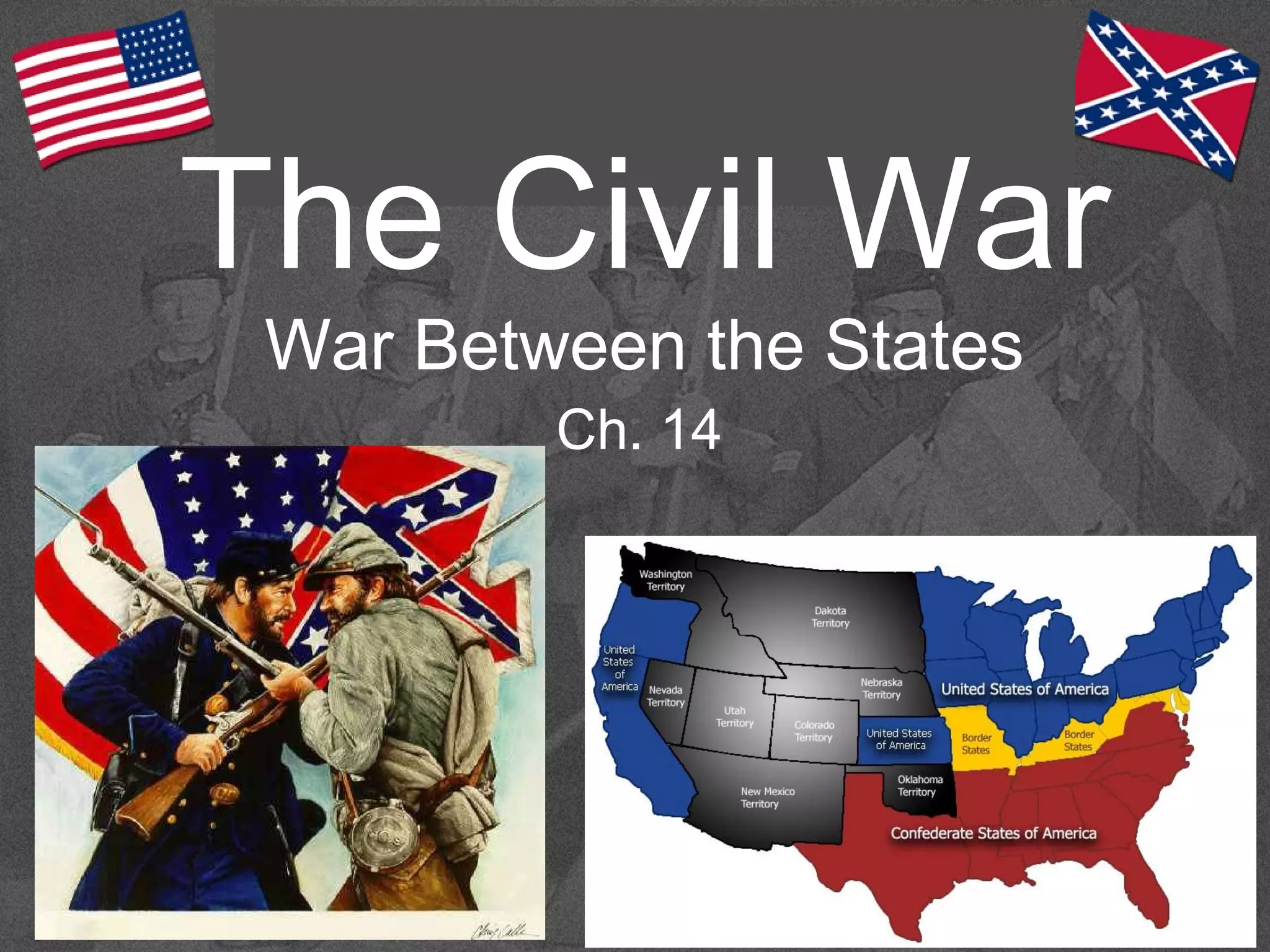
The Civil War
War Between the States
Ch. 14
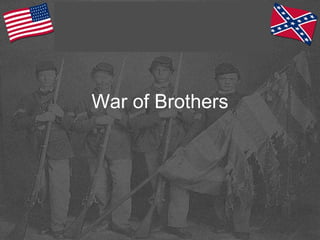
War of Brothers
Causes of War
Union vs. Independance
• Do states have a right to leave the union if
they do not agree with Federal Gov't.?
• North
– "Preserve union!"
• South
– "Preserve states rights!"
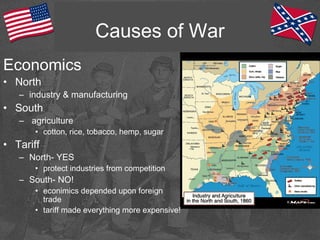
Causes of War
Economics
• North
– industry & manufacturing
• South
– agriculture
• cotton, rice, tobacco, hemp, sugar
• Tariff
– North- YES
• protect industries from competition
– South- NO!
• econimics depended upon foreign
trade
• tariff made everything more expensive!
Causes of War
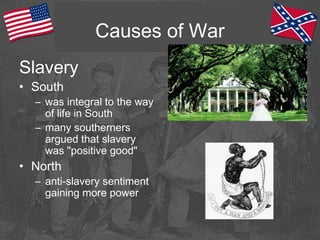
Slavery
• South
– was integral to the way
of life in South
– many southerners
argued that slavery
was "positive good"
• North
– anti-slavery sentiment
gaining more power
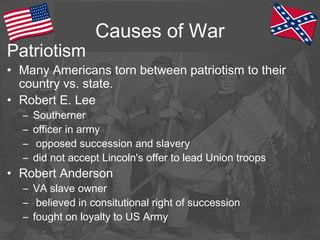
Causes of War
Patriotism
• Many Americans torn between patriotism to their
country vs. state.
• Robert E. Lee
– Southerner
– officer in army
– opposed succession and slavery
– did not accept Lincoln's offer to lead Union troops
• Robert Anderson
– VA slave owner
– believed in consitutional right of succession
– fought on loyalty to US Army
Comparisons
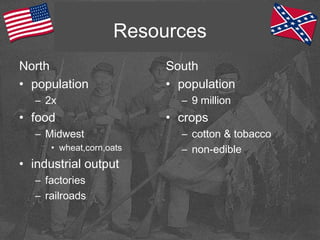
Resources
North
• population
– 2x
• food
– Midwest
• wheat,corn,oats
• industrial output
– factories
– railroads
South
• population
– 9 million
• crops
– cotton & tobacco
– non-edible
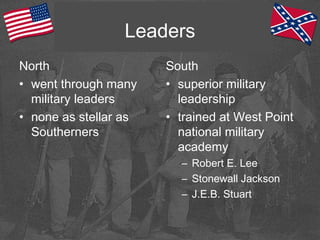
Leaders
North
• went through many
military leaders
• none as stellar as
Southerners
South
• superior military
leadership
• trained at West Point
national military
academy
– Robert E. Lee
– Stonewall Jackson
– J.E.B. Stuart
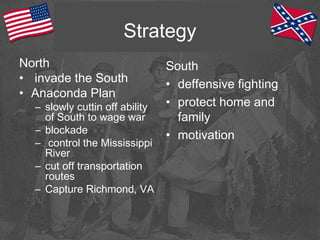
Strategy
North
• invade the South
• Anaconda Plan
– slowly cuttin off ability
of South to wage war
– blockade
– control the Mississippi
River
– cut off transportation
routes
– Capture Richmond, VA
South
• deffensive fighting
• protect home and
family
• motivation
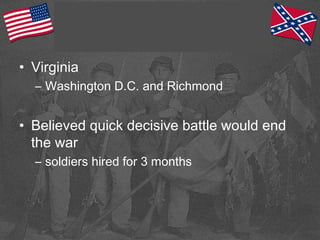
War in the East
• Virginia
– Washington D.C. and Richmond
• Believed quick decisive battle would end
the war
– soldiers hired for 3 months
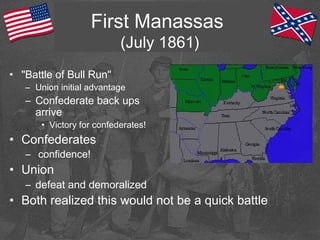
First Manassas
(July 1861)
• "Battle of Bull Run"
– Union initial advantage
– Confederate back ups
arrive
• Victory for confederates!
• Confederates
– confidence!
• Union
– defeat and demoralized
• Both realized this would not be a quick battle
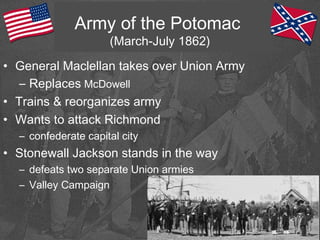
Army of the Potomac
(March-July 1862)
• General Maclellan takes over Union Army
– Replaces McDowell
• Trains & reorganizes army
• Wants to attack Richmond
– confederate capital city
• Stonewall Jackson stands in the way
– defeats two separate Union armies
– Valley Campaign
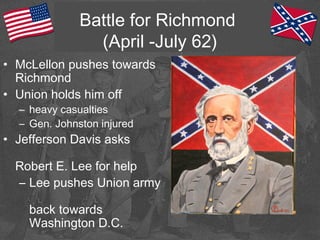
Battle for Richmond
(April -July 62)
• McLellon pushes towards
Richmond
• Union holds him off
– heavy casualties
– Gen. Johnston injured
• Jefferson Davis asks
Robert E. Lee for help
– Lee pushes Union army
back towards
Washington D.C.
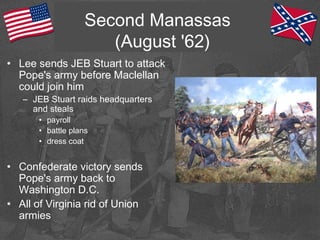
Second Manassas
(August '62)
• Lee sends JEB Stuart to attack
Pope's army before Maclellan
could join him
– JEB Stuart raids headquarters
and steals
• payroll
• battle plans
• dress coat
• Confederate victory sends
Pope's army back to
Washington D.C.
• All of Virginia rid of Union
armies
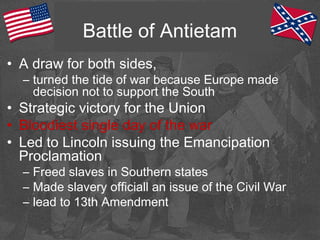
Battle of Antietam
• A draw for both sides,
– turned the tide of war because Europe made
decision not to support the South
• Strategic victory for the Union
• Bloodiest single day of the war
• Led to Lincoln issuing the Emancipation
Proclamation
– Freed slaves in Southern states
– Made slavery officiall an issue of the Civil War
– lead to 13th Amendment
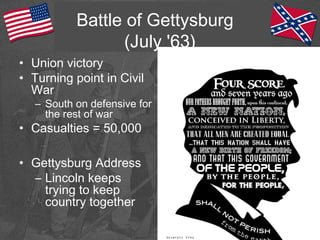
Battle of Gettysburg
(July '63)
• Union victory
• Turning point in Civil
War
– South on defensive for
the rest of war
• Casualties = 50,000
• Gettysburg Address
– Lincoln keeps
trying to keep
country together
War in the West
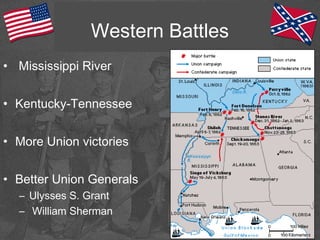
Western Battles
• Mississippi River
• Kentucky-Tennessee
• More Union victories
• Better Union Generals
– Ulysses S. Grant
– William Sherman
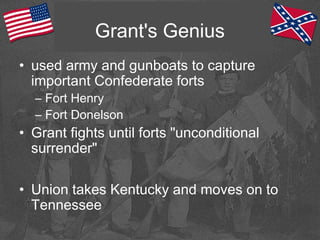
Grant's Genius
• used army and gunboats to capture
important Confederate forts
– Fort Henry
– Fort Donelson
• Grant fights until forts "unconditional
surrender"
• Union takes Kentucky and moves on to
Tennessee
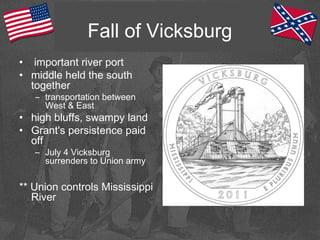
Fall of Vicksburg
• important river port
• middle held the south
together
– transportation between
West & East
• high bluffs, swampy land
• Grant's persistence paid
off
– July 4 Vicksburg
surrenders to Union army
** Union controls Mississippi
River
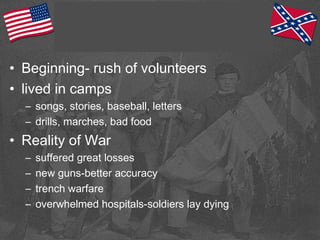
Reality of War
• Beginning- rush of volunteers
• lived in camps
– songs, stories, baseball, letters
– drills, marches, bad food
• Reality of War
– suffered great losses
– new guns-better accuracy
– trench warfare
– overwhelmed hospitals-soldiers lay dying
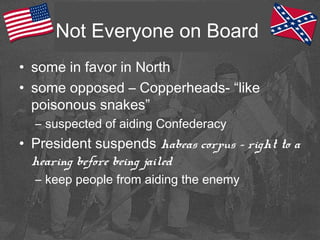
Women & the War
• new jobs
– teachers, office workers, sales clerks, factory
workers, government workers,
• losses
– husbands, sons, brothers, fathers
• wove blankets, rolled bandages, made ammo,
collected food, clothing, meds, $
• spies- Rose O’Neal Greenhow, Belle Boyd,
Loretta Velazquez
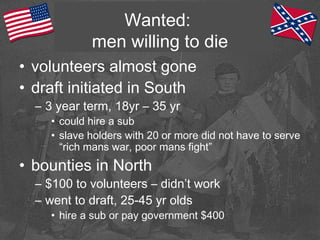
• Served as nurses
– improper
– too delicate
• Dorothea Dix
• Clara Barton
– organized nurses
– American Red Cross
Not Everyone on Board
• some in favor in North
• some opposed – Copperheads- “like
poisonous snakes”
– suspected of aiding Confederacy
• President suspends habeas corpus – right to a
hearing before being jailed
– keep people from aiding the enemy
Wanted:
men willing to die
• volunteers almost gone
• draft initiated in South
– 3 year term, 18yr – 35 yr
• could hire a sub
• slave holders with 20 or more did not have to serve
“rich mans war, poor mans fight”
• bounties in North
– $100 to volunteers – didn’t work
– went to draft, 25-45 yr olds
• hire a sub or pay government $400
War & the Economy
• Strained both sides
• North better equipped than South
• Both raised money by:
– borrowing money
• $2 billion in war bonds-North,
• $700 million in South
– raising taxes
– printing paper money
• Greenbacks – North
• South printed 2X as much
up, up, up!
•
• Prices rose higher than wages = inflation
• more prosperous in North
• South suffered more
– more fighting occurred in South
– land ruined
– thousands homeless
– cities burned
– blockades – shortage of supplies
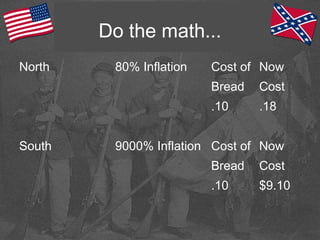
Do the math...
North 80% Inflation Cost of
Bread
.10
Now
Cost
.18
South 9000% Inflation Cost of
Bread
.10
Now
Cost
$9.10
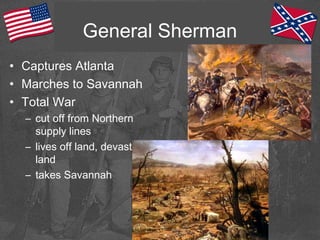
General Sherman
• Captures Atlanta
• Marches to Savannah
• Total War
– cut off from Northern
supply lines
– lives off land, devastating
land
– takes Savannah
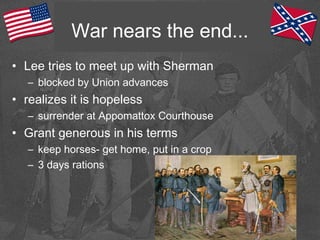
War nears the end...
• Lee tries to meet up with Sherman
– blocked by Union advances
• realizes it is hopeless
– surrender at Appomattox Courthouse
• Grant generous in his terms
– keep horses- get home, put in a crop
– 3 days rations
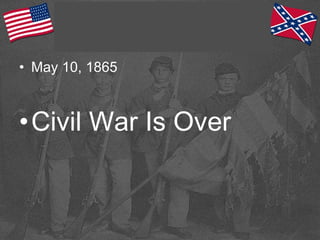
• May 10, 1865
•Civil War Is Over
• ......but the work of
reconstruction is just
beginning...

AmHist ch.14 the civil war

  • 1.
    The Civil War WarBetween the States Ch. 14
  • 2.
  • 3.
    Causes of War Unionvs. Independance • Do states have a right to leave the union if they do not agree with Federal Gov't.? • North – "Preserve union!" • South – "Preserve states rights!"
  • 4.
    Causes of War Economics •North – industry & manufacturing • South – agriculture • cotton, rice, tobacco, hemp, sugar • Tariff – North- YES • protect industries from competition – South- NO! • econimics depended upon foreign trade • tariff made everything more expensive!
  • 5.
    Causes of War Slavery •South – was integral to the way of life in South – many southerners argued that slavery was "positive good" • North – anti-slavery sentiment gaining more power
  • 6.
    Causes of War Patriotism •Many Americans torn between patriotism to their country vs. state. • Robert E. Lee – Southerner – officer in army – opposed succession and slavery – did not accept Lincoln's offer to lead Union troops • Robert Anderson – VA slave owner – believed in consitutional right of succession – fought on loyalty to US Army
  • 7.
  • 8.
    Resources North • population – 2x •food – Midwest • wheat,corn,oats • industrial output – factories – railroads South • population – 9 million • crops – cotton & tobacco – non-edible
  • 9.
    Leaders North • went throughmany military leaders • none as stellar as Southerners South • superior military leadership • trained at West Point national military academy – Robert E. Lee – Stonewall Jackson – J.E.B. Stuart
  • 10.
    Strategy North • invade theSouth • Anaconda Plan – slowly cuttin off ability of South to wage war – blockade – control the Mississippi River – cut off transportation routes – Capture Richmond, VA South • deffensive fighting • protect home and family • motivation
  • 11.
  • 12.
    • Virginia – WashingtonD.C. and Richmond • Believed quick decisive battle would end the war – soldiers hired for 3 months
  • 13.
    First Manassas (July 1861) •"Battle of Bull Run" – Union initial advantage – Confederate back ups arrive • Victory for confederates! • Confederates – confidence! • Union – defeat and demoralized • Both realized this would not be a quick battle
  • 14.
    Army of thePotomac (March-July 1862) • General Maclellan takes over Union Army – Replaces McDowell • Trains & reorganizes army • Wants to attack Richmond – confederate capital city • Stonewall Jackson stands in the way – defeats two separate Union armies – Valley Campaign
  • 15.
    Battle for Richmond (April-July 62) • McLellon pushes towards Richmond • Union holds him off – heavy casualties – Gen. Johnston injured • Jefferson Davis asks Robert E. Lee for help – Lee pushes Union army back towards Washington D.C.
  • 16.
    Second Manassas (August '62) •Lee sends JEB Stuart to attack Pope's army before Maclellan could join him – JEB Stuart raids headquarters and steals • payroll • battle plans • dress coat • Confederate victory sends Pope's army back to Washington D.C. • All of Virginia rid of Union armies
  • 17.
    Battle of Antietam •A draw for both sides, – turned the tide of war because Europe made decision not to support the South • Strategic victory for the Union • Bloodiest single day of the war • Led to Lincoln issuing the Emancipation Proclamation – Freed slaves in Southern states – Made slavery officiall an issue of the Civil War – lead to 13th Amendment
  • 18.
    Battle of Gettysburg (July'63) • Union victory • Turning point in Civil War – South on defensive for the rest of war • Casualties = 50,000 • Gettysburg Address – Lincoln keeps trying to keep country together
  • 19.
  • 20.
    Western Battles • MississippiRiver • Kentucky-Tennessee • More Union victories • Better Union Generals – Ulysses S. Grant – William Sherman
  • 21.
    Grant's Genius • usedarmy and gunboats to capture important Confederate forts – Fort Henry – Fort Donelson • Grant fights until forts "unconditional surrender" • Union takes Kentucky and moves on to Tennessee
  • 22.
    Fall of Vicksburg •important river port • middle held the south together – transportation between West & East • high bluffs, swampy land • Grant's persistence paid off – July 4 Vicksburg surrenders to Union army ** Union controls Mississippi River
  • 23.
  • 24.
    • Beginning- rushof volunteers • lived in camps – songs, stories, baseball, letters – drills, marches, bad food • Reality of War – suffered great losses – new guns-better accuracy – trench warfare – overwhelmed hospitals-soldiers lay dying
  • 25.
    Women & theWar • new jobs – teachers, office workers, sales clerks, factory workers, government workers, • losses – husbands, sons, brothers, fathers • wove blankets, rolled bandages, made ammo, collected food, clothing, meds, $ • spies- Rose O’Neal Greenhow, Belle Boyd, Loretta Velazquez
  • 26.
    • Served asnurses – improper – too delicate • Dorothea Dix • Clara Barton – organized nurses – American Red Cross
  • 27.
    Not Everyone onBoard • some in favor in North • some opposed – Copperheads- “like poisonous snakes” – suspected of aiding Confederacy • President suspends habeas corpus – right to a hearing before being jailed – keep people from aiding the enemy
  • 28.
    Wanted: men willing todie • volunteers almost gone • draft initiated in South – 3 year term, 18yr – 35 yr • could hire a sub • slave holders with 20 or more did not have to serve “rich mans war, poor mans fight” • bounties in North – $100 to volunteers – didn’t work – went to draft, 25-45 yr olds • hire a sub or pay government $400
  • 29.
    War & theEconomy • Strained both sides • North better equipped than South • Both raised money by: – borrowing money • $2 billion in war bonds-North, • $700 million in South – raising taxes – printing paper money • Greenbacks – North • South printed 2X as much
  • 30.
    up, up, up! • •Prices rose higher than wages = inflation • more prosperous in North • South suffered more – more fighting occurred in South – land ruined – thousands homeless – cities burned – blockades – shortage of supplies
  • 31.
    Do the math... North80% Inflation Cost of Bread .10 Now Cost .18 South 9000% Inflation Cost of Bread .10 Now Cost $9.10
  • 32.
    General Sherman • CapturesAtlanta • Marches to Savannah • Total War – cut off from Northern supply lines – lives off land, devastating land – takes Savannah
  • 33.
    War nears theend... • Lee tries to meet up with Sherman – blocked by Union advances • realizes it is hopeless – surrender at Appomattox Courthouse • Grant generous in his terms – keep horses- get home, put in a crop – 3 days rations
  • 34.
    • May 10,1865 •Civil War Is Over
  • 35.
    • ......but thework of reconstruction is just beginning...