GPS 5 – 8 (#’s 42 – 80)
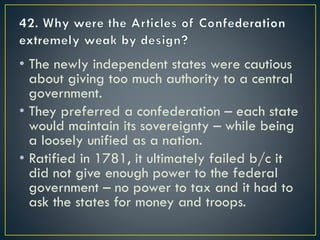
• The newly independent states were cautious
about giving too much authority to a central
government.
• They preferred a confederation – each state
would maintain its sovereignty – while being
a loosely unified as a nation.
• Ratified in 1781, it ultimately failed b/c it
did not give enough power to the federal
government – no power to tax and it had to
ask the states for money and troops.
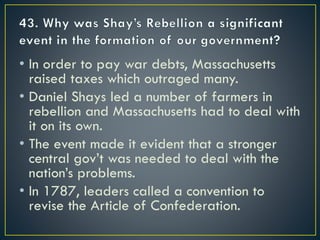
• In order to pay war debts, Massachusetts
raised taxes which outraged many.
• Daniel Shays led a number of farmers in
rebellion and Massachusetts had to deal with
it on its own.
• The event made it evident that a stronger
central gov’t was needed to deal with the
nation’s problems.
• In 1787, leaders called a convention to
revise the Article of Confederation.
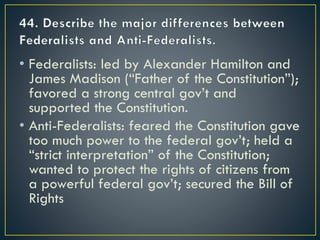
• Federalists: led by Alexander Hamilton and
James Madison (“Father of the Constitution”);
favored a strong central gov’t and
supported the Constitution.
• Anti-Federalists: feared the Constitution gave
too much power to the federal gov’t; held a
“strict interpretation” of the Constitution;
wanted to protect the rights of citizens from
a powerful federal gov’t; secured the Bill of
Rights
• Authors: Hamilton and Madison
• Essays written to persuade NY
legislature to ratify the Constitution by
easing fears that the document left
the gov’t susceptible to any one
faction seizing too much power.
• Powers given to each branch that
allow each branch to check the
powers of the other two – presidential
veto of laws; 2/3 Congressional vote
to override veto; Judicial Review
• Legislative: make laws
• Executive: enforce laws
• Judicial: interpret laws; make sure
they are applied fairly and
appropriately.
• Compromise on how representation in
Congress is determined; established a
bicameral (2 houses) legislature.
• Senate: equal representation – 2
Senators from each state.
• House of Representatives: representation
based on a state’s population.
• He believed the best form of gov’t
was one that featured a “separation
of powers”.
• Advocated 3 branches with some
degree of power over the others –
“checks and balances” to ensure no
one branch becomes too powerful.
• Southern states, with far more slaves than
the North, wanted to count them as part
of the population for representation in
Congress.
• Three-fifths Compromise: each slave
would count “three-fifths” a person.
• Slave Trade Compromise: agreed to
allow the slave trade to continue for 20
years, without Congressional regulation.
• Passed in 1789 for the purpose of
protecting civil liberties.
• The first 10 Amendments to the
Constitution.
• Commander of the Continental Army during
the American Revolution.
• Elected first President of the United States
• Chose the site of the national capital named
Washington D.C.
• Created the “Cabinet”
• Put down Whiskey Rebellion which showed
the power of the new federal government
• 3 Key points:
•1 – stay neutral and avoid permanent
alliances with foreign countries
•2 – good government is based on religion
and morality
•3 – avoid the formation of political parties;
they cause people to work for their own
interest rather than for public good.
• Part of Hamilton’s debt plan was to place a tax on
whiskey to pay for the Revolutionary War debt –
which was very unpopular with farmers that made
their living converting grain into whiskey.
• Pennsylvania farmers refused to pay the debt and
resorted to violence.
• The uprising ended when Washington organized a
military force – thanks to the Constitution – to put
down the rebellion.
• The event showed the new gov’t had the power to
enforce its laws as compared to the Articles of
Confederation and Shay’s Rebellion.
• Part of Hamilton’s debt plan – he had a
loose interpretation of the Constitution
and believed that its “necessary and
proper clause” gave the gov’t the right to
charter a bank.
• He believed it was necessary to exercise
its constitutional duties – in this case, coin
money.
• The Northwest territory was the area lying
north of the Ohio River and east of the
Mississippi River.
• Congress passed this law which divided the
area into smaller territories and provided
guidelines under which new states could be
admitted to the Union.
• It made slavery illegal in the new territories;
those that already had slaves could keep
them.
• As President, Thomas Jefferson wanted to secure U.S.
trading on the Mississippi River and he sent
representatives to France to negotiate the purchase
New Orleans.
• Napoleon, dealing with a slave revolt in Haiti and
fighting a war with England, lost hope in revitalizing
colonies in North America.
• He surprised Jefferson by offering to sell not only New
Orleans, but the entire Louisiana Territory for $15
million – the Louisiana Purchase.
• Jefferson believed it was important for citizens of a
republic to have access to land and bought it b/c of
the resources and promise it offered.
• The Louisiana Purchase in 1803 was the
U.S.’s largest land purchase, roughly
doubling the size of the country.
• It marked a turning point for the new
nation economically as it began to pursue
prosperity within its own borders, rather
than from foreign nation.
• Meriwether Lewis and William Clark
were sent to explore the newly acquired
Louisiana Territory to find a water route
to the Pacific and discover what
resources it held.
• The exploration led to the rapid
migration of settlers to the Pacific
Northwest – the pathway these settlers
followed from Missouri became known as
the Oregon Trail.
• French Emperor Napoleon Bonaparte sold
the Louisiana Territory to President Thomas
Jefferson in 1803.
• At first, Napoleon wasn’t interested in selling
it b/c he wanted to revitalize the French
colonial empire in the Western Hemisphere.
• However, slaves revolted in Haiti and Britain
resumed its war with France and Napoleon
needed the money – and couldn’t focus on
revitalizing colonization of the Western
Hemisphere.
• As U.S. settlers attempted to move west, they
encountered Native American resistance – which
was blamed on the British in order to protect their
own interests in the area.
• The U.S. felt threatened by British presence in
Canada and that, combined with the British
navy’s policy of impressing U.S. seamen (taking
them captive and forcing them into service on
British ships) led many in the U.S. to demand war.
• Congress declared war in June 18, 1812, hoping
to win Canada from the British and Florida from
the Spanish.
• It showed that the U.S. was now a
world power that could defend itself
and assert its interests in North
America against foreign powers.
• The canal provided a new shipping route from
Lake Erie to the Hudson River and it connected
the Great Lakes to New York City.
• The canal helped make NY a dominant
commercial center by expanding its markets.
• It also allowed people to travel much more
cheaply and move west easier than ever before.
• Along with the invention of the steam-powered
boat, the Erie Canal greatly enhanced the
economy of NY City and the northeastern U.S.
• Sec. of State Henry Clay’s “American
System” proposed several measures he
thought were crucial to improving the nation’s
economy and infrastructure.
• “Infrastructure” is what provided the
framework and connections for holding
something together – roads, rail lines,
services and utilities, and canals.
• He believed it would strengthen the U.S. and
make it more economically independent as
well as unite different regions of the country.
• Issued in 1823 by President James Monroe
and it stated:
•The U.S. would not tolerate European
intervention in the affairs of any independent
nation in the Americas
•The American continents were no longer open
for European colonization
•The U.S. would view any future attempt to
colonize them as acts of aggression
•The U.S. would not interfere with the internal
affairs of other American countries, nor in those
of European nations.
• It was a time when advances in
technology led to massive economic
changes.
• With industrialization, factories began to
rely on mechanization (machines) which
replaced manual labor.
• This transformation dramatically
increased production which impacted
trade and economies around the globe.
• His 1793 invention of the “cotton gin” allowed people
(slaves) to process raw cotton much faster and made
the South a “cotton kingdom” – “King Cotton” which
was the basis of its economy.
• It led to a boom in cotton plantations and also made
the South even more dependent on slavery.
• His invention of “interchangeable parts” transformed
the economy of the North and the manufacture of
muskets.
• Each part of the musket was produced with precision
and could fit with parts from any other musket.
• This concept spread to other industries and became a
key principle behind industrial development.
• During the 1800s, many leaders and
citizens believed it was God’s
sovereign will for the U.S. to expand
and possess territory all the way to
the Pacific Ocean.
• They considered it the nation’s sacred
duty to conquer the West.
• Temperance: members of this movement wanted to
moderate the consumption of alcohol; later advocating
the abstinence from alcohol; many states passed laws
prohibiting its sale; it owes much of its success to
women and church leaders.
• Abolition: end slavery; white members were mostly
middle class, educated, church people from NE; ex-
slaves; increased the tension of the North and South
prior to the Civil War
• Public Schools: Horace Mann; wanted men and women
to have access to public edu. which was essential in a
democracy; helped create the Board of Edu in Mass.
• Suffrage: the right to vote
• Elizabeth Cady Stanton: organized the
first women’s rights convention in Seneca
Falls, NY, 1848; called for women’s
suffrage
• Seneca Falls Convention: first women’s
rights convention in U.S. History; drew a
lot of attention to the issue of women’s
rights because of their participation in
the abolition and temperance movements.
• Defeated the British at New Orleans in 1814; forced
concessions from Spain that led to Florida becoming a
U.S. territory
• He was a “common man”; achieved his success despite
growing up poor and uneducated which made him
popular with frontiersmen and “common folk”
• Favored universal suffrage for all white males –
helped in 1828 election.
• Set presidential precedent with the “spoils system”
• His believe in Manifest Destiny and westward
expansion resulted in the Indian Removal
• The War of 1812 helped produce a
stronger sense of national pride and
political unity after standing up the British
again – “Era of Good Feelings”; Monroe
Doctrine.
• U.S. manufacturing and agriculture
improved and grew prosperous.
• America was geographically connected
by the American System – Erie Canal.
• Refers to the economic, social, cultural, and
political differences that exist between different
parts of the country.
• South: dependent on slavery and the plantation
system; Southern politicians fought to uphold
slavery and its expansion; believed in states’
rights
• North: industrial; home to the abolition movement;
Northern politicians sought to halt slavery’s
expansion
• This constant conflict b/t the two regions led to
constant battles for power in the national
government – representation in Congress.
• Southern attitudes about slavery hardened even
more after a failed slave uprising in VA – Nat
Turner’s Rebellion.
• Turner, a preacher and slave, believed he had a
divine mission to deliver his people from slavery.
• In Aug. 1831 he organized a revolt where 160
people (white & black) were killed.
• As a result, the few abolitionist societies in the
south came to an end and “slave codes” – laws
restricting the activities and conduct of slaves –
were made tighter and strictly enforced.
• William Lloyd Garrison: founded an influential,
anti-slavery newspaper called “The Liberator” in
1831 and helped establish the “American Anti-
Slavery Society”.
• Frederick Douglass: escaped slave from
Maryland; self-educated; became the most
prominent African American speaker for the
abolition of slavery; “North Star” newspaper
• Grimke Sisters: Sarah and Angelina Grimke were
members of a prominent slaveholding family in
SC who became abolitionists and won national
acclaim for their passionate anti-slavery
speeches.
• Free northern states opposed the addition of slaves states;
Southern states feared the additions of free states would
leave them at a political disadvantage in Congress.
• In 1819, debate raged over Missouri’s application for
statehood and its admission would disrupt the balance in
the Senate.
• Missouri was admitted as a slave state; Maine was
admitted as a free state; The southern boundary of
Missouri 36˚30‘N would be a dividing line – any new state
north of that line would be a free state, any south would
be slave states.
• S.C. protests high tariffs on imported goods b/c
they believed the national gov’t used high tariffs
to help the rich, northern businessmen at the
expense of small land owners and southern
farmers.
• Sen. Calhoun wrote “Exposition and Protest”
arguing for states rights and the doctrine of
nullification – a state could refuse to enforce a
law it saw as unconstitutional.
• S.C. threatened to invoke this right a secede from
the Union – the issues of states’ rights and
secession remained alive until the end of the Civil
War.
• Texas won its independence from Mexico
and remained an independent nation until
1845 when they were admitted into the
Union as a slave state.
• Because of manifest destiny, the U.S. fought
Mexico over the Texas border and New
Mexico and California territories; the land
was gained in 1848 with the Treaty of
Guadalupe Hidalgo.
• In 1853, the Gadsden Purchase gave the
U.S. parts of NM and AZ for $10 million.
• The U.S. went to war with Mexico in 1846
and even before the war was over, it was
evident that a victory would mean new
territories and bring up the issue of slavery.
• The “Wilmot Proviso” – the “proviso” or
condition proposed banning slavery from
any land purchased from Mexico;
Northerners embrace it, southerners
denounced it.
• Congress voted against it but still, the
debate it stirred exposed the serious
sectional divisions over slavery that exited in
the country.
• The Compromise admitted CA to the Union
as a free state and declared unorganized
western territories free as well.
• UT and NM were allowed to decide on
slavery by “popular sovereignty”.
• Attached to the Compromise was the Fugitive
Slave Law – required northern states to
forcibly return escaped slaves to their
owners in the South; many northerners
refused to obey this law.

Eoct review questions gps 5 8

  • 1.
    GPS 5 –8 (#’s 42 – 80)
  • 2.
    • The newlyindependent states were cautious about giving too much authority to a central government. • They preferred a confederation – each state would maintain its sovereignty – while being a loosely unified as a nation. • Ratified in 1781, it ultimately failed b/c it did not give enough power to the federal government – no power to tax and it had to ask the states for money and troops.
  • 3.
    • In orderto pay war debts, Massachusetts raised taxes which outraged many. • Daniel Shays led a number of farmers in rebellion and Massachusetts had to deal with it on its own. • The event made it evident that a stronger central gov’t was needed to deal with the nation’s problems. • In 1787, leaders called a convention to revise the Article of Confederation.
  • 4.
    • Federalists: ledby Alexander Hamilton and James Madison (“Father of the Constitution”); favored a strong central gov’t and supported the Constitution. • Anti-Federalists: feared the Constitution gave too much power to the federal gov’t; held a “strict interpretation” of the Constitution; wanted to protect the rights of citizens from a powerful federal gov’t; secured the Bill of Rights
  • 5.
    • Authors: Hamiltonand Madison • Essays written to persuade NY legislature to ratify the Constitution by easing fears that the document left the gov’t susceptible to any one faction seizing too much power.
  • 6.
    • Powers givento each branch that allow each branch to check the powers of the other two – presidential veto of laws; 2/3 Congressional vote to override veto; Judicial Review
  • 7.
    • Legislative: makelaws • Executive: enforce laws • Judicial: interpret laws; make sure they are applied fairly and appropriately.
  • 8.
    • Compromise onhow representation in Congress is determined; established a bicameral (2 houses) legislature. • Senate: equal representation – 2 Senators from each state. • House of Representatives: representation based on a state’s population.
  • 9.
    • He believedthe best form of gov’t was one that featured a “separation of powers”. • Advocated 3 branches with some degree of power over the others – “checks and balances” to ensure no one branch becomes too powerful.
  • 10.
    • Southern states,with far more slaves than the North, wanted to count them as part of the population for representation in Congress. • Three-fifths Compromise: each slave would count “three-fifths” a person. • Slave Trade Compromise: agreed to allow the slave trade to continue for 20 years, without Congressional regulation.
  • 11.
    • Passed in1789 for the purpose of protecting civil liberties. • The first 10 Amendments to the Constitution.
  • 12.
    • Commander ofthe Continental Army during the American Revolution. • Elected first President of the United States • Chose the site of the national capital named Washington D.C. • Created the “Cabinet” • Put down Whiskey Rebellion which showed the power of the new federal government
  • 13.
    • 3 Keypoints: •1 – stay neutral and avoid permanent alliances with foreign countries •2 – good government is based on religion and morality •3 – avoid the formation of political parties; they cause people to work for their own interest rather than for public good.
  • 14.
    • Part ofHamilton’s debt plan was to place a tax on whiskey to pay for the Revolutionary War debt – which was very unpopular with farmers that made their living converting grain into whiskey. • Pennsylvania farmers refused to pay the debt and resorted to violence. • The uprising ended when Washington organized a military force – thanks to the Constitution – to put down the rebellion. • The event showed the new gov’t had the power to enforce its laws as compared to the Articles of Confederation and Shay’s Rebellion.
  • 15.
    • Part ofHamilton’s debt plan – he had a loose interpretation of the Constitution and believed that its “necessary and proper clause” gave the gov’t the right to charter a bank. • He believed it was necessary to exercise its constitutional duties – in this case, coin money.
  • 16.
    • The Northwestterritory was the area lying north of the Ohio River and east of the Mississippi River. • Congress passed this law which divided the area into smaller territories and provided guidelines under which new states could be admitted to the Union. • It made slavery illegal in the new territories; those that already had slaves could keep them.
  • 17.
    • As President,Thomas Jefferson wanted to secure U.S. trading on the Mississippi River and he sent representatives to France to negotiate the purchase New Orleans. • Napoleon, dealing with a slave revolt in Haiti and fighting a war with England, lost hope in revitalizing colonies in North America. • He surprised Jefferson by offering to sell not only New Orleans, but the entire Louisiana Territory for $15 million – the Louisiana Purchase. • Jefferson believed it was important for citizens of a republic to have access to land and bought it b/c of the resources and promise it offered.
  • 18.
    • The LouisianaPurchase in 1803 was the U.S.’s largest land purchase, roughly doubling the size of the country. • It marked a turning point for the new nation economically as it began to pursue prosperity within its own borders, rather than from foreign nation.
  • 19.
    • Meriwether Lewisand William Clark were sent to explore the newly acquired Louisiana Territory to find a water route to the Pacific and discover what resources it held. • The exploration led to the rapid migration of settlers to the Pacific Northwest – the pathway these settlers followed from Missouri became known as the Oregon Trail.
  • 20.
    • French EmperorNapoleon Bonaparte sold the Louisiana Territory to President Thomas Jefferson in 1803. • At first, Napoleon wasn’t interested in selling it b/c he wanted to revitalize the French colonial empire in the Western Hemisphere. • However, slaves revolted in Haiti and Britain resumed its war with France and Napoleon needed the money – and couldn’t focus on revitalizing colonization of the Western Hemisphere.
  • 21.
    • As U.S.settlers attempted to move west, they encountered Native American resistance – which was blamed on the British in order to protect their own interests in the area. • The U.S. felt threatened by British presence in Canada and that, combined with the British navy’s policy of impressing U.S. seamen (taking them captive and forcing them into service on British ships) led many in the U.S. to demand war. • Congress declared war in June 18, 1812, hoping to win Canada from the British and Florida from the Spanish.
  • 22.
    • It showedthat the U.S. was now a world power that could defend itself and assert its interests in North America against foreign powers.
  • 23.
    • The canalprovided a new shipping route from Lake Erie to the Hudson River and it connected the Great Lakes to New York City. • The canal helped make NY a dominant commercial center by expanding its markets. • It also allowed people to travel much more cheaply and move west easier than ever before. • Along with the invention of the steam-powered boat, the Erie Canal greatly enhanced the economy of NY City and the northeastern U.S.
  • 24.
    • Sec. ofState Henry Clay’s “American System” proposed several measures he thought were crucial to improving the nation’s economy and infrastructure. • “Infrastructure” is what provided the framework and connections for holding something together – roads, rail lines, services and utilities, and canals. • He believed it would strengthen the U.S. and make it more economically independent as well as unite different regions of the country.
  • 25.
    • Issued in1823 by President James Monroe and it stated: •The U.S. would not tolerate European intervention in the affairs of any independent nation in the Americas •The American continents were no longer open for European colonization •The U.S. would view any future attempt to colonize them as acts of aggression •The U.S. would not interfere with the internal affairs of other American countries, nor in those of European nations.
  • 26.
    • It wasa time when advances in technology led to massive economic changes. • With industrialization, factories began to rely on mechanization (machines) which replaced manual labor. • This transformation dramatically increased production which impacted trade and economies around the globe.
  • 27.
    • His 1793invention of the “cotton gin” allowed people (slaves) to process raw cotton much faster and made the South a “cotton kingdom” – “King Cotton” which was the basis of its economy. • It led to a boom in cotton plantations and also made the South even more dependent on slavery. • His invention of “interchangeable parts” transformed the economy of the North and the manufacture of muskets. • Each part of the musket was produced with precision and could fit with parts from any other musket. • This concept spread to other industries and became a key principle behind industrial development.
  • 28.
    • During the1800s, many leaders and citizens believed it was God’s sovereign will for the U.S. to expand and possess territory all the way to the Pacific Ocean. • They considered it the nation’s sacred duty to conquer the West.
  • 29.
    • Temperance: membersof this movement wanted to moderate the consumption of alcohol; later advocating the abstinence from alcohol; many states passed laws prohibiting its sale; it owes much of its success to women and church leaders. • Abolition: end slavery; white members were mostly middle class, educated, church people from NE; ex- slaves; increased the tension of the North and South prior to the Civil War • Public Schools: Horace Mann; wanted men and women to have access to public edu. which was essential in a democracy; helped create the Board of Edu in Mass.
  • 30.
    • Suffrage: theright to vote • Elizabeth Cady Stanton: organized the first women’s rights convention in Seneca Falls, NY, 1848; called for women’s suffrage • Seneca Falls Convention: first women’s rights convention in U.S. History; drew a lot of attention to the issue of women’s rights because of their participation in the abolition and temperance movements.
  • 31.
    • Defeated theBritish at New Orleans in 1814; forced concessions from Spain that led to Florida becoming a U.S. territory • He was a “common man”; achieved his success despite growing up poor and uneducated which made him popular with frontiersmen and “common folk” • Favored universal suffrage for all white males – helped in 1828 election. • Set presidential precedent with the “spoils system” • His believe in Manifest Destiny and westward expansion resulted in the Indian Removal
  • 32.
    • The Warof 1812 helped produce a stronger sense of national pride and political unity after standing up the British again – “Era of Good Feelings”; Monroe Doctrine. • U.S. manufacturing and agriculture improved and grew prosperous. • America was geographically connected by the American System – Erie Canal.
  • 33.
    • Refers tothe economic, social, cultural, and political differences that exist between different parts of the country. • South: dependent on slavery and the plantation system; Southern politicians fought to uphold slavery and its expansion; believed in states’ rights • North: industrial; home to the abolition movement; Northern politicians sought to halt slavery’s expansion • This constant conflict b/t the two regions led to constant battles for power in the national government – representation in Congress.
  • 34.
    • Southern attitudesabout slavery hardened even more after a failed slave uprising in VA – Nat Turner’s Rebellion. • Turner, a preacher and slave, believed he had a divine mission to deliver his people from slavery. • In Aug. 1831 he organized a revolt where 160 people (white & black) were killed. • As a result, the few abolitionist societies in the south came to an end and “slave codes” – laws restricting the activities and conduct of slaves – were made tighter and strictly enforced.
  • 35.
    • William LloydGarrison: founded an influential, anti-slavery newspaper called “The Liberator” in 1831 and helped establish the “American Anti- Slavery Society”. • Frederick Douglass: escaped slave from Maryland; self-educated; became the most prominent African American speaker for the abolition of slavery; “North Star” newspaper • Grimke Sisters: Sarah and Angelina Grimke were members of a prominent slaveholding family in SC who became abolitionists and won national acclaim for their passionate anti-slavery speeches.
  • 36.
    • Free northernstates opposed the addition of slaves states; Southern states feared the additions of free states would leave them at a political disadvantage in Congress. • In 1819, debate raged over Missouri’s application for statehood and its admission would disrupt the balance in the Senate. • Missouri was admitted as a slave state; Maine was admitted as a free state; The southern boundary of Missouri 36˚30‘N would be a dividing line – any new state north of that line would be a free state, any south would be slave states.
  • 37.
    • S.C. protestshigh tariffs on imported goods b/c they believed the national gov’t used high tariffs to help the rich, northern businessmen at the expense of small land owners and southern farmers. • Sen. Calhoun wrote “Exposition and Protest” arguing for states rights and the doctrine of nullification – a state could refuse to enforce a law it saw as unconstitutional. • S.C. threatened to invoke this right a secede from the Union – the issues of states’ rights and secession remained alive until the end of the Civil War.
  • 38.
    • Texas wonits independence from Mexico and remained an independent nation until 1845 when they were admitted into the Union as a slave state. • Because of manifest destiny, the U.S. fought Mexico over the Texas border and New Mexico and California territories; the land was gained in 1848 with the Treaty of Guadalupe Hidalgo. • In 1853, the Gadsden Purchase gave the U.S. parts of NM and AZ for $10 million.
  • 39.
    • The U.S.went to war with Mexico in 1846 and even before the war was over, it was evident that a victory would mean new territories and bring up the issue of slavery. • The “Wilmot Proviso” – the “proviso” or condition proposed banning slavery from any land purchased from Mexico; Northerners embrace it, southerners denounced it. • Congress voted against it but still, the debate it stirred exposed the serious sectional divisions over slavery that exited in the country.
  • 40.
    • The Compromiseadmitted CA to the Union as a free state and declared unorganized western territories free as well. • UT and NM were allowed to decide on slavery by “popular sovereignty”. • Attached to the Compromise was the Fugitive Slave Law – required northern states to forcibly return escaped slaves to their owners in the South; many northerners refused to obey this law.