2   War


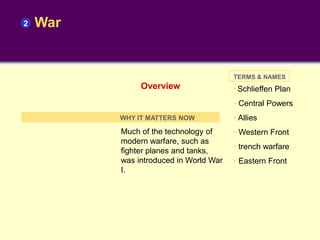
                                        TERMS & NAMES
               Overview                 • Schlieffen Plan
                                        • Central Powers
          WHY IT MATTERS NOW            • Allies
          Much of the technology of     • Western Front
          modern warfare, such as
                                        • trench warfare
          fighter planes and tanks,
          was introduced in World War   • Eastern Front
          I.
The Schlieffen Plan
The Schlieffen
         Plan
Belgium
was neutral,
    but
  Germany
invaded it to
   get to
  France.
Trench Warfare
--- fighting from a
     hole in the
       ground
trench warfare aerial view
trench warfare --- not really
Christmas truce 1914
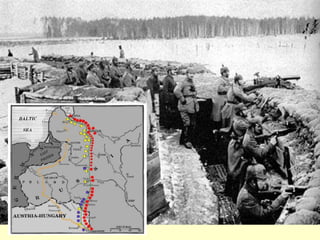
Eastern front
U-boat
Lusitania
US patience cartoon
Lusitania cartoons
Zimmerman promise
Zimmerman encoded
"We intend to begin on the first of February unrestricted
    submarine warfare. We shall endeavor in spite of this to keep
    the United States of America neutral. In the event of this not
    succeeding, we make Mexico a proposal or alliance on the
    following basis: make war together, make peace together,
    generous financial support and an understanding on our part
    that Mexico is to reconquer the lost territory in Texas, New
    Mexico, and Arizona.

The settlement in detail is left to you. You will inform the
    President of the above most secretly as soon as the outbreak of
    war with the United States of America is certain and add the
    suggestion that he should, on his own initiative, invite Japan to
    immediate adherence and at the same time mediate between
    Japan and ourselves. Please call the President's attention to the
    fact that the ruthless employment of our submarines now
    offers the prospect of compelling England in a few months to
    make peace.”
Signed, ZIMMERMANN.
Pancho Villa’s men
Mexican Revolution
•   1910-1917
•   Against dictatorship
•   Promoting democracy
•   Rebel Emiliano Zapata
Lusitania propaganda
supreme
command
red Baron
The Red Baron
snoopy
Spanish Flu
influenza collage
influenza chart
women in France
2   War


             1. Look at the graphic to help organize your
             thoughts. Write the immediate reason why each
             nation listed below declared war on the other
             nation listed.

       War Declaration                  Reason for Declaration

    Germany on Russia        Saw Russia’s troops along German border as threat

    Germany on France        Wanted a quick victory in the west

    Britain on Germany       Outraged over violation of Belgian neutrality
2   War


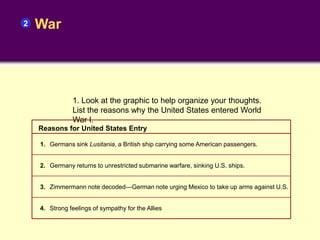
                1. Look at the graphic to help organize your thoughts.
                List the reasons why the United States entered World
                War I.
    Reasons for United States Entry

    1. Germans sink Lusitania, a British ship carrying some American passengers.


    2. Germany returns to unrestricted submarine warfare, sinking U.S. ships.


    3. Zimmermann note decoded—German note urging Mexico to take up arms against U.S.


    4. Strong feelings of sympathy for the Allies
Part 3: Effects of War
• Your goal:
 Understand how World War I affected the
  world.
3   Effects of War


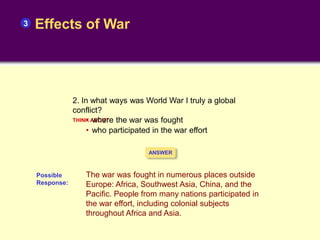
                2. In what ways was World War I truly a global
                conflict?
                     • where
                THINK ABOUT the war was fought

                     • who participated in the war effort

                                     ANSWER


    Possible       The war was fought in numerous places outside
    Response:      Europe: Africa, Southwest Asia, China, and the
                   Pacific. People from many nations participated in
                   the war effort, including colonial subjects
                   throughout Africa and Asia.
3   Effects of War


                                Section   3   Assessment

                 3. How did the concept of total war affect the
                 warring nations’ economies? THINK ABOUT
                     • the governments’ new role in their
                       economies
                     • the scarcity of food and other products
                     • the role of women
                     • unemployment rates during the war years
                                      ANSWER

    Possible        • Governments took greater control of economies,
    Responses:        telling factories what and how much to produce.
                    • Civilian factories were turned into munitions
                      factories.
                    • Rationing was common.
                    • Women became a significant part of the work

World War I Slideshow Part Two

  • 1.
    2 War TERMS & NAMES Overview • Schlieffen Plan • Central Powers WHY IT MATTERS NOW • Allies Much of the technology of • Western Front modern warfare, such as • trench warfare fighter planes and tanks, was introduced in World War • Eastern Front I.
  • 2.
  • 3.
  • 4.
    Belgium was neutral, but Germany invaded it to get to France.
  • 5.
    Trench Warfare --- fightingfrom a hole in the ground
  • 6.
  • 7.
  • 8.
  • 9.
  • 10.
  • 11.
  • 12.
  • 13.
  • 14.
  • 15.
  • 16.
    "We intend tobegin on the first of February unrestricted submarine warfare. We shall endeavor in spite of this to keep the United States of America neutral. In the event of this not succeeding, we make Mexico a proposal or alliance on the following basis: make war together, make peace together, generous financial support and an understanding on our part that Mexico is to reconquer the lost territory in Texas, New Mexico, and Arizona. The settlement in detail is left to you. You will inform the President of the above most secretly as soon as the outbreak of war with the United States of America is certain and add the suggestion that he should, on his own initiative, invite Japan to immediate adherence and at the same time mediate between Japan and ourselves. Please call the President's attention to the fact that the ruthless employment of our submarines now offers the prospect of compelling England in a few months to make peace.” Signed, ZIMMERMANN.
  • 17.
  • 18.
    Mexican Revolution • 1910-1917 • Against dictatorship • Promoting democracy • Rebel Emiliano Zapata
  • 19.
  • 20.
  • 21.
  • 22.
  • 23.
  • 24.
  • 25.
  • 26.
  • 27.
    2 War 1. Look at the graphic to help organize your thoughts. Write the immediate reason why each nation listed below declared war on the other nation listed. War Declaration Reason for Declaration Germany on Russia Saw Russia’s troops along German border as threat Germany on France Wanted a quick victory in the west Britain on Germany Outraged over violation of Belgian neutrality
  • 28.
    2 War 1. Look at the graphic to help organize your thoughts. List the reasons why the United States entered World War I. Reasons for United States Entry 1. Germans sink Lusitania, a British ship carrying some American passengers. 2. Germany returns to unrestricted submarine warfare, sinking U.S. ships. 3. Zimmermann note decoded—German note urging Mexico to take up arms against U.S. 4. Strong feelings of sympathy for the Allies
  • 29.
    Part 3: Effectsof War • Your goal: Understand how World War I affected the world.
  • 30.
    3 Effects of War 2. In what ways was World War I truly a global conflict? • where THINK ABOUT the war was fought • who participated in the war effort ANSWER Possible The war was fought in numerous places outside Response: Europe: Africa, Southwest Asia, China, and the Pacific. People from many nations participated in the war effort, including colonial subjects throughout Africa and Asia.
  • 31.
    3 Effects of War Section 3 Assessment 3. How did the concept of total war affect the warring nations’ economies? THINK ABOUT • the governments’ new role in their economies • the scarcity of food and other products • the role of women • unemployment rates during the war years ANSWER Possible • Governments took greater control of economies, Responses: telling factories what and how much to produce. • Civilian factories were turned into munitions factories. • Rationing was common. • Women became a significant part of the work