A Nation
Divided
SSUSH8 - Explore the relationship
between slavery, growing north-
south divisions, & westward
expansion that led to the outbreak
of the Civil War.
Missouri Compromise (SSUSH8a)
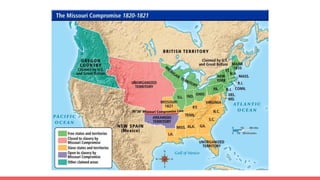
● After the Louisiana Purchase, a debate raged in Congress over
Missouri's application for statehood.
● Slave states and free-states were equally represented in the Senate,
and Missouri's admission would disrupt the balance of power.
● This issue was resolved when Congress passed the Missouri
Compromise.
○ Maine would be admitted to the Union as a free state
○ Missouri would be admitted as a slave state
● The balance between proslavery and antislavery senators was equal
again––until the next state asked to enter the Union.
Polk, Texas, & Oregon (SSUSH8b)
● James K. Polk was a strong supporter of Manifest Destiny
● Manifest Destiny was the belief that United States needed to control land between the Atlantic
and Pacific Ocean.
● Texas Annexation - Increasing numbers of American settlers filled the region north of the Rio
Grande, particularly in the 1820s and 1830s.
● This resulted in a successful drive for Texas independence and a push for annexation that soon
after the United States recognized the Texas Republic on March 3, 1837.
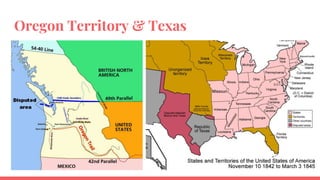
● Oregon - Polk ultimately negotiated with Great Britain concerning Oregon in an attempt to avoid
armed conflict over the region. Instead of acquiring the entire Oregon territory to the 54° 40" line,
a compromise was reached.
● The Oregon territory would be divided and the northern section would remain in Great Britain's
possession and the southern section would be annexed by the United States; ratified by the Senate
- Oregon Treaty of 1846.
Oregon Territory & Texas
The Mexican War (SSUSH8c)
● Reason for Mexican-American War: the United States took Texas into the Union
and set its sights on the Mexican territories of New Mexico and California.
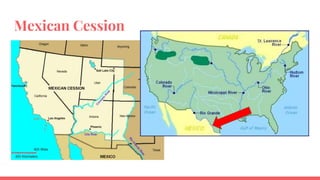
● The Treaty of Guadalupe Hidalgo officially ends the war and the U.S. gains
Texas, California, New Mexico and Arizona.
● The Wilmot Provision - During the Mexican-American War, Congress debated
whether slavery would be allowed in New Mexico and California if these territories
were acquired from Mexico.
● The antislavery position was outlined in a proposal called the Wilmot Proviso,
but the House of Representatives failed to approve it, and the issue of whether to
allow or prohibit slavery in new states remained unresolved.
● The Mexican American War and the Wilmot Proviso led to an increase in
sectionalism between the North and South.
Mexican Cession
The Compromise of 1850 (SSUSH8d)
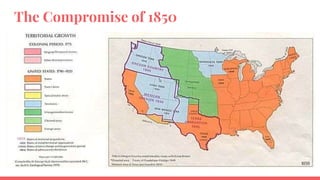
● Due to land gained during the Mexican-American War and population growth in the West
political tensions between free-states and slave states over the extension of slavery
continued. Eventually the free-states and slave states agreed to the Compromise of 1850.
● The Compromise of 1850 stated:
○ The state of New Mexico would be established by carving its borders from the state of
Texas.
○ New Mexico voters would determine whether the state would permit or prohibit the
practice of slavery.
○ California would be admitted to the Union as a free state.
○ All citizens would be required to apprehend runaway slaves and return them to their
owners. Those who failed to do so would be fined or imprisoned.
○ The slave trade would be abolished in the District of Columbia, but the practice of
slavery would be allowed to continue there.
● ·The Compromise of 1850 eased sectional tensions over slavery for a short time.
The Compromise of 1850
Kansas-Nebraska Act (SSUSH8e)
● In 1854, Congress again took up the issue of slavery.
● This time, Congress approved the Kansas- Nebraska Act, which
repealed the Missouri Compromise of 1820
● Kansas and Nebraska popular sovereignty (rule by the people) the
right to decide for themselves whether their state would be a free or a
slave state.
● Pro- and antislavery groups moved to Kansas to support their political
views.
● Popular sovereignty eventually failed and led to Bleeding Kansas a
violent or warlike battle between pro and antislavery groups.
Scott v. Sanford (SSUSH8e)
● In 1857, the U.S. Supreme Court issued the Scott v. Sanford
decision, settling a lawsuit in which an African American slave
named Dred Scott claimed he should be a free man because he had
lived with his master in slave states and in free-states.
● The Court ruled
○ No African American could ever be a U.S. citizen
○ Congress could not prohibit slavery in federal territories
○ Popular sovereignty was unconstitutional
● The Dred Scott decision gave slavery protection under the
Constitution.
John Brown’s Raid on Harper’s Ferry (SSUSH8e)
● John Brown, a white abolitionist, decided to fight slavery with violence and
killing.
● He led a group of white and black men in a raid on the federal armory at
Harpers Ferry, Virginia.
● John Brown’s Raid was to deliver the weapons and ammunition to slaves,
who would then use them in an uprising against slaveholders and proslavery
government officials.
● Brown raid failed and he was convicted of treason against the state of Virginia
and executed by hanging.
● Southerners thought Brown was a terrorist. Northerners thought he was an
abolitionist martyr.
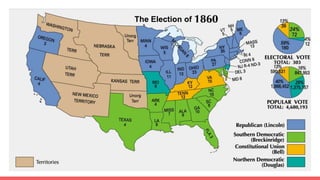
Election of 1860 (SSUSH8e)
● By the time of the presidential election of 1860, the country was at
a boiling point regarding slavery.
● The southern states feared that Lincoln would seek not only to
prevent slavery in the new territories, but to dismantle it in the
South as well.
● When Lincoln won the election, South Carolina responded by
seceding (withdrawing) from the Union on December 20, 1860.
● Within two months, six other states had seceded as well:
Mississippi, Alabama, Georgia, Florida, Louisiana and Texas.
The Election of

A nation divided ssush8

  • 1.
    A Nation Divided SSUSH8 -Explore the relationship between slavery, growing north- south divisions, & westward expansion that led to the outbreak of the Civil War.
  • 2.
    Missouri Compromise (SSUSH8a) ●After the Louisiana Purchase, a debate raged in Congress over Missouri's application for statehood. ● Slave states and free-states were equally represented in the Senate, and Missouri's admission would disrupt the balance of power. ● This issue was resolved when Congress passed the Missouri Compromise. ○ Maine would be admitted to the Union as a free state ○ Missouri would be admitted as a slave state ● The balance between proslavery and antislavery senators was equal again––until the next state asked to enter the Union.
  • 4.
    Polk, Texas, &Oregon (SSUSH8b) ● James K. Polk was a strong supporter of Manifest Destiny ● Manifest Destiny was the belief that United States needed to control land between the Atlantic and Pacific Ocean. ● Texas Annexation - Increasing numbers of American settlers filled the region north of the Rio Grande, particularly in the 1820s and 1830s. ● This resulted in a successful drive for Texas independence and a push for annexation that soon after the United States recognized the Texas Republic on March 3, 1837. ● Oregon - Polk ultimately negotiated with Great Britain concerning Oregon in an attempt to avoid armed conflict over the region. Instead of acquiring the entire Oregon territory to the 54° 40" line, a compromise was reached. ● The Oregon territory would be divided and the northern section would remain in Great Britain's possession and the southern section would be annexed by the United States; ratified by the Senate - Oregon Treaty of 1846.
  • 5.
  • 6.
    The Mexican War(SSUSH8c) ● Reason for Mexican-American War: the United States took Texas into the Union and set its sights on the Mexican territories of New Mexico and California. ● The Treaty of Guadalupe Hidalgo officially ends the war and the U.S. gains Texas, California, New Mexico and Arizona. ● The Wilmot Provision - During the Mexican-American War, Congress debated whether slavery would be allowed in New Mexico and California if these territories were acquired from Mexico. ● The antislavery position was outlined in a proposal called the Wilmot Proviso, but the House of Representatives failed to approve it, and the issue of whether to allow or prohibit slavery in new states remained unresolved. ● The Mexican American War and the Wilmot Proviso led to an increase in sectionalism between the North and South.
  • 7.
  • 8.
    The Compromise of1850 (SSUSH8d) ● Due to land gained during the Mexican-American War and population growth in the West political tensions between free-states and slave states over the extension of slavery continued. Eventually the free-states and slave states agreed to the Compromise of 1850. ● The Compromise of 1850 stated: ○ The state of New Mexico would be established by carving its borders from the state of Texas. ○ New Mexico voters would determine whether the state would permit or prohibit the practice of slavery. ○ California would be admitted to the Union as a free state. ○ All citizens would be required to apprehend runaway slaves and return them to their owners. Those who failed to do so would be fined or imprisoned. ○ The slave trade would be abolished in the District of Columbia, but the practice of slavery would be allowed to continue there. ● ·The Compromise of 1850 eased sectional tensions over slavery for a short time.
  • 9.
  • 10.
    Kansas-Nebraska Act (SSUSH8e) ●In 1854, Congress again took up the issue of slavery. ● This time, Congress approved the Kansas- Nebraska Act, which repealed the Missouri Compromise of 1820 ● Kansas and Nebraska popular sovereignty (rule by the people) the right to decide for themselves whether their state would be a free or a slave state. ● Pro- and antislavery groups moved to Kansas to support their political views. ● Popular sovereignty eventually failed and led to Bleeding Kansas a violent or warlike battle between pro and antislavery groups.
  • 11.
    Scott v. Sanford(SSUSH8e) ● In 1857, the U.S. Supreme Court issued the Scott v. Sanford decision, settling a lawsuit in which an African American slave named Dred Scott claimed he should be a free man because he had lived with his master in slave states and in free-states. ● The Court ruled ○ No African American could ever be a U.S. citizen ○ Congress could not prohibit slavery in federal territories ○ Popular sovereignty was unconstitutional ● The Dred Scott decision gave slavery protection under the Constitution.
  • 12.
    John Brown’s Raidon Harper’s Ferry (SSUSH8e) ● John Brown, a white abolitionist, decided to fight slavery with violence and killing. ● He led a group of white and black men in a raid on the federal armory at Harpers Ferry, Virginia. ● John Brown’s Raid was to deliver the weapons and ammunition to slaves, who would then use them in an uprising against slaveholders and proslavery government officials. ● Brown raid failed and he was convicted of treason against the state of Virginia and executed by hanging. ● Southerners thought Brown was a terrorist. Northerners thought he was an abolitionist martyr.
  • 13.
    Election of 1860(SSUSH8e) ● By the time of the presidential election of 1860, the country was at a boiling point regarding slavery. ● The southern states feared that Lincoln would seek not only to prevent slavery in the new territories, but to dismantle it in the South as well. ● When Lincoln won the election, South Carolina responded by seceding (withdrawing) from the Union on December 20, 1860. ● Within two months, six other states had seceded as well: Mississippi, Alabama, Georgia, Florida, Louisiana and Texas.
  • 14.