AMERICA IN WWII
THE HOMEFRONT
MOBILIZATION FOR WAR
 U.S. had the world’s 17th
largest military in
1939
• Mobilized itself for total war production almost
overnight once the nation entered the war
 Immediate conversion of peacetime industries
into war production facilities
• Toy companies manufactured compasses
• Typewriter companies made rifles
• Piano factories made airplane motors
• Ford ceased producing cars & began turning out
tanks and bombers
MILITARY BUILD-UP
U.S. became Allies biggest armaments
supplier
1940-1945: U.S. war plants produced
millions of planes, tanks, jeeps, & guns
Shipbuilders produced thousands of
ships
Jobless sank to fewer than 700,000
Earnings nearly doubled
• Typical factory worker $25  $47
• Working overtime & brought home fat checks
END OF THE WAR NUMBERS
 From 1940 until Japanese surrender, U.S. produced:
• More than 300,000 aircraft
• 86,333 tanks
• 12.5 million rifles
• 107 aircraft carriers
• 352 destroyers
 By 1945, produced more than twice the war supplies of
Germany, Italy, and Japan combined
 At war’s end – military orders totaled $330 billion
 National debt increased from $49 billion in 1941 to
$259 billion in 1945
MIGRATION
4 million people left their homes for
other states with industry jobs
• Gulf & Pacific coasts (shipbuilding)
• Midwest & West (factories)
 Government spent billions of dollars to build
factories & military bases
 Create industrial areas that will remain after WWII
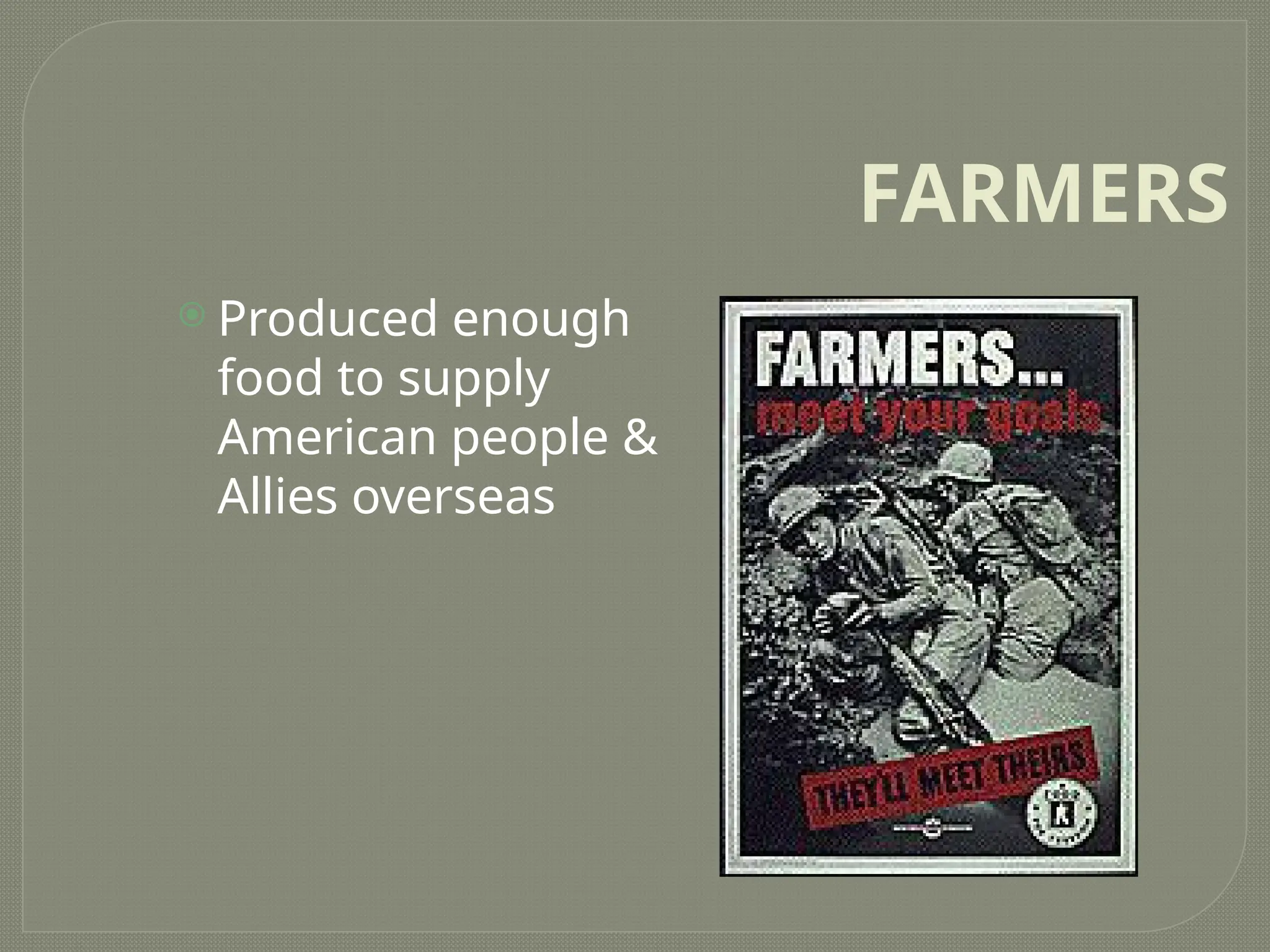
FARMERS
 Produced enough
food to supply
American people &
Allies overseas
GOVERNMENT
EXPANSION
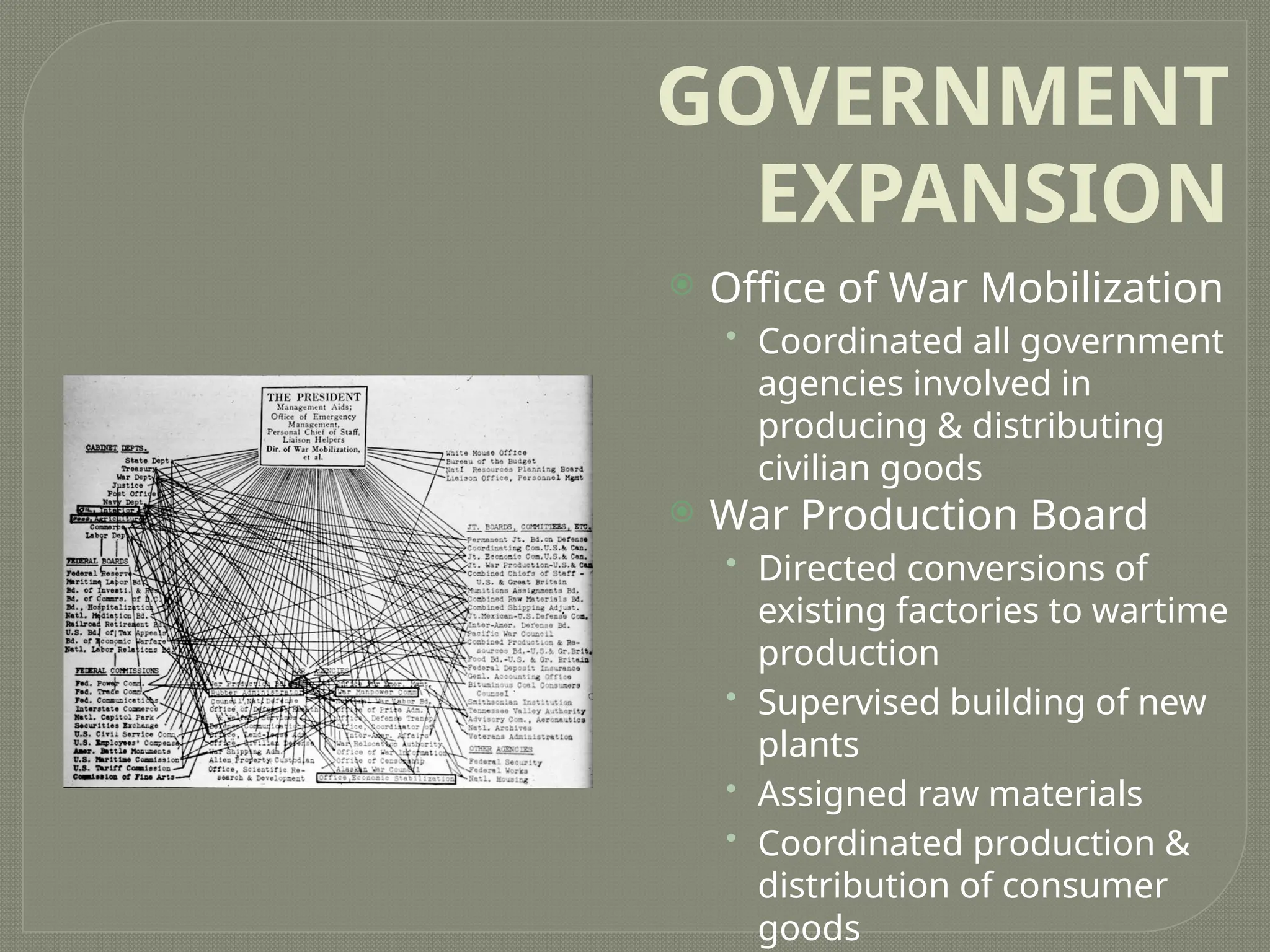
 Office of War Mobilization
• Coordinated all government
agencies involved in
producing & distributing
civilian goods
 War Production Board
• Directed conversions of
existing factories to wartime
production
• Supervised building of new
plants
• Assigned raw materials
• Coordinated production &
distribution of consumer
goods
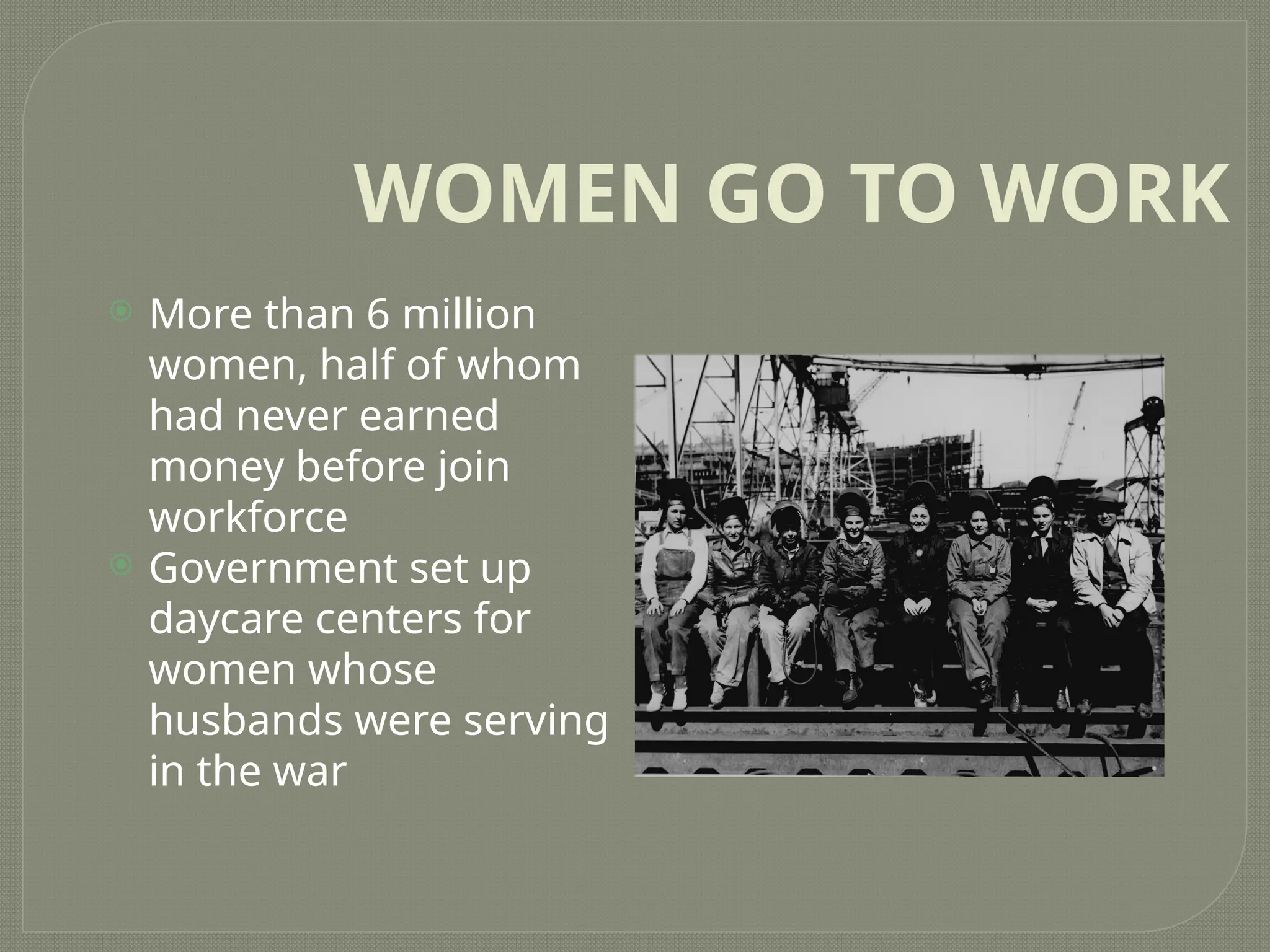
WOMEN GO TO WORK
 More than 6 million
women, half of whom
had never earned
money before join
workforce
 Government set up
daycare centers for
women whose
husbands were serving
in the war
ROSIE THE RIVETER
 Publicity campaign to
encourage women to get
jobs
• More than 5 million women
joined the labor force during
the war
 Showed that it was NOT
unfeminine to work &
would make an important
contribution to war effort
 1945 – average woman’s
pay still less than 2/3 that of
male
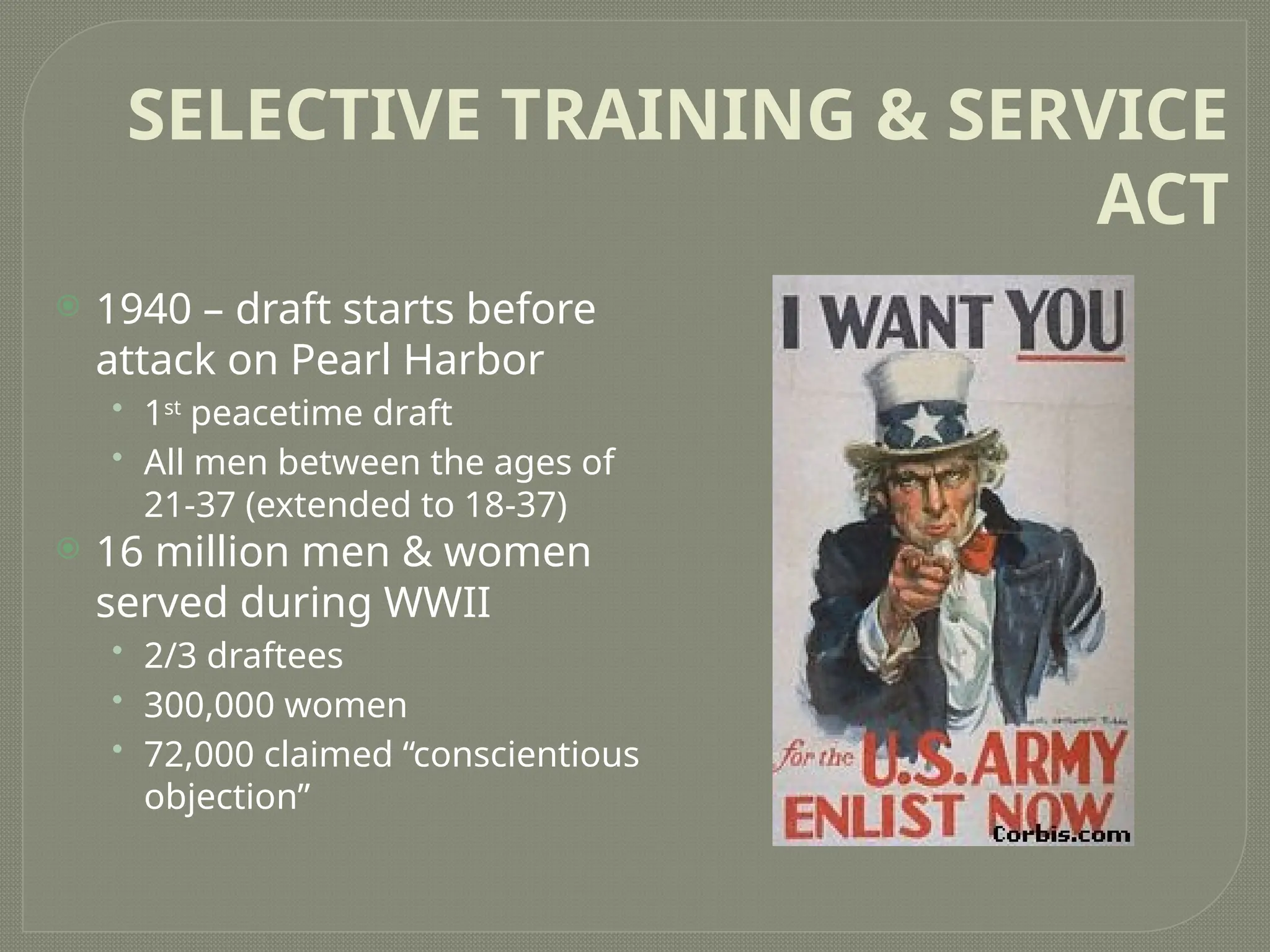
SELECTIVE TRAINING & SERVICE
ACT
 1940 – draft starts before
attack on Pearl Harbor
• 1st
peacetime draft
• All men between the ages of
21-37 (extended to 18-37)
 16 million men & women
served during WWII
• 2/3 draftees
• 300,000 women
• 72,000 claimed “conscientious
objection”
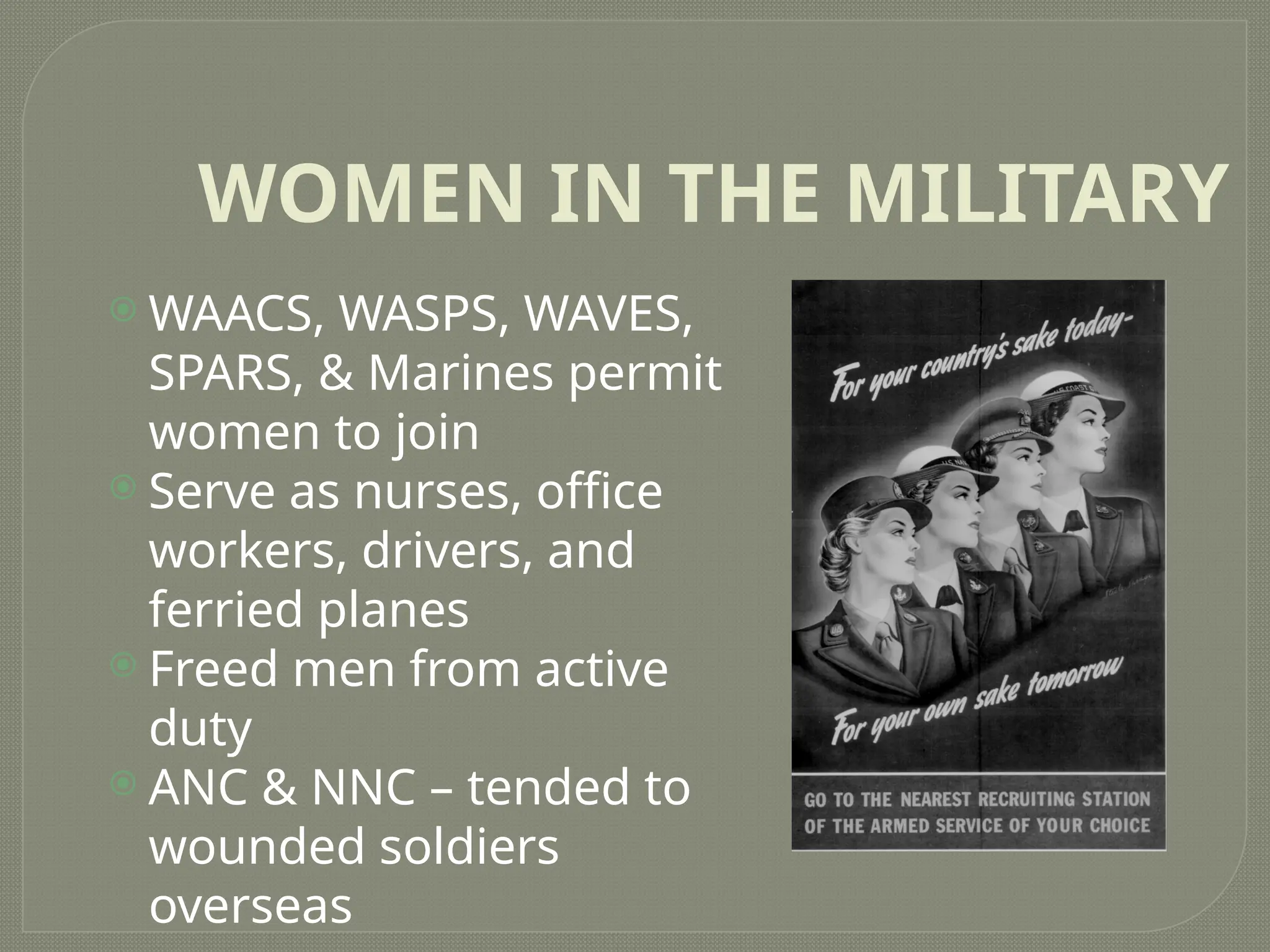
WOMEN IN THE MILITARY
 WAACS, WASPS, WAVES,
SPARS, & Marines permit
women to join
 Serve as nurses, office
workers, drivers, and
ferried planes
 Freed men from active
duty
 ANC & NNC – tended to
wounded soldiers
overseas
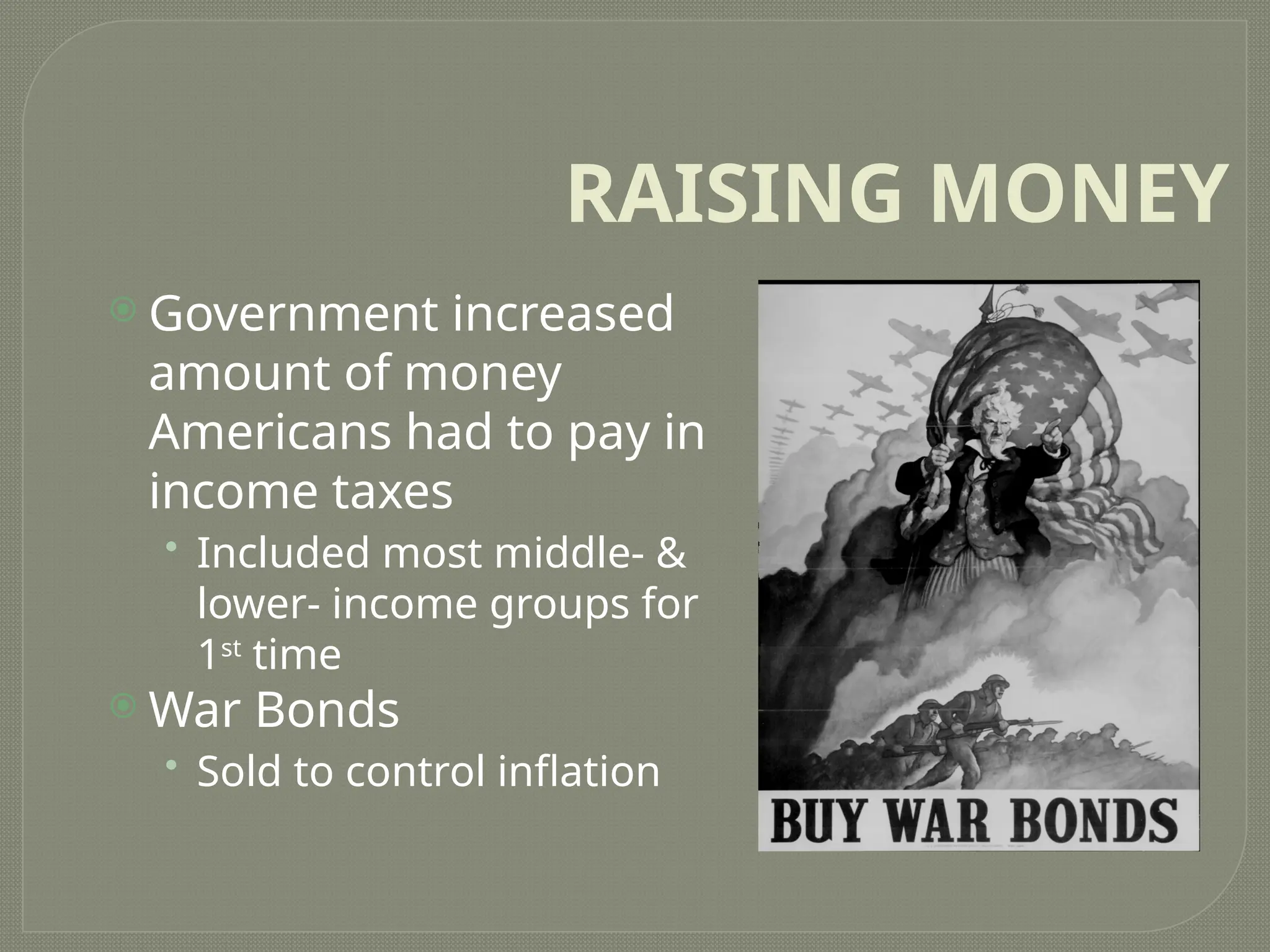
RAISING MONEY
 Government increased
amount of money
Americans had to pay in
income taxes
• Included most middle- &
lower- income groups for
1st
time
 War Bonds
• Sold to control inflation
BEGINNING OF NATIONAL
DEBT
1941 = $49 billion; 1945 = $259 billion
2/5 was pay as we go; 3/5 borrowed
New Deal + WWII = “warfare welfare”
state
OFFICE OF WAR
INFORMATION
Controlled the flow of news at home
Radio played wartime musical hits
• “Bebop” music becomes popular
• “White Christmas”
• Ban certain programs, sound effects, sirens,
etc.
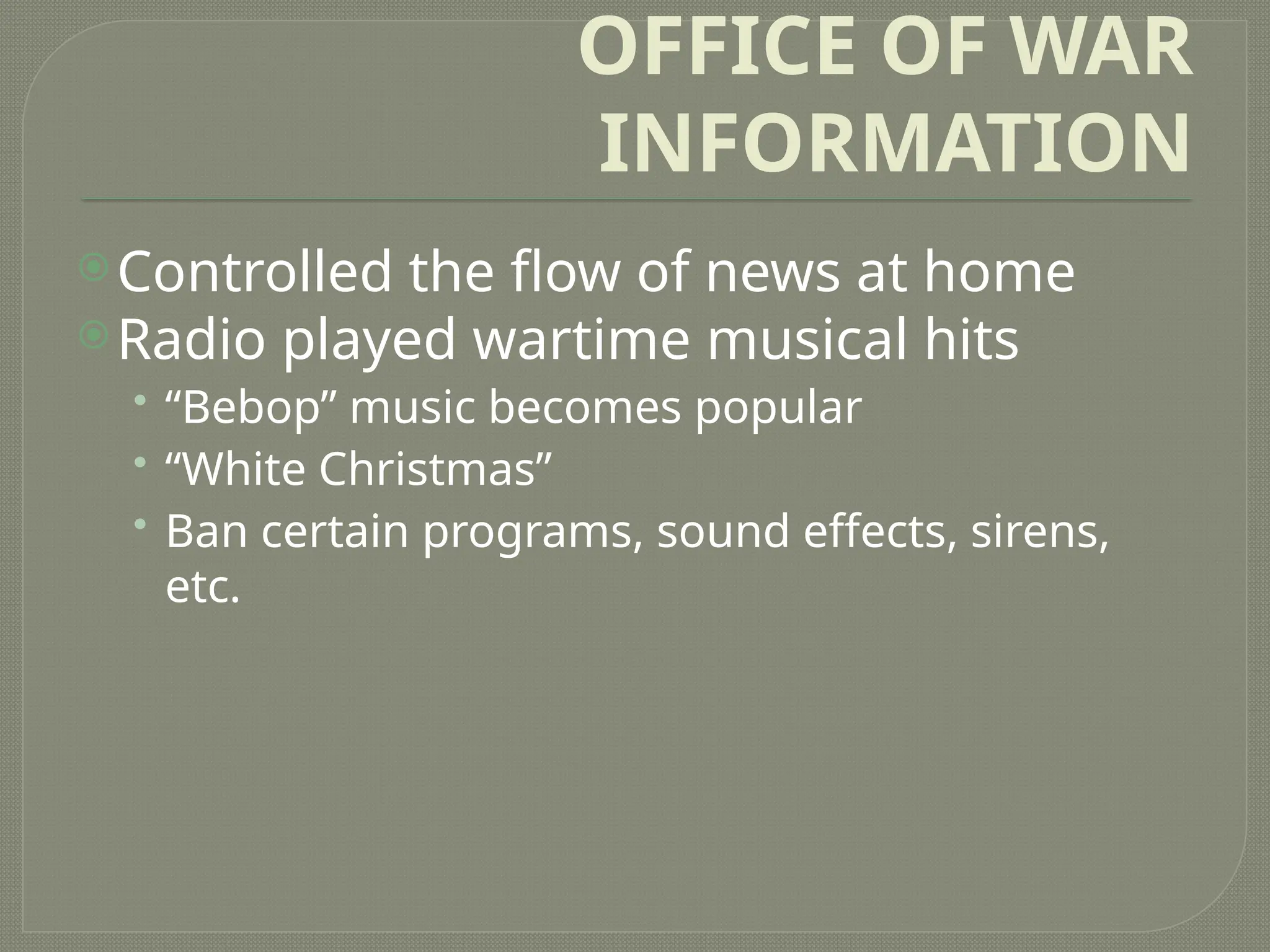
PROMOTING THE WAR
 Government encouraged media
to increase morale after
unsuccessful start
 Movies
• Movie stars advertised war bonds
• Traveled overseas to entertain the
troops
• War movies produced –
romanticized American & other
Allied soldiers
 Stereotyped Japanese, Germans, and
Italians
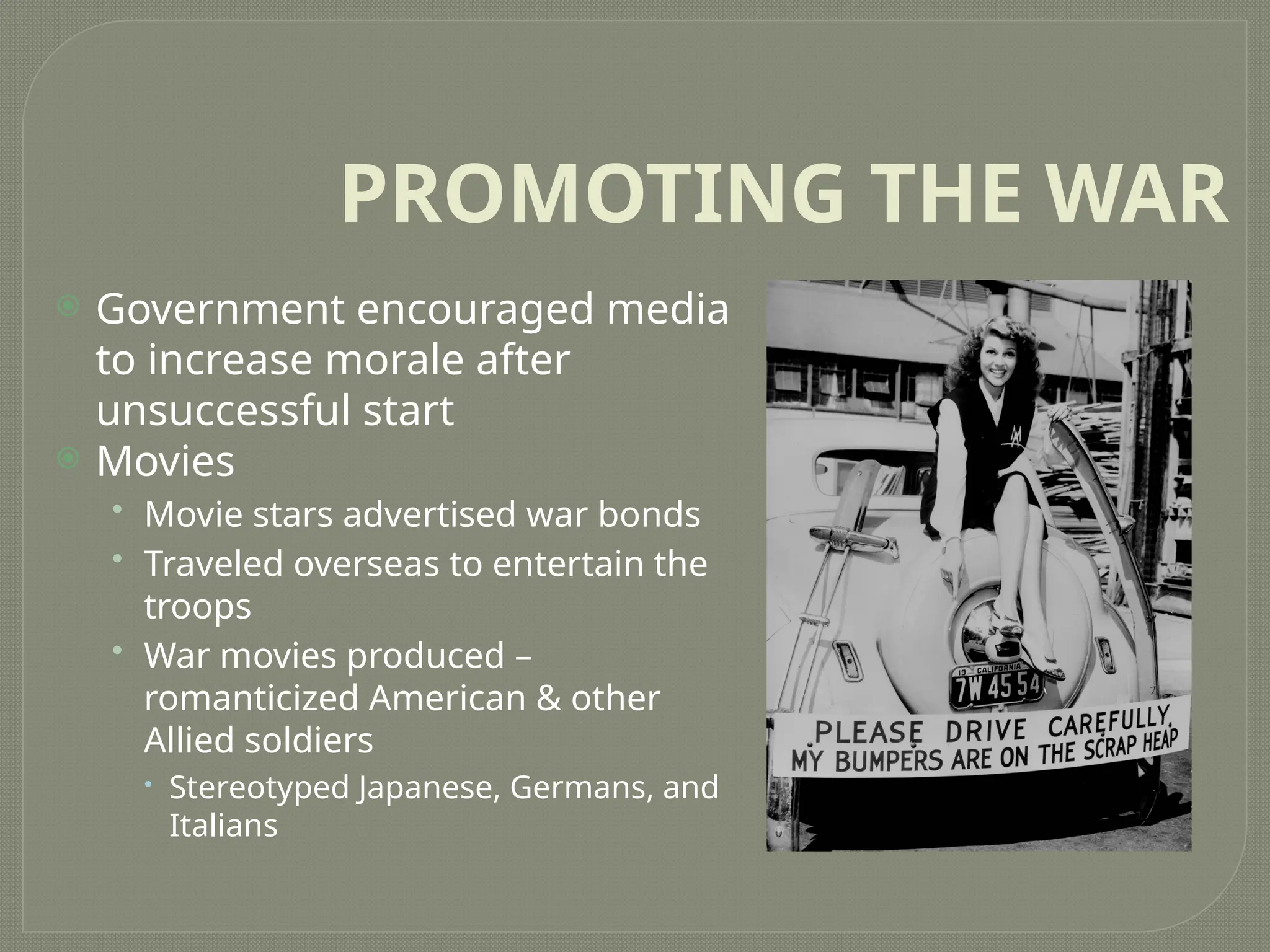
PROPOGANDA
 Comic books with
patriotic themes
 Slogans “Kick ‘Em in
the Axis” became
popular
CELEBRITIES IN THE SPOTLIGHT
 A long list of actors
fought in the war
• Paul Newman
• Kirk Douglas
• Mel Brooks
• Ed McMahon
• Walter Matthau
 Pinup Girls
• Betty Grable
• Rita Hayworth
CELEBRITY ENTERTAINERS
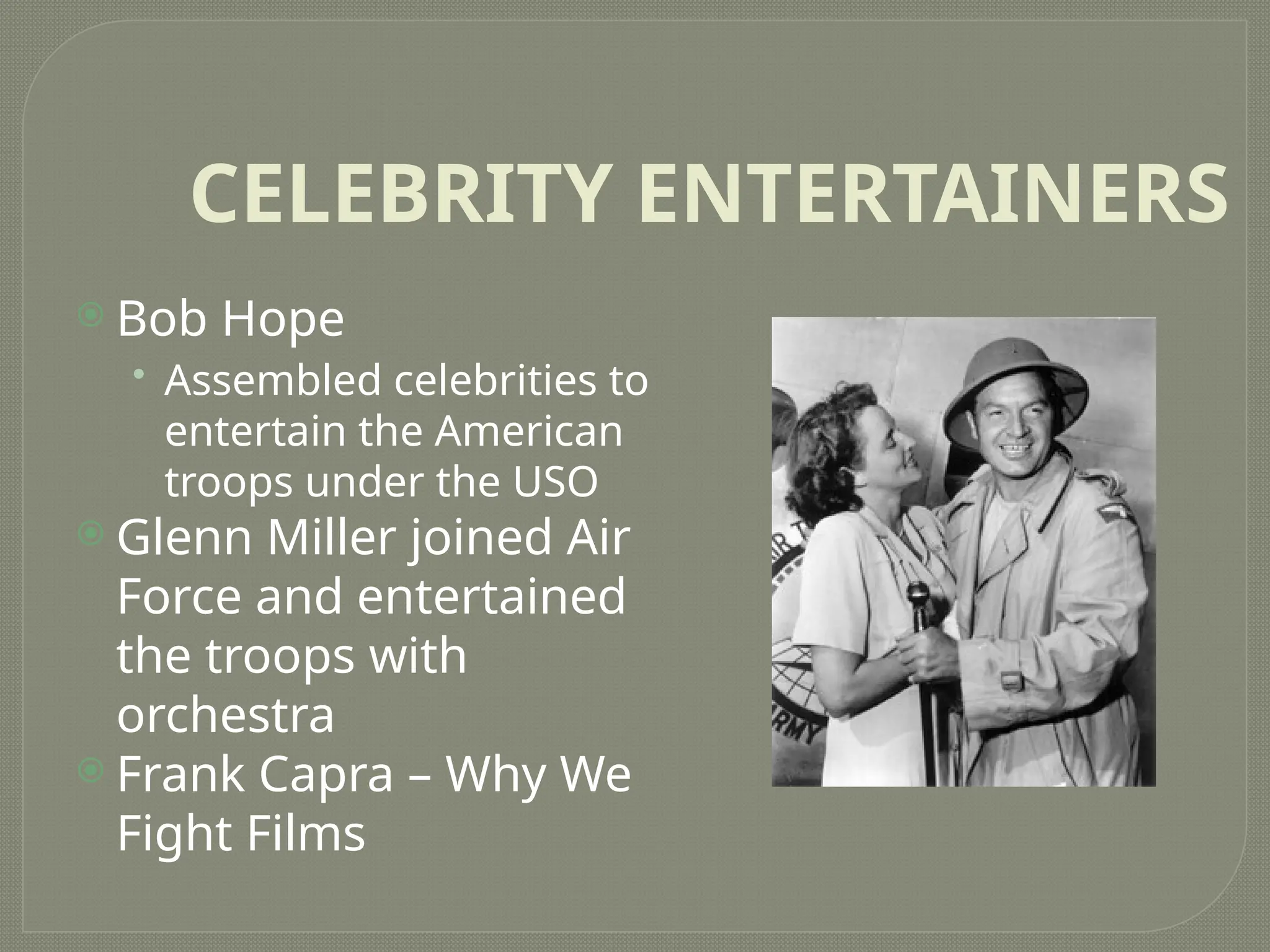
 Bob Hope
• Assembled celebrities to
entertain the American
troops under the USO
 Glenn Miller joined Air
Force and entertained
the troops with
orchestra
 Frank Capra – Why We
Fight Films
FAMOUS POLITICIANS
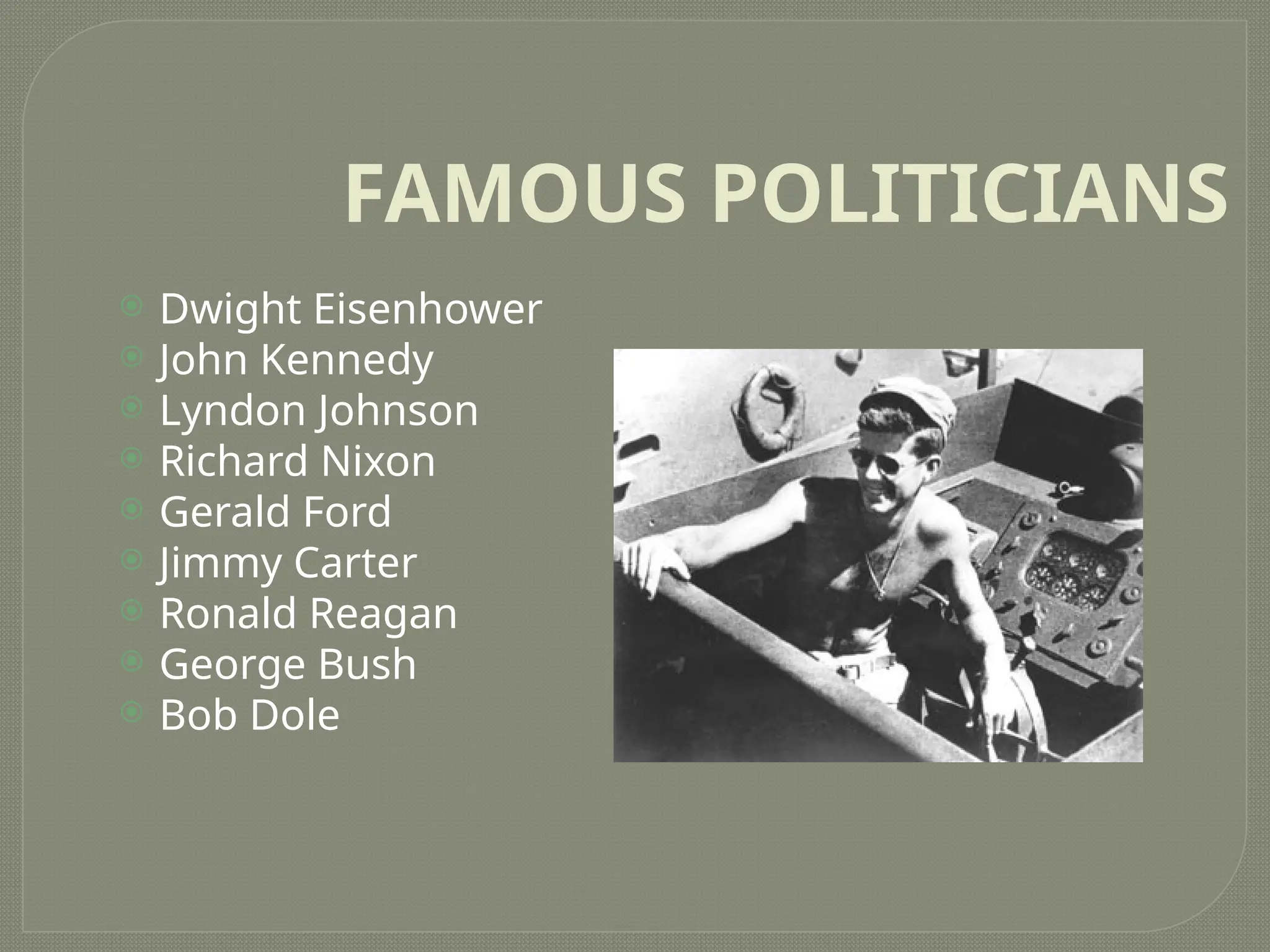
 Dwight Eisenhower
 John Kennedy
 Lyndon Johnson
 Richard Nixon
 Gerald Ford
 Jimmy Carter
 Ronald Reagan
 George Bush
 Bob Dole
PATRIOTISM
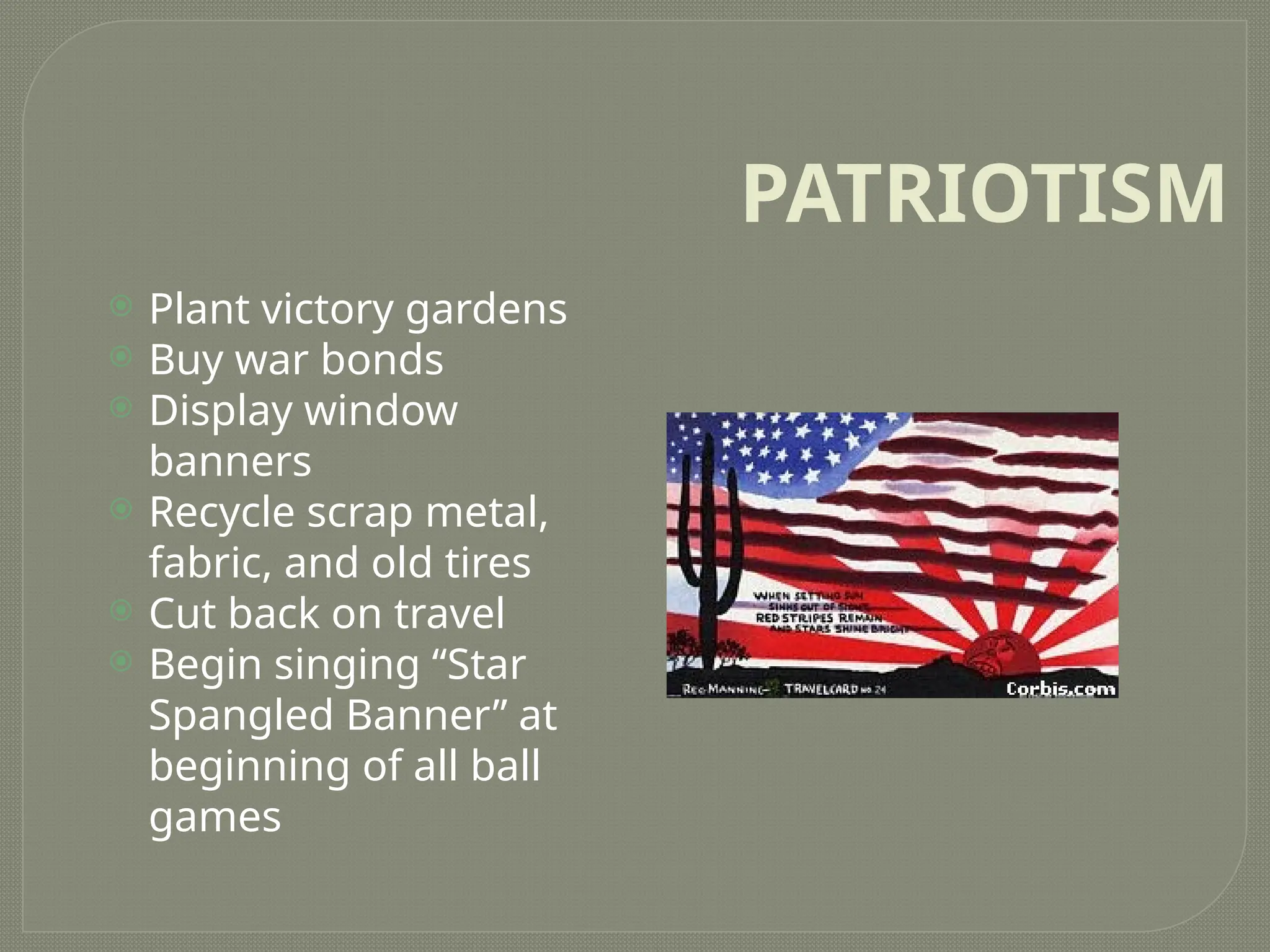
 Plant victory gardens
 Buy war bonds
 Display window
banners
 Recycle scrap metal,
fabric, and old tires
 Cut back on travel
 Begin singing “Star
Spangled Banner” at
beginning of all ball
games
RATIONING – OFFICE OF
ECONOMIC STABILIZATION
 Reduced demand by
limiting what and how
much people could buy
 Cut civilian purchases
needed for war effort
• Gasoline, heating fuel,
tires, coffee, sugar, meat,
butter, canned goods
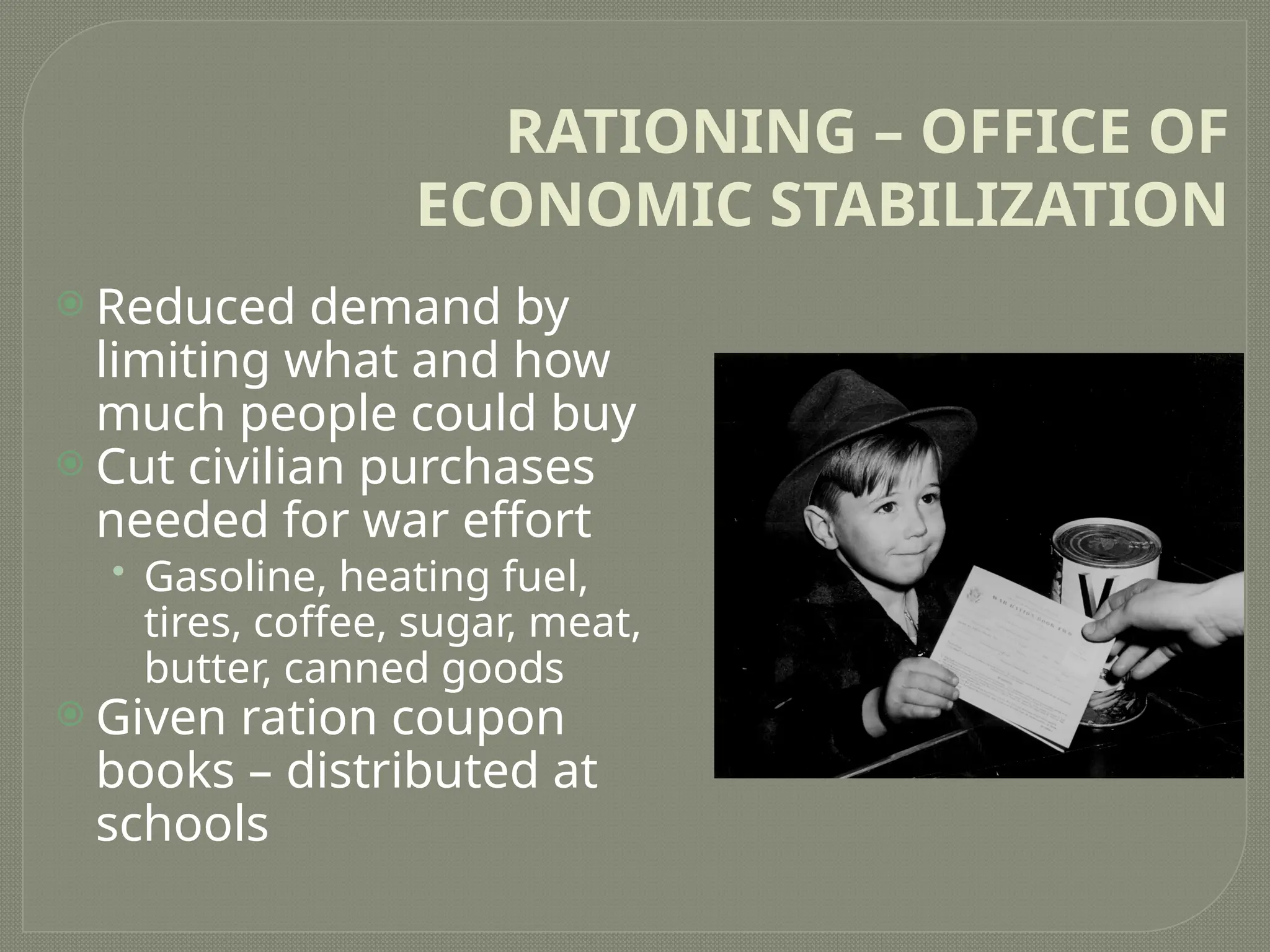
 Given ration coupon
books – distributed at
schools
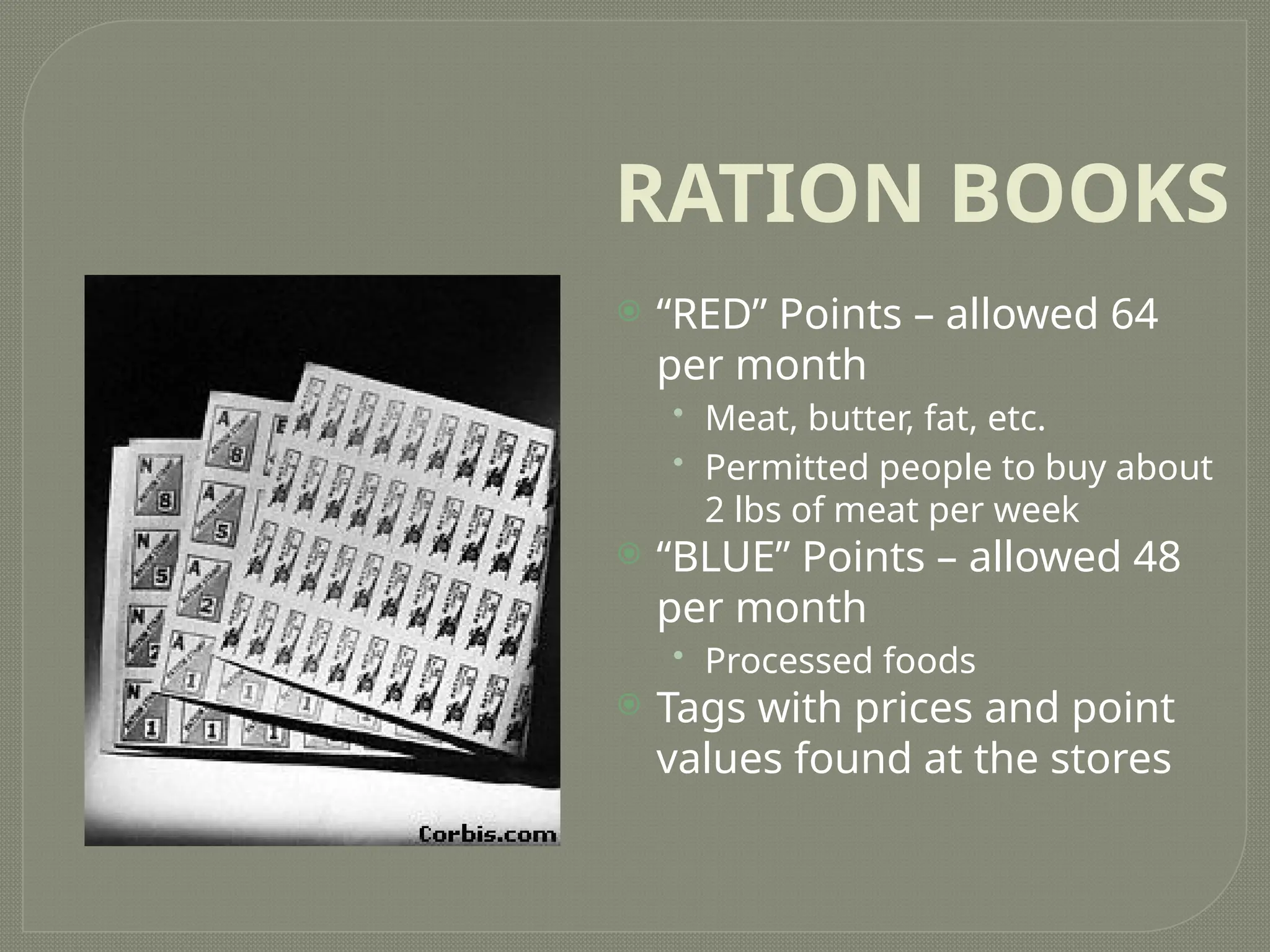
RATION BOOKS
 “RED” Points – allowed 64
per month
• Meat, butter, fat, etc.
• Permitted people to buy about
2 lbs of meat per week
 “BLUE” Points – allowed 48
per month
• Processed foods
 Tags with prices and point
values found at the stores
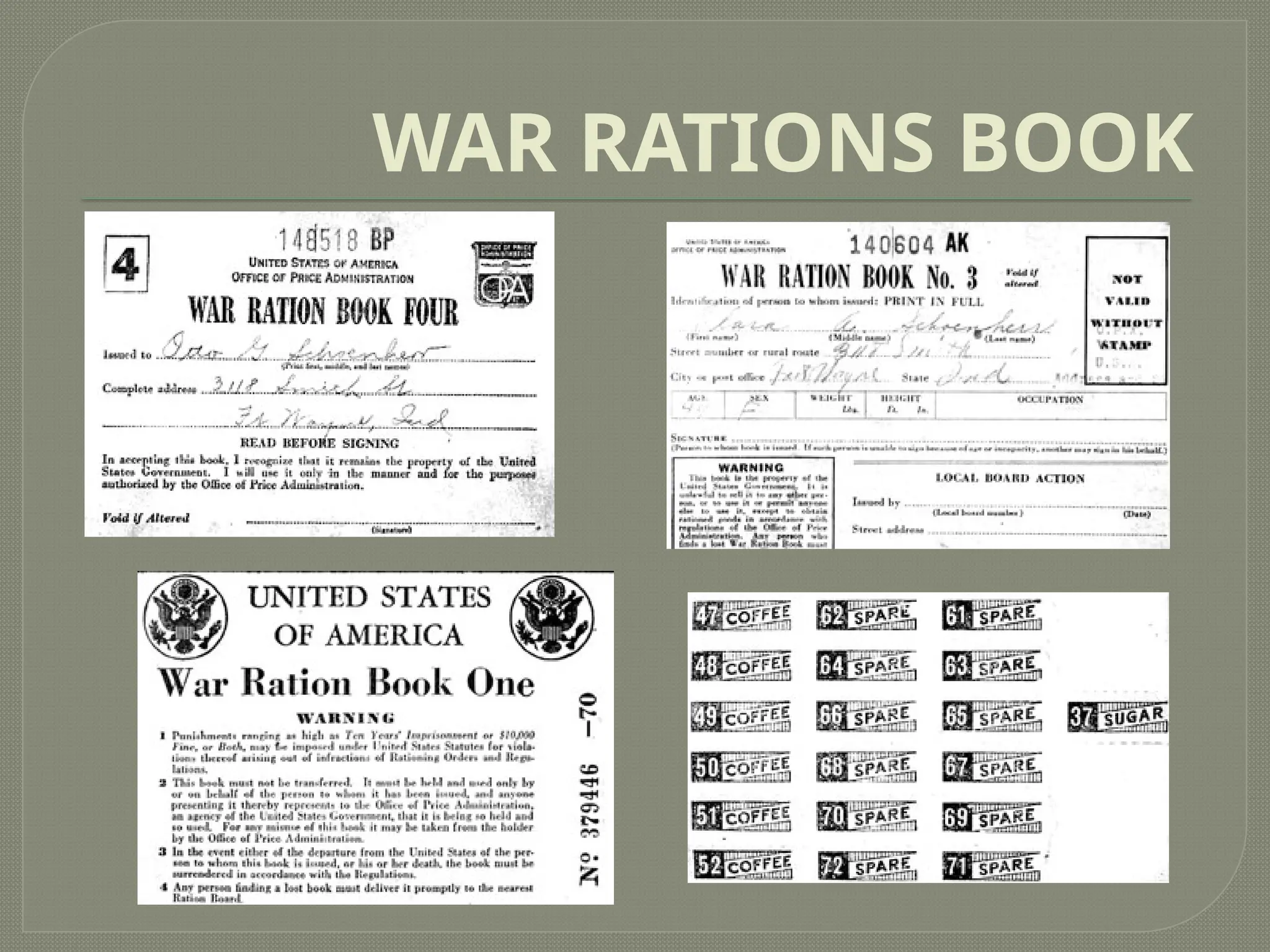
WAR RATIONS BOOK
DEMAND FOR RATIONS
BOOK
 Government imposed a
national speed limit
• Average person entitled to 4
gallons per week
• People who needed cars for
work were given more
• No limit placed on those who
provided essential services,
such as doctors
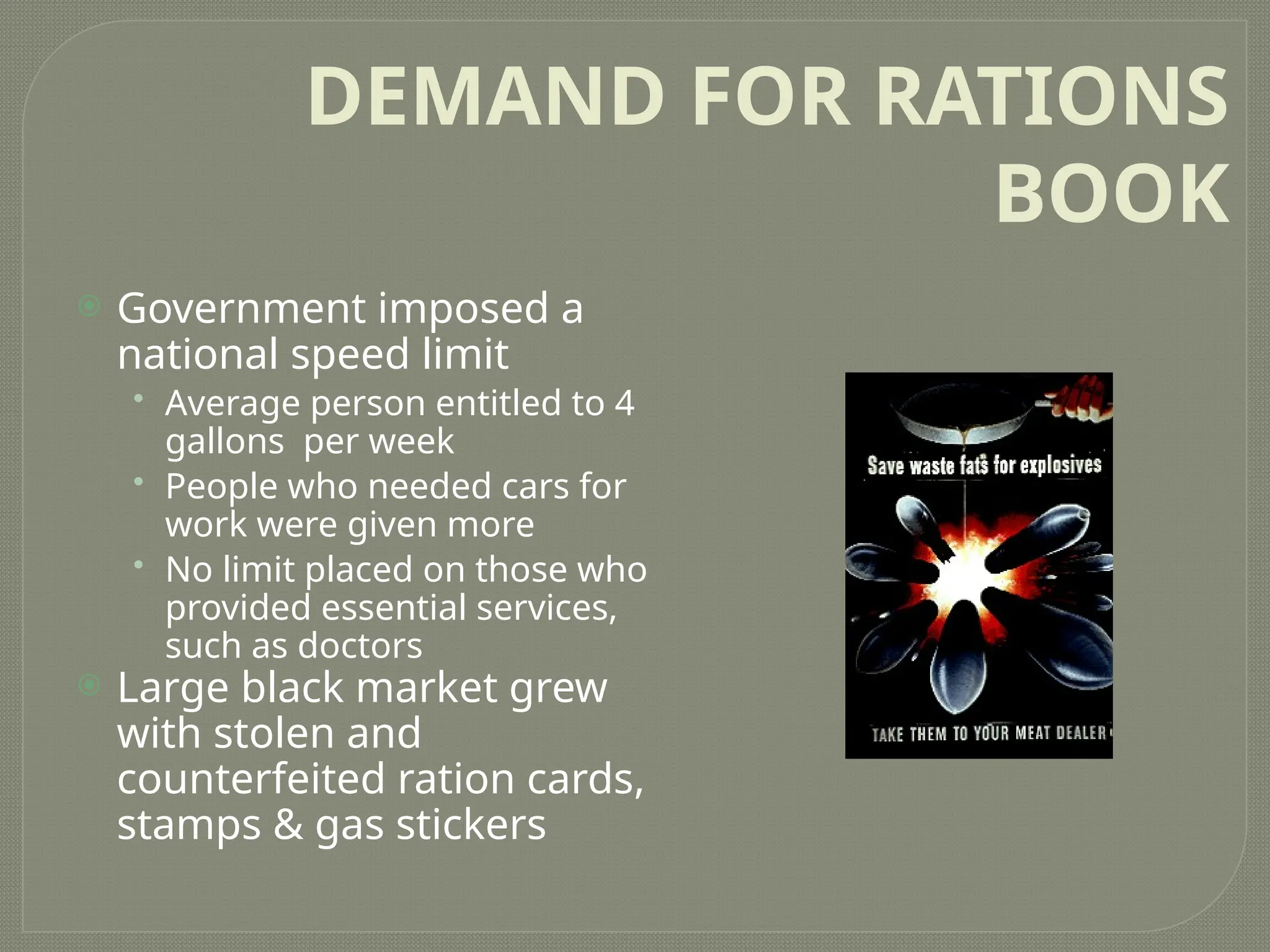
 Large black market grew
with stolen and
counterfeited ration cards,
stamps & gas stickers
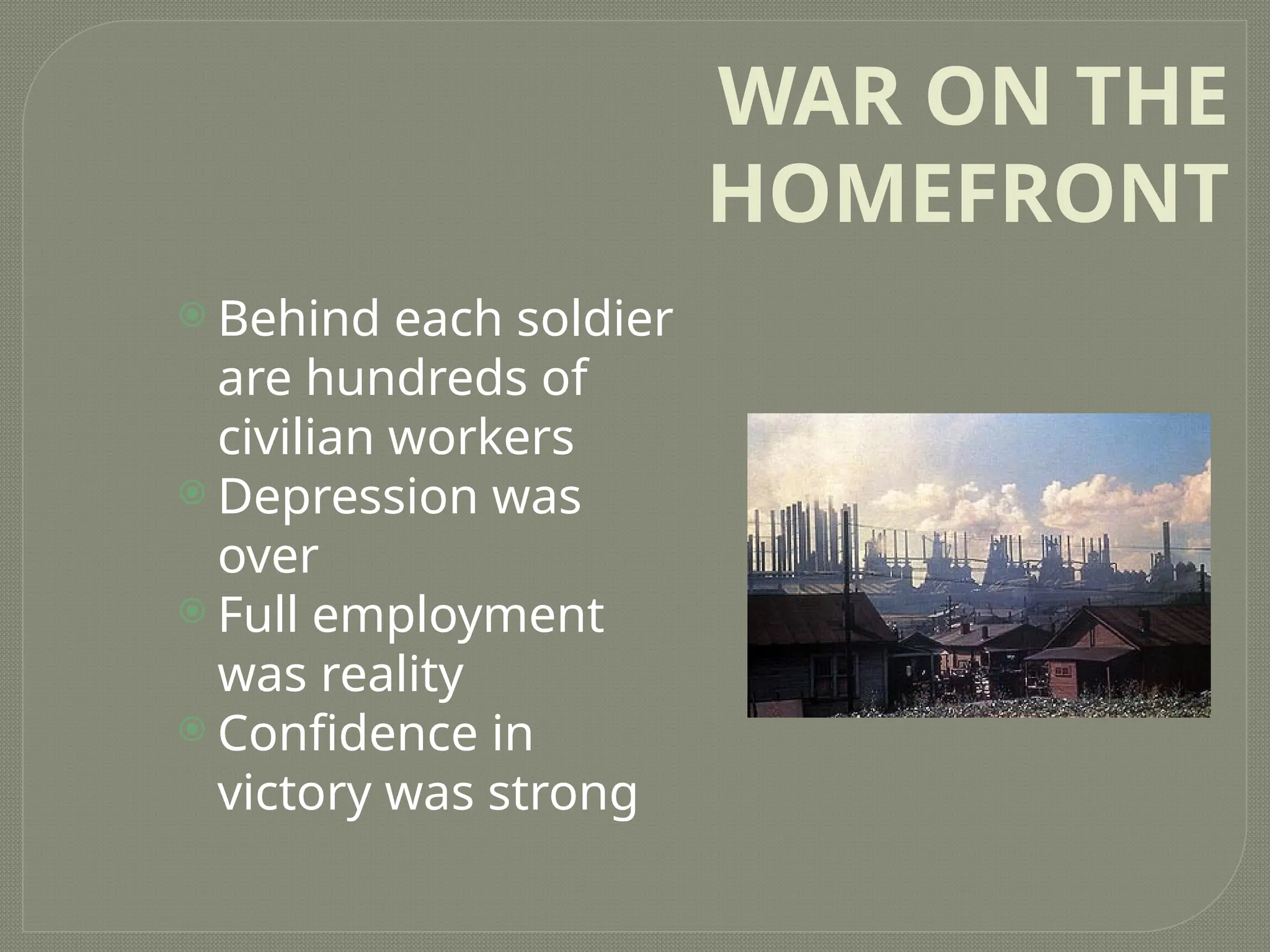
WAR ON THE
HOMEFRONT
 Behind each soldier
are hundreds of
civilian workers
 Depression was
over
 Full employment
was reality
 Confidence in
victory was strong

Mobilization of US military within the homefront

  • 1.
  • 2.
    MOBILIZATION FOR WAR U.S. had the world’s 17th largest military in 1939 • Mobilized itself for total war production almost overnight once the nation entered the war  Immediate conversion of peacetime industries into war production facilities • Toy companies manufactured compasses • Typewriter companies made rifles • Piano factories made airplane motors • Ford ceased producing cars & began turning out tanks and bombers
  • 3.
    MILITARY BUILD-UP U.S. becameAllies biggest armaments supplier 1940-1945: U.S. war plants produced millions of planes, tanks, jeeps, & guns Shipbuilders produced thousands of ships Jobless sank to fewer than 700,000 Earnings nearly doubled • Typical factory worker $25  $47 • Working overtime & brought home fat checks
  • 4.
    END OF THEWAR NUMBERS  From 1940 until Japanese surrender, U.S. produced: • More than 300,000 aircraft • 86,333 tanks • 12.5 million rifles • 107 aircraft carriers • 352 destroyers  By 1945, produced more than twice the war supplies of Germany, Italy, and Japan combined  At war’s end – military orders totaled $330 billion  National debt increased from $49 billion in 1941 to $259 billion in 1945
  • 5.
    MIGRATION 4 million peopleleft their homes for other states with industry jobs • Gulf & Pacific coasts (shipbuilding) • Midwest & West (factories)  Government spent billions of dollars to build factories & military bases  Create industrial areas that will remain after WWII
  • 6.
    FARMERS  Produced enough foodto supply American people & Allies overseas
  • 7.
    GOVERNMENT EXPANSION  Office ofWar Mobilization • Coordinated all government agencies involved in producing & distributing civilian goods  War Production Board • Directed conversions of existing factories to wartime production • Supervised building of new plants • Assigned raw materials • Coordinated production & distribution of consumer goods
  • 8.
    WOMEN GO TOWORK  More than 6 million women, half of whom had never earned money before join workforce  Government set up daycare centers for women whose husbands were serving in the war
  • 9.
    ROSIE THE RIVETER Publicity campaign to encourage women to get jobs • More than 5 million women joined the labor force during the war  Showed that it was NOT unfeminine to work & would make an important contribution to war effort  1945 – average woman’s pay still less than 2/3 that of male
  • 10.
    SELECTIVE TRAINING &SERVICE ACT  1940 – draft starts before attack on Pearl Harbor • 1st peacetime draft • All men between the ages of 21-37 (extended to 18-37)  16 million men & women served during WWII • 2/3 draftees • 300,000 women • 72,000 claimed “conscientious objection”
  • 11.
    WOMEN IN THEMILITARY  WAACS, WASPS, WAVES, SPARS, & Marines permit women to join  Serve as nurses, office workers, drivers, and ferried planes  Freed men from active duty  ANC & NNC – tended to wounded soldiers overseas
  • 12.
    RAISING MONEY  Governmentincreased amount of money Americans had to pay in income taxes • Included most middle- & lower- income groups for 1st time  War Bonds • Sold to control inflation
  • 13.
    BEGINNING OF NATIONAL DEBT 1941= $49 billion; 1945 = $259 billion 2/5 was pay as we go; 3/5 borrowed New Deal + WWII = “warfare welfare” state
  • 14.
    OFFICE OF WAR INFORMATION Controlledthe flow of news at home Radio played wartime musical hits • “Bebop” music becomes popular • “White Christmas” • Ban certain programs, sound effects, sirens, etc.
  • 15.
    PROMOTING THE WAR Government encouraged media to increase morale after unsuccessful start  Movies • Movie stars advertised war bonds • Traveled overseas to entertain the troops • War movies produced – romanticized American & other Allied soldiers  Stereotyped Japanese, Germans, and Italians
  • 16.
    PROPOGANDA  Comic bookswith patriotic themes  Slogans “Kick ‘Em in the Axis” became popular
  • 17.
    CELEBRITIES IN THESPOTLIGHT  A long list of actors fought in the war • Paul Newman • Kirk Douglas • Mel Brooks • Ed McMahon • Walter Matthau  Pinup Girls • Betty Grable • Rita Hayworth
  • 18.
    CELEBRITY ENTERTAINERS  BobHope • Assembled celebrities to entertain the American troops under the USO  Glenn Miller joined Air Force and entertained the troops with orchestra  Frank Capra – Why We Fight Films
  • 19.
    FAMOUS POLITICIANS  DwightEisenhower  John Kennedy  Lyndon Johnson  Richard Nixon  Gerald Ford  Jimmy Carter  Ronald Reagan  George Bush  Bob Dole
  • 20.
    PATRIOTISM  Plant victorygardens  Buy war bonds  Display window banners  Recycle scrap metal, fabric, and old tires  Cut back on travel  Begin singing “Star Spangled Banner” at beginning of all ball games
  • 21.
    RATIONING – OFFICEOF ECONOMIC STABILIZATION  Reduced demand by limiting what and how much people could buy  Cut civilian purchases needed for war effort • Gasoline, heating fuel, tires, coffee, sugar, meat, butter, canned goods  Given ration coupon books – distributed at schools
  • 22.
    RATION BOOKS  “RED”Points – allowed 64 per month • Meat, butter, fat, etc. • Permitted people to buy about 2 lbs of meat per week  “BLUE” Points – allowed 48 per month • Processed foods  Tags with prices and point values found at the stores
  • 23.
  • 24.
    DEMAND FOR RATIONS BOOK Government imposed a national speed limit • Average person entitled to 4 gallons per week • People who needed cars for work were given more • No limit placed on those who provided essential services, such as doctors  Large black market grew with stolen and counterfeited ration cards, stamps & gas stickers
  • 25.
    WAR ON THE HOMEFRONT Behind each soldier are hundreds of civilian workers  Depression was over  Full employment was reality  Confidence in victory was strong