African
Kingdoms
SSWH6a
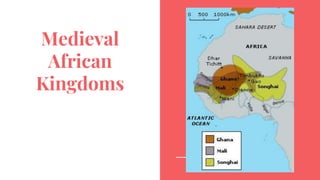
Medieval
African
Kingdoms
Medieval African Kingdoms
● States emerged in West Africa with the arrival of the domesticated camel in
third century CE.
● With the camel as a beast of burden and war, lucrative trade developed across
the Sahara Desert.
● Salt and manufactured goods were transported south and gold, kola nuts, and
forest products were transported north.
● Merchants meet in the Sahel region just south of the Sahara Desert.
● This region was inhabited by the Soninke, and agricultural people ruled by a
warrior chief called the Ghana.
Kingdom of Ghana
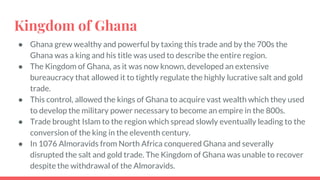
● Ghana grew wealthy and powerful by taxing this trade and by the 700s the
Ghana was a king and his title was used to describe the entire region.
● The Kingdom of Ghana, as it was now known, developed an extensive
bureaucracy that allowed it to tightly regulate the highly lucrative salt and gold
trade.
● This control, allowed the kings of Ghana to acquire vast wealth which they used
to develop the military power necessary to become an empire in the 800s.
● Trade brought Islam to the region which spread slowly eventually leading to the
conversion of the king in the eleventh century.
● In 1076 Almoravids from North Africa conquered Ghana and severally
disrupted the salt and gold trade. The Kingdom of Ghana was unable to recover
despite the withdrawal of the Almoravids.
Kingdom of Ghana
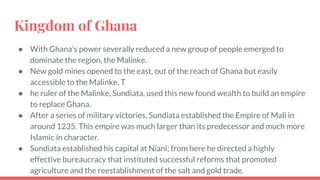
● With Ghana’s power severally reduced a new group of people emerged to
dominate the region, the Malinke.
● New gold mines opened to the east, out of the reach of Ghana but easily
accessible to the Malinke. T
● he ruler of the Malinke, Sundiata, used this new found wealth to build an empire
to replace Ghana.
● After a series of military victories, Sundiata established the Empire of Mali in
around 1235. This empire was much larger than its predecessor and much more
Islamic in character.
● Sundiata established his capital at Niani; from here he directed a highly
effective bureaucracy that instituted successful reforms that promoted
agriculture and the reestablishment of the salt and gold trade.
Mansa Musa
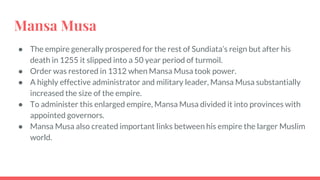
● The empire generally prospered for the rest of Sundiata’s reign but after his
death in 1255 it slipped into a 50 year period of turmoil.
● Order was restored in 1312 when Mansa Musa took power.
● A highly effective administrator and military leader, Mansa Musa substantially
increased the size of the empire.
● To administer this enlarged empire, Mansa Musa divided it into provinces with
appointed governors.
● Mansa Musa also created important links between his empire the larger Muslim
world.
Mansa Musa
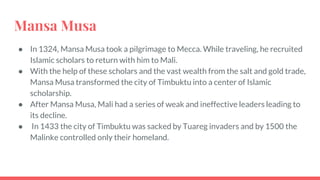
● In 1324, Mansa Musa took a pilgrimage to Mecca. While traveling, he recruited
Islamic scholars to return with him to Mali.
● With the help of these scholars and the vast wealth from the salt and gold trade,
Mansa Musa transformed the city of Timbuktu into a center of Islamic
scholarship.
● After Mansa Musa, Mali had a series of weak and ineffective leaders leading to
its decline.
● In 1433 the city of Timbuktu was sacked by Tuareg invaders and by 1500 the
Malinke controlled only their homeland.
Songhai Kingdom
● The Songhai people stepped into the power vacuum left by the decline of Mali.
Like Ghana and Mali, the Songhai used the wealth from the salt and gold trade
to build a vast Islamic empire in 1464.
● This wealth paid for a highly effective professional military equipped with
cavalry and freshwater naval units. The Songhai Empire surpassed Mali in size.
● To administer this territory the emperor established a highly centralized
bureaucracy with ministries of the treasury, army, navy and agriculture.
● Technological advances made in the heart of the Islamic world proved to be
Songhai’s undoing.
● Gunpowder diffused across the Silk Road and Muslim armies in the Middle East
weaponized it. In 1591 a Moroccan army equipped with cannon and muskets
invaded and defeated Songhai.

African kingdoms ssush6a

  • 1.
  • 2.
  • 3.
    Medieval African Kingdoms ●States emerged in West Africa with the arrival of the domesticated camel in third century CE. ● With the camel as a beast of burden and war, lucrative trade developed across the Sahara Desert. ● Salt and manufactured goods were transported south and gold, kola nuts, and forest products were transported north. ● Merchants meet in the Sahel region just south of the Sahara Desert. ● This region was inhabited by the Soninke, and agricultural people ruled by a warrior chief called the Ghana.
  • 4.
    Kingdom of Ghana ●Ghana grew wealthy and powerful by taxing this trade and by the 700s the Ghana was a king and his title was used to describe the entire region. ● The Kingdom of Ghana, as it was now known, developed an extensive bureaucracy that allowed it to tightly regulate the highly lucrative salt and gold trade. ● This control, allowed the kings of Ghana to acquire vast wealth which they used to develop the military power necessary to become an empire in the 800s. ● Trade brought Islam to the region which spread slowly eventually leading to the conversion of the king in the eleventh century. ● In 1076 Almoravids from North Africa conquered Ghana and severally disrupted the salt and gold trade. The Kingdom of Ghana was unable to recover despite the withdrawal of the Almoravids.
  • 5.
    Kingdom of Ghana ●With Ghana’s power severally reduced a new group of people emerged to dominate the region, the Malinke. ● New gold mines opened to the east, out of the reach of Ghana but easily accessible to the Malinke. T ● he ruler of the Malinke, Sundiata, used this new found wealth to build an empire to replace Ghana. ● After a series of military victories, Sundiata established the Empire of Mali in around 1235. This empire was much larger than its predecessor and much more Islamic in character. ● Sundiata established his capital at Niani; from here he directed a highly effective bureaucracy that instituted successful reforms that promoted agriculture and the reestablishment of the salt and gold trade.
  • 6.
    Mansa Musa ● Theempire generally prospered for the rest of Sundiata’s reign but after his death in 1255 it slipped into a 50 year period of turmoil. ● Order was restored in 1312 when Mansa Musa took power. ● A highly effective administrator and military leader, Mansa Musa substantially increased the size of the empire. ● To administer this enlarged empire, Mansa Musa divided it into provinces with appointed governors. ● Mansa Musa also created important links between his empire the larger Muslim world.
  • 7.
    Mansa Musa ● In1324, Mansa Musa took a pilgrimage to Mecca. While traveling, he recruited Islamic scholars to return with him to Mali. ● With the help of these scholars and the vast wealth from the salt and gold trade, Mansa Musa transformed the city of Timbuktu into a center of Islamic scholarship. ● After Mansa Musa, Mali had a series of weak and ineffective leaders leading to its decline. ● In 1433 the city of Timbuktu was sacked by Tuareg invaders and by 1500 the Malinke controlled only their homeland.
  • 9.
    Songhai Kingdom ● TheSonghai people stepped into the power vacuum left by the decline of Mali. Like Ghana and Mali, the Songhai used the wealth from the salt and gold trade to build a vast Islamic empire in 1464. ● This wealth paid for a highly effective professional military equipped with cavalry and freshwater naval units. The Songhai Empire surpassed Mali in size. ● To administer this territory the emperor established a highly centralized bureaucracy with ministries of the treasury, army, navy and agriculture. ● Technological advances made in the heart of the Islamic world proved to be Songhai’s undoing. ● Gunpowder diffused across the Silk Road and Muslim armies in the Middle East weaponized it. In 1591 a Moroccan army equipped with cannon and muskets invaded and defeated Songhai.