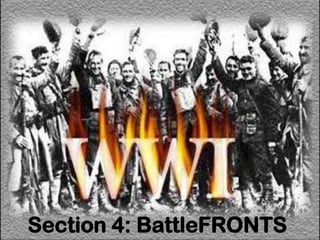
Section 4: BattleFRONTS
Support for War
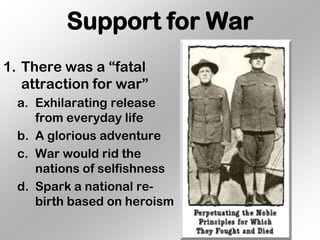
1. There was a “fatal
   attraction for war”
  a. Exhilarating release
     from everyday life
  b. A glorious adventure
  c. War would rid the
     nations of selfishness
  d. Spark a national re-
     birth based on heroism
Support for War
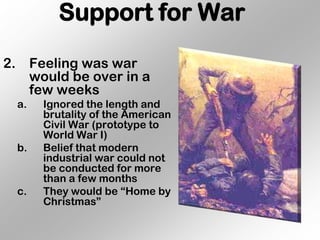
2. Feeling was war
   would be over in a
   few weeks
  a.   Ignored the length and
       brutality of the American
       Civil War (prototype to
       World War I)
  b.   Belief that modern
       industrial war could not
       be conducted for more
       than a few months
  c.   They would be “Home by
       Christmas”
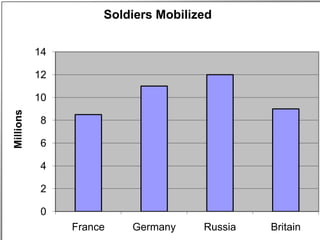
Soldiers Mobilized

           14

           12

           10
Millions


            8

            6

            4

            2

            0
                France   Germany     Russia   Britain
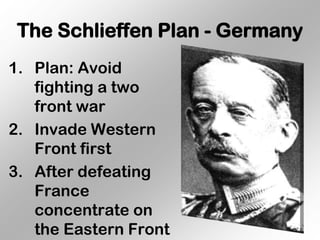
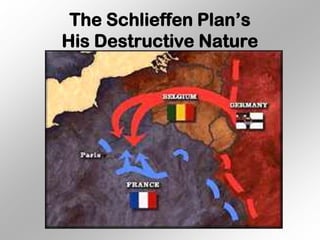
The Schlieffen Plan - Germany
1. Plan: Avoid
   fighting a two
   front war
2. Invade Western
   Front first
3. After defeating
   France
   concentrate on
   the Eastern Front
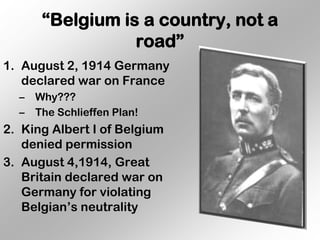
“Belgium is a country, not a
                  road”
1. August 2, 1914 Germany
   declared war on France
  –   Why???
  –   The Schlieffen Plan!
2. King Albert I of Belgium
   denied permission
3. August 4,1914, Great
   Britain declared war on
   Germany for violating
   Belgian’s neutrality
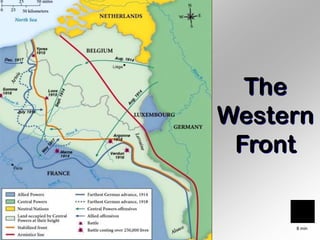
The Schlieffen Plan’s
His Destructive Nature
The
Western
 Front


     8 min
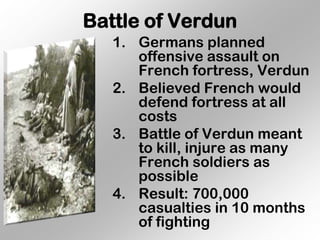
Battle of Verdun
   1. Germans planned
      offensive assault on
      French fortress, Verdun
   2. Believed French would
      defend fortress at all
      costs
   3. Battle of Verdun meant
      to kill, injure as many
      French soldiers as
      possible
   4. Result: 700,000
      casualties in 10 months
      of fighting
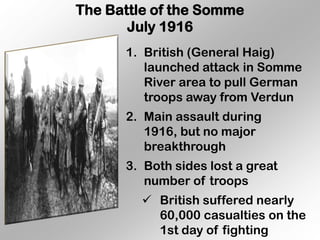
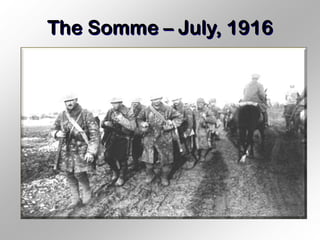
The Battle of the Somme
       July 1916
      1. British (General Haig)
         launched attack in Somme
         River area to pull German
         troops away from Verdun
      2. Main assault during
         1916, but no major
         breakthrough
      3. Both sides lost a great
         number of troops
          British suffered nearly
           60,000 casualties on the
           1st day of fighting
The Somme – July, 1916
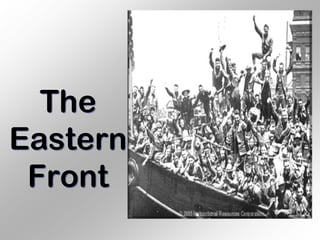
The
Eastern
 Front
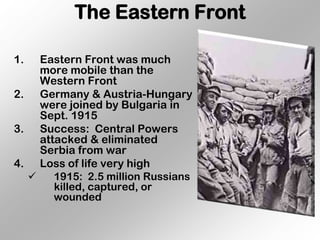
The Eastern Front

1.  Eastern Front was much
    more mobile than the
    Western Front
2. Germany & Austria-Hungary
    were joined by Bulgaria in
    Sept. 1915
3. Success: Central Powers
    attacked & eliminated
    Serbia from war
4. Loss of life very high
      1915: 2.5 million Russians
       killed, captured, or
       wounded
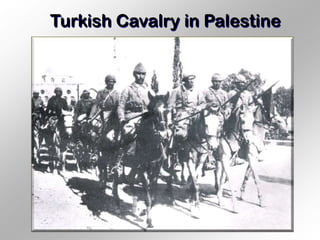
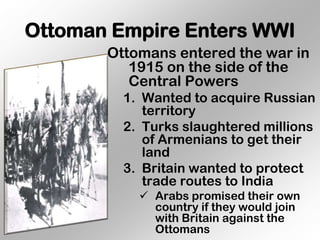
Turkish Cavalry in Palestine
Ottoman Empire Enters WWI
       Ottomans entered the war in
          1915 on the side of the
          Central Powers
         1. Wanted to acquire Russian
            territory
         2. Turks slaughtered millions
            of Armenians to get their
            land
         3. Britain wanted to protect
            trade routes to India
            Arabs promised their own
             country if they would join
             with Britain against the
             Ottomans
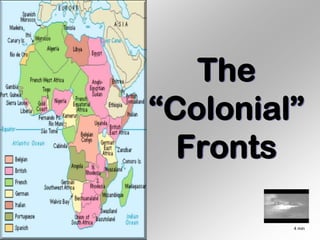
The
“Colonial”
  Fronts

         4 min
The Colonial Front
1.   Africa is the forgotten front of World War I
2.   World War I started in Africa in 1914
3.   Largest war of its times on African soil
4.   French trading post in West Central Africa found
     itself at odds with a formerly peaceful German
     post
       For no other reason than their parent countries were
       at war
5. The Allied failed in their attempt to defeat Central
   Powers on the Colonial Front
6. Conflict on the Colonial Front ended in 1918
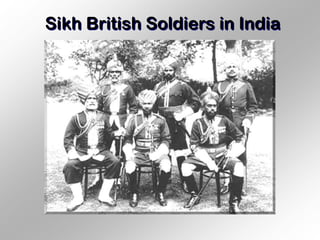
Sikh British Soldiers in India
Fighting in Africa


                      Black Soldiers in the
                            German
                        Schutztruppen
                       [German E. Africa]


  British Sikh
Mountain Gunners
Fighting in Africa


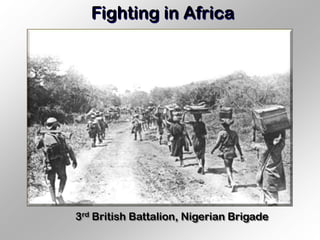
3rd British Battalion, Nigerian Brigade
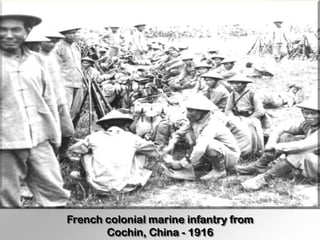
French colonial marine infantry from
       Cochin, China - 1916
War on the Home Fronts
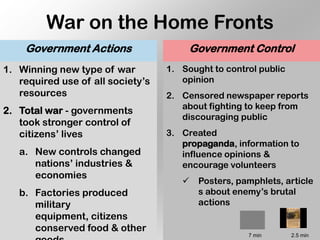
    Government Actions                  Government Control
1. Winning new type of war         1. Sought to control public
   required use of all society’s      opinion
   resources                       2. Censored newspaper reports
                                      about fighting to keep from
2. Total war - governments
                                      discouraging public
   took stronger control of
   citizens’ lives                 3. Created
                                      propaganda, information to
   a. New controls changed            influence opinions &
      nations’ industries &           encourage volunteers
      economies
                                         Posters, pamphlets, article
   b. Factories produced                  s about enemy’s brutal
      military                            actions
      equipment, citizens
      conserved food & other
                                                     7 min       2.5 min
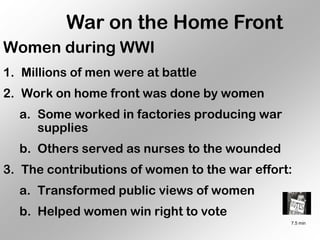
War on the Home Front
Women during WWI
1. Millions of men were at battle
2. Work on home front was done by women
  a. Some worked in factories producing war
     supplies
  b. Others served as nurses to the wounded
3. The contributions of women to the war effort:
  a. Transformed public views of women
  b. Helped women win right to vote
                                               7.5 min
The War at Sea
1. The U-Boat threat to          If a boat was
   Britain meant that vital       bombed at
   supplies were not              sea, troops &
   arriving, leaving people       supplies would
   in Britain losing faith in     not arrive for
   the war and illness            those fighting and
   increased                      also the people in
2. A British Blockade             Britain would be
   meant German                   starved for
   supplies were not              supplies.
   arriving as well.
3. People still at home, as
   well as those
   fighting, were suffering
   because of the war at                          3.75 min
10 min


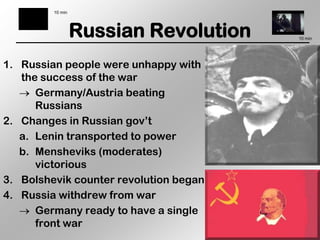
                  Russian Revolution    10 min


1. Russian people were unhappy with
   the success of the war
      Germany/Austria beating
      Russians
2. Changes in Russian gov’t
   a. Lenin transported to power
   b. Mensheviks (moderates)
      victorious
3. Bolshevik counter revolution began
4. Russia withdrew from war
      Germany ready to have a single
      front war
War around the World
1. WWI was also fought in Asia & Africa
2. Japan declared war on Germany
  a. Part of military agreement with Great Britain
  b. Japanese captured German colonies in China
3. British & French attacked German colonies in
   Africa
4. Allied Colonies scattered around world made
   contributions to war
  a. Some colonists worked as laborers to keep armies
     supplied
  b. Others fought in battles in hopes of winning
     independence - Hopes were in vain
5. Over 30 nations officially took sides in WWI
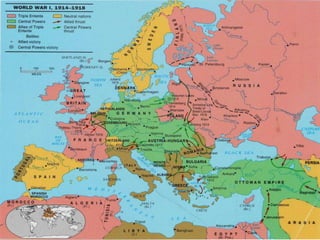
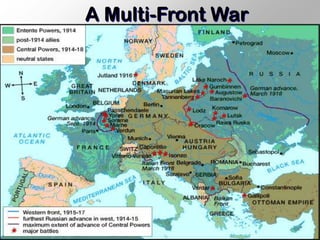
A Multi-Front War

Wwi battle fronts4

  • 1.
  • 2.
    Support for War 1.There was a “fatal attraction for war” a. Exhilarating release from everyday life b. A glorious adventure c. War would rid the nations of selfishness d. Spark a national re- birth based on heroism
  • 3.
    Support for War 2.Feeling was war would be over in a few weeks a. Ignored the length and brutality of the American Civil War (prototype to World War I) b. Belief that modern industrial war could not be conducted for more than a few months c. They would be “Home by Christmas”
  • 4.
    Soldiers Mobilized 14 12 10 Millions 8 6 4 2 0 France Germany Russia Britain
  • 5.
    The Schlieffen Plan- Germany 1. Plan: Avoid fighting a two front war 2. Invade Western Front first 3. After defeating France concentrate on the Eastern Front
  • 6.
    “Belgium is acountry, not a road” 1. August 2, 1914 Germany declared war on France – Why??? – The Schlieffen Plan! 2. King Albert I of Belgium denied permission 3. August 4,1914, Great Britain declared war on Germany for violating Belgian’s neutrality
  • 7.
    The Schlieffen Plan’s HisDestructive Nature
  • 10.
  • 11.
    Battle of Verdun 1. Germans planned offensive assault on French fortress, Verdun 2. Believed French would defend fortress at all costs 3. Battle of Verdun meant to kill, injure as many French soldiers as possible 4. Result: 700,000 casualties in 10 months of fighting
  • 12.
    The Battle ofthe Somme July 1916 1. British (General Haig) launched attack in Somme River area to pull German troops away from Verdun 2. Main assault during 1916, but no major breakthrough 3. Both sides lost a great number of troops  British suffered nearly 60,000 casualties on the 1st day of fighting
  • 13.
    The Somme –July, 1916
  • 14.
  • 15.
    The Eastern Front 1. Eastern Front was much more mobile than the Western Front 2. Germany & Austria-Hungary were joined by Bulgaria in Sept. 1915 3. Success: Central Powers attacked & eliminated Serbia from war 4. Loss of life very high  1915: 2.5 million Russians killed, captured, or wounded
  • 16.
  • 17.
    Ottoman Empire EntersWWI Ottomans entered the war in 1915 on the side of the Central Powers 1. Wanted to acquire Russian territory 2. Turks slaughtered millions of Armenians to get their land 3. Britain wanted to protect trade routes to India  Arabs promised their own country if they would join with Britain against the Ottomans
  • 18.
  • 19.
    The Colonial Front 1. Africa is the forgotten front of World War I 2. World War I started in Africa in 1914 3. Largest war of its times on African soil 4. French trading post in West Central Africa found itself at odds with a formerly peaceful German post For no other reason than their parent countries were at war 5. The Allied failed in their attempt to defeat Central Powers on the Colonial Front 6. Conflict on the Colonial Front ended in 1918
  • 20.
  • 21.
    Fighting in Africa Black Soldiers in the German Schutztruppen [German E. Africa] British Sikh Mountain Gunners
  • 22.
    Fighting in Africa 3rdBritish Battalion, Nigerian Brigade
  • 23.
    French colonial marineinfantry from Cochin, China - 1916
  • 24.
    War on theHome Fronts Government Actions Government Control 1. Winning new type of war 1. Sought to control public required use of all society’s opinion resources 2. Censored newspaper reports about fighting to keep from 2. Total war - governments discouraging public took stronger control of citizens’ lives 3. Created propaganda, information to a. New controls changed influence opinions & nations’ industries & encourage volunteers economies  Posters, pamphlets, article b. Factories produced s about enemy’s brutal military actions equipment, citizens conserved food & other 7 min 2.5 min
  • 25.
    War on theHome Front Women during WWI 1. Millions of men were at battle 2. Work on home front was done by women a. Some worked in factories producing war supplies b. Others served as nurses to the wounded 3. The contributions of women to the war effort: a. Transformed public views of women b. Helped women win right to vote 7.5 min
  • 26.
    The War atSea 1. The U-Boat threat to  If a boat was Britain meant that vital bombed at supplies were not sea, troops & arriving, leaving people supplies would in Britain losing faith in not arrive for the war and illness those fighting and increased also the people in 2. A British Blockade Britain would be meant German starved for supplies were not supplies. arriving as well. 3. People still at home, as well as those fighting, were suffering because of the war at 3.75 min
  • 27.
    10 min Russian Revolution 10 min 1. Russian people were unhappy with the success of the war Germany/Austria beating Russians 2. Changes in Russian gov’t a. Lenin transported to power b. Mensheviks (moderates) victorious 3. Bolshevik counter revolution began 4. Russia withdrew from war Germany ready to have a single front war
  • 28.
    War around theWorld 1. WWI was also fought in Asia & Africa 2. Japan declared war on Germany a. Part of military agreement with Great Britain b. Japanese captured German colonies in China 3. British & French attacked German colonies in Africa 4. Allied Colonies scattered around world made contributions to war a. Some colonists worked as laborers to keep armies supplied b. Others fought in battles in hopes of winning independence - Hopes were in vain 5. Over 30 nations officially took sides in WWI
  • 29.