World War I
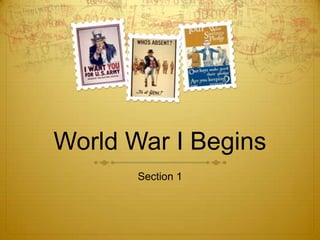
World War I Begins
       Section 1
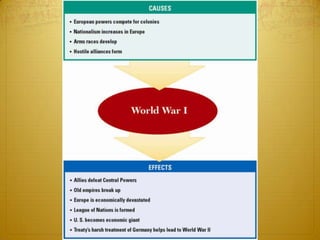
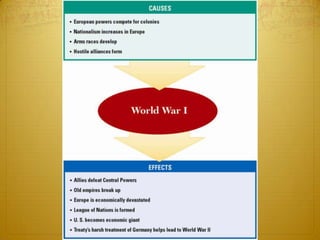
Causes of World War I
 Nationalism
   Led to competitive and antagonistic rivalries among
    nations
   Feared Germany’s growing power
   Russia – protector of Europe’s Slavic peoples
   Serbs – Slavic people, under rule of Austria-Hungary
   Russia and Austria-Hungary rivals
Causes of World
      War I

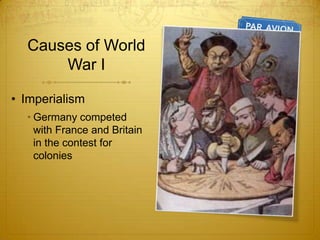
• Imperialism
  • Germany competed
    with France and Britain
    in the contest for
    colonies
Causes of World War I
 Militarism
    Germany - strongest nation on the European continent.
    Britain – strongest navy in the world
    1897 Germany competes to build up largest battleships
     and destroyers
    France, Italy, Japan, & United States join the naval
     arms race.
Causes of World War I
 Alliance System
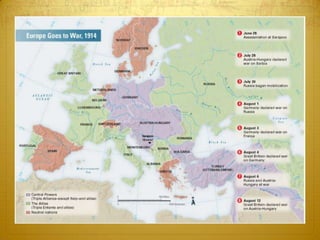
   Triple Entente (AKA: Allies) – France, Britain, & Russia
   Triple Alliance (AKA: Central Powers) – Germany,
    Austria-Hungary, & Italy, later Ottoman Empire
An
  Assassination
  Leads to War
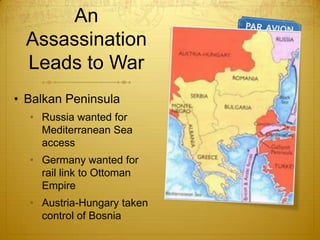
• Balkan Peninsula
  • Russia wanted for
    Mediterranean Sea
    access
  • Germany wanted for
    rail link to Ottoman
    Empire
  • Austria-Hungary taken
    control of Bosnia
An
  Assassination
  Leads to War
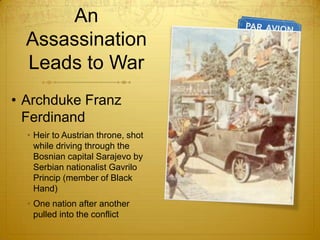
• Archduke Franz
  Ferdinand
  • Heir to Austrian throne, shot
    while driving through the
    Bosnian capital Sarajevo by
    Serbian nationalist Gavrilo
    Princip (member of Black
    Hand)
  • One nation after another
    pulled into the conflict
The Fighting Starts
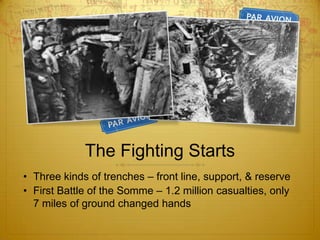
• Three kinds of trenches – front line, support, & reserve
• First Battle of the Somme – 1.2 million casualties, only
  7 miles of ground changed hands
Americans Question Neutrality

 Divided Loyalties
    Socialists – war as capitalist
    Imperialist – struggle between Germany and Britain to control
     markets and colonies in China, Africa & Middle East
    Pacifists – war was evil and the US should set an example of
     peace to the world.
    Parents – didn’t want sons to experience horrors of war
    Naturalized US Citizens – ties to nations from which the
     emigrated
The War Hits Home
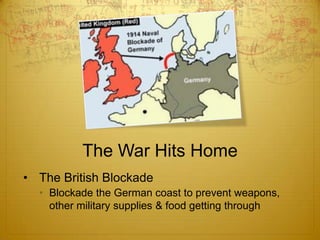
• The British Blockade
  • Blockade the German coast to prevent weapons,
    other military supplies & food getting through
The War Hits Home
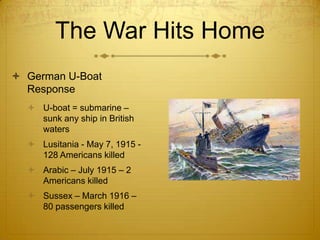
 German U-Boat
  Response
   U-boat = submarine –
    sunk any ship in British
    waters
   Lusitania - May 7, 1915 -
    128 Americans killed
   Arabic – July 1915 – 2
    Americans killed
   Sussex – March 1916 –
    80 passengers killed
The War Hits Home
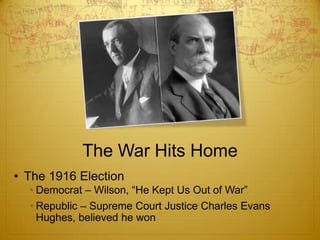
• The 1916 Election
  • Democrat – Wilson, “He Kept Us Out of War”
  • Republic – Supreme Court Justice Charles Evans
    Hughes, believed he won
The United States Declares
              War
 German Provocation
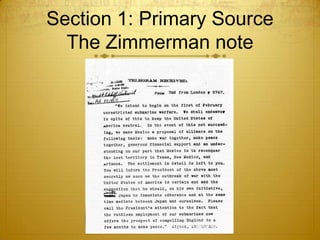
   Zimmermann note – Germany ally with Mexico
 America Acts
   April 2, 1917 – President Wilson deliver war resolution
   Neutrally finally shattered – pave way for future order of
    peace and freedom
World War I Begins
                   Foldable
 Title: World War I Begins
 Helped to ignite the war in Europe
    Nationalism, Imperialism, Militarism, Alliances, Assassination
     of Archduke Ferdinand (pages 373-374)
 Opposed U.S. participation in the war
    Naturalized Citizens, Socialists, Pacifists, Parents (page 377)
 Encouraged U.S. participation in the war
    Britain (page 377), Germany (page 378-379) , Russia (page
     379-380)
 Back cover: Alliances during World War I (page 379)
    Allies, Central Powers
Section 1: Primary Source
  The Zimmerman note
Section 1: Primary Source
         The Zimmerman note
 According to this telegram, what did the German
  government decide to begin on February 1, 1917?
    Unlimited submarine warfare
 What did Zimmerman propose if the United States went to
  war with Germany during World War I?
    He proposed that if Mexico formed a military alliance with
     Germany, then Germany would help Mexico recover New
     Mexico, Texas, and Arizona from the United States.
 If this telegram had not been intercepted by British agents,
  what do you think might have happened? Cite evidence from
  your textbook to support your opinion.
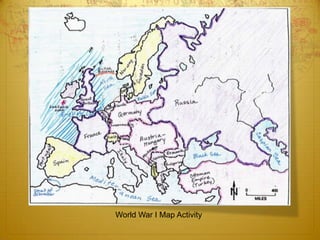
World War I Map Activity
American Power Tips
   the Balance
        Section 2
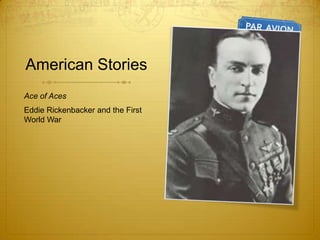
American Stories
Ace of Aces
Eddie Rickenbacker and the First
World War
America Mobilizes
 Raising an Army
   Selective Service Act – required men to register with the
    government in order to be randomly selected for military
    service
      24 million registered – 3 million called up
      Most did not attend high school; 1 in 5 foreign born
      400,000 African-Americans,
         Segregated units, excluded from navy & marines, non-
          combat duties.
         Henry Johnson & Needham Roberts – first Americans to
          receive France’s highest military honor – the “cross of war”
America Mobilizes
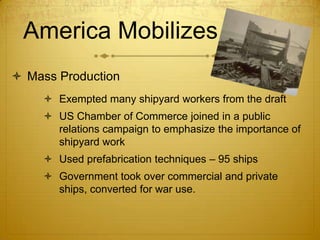
 Mass Production
      Exempted many shipyard workers from the draft
      US Chamber of Commerce joined in a public
       relations campaign to emphasize the importance of
       shipyard work
      Used prefabrication techniques – 95 ships
      Government took over commercial and private
       ships, converted for war use.
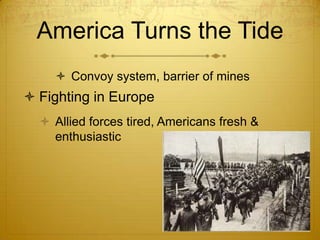
America Turns the Tide
     Convoy system, barrier of mines
 Fighting in Europe
   Allied forces tired, Americans fresh &
    enthusiastic
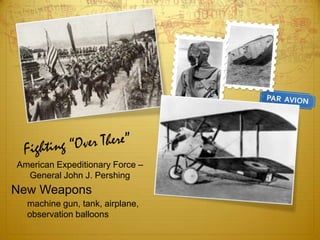
American Expeditionary Force –
  General John J. Pershing
New Weapons
  machine gun, tank, airplane,
  observation balloons
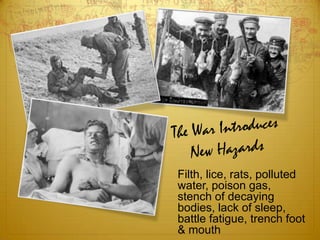
Filth, lice, rats, polluted
water, poison gas,
stench of decaying
bodies, lack of sleep,
battle fatigue, trench foot
& mouth
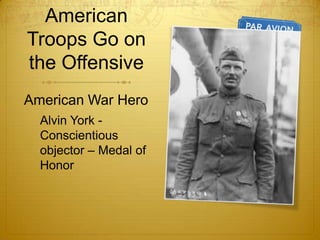
American
Troops Go on
the Offensive
American War Hero
  Alvin York -
  Conscientious
  objector – Medal of
  Honor
American Troops Go on the
        Offensive
 The Collapse of Germany
   November 3, 1918 – Austria-Hungary surrender to
    the Allies
   11th hour, 11th day, 11th month of 1918 – Germany
    signed armistice
American Troops Go on the
        Offensive
 The Final Toll
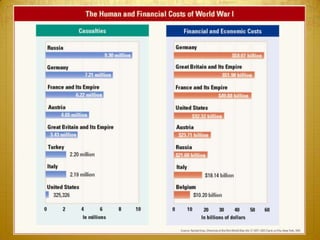
   22 million deaths, 20 million wounded, 10
    million refugees, cost $338 billion
   United States – 48,000 lost in battle,
    62,000 died of disease, 200,000 wounded
Section 2: Primary Source
          Patriotic Song
 Why do you think this song was used as a
  marching song?
 Why did it spur people to give money for the
  war effort?
 Over There
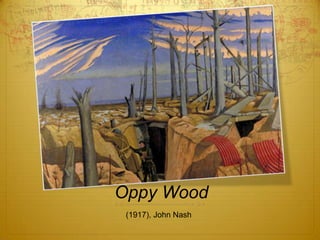
Oppy Wood
 (1917), John Nash
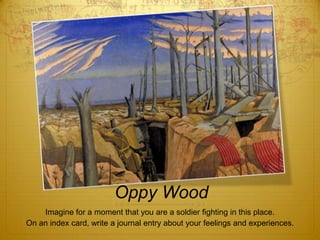
Oppy Wood
    Imagine for a moment that you are a soldier fighting in this place.
On an index card, write a journal entry about your feelings and experiences.
The War at Home
      Section 3
Congress Gives Power to
          Wilson
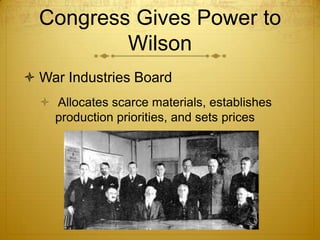
 War Industries Board
   Allocates scarce materials, establishes
    production priorities, and sets prices
Congress Gives Power to
            Wilson
 War Economy
   Wages increased
   Company stock increased
   Uneven pay between labor and management,
    increasing work hours, child labor, dangerous
    conditions, unions boomed.
   National War Labor Board – 1918 – established to settle
    disputes between management and labor.
      Refusing meant losing draft exemptions
      Improved factory conditions, 8-hour work day, safety
       inspections, and child labor ban
Congress Gives Power to
            Wilson
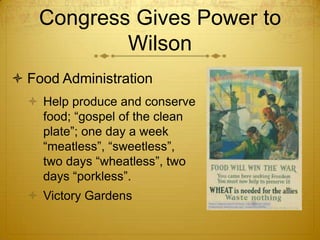
 Food Administration
   Help produce and conserve
    food; “gospel of the clean
    plate”; one day a week
    “meatless”, “sweetless”,
    two days “wheatless”, two
    days “porkless”.
   Victory Gardens
Selling the War
 War Financing
   US spent $35.5 billion on the war effort
   1/3 raised through taxes; progressive income tax,
    war-profits tax, excise tax on tobacco, liquor, and
    luxury goods.
   2/3 raised by selling “Liberty Loan” and “Victory
    Loan” bonds
Selling the War
 Committee on Public Information
    Propaganda agency, designed to influence people’s thoughts and
     actions.
    George Creel
       Persuaded artists and advertising agencies to create
        thousands of painting, posters, cartoons, and sculptures to
        promote the war.
       “Four-Minute Men” – spoke about everything relating to the war
       Printed 25 million copies of “How the War Came to America” –
        which included Wilson’s war message
       Promoted patriotism, but inflamed hatred and violations of the
        civil liberties of certain ethnic groups and opponents of the war
Attacks on Civil Liberties
           Increase
 Anti-Immigrant Hysteria
   Main targets: Americans who had
    emigrated from other nations, especially
    Germany and Austria-Hungary
   Lost jobs, orchestras refused to play
    German music, towns changed names,
    schools stopped teaching German, library
    books by German authors removed
Attacks on Civil Liberties
             Increase
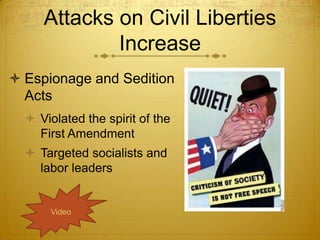
 Espionage and Sedition
  Acts
   Violated the spirit of the
    First Amendment
   Targeted socialists and
    labor leaders


       Video
The War Encourages Social
         Change
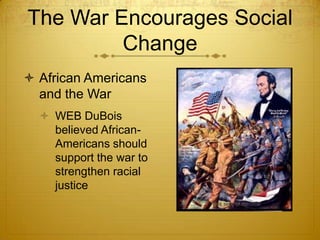
 African Americans
  and the War
   WEB DuBois
    believed African-
    Americans should
    support the war to
    strengthen racial
    justice
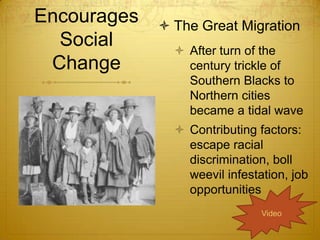
Encourages    The Great Migration
  Social        After turn of the
 Change          century trickle of
                 Southern Blacks to
                 Northern cities
                 became a tidal wave
                Contributing factors:
                 escape racial
                 discrimination, boll
                 weevil infestation, job
                 opportunities
                               Video
The War Encourages Social
           Change
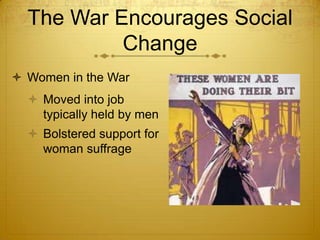
 Women in the War
   Moved into job
    typically held by men
   Bolstered support for
    woman suffrage
The War Encourages Social
          Change
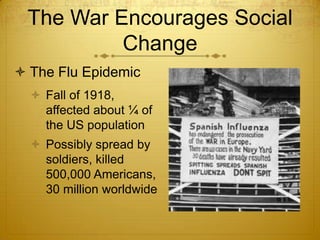
 The Flu Epidemic
   Fall of 1918,
    affected about ¼ of
    the US population
   Possibly spread by
    soldiers, killed
    500,000 Americans,
    30 million worldwide
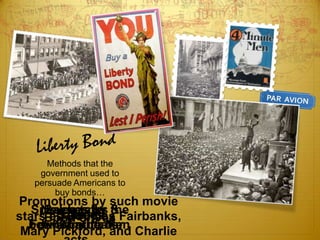
Methods that the
    government used to
   persuade Americans to
        buy bonds…
Promotions by such movie
   Speeches by &
    Newspaper the
     Sales talks
      asrallies
       parades
starsBond drives Fairbanks,
         Douglas
  between theater
  Four-Minute Men
    billboard ads
 Mary Pickford, and Charlie
Section 3: Primary Source
       Liberty Bond Poster
 How much money was raised for the war
  through sales of Liberty Bonds?
   Bonds raised about $21 million for the war
    effort.
Section 3: Primary Source
       Liberty Bond Poster
 On average how much did every American
  spend on Liberty Bonds?
   Every American spent an average of $400 on
    bonds
Section 3: Primary Source
       Liberty Bond Poster
 How did the sale of Liberty Bonds affect the
  national debt?
   Heavy borrowing caused the national debt to
    soar from $1 billion in 1914 to $27 billion in
    1919.
Section 3: Primary Source
        Returning Soldiers
 According to DuBois, what positive
  principles did African Americans fight for
  during World War I?
   For the liberations of France, for freedom, for
    America’s ideals.
Section 3: Primary Source
        Returning Soldiers
 Why does he characterize the United States
  as “a shameful land”?
   Because the United States does not treat all of
    its citizens fairly and subjects African Americans
    to lynching, disenfranchisement, discrimination
    in education, cheating, and insults.
Section 3: Primary Source
        Returning Soldiers
 What fight does he believe should be fought
  now that African-American soldiers have
  returned home?
   The fight for democracy, equality, and justice in
    the United States.
Section 3: Primary Source
        Returning Soldiers
 Members of Congress accused DuBois of
  inciting race riots. What evidence, if any, do
  you find in this excerpt to support their
  accusations?
   Some may say that DuBois uses inflammatory
    language and urges his readers to fight for
    democracy. Others may say that this excerpt
    contains no evidence that DuBois incited race
    riots.
Wilson Fights for Peace
         Section 4
Wilson Presents His Plan
 Fourteen Points
   Plan for world peace; points 1-5 = to prevent
    another war, 6-13 = boundary changes, 14 =
    creation of League of Nations
 The Allies Reject Wilson’s Plan
   Allied leaders angry, wanted to punish Central
    Powers
   Central Powers had no say
   Wilson conceded on most of Fourteen Points in
    return for League of Nations
Debating the Treaty of
Versailles
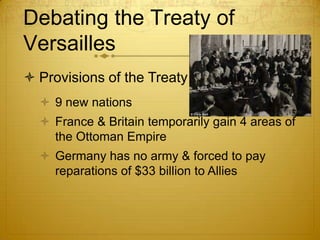
 Provisions of the Treaty
   9 new nations
   France & Britain temporarily gain 4 areas of
    the Ottoman Empire
   Germany has no army & forced to pay
    reparations of $33 billion to Allies
Debating the Treaty of
             Versailles
 The Treaty’s Weaknesses
   The severe treatment of Germany fails to
    provide a lasting peace; problems eventually
    led to WWII
   Germany – Humiliated; war-guilt clause; no way
    to pay reparations due to lost territories
   Russia excluded – lost territory, wanted it back
   Ignored claims of colonized people for self-
    determination
Debating the Treaty of
       Versailles
 Opposition to the Treaty
   Too harsh with dire economic
    consequences
   Did not end colonialism
   Treaty did not satisfy self-determination
    demands of ethnic groups
Debating the Treaty of
         Versailles
 Debate Over the League of Nations
   A few thought it threatened the US foreign
    policy of isolationism
   Conservative senators were suspicious of the
    provision for joint economic and military action
    against aggression. Wanted the constitutional
    right of Congress to declare war.
Debating the Treaty of
             Versailles                           Video

 Wilson Refuses to Compromise

   Wilson set out on 8,000 mile tour giving 34 speeches
    explaining why the US should join the League of
    Nations; suffered a stroke, partially paralyzed for more
    than 2 months
   Senate added amendments which qualified the terms
    under which the US would enter the League of Nations;
    Senate rejected the amendments, failed to ratify the
    treaty
   Wilson refused to compromise; Senate again failed to
    ratify
   US signed a separate treaty with Germany in 1921 with
The Legacy of War
 America – strengthened US military and power of
  government; accelerated social change; fears and
  antagonisms left unchanneled
 Europe – destruction and massive loss of life
  severely damaged social and political systems
 Called “the war to end all wars”, however,
  unresolved issues would create another war;
  Treaty of Versailles solved nothing
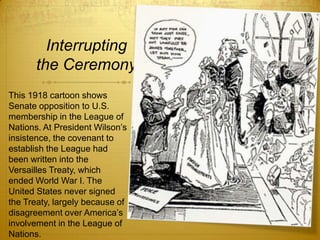
Interrupting
       the Ceremony
This 1918 cartoon shows
Senate opposition to U.S.
membership in the League of
Nations. At President Wilson’s
insistence, the covenant to
establish the League had
been written into the
Versailles Treaty, which
ended World War I. The
United States never signed
the Treaty, largely because of
disagreement over America’s
involvement in the League of
Nations.

World war i

  • 1.
  • 2.
    World War IBegins Section 1
  • 3.
    Causes of WorldWar I  Nationalism  Led to competitive and antagonistic rivalries among nations  Feared Germany’s growing power  Russia – protector of Europe’s Slavic peoples  Serbs – Slavic people, under rule of Austria-Hungary  Russia and Austria-Hungary rivals
  • 4.
    Causes of World War I • Imperialism • Germany competed with France and Britain in the contest for colonies
  • 5.
    Causes of WorldWar I  Militarism  Germany - strongest nation on the European continent.  Britain – strongest navy in the world  1897 Germany competes to build up largest battleships and destroyers  France, Italy, Japan, & United States join the naval arms race.
  • 6.
    Causes of WorldWar I  Alliance System  Triple Entente (AKA: Allies) – France, Britain, & Russia  Triple Alliance (AKA: Central Powers) – Germany, Austria-Hungary, & Italy, later Ottoman Empire
  • 7.
    An Assassination Leads to War • Balkan Peninsula • Russia wanted for Mediterranean Sea access • Germany wanted for rail link to Ottoman Empire • Austria-Hungary taken control of Bosnia
  • 8.
    An Assassination Leads to War • Archduke Franz Ferdinand • Heir to Austrian throne, shot while driving through the Bosnian capital Sarajevo by Serbian nationalist Gavrilo Princip (member of Black Hand) • One nation after another pulled into the conflict
  • 9.
    The Fighting Starts •Three kinds of trenches – front line, support, & reserve • First Battle of the Somme – 1.2 million casualties, only 7 miles of ground changed hands
  • 10.
    Americans Question Neutrality Divided Loyalties  Socialists – war as capitalist  Imperialist – struggle between Germany and Britain to control markets and colonies in China, Africa & Middle East  Pacifists – war was evil and the US should set an example of peace to the world.  Parents – didn’t want sons to experience horrors of war  Naturalized US Citizens – ties to nations from which the emigrated
  • 11.
    The War HitsHome • The British Blockade • Blockade the German coast to prevent weapons, other military supplies & food getting through
  • 12.
    The War HitsHome  German U-Boat Response  U-boat = submarine – sunk any ship in British waters  Lusitania - May 7, 1915 - 128 Americans killed  Arabic – July 1915 – 2 Americans killed  Sussex – March 1916 – 80 passengers killed
  • 13.
    The War HitsHome • The 1916 Election • Democrat – Wilson, “He Kept Us Out of War” • Republic – Supreme Court Justice Charles Evans Hughes, believed he won
  • 14.
    The United StatesDeclares War  German Provocation  Zimmermann note – Germany ally with Mexico  America Acts  April 2, 1917 – President Wilson deliver war resolution  Neutrally finally shattered – pave way for future order of peace and freedom
  • 15.
    World War IBegins Foldable  Title: World War I Begins  Helped to ignite the war in Europe  Nationalism, Imperialism, Militarism, Alliances, Assassination of Archduke Ferdinand (pages 373-374)  Opposed U.S. participation in the war  Naturalized Citizens, Socialists, Pacifists, Parents (page 377)  Encouraged U.S. participation in the war  Britain (page 377), Germany (page 378-379) , Russia (page 379-380)  Back cover: Alliances during World War I (page 379)  Allies, Central Powers
  • 16.
    Section 1: PrimarySource The Zimmerman note
  • 17.
    Section 1: PrimarySource The Zimmerman note  According to this telegram, what did the German government decide to begin on February 1, 1917?  Unlimited submarine warfare  What did Zimmerman propose if the United States went to war with Germany during World War I?  He proposed that if Mexico formed a military alliance with Germany, then Germany would help Mexico recover New Mexico, Texas, and Arizona from the United States.  If this telegram had not been intercepted by British agents, what do you think might have happened? Cite evidence from your textbook to support your opinion.
  • 20.
    World War IMap Activity
  • 21.
    American Power Tips the Balance Section 2
  • 22.
    American Stories Ace ofAces Eddie Rickenbacker and the First World War
  • 23.
    America Mobilizes  Raisingan Army  Selective Service Act – required men to register with the government in order to be randomly selected for military service  24 million registered – 3 million called up  Most did not attend high school; 1 in 5 foreign born  400,000 African-Americans,  Segregated units, excluded from navy & marines, non- combat duties.  Henry Johnson & Needham Roberts – first Americans to receive France’s highest military honor – the “cross of war”
  • 24.
    America Mobilizes  MassProduction  Exempted many shipyard workers from the draft  US Chamber of Commerce joined in a public relations campaign to emphasize the importance of shipyard work  Used prefabrication techniques – 95 ships  Government took over commercial and private ships, converted for war use.
  • 25.
    America Turns theTide  Convoy system, barrier of mines  Fighting in Europe  Allied forces tired, Americans fresh & enthusiastic
  • 26.
    American Expeditionary Force– General John J. Pershing New Weapons machine gun, tank, airplane, observation balloons
  • 27.
    Filth, lice, rats,polluted water, poison gas, stench of decaying bodies, lack of sleep, battle fatigue, trench foot & mouth
  • 28.
    American Troops Go on theOffensive American War Hero Alvin York - Conscientious objector – Medal of Honor
  • 29.
    American Troops Goon the Offensive  The Collapse of Germany  November 3, 1918 – Austria-Hungary surrender to the Allies  11th hour, 11th day, 11th month of 1918 – Germany signed armistice
  • 30.
    American Troops Goon the Offensive  The Final Toll  22 million deaths, 20 million wounded, 10 million refugees, cost $338 billion  United States – 48,000 lost in battle, 62,000 died of disease, 200,000 wounded
  • 31.
    Section 2: PrimarySource Patriotic Song  Why do you think this song was used as a marching song?  Why did it spur people to give money for the war effort?  Over There
  • 33.
  • 34.
    Oppy Wood Imagine for a moment that you are a soldier fighting in this place. On an index card, write a journal entry about your feelings and experiences.
  • 35.
    The War atHome Section 3
  • 36.
    Congress Gives Powerto Wilson  War Industries Board  Allocates scarce materials, establishes production priorities, and sets prices
  • 37.
    Congress Gives Powerto Wilson  War Economy  Wages increased  Company stock increased  Uneven pay between labor and management, increasing work hours, child labor, dangerous conditions, unions boomed.  National War Labor Board – 1918 – established to settle disputes between management and labor.  Refusing meant losing draft exemptions  Improved factory conditions, 8-hour work day, safety inspections, and child labor ban
  • 38.
    Congress Gives Powerto Wilson  Food Administration  Help produce and conserve food; “gospel of the clean plate”; one day a week “meatless”, “sweetless”, two days “wheatless”, two days “porkless”.  Victory Gardens
  • 39.
    Selling the War War Financing  US spent $35.5 billion on the war effort  1/3 raised through taxes; progressive income tax, war-profits tax, excise tax on tobacco, liquor, and luxury goods.  2/3 raised by selling “Liberty Loan” and “Victory Loan” bonds
  • 40.
    Selling the War Committee on Public Information  Propaganda agency, designed to influence people’s thoughts and actions.  George Creel  Persuaded artists and advertising agencies to create thousands of painting, posters, cartoons, and sculptures to promote the war.  “Four-Minute Men” – spoke about everything relating to the war  Printed 25 million copies of “How the War Came to America” – which included Wilson’s war message  Promoted patriotism, but inflamed hatred and violations of the civil liberties of certain ethnic groups and opponents of the war
  • 41.
    Attacks on CivilLiberties Increase  Anti-Immigrant Hysteria  Main targets: Americans who had emigrated from other nations, especially Germany and Austria-Hungary  Lost jobs, orchestras refused to play German music, towns changed names, schools stopped teaching German, library books by German authors removed
  • 42.
    Attacks on CivilLiberties Increase  Espionage and Sedition Acts  Violated the spirit of the First Amendment  Targeted socialists and labor leaders Video
  • 43.
    The War EncouragesSocial Change  African Americans and the War  WEB DuBois believed African- Americans should support the war to strengthen racial justice
  • 44.
    Encourages  The Great Migration Social  After turn of the Change century trickle of Southern Blacks to Northern cities became a tidal wave  Contributing factors: escape racial discrimination, boll weevil infestation, job opportunities Video
  • 45.
    The War EncouragesSocial Change  Women in the War  Moved into job typically held by men  Bolstered support for woman suffrage
  • 46.
    The War EncouragesSocial Change  The Flu Epidemic  Fall of 1918, affected about ¼ of the US population  Possibly spread by soldiers, killed 500,000 Americans, 30 million worldwide
  • 47.
    Methods that the government used to persuade Americans to buy bonds… Promotions by such movie Speeches by & Newspaper the Sales talks asrallies parades starsBond drives Fairbanks, Douglas between theater Four-Minute Men billboard ads Mary Pickford, and Charlie
  • 48.
    Section 3: PrimarySource Liberty Bond Poster  How much money was raised for the war through sales of Liberty Bonds?  Bonds raised about $21 million for the war effort.
  • 49.
    Section 3: PrimarySource Liberty Bond Poster  On average how much did every American spend on Liberty Bonds?  Every American spent an average of $400 on bonds
  • 50.
    Section 3: PrimarySource Liberty Bond Poster  How did the sale of Liberty Bonds affect the national debt?  Heavy borrowing caused the national debt to soar from $1 billion in 1914 to $27 billion in 1919.
  • 51.
    Section 3: PrimarySource Returning Soldiers  According to DuBois, what positive principles did African Americans fight for during World War I?  For the liberations of France, for freedom, for America’s ideals.
  • 52.
    Section 3: PrimarySource Returning Soldiers  Why does he characterize the United States as “a shameful land”?  Because the United States does not treat all of its citizens fairly and subjects African Americans to lynching, disenfranchisement, discrimination in education, cheating, and insults.
  • 53.
    Section 3: PrimarySource Returning Soldiers  What fight does he believe should be fought now that African-American soldiers have returned home?  The fight for democracy, equality, and justice in the United States.
  • 54.
    Section 3: PrimarySource Returning Soldiers  Members of Congress accused DuBois of inciting race riots. What evidence, if any, do you find in this excerpt to support their accusations?  Some may say that DuBois uses inflammatory language and urges his readers to fight for democracy. Others may say that this excerpt contains no evidence that DuBois incited race riots.
  • 56.
    Wilson Fights forPeace Section 4
  • 57.
    Wilson Presents HisPlan  Fourteen Points  Plan for world peace; points 1-5 = to prevent another war, 6-13 = boundary changes, 14 = creation of League of Nations  The Allies Reject Wilson’s Plan  Allied leaders angry, wanted to punish Central Powers  Central Powers had no say  Wilson conceded on most of Fourteen Points in return for League of Nations
  • 58.
    Debating the Treatyof Versailles  Provisions of the Treaty  9 new nations  France & Britain temporarily gain 4 areas of the Ottoman Empire  Germany has no army & forced to pay reparations of $33 billion to Allies
  • 59.
    Debating the Treatyof Versailles  The Treaty’s Weaknesses  The severe treatment of Germany fails to provide a lasting peace; problems eventually led to WWII  Germany – Humiliated; war-guilt clause; no way to pay reparations due to lost territories  Russia excluded – lost territory, wanted it back  Ignored claims of colonized people for self- determination
  • 60.
    Debating the Treatyof Versailles  Opposition to the Treaty  Too harsh with dire economic consequences  Did not end colonialism  Treaty did not satisfy self-determination demands of ethnic groups
  • 61.
    Debating the Treatyof Versailles  Debate Over the League of Nations  A few thought it threatened the US foreign policy of isolationism  Conservative senators were suspicious of the provision for joint economic and military action against aggression. Wanted the constitutional right of Congress to declare war.
  • 62.
    Debating the Treatyof Versailles Video  Wilson Refuses to Compromise  Wilson set out on 8,000 mile tour giving 34 speeches explaining why the US should join the League of Nations; suffered a stroke, partially paralyzed for more than 2 months  Senate added amendments which qualified the terms under which the US would enter the League of Nations; Senate rejected the amendments, failed to ratify the treaty  Wilson refused to compromise; Senate again failed to ratify  US signed a separate treaty with Germany in 1921 with
  • 63.
    The Legacy ofWar  America – strengthened US military and power of government; accelerated social change; fears and antagonisms left unchanneled  Europe – destruction and massive loss of life severely damaged social and political systems  Called “the war to end all wars”, however, unresolved issues would create another war; Treaty of Versailles solved nothing
  • 64.
    Interrupting the Ceremony This 1918 cartoon shows Senate opposition to U.S. membership in the League of Nations. At President Wilson’s insistence, the covenant to establish the League had been written into the Versailles Treaty, which ended World War I. The United States never signed the Treaty, largely because of disagreement over America’s involvement in the League of Nations.

Editor's Notes

  • #19 Critical Thinking Transparencies – CT19 World War IWith the whole class discuss the questions on page 10. In table groups, have students answer question #4.
  • #20 Geography Transparencies – G19 Europe Goes to WarWith the whole class discuss the questions on page 10. In table groups, have students answer question #4. Provide them with the declaration of war timeline found on the next slide.
  • #33 Critical Thinking Transparencies – CT53 The Human and Financial Costs of World War IWith the whole class discuss the questions on page 27. In table groups, have students answer question #6.
  • #34 This stark painting of a front-line stronghold near Arras in northern France conveys the unearthly desolation of trench warfare after three years of often stalemate fighting. Trench warfare, in which armies fought and died to gain mere yards of territory, was a nightmare to the combatants who often stood in wet trenches for hours at a time. They were surrounded by filth, rats, and the stench of poison gas and decaying bodies. Sleep was almost impossible as bombardments continued for hours at a time.John Nash (1893-1977), born in London, had no formal training as a painter, but was persuaded by his brother, Paul, to take up the career of an artist. He was an official War Artist in 1918 and 1940. Nash is best know for landscape and illustrations for botanical works.
  • #56 Critical Thinking Transparencies – CT19 World War IWith the whole class discuss the questions on page 10. In table groups, have students answer question #4.