Bell ringer!!!!
In the United States, the main purpose of
antitrust legislation is to
A. protect the environment.
B. increase competition in business.
C. encourage the growth of monopolies.
D. strengthen the rights of workers.
5/16/2013 1
World War
I
5/16/2013 2
TN Curriculum Standards:
• 4.0- Understand the reforms and changes in
American politics that affected America and the
world during 1890s and 1930s.
• 5.0- Understand the role of the U.S. in world
affairs.
• 6.0- Understand the moral, social, and cultural
changes that occurred in the 1920s.
SPI:
7.4- Identify the causes of American involvement in
World War I.
5/16/2013 3
WORLD WAR I
5/16/2013 4
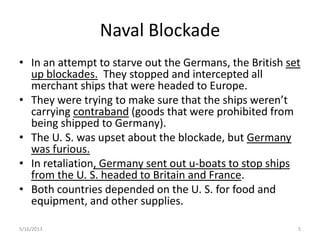
Naval Blockade
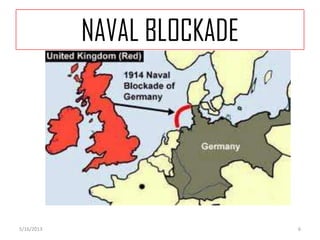
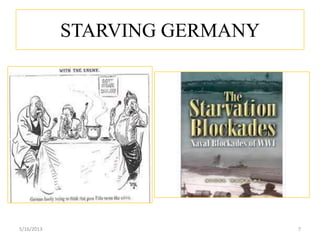
• In an attempt to starve out the Germans, the British set
up blockades. They stopped and intercepted all
merchant ships that were headed to Europe.
• They were trying to make sure that the ships weren’t
carrying contraband (goods that were prohibited from
being shipped to Germany).
• The U. S. was upset about the blockade, but Germany
was furious.
• In retaliation, Germany sent out u-boats to stop ships
from the U. S. headed to Britain and France.
• Both countries depended on the U. S. for food and
equipment, and other supplies.
5/16/2013 5
NAVAL BLOCKADE
5/16/2013 6
STARVING GERMANY
5/16/2013 7
WARNING!!!!!
• To their credit, Germany did announce that
they would sink without warning any ship that
was in the waters near Britain.
• The U. S. was furious about this because
Germany had signed an international
agreement that said that they would not sink
civilian ships without warning
5/16/2013 8
LUSITANIA
5/16/2013 9
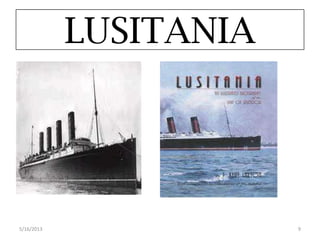
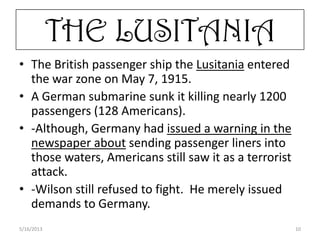
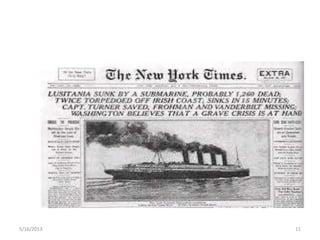
THE LUSITANIA
• The British passenger ship the Lusitania entered
the war zone on May 7, 1915.
• A German submarine sunk it killing nearly 1200
passengers (128 Americans).
• -Although, Germany had issued a warning in the
newspaper about sending passenger liners into
those waters, Americans still saw it as a terrorist
attack.
• -Wilson still refused to fight. He merely issued
demands to Germany.
5/16/2013 10
5/16/2013 11
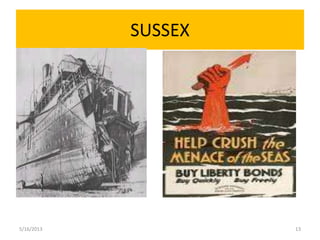
SUSSEX PLEDGE
• Germany responded by sinking a French
passenger ship named the Sussex.
• To this, Wilson issued another warning. To
keep the U. S. from entering the war, Germany
signed the Sussex Pledge.
• It was a promise not to sink anymore
merchant ships without warning.
5/16/2013 12
SUSSEX
5/16/2013 13
ZIMMERMAN TELEGRAM
• Wilson ran for reelection and won with the
slogan “He kept us out of the war”.
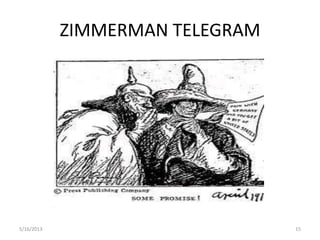
• Shortly after the election, British intelligence
intercepted a telegram from Arthur Zimmermann
(German official) to a German ambassador in
Mexico.
• The telegram promised to help Mexico recover
“lost territories in Texas, New Mexico, and
Arizona in exchange for helping Germany fight
against the U. S.
5/16/2013 14
ZIMMERMAN TELEGRAM
5/16/2013 15
ZIMMERMAN TELEGRAM
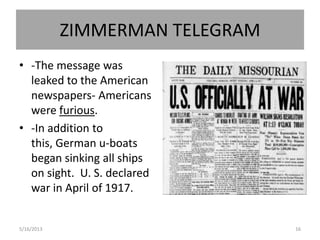
• -The message was
leaked to the American
newspapers- Americans
were furious.
• -In addition to
this, German u-boats
began sinking all ships
on sight. U. S. declared
war in April of 1917.
5/16/2013 16
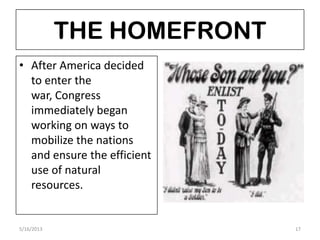
THE HOMEFRONT
• After America decided
to enter the
war, Congress
immediately began
working on ways to
mobilize the nations
and ensure the efficient
use of natural
resources.
5/16/2013 17
WAR AGENCIES
• The most important agency was the War Industries
Board. They were responsible with coordinating the
production of war materials.
• They told manufacturers what they could
produce, allocated raw materials, ordered the new
construction of factories, and even occasionally set
prices.
• The most successful agency was the Food
Administration, run by Herbert Hoover. They were
responsible for increasing food production for troops
and limiting food consumption for civilians.
5/16/2013 18
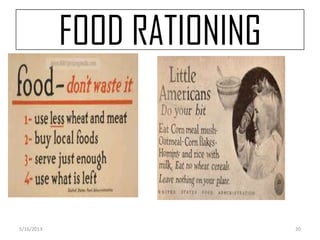
FOOD CONSERVATION
• They encouraged families to conserve food
and grow their own gardens. These gardens
were called “victory gardens”. They instituted
other measures to save food for the troops
like Wheatless Mondays, Meatless
Tuesdays, and Porkless Thursdays.
• Another agency was the Fuel Administration.
They were responsible for managing the
amount of coal and oil that troops used.
5/16/2013 19
FOOD RATIONING
5/16/2013 20
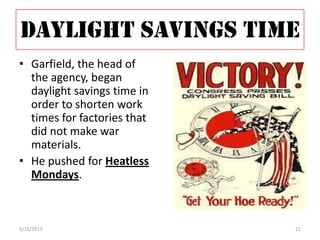
DAYLIGHT SAVINGS TIME
• Garfield, the head of
the agency, began
daylight savings time in
order to shorten work
times for factories that
did not make war
materials.
• He pushed for Heatless
Mondays.
5/16/2013 21
PAYING FOR THE WAR
• To fund the war, Congress raised income taxes
and placed higher taxes on corporations.
• The government also borrowed money from the
people to pay for the war.
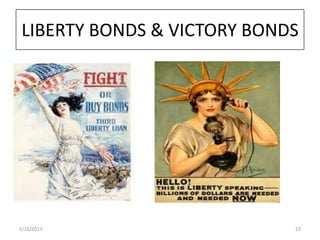
• Americans were encouraged to buy Liberty
Bonds and Victory Bonds. The money earned off
the bonds would go directly to the government.
• The government was supposed to repay the bond
with interest in a specified number of years.
5/16/2013 22
LIBERTY BONDS & VICTORY BONDS
5/16/2013 23
MOBILIZING THE WORKFORCE
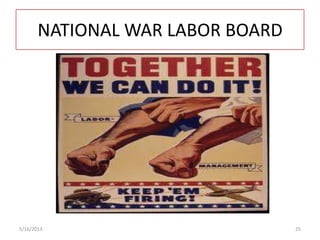
• The government could not afford for workers to
go on strike during the war so they created the
National War Labor Board.
• They served as mediators in labor disputes to
prevent workers from striking.
• The National War Labor Board encouraged
corporations to increase worker wages, establish
an 8 hour work day, and allow workers to be a
part of unions all in order to prevent strikes.
5/16/2013 24
NATIONAL WAR LABOR BOARD
5/16/2013 25
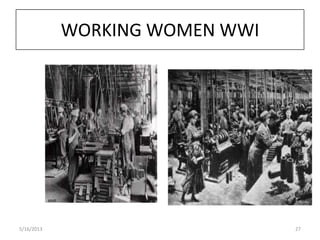
WOMEN IN THE WORKFORCE
• With so many men needed to fight in the
war, employers began to allow women to fill the
jobs that were traditionally thought to be men’s
jobs.
• Women worked in factories, shipyards, railroad
yards, served as police officers, mail carriers, and
train engineers.
• After the war ended, women were expected to
return to their previous jobs and roles.
5/16/2013 26
WORKING WOMEN WWI
5/16/2013 27
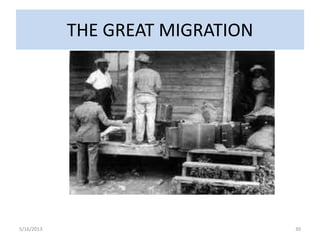
MINORITIES IN THE WORKFORCE
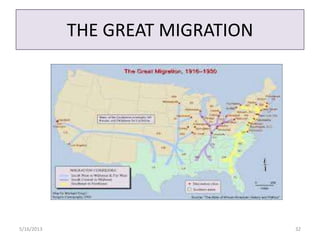
• Henry Ford, creator of the T-Model car, was so
desperate for workers that he sent agents to
the south to recruit African Americans.
• Other companies quickly followed suit. As a
result of this 300,000- 500,000 African
Americans left the south and moved North.
• This movement is known as The Great
Migration.
5/16/2013 28
GREAT MIGRATION
• In the South, African Americans had been
denied the right to vote. In the Northern
cities, they were extended this right.
• At this same time, Mexicans fleeing political
turmoil in their own country, also began to
migrate.
• Approximately 100,000 Mexicans moved into
the southwest between 1917-1920.
5/16/2013 29
THE GREAT MIGRATION
5/16/2013 30
MOVING NORTH
• They were able to find factory jobs in cities
like Chicago, St. Louis, and Omaha.
• Even though they were allowed to work, they
still faced a great amount of hostility and
discrimination.
• As a result of this, they tended to settle
within their own communities.
5/16/2013 31
THE GREAT MIGRATION
5/16/2013 32
COMMITTEE ON PUBLIC
INFORMATION
• This agency hired
advertisers, actors, authors, artists, songwriter
s, entertainers, public speakers, and motion
picture companies to help want to support the
war(basically, they used propaganda).
• The govt. also passed legislation to limit
speaking against the war and to prevent
espionage (spying).
5/16/2013 33
FIRST AMENDMENT VIOLATIONS
• The Espionage Act of 1917 made it illegal to assist the
enemy, give false reports, or interfere with the war effort.
• The Sedition Act made it illegal to speak against the war
publicly.
• These two acts made it legal for the government to
prosecute violators. More than 1000 people were
prosecuted because of this. War time fears also lead to
attacks on German Americans, labor organizers, and
socialists.
• Americans began spying on and reporting on the activities
of their neighbors and coworkers.
• Even though this contradicted with First Amendment
rights, the government permitted this behavior.
5/16/2013 34
Let’s Check for Understanding
• After World War I, which factor was the major
cause of the migration of many African
Americans to the North?
A. the start of the Harlem Renaissance
B. increased job opportunities in Northern cities
C. laws passed in Northern States to end racial
discrimination
D. federal government job-training programs
5/16/2013 35
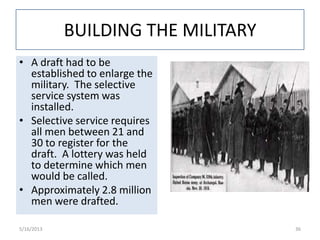
BUILDING THE MILITARY
• A draft had to be
established to enlarge the
military. The selective
service system was
installed.
• Selective service requires
all men between 21 and
30 to register for the
draft. A lottery was held
to determine which men
would be called.
• Approximately 2.8 million
men were drafted.
5/16/2013 36
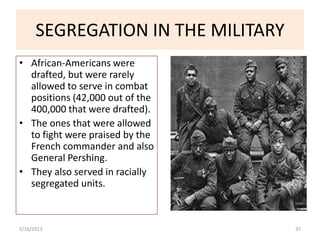
SEGREGATION IN THE MILITARY
• African-Americans were
drafted, but were rarely
allowed to serve in combat
positions (42,000 out of the
400,000 that were drafted).
• The ones that were allowed
to fight were praised by the
French commander and also
General Pershing.
• They also served in racially
segregated units.
5/16/2013 37

World War I ( pts. 2 & 3)

  • 1.
    Bell ringer!!!! In theUnited States, the main purpose of antitrust legislation is to A. protect the environment. B. increase competition in business. C. encourage the growth of monopolies. D. strengthen the rights of workers. 5/16/2013 1
  • 2.
  • 3.
    TN Curriculum Standards: •4.0- Understand the reforms and changes in American politics that affected America and the world during 1890s and 1930s. • 5.0- Understand the role of the U.S. in world affairs. • 6.0- Understand the moral, social, and cultural changes that occurred in the 1920s. SPI: 7.4- Identify the causes of American involvement in World War I. 5/16/2013 3
  • 4.
  • 5.
    Naval Blockade • Inan attempt to starve out the Germans, the British set up blockades. They stopped and intercepted all merchant ships that were headed to Europe. • They were trying to make sure that the ships weren’t carrying contraband (goods that were prohibited from being shipped to Germany). • The U. S. was upset about the blockade, but Germany was furious. • In retaliation, Germany sent out u-boats to stop ships from the U. S. headed to Britain and France. • Both countries depended on the U. S. for food and equipment, and other supplies. 5/16/2013 5
  • 6.
  • 7.
  • 8.
    WARNING!!!!! • To theircredit, Germany did announce that they would sink without warning any ship that was in the waters near Britain. • The U. S. was furious about this because Germany had signed an international agreement that said that they would not sink civilian ships without warning 5/16/2013 8
  • 9.
  • 10.
    THE LUSITANIA • TheBritish passenger ship the Lusitania entered the war zone on May 7, 1915. • A German submarine sunk it killing nearly 1200 passengers (128 Americans). • -Although, Germany had issued a warning in the newspaper about sending passenger liners into those waters, Americans still saw it as a terrorist attack. • -Wilson still refused to fight. He merely issued demands to Germany. 5/16/2013 10
  • 11.
  • 12.
    SUSSEX PLEDGE • Germanyresponded by sinking a French passenger ship named the Sussex. • To this, Wilson issued another warning. To keep the U. S. from entering the war, Germany signed the Sussex Pledge. • It was a promise not to sink anymore merchant ships without warning. 5/16/2013 12
  • 13.
  • 14.
    ZIMMERMAN TELEGRAM • Wilsonran for reelection and won with the slogan “He kept us out of the war”. • Shortly after the election, British intelligence intercepted a telegram from Arthur Zimmermann (German official) to a German ambassador in Mexico. • The telegram promised to help Mexico recover “lost territories in Texas, New Mexico, and Arizona in exchange for helping Germany fight against the U. S. 5/16/2013 14
  • 15.
  • 16.
    ZIMMERMAN TELEGRAM • -Themessage was leaked to the American newspapers- Americans were furious. • -In addition to this, German u-boats began sinking all ships on sight. U. S. declared war in April of 1917. 5/16/2013 16
  • 17.
    THE HOMEFRONT • AfterAmerica decided to enter the war, Congress immediately began working on ways to mobilize the nations and ensure the efficient use of natural resources. 5/16/2013 17
  • 18.
    WAR AGENCIES • Themost important agency was the War Industries Board. They were responsible with coordinating the production of war materials. • They told manufacturers what they could produce, allocated raw materials, ordered the new construction of factories, and even occasionally set prices. • The most successful agency was the Food Administration, run by Herbert Hoover. They were responsible for increasing food production for troops and limiting food consumption for civilians. 5/16/2013 18
  • 19.
    FOOD CONSERVATION • Theyencouraged families to conserve food and grow their own gardens. These gardens were called “victory gardens”. They instituted other measures to save food for the troops like Wheatless Mondays, Meatless Tuesdays, and Porkless Thursdays. • Another agency was the Fuel Administration. They were responsible for managing the amount of coal and oil that troops used. 5/16/2013 19
  • 20.
  • 21.
    DAYLIGHT SAVINGS TIME •Garfield, the head of the agency, began daylight savings time in order to shorten work times for factories that did not make war materials. • He pushed for Heatless Mondays. 5/16/2013 21
  • 22.
    PAYING FOR THEWAR • To fund the war, Congress raised income taxes and placed higher taxes on corporations. • The government also borrowed money from the people to pay for the war. • Americans were encouraged to buy Liberty Bonds and Victory Bonds. The money earned off the bonds would go directly to the government. • The government was supposed to repay the bond with interest in a specified number of years. 5/16/2013 22
  • 23.
    LIBERTY BONDS &VICTORY BONDS 5/16/2013 23
  • 24.
    MOBILIZING THE WORKFORCE •The government could not afford for workers to go on strike during the war so they created the National War Labor Board. • They served as mediators in labor disputes to prevent workers from striking. • The National War Labor Board encouraged corporations to increase worker wages, establish an 8 hour work day, and allow workers to be a part of unions all in order to prevent strikes. 5/16/2013 24
  • 25.
    NATIONAL WAR LABORBOARD 5/16/2013 25
  • 26.
    WOMEN IN THEWORKFORCE • With so many men needed to fight in the war, employers began to allow women to fill the jobs that were traditionally thought to be men’s jobs. • Women worked in factories, shipyards, railroad yards, served as police officers, mail carriers, and train engineers. • After the war ended, women were expected to return to their previous jobs and roles. 5/16/2013 26
  • 27.
  • 28.
    MINORITIES IN THEWORKFORCE • Henry Ford, creator of the T-Model car, was so desperate for workers that he sent agents to the south to recruit African Americans. • Other companies quickly followed suit. As a result of this 300,000- 500,000 African Americans left the south and moved North. • This movement is known as The Great Migration. 5/16/2013 28
  • 29.
    GREAT MIGRATION • Inthe South, African Americans had been denied the right to vote. In the Northern cities, they were extended this right. • At this same time, Mexicans fleeing political turmoil in their own country, also began to migrate. • Approximately 100,000 Mexicans moved into the southwest between 1917-1920. 5/16/2013 29
  • 30.
  • 31.
    MOVING NORTH • Theywere able to find factory jobs in cities like Chicago, St. Louis, and Omaha. • Even though they were allowed to work, they still faced a great amount of hostility and discrimination. • As a result of this, they tended to settle within their own communities. 5/16/2013 31
  • 32.
  • 33.
    COMMITTEE ON PUBLIC INFORMATION •This agency hired advertisers, actors, authors, artists, songwriter s, entertainers, public speakers, and motion picture companies to help want to support the war(basically, they used propaganda). • The govt. also passed legislation to limit speaking against the war and to prevent espionage (spying). 5/16/2013 33
  • 34.
    FIRST AMENDMENT VIOLATIONS •The Espionage Act of 1917 made it illegal to assist the enemy, give false reports, or interfere with the war effort. • The Sedition Act made it illegal to speak against the war publicly. • These two acts made it legal for the government to prosecute violators. More than 1000 people were prosecuted because of this. War time fears also lead to attacks on German Americans, labor organizers, and socialists. • Americans began spying on and reporting on the activities of their neighbors and coworkers. • Even though this contradicted with First Amendment rights, the government permitted this behavior. 5/16/2013 34
  • 35.
    Let’s Check forUnderstanding • After World War I, which factor was the major cause of the migration of many African Americans to the North? A. the start of the Harlem Renaissance B. increased job opportunities in Northern cities C. laws passed in Northern States to end racial discrimination D. federal government job-training programs 5/16/2013 35
  • 36.
    BUILDING THE MILITARY •A draft had to be established to enlarge the military. The selective service system was installed. • Selective service requires all men between 21 and 30 to register for the draft. A lottery was held to determine which men would be called. • Approximately 2.8 million men were drafted. 5/16/2013 36
  • 37.
    SEGREGATION IN THEMILITARY • African-Americans were drafted, but were rarely allowed to serve in combat positions (42,000 out of the 400,000 that were drafted). • The ones that were allowed to fight were praised by the French commander and also General Pershing. • They also served in racially segregated units. 5/16/2013 37