Lecture 16 -1
Random Access protocols
A node transmits at random at full channel data rate R.
If two or more nodes “collide”, they retransmit at random times
The random access MAC protocol specifies how to detect collisions
and how to recover from them (via delayed retransmissions, for
example)
Examples of random access MAC protocols
SLOTTED ALOHA
ALOHA
CSMA and CSMA/CD
Lecture 16 -2
Slotted Aloha
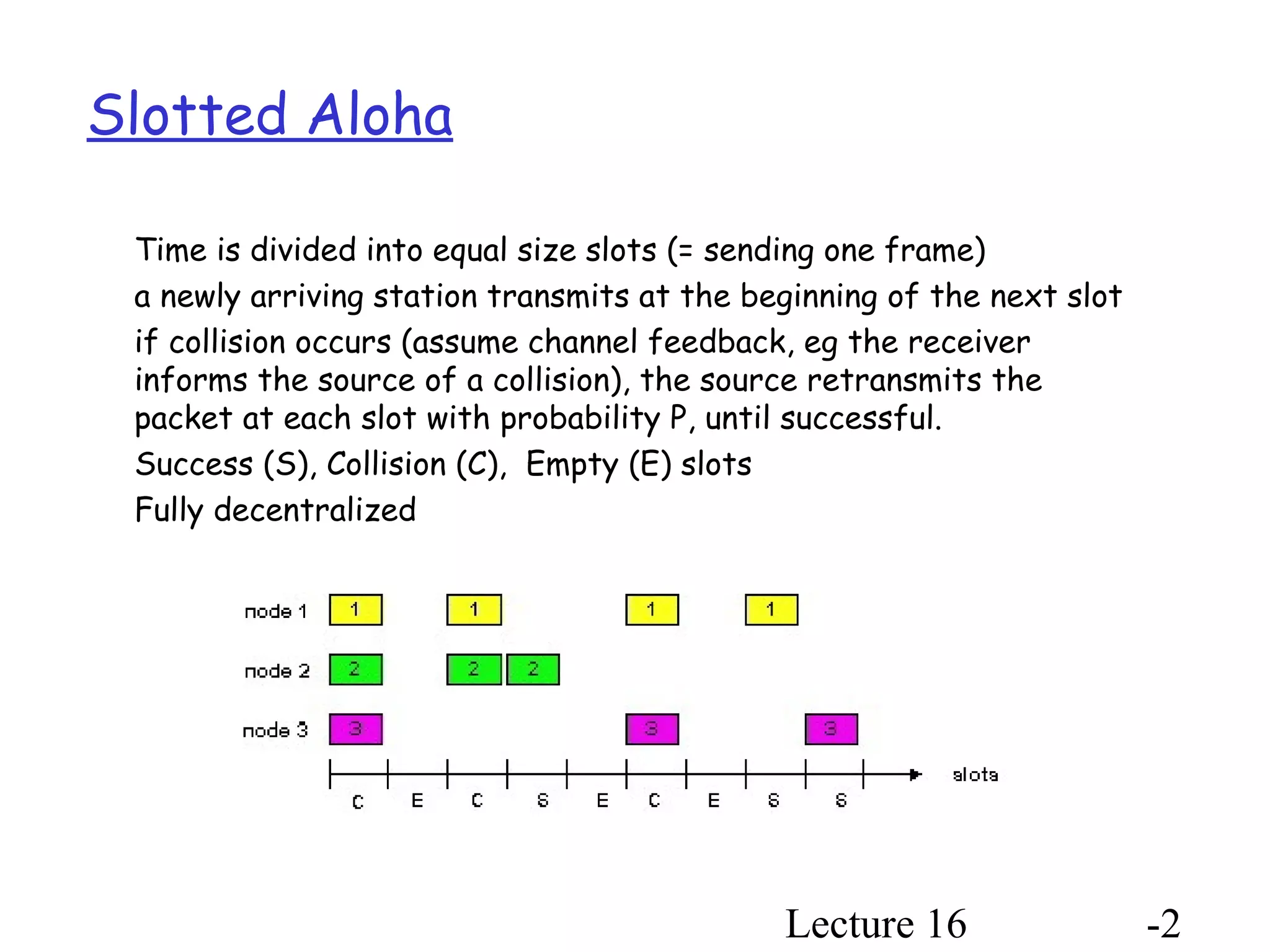
Time is divided into equal size slots (= sending one frame)
a newly arriving station transmits at the beginning of the next slot
if collision occurs (assume channel feedback, eg the receiver
informs the source of a collision), the source retransmits the
packet at each slot with probability P, until successful.
Success (S), Collision (C), Empty (E) slots
Fully decentralized
Lecture 16 -3
Slotted Aloha efficiency
If N stations always have frames to send, and each transmits in
each slot with probability P, the probability of successful
transmission S is:
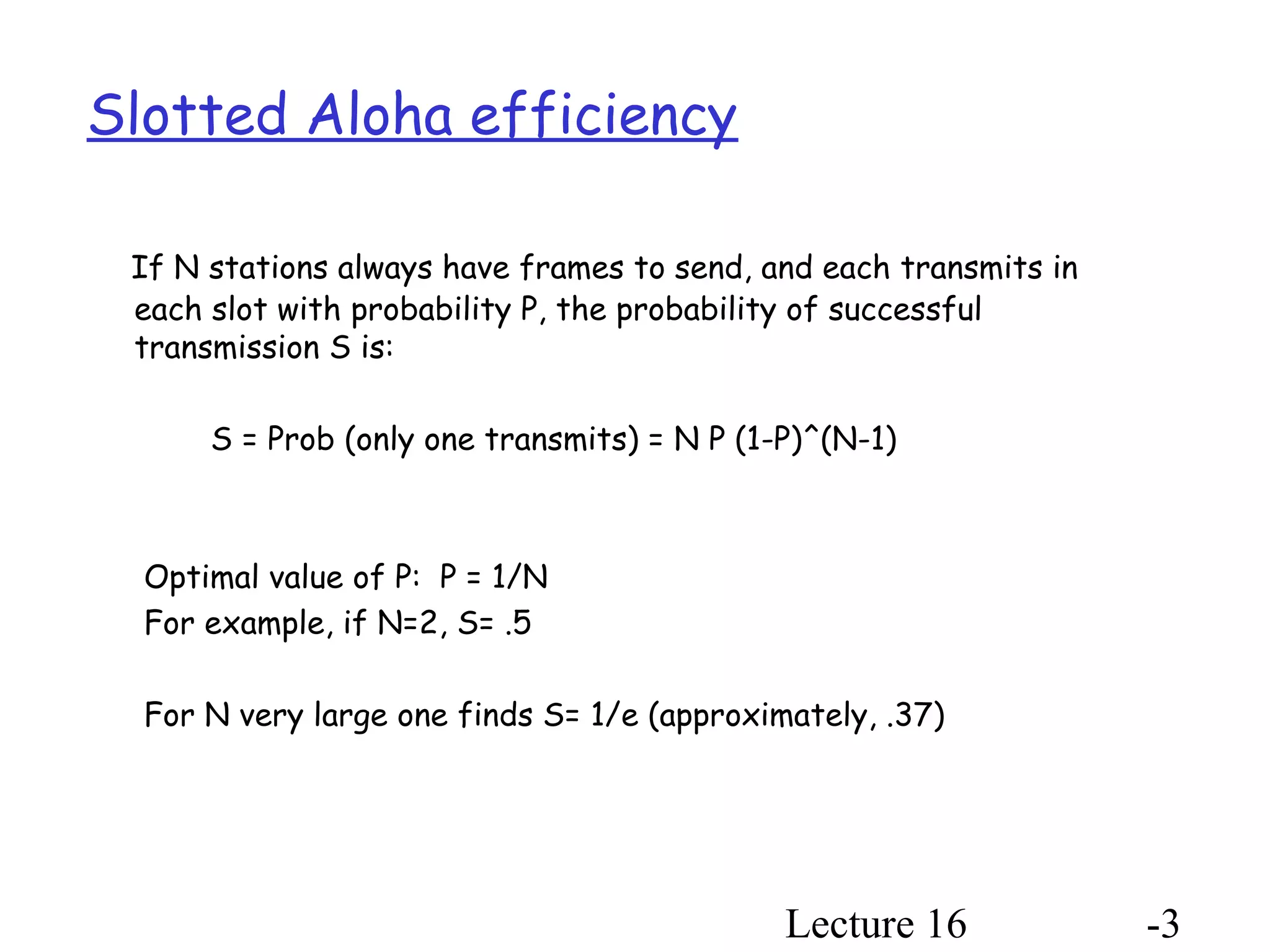
S = Prob (only one transmits) = N P (1-P)^(N-1)
Optimal value of P: P = 1/N
For example, if N=2, S= .5
For N very large one finds S= 1/e (approximately, .37)
Lecture 16 -4
Pure (unslotted) ALOHA
Slotted ALOHA requires slot synchronization
A simpler version, pure ALOHA, does not require slots
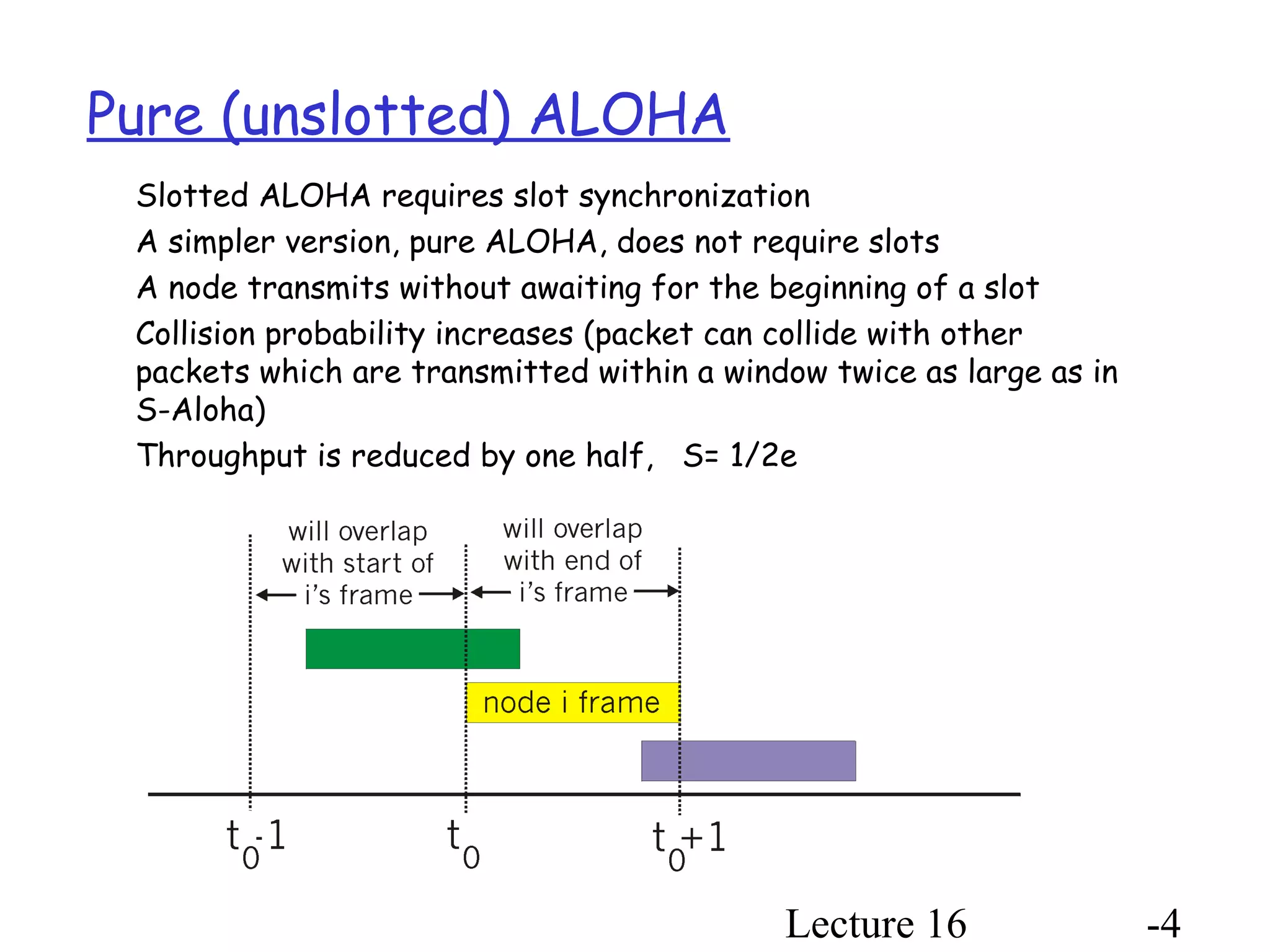
A node transmits without awaiting for the beginning of a slot
Collision probability increases (packet can collide with other
packets which are transmitted within a window twice as large as in
S-Aloha)
Throughput is reduced by one half, S= 1/2e
Lecture 16 -5
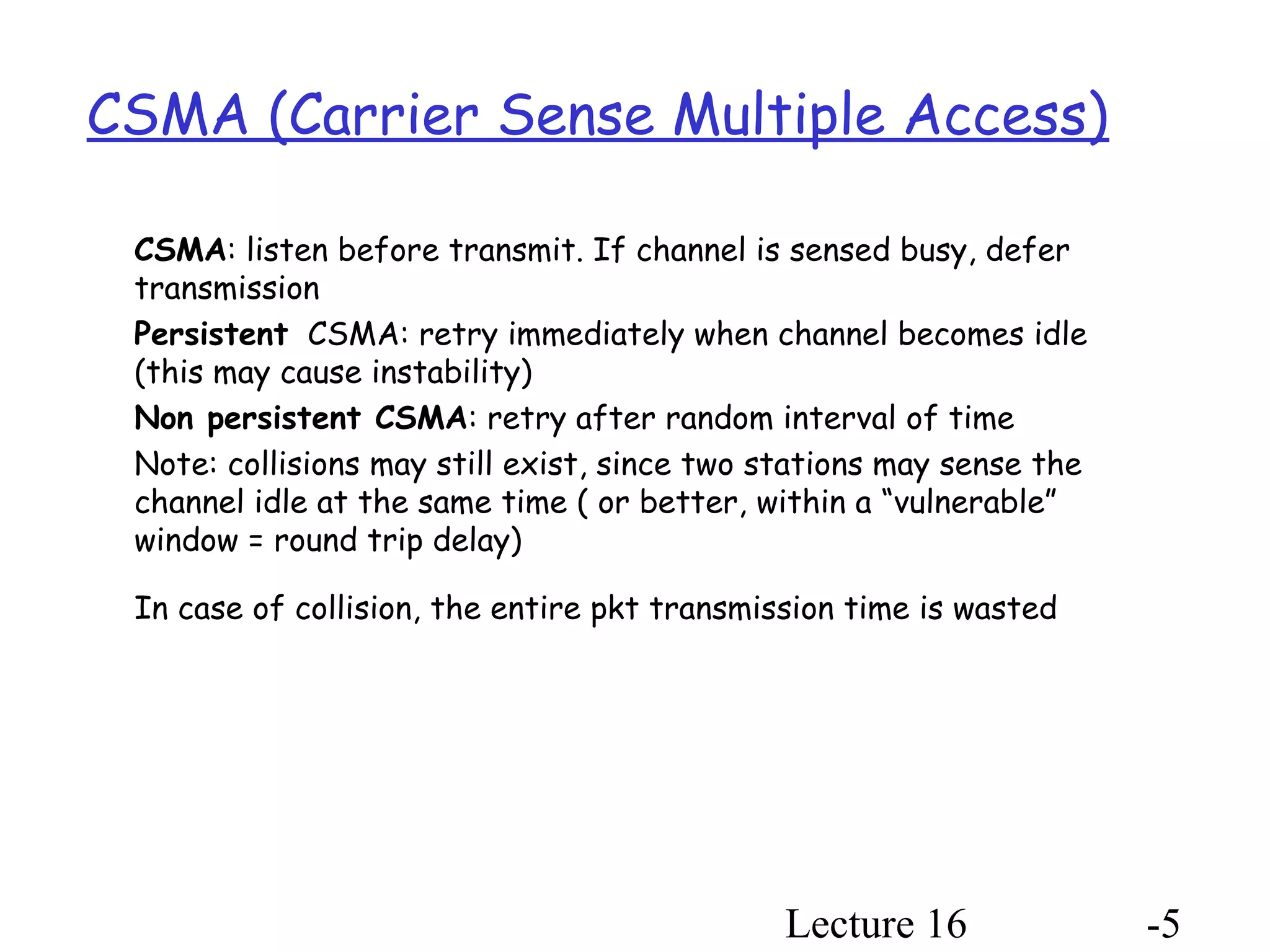
CSMA (Carrier Sense Multiple Access)
CSMA: listen before transmit. If channel is sensed busy, defer
transmission
Persistent CSMA: retry immediately when channel becomes idle
(this may cause instability)
Non persistent CSMA: retry after random interval of time
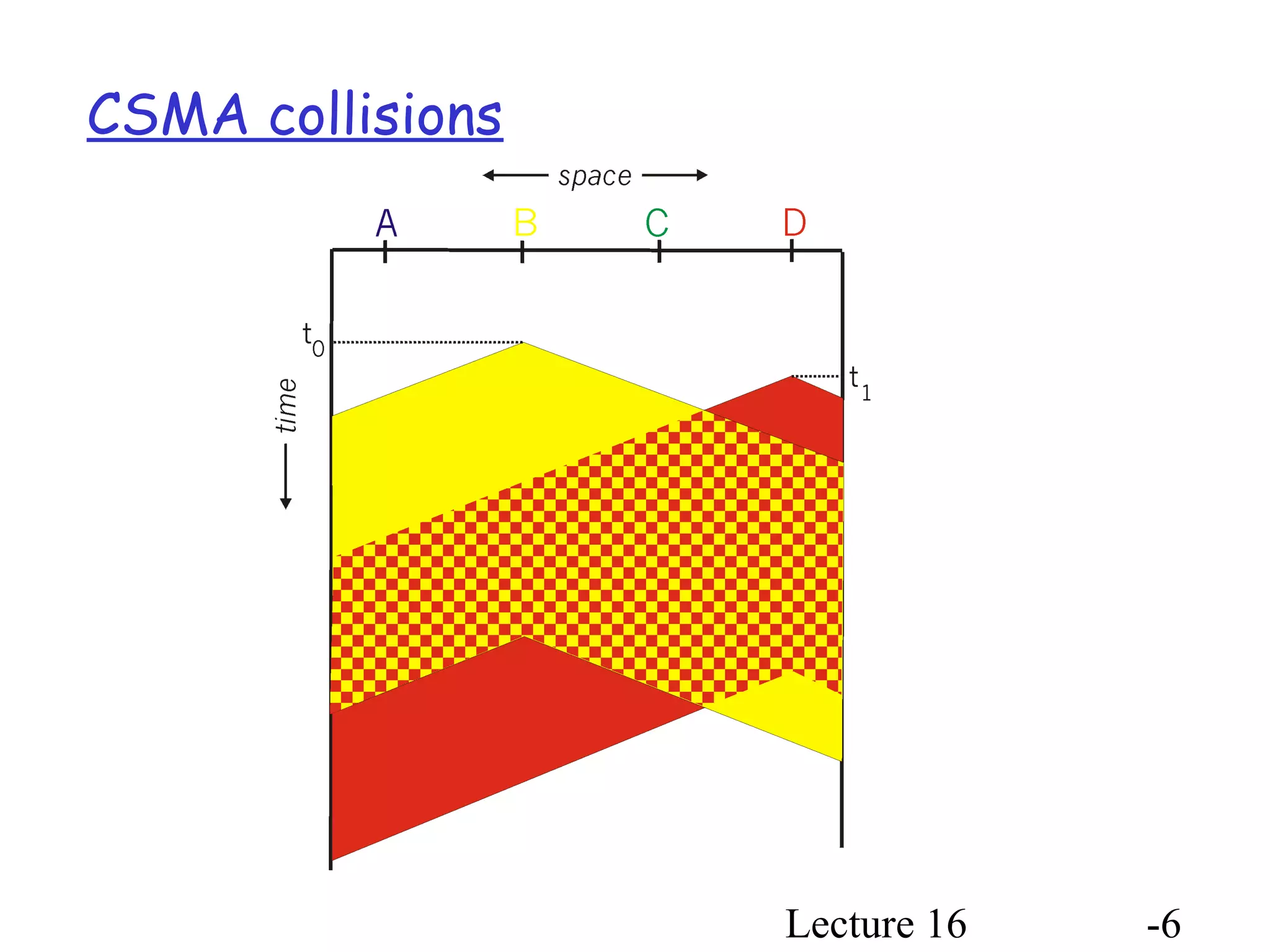
Note: collisions may still exist, since two stations may sense the
channel idle at the same time ( or better, within a “vulnerable”
window = round trip delay)
In case of collision, the entire pkt transmission time is wasted
Lecture 16 -6
CSMA collisions
Lecture 16 -7
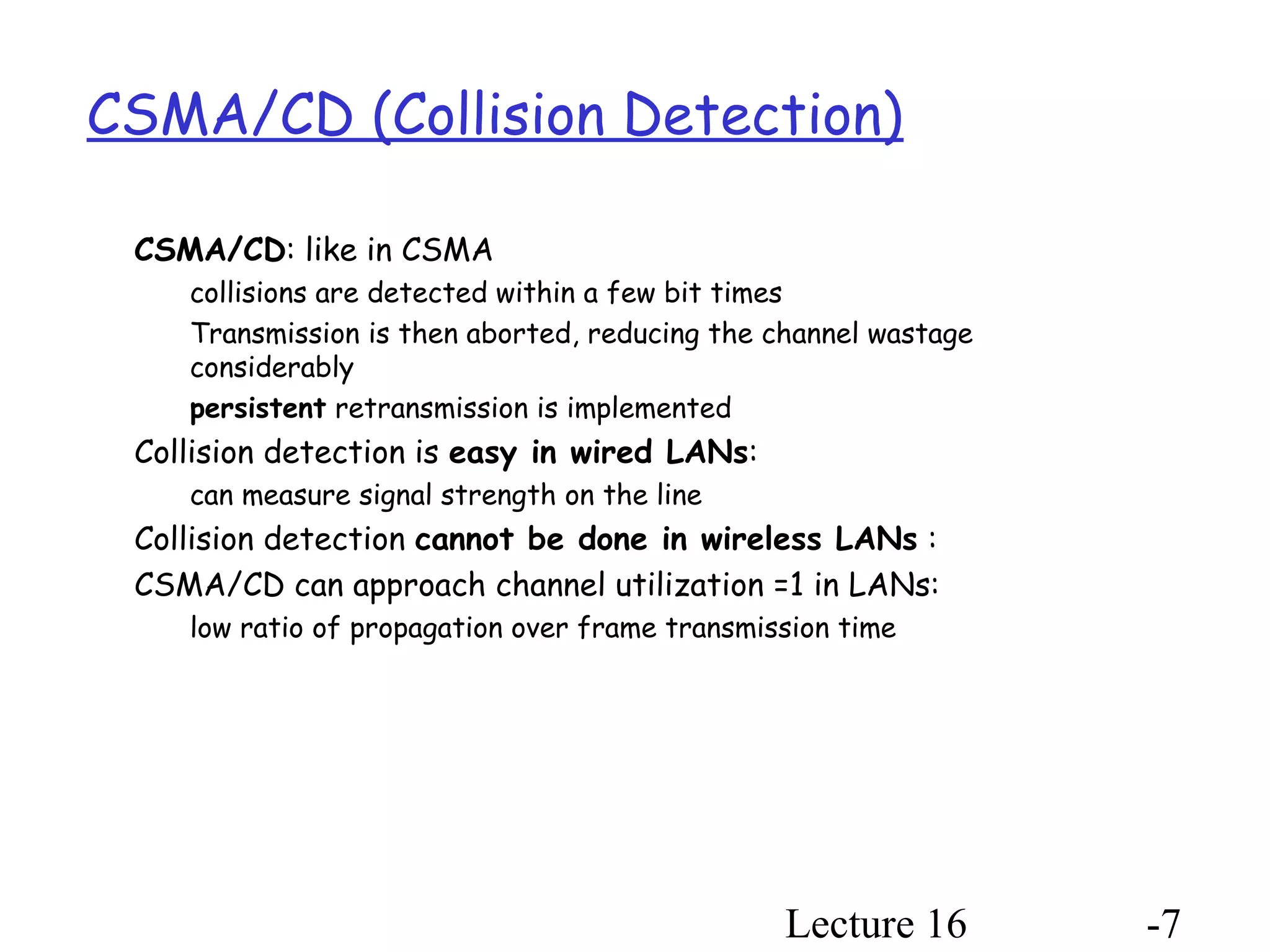
CSMA/CD (Collision Detection)
CSMA/CD: like in CSMA
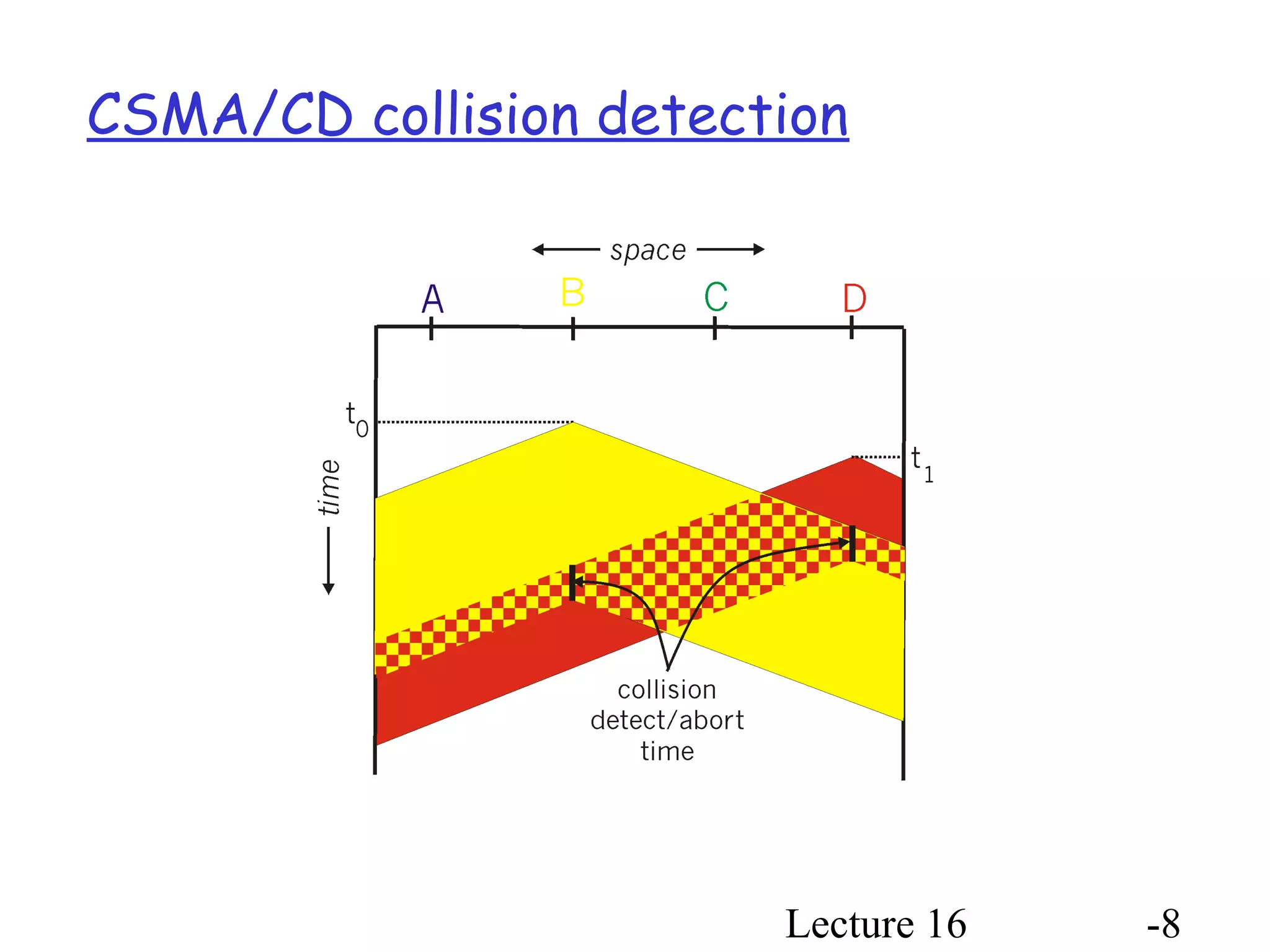
collisions are detected within a few bit times
Transmission is then aborted, reducing the channel wastage
considerably
persistent retransmission is implemented
Collision detection is easy in wired LANs:
can measure signal strength on the line
Collision detection cannot be done in wireless LANs :
CSMA/CD can approach channel utilization =1 in LANs:
low ratio of propagation over frame transmission time
Lecture 16 -8
CSMA/CD collision detection
Lecture 16 -9
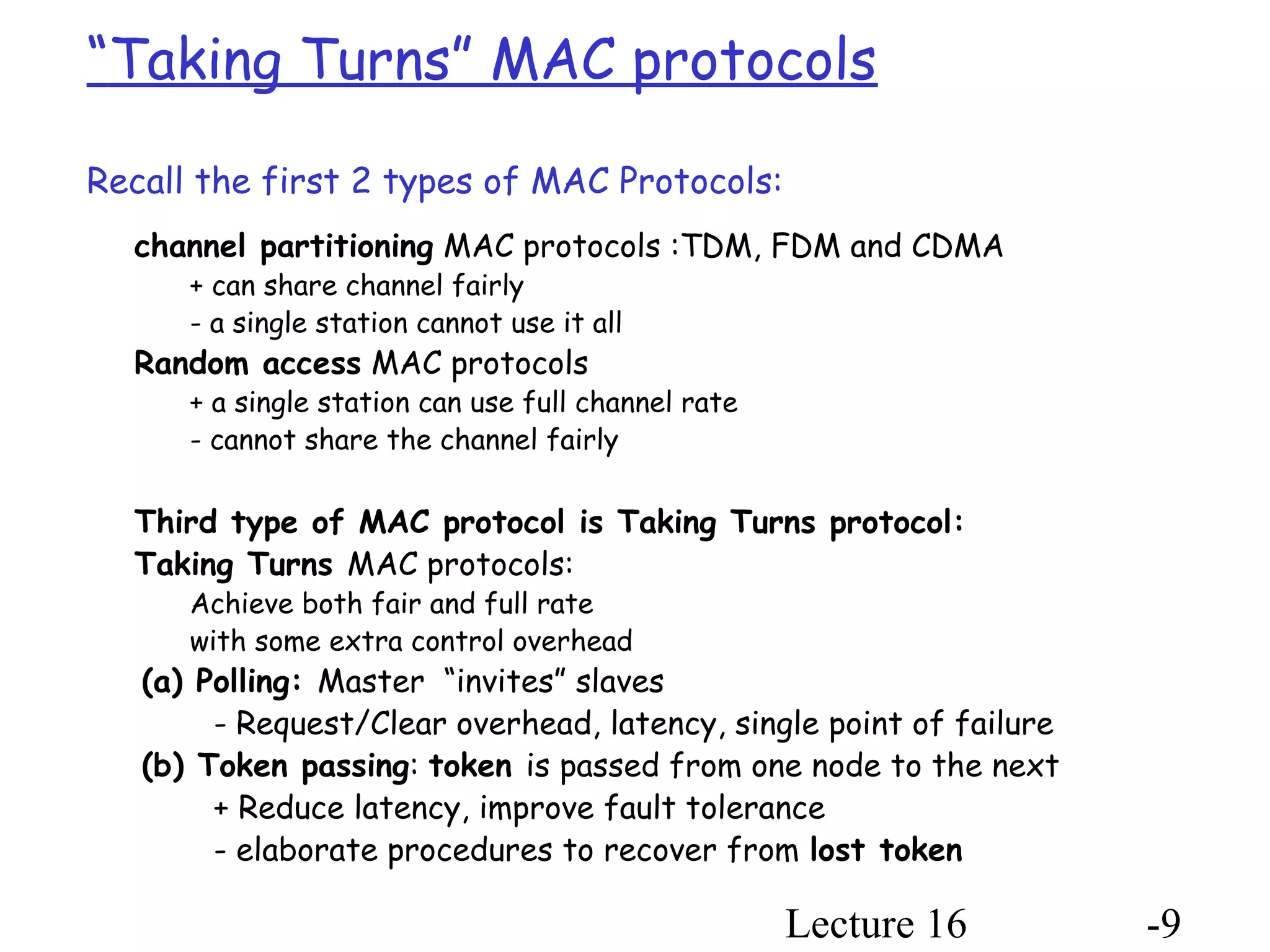
“Taking Turns” MAC protocols
Recall the first 2 types of MAC Protocols:
channel partitioning MAC protocols :TDM, FDM and CDMA
+ can share channel fairly
- a single station cannot use it all
Random access MAC protocols
+ a single station can use full channel rate
- cannot share the channel fairly
Third type of MAC protocol is Taking Turns protocol:
Taking Turns MAC protocols:
Achieve both fair and full rate
with some extra control overhead
(a) Polling: Master “invites” slaves
- Request/Clear overhead, latency, single point of failure
(b) Token passing: token is passed from one node to the next
+ Reduce latency, improve fault tolerance
- elaborate procedures to recover from lost token
Lecture 16 -10
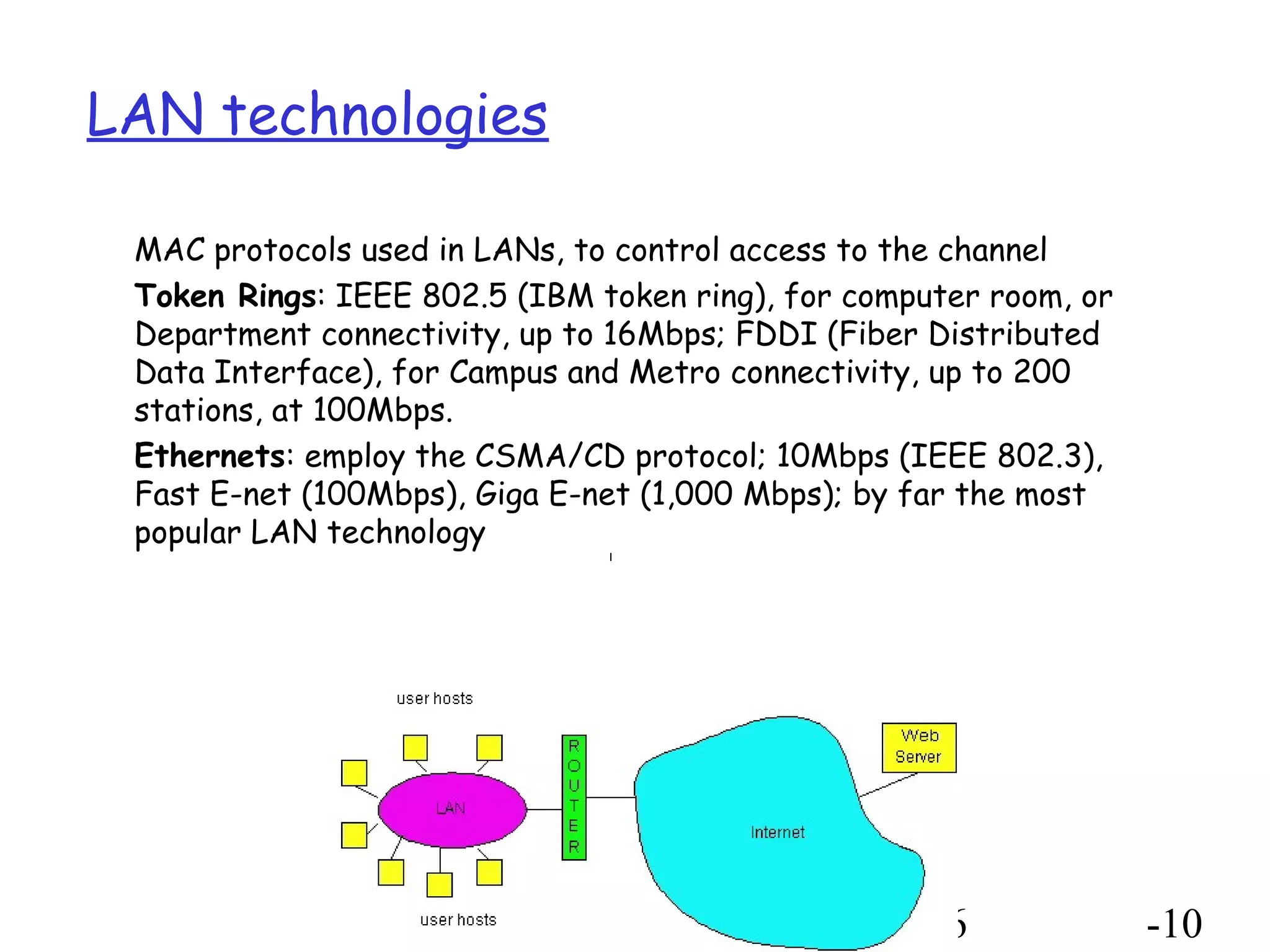
LAN technologies
MAC protocols used in LANs, to control access to the channel
Token Rings: IEEE 802.5 (IBM token ring), for computer room, or
Department connectivity, up to 16Mbps; FDDI (Fiber Distributed
Data Interface), for Campus and Metro connectivity, up to 200
stations, at 100Mbps.
Ethernets: employ the CSMA/CD protocol; 10Mbps (IEEE 802.3),
Fast E-net (100Mbps), Giga E-net (1,000 Mbps); by far the most
popular LAN technology
Lecture 16 -11
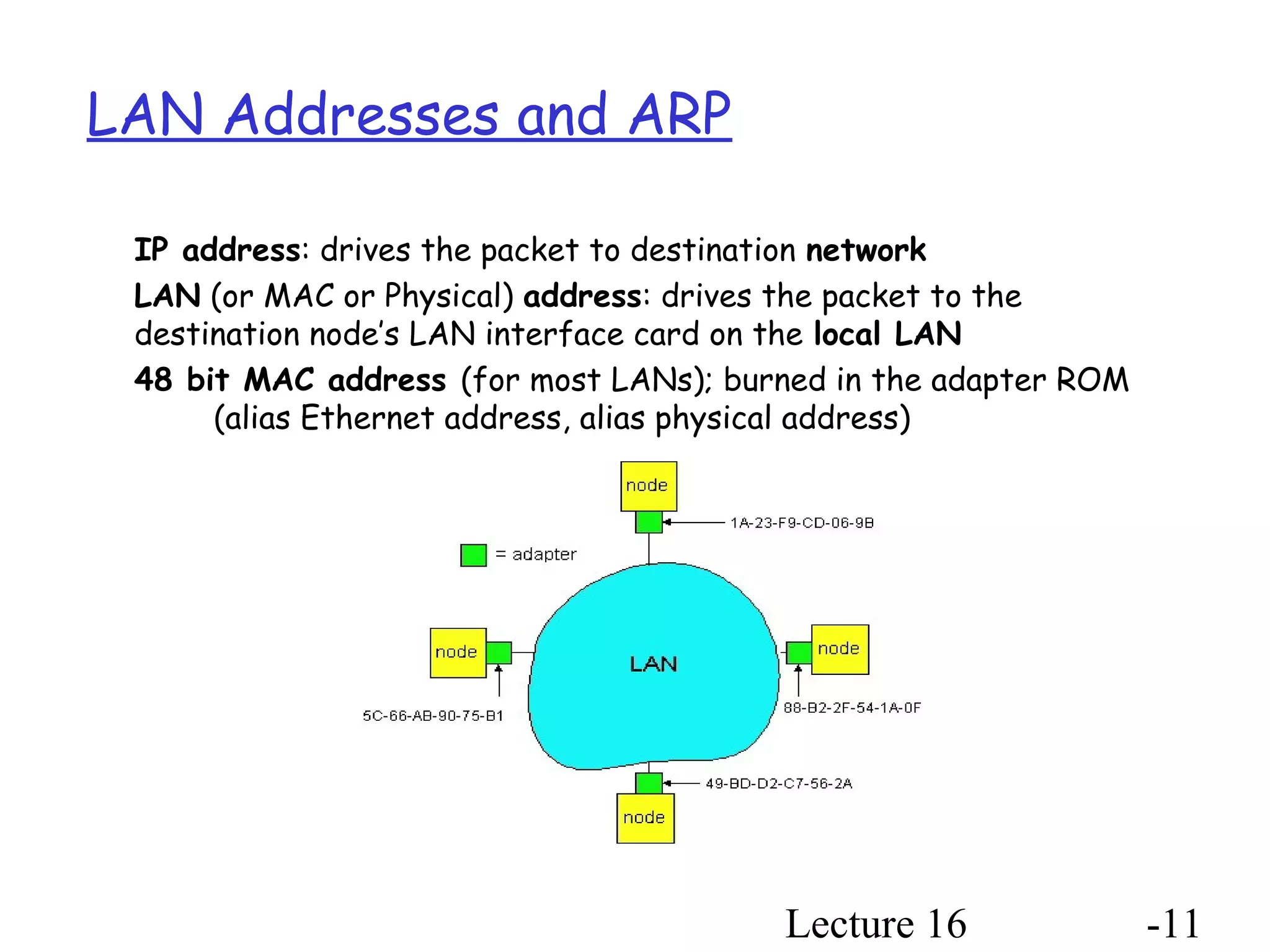
LAN Addresses and ARP
IP address: drives the packet to destination network
LAN (or MAC or Physical) address: drives the packet to the
destination node’s LAN interface card on the local LAN
48 bit MAC address (for most LANs); burned in the adapter ROM
(alias Ethernet address, alias physical address)
Lecture 16 -12
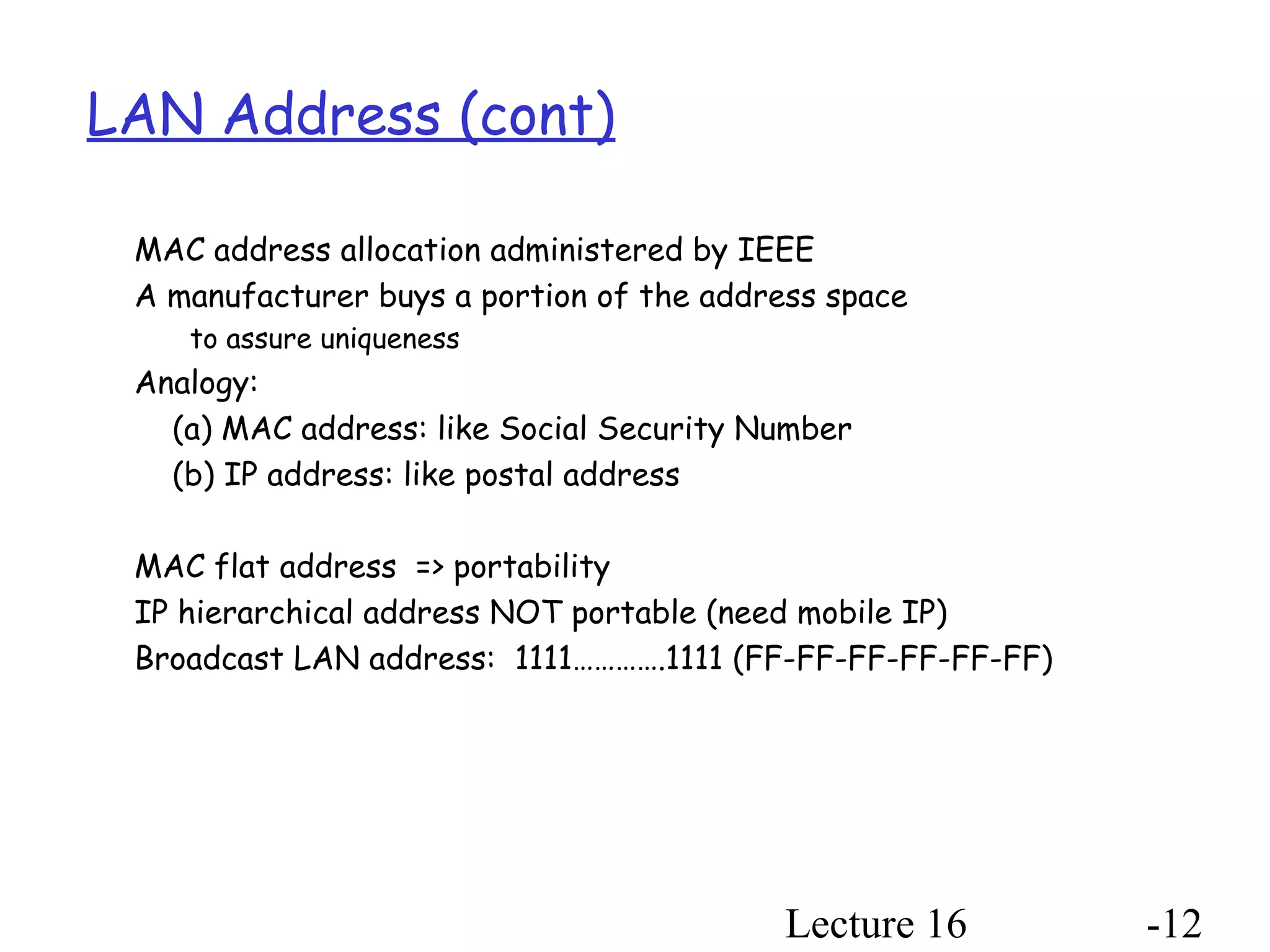
LAN Address (cont)
MAC address allocation administered by IEEE
A manufacturer buys a portion of the address space
to assure uniqueness
Analogy:
(a) MAC address: like Social Security Number
(b) IP address: like postal address
MAC flat address => portability
IP hierarchical address NOT portable (need mobile IP)
Broadcast LAN address: 1111………….1111 (FF-FF-FF-FF-FF-FF)
Lecture 16 -13
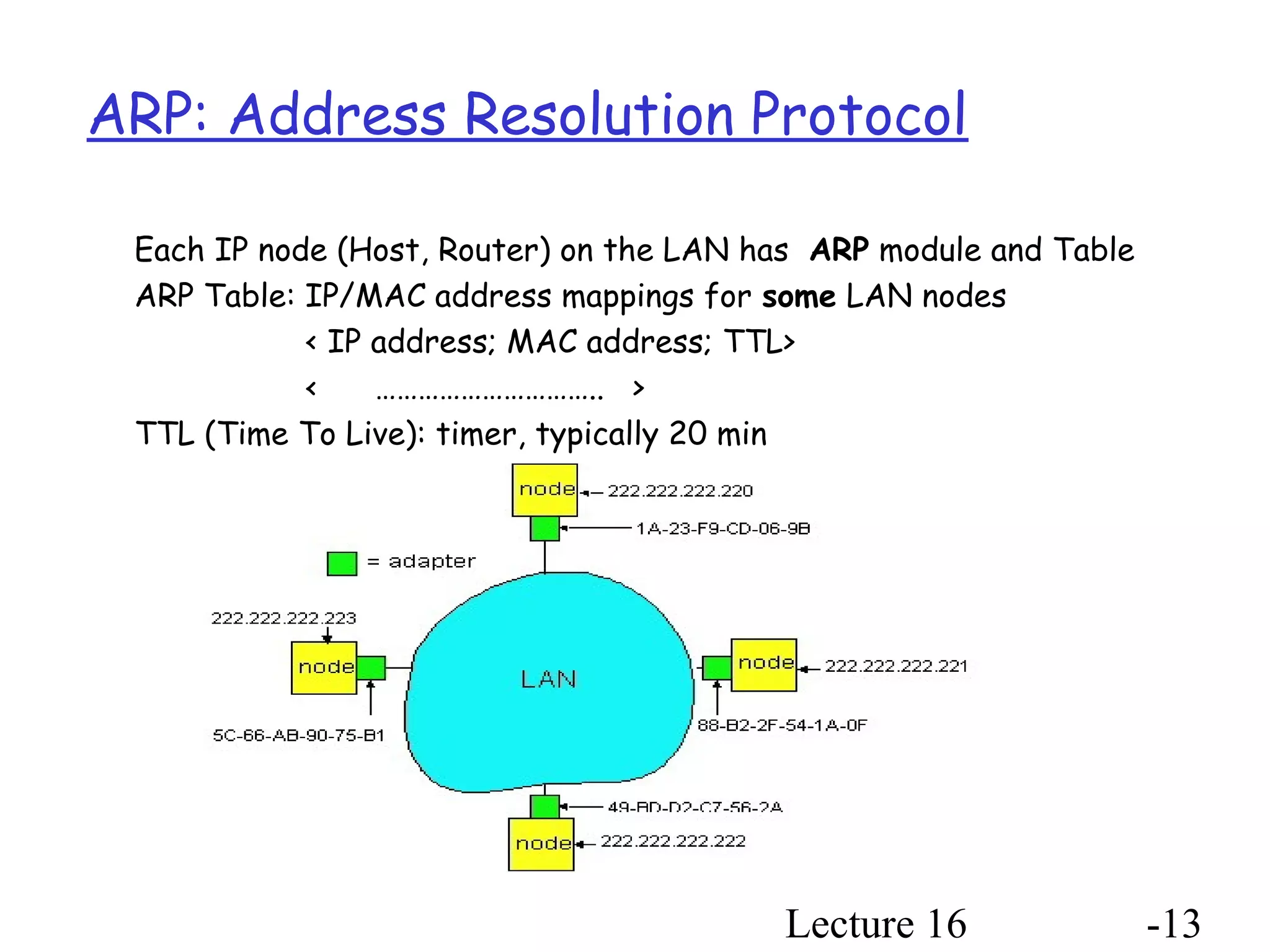
ARP: Address Resolution Protocol
Each IP node (Host, Router) on the LAN has ARP module and Table
ARP Table: IP/MAC address mappings for some LAN nodes
< IP address; MAC address; TTL>
< ………………………….. >
TTL (Time To Live): timer, typically 20 min
Lecture 16 -14
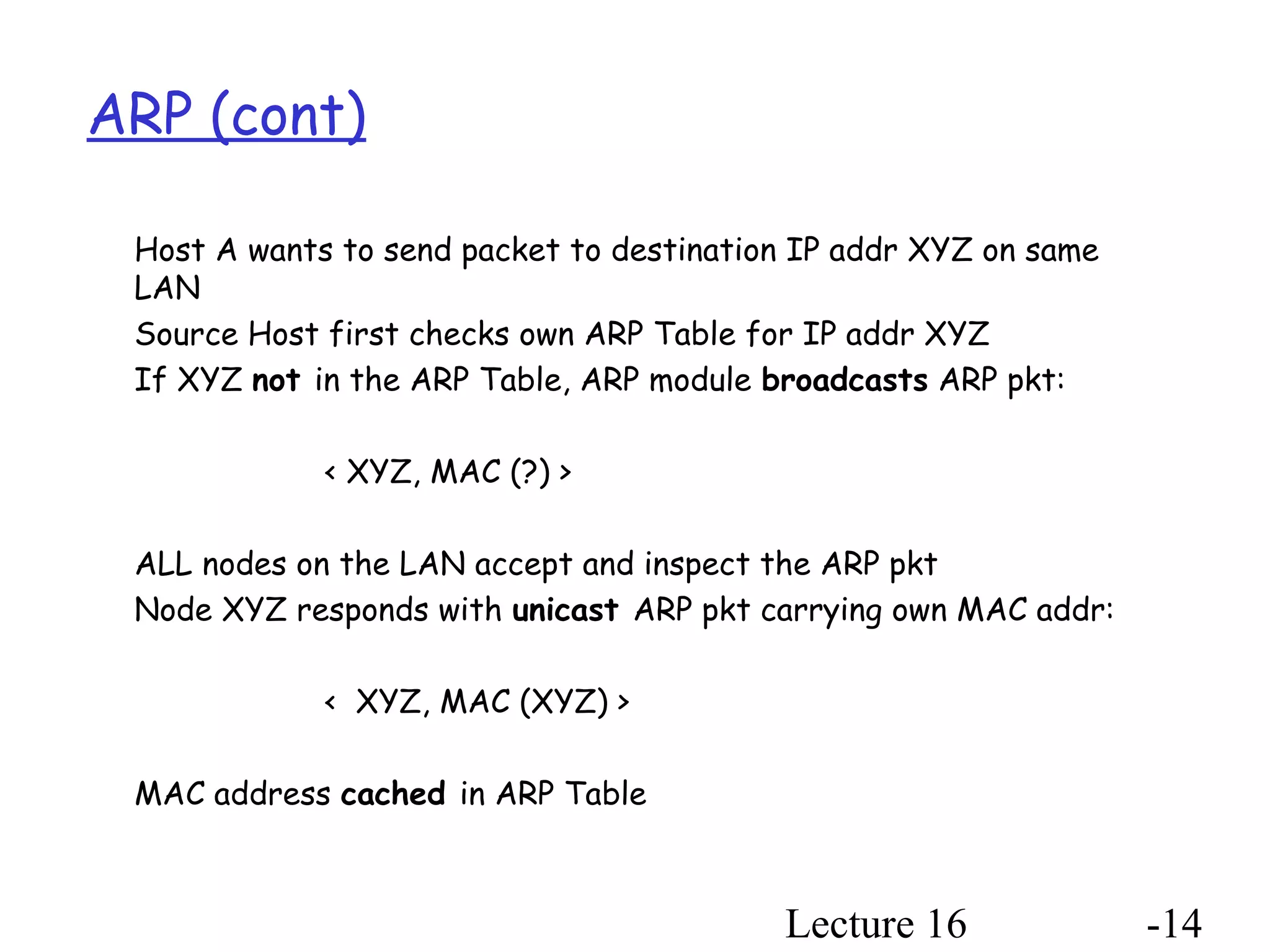
ARP (cont)
Host A wants to send packet to destination IP addr XYZ on same
LAN
Source Host first checks own ARP Table for IP addr XYZ
If XYZ not in the ARP Table, ARP module broadcasts ARP pkt:
< XYZ, MAC (?) >
ALL nodes on the LAN accept and inspect the ARP pkt
Node XYZ responds with unicast ARP pkt carrying own MAC addr:
< XYZ, MAC (XYZ) >
MAC address cached in ARP Table
Lecture 16 -15
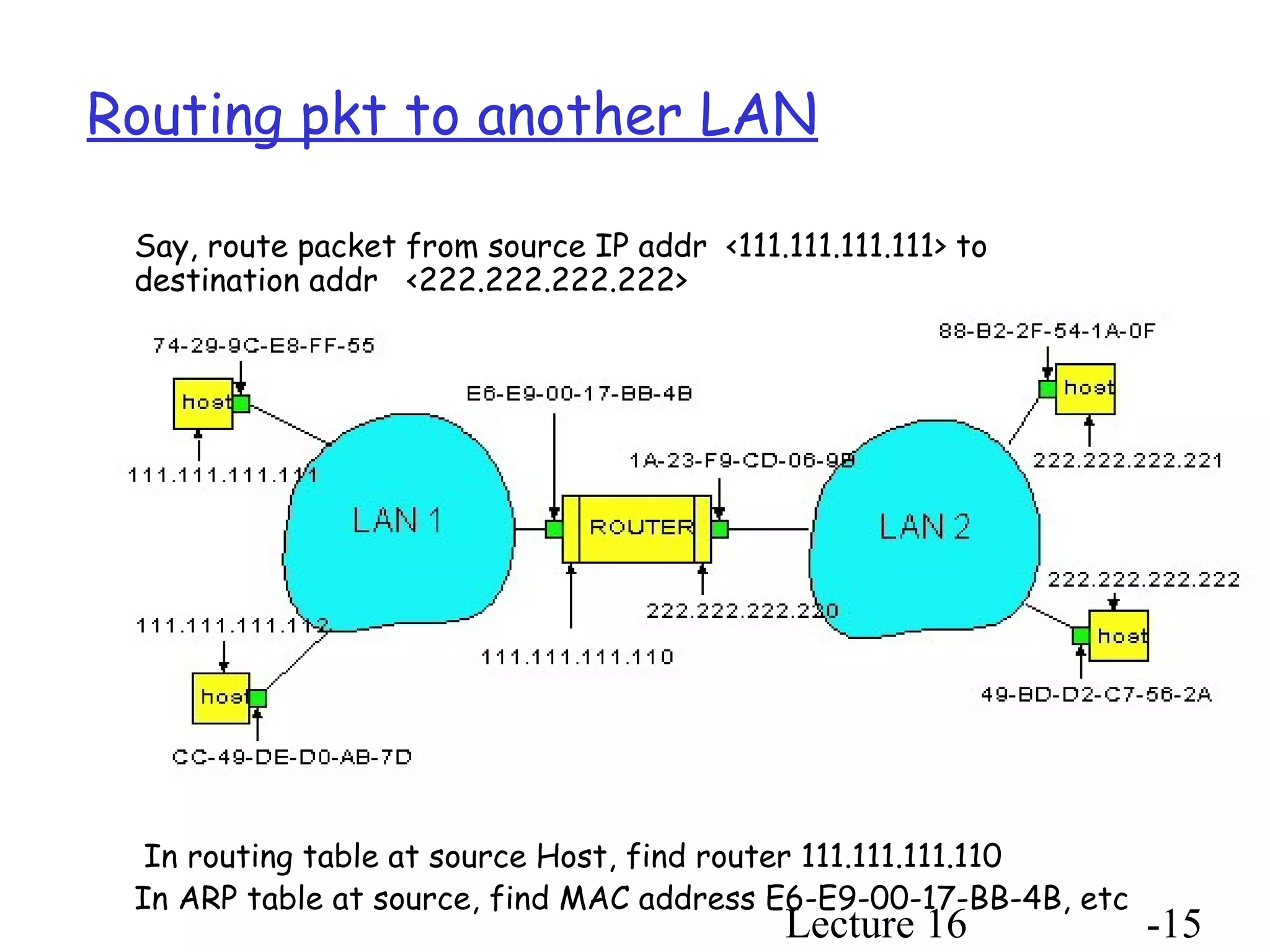
Routing pkt to another LAN
Say, route packet from source IP addr <111.111.111.111> to
destination addr <222.222.222.222>
In routing table at source Host, find router 111.111.111.110
In ARP table at source, find MAC address E6-E9-00-17-BB-4B, etc

Lect16

  • 1.
    Lecture 16 -1 RandomAccess protocols A node transmits at random at full channel data rate R. If two or more nodes “collide”, they retransmit at random times The random access MAC protocol specifies how to detect collisions and how to recover from them (via delayed retransmissions, for example) Examples of random access MAC protocols SLOTTED ALOHA ALOHA CSMA and CSMA/CD
  • 2.
    Lecture 16 -2 SlottedAloha Time is divided into equal size slots (= sending one frame) a newly arriving station transmits at the beginning of the next slot if collision occurs (assume channel feedback, eg the receiver informs the source of a collision), the source retransmits the packet at each slot with probability P, until successful. Success (S), Collision (C), Empty (E) slots Fully decentralized
  • 3.
    Lecture 16 -3 SlottedAloha efficiency If N stations always have frames to send, and each transmits in each slot with probability P, the probability of successful transmission S is: S = Prob (only one transmits) = N P (1-P)^(N-1) Optimal value of P: P = 1/N For example, if N=2, S= .5 For N very large one finds S= 1/e (approximately, .37)
  • 4.
    Lecture 16 -4 Pure(unslotted) ALOHA Slotted ALOHA requires slot synchronization A simpler version, pure ALOHA, does not require slots A node transmits without awaiting for the beginning of a slot Collision probability increases (packet can collide with other packets which are transmitted within a window twice as large as in S-Aloha) Throughput is reduced by one half, S= 1/2e
  • 5.
    Lecture 16 -5 CSMA(Carrier Sense Multiple Access) CSMA: listen before transmit. If channel is sensed busy, defer transmission Persistent CSMA: retry immediately when channel becomes idle (this may cause instability) Non persistent CSMA: retry after random interval of time Note: collisions may still exist, since two stations may sense the channel idle at the same time ( or better, within a “vulnerable” window = round trip delay) In case of collision, the entire pkt transmission time is wasted
  • 6.
  • 7.
    Lecture 16 -7 CSMA/CD(Collision Detection) CSMA/CD: like in CSMA collisions are detected within a few bit times Transmission is then aborted, reducing the channel wastage considerably persistent retransmission is implemented Collision detection is easy in wired LANs: can measure signal strength on the line Collision detection cannot be done in wireless LANs : CSMA/CD can approach channel utilization =1 in LANs: low ratio of propagation over frame transmission time
  • 8.
    Lecture 16 -8 CSMA/CDcollision detection
  • 9.
    Lecture 16 -9 “TakingTurns” MAC protocols Recall the first 2 types of MAC Protocols: channel partitioning MAC protocols :TDM, FDM and CDMA + can share channel fairly - a single station cannot use it all Random access MAC protocols + a single station can use full channel rate - cannot share the channel fairly Third type of MAC protocol is Taking Turns protocol: Taking Turns MAC protocols: Achieve both fair and full rate with some extra control overhead (a) Polling: Master “invites” slaves - Request/Clear overhead, latency, single point of failure (b) Token passing: token is passed from one node to the next + Reduce latency, improve fault tolerance - elaborate procedures to recover from lost token
  • 10.
    Lecture 16 -10 LANtechnologies MAC protocols used in LANs, to control access to the channel Token Rings: IEEE 802.5 (IBM token ring), for computer room, or Department connectivity, up to 16Mbps; FDDI (Fiber Distributed Data Interface), for Campus and Metro connectivity, up to 200 stations, at 100Mbps. Ethernets: employ the CSMA/CD protocol; 10Mbps (IEEE 802.3), Fast E-net (100Mbps), Giga E-net (1,000 Mbps); by far the most popular LAN technology
  • 11.
    Lecture 16 -11 LANAddresses and ARP IP address: drives the packet to destination network LAN (or MAC or Physical) address: drives the packet to the destination node’s LAN interface card on the local LAN 48 bit MAC address (for most LANs); burned in the adapter ROM (alias Ethernet address, alias physical address)
  • 12.
    Lecture 16 -12 LANAddress (cont) MAC address allocation administered by IEEE A manufacturer buys a portion of the address space to assure uniqueness Analogy: (a) MAC address: like Social Security Number (b) IP address: like postal address MAC flat address => portability IP hierarchical address NOT portable (need mobile IP) Broadcast LAN address: 1111………….1111 (FF-FF-FF-FF-FF-FF)
  • 13.
    Lecture 16 -13 ARP:Address Resolution Protocol Each IP node (Host, Router) on the LAN has ARP module and Table ARP Table: IP/MAC address mappings for some LAN nodes < IP address; MAC address; TTL> < ………………………….. > TTL (Time To Live): timer, typically 20 min
  • 14.
    Lecture 16 -14 ARP(cont) Host A wants to send packet to destination IP addr XYZ on same LAN Source Host first checks own ARP Table for IP addr XYZ If XYZ not in the ARP Table, ARP module broadcasts ARP pkt: < XYZ, MAC (?) > ALL nodes on the LAN accept and inspect the ARP pkt Node XYZ responds with unicast ARP pkt carrying own MAC addr: < XYZ, MAC (XYZ) > MAC address cached in ARP Table
  • 15.
    Lecture 16 -15 Routingpkt to another LAN Say, route packet from source IP addr <111.111.111.111> to destination addr <222.222.222.222> In routing table at source Host, find router 111.111.111.110 In ARP table at source, find MAC address E6-E9-00-17-BB-4B, etc