MADE BY NITYANT SINGHAL
CONTENTS
• What are Vitamins?
• What are the Categories of
Vitamins?
• What is Fat Soluble Vitamin ?
• Types of Fat Soluble Vitamin
• Vitamin A
• Vitamin D
• Vitamin E
• Vitamin K
• What is Water Soluble Vitamin ?
• Types of Water Soluble Vitamin
• Vitamin B
• VITAMIN B1
• Vitamin B2
• Vitamin B3
•Vitamin B5
•Vitamin B6
•Vitamin B7
•VITAMIN B9
•VITAMIN B12
•Vitamin C
•What is the difference between fat‐soluble
and water‐soluble vitamins?
•What are the deficiencies caused by
shortage of vitamins?
•B‐1 Deficiency
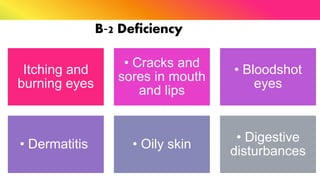
•B‐2 Deficiency
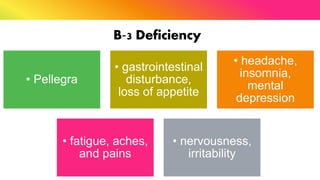
•B‐3 Deficiency
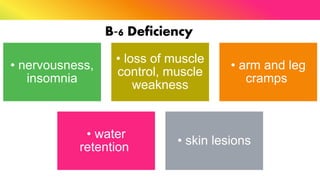
•B‐6 Deficiency
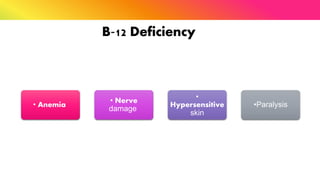
•B‐12 Deficiency
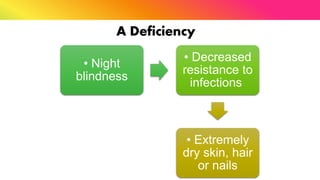
•A Deficiency
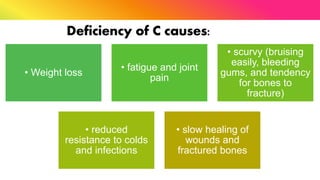
•Deficiency of C causes:
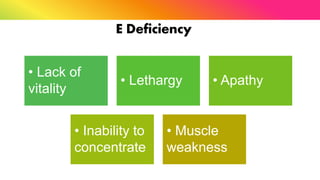
•E Deficiency
•How can we prevent/cure vitamin
deficiencies?
•Can we take too many vitamins?
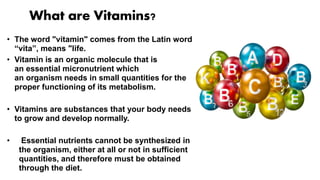
• The word "vitamin" comes from the Latin word
“vita”, means "life.
• Vitamin is an organic molecule that is
an essential micronutrient which
an organism needs in small quantities for the
proper functioning of its metabolism.
• Vitamins are substances that your body needs
to grow and develop normally.
• Essential nutrients cannot be synthesized in
the organism, either at all or not in sufficient
quantities, and therefore must be obtained
through the diet.
What are Vitamins?
What are the
Categories of
Vitamins?
Vitamins are grouped
into two categories:-
1. FAT SOLUBLE
VITAMINS
2. WATER SOLUBLE
VITAMINS
What is Fat Soluble Vitamin ?
A vitamin that can dissolve in fats
and oils is called fat soluble
vitamin.
Fat-soluble vitamins are
absorbed along with fats in the
diet and are stored in the body’s
fatty tissue and in the liver.
They are found in many plant and
animal foods and in dietary
supplements.
If you take too much of a fat-
soluble vitamin, it could become
toxic. Your body is especially
sensitive to too much vitamin A
from animal sources (retinol) and
too much vitamin D. A balanced
diet usually provides enough fat-
soluble vitamins.
Types of Fat Soluble Vitamin
The fat-
soluble
vitamins
are A, D, E
and K.
Let's know
more about
these
vitamins.
Vitamin A
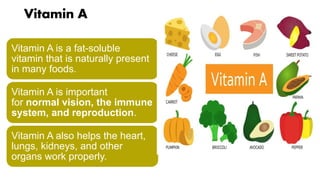
Vitamin A is a fat-soluble
vitamin that is naturally present
in many foods.
Vitamin A is important
for normal vision, the immune
system, and reproduction.
Vitamin A also helps the heart,
lungs, kidneys, and other
organs work properly.
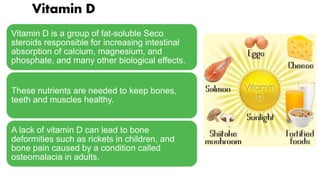
Vitamin D is a group of fat-soluble Seco
steroids responsible for increasing intestinal
absorption of calcium, magnesium, and
phosphate, and many other biological effects.
These nutrients are needed to keep bones,
teeth and muscles healthy.
A lack of vitamin D can lead to bone
deformities such as rickets in children, and
bone pain caused by a condition called
osteomalacia in adults.
Vitamin D
Vitamin E
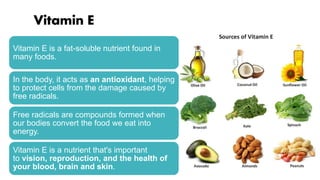
Vitamin E is a fat-soluble nutrient found in
many foods.
In the body, it acts as an antioxidant, helping
to protect cells from the damage caused by
free radicals.
Free radicals are compounds formed when
our bodies convert the food we eat into
energy.
Vitamin E is a nutrient that's important
to vision, reproduction, and the health of
your blood, brain and skin.
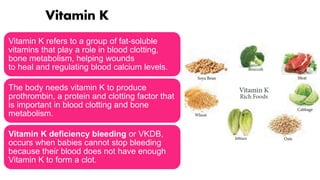
Vitamin K
Vitamin K refers to a group of fat-soluble
vitamins that play a role in blood clotting,
bone metabolism, helping wounds
to heal and regulating blood calcium levels.
The body needs vitamin K to produce
prothrombin, a protein and clotting factor that
is important in blood clotting and bone
metabolism.
Vitamin K deficiency bleeding or VKDB,
occurs when babies cannot stop bleeding
because their blood does not have enough
Vitamin K to form a clot.
What is Water Soluble Vitamin ?
A vitamin that can
dissolve in water is
called water soluble
vitamin.
Water-soluble vitamins
are carried to the body's
tissues but are not
stored in the body.
They are found in many
plant and animal foods
and in dietary
supplements and must
be taken in daily.
Any excess of water-
soluble vitamins is
quickly excreted in urine
and will rarely
accumulate to toxic
levels.
Types of Water Soluble Vitamin
THE WATER
SOLUBLE
VITAMINS
ARE VITAMIN
B COMPLEX
AND C.
LET'S KNOW
MORE
ABOUT
THESE
VITAMINS.
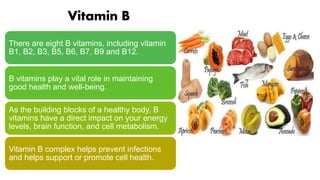
Vitamin B
There are eight B vitamins, including vitamin
B1, B2, B3, B5, B6, B7, B9 and B12.
B vitamins play a vital role in maintaining
good health and well-being.
As the building blocks of a healthy body, B
vitamins have a direct impact on your energy
levels, brain function, and cell metabolism.
Vitamin B complex helps prevent infections
and helps support or promote cell health.
VITAMIN B1
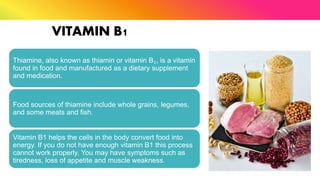
Thiamine, also known as thiamin or vitamin B₁, is a vitamin
found in food and manufactured as a dietary supplement
and medication.
Food sources of thiamine include whole grains, legumes,
and some meats and fish.
Vitamin B1 helps the cells in the body convert food into
energy. If you do not have enough vitamin B1 this process
cannot work properly. You may have symptoms such as
tiredness, loss of appetite and muscle weakness.
Vitamin B2
Vitamin B2 helps break down proteins, fats,
and carbohydrates.
It plays a vital role in maintaining the body's energy supply.
Riboflavin helps convert carbohydrates into adenosine
triphosphate (ATP).
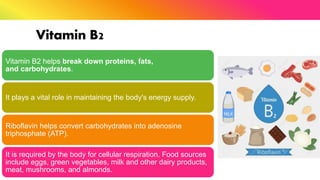
It is required by the body for cellular respiration. Food sources
include eggs, green vegetables, milk and other dairy products,
meat, mushrooms, and almonds.
Vitamin B3
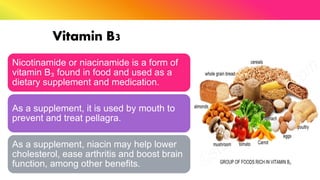
Nicotinamide or niacinamide is a form of
vitamin B₃ found in food and used as a
dietary supplement and medication.
As a supplement, it is used by mouth to
prevent and treat pellagra.
As a supplement, niacin may help lower
cholesterol, ease arthritis and boost brain
function, among other benefits.
Vitamin B5
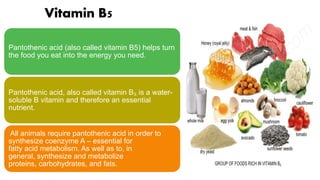
Pantothenic acid (also called vitamin B5) helps turn
the food you eat into the energy you need.
Pantothenic acid, also called vitamin B₅ is a water-
soluble B vitamin and therefore an essential
nutrient.
All animals require pantothenic acid in order to
synthesize coenzyme A – essential for
fatty acid metabolism. As well as to, in
general, synthesize and metabolize
proteins, carbohydrates, and fats.
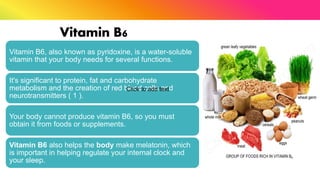
Vitamin B6
Vitamin B6, also known as pyridoxine, is a water-soluble
vitamin that your body needs for several functions.
It's significant to protein, fat and carbohydrate
metabolism and the creation of red blood cells and
neurotransmitters ( 1 ).
Your body cannot produce vitamin B6, so you must
obtain it from foods or supplements.
Vitamin B6 also helps the body make melatonin, which
is important in helping regulate your internal clock and
your sleep.
Click to add text
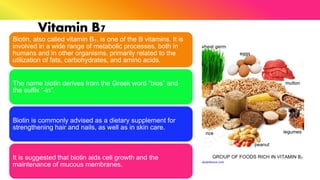
Vitamin B7
Biotin, also called vitamin B₇, is one of the B vitamins. It is
involved in a wide range of metabolic processes, both in
humans and in other organisms, primarily related to the
utilization of fats, carbohydrates, and amino acids.
The name biotin derives from the Greek word “bios” and
the suffix “-in”.
Biotin is commonly advised as a dietary supplement for
strengthening hair and nails, as well as in skin care.
It is suggested that biotin aids cell growth and the
maintenance of mucous membranes.
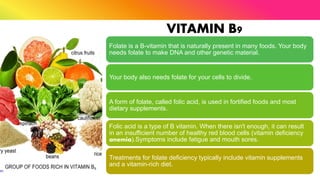
VITAMIN B9
Folate is a B-vitamin that is naturally present in many foods. Your body
needs folate to make DNA and other genetic material.
Your body also needs folate for your cells to divide.
A form of folate, called folic acid, is used in fortified foods and most
dietary supplements.
Folic acid is a type of B vitamin. When there isn't enough, it can result
in an insufficient number of healthy red blood cells (vitamin deficiency
anemia).Symptoms include fatigue and mouth sores.
Treatments for folate deficiency typically include vitamin supplements
and a vitamin-rich diet.
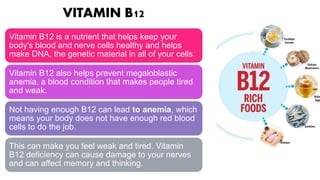
VITAMIN B12
Vitamin B12 is a nutrient that helps keep your
body's blood and nerve cells healthy and helps
make DNA, the genetic material in all of your cells.
Vitamin B12 also helps prevent megaloblastic
anemia, a blood condition that makes people tired
and weak.
Not having enough B12 can lead to anemia, which
means your body does not have enough red blood
cells to do the job.
This can make you feel weak and tired. Vitamin
B12 deficiency can cause damage to your nerves
and can affect memory and thinking.
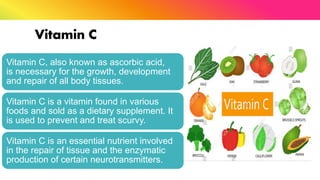
Vitamin C
Vitamin C, also known as ascorbic acid,
is necessary for the growth, development
and repair of all body tissues.
Vitamin C is a vitamin found in various
foods and sold as a dietary supplement. It
is used to prevent and treat scurvy.
Vitamin C is an essential nutrient involved
in the repair of tissue and the enzymatic
production of certain neurotransmitters.
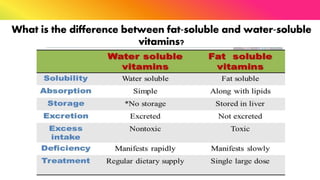
What is the difference between fat‐soluble and water‐soluble
vitamins?
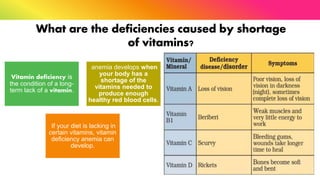
What are the deficiencies caused by shortage
of vitamins?
Vitamin deficiency is
the condition of a long-
term lack of a vitamin.
anemia develops when
your body has a
shortage of the
vitamins needed to
produce enough
healthy red blood cells.
If your diet is lacking in
certain vitamins, vitamin
deficiency anemia can
develop.
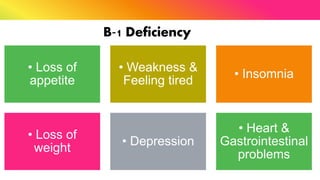
B‐1 Deficiency
• Loss of
appetite
• Weakness &
Feeling tired
• Insomnia
• Loss of
weight
• Depression
• Heart &
Gastrointestinal
problems
B‐2 Deficiency
Itching and
burning eyes
• Cracks and
sores in mouth
and lips
• Bloodshot
eyes
• Dermatitis • Oily skin
• Digestive
disturbances
B‐3 Deficiency
• Pellegra
• gastrointestinal
disturbance,
loss of appetite
• headache,
insomnia,
mental
depression
• fatigue, aches,
and pains
• nervousness,
irritability
B‐6 Deficiency
• nervousness,
insomnia
• loss of muscle
control, muscle
weakness
• arm and leg
cramps
• water
retention
• skin lesions
B‐12 Deficiency
• Anemia
• Nerve
damage
•
Hypersensitive
skin
•Paralysis
A Deficiency
• Night
blindness
• Decreased
resistance to
infections
• Extremely
dry skin, hair
or nails
Deficiency of C causes:
• Weight loss
• fatigue and joint
pain
• scurvy (bruising
easily, bleeding
gums, and tendency
for bones to
fracture)
• reduced
resistance to colds
and infections
• slow healing of
wounds and
fractured bones
E Deficiency
• Lack of
vitality
• Lethargy • Apathy
• Inability to
concentrate
• Muscle
weakness
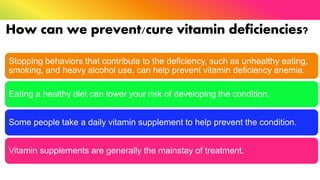
How can we prevent/cure vitamin deficiencies?
Stopping behaviors that contribute to the deficiency, such as unhealthy eating,
smoking, and heavy alcohol use, can help prevent vitamin deficiency anemia.
Eating a healthy diet can lower your risk of developing the condition.
Some people take a daily vitamin supplement to help prevent the condition.
Vitamin supplements are generally the mainstay of treatment.
Can we take too many vitamins?
For the most part vitamin supplements are safe to take.
Follow the recommended dosages on the label of the bottle.
Fat‐soluble vitamins are more likely to be toxic to your health if taken
in excess, because they are stored in the body, where as
water‐soluble are excreted.
THANK
YOU

nityant ppt on vitamins

  • 1.
  • 2.
    CONTENTS • What areVitamins? • What are the Categories of Vitamins? • What is Fat Soluble Vitamin ? • Types of Fat Soluble Vitamin • Vitamin A • Vitamin D • Vitamin E • Vitamin K • What is Water Soluble Vitamin ? • Types of Water Soluble Vitamin • Vitamin B • VITAMIN B1 • Vitamin B2 • Vitamin B3 •Vitamin B5 •Vitamin B6 •Vitamin B7 •VITAMIN B9 •VITAMIN B12 •Vitamin C •What is the difference between fat‐soluble and water‐soluble vitamins? •What are the deficiencies caused by shortage of vitamins? •B‐1 Deficiency •B‐2 Deficiency •B‐3 Deficiency •B‐6 Deficiency •B‐12 Deficiency •A Deficiency •Deficiency of C causes: •E Deficiency •How can we prevent/cure vitamin deficiencies? •Can we take too many vitamins?
  • 3.
    • The word"vitamin" comes from the Latin word “vita”, means "life. • Vitamin is an organic molecule that is an essential micronutrient which an organism needs in small quantities for the proper functioning of its metabolism. • Vitamins are substances that your body needs to grow and develop normally. • Essential nutrients cannot be synthesized in the organism, either at all or not in sufficient quantities, and therefore must be obtained through the diet. What are Vitamins?
  • 4.
    What are the Categoriesof Vitamins? Vitamins are grouped into two categories:- 1. FAT SOLUBLE VITAMINS 2. WATER SOLUBLE VITAMINS
  • 5.
    What is FatSoluble Vitamin ? A vitamin that can dissolve in fats and oils is called fat soluble vitamin. Fat-soluble vitamins are absorbed along with fats in the diet and are stored in the body’s fatty tissue and in the liver. They are found in many plant and animal foods and in dietary supplements. If you take too much of a fat- soluble vitamin, it could become toxic. Your body is especially sensitive to too much vitamin A from animal sources (retinol) and too much vitamin D. A balanced diet usually provides enough fat- soluble vitamins.
  • 6.
    Types of FatSoluble Vitamin The fat- soluble vitamins are A, D, E and K. Let's know more about these vitamins.
  • 7.
    Vitamin A Vitamin Ais a fat-soluble vitamin that is naturally present in many foods. Vitamin A is important for normal vision, the immune system, and reproduction. Vitamin A also helps the heart, lungs, kidneys, and other organs work properly.
  • 8.
    Vitamin D isa group of fat-soluble Seco steroids responsible for increasing intestinal absorption of calcium, magnesium, and phosphate, and many other biological effects. These nutrients are needed to keep bones, teeth and muscles healthy. A lack of vitamin D can lead to bone deformities such as rickets in children, and bone pain caused by a condition called osteomalacia in adults. Vitamin D
  • 9.
    Vitamin E Vitamin Eis a fat-soluble nutrient found in many foods. In the body, it acts as an antioxidant, helping to protect cells from the damage caused by free radicals. Free radicals are compounds formed when our bodies convert the food we eat into energy. Vitamin E is a nutrient that's important to vision, reproduction, and the health of your blood, brain and skin.
  • 10.
    Vitamin K Vitamin Krefers to a group of fat-soluble vitamins that play a role in blood clotting, bone metabolism, helping wounds to heal and regulating blood calcium levels. The body needs vitamin K to produce prothrombin, a protein and clotting factor that is important in blood clotting and bone metabolism. Vitamin K deficiency bleeding or VKDB, occurs when babies cannot stop bleeding because their blood does not have enough Vitamin K to form a clot.
  • 11.
    What is WaterSoluble Vitamin ? A vitamin that can dissolve in water is called water soluble vitamin. Water-soluble vitamins are carried to the body's tissues but are not stored in the body. They are found in many plant and animal foods and in dietary supplements and must be taken in daily. Any excess of water- soluble vitamins is quickly excreted in urine and will rarely accumulate to toxic levels.
  • 12.
    Types of WaterSoluble Vitamin THE WATER SOLUBLE VITAMINS ARE VITAMIN B COMPLEX AND C. LET'S KNOW MORE ABOUT THESE VITAMINS.
  • 13.
    Vitamin B There areeight B vitamins, including vitamin B1, B2, B3, B5, B6, B7, B9 and B12. B vitamins play a vital role in maintaining good health and well-being. As the building blocks of a healthy body, B vitamins have a direct impact on your energy levels, brain function, and cell metabolism. Vitamin B complex helps prevent infections and helps support or promote cell health.
  • 14.
    VITAMIN B1 Thiamine, alsoknown as thiamin or vitamin B₁, is a vitamin found in food and manufactured as a dietary supplement and medication. Food sources of thiamine include whole grains, legumes, and some meats and fish. Vitamin B1 helps the cells in the body convert food into energy. If you do not have enough vitamin B1 this process cannot work properly. You may have symptoms such as tiredness, loss of appetite and muscle weakness.
  • 15.
    Vitamin B2 Vitamin B2helps break down proteins, fats, and carbohydrates. It plays a vital role in maintaining the body's energy supply. Riboflavin helps convert carbohydrates into adenosine triphosphate (ATP). It is required by the body for cellular respiration. Food sources include eggs, green vegetables, milk and other dairy products, meat, mushrooms, and almonds.
  • 16.
    Vitamin B3 Nicotinamide orniacinamide is a form of vitamin B₃ found in food and used as a dietary supplement and medication. As a supplement, it is used by mouth to prevent and treat pellagra. As a supplement, niacin may help lower cholesterol, ease arthritis and boost brain function, among other benefits.
  • 17.
    Vitamin B5 Pantothenic acid(also called vitamin B5) helps turn the food you eat into the energy you need. Pantothenic acid, also called vitamin B₅ is a water- soluble B vitamin and therefore an essential nutrient. All animals require pantothenic acid in order to synthesize coenzyme A – essential for fatty acid metabolism. As well as to, in general, synthesize and metabolize proteins, carbohydrates, and fats.
  • 18.
    Vitamin B6 Vitamin B6,also known as pyridoxine, is a water-soluble vitamin that your body needs for several functions. It's significant to protein, fat and carbohydrate metabolism and the creation of red blood cells and neurotransmitters ( 1 ). Your body cannot produce vitamin B6, so you must obtain it from foods or supplements. Vitamin B6 also helps the body make melatonin, which is important in helping regulate your internal clock and your sleep. Click to add text
  • 19.
    Vitamin B7 Biotin, alsocalled vitamin B₇, is one of the B vitamins. It is involved in a wide range of metabolic processes, both in humans and in other organisms, primarily related to the utilization of fats, carbohydrates, and amino acids. The name biotin derives from the Greek word “bios” and the suffix “-in”. Biotin is commonly advised as a dietary supplement for strengthening hair and nails, as well as in skin care. It is suggested that biotin aids cell growth and the maintenance of mucous membranes.
  • 20.
    VITAMIN B9 Folate isa B-vitamin that is naturally present in many foods. Your body needs folate to make DNA and other genetic material. Your body also needs folate for your cells to divide. A form of folate, called folic acid, is used in fortified foods and most dietary supplements. Folic acid is a type of B vitamin. When there isn't enough, it can result in an insufficient number of healthy red blood cells (vitamin deficiency anemia).Symptoms include fatigue and mouth sores. Treatments for folate deficiency typically include vitamin supplements and a vitamin-rich diet.
  • 21.
    VITAMIN B12 Vitamin B12is a nutrient that helps keep your body's blood and nerve cells healthy and helps make DNA, the genetic material in all of your cells. Vitamin B12 also helps prevent megaloblastic anemia, a blood condition that makes people tired and weak. Not having enough B12 can lead to anemia, which means your body does not have enough red blood cells to do the job. This can make you feel weak and tired. Vitamin B12 deficiency can cause damage to your nerves and can affect memory and thinking.
  • 22.
    Vitamin C Vitamin C,also known as ascorbic acid, is necessary for the growth, development and repair of all body tissues. Vitamin C is a vitamin found in various foods and sold as a dietary supplement. It is used to prevent and treat scurvy. Vitamin C is an essential nutrient involved in the repair of tissue and the enzymatic production of certain neurotransmitters.
  • 23.
    What is thedifference between fat‐soluble and water‐soluble vitamins?
  • 24.
    What are thedeficiencies caused by shortage of vitamins? Vitamin deficiency is the condition of a long- term lack of a vitamin. anemia develops when your body has a shortage of the vitamins needed to produce enough healthy red blood cells. If your diet is lacking in certain vitamins, vitamin deficiency anemia can develop.
  • 25.
    B‐1 Deficiency • Lossof appetite • Weakness & Feeling tired • Insomnia • Loss of weight • Depression • Heart & Gastrointestinal problems
  • 26.
    B‐2 Deficiency Itching and burningeyes • Cracks and sores in mouth and lips • Bloodshot eyes • Dermatitis • Oily skin • Digestive disturbances
  • 27.
    B‐3 Deficiency • Pellegra •gastrointestinal disturbance, loss of appetite • headache, insomnia, mental depression • fatigue, aches, and pains • nervousness, irritability
  • 28.
    B‐6 Deficiency • nervousness, insomnia •loss of muscle control, muscle weakness • arm and leg cramps • water retention • skin lesions
  • 29.
    B‐12 Deficiency • Anemia •Nerve damage • Hypersensitive skin •Paralysis
  • 30.
    A Deficiency • Night blindness •Decreased resistance to infections • Extremely dry skin, hair or nails
  • 31.
    Deficiency of Ccauses: • Weight loss • fatigue and joint pain • scurvy (bruising easily, bleeding gums, and tendency for bones to fracture) • reduced resistance to colds and infections • slow healing of wounds and fractured bones
  • 32.
    E Deficiency • Lackof vitality • Lethargy • Apathy • Inability to concentrate • Muscle weakness
  • 33.
    How can weprevent/cure vitamin deficiencies? Stopping behaviors that contribute to the deficiency, such as unhealthy eating, smoking, and heavy alcohol use, can help prevent vitamin deficiency anemia. Eating a healthy diet can lower your risk of developing the condition. Some people take a daily vitamin supplement to help prevent the condition. Vitamin supplements are generally the mainstay of treatment.
  • 34.
    Can we taketoo many vitamins? For the most part vitamin supplements are safe to take. Follow the recommended dosages on the label of the bottle. Fat‐soluble vitamins are more likely to be toxic to your health if taken in excess, because they are stored in the body, where as water‐soluble are excreted.
  • 35.