Case Presentation
• 3 days old Baby boy of Mrs.R from Kottawa presented
with yellowish discoloration of the body and eyes for 1
day duration
Antenatal history
• This is mothers second pregnancy with an uneventful
antenatal period upto 34th week where the OGTT test
has showed increased glucose levels but was controlled
on diet.
Birth history
• Baby was delivered via a normal vaginal delivery at 37
weeks.
• Birth weight was 2.7Kg.
• APGAR 1 min- 9 , 5 min- 10
• Blood sugars were monitored 4 hrly for 24 hrs and was
above 46mg.
History of presenting complaint
• Patient was last well 1 day ago where the
mother has noticed yellowish discolouration
of the whole body and sclera.
• During the first two days stools were said to
be dark in colour which has turned yellowish
by the 3rd day but it was not pale.
• Mother also mentioned of 1 episode of dark coloured
urine on the 3rd day after birth.
• Baby was said to be lethargic where the mother had to
wake him up during the feeds.
• No difficulty in feeding , excessive crying, fever or
discharge from the umbilicus noted.
• Urine output, Bowel output normal.
• In the evening of the 3rd day after birth baby was
brought to the hospital and since the baby was severly
jaundiced, blood was sent for FBC,CRP,SBR,GP,DCT and
started on triple phototherapy. After 1 hr serum
bilirubin level was found out to be 26.46mg/dl which
was above the exchange transfusion level.
• Blood group - mother is O +ve
Fathers not known
baby is B +ve
• Not a consangous marriage.
• Immunization history
BCG given within 24hrs.
• Family history
No family members with jaundice in the
neonatal period. No history of anemia,
splenectomy or Bile stones in family members or
known heredity for haemolytic disorders.
• Social history
Baby is living with his mother, father ,
grandmother and the elder sibling who is 1 ½
years.
Mother is 36 years old and a housewife.
Father is a 36 years old businessman.
She receives a good family support
The family is financially stable.
Examination
• Baby was on triple phototherapy in NICU.
• No dysmorphic features ,not dyspnoeic.
• Yellow discolouration of the skin and sclera
was observed.
• Weight on examination 2.61kg (only 4% loss
not significant)
• OFC 32cm.
• Length 46cm
• BP-64/29
• HR – 152 BPM
• CRFT - < 2 sec
• RR – 42
• TEMP – 98.4 F
• Other than that Neonatal examination was
unremarkable.
• Management
Soon after admission
– Triple phototherapy started
• 10% Dextrose infusion at 6.8CC per hour
• EBM 30CC per 3 hours.
• Investigations done
FBC/CRP/SBR/GP/ DCT/ Blood picture/ Reticulocyte count
22 Aug 2016 ( day 1 of admission)
– FBC - Hb 12.9 g/dl
- RBC 3.34 10^12/L
- HCT 37 %
- WBC 14.53 10^9/L
- N 38.1%
- L 42.8%
- PLT 343 10^9/L
-- CRP -1.4 mg/L
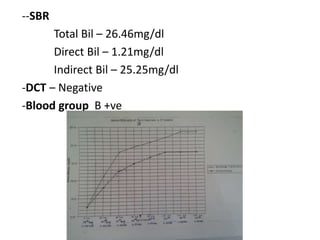
--SBR
Total Bil – 26.46mg/dl
Direct Bil – 1.21mg/dl
Indirect Bil – 25.25mg/dl
-DCT – Negative
-Blood group B +ve
• Bilirubin level was above the exchange
transfusion level.
• Preparation for an exchange transfusion was
done which is to be carried out after the next
serum bilirubin level in 8 hrs.
• While waiting, two hours after admission
40ml of group B FFP at 13.3CC per hour over 3 hours
IV Furosemide 2.5mg
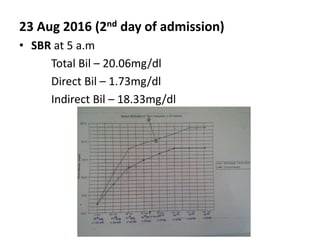
23 Aug 2016 (2nd day of admission)
• SBR at 5 a.m
Total Bil – 20.06mg/dl
Direct Bil – 1.73mg/dl
Indirect Bil – 18.33mg/dl
• Bilirubin level below exchange transfusion
level
No exchange transfusion done
• Triple photo therapy continued
• IV fluids stopped and EBM given.
• Reticulocyte count at 10 a.m - 10%
• FBC at 6 p.m
- Hb 11.6 g/dl
- RBC 2.99 10^12/L
- HCT 32.4%
- WBC 15.91 10^9/L
- N 41.7%
- L 39.8%
- PLT 356 10^9/L
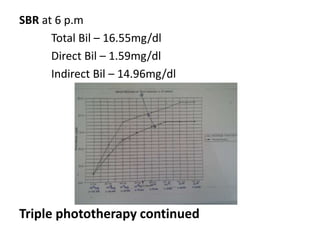
SBR at 6 p.m
Total Bil – 16.55mg/dl
Direct Bil – 1.59mg/dl
Indirect Bil – 14.96mg/dl
Triple phototherapy continued
24 Aug 2016 (3rd day of admission)
• Total Bilirubin at 8 a.m
13.1mg/dl
• Blood picture
RBC – Normochromic Macrocytic red cells
Occational sphyrocytes, tear drops,
contracted cells and basophilic stipling.
Polychromasia
WBC – Neutrophilia. NO abnormal cells
PLT – Plentiful
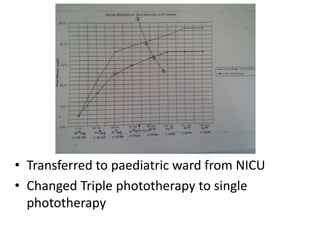
• Transferred to paediatric ward from NICU
• Changed Triple phototherapy to single
phototherapy
25 Aug 2016 (4th day of admission)
• FBC at 7 am
- Hb 11.6 g/dl
- RBC 3.14 10^12/L
- HCT 33.4%
- WBC 14.4 10^9/L
- N 35%
- L 48%
- PLT 382 10^9/L
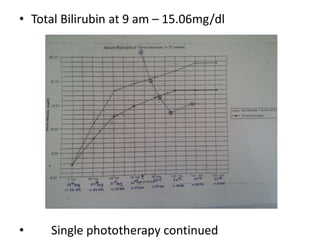
• Total Bilirubin at 9 am – 15.06mg/dl
• Single phototherapy continued
26th Aug 2016 (5th day of admission)
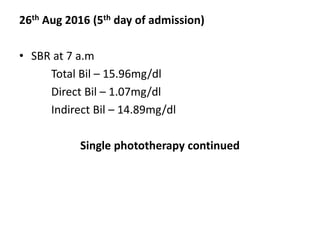
• SBR at 7 a.m
Total Bil – 15.96mg/dl
Direct Bil – 1.07mg/dl
Indirect Bil – 14.89mg/dl
Single phototherapy continued
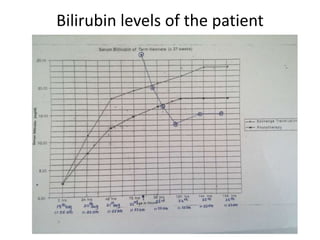
Bilirubin levels of the patient
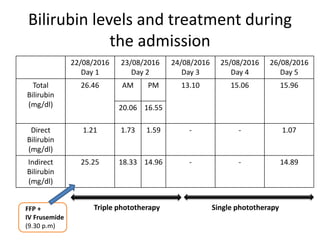
Bilirubin levels and treatment during
the admission
22/08/2016
Day 1
23/08/2016
Day 2
24/08/2016
Day 3
25/08/2016
Day 4
26/08/2016
Day 5
Total
Bilirubin
(mg/dl)
26.46 AM PM 13.10 15.06 15.96
20.06 16.55
Direct
Bilirubin
(mg/dl)
1.21 1.73 1.59 - - 1.07
Indirect
Bilirubin
(mg/dl)
25.25 18.33 14.96 - - 14.89
FFP +
IV Frusemide
(9.30 p.m)
Triple phototherapy Single phototherapy
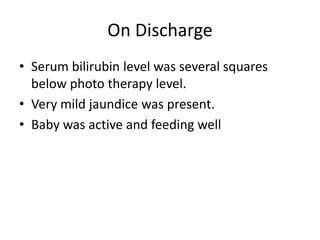
On Discharge
• Serum bilirubin level was several squares
below photo therapy level.
• Very mild jaundice was present.
• Baby was active and feeding well
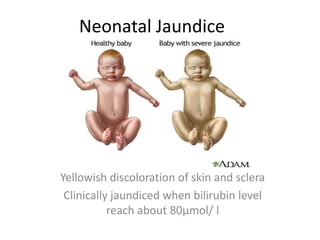
Neonatal Jaundice
Yellowish discoloration of skin and sclera
Clinically jaundiced when bilirubin level
reach about 80µmol/ l
• Usually over 50% of all new born infants become visibly
jaundiced because of,
 High [Hb] at birth RBC breakdown
 RBC life span of infants are short(70 days)
 Less efficient bilirubin metabolism
Early neonatal jaundice is important :
# as it may be a sign of another disorder;
Eg: Haemolytic anaemia
Infection
Metabolic disease
Liver disease
# Unconjugated bilirubin deposition in basal ganglia may
cause Kernicterus
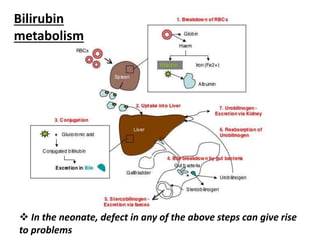
 In the neonate, defect in any of the above steps can give rise
to problems
Bilirubin
metabolism
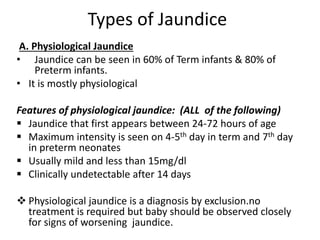
Types of Jaundice
A. Physiological Jaundice
• Jaundice can be seen in 60% of Term infants & 80% of
Preterm infants.
• It is mostly physiological
Features of physiological jaundice: (ALL of the following)
 Jaundice that first appears between 24-72 hours of age
 Maximum intensity is seen on 4-5th day in term and 7th day
in preterm neonates
 Usually mild and less than 15mg/dl
 Clinically undetectable after 14 days
 Physiological jaundice is a diagnosis by exclusion.no
treatment is required but baby should be observed closely
for signs of worsening jaundice.
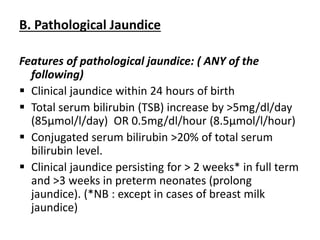
B. Pathological Jaundice
Features of pathological jaundice: ( ANY of the
following)
 Clinical jaundice within 24 hours of birth
 Total serum bilirubin (TSB) increase by >5mg/dl/day
(85µmol/l/day) OR 0.5mg/dl/hour (8.5µmol/l/hour)
 Conjugated serum bilirubin >20% of total serum
bilirubin level.
 Clinical jaundice persisting for > 2 weeks* in full term
and >3 weeks in preterm neonates (prolong
jaundice). (*NB : except in cases of breast milk
jaundice)
Causes of Jaundice
• Hyperbilirubinaemia in the first week of life is usually of the
unconjugated (Indirect) variety.
• Although conjugated hyperbilirubinaemia (Direct) occurs less
commonly , it is always pathological.
Appearing within 24 hours of age ;
 Haemolytic disease of newborn –
Blood group incompatibility - ABO ,Rh and minor blood
group incompatibility
Hereditary hemolytic anaemias -
Congenital spherocytosis
G6PD deficiency
 Infections –perinatal sepsis
Appearing after 24 hours after life ;
All of the above
Physiological
Polycythemia
Concealed haemorrhages- Subneurotic
/subarachnoid/intraventricular haemorrhage
Prolonged jaundice (In term babies > 2 weeks)
(In pre term babies > 3 weeks)
A.Prolong Unconjugated hyperbilirubinaemia:
 New or persisting sepsis- eg: UTI
 Metabolic –Hypothyroidism , Galactosaemia
 Persisting haemolysis
 Breast milk jaundice
B. Prolonged Conjugated hyperbilirubinaemia:
 Neonatal hepatitis -
Congenital infections
Intrauterine infections (TORCH)
α1 antitrypsin deficiancy
 Extra hepatic biliary atresia
 Choledochal cyst
 Metabolic disorders-
Eg: Galactocaemia
Crigler Najjar Syndrome
Assessment of a jaundiced within the
1st week
• This is directed towards assessing the severity,
complications and determining the aetiology of
jaundice.
Severity of jaundice
• Jaundice in the newborn progresses in the cephalo-
caudal direction and thus the extent of yellowness of
the skin is useful to assess the level of bilirubin.
• When a neonate is clinically jaundiced, the TSB is
usually >5 mg/dl (85 μmol/l).
• Serum bilirubin profiles and transcutaneous methods
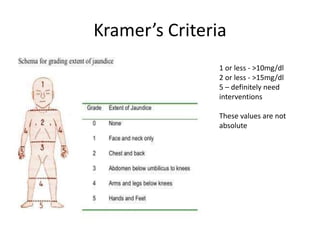
• Kramer’s criteria are used to clinically estimate severity
Kramer’s Criteria
1 or less - >10mg/dl
2 or less - >15mg/dl
5 – definitely need
interventions
These values are not
absolute
Management
• Mx of jaundice is directed towards reducing the level of
bilirubin and preventing CNS toxicity.
1. Reduction of bilirubin is achieved by phototherapy
and / or exchange transfusion.
2. Dilution of bilirubin by giving FFP, fluids.
3. Hyperbilirubinaemia due to dehydration may be
prevented by early and frequent feeding.
The decision to treat depends on the severity and the
cause of jaundice.
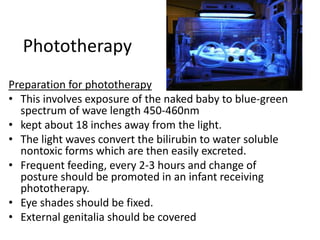
Phototherapy
Preparation for phototherapy
• This involves exposure of the naked baby to blue-green
spectrum of wave length 450-460nm
• kept about 18 inches away from the light.
• The light waves convert the bilirubin to water soluble
nontoxic forms which are then easily excreted.
• Frequent feeding, every 2-3 hours and change of
posture should be promoted in an infant receiving
phototherapy.
• Eye shades should be fixed.
• External genitalia should be covered
Provision of phototherapy
 Degree of phototherapy depends on severity of jaundice
 Initiate continuous multiple phototherapy if any of the
following apply;
• TSB level is rising> 0.5 mg/dl/hr
• TSB is at a level within 3mg/dl below the level for which
exchange transfusion is indicated
• TSB level fails to respond to single phototherapy
• When bilirubin level falls during continuous multiple
phototherapy to a level > 3mg/dl below the threshold level
for which exchange transfusion is indicated , step down.
 Repeat serum bilirubin measurement 4–6 hours after
initiating phototherapy and continue 6hrly if rising or non
responsive or 12hrly if responsive.
Side effects of phototherapy
• Increased insensible water loss when providing
phototherapy in cots: breastfeed more frequently / provide
adequate fluids to avoid dehydration
• Loose green stools: weigh often and compensate with
breast milk.
• Skin rashes: harmless, no need to discontinue
phototherapy;
• Bronze baby syndrome: occurs if baby has conjugated
hyperbilirubinaemia. If so, discontinue phototherapy
• Hypo or hyperthermia: monitor temperature frequently.
• Damage to eyes: cover eyes
Exchange Transfusion
• should be performed if the TSB remains in
exchange transfusion range as per treatment
threshold graphs, despite effective phototherapy.
• Immediate exchange transfusion is indicated if
features of bilirubin encephalopathy are evident.
• Delay in treatment may result in permanent brain
damage.
• When referring a baby with jaundice, make sure
that either the mother is referred or mother’s
blood sample is sent.
 Use a double-volume exchange transfusion (2
x 80 ml /kg)
 Umbilical vessels are the preferred access
method for performing an exchange
transfusion
 Electrolytes, blood gases and vital signs should
be monitored during exchange transfusion
Type of blood
• In ‘Rh’ isoimmunisation, the best choice would be O
negative packed cells suspended in AB positive plasma.
O negative whole blood or cross-matched baby’s blood
group (but Rh negative) may also be used.
• For ‘ABO’ isoimmunisation, O group (Rh compatible)
packed cells suspended in AB plasma or O group whole
blood (Rh compatible with baby) should be used.
• In other situations baby’s blood group should be used.
All blood must be cross matched against maternal
plasma.
complications of exchange transfusion
anaphylaxis
ABO incompatibility
Electrolyte disturbances
Acid base disturbances
Hypothermia
Infection
Thank you

Case presentation on neonatal jaundice corrected

  • 1.
  • 2.
    • 3 daysold Baby boy of Mrs.R from Kottawa presented with yellowish discoloration of the body and eyes for 1 day duration Antenatal history • This is mothers second pregnancy with an uneventful antenatal period upto 34th week where the OGTT test has showed increased glucose levels but was controlled on diet. Birth history • Baby was delivered via a normal vaginal delivery at 37 weeks. • Birth weight was 2.7Kg. • APGAR 1 min- 9 , 5 min- 10 • Blood sugars were monitored 4 hrly for 24 hrs and was above 46mg.
  • 3.
    History of presentingcomplaint • Patient was last well 1 day ago where the mother has noticed yellowish discolouration of the whole body and sclera. • During the first two days stools were said to be dark in colour which has turned yellowish by the 3rd day but it was not pale.
  • 4.
    • Mother alsomentioned of 1 episode of dark coloured urine on the 3rd day after birth. • Baby was said to be lethargic where the mother had to wake him up during the feeds. • No difficulty in feeding , excessive crying, fever or discharge from the umbilicus noted. • Urine output, Bowel output normal. • In the evening of the 3rd day after birth baby was brought to the hospital and since the baby was severly jaundiced, blood was sent for FBC,CRP,SBR,GP,DCT and started on triple phototherapy. After 1 hr serum bilirubin level was found out to be 26.46mg/dl which was above the exchange transfusion level.
  • 5.
    • Blood group- mother is O +ve Fathers not known baby is B +ve • Not a consangous marriage.
  • 6.
    • Immunization history BCGgiven within 24hrs. • Family history No family members with jaundice in the neonatal period. No history of anemia, splenectomy or Bile stones in family members or known heredity for haemolytic disorders.
  • 7.
    • Social history Babyis living with his mother, father , grandmother and the elder sibling who is 1 ½ years. Mother is 36 years old and a housewife. Father is a 36 years old businessman. She receives a good family support The family is financially stable.
  • 8.
    Examination • Baby wason triple phototherapy in NICU. • No dysmorphic features ,not dyspnoeic. • Yellow discolouration of the skin and sclera was observed. • Weight on examination 2.61kg (only 4% loss not significant) • OFC 32cm. • Length 46cm
  • 9.
    • BP-64/29 • HR– 152 BPM • CRFT - < 2 sec • RR – 42 • TEMP – 98.4 F • Other than that Neonatal examination was unremarkable.
  • 10.
    • Management Soon afteradmission – Triple phototherapy started • 10% Dextrose infusion at 6.8CC per hour • EBM 30CC per 3 hours. • Investigations done FBC/CRP/SBR/GP/ DCT/ Blood picture/ Reticulocyte count
  • 11.
    22 Aug 2016( day 1 of admission) – FBC - Hb 12.9 g/dl - RBC 3.34 10^12/L - HCT 37 % - WBC 14.53 10^9/L - N 38.1% - L 42.8% - PLT 343 10^9/L -- CRP -1.4 mg/L
  • 12.
    --SBR Total Bil –26.46mg/dl Direct Bil – 1.21mg/dl Indirect Bil – 25.25mg/dl -DCT – Negative -Blood group B +ve
  • 13.
    • Bilirubin levelwas above the exchange transfusion level. • Preparation for an exchange transfusion was done which is to be carried out after the next serum bilirubin level in 8 hrs. • While waiting, two hours after admission 40ml of group B FFP at 13.3CC per hour over 3 hours IV Furosemide 2.5mg
  • 14.
    23 Aug 2016(2nd day of admission) • SBR at 5 a.m Total Bil – 20.06mg/dl Direct Bil – 1.73mg/dl Indirect Bil – 18.33mg/dl
  • 15.
    • Bilirubin levelbelow exchange transfusion level No exchange transfusion done • Triple photo therapy continued • IV fluids stopped and EBM given. • Reticulocyte count at 10 a.m - 10%
  • 16.
    • FBC at6 p.m - Hb 11.6 g/dl - RBC 2.99 10^12/L - HCT 32.4% - WBC 15.91 10^9/L - N 41.7% - L 39.8% - PLT 356 10^9/L
  • 17.
    SBR at 6p.m Total Bil – 16.55mg/dl Direct Bil – 1.59mg/dl Indirect Bil – 14.96mg/dl Triple phototherapy continued
  • 18.
    24 Aug 2016(3rd day of admission) • Total Bilirubin at 8 a.m 13.1mg/dl • Blood picture RBC – Normochromic Macrocytic red cells Occational sphyrocytes, tear drops, contracted cells and basophilic stipling. Polychromasia WBC – Neutrophilia. NO abnormal cells PLT – Plentiful
  • 19.
    • Transferred topaediatric ward from NICU • Changed Triple phototherapy to single phototherapy
  • 20.
    25 Aug 2016(4th day of admission) • FBC at 7 am - Hb 11.6 g/dl - RBC 3.14 10^12/L - HCT 33.4% - WBC 14.4 10^9/L - N 35% - L 48% - PLT 382 10^9/L
  • 21.
    • Total Bilirubinat 9 am – 15.06mg/dl • Single phototherapy continued
  • 22.
    26th Aug 2016(5th day of admission) • SBR at 7 a.m Total Bil – 15.96mg/dl Direct Bil – 1.07mg/dl Indirect Bil – 14.89mg/dl Single phototherapy continued
  • 23.
  • 24.
    Bilirubin levels andtreatment during the admission 22/08/2016 Day 1 23/08/2016 Day 2 24/08/2016 Day 3 25/08/2016 Day 4 26/08/2016 Day 5 Total Bilirubin (mg/dl) 26.46 AM PM 13.10 15.06 15.96 20.06 16.55 Direct Bilirubin (mg/dl) 1.21 1.73 1.59 - - 1.07 Indirect Bilirubin (mg/dl) 25.25 18.33 14.96 - - 14.89 FFP + IV Frusemide (9.30 p.m) Triple phototherapy Single phototherapy
  • 25.
    On Discharge • Serumbilirubin level was several squares below photo therapy level. • Very mild jaundice was present. • Baby was active and feeding well
  • 26.
    Neonatal Jaundice Yellowish discolorationof skin and sclera Clinically jaundiced when bilirubin level reach about 80µmol/ l
  • 27.
    • Usually over50% of all new born infants become visibly jaundiced because of,  High [Hb] at birth RBC breakdown  RBC life span of infants are short(70 days)  Less efficient bilirubin metabolism Early neonatal jaundice is important : # as it may be a sign of another disorder; Eg: Haemolytic anaemia Infection Metabolic disease Liver disease # Unconjugated bilirubin deposition in basal ganglia may cause Kernicterus
  • 28.
     In theneonate, defect in any of the above steps can give rise to problems Bilirubin metabolism
  • 29.
    Types of Jaundice A.Physiological Jaundice • Jaundice can be seen in 60% of Term infants & 80% of Preterm infants. • It is mostly physiological Features of physiological jaundice: (ALL of the following)  Jaundice that first appears between 24-72 hours of age  Maximum intensity is seen on 4-5th day in term and 7th day in preterm neonates  Usually mild and less than 15mg/dl  Clinically undetectable after 14 days  Physiological jaundice is a diagnosis by exclusion.no treatment is required but baby should be observed closely for signs of worsening jaundice.
  • 30.
    B. Pathological Jaundice Featuresof pathological jaundice: ( ANY of the following)  Clinical jaundice within 24 hours of birth  Total serum bilirubin (TSB) increase by >5mg/dl/day (85µmol/l/day) OR 0.5mg/dl/hour (8.5µmol/l/hour)  Conjugated serum bilirubin >20% of total serum bilirubin level.  Clinical jaundice persisting for > 2 weeks* in full term and >3 weeks in preterm neonates (prolong jaundice). (*NB : except in cases of breast milk jaundice)
  • 31.
    Causes of Jaundice •Hyperbilirubinaemia in the first week of life is usually of the unconjugated (Indirect) variety. • Although conjugated hyperbilirubinaemia (Direct) occurs less commonly , it is always pathological. Appearing within 24 hours of age ;  Haemolytic disease of newborn – Blood group incompatibility - ABO ,Rh and minor blood group incompatibility Hereditary hemolytic anaemias - Congenital spherocytosis G6PD deficiency  Infections –perinatal sepsis
  • 32.
    Appearing after 24hours after life ; All of the above Physiological Polycythemia Concealed haemorrhages- Subneurotic /subarachnoid/intraventricular haemorrhage
  • 33.
    Prolonged jaundice (Interm babies > 2 weeks) (In pre term babies > 3 weeks) A.Prolong Unconjugated hyperbilirubinaemia:  New or persisting sepsis- eg: UTI  Metabolic –Hypothyroidism , Galactosaemia  Persisting haemolysis  Breast milk jaundice B. Prolonged Conjugated hyperbilirubinaemia:  Neonatal hepatitis - Congenital infections Intrauterine infections (TORCH) α1 antitrypsin deficiancy  Extra hepatic biliary atresia  Choledochal cyst  Metabolic disorders- Eg: Galactocaemia Crigler Najjar Syndrome
  • 34.
    Assessment of ajaundiced within the 1st week • This is directed towards assessing the severity, complications and determining the aetiology of jaundice. Severity of jaundice • Jaundice in the newborn progresses in the cephalo- caudal direction and thus the extent of yellowness of the skin is useful to assess the level of bilirubin. • When a neonate is clinically jaundiced, the TSB is usually >5 mg/dl (85 μmol/l). • Serum bilirubin profiles and transcutaneous methods • Kramer’s criteria are used to clinically estimate severity
  • 35.
    Kramer’s Criteria 1 orless - >10mg/dl 2 or less - >15mg/dl 5 – definitely need interventions These values are not absolute
  • 36.
    Management • Mx ofjaundice is directed towards reducing the level of bilirubin and preventing CNS toxicity. 1. Reduction of bilirubin is achieved by phototherapy and / or exchange transfusion. 2. Dilution of bilirubin by giving FFP, fluids. 3. Hyperbilirubinaemia due to dehydration may be prevented by early and frequent feeding. The decision to treat depends on the severity and the cause of jaundice.
  • 37.
    Phototherapy Preparation for phototherapy •This involves exposure of the naked baby to blue-green spectrum of wave length 450-460nm • kept about 18 inches away from the light. • The light waves convert the bilirubin to water soluble nontoxic forms which are then easily excreted. • Frequent feeding, every 2-3 hours and change of posture should be promoted in an infant receiving phototherapy. • Eye shades should be fixed. • External genitalia should be covered
  • 38.
    Provision of phototherapy Degree of phototherapy depends on severity of jaundice  Initiate continuous multiple phototherapy if any of the following apply; • TSB level is rising> 0.5 mg/dl/hr • TSB is at a level within 3mg/dl below the level for which exchange transfusion is indicated • TSB level fails to respond to single phototherapy • When bilirubin level falls during continuous multiple phototherapy to a level > 3mg/dl below the threshold level for which exchange transfusion is indicated , step down.  Repeat serum bilirubin measurement 4–6 hours after initiating phototherapy and continue 6hrly if rising or non responsive or 12hrly if responsive.
  • 39.
    Side effects ofphototherapy • Increased insensible water loss when providing phototherapy in cots: breastfeed more frequently / provide adequate fluids to avoid dehydration • Loose green stools: weigh often and compensate with breast milk. • Skin rashes: harmless, no need to discontinue phototherapy; • Bronze baby syndrome: occurs if baby has conjugated hyperbilirubinaemia. If so, discontinue phototherapy • Hypo or hyperthermia: monitor temperature frequently. • Damage to eyes: cover eyes
  • 40.
    Exchange Transfusion • shouldbe performed if the TSB remains in exchange transfusion range as per treatment threshold graphs, despite effective phototherapy. • Immediate exchange transfusion is indicated if features of bilirubin encephalopathy are evident. • Delay in treatment may result in permanent brain damage. • When referring a baby with jaundice, make sure that either the mother is referred or mother’s blood sample is sent.
  • 41.
     Use adouble-volume exchange transfusion (2 x 80 ml /kg)  Umbilical vessels are the preferred access method for performing an exchange transfusion  Electrolytes, blood gases and vital signs should be monitored during exchange transfusion
  • 42.
    Type of blood •In ‘Rh’ isoimmunisation, the best choice would be O negative packed cells suspended in AB positive plasma. O negative whole blood or cross-matched baby’s blood group (but Rh negative) may also be used. • For ‘ABO’ isoimmunisation, O group (Rh compatible) packed cells suspended in AB plasma or O group whole blood (Rh compatible with baby) should be used. • In other situations baby’s blood group should be used. All blood must be cross matched against maternal plasma.
  • 43.
    complications of exchangetransfusion anaphylaxis ABO incompatibility Electrolyte disturbances Acid base disturbances Hypothermia Infection
  • 44.