VisualThinking
forServiceDesign
CanUX, Ottawa - 11 November 2016
Boon Yew Chew, SapientNitro
@boonych
Today'sagenda
Why and What
Applying VT to SD
Visual thinking basics
Workshop Activity
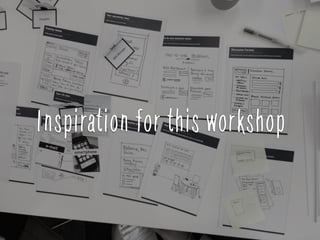
Inspiration for this workshop
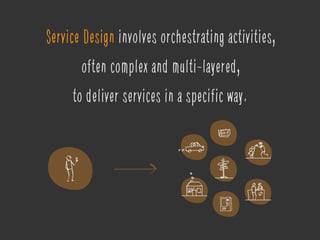
Service Design involves orchestrating activities,
often complex and multi-layered,
to deliver services in a specific way.
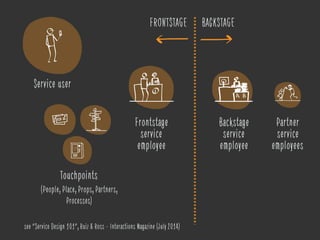
Service user
Frontstage
service
employee
Touchpoints
(People, Place, Props, Partners,
Processes)
FRONTSTAGE BACKSTAGE
Backstage
service
employee
Partner
service
employees
see "Service Design 101", Ruiz & Ross - Interactions Magazine (July 2014)
INTERACTION
Speakers
INTERACTION
Cameras
INTERACTION
Lights
INTERACTION
Advertisement
Display
INTERACTION
Locks
INTERACTION
INTERACTION
Check-in
Device
INTERACTION
USER
Wearable
Joker Card
INTERACTION
Drone
INTERACTION
Screen / Display
INTERACTION
Urban Furniture
INTERACTION
Payment Device
ABLER
h Sensor
ENABLER
Motion Sensor Vibration Sensor Infrared Sensor
NABLER
Beacon
ENABLER
Smart Beacon
ENABLER
Wi-Fi Network
ENABLER
Sound Sensor
ENABLER
emperature
Sensor
ENABLER
Humidity
Sensor
ENABLER
Weight Sensor
Kg
Joker Card
METHODOLOGY
FEASIBILITY
DESIGN SCOPE
FRAMING
IDEATION
USERINSIGHTS
SERVICECONCEPT
PROTOTYPE&TEST
PERSON
TEST PREPARATION
TEST &
EVALUATIO
N
BLUEPRIN
T
ROADMAP
USERS’ JOURNEYS
(S
ERIO
US
PLAY) SCENARIO
ID
EA
SELECTIO
N
-COCD
BOX
LOTUSBLOSSOM
INTERVIEW: ACTORS MAP
PERSONA DIMENSIONS
PERSONA
DESIG
N
CHALLENGE
DESIGNREQUIREMENTS
IN
TERVIE
W
:
USER
EXPERIE
NCE
RESEARCH
QUESTIO
NS
CONTEXT&OBJECTIVE
Harvard Business Review
January-February 1984
bit I
rKlard
ecution time
minutes
otal
cceptable
execution time
5 minutes
Blueprint for a comer shoeshine
Brush
shoes
Faciiitating services
and products
Une of
vialblllty
Not seen
by customer
essary
Select
and purchase
supplies
uires much
Punchy label
image attribution url goes here
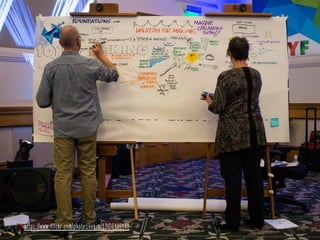
Sowhat'svisualthinking?
it is the activity of making
sense of things using visuals
Punchy label
image attribution url goes herehttps://www.flickr.com/photos/eekim/13920189148
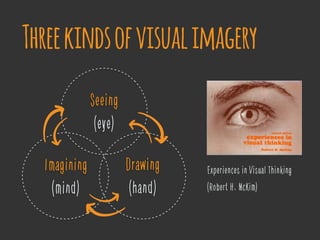
Imagining
(mind)
Seeing
(eye)
Drawing
(hand)
Experiences in Visual Thinking
(Robert H. McKim)
Threekindsofvisualimagery
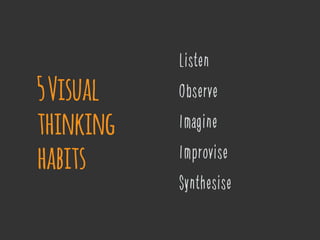
Listen
Observe
Imagine
Improvise
Synthesise
5Visual
thinking
habits
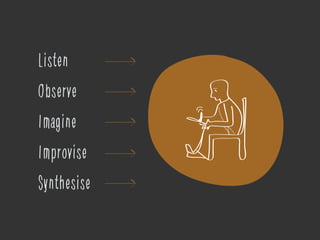
Listen
Observe
Imagine
Improvise
Synthesise
1. Developing empathy
2. Visual sensemaking
3. Illustrating complexity
4. Visualising experience
Whyvisual
thinking
forService
design?
User-centred
Co-creative
Sequencing
Evidencing
Holistic
Applying
visual
thinkingto
Servicedesign
through SD’'s 5 principles*
*This is Service Design Thinking - Stickdom & Schneider, 2014
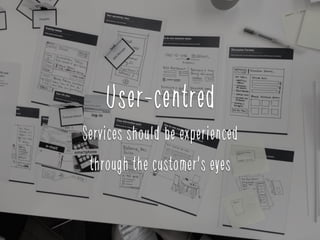
User-centred
Services should be experienced
through the customer's eyes
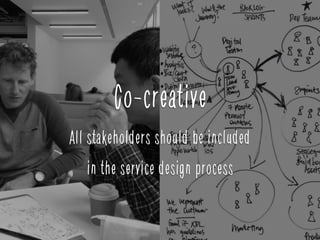
Co-creative
All stakeholders should be included
in the service design process
Service conceptual model
PHYSICAL PRODUCTS
PRINT & MEDIA
MOBILE & APPS
ONLINE & INTERNET BANKING
PHONE CALL
BRANCH OR OTHER LOCATION
Re-AssessSet up UseAwareness Research Show me howCompare
Li Europan
lingues es
membres del
sam familie.
Nemo enim ipsam voluptatem
quia voluptas sit aspernatur
aut odit aut fugit, sed quia
consequuntur magni dolores
eos qui ratione voluptatem
sequi nesciunt. Neque porro
quisquam est, qui dolorem
ipsum quia dolor
Quis autem vel eum iure
reprehenderit qui in ea
voluptate velit esse quam
Nam libero tempore, cum
soluta nobis est eligendi optio
cumque nihil impedit quo
At vero eos et accusamus et
iusto odio dignissimos
ducimus qui blanditiis
Ut enim ad minima veniam,
quis nostrum exercitationem
ullam corporis suscipit
Neque porro quisquam est,
qui dolorem ipsum quia
Idea
Idea
Idea
Idea
Idea
Idea
Idea
Idea
Idea
Idea Idea
Idea
Idea
Etiam ultricies nisi vel
augue. Curabitur
ullamcorper ultricies nisi
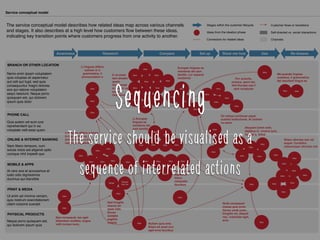
The service conceptual model describes how related ideas map across various channels
and stages. It also describes at a high level how customers flow between these ideas,
indicating key transition points where customers progress from one activity to another.
Stages within the customer lifecycle
Ideas from the ideation phase
Connectors for related ideas
Customer flows or transitions
Self-directed vs. social interactions
Channels
Idea
Idea
Sed consequat, leo eget
bibendum sodales, augue
velit cursus nunc,
Idea
Idea
Idea
Idea
Idea
Idea
Idea IdeaIdea
Li lingues differe solmen
in li grammatica, li
pronunciation e li plu
commun vocabules
Slider
People
like me
Idea
Sed fringilla
mauris sit
amet nibh.
Donec
sodales
sagittis
magna.
Donec vitae
sapien ut
libero
venenatis
faucibus
Nulla consequat
massa quis enim.
Donec pede justo,
fringilla vel, aliquet
nec, vulputate eget,
arcu
Idea
Idea
Idea
Idea
Idea
Idea
Idea
Idea
Idea
Idea
Idea
Idea
Idea
Idea
Ma quande lingues
coalesce, li grammatica
del resultant lingue es
Europan lingues es
membres del sam
familie. Lor separat
existentie
Idea
Idea
Idea
Idea
Idea
Idea
Li lingues differe
solmen in li
grammatica, li
pronunciation e
On refusa continuar payar
custosi traductores. At solmen
va esser
Idea
Idea
Idea
Idea
Por scientie,
musica, sport etc,
litot Europa usa li
sam vocabular
Idea
Idea
Idea
Idea
Idea
Idea
Idea
Idea
Idea
Idea
Idea
It va esser
tam simplic
quam
Occidental
in fact, it va
esser
Occidental
IdeaIdea
Idea
Aliquam lorem ante,
dapibus in, viverra quis,
feugiat a, tellus
Idea
Idea
Idea
Idea
Idea
Nullam quis ante.
Etiam sit amet orci
eget eros faucibus
Idea
Sequencing
The service should be visualised as a
sequence of interrelated actions
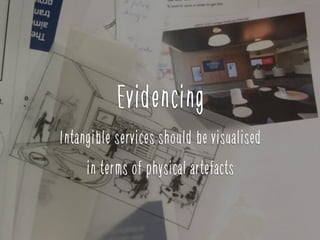
Evidencing
Intangible services should be visualised
in terms of physical artefacts
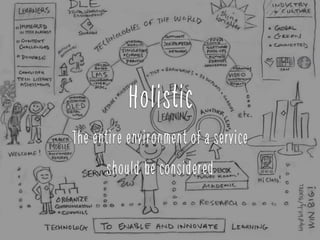
Holistic
The entire environment of a service
should be considered
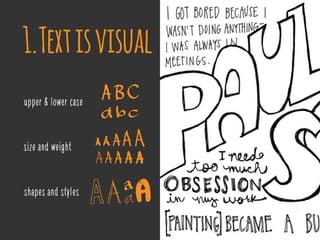
1. Text is visual
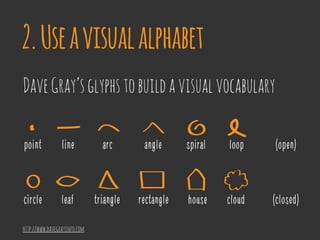
2. Use a visual alphabet
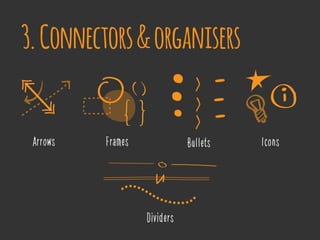
3. Connectors & organisers
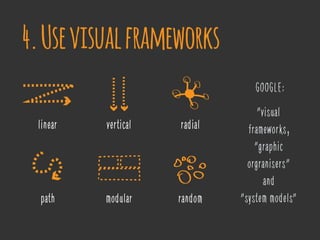
4. Use visual frameworks
Visual
thinking
building
blocks
1.Textisvisual
upper & lower case
size and weight
shapes and styles
point line arc angle spiral loop (open)
circle leaf triangle rectangle house cloud (closed)
DaveGray’sglyphstobuildavisualvocabulary
http://www.davegrayinfo.com
2.Useavisualalphabet
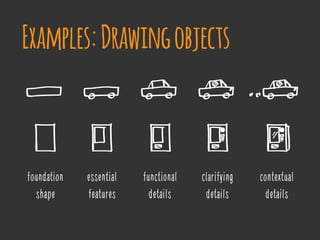
Examples:Drawingobjects
foundation
shape
essential
features
functional
details
clarifying
details
contextual
details
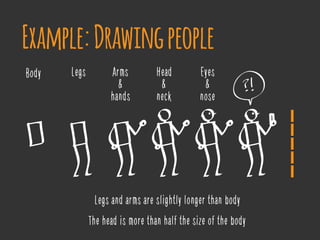
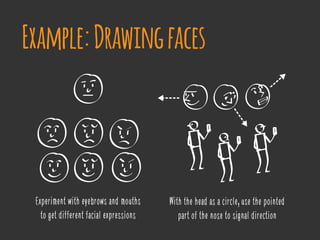
Example:Drawingpeople
Legs and arms are slightly longer than body
The head is more than half the size of the body
Body Legs Arms
&
hands
Head
&
neck
Eyes
&
nose
Example:Drawingfaces
Experiment with eyebrows and mouths
to get different facial expressions
With the head as a circle, use the pointed
part of the nose to signal direction
Arrows Frames
>
>
>
---
3.Connectors&organisers
Dividers
IconsBullets
4.Usevisualframeworks
GOOGLE:
"visual
frameworks”,
"graphic
orgranisers”"
and
"system models"
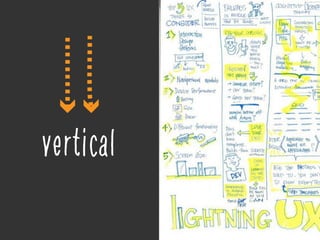
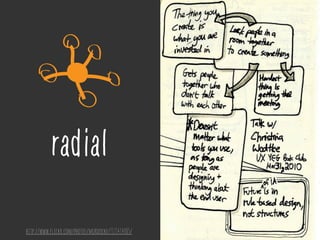
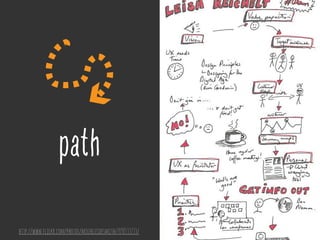
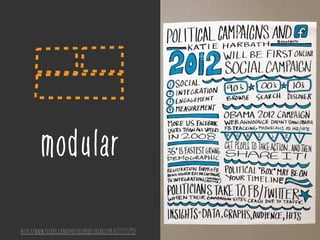
linear vertical radial
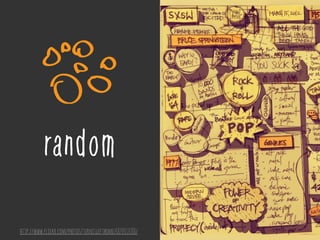
path modular random
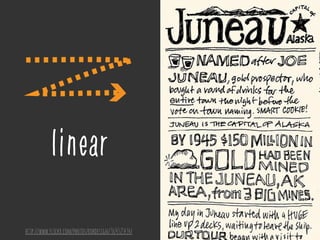
http://www.flickr.com/photos/rohdesign/3674525434/
linear
vertical
radial
http://www.flickr.com/photos/murdocke/7171414085/
path
http://www.flickr.com/photos/micheleidesmith/7098533733/
modular
http://www.flickr.com/photos/pedestriantype/6755973299/
random
http://www.flickr.com/photos/turnislefthome/6870010788/
Let'stakeabreak
for15minutes
Part2:
WorkshopActivity
The 8-minute drawing
challenge
WARM-UP DRAWING EXERCISE
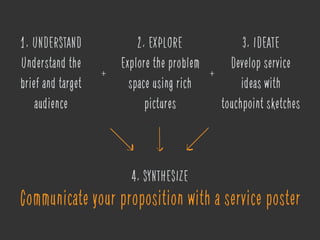
1. UNDERSTAND
Understand the
brief and target
audience
2. EXPLORE
Explore the problem
space using rich
pictures
3. IDEATE
Develop service
ideas with
touchpoint sketches
+ +
Communicate your proposition with a service poster
4. SYNTHESIZE
Servicedesignbrief
“”"art for all"
A neighbourhood art museum focusing on local culture
and history wants to better serve families with small
children while keeping it enjoyable to other visitors.
Your job is to design a service that addresses young
family needs while fostering a sense of community.
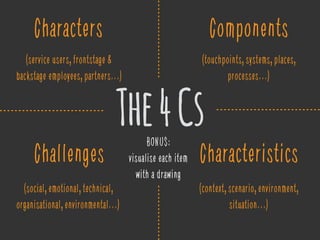
1. UNDERSTAND
Challenges
Characters Components
Characteristics
The4Cs
(service users, frontstage &
backstage employees, partners...)
(touchpoints, systems, places,
processes...)
(social, emotional, technical,
organisational, environmental...)
(context, scenario, environment,
situation...)
BONUS:
visualise each item
with a drawing
assumptions made evident in your sketch?
how sketches help you think about the service problem?
sketching ‘the 'invisible' - context, feelings, concepts
Sketchingobjects:thinkabout…
Exploring problems
using Rich Pictures
2. EXPLORE
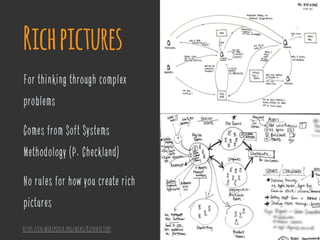
For thinking through complex
problems
Comes from Soft Systems
Methodology (P. Checkland)
No rules for how you create rich
pictures
Richpictures
https://en.wikipedia.org/wiki/Rich_picture
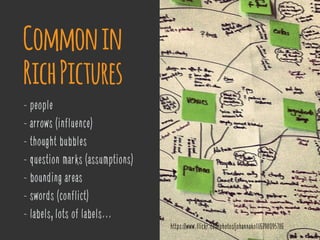
- people
- arrows (influence)
- thought bubbles
- question marks (assumptions)
- bounding areas
- swords (conflict)
- labels, lots of labels...
Commonin
RichPictures
https://www.flickr.com/photos/johannakoll/6798095786
what problems are worth solving?
how are your characters involved?
how do the relevant parts work together?
what’s the big picture idea?
Userichpicturestofigureout…
Let'stakeabreak
for15minutes
Sketching touchpoints
to develop service ideas
3. IDEATE
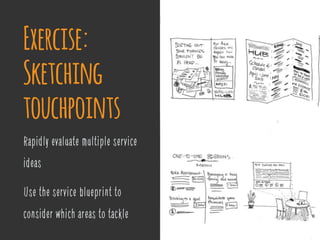
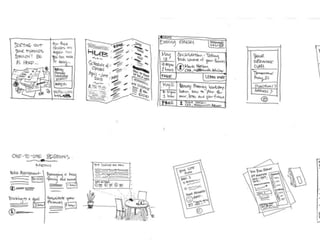
Rapidly evaluate multiple service
ideas
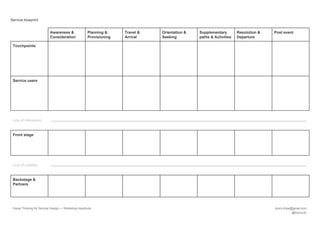
Use the service blueprint to
consider which areas to tackle
Exercise:

Sketching
touchpoints
For thinking through complex
problems
Comes from Soft Systems
Methodology (P. Checkland)
No rules for how you create rich
pictures
Richpictures
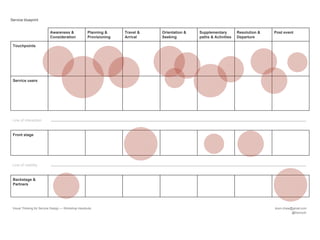
Service blueprint
Awareness &
Consideration
Planning &
Provisioning
Travel &
Arrival
Orientation &
Seeking
Supplementary
paths & Activities
Resolution &
Departure
Post event
Touchpoints
Service users
Line of interaction
Front stage
Line of visibility
Backstage &
Partners
Visual Thinking for Service Design — Workshop Handouts boon.chew@gmail.com
@boonych
Service blueprint
Awareness &
Consideration
Planning &
Provisioning
Travel &
Arrival
Orientation &
Seeking
Supplementary
paths & Activities
Resolution &
Departure
Post event
Touchpoints
Service users
Line of interaction
Front stage
Line of visibility
Backstage &
Partners
Visual Thinking for Service Design — Workshop Handouts boon.chew@gmail.com
@boonych
think like a copywriter & sketch like a prototyper
what details reveal what you want to validate?
what clues do you give about the object and context?
what is 'just enough' detail’ in your sketches?
what is common vs. what might need 'explaining'?
Sketchingtouchpoints…
4. SYNTHESIZE
Create a service poster
visualising your service
proposition
Punchy label
image attribution url goes here
bring to life the various parts of the service
show how the characters and elements inter-relate
highlight problem areas you think are worth tackling
Useyourposterto…
ClosingandDiscussion
Resources
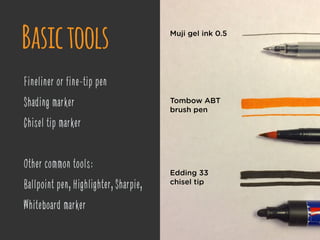
Fineliner or fine-tip pen
Shading marker
Chisel tip marker
Other common tools:
Ballpoint pen, Highlighter, Sharpie,
Whiteboard marker
Basictools
Ultra-fine point sharpie, Muji gel
ink 0.38 or 0.5
Edding 33
Tombow ABT
Muji gel ink 0.5
Tombow ABT
brush pen
Edding 33
chisel tip
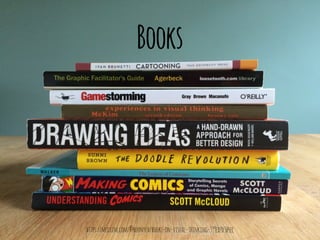
Books
https://medium.com/@boonych/books-on-visual-thinking-599ed7d3b4ec
ThankYou
e: boon.chew@gmail.com
t: @boonych

Visual thinking for service design — CanUX November 2016