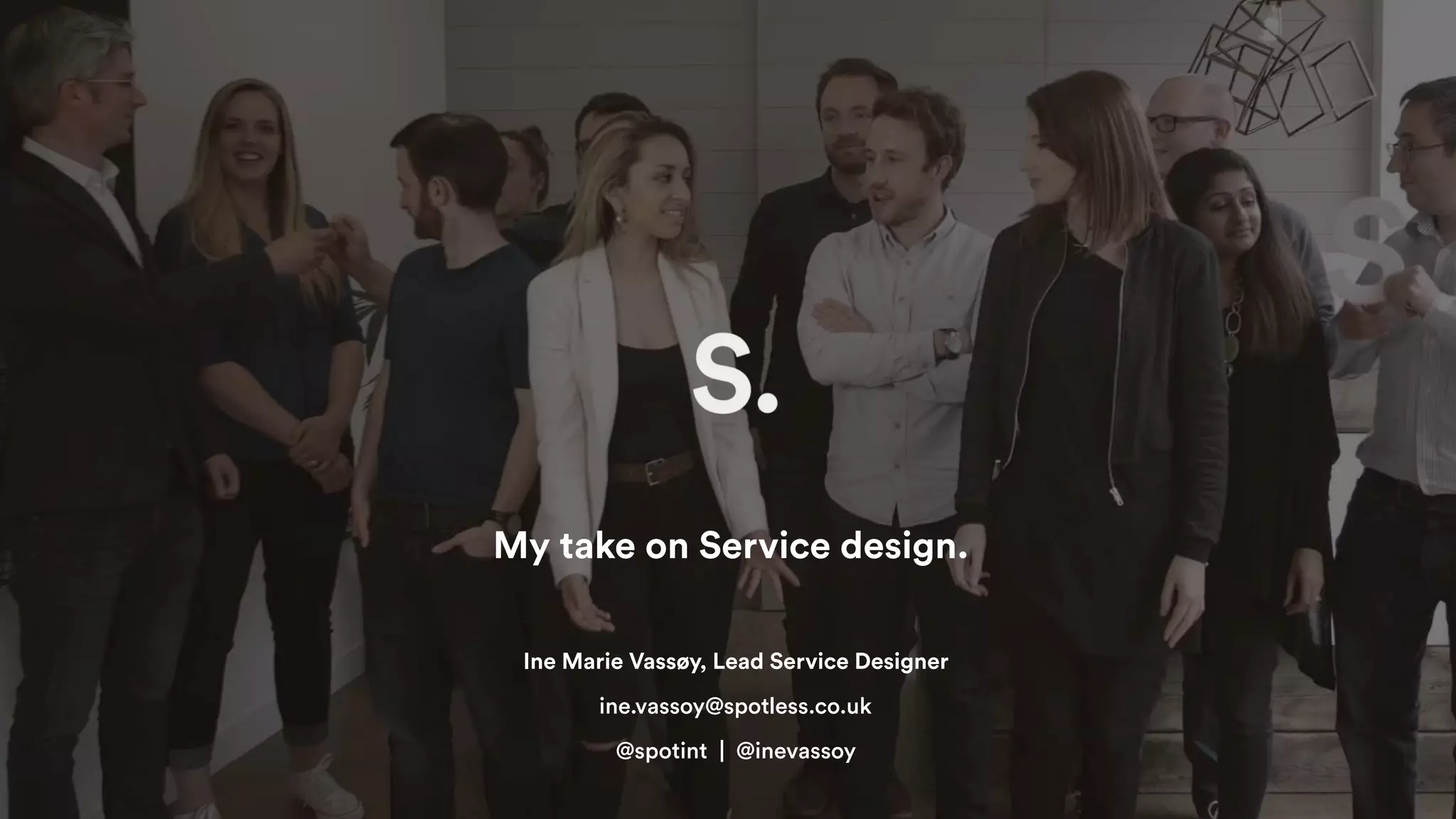
Ine Marie Vassรธy, Lead Service Designer
My take on Service design.
ine.vassoy@spotless.co.uk
@spotint | @inevassoy
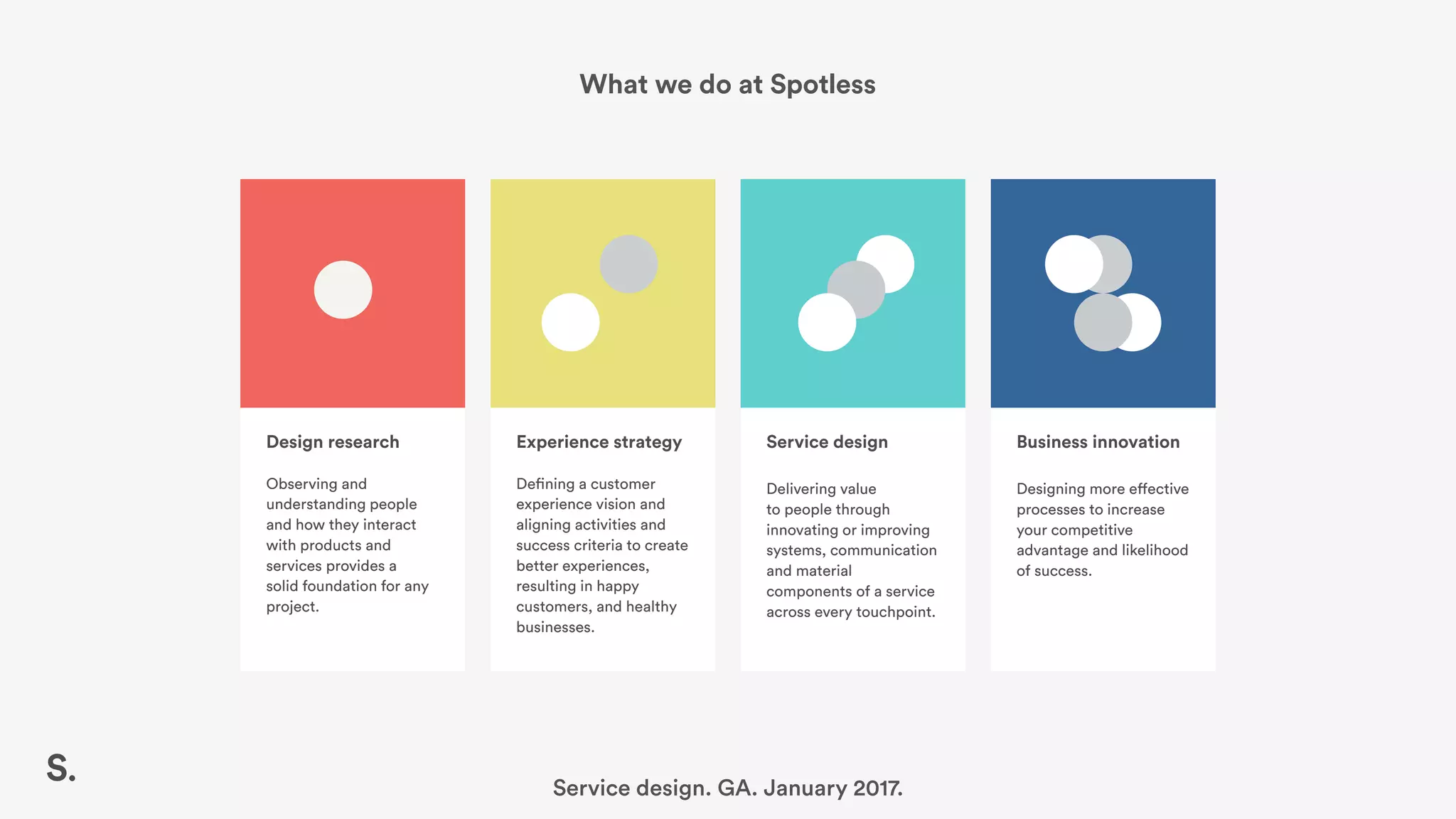
What we do at Spotless
Service design. GA. January 2017.
Service design
Delivering value
to people through
innovating or improving
systems, communication
and material
components of a service
across every touchpoint.
Business innovation
Designing more effective
processes to increase
your competitive
advantage and likelihood
of success.
Experience strategy
Defining a customer
experience vision and
aligning activities and
success criteria to create
better experiences,
resulting in happy
customers, and healthy
businesses.
Design research
Observing and
understanding people
and how they interact
with products and
services provides a
solid foundation for any
project.
What is Service Design?
Service design. GA. January 2017.
Service design is the designing and marketing of services that improve
the customer experience, and the interactions between the service
providers and the customers.
- This is Service Design thinking
โ€œ
Service design. GA. January 2017.
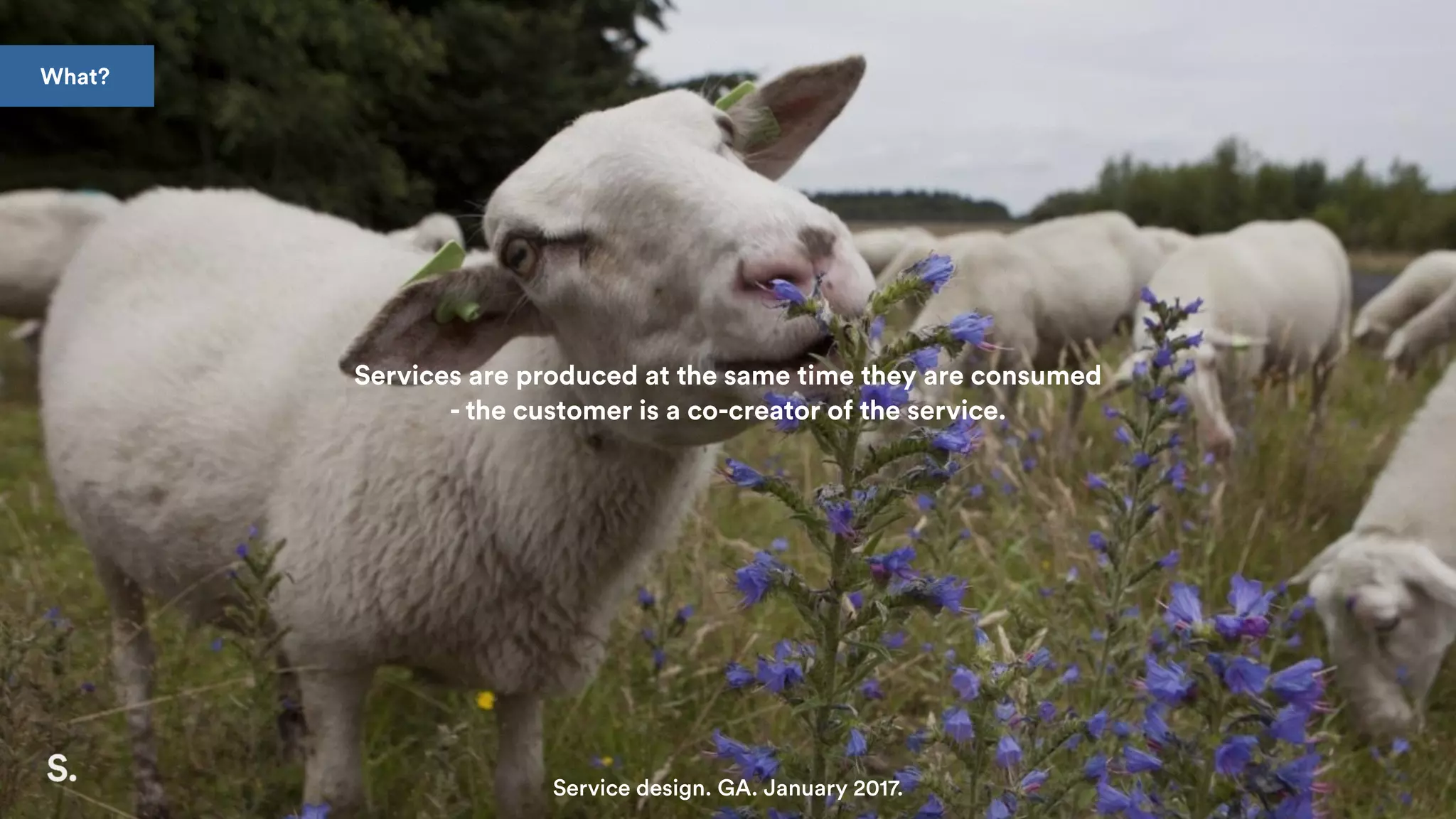
Services are produced at the same time they are consumed
- the customer is a co-creator of the service.
Service design. GA. January 2017.
What?
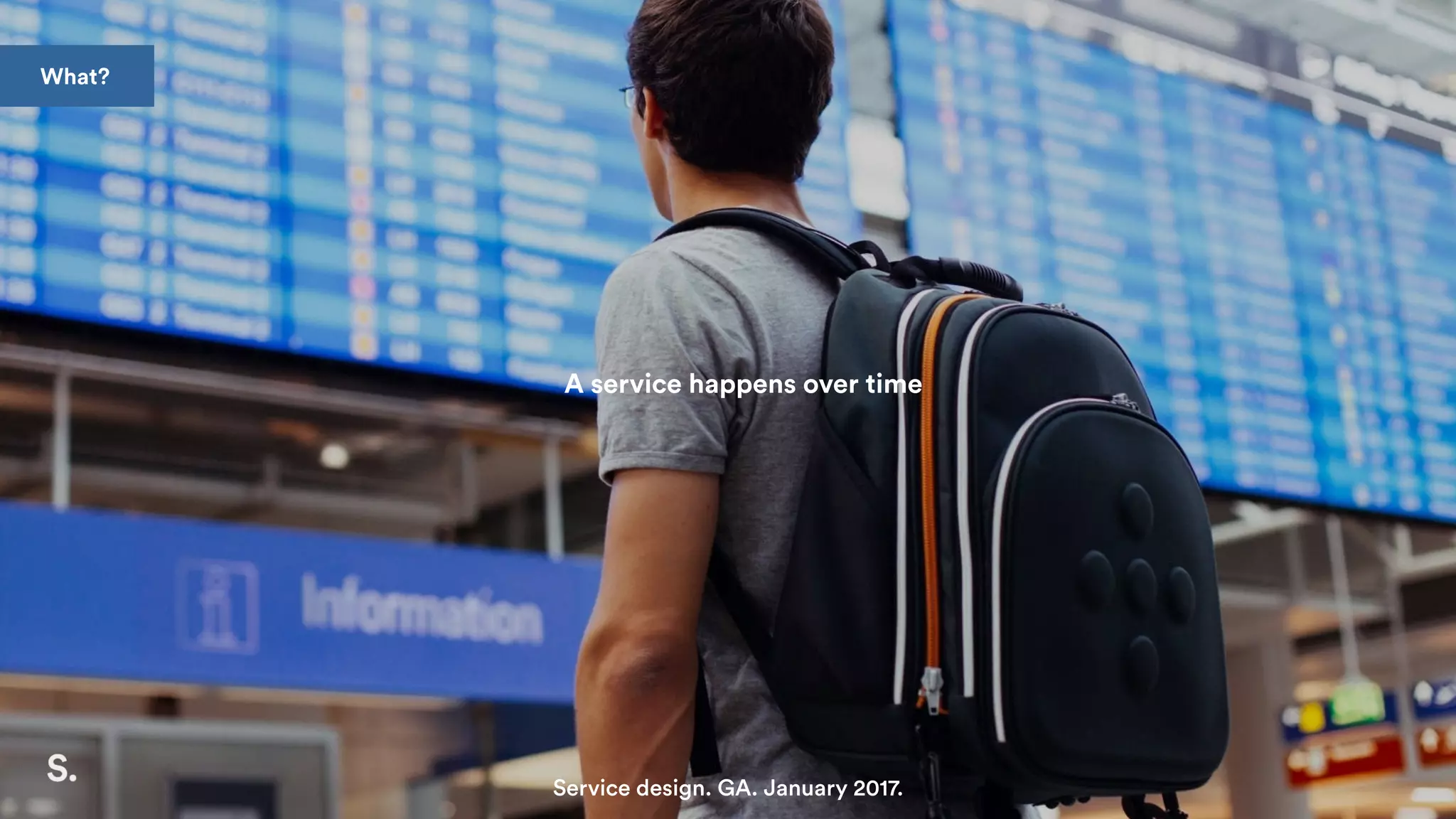
A service happens over time
Service design. GA. January 2017.
What?
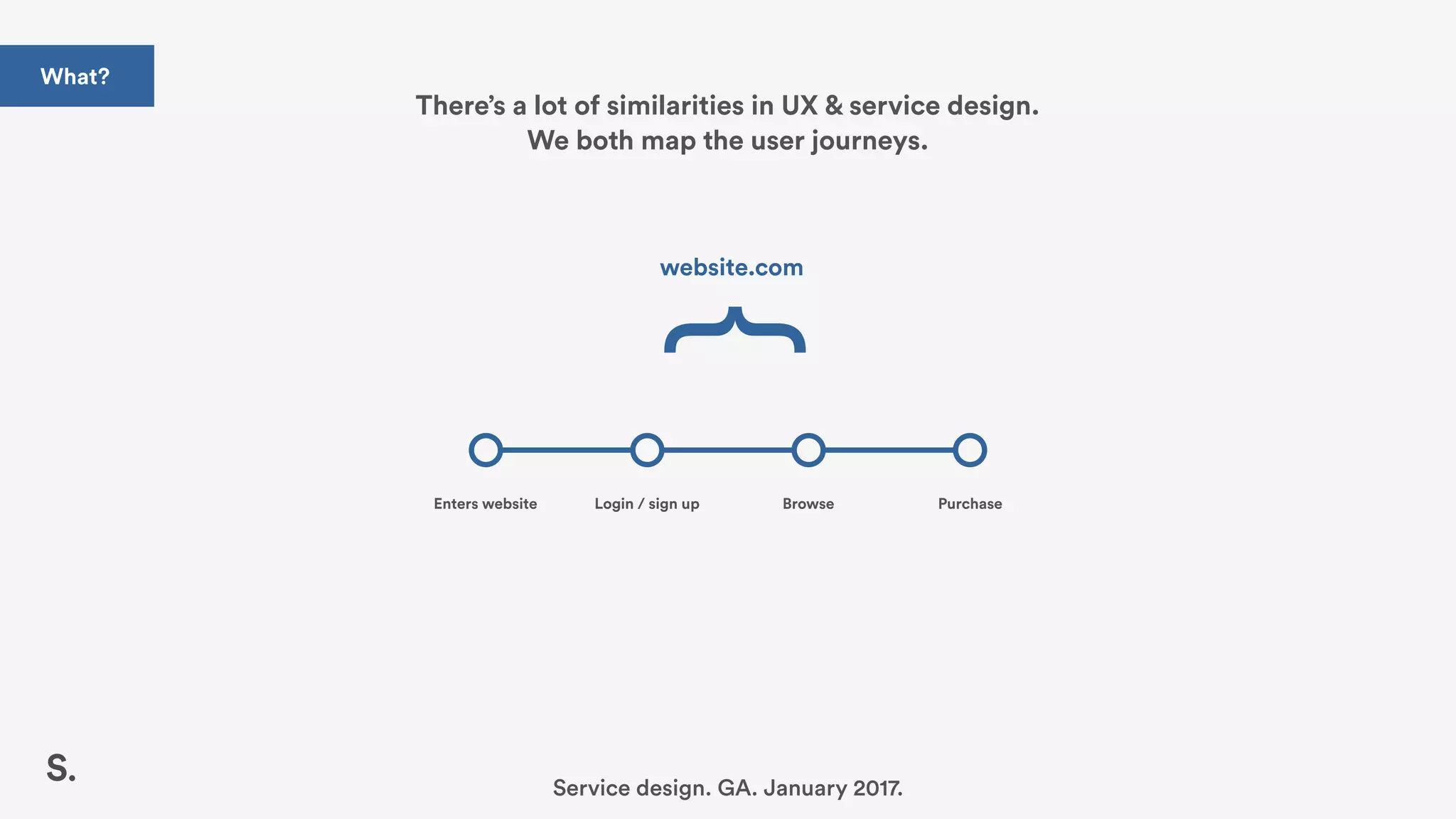
Thereโ€™s a lot of similarities in UX & service design.
We both map the user journeys.
website.com
}
Enters website Login / sign up Browse Purchase
Service design. GA. January 2017.
What?
}
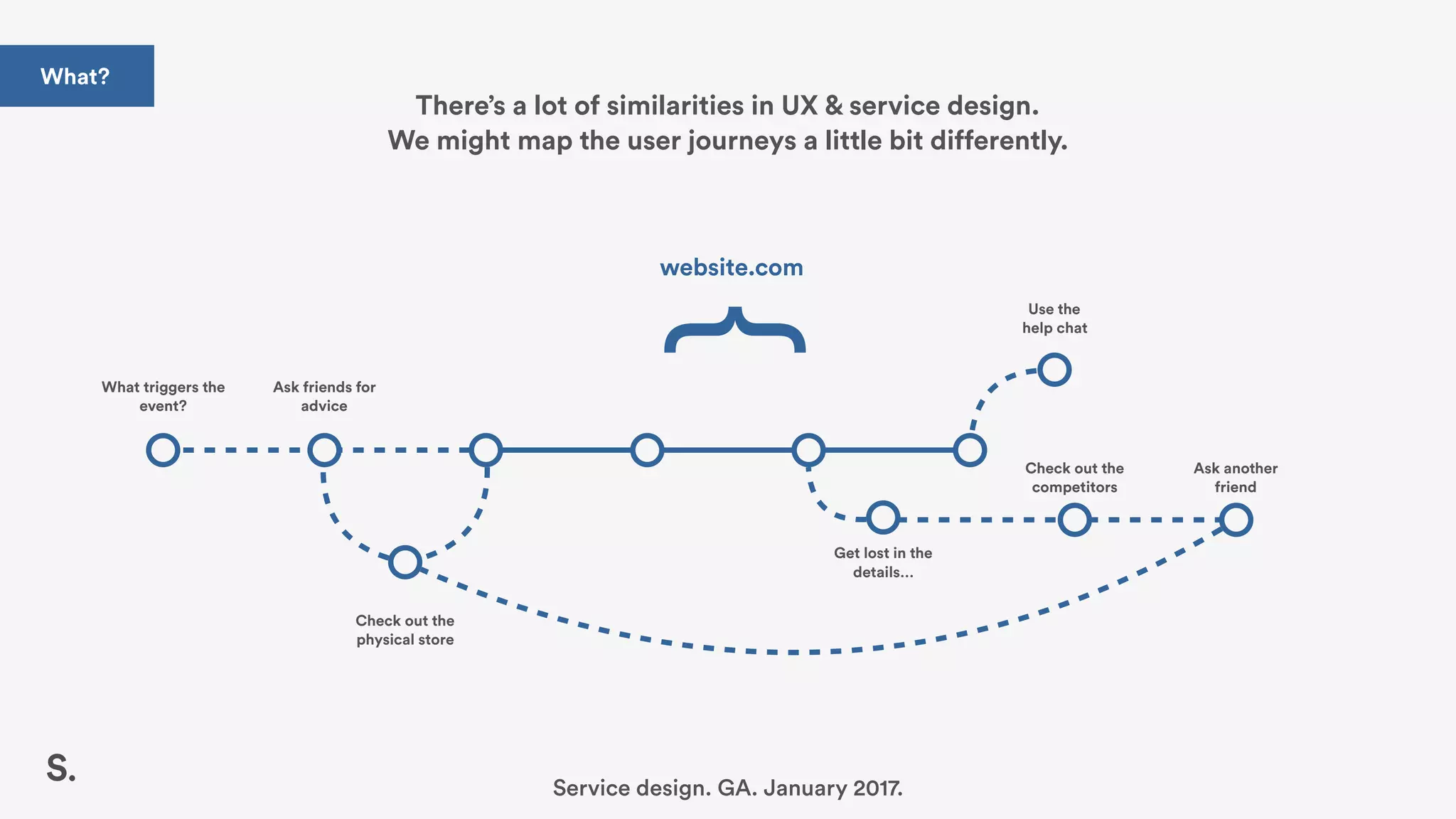
What triggers the
event?
Ask friends for
advice
Check out the
competitors
Ask another
friend
Use the
help chat
Get lost in the
detailsโ€ฆ
Service design. GA. January 2017.
website.com
Check out the
physical store
Thereโ€™s a lot of similarities in UX & service design.
We might map the user journeys a little bit differently.
What?
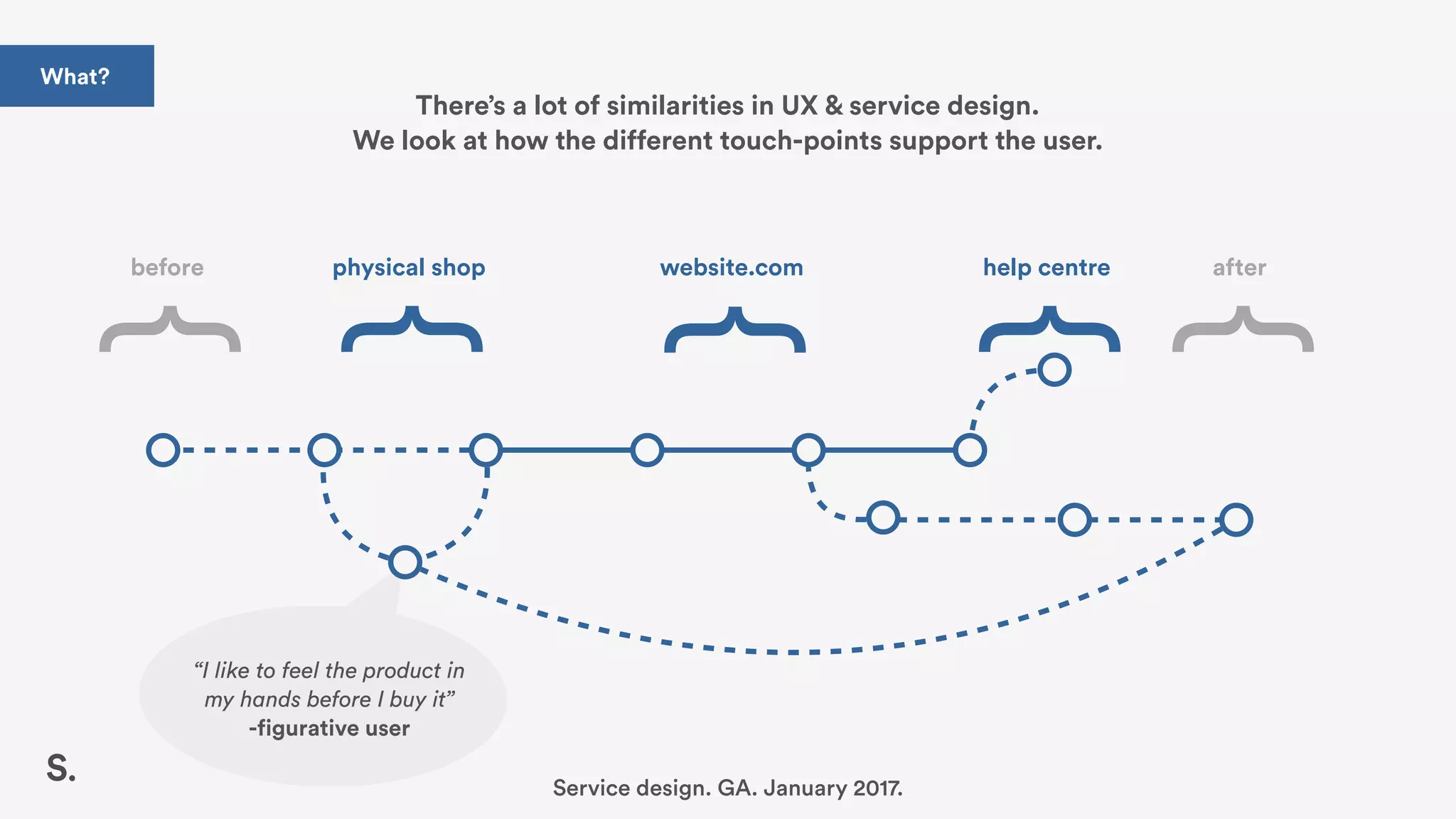
โ€œI like to feel the product in
my hands before I buy itโ€
-figurative user
}Service design. GA. January 2017.
website.com
Thereโ€™s a lot of similarities in UX & service design.
We look at how the different touch-points support the user.
}
physical shop
}
help centre
}before
}
after
What?
A method for designing experiences that reach people through
many different touch-points, and that happen over time.
- www.servicedesign.org
โ€œ
Service design. GA. January 2017.
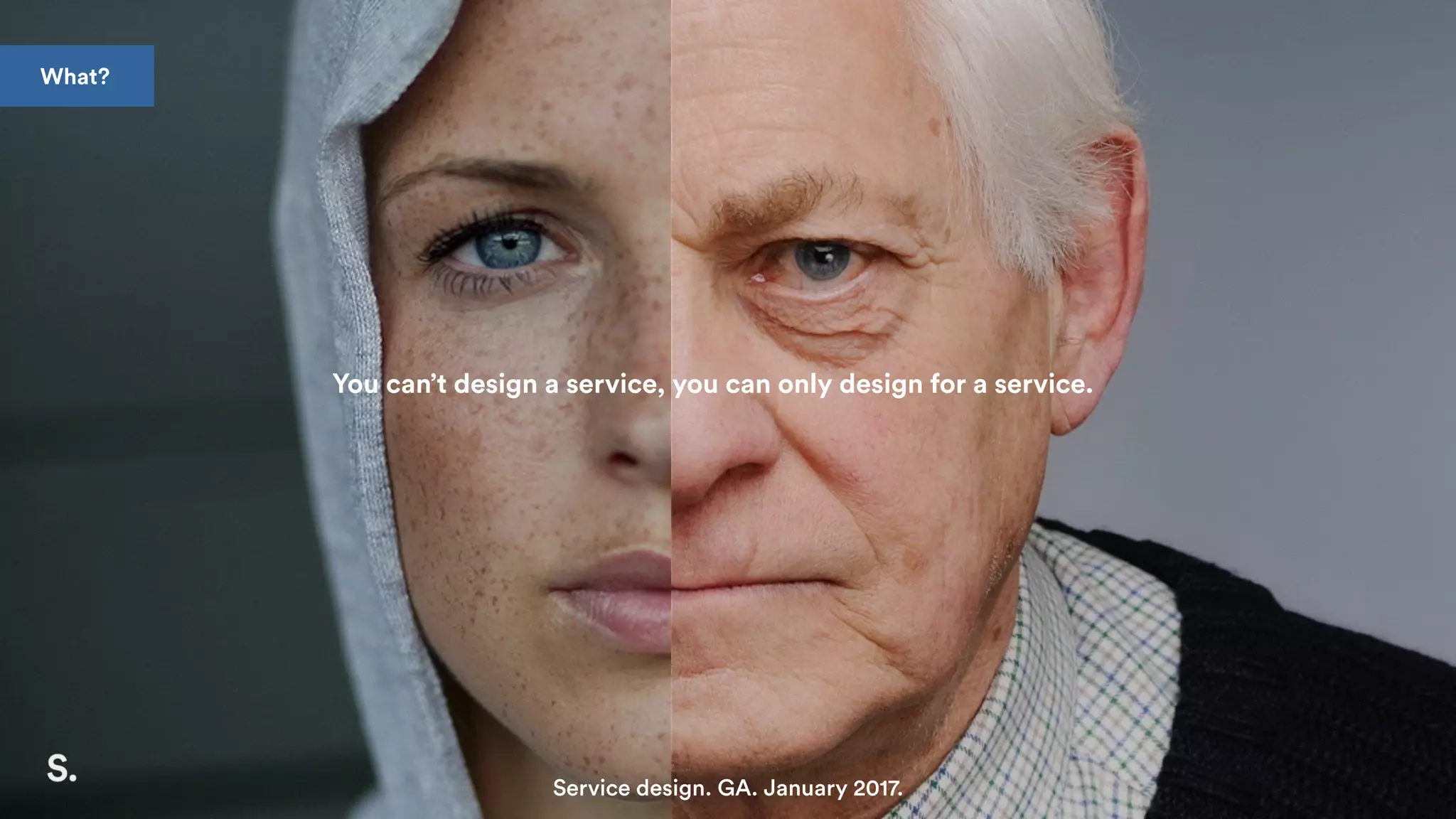
You canโ€™t design a service, you can only design for a service.
Service design. GA. January 2017.
What?
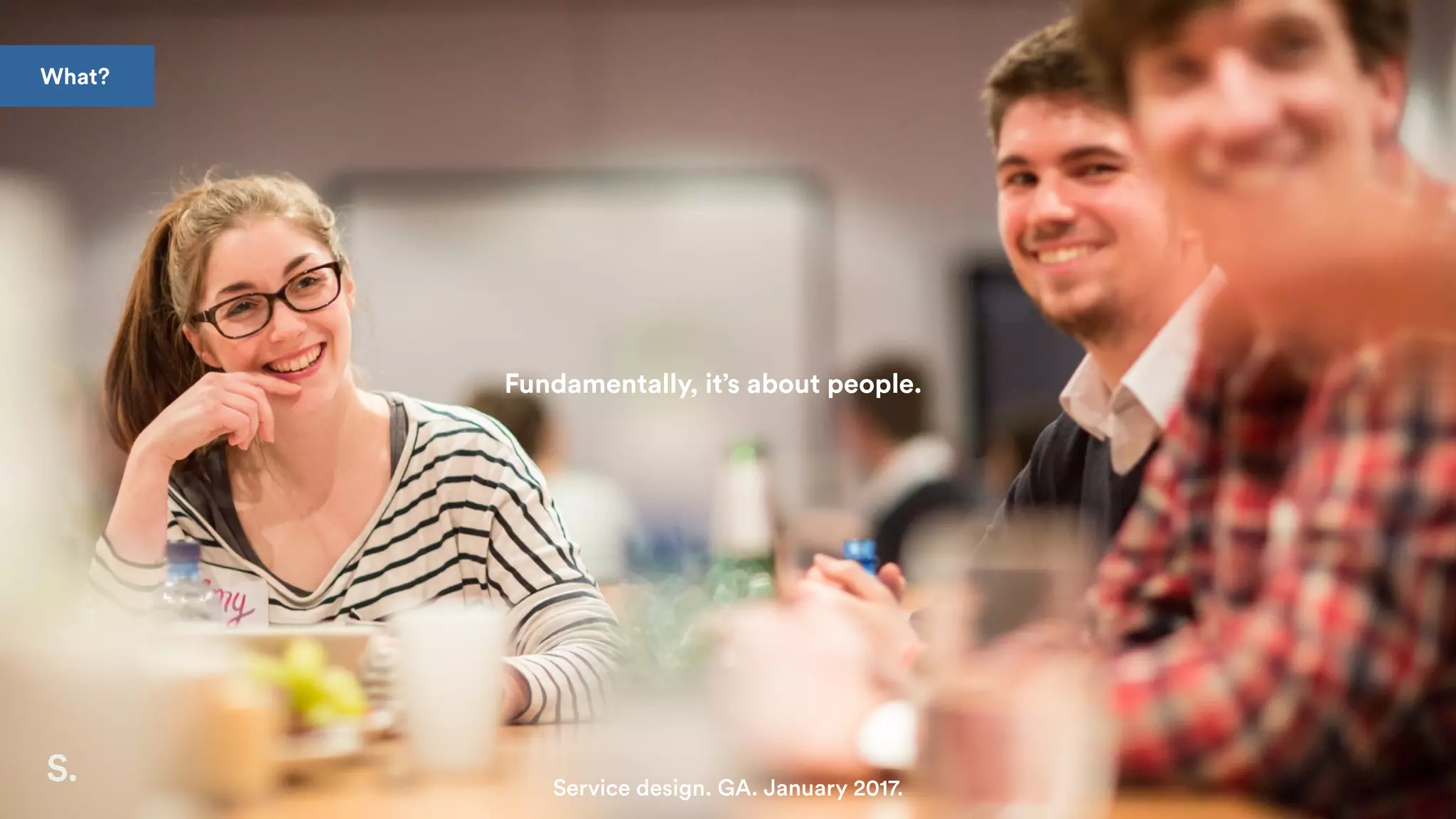
Fundamentally, itโ€™s about people.
Service design. GA. January 2017.
What?
Why Service Design?
Service design. GA. January 2017.
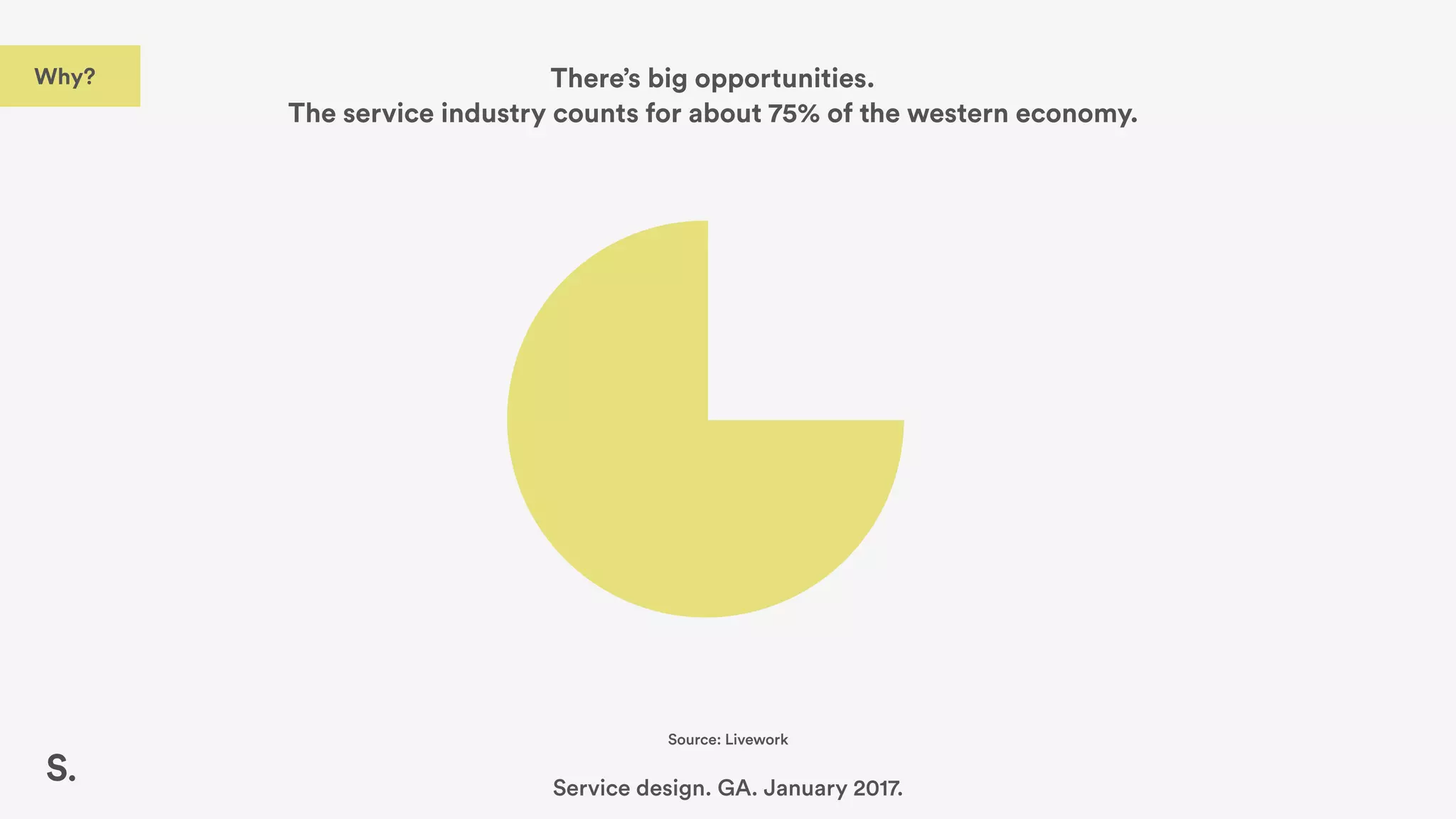
Thereโ€™s big opportunities.
The service industry counts for about 75% of the western economy.
Source: Livework
Service design. GA. January 2017.
Why?
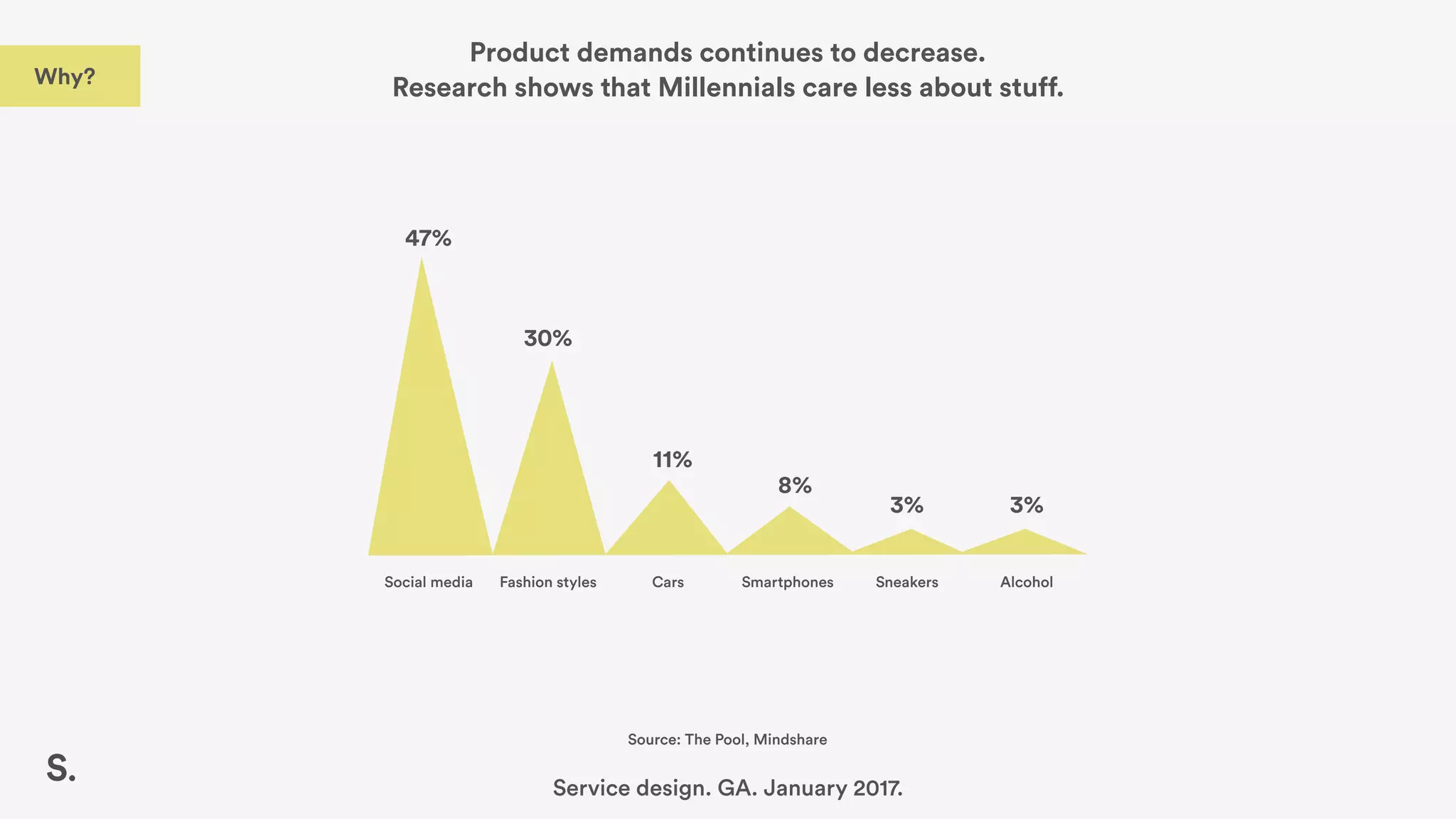
Product demands continues to decrease.
Research shows that Millennials care less about stuff.
Social media
47%
30%
11%
8%
3% 3%
Fashion styles Cars Smartphones Sneakers Alcohol
Source: The Pool, Mindshare
Service design. GA. January 2017.
Why?
Every product is a service
waiting to happen.
Service design. GA. January 2017.
Source: Malin Maki.
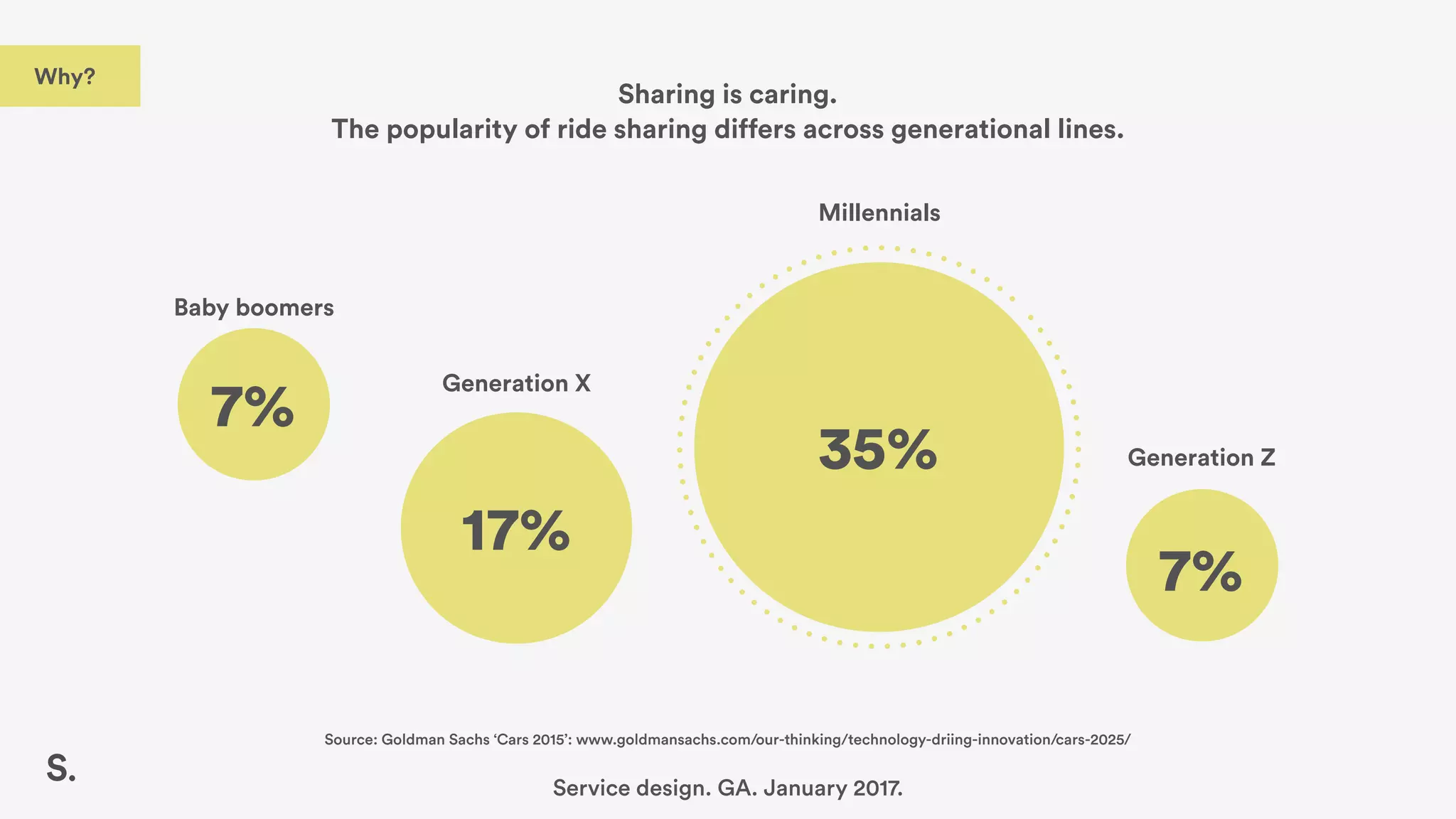
Sharing is caring.
The popularity of ride sharing differs across generational lines.
7%
7%
17%
35%
Baby boomers
Generation Z
Millennials
Generation X
Source: Goldman Sachs โ€˜Cars 2015โ€™: www.goldmansachs.com/our-thinking/technology-driing-innovation/cars-2025/
Service design. GA. January 2017.
Why?
Better designed services lead to customer loyalty and theyโ€™re willing to pay more.
The business processes are also a whole lot more efficient.
Service design. GA. January 2017.
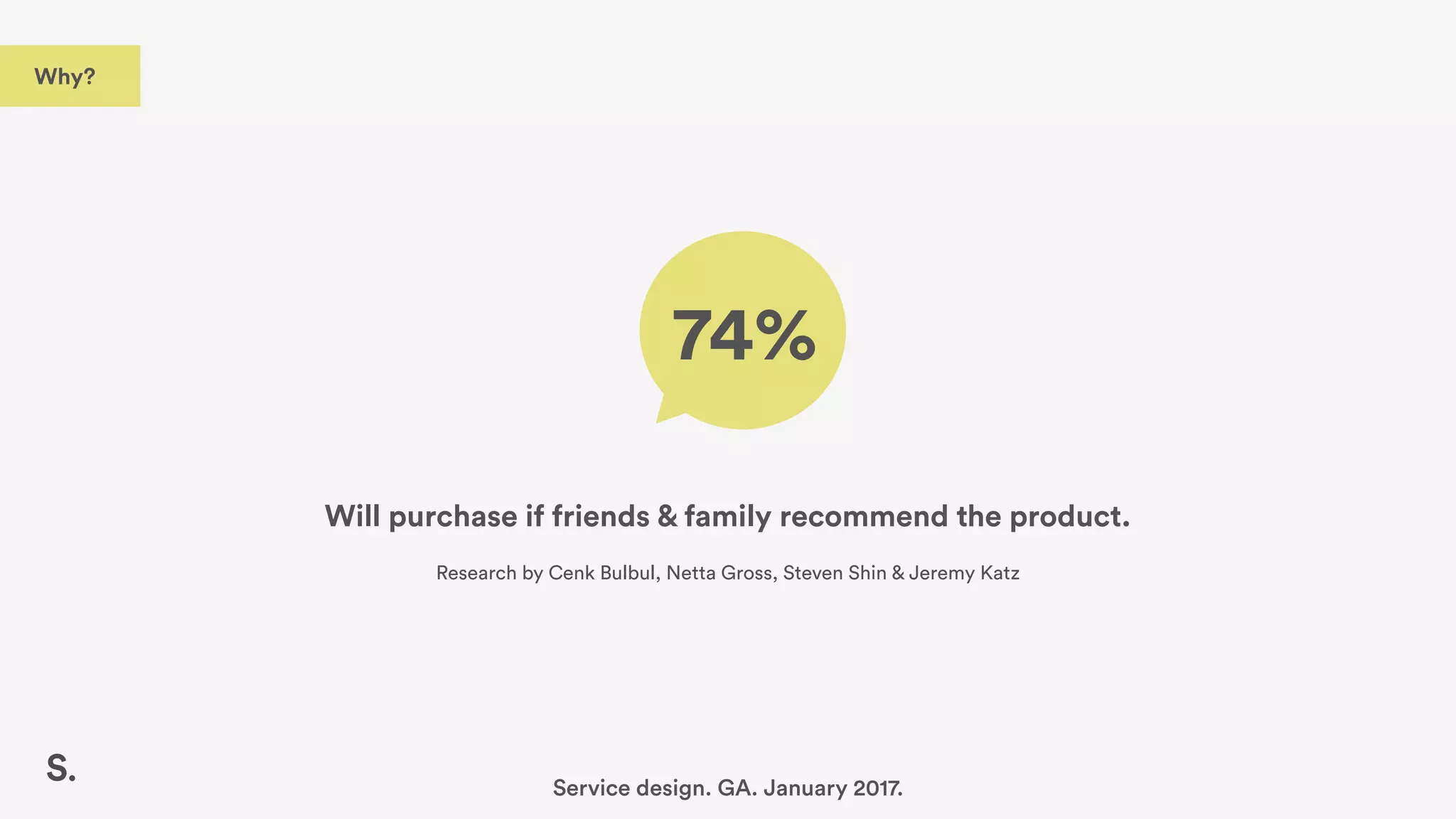
Will purchase if friends & family recommend the product.
Research by Cenk Bulbul, Netta Gross, Steven Shin & Jeremy Katz
74%
Service design. GA. January 2017.
Why?
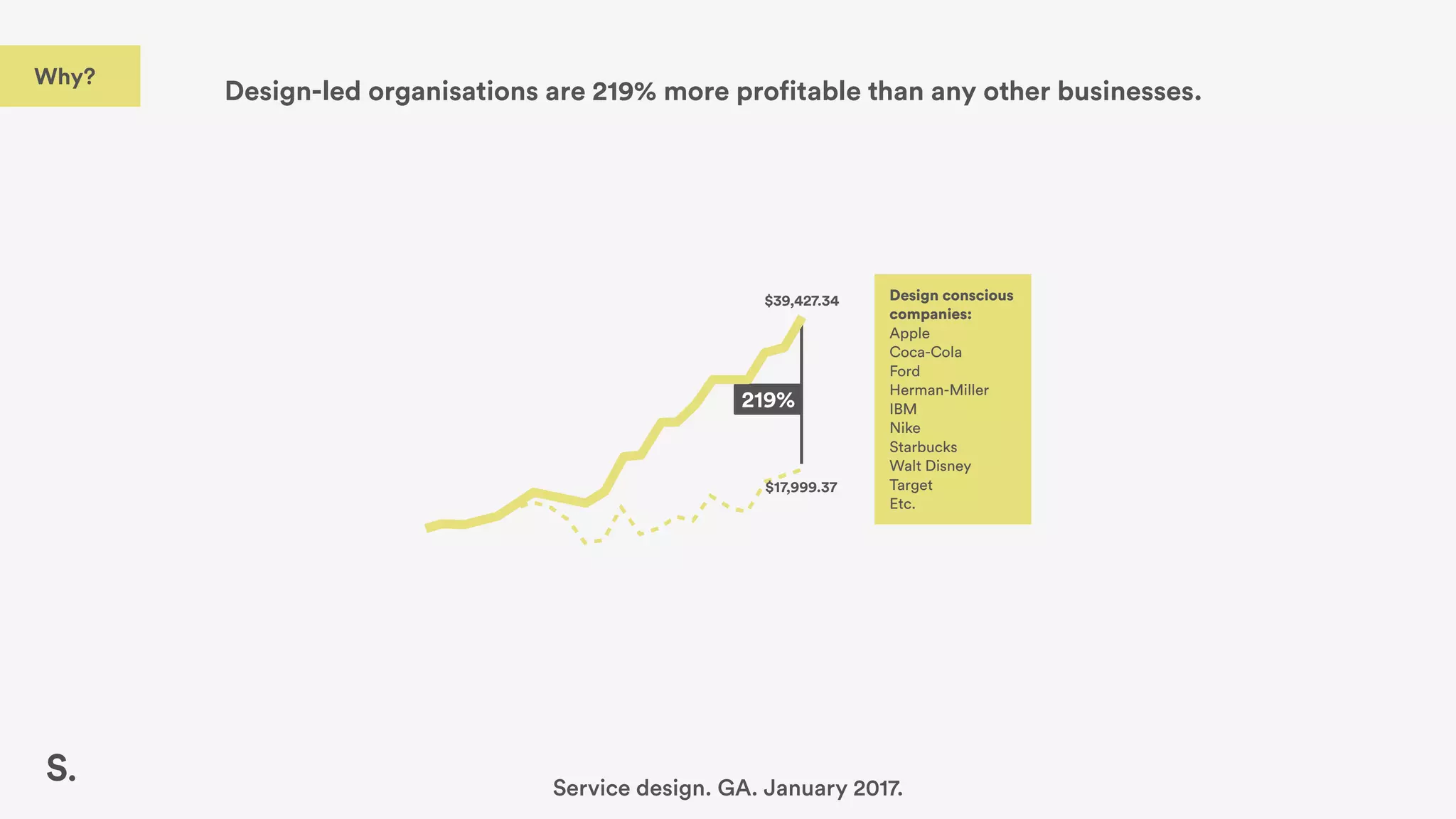
Design-led organisations are 219% more profitable than any other businesses.
219%
$39,427.34
$17,999.37
Design conscious
companies:
Apple
Coca-Cola
Ford
Herman-Miller
IBM
Nike
Starbucks
Walt Disney
Target
Etc.
Service design. GA. January 2017.
Why?
How to do Service Design?
Service design. GA. January 2017.
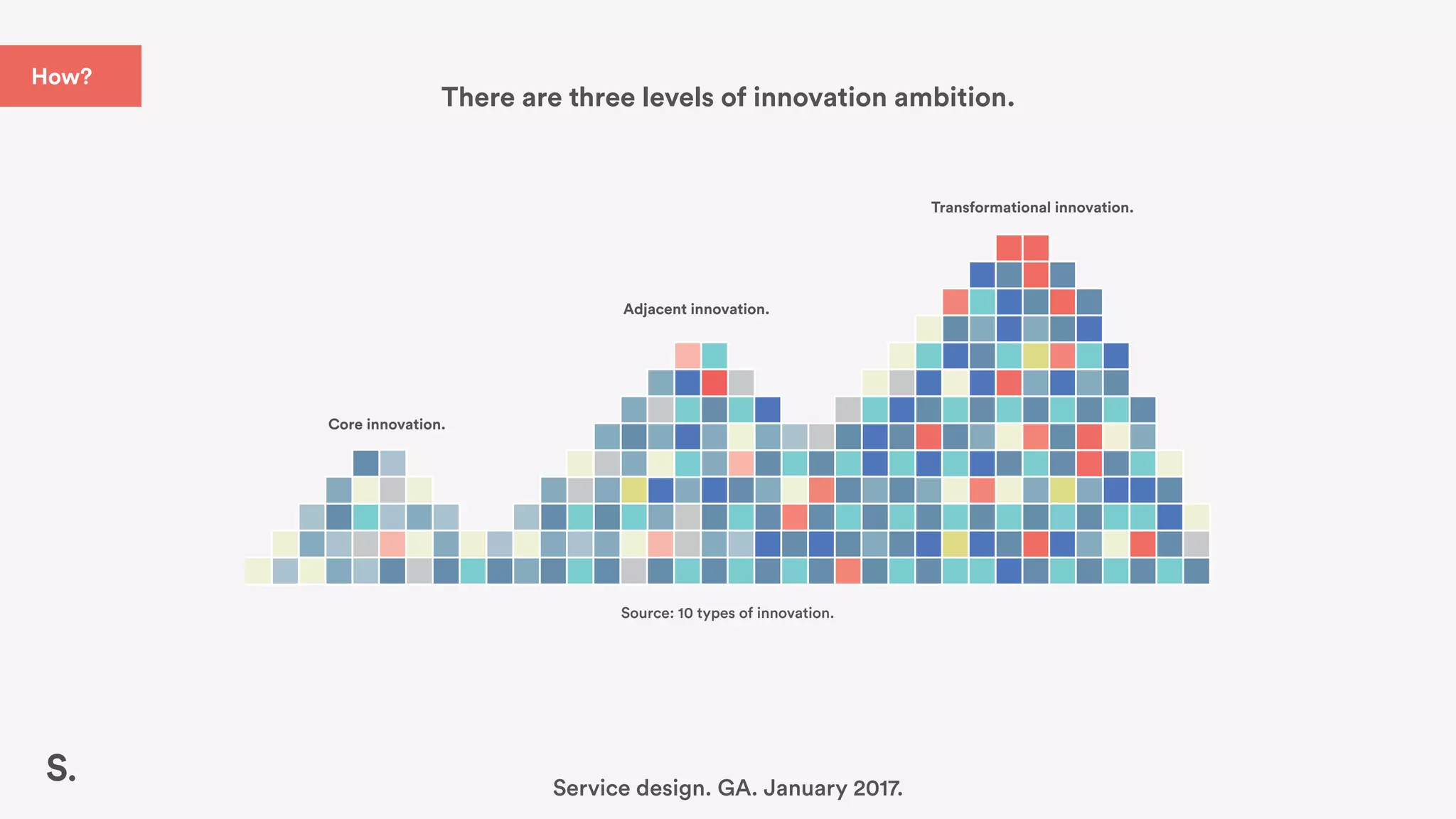
There are three levels of innovation ambition.
Source: 10 types of innovation.
Core innovation.
Adjacent innovation.
Transformational innovation.
Service design. GA. January 2017.
How?
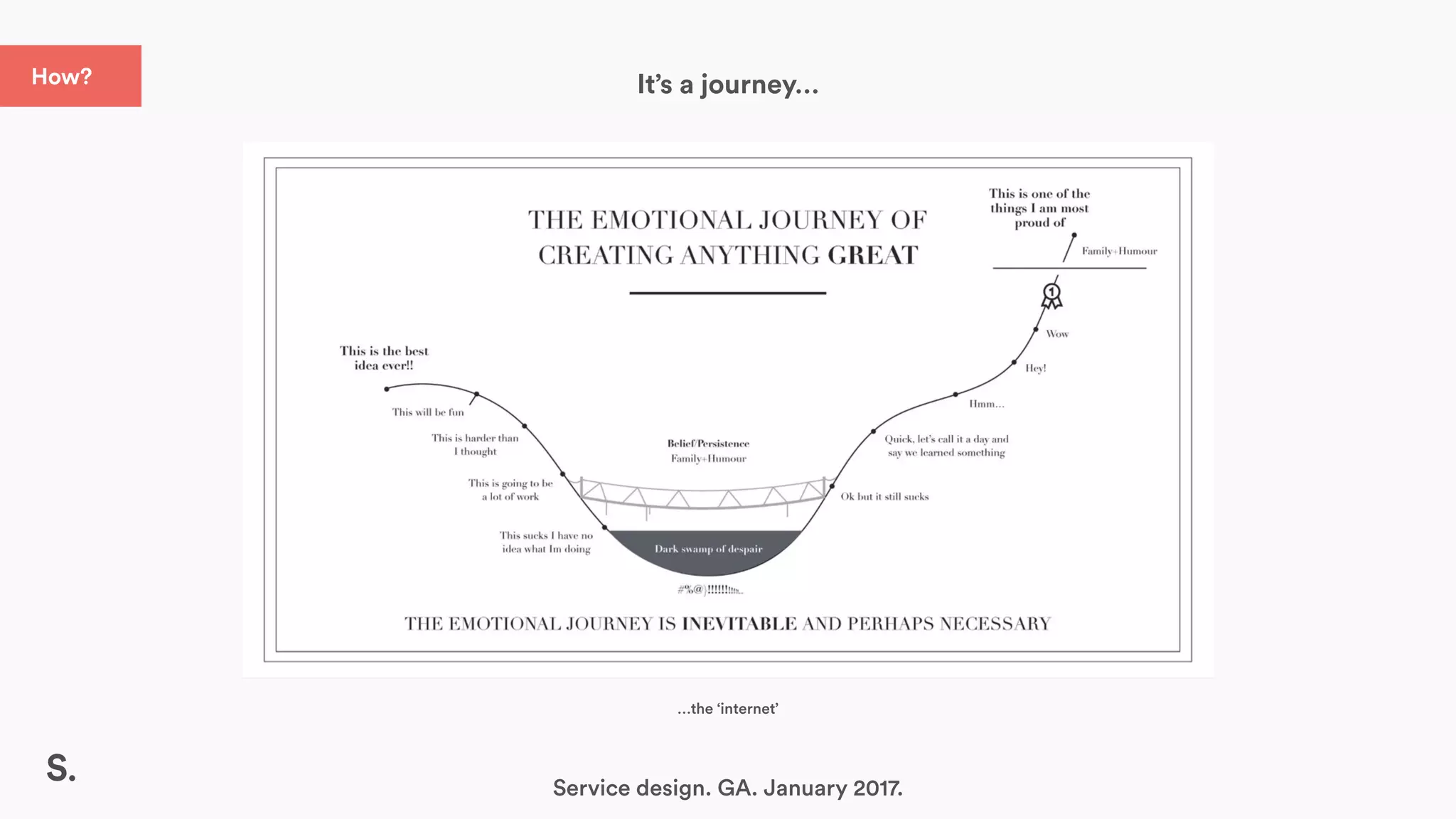
Itโ€™s a journeyโ€ฆ
โ€ฆthe โ€˜internetโ€™
Service design. GA. January 2017.
How?
Service design is evolving from traditional design.
Service design. GA. January 2017.
Ideate TransformDefineExplore
Business
O
bjectives
C
ustom
er
Insight
Guide
Implement
Support
D
esign
Evaluate
Test
H
ypothesis
Interactions
Strategy
Technology
People
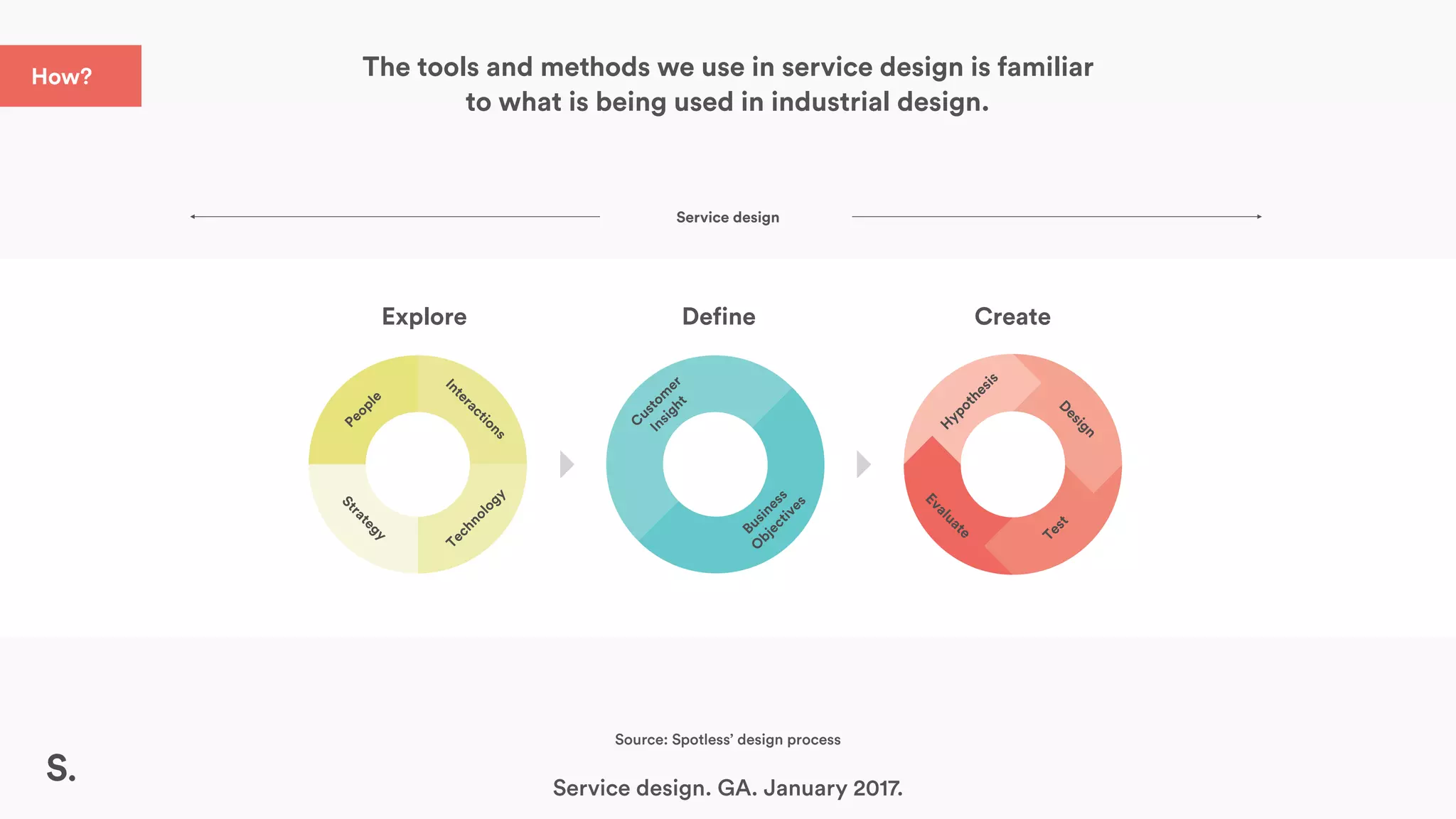
The tools and methods we use in service design is familiar
to what is being used in industrial design.
Source: Spotlessโ€™ design process
Service design. GA. January 2017.
How?
Business
O
bjectives
C
ustom
er
Insight
D
esign
Evaluate
Test
H
ypothesis
InteractionsStrategy
Technology
People
Service design
Explore Define Create
Research
Service design. GA. January 2017.
How?
Diary studies
Also called Cultural Probes, is
used for collecting information
about the users without being
intrusive. Itโ€™s quite handy if the
topic is sensitive and the user
wants anonymity.
Challenges with this study is that
you're not in control (the user is)
with means that the results can
be varied.
Service design. GA. January 2017.
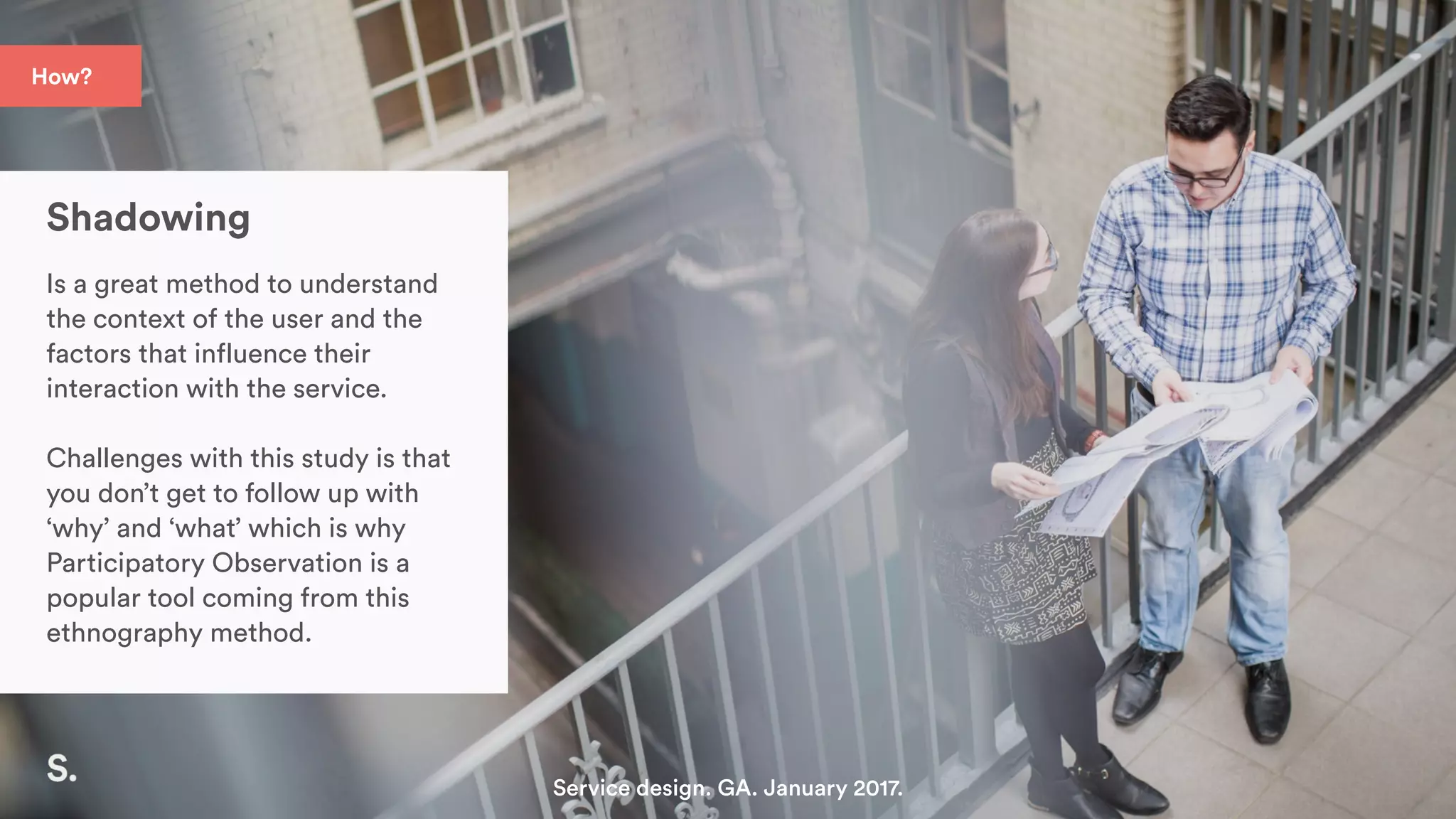
Shadowing
Is a great method to understand
the context of the user and the
factors that influence their
interaction with the service.
Challenges with this study is that
you donโ€™t get to follow up with
โ€˜whyโ€™ and โ€˜whatโ€™ which is why
Participatory Observation is a
popular tool coming from this
ethnography method.
Service design. GA. January 2017.
How?
How?
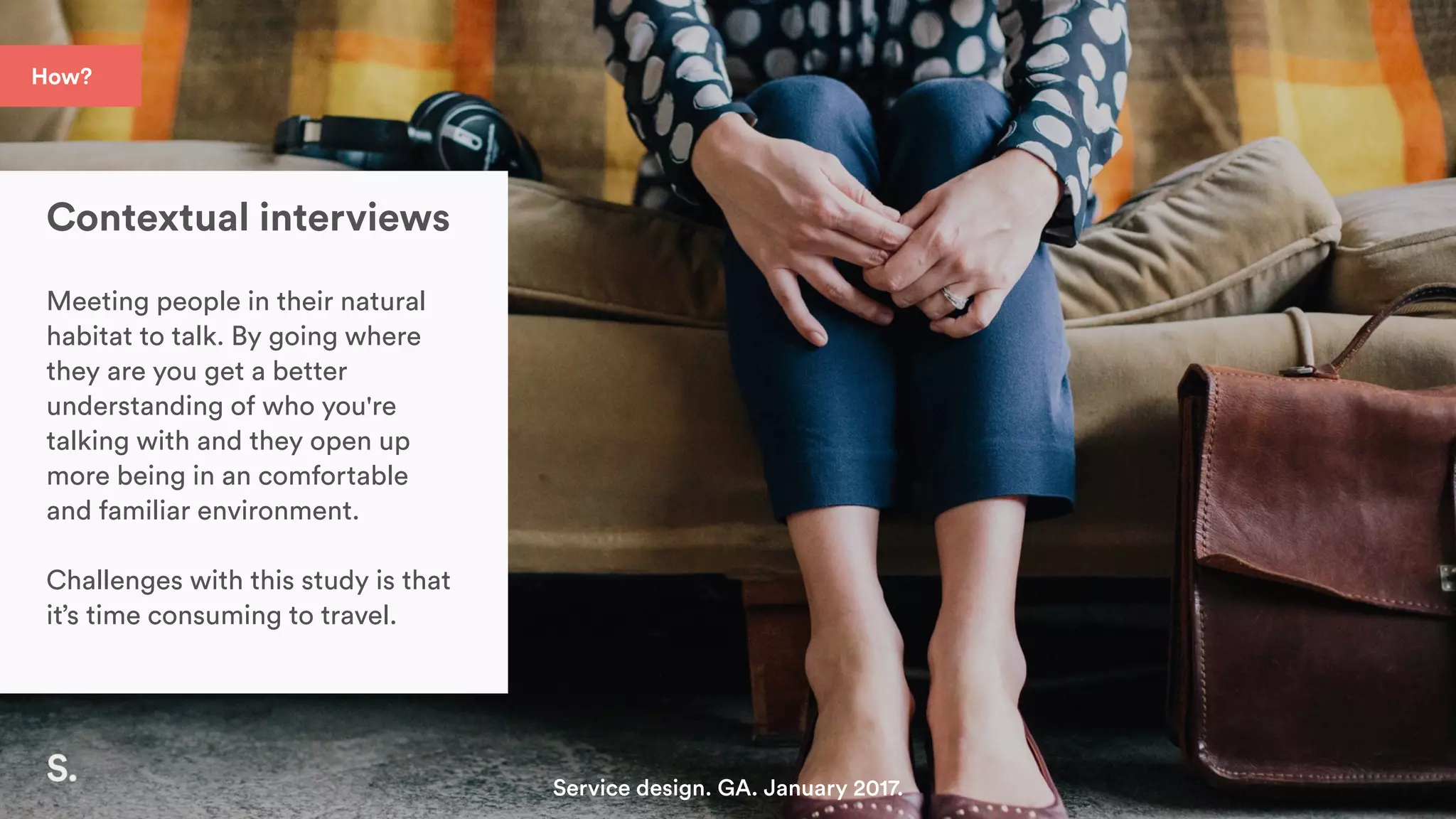
Contextual interviews
Meeting people in their natural
habitat to talk. By going where
they are you get a better
understanding of who you're
talking with and they open up
more being in an comfortable
and familiar environment.
Challenges with this study is that
itโ€™s time consuming to travel.
Service design. GA. January 2017.
How?
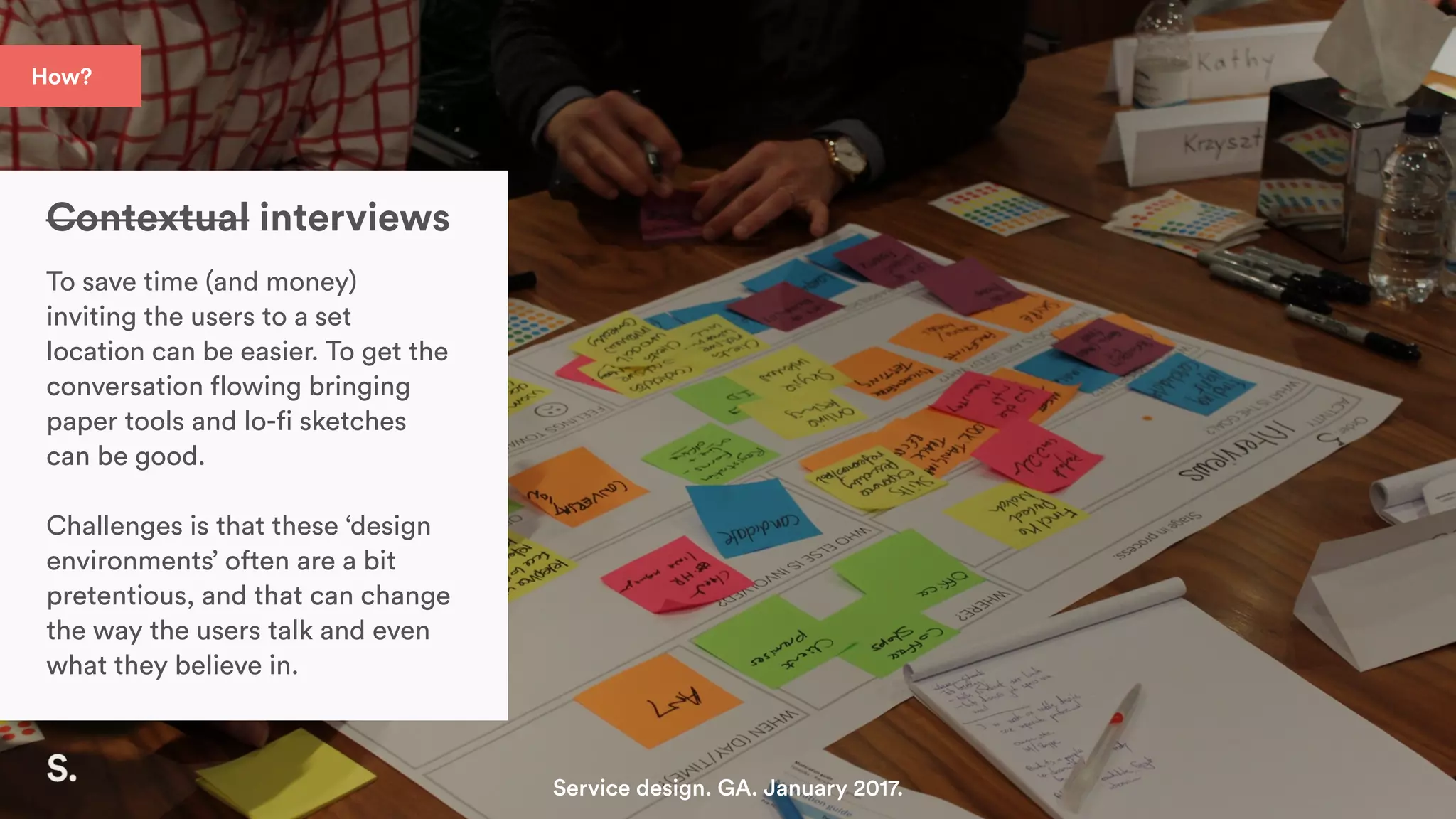
Contextual interviews
To save time (and money)
inviting the users to a set
location can be easier. To get the
conversation flowing bringing
paper tools and lo-fi sketches
can be good.
Challenges is that these โ€˜design
environmentsโ€™ often are a bit
pretentious, and that can change
the way the users talk and even
what they believe in.
Service design. GA. January 2017.
How?
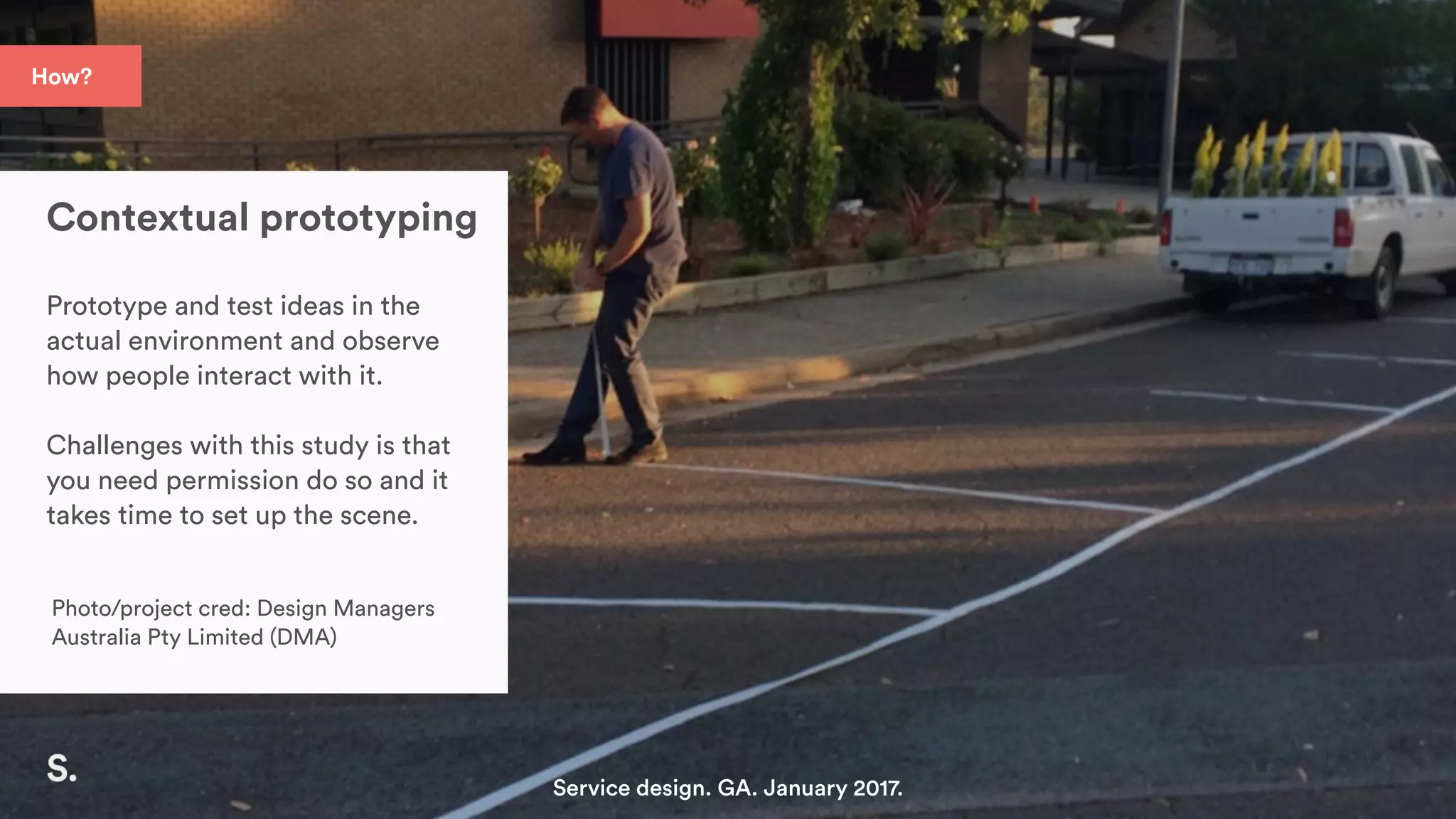
Contextual prototyping
Prototype and test ideas in the
actual environment and observe
how people interact with it.
Challenges with this study is that
you need permission do so and it
takes time to set up the scene.
Photo/project cred: Design Managers
Australia Pty Limited (DMA)
Service design. GA. January 2017.
How?
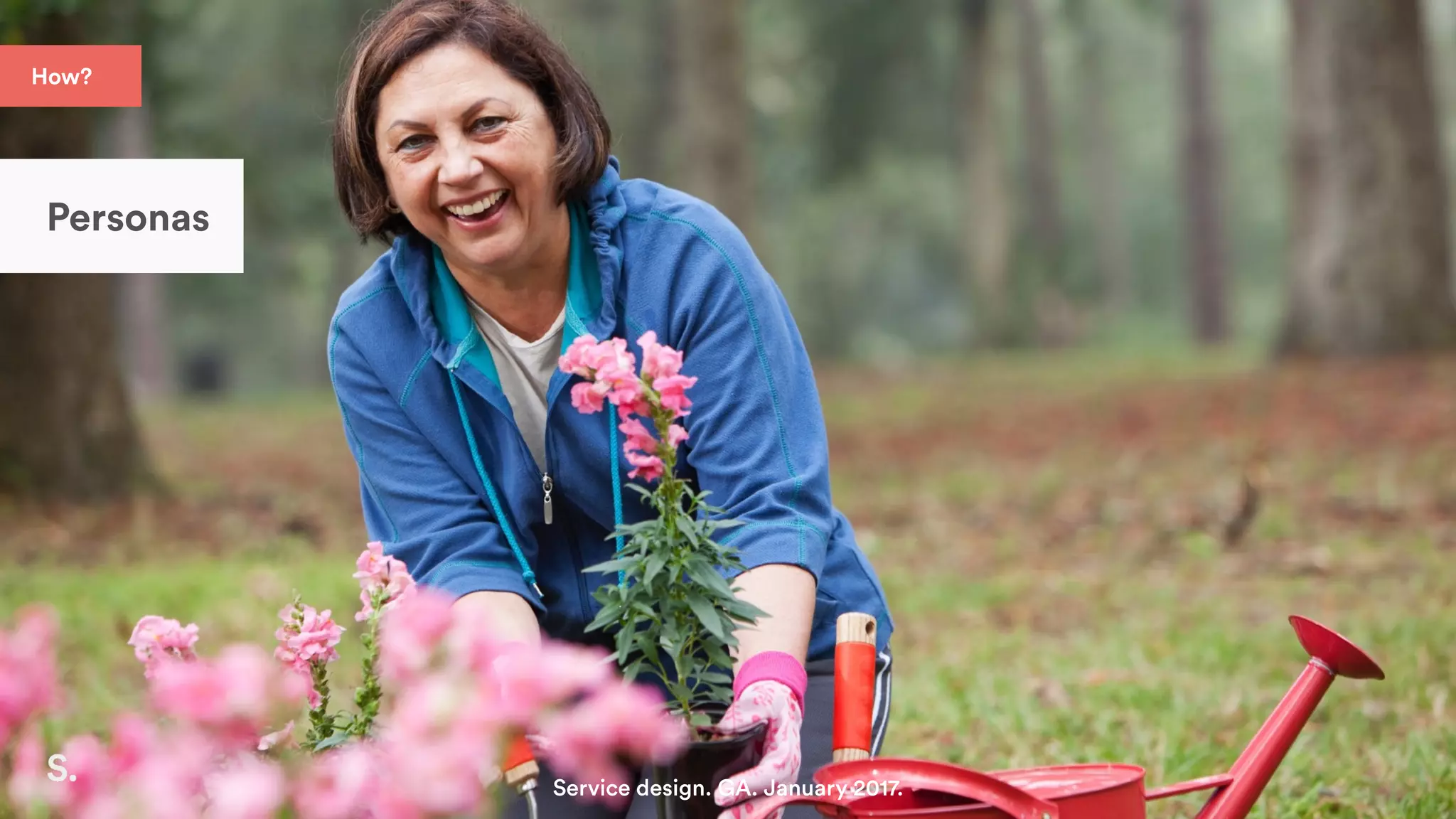
Personas
Service design. GA. January 2017.
Ideate
Service design. GA. January 2017.
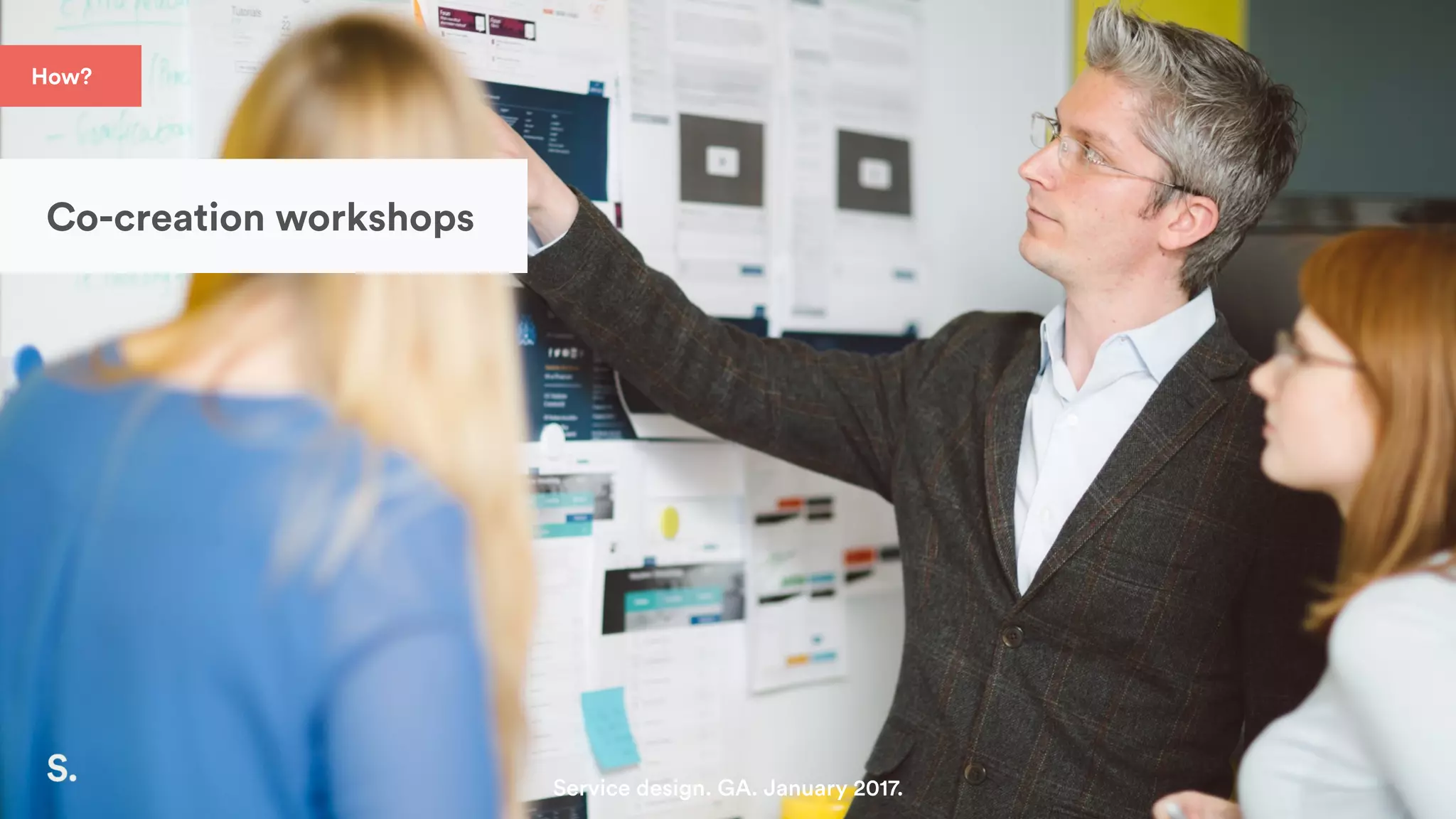
Co-creation workshops
Service design. GA. January 2017.
How?
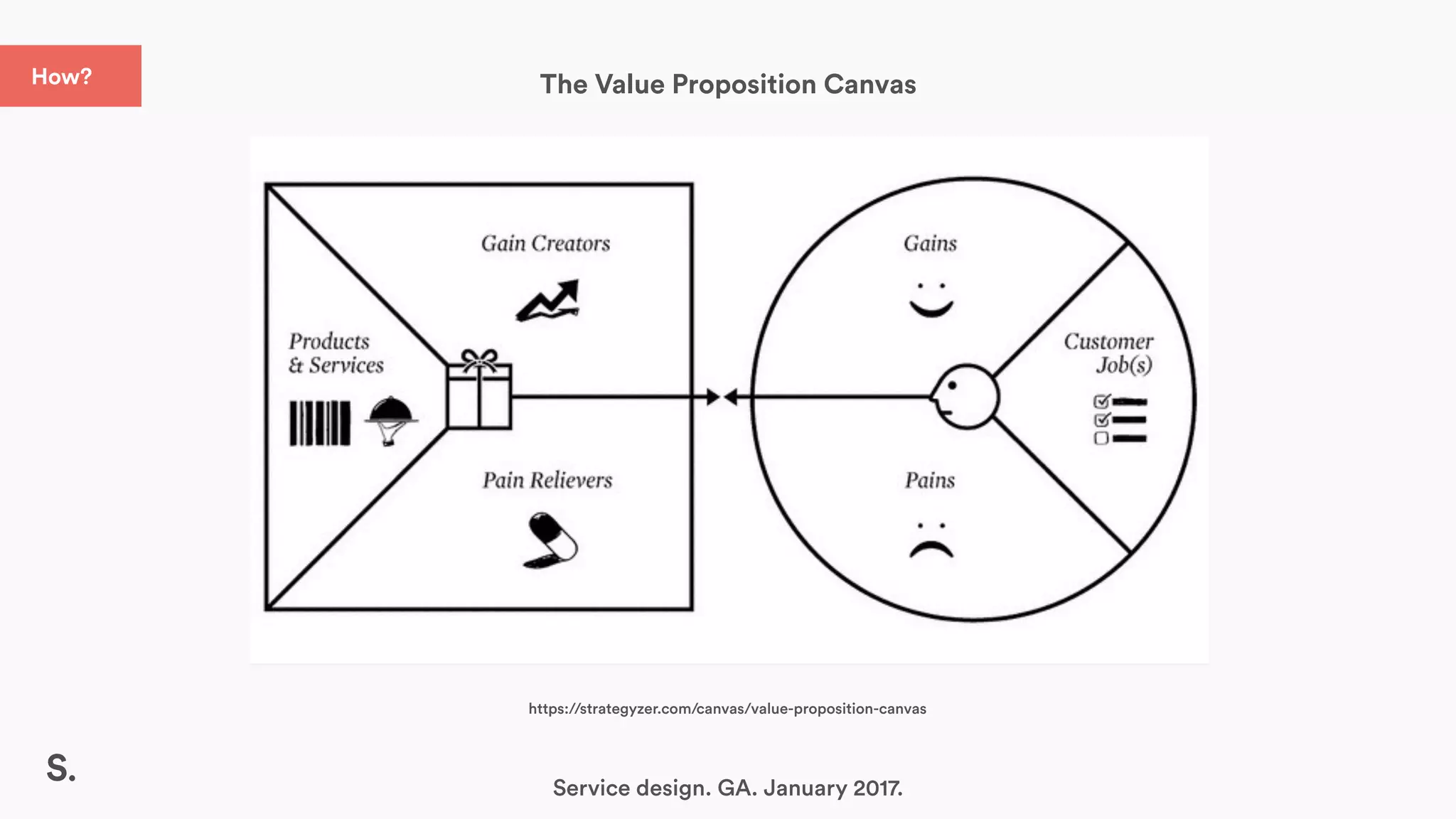
The Value Proposition Canvas
https://strategyzer.com/canvas/value-proposition-canvas
Service design. GA. January 2017.
How?
Service design. GA. January 2017.
How?
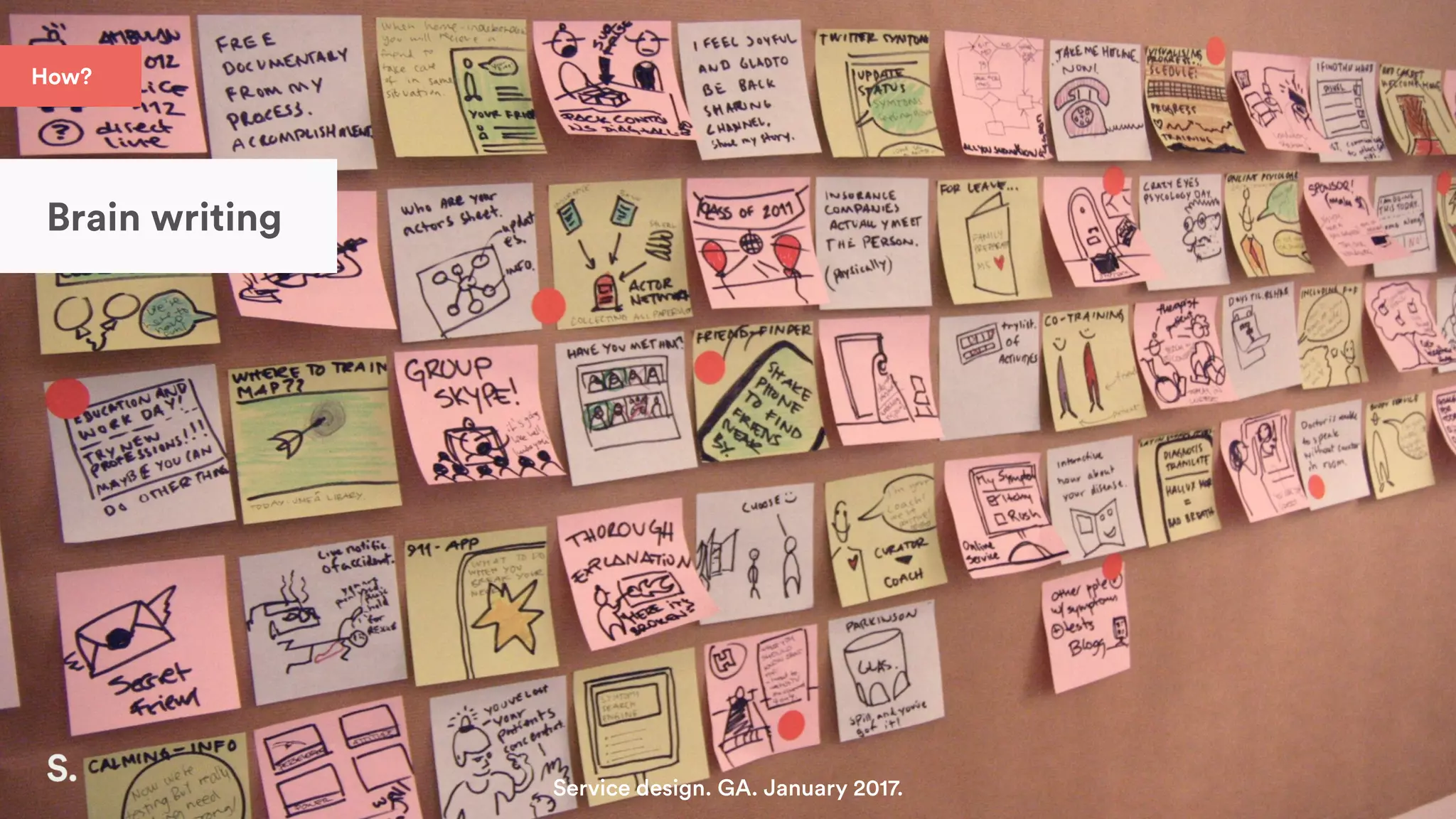
Brain writing
Create
Service design. GA. January 2017.
Understanding the client needs
Geoff works with his client to understand the timeframe,
budget, the building location and use.
It is important to have awareness of different opportunities so
that they can bring these ideas to clients early on in the
project.
"I will take notice of information sent to me [from
brands] if it's relevant to a project I'm working on.
You need to understand the client and how they
want to use a building."
Agreeing on a rough idea quickly
At this stage Geoff is working with his client to agree on the
look, feel and basic layout of the building and for reassurance
that their initial ideas are possible.
With each stage you get more zoomed in. We're
going to build this building with this purpose.
Agreeing on a rough idea quickly
At this stage Geoff is working with his client to agree on the
look, feel and basic layout of the building and for reassurance
that their initial ideas are possible.
With each stage you get more zoomed in. We're
going to build this building with this purpose.
Agreeing on a rough idea quickly
At this stage Geoff is working with his client to agree on the
look, feel and basic layout of the building and for reassurance
that their initial ideas are possible.
With each stage you get more zoomed in.
We're going to build this building with this
purpose.
Agreeing on a rough idea quickly
At this stage Geoff is working with his client to agree on the
look, feel and basic layout of the building and for reassurance
that their initial ideas are possible.
With each stage you get more zoomed in. We're
going to build this building with this purpose.
Agreeing on a rough idea quickly
At this stage Geoff is working with his client to agree on the
look, feel and basic layout of the building and for reassurance
that their initial ideas are possible.
With each stage you get more zoomed in. We're
going to build this building with this purpose.
nt logo
Geoff
rchitect
it ullamcorpe scelerisque mi a dolor
amcorper hendrerit a suspendisse felis
morbi hac adipiscing netus consectetur
itasse hendrerit.
Journey Name
Exploring materials and systems.
Working with suppliers to understand the feasibility of their idea.
Face to face or phone support from brands technical team.
Clients can have their own prejudice that limits design or use of
systems.
Brands want too many details about the project before it is even
confirmed - this is a barrier.
Brands are too focused on sales and not on helping Architects answer
questions.
Downloadable rvt/dwg files are too detailed for this phase when
details have not been ironed out (thus causing more questions at
planning stage).
Exploring materials and systems.
Working with suppliers to understand the feasibility of their idea.
Face to face or phone support from brands technical team.
Clients can have their own prejudice that limits design or use of
systems.
Brands want too many details about the project before it is even
confirmed - this is a barrier.
Brands are too focused on sales and not on helping Architects answer
questions.
Downloadable rvt/dwg files are too detailed for this phase when
details have not been ironed out (thus causing more questions at
planning stage).
Exploring materials and systems.
Working with suppliers to understand the feasibility of their idea.
Face to face or phone support from brands technical team.
Clients can have their own prejudice that limits design or use of
systems.
Brands want too many details about the project before it is even
confirmed - this is a barrier.
Brands are too focused on sales and not on helping Architects answer
questions.
Downloadable rvt/dwg files are too detailed for this phase when
details have not been ironed out (thus causing more questions at
planning stage).
Exploring materials and systems.
Working with suppliers to understand the feasibility of their idea.
Face to face or phone support from brands technical team.
Clients can have their own prejudice that limits design or use of
systems.
Brands want too many details about the project before it is even
confirmed - this is a barrier.
Brands are too focused on sales and not on helping Architects answer
questions.
Downloadable rvt/dwg files are too detailed for this phase when
details have not been ironed out (thus causing more questions at
planning stage).
Exploring materials and systems.
Working with suppliers to understand the feasibility of their idea.
Face to face or phone support from brands technical team.
Clients can have their own prejudice that limits design or use of
systems.
Brands want too many details about the project before it is even
confirmed - this is a barrier.
Brands are too focused on sales and not on helping Architects answer
questions.
Downloadable rvt/dwg files are too detailed for this phase when
details have not been ironed out (thus causing more questions at
planning stage).
Exploring materials and systems.
Working with suppliers to understand the feasibility of their idea.
Face to face or phone support from brands technical team.
Clients can have their own prejudice that limits design or use of
systems.
Brands want too many details about the project before it is even
confirmed - this is a barrier.
Brands are too focused on sales and not on helping Architects answ
questions.
Downloadable rvt/dwg files are too detailed for this phase when
details have not been ironed out (thus causing more questions at
planning stage).
PLANNING DEVELOPED DESIGNSTART TECHNICAL DESIGN HANDOVER IN-USE
Service design. GA. January 2017.
How?
User Journey maps
Service design. GA. January 2017.Service design. GA. January 2017.
How?
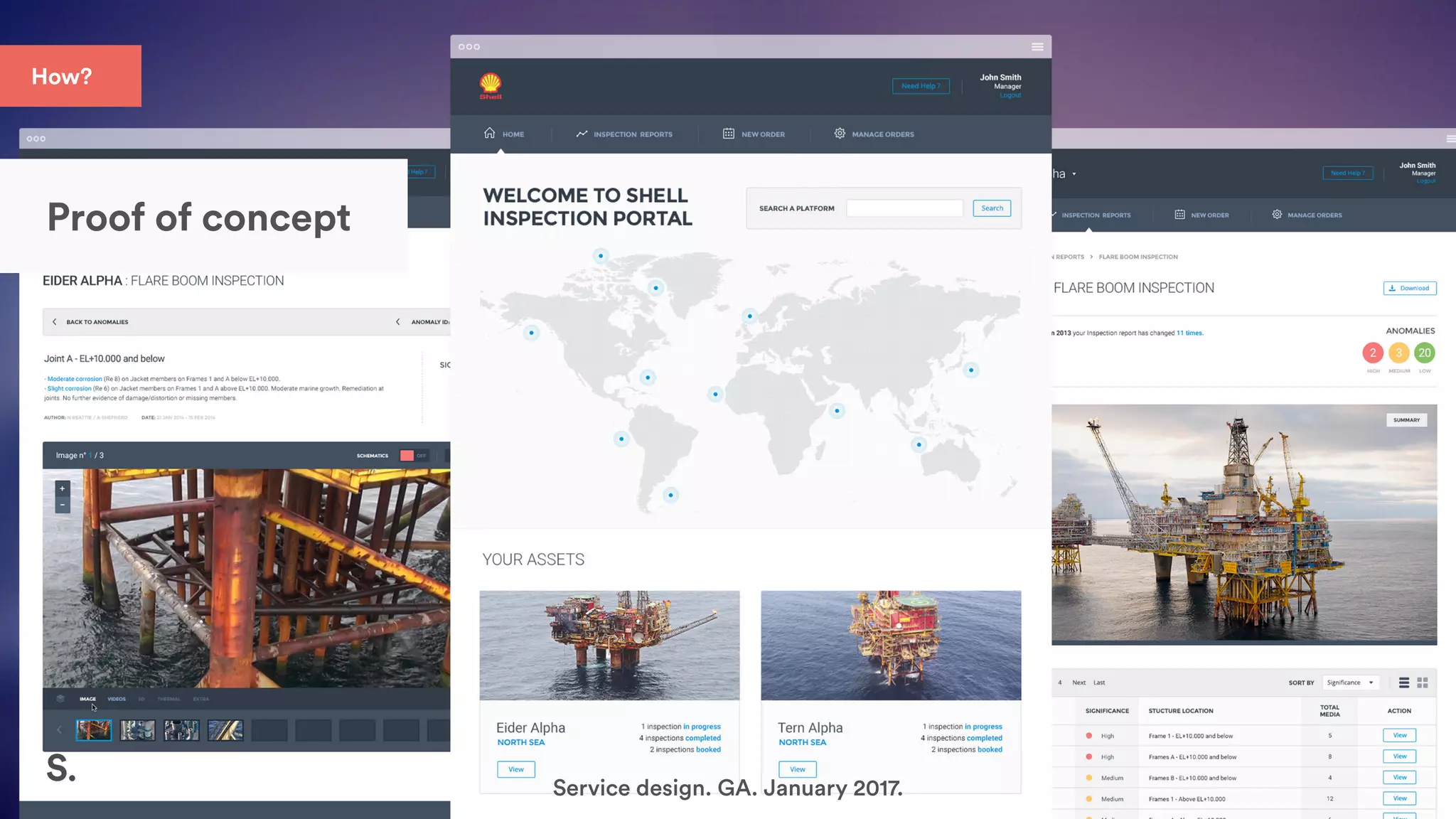
Proof of concept
Service design. GA. January 2017.
How?
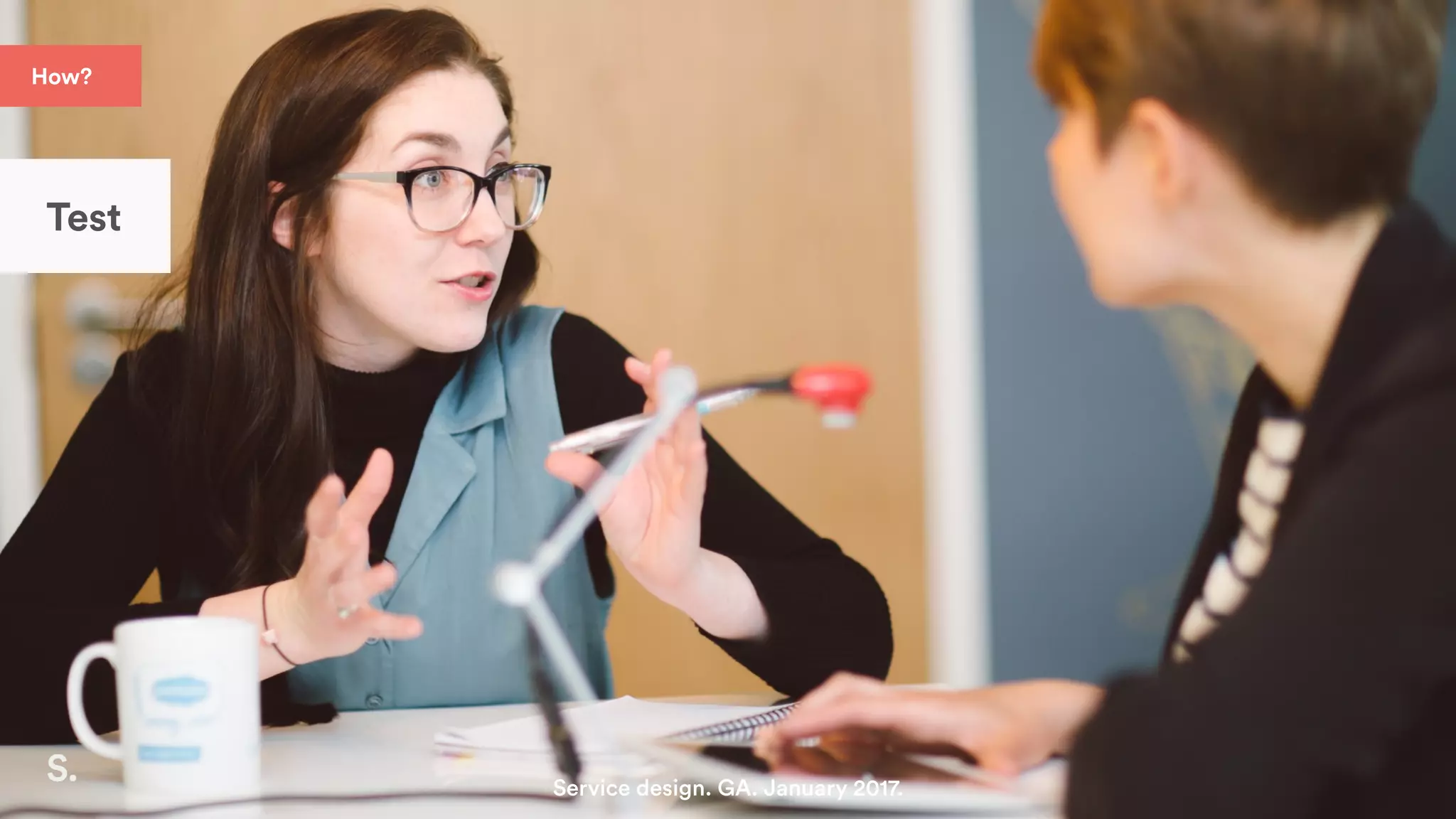
Test
Thank you
Ine Marie Vassรธy, Lead Service Designer
ine.vassoy@spotless.co.uk
@spotint | @inevassoy

The what, why and how of Service Design

  • 1.
    Ine Marie Vassรธy,Lead Service Designer My take on Service design. ine.vassoy@spotless.co.uk @spotint | @inevassoy
  • 2.
    What we doat Spotless Service design. GA. January 2017. Service design Delivering value to people through innovating or improving systems, communication and material components of a service across every touchpoint. Business innovation Designing more effective processes to increase your competitive advantage and likelihood of success. Experience strategy Defining a customer experience vision and aligning activities and success criteria to create better experiences, resulting in happy customers, and healthy businesses. Design research Observing and understanding people and how they interact with products and services provides a solid foundation for any project.
  • 3.
    What is ServiceDesign? Service design. GA. January 2017.
  • 4.
    Service design isthe designing and marketing of services that improve the customer experience, and the interactions between the service providers and the customers. - This is Service Design thinking โ€œ Service design. GA. January 2017.
  • 5.
    Services are producedat the same time they are consumed - the customer is a co-creator of the service. Service design. GA. January 2017. What?
  • 6.
    A service happensover time Service design. GA. January 2017. What?
  • 7.
    Thereโ€™s a lotof similarities in UX & service design. We both map the user journeys. website.com } Enters website Login / sign up Browse Purchase Service design. GA. January 2017. What?
  • 8.
    } What triggers the event? Askfriends for advice Check out the competitors Ask another friend Use the help chat Get lost in the detailsโ€ฆ Service design. GA. January 2017. website.com Check out the physical store Thereโ€™s a lot of similarities in UX & service design. We might map the user journeys a little bit differently. What?
  • 9.
    โ€œI like tofeel the product in my hands before I buy itโ€ -figurative user }Service design. GA. January 2017. website.com Thereโ€™s a lot of similarities in UX & service design. We look at how the different touch-points support the user. } physical shop } help centre }before } after What?
  • 10.
    A method fordesigning experiences that reach people through many different touch-points, and that happen over time. - www.servicedesign.org โ€œ Service design. GA. January 2017.
  • 11.
    You canโ€™t designa service, you can only design for a service. Service design. GA. January 2017. What?
  • 12.
    Fundamentally, itโ€™s aboutpeople. Service design. GA. January 2017. What?
  • 13.
    Why Service Design? Servicedesign. GA. January 2017.
  • 14.
    Thereโ€™s big opportunities. Theservice industry counts for about 75% of the western economy. Source: Livework Service design. GA. January 2017. Why?
  • 15.
    Product demands continuesto decrease. Research shows that Millennials care less about stuff. Social media 47% 30% 11% 8% 3% 3% Fashion styles Cars Smartphones Sneakers Alcohol Source: The Pool, Mindshare Service design. GA. January 2017. Why?
  • 16.
    Every product isa service waiting to happen. Service design. GA. January 2017. Source: Malin Maki.
  • 17.
    Sharing is caring. Thepopularity of ride sharing differs across generational lines. 7% 7% 17% 35% Baby boomers Generation Z Millennials Generation X Source: Goldman Sachs โ€˜Cars 2015โ€™: www.goldmansachs.com/our-thinking/technology-driing-innovation/cars-2025/ Service design. GA. January 2017. Why?
  • 18.
    Better designed serviceslead to customer loyalty and theyโ€™re willing to pay more. The business processes are also a whole lot more efficient. Service design. GA. January 2017.
  • 19.
    Will purchase iffriends & family recommend the product. Research by Cenk Bulbul, Netta Gross, Steven Shin & Jeremy Katz 74% Service design. GA. January 2017. Why?
  • 20.
    Design-led organisations are219% more profitable than any other businesses. 219% $39,427.34 $17,999.37 Design conscious companies: Apple Coca-Cola Ford Herman-Miller IBM Nike Starbucks Walt Disney Target Etc. Service design. GA. January 2017. Why?
  • 21.
    How to doService Design? Service design. GA. January 2017.
  • 22.
    There are threelevels of innovation ambition. Source: 10 types of innovation. Core innovation. Adjacent innovation. Transformational innovation. Service design. GA. January 2017. How?
  • 23.
    Itโ€™s a journeyโ€ฆ โ€ฆtheโ€˜internetโ€™ Service design. GA. January 2017. How?
  • 24.
    Service design isevolving from traditional design. Service design. GA. January 2017.
  • 25.
    Ideate TransformDefineExplore Business O bjectives C ustom er Insight Guide Implement Support D esign Evaluate Test H ypothesis Interactions Strategy Technology People The toolsand methods we use in service design is familiar to what is being used in industrial design. Source: Spotlessโ€™ design process Service design. GA. January 2017. How? Business O bjectives C ustom er Insight D esign Evaluate Test H ypothesis InteractionsStrategy Technology People Service design Explore Define Create
  • 26.
  • 27.
    How? Diary studies Also calledCultural Probes, is used for collecting information about the users without being intrusive. Itโ€™s quite handy if the topic is sensitive and the user wants anonymity. Challenges with this study is that you're not in control (the user is) with means that the results can be varied. Service design. GA. January 2017.
  • 28.
    Shadowing Is a greatmethod to understand the context of the user and the factors that influence their interaction with the service. Challenges with this study is that you donโ€™t get to follow up with โ€˜whyโ€™ and โ€˜whatโ€™ which is why Participatory Observation is a popular tool coming from this ethnography method. Service design. GA. January 2017. How?
  • 29.
    How? Contextual interviews Meeting peoplein their natural habitat to talk. By going where they are you get a better understanding of who you're talking with and they open up more being in an comfortable and familiar environment. Challenges with this study is that itโ€™s time consuming to travel. Service design. GA. January 2017.
  • 30.
    How? Contextual interviews To savetime (and money) inviting the users to a set location can be easier. To get the conversation flowing bringing paper tools and lo-fi sketches can be good. Challenges is that these โ€˜design environmentsโ€™ often are a bit pretentious, and that can change the way the users talk and even what they believe in. Service design. GA. January 2017.
  • 31.
    How? Contextual prototyping Prototype andtest ideas in the actual environment and observe how people interact with it. Challenges with this study is that you need permission do so and it takes time to set up the scene. Photo/project cred: Design Managers Australia Pty Limited (DMA) Service design. GA. January 2017.
  • 32.
  • 33.
  • 34.
  • 35.
    The Value PropositionCanvas https://strategyzer.com/canvas/value-proposition-canvas Service design. GA. January 2017. How?
  • 36.
    Service design. GA.January 2017. How? Brain writing
  • 37.
  • 38.
    Understanding the clientneeds Geoff works with his client to understand the timeframe, budget, the building location and use. It is important to have awareness of different opportunities so that they can bring these ideas to clients early on in the project. "I will take notice of information sent to me [from brands] if it's relevant to a project I'm working on. You need to understand the client and how they want to use a building." Agreeing on a rough idea quickly At this stage Geoff is working with his client to agree on the look, feel and basic layout of the building and for reassurance that their initial ideas are possible. With each stage you get more zoomed in. We're going to build this building with this purpose. Agreeing on a rough idea quickly At this stage Geoff is working with his client to agree on the look, feel and basic layout of the building and for reassurance that their initial ideas are possible. With each stage you get more zoomed in. We're going to build this building with this purpose. Agreeing on a rough idea quickly At this stage Geoff is working with his client to agree on the look, feel and basic layout of the building and for reassurance that their initial ideas are possible. With each stage you get more zoomed in. We're going to build this building with this purpose. Agreeing on a rough idea quickly At this stage Geoff is working with his client to agree on the look, feel and basic layout of the building and for reassurance that their initial ideas are possible. With each stage you get more zoomed in. We're going to build this building with this purpose. Agreeing on a rough idea quickly At this stage Geoff is working with his client to agree on the look, feel and basic layout of the building and for reassurance that their initial ideas are possible. With each stage you get more zoomed in. We're going to build this building with this purpose. nt logo Geoff rchitect it ullamcorpe scelerisque mi a dolor amcorper hendrerit a suspendisse felis morbi hac adipiscing netus consectetur itasse hendrerit. Journey Name Exploring materials and systems. Working with suppliers to understand the feasibility of their idea. Face to face or phone support from brands technical team. Clients can have their own prejudice that limits design or use of systems. Brands want too many details about the project before it is even confirmed - this is a barrier. Brands are too focused on sales and not on helping Architects answer questions. Downloadable rvt/dwg files are too detailed for this phase when details have not been ironed out (thus causing more questions at planning stage). Exploring materials and systems. Working with suppliers to understand the feasibility of their idea. Face to face or phone support from brands technical team. Clients can have their own prejudice that limits design or use of systems. Brands want too many details about the project before it is even confirmed - this is a barrier. Brands are too focused on sales and not on helping Architects answer questions. Downloadable rvt/dwg files are too detailed for this phase when details have not been ironed out (thus causing more questions at planning stage). Exploring materials and systems. Working with suppliers to understand the feasibility of their idea. Face to face or phone support from brands technical team. Clients can have their own prejudice that limits design or use of systems. Brands want too many details about the project before it is even confirmed - this is a barrier. Brands are too focused on sales and not on helping Architects answer questions. Downloadable rvt/dwg files are too detailed for this phase when details have not been ironed out (thus causing more questions at planning stage). Exploring materials and systems. Working with suppliers to understand the feasibility of their idea. Face to face or phone support from brands technical team. Clients can have their own prejudice that limits design or use of systems. Brands want too many details about the project before it is even confirmed - this is a barrier. Brands are too focused on sales and not on helping Architects answer questions. Downloadable rvt/dwg files are too detailed for this phase when details have not been ironed out (thus causing more questions at planning stage). Exploring materials and systems. Working with suppliers to understand the feasibility of their idea. Face to face or phone support from brands technical team. Clients can have their own prejudice that limits design or use of systems. Brands want too many details about the project before it is even confirmed - this is a barrier. Brands are too focused on sales and not on helping Architects answer questions. Downloadable rvt/dwg files are too detailed for this phase when details have not been ironed out (thus causing more questions at planning stage). Exploring materials and systems. Working with suppliers to understand the feasibility of their idea. Face to face or phone support from brands technical team. Clients can have their own prejudice that limits design or use of systems. Brands want too many details about the project before it is even confirmed - this is a barrier. Brands are too focused on sales and not on helping Architects answ questions. Downloadable rvt/dwg files are too detailed for this phase when details have not been ironed out (thus causing more questions at planning stage). PLANNING DEVELOPED DESIGNSTART TECHNICAL DESIGN HANDOVER IN-USE Service design. GA. January 2017. How? User Journey maps
  • 39.
    Service design. GA.January 2017.Service design. GA. January 2017. How? Proof of concept
  • 40.
    Service design. GA.January 2017. How? Test
  • 41.
    Thank you Ine MarieVassรธy, Lead Service Designer ine.vassoy@spotless.co.uk @spotint | @inevassoy