BUILDING A CUSTOMER
EXPERIENCE FRAMEWORK
2015 HIGH FIVE CONFERENCE
WORKSHOP:
Worksheets included
KATE WILLIAMSON
WELCOME

WE’RE A BUNCH OF CX JUNKIES FROM CENTERLINE DIGITAL
@CENTERLINE DIGITAL
CAIT VLASTAKIS SMITH
JOHN LANE STEVEN KEITH
@kateawilliamson
@johnvlane
@caitvsmith
@stevenkeith
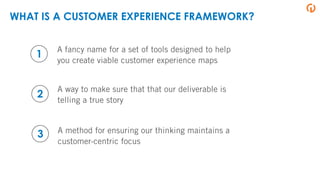
WHAT IS A CUSTOMER EXPERIENCE FRAMEWORK?
A fancy name for a set of tools designed to help
you create viable customer experience maps
1
A way to make sure that that our deliverable is
telling a true story
2
A method for ensuring our thinking maintains a
customer-centric focus
3
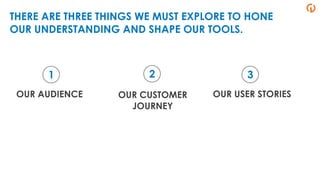
THERE ARE THREE THINGS WE MUST EXPLORE TO HONE
OUR UNDERSTANDING AND SHAPE OUR TOOLS.
OUR AUDIENCE
1
OUR CUSTOMER
JOURNEY
2
OUR USER STORIES
3
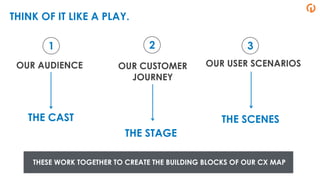
THINK OF IT LIKE A PLAY.
THE CAST
THE STAGE
THE SCENES
OUR AUDIENCE
1
OUR CUSTOMER
JOURNEY
2
OUR USER SCENARIOS
3
THESE WORK TOGETHER TO CREATE THE BUILDING BLOCKS OF OUR CX MAP
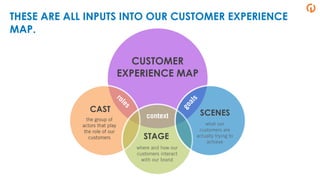
CUSTOMER
EXPERIENCE MAP
THESE ARE ALL INPUTS INTO OUR CUSTOMER EXPERIENCE
MAP.
CAST
STAGE
SCENES
where and how our
customers interact
with our brand
the group of
actors that play
the role of our
customers
roles
context
goals
what our
customers are
actually trying to
achieve
Illustration adapted from: David Bessenhoffer & Matt Wilczynski
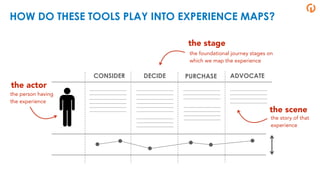
HOW DO THESE TOOLS PLAY INTO EXPERIENCE MAPS?
CONSIDER DECIDE PURCHASE
the stage
the actor
the scene
the person having
the experience
the story of that
experience
the foundational journey stages on
which we map the experience
ADVOCATE
BOTTOM LINE:
WE NEED THESE BUILDING BLOCKS IN PLACE IN ORDER
FOR OUR CUSTOMER EXPERIENCE MAPS TO BE VIABLE,
AND IN ORDER TO ESTABLISH THE RIGHT METRICS.
LET’S BEGIN!
HERE’S YOUR
BUSINESS SCENARIO…
THE CAST
I.E. YOUR AUDIENCE
THE CAST is your audience.
The cast is not only your buyers, it is
comprised of anyone who has an 

impact on the customer experience.
THE CAST
Identify “The Cast” of
Fabian’s MotorSports
GROUP EXERCISE: PART I
THE CAST
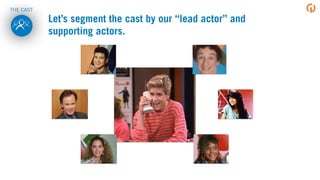
Let’s segment the cast by our “lead actor” and
supporting actors.
THE CAST
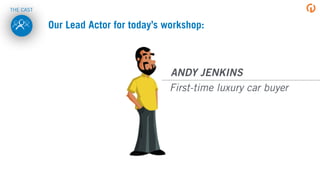
Our Lead Actor for today’s workshop:
First-time luxury car buyer
ANDY JENKINS
THE CAST
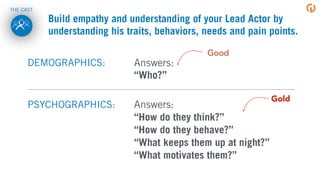
Build empathy and understanding of your Lead Actor by
understanding his traits, behaviors, needs and pain points.
DEMOGRAPHICS:
PSYCHOGRAPHICS:
Answers: 

“Who?”
Answers:
“How do they think?”
“How do they behave?”
“What keeps them up at night?”
“What motivates them?”
Good
Gold
THE CAST
Complete the Actor
Profile
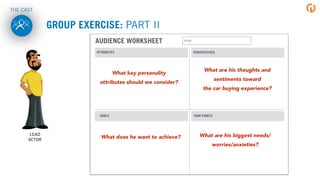
GROUP EXERCISE: PART II
THE CAST
GROUP EXERCISE: PART II
LEAD
ACTOR
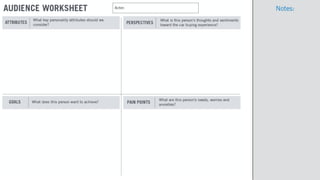
What does he want to achieve?
What key personality
attributes should we consider?
What are his thoughts and
sentiments toward 

the car buying experience?
What are his biggest needs/
worries/anxieties?
THE CAST
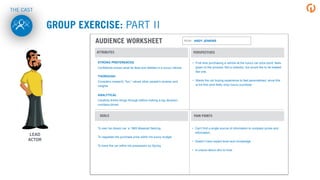
GROUP EXERCISE: PART II
LEAD
ACTOR
Confidently knows what he likes and dislikes in a luxury vehicle
STRONG PREFERENCES
Considers research “fun;” values other people’s reviews and
insights
THOROUGH
Carefully thinks things through before making a big decision;
numbers-driven
ANALYTICAL
To own his dream car: a 1965 Maserati Sebring
To negotiate the purchase price within his luxury budget
To have the car within his possession by Spring
• First time purchasing a vehicle at the luxury car price point; feels
green to the process; Not a collector, but would like to be treated
like one.
• Wants the car buying experience to feel personalized, since this
is his first (and likely only) luxury purchase
• Can’t find a single source of information to compare prices and
information
• Doesn’t have expert-level auto knowledge
• Is unsure about who to trust
ANDY JENKINS
THE CAST
THE STAGE
I.E. YOUR CUSTOMER JOURNEY PHASES
THE STAGE is a comprehensive customer journey.
Laying a foundational model of what
phases our customers go through during
their relationship with us gives us

a way to categorize behaviors and needs
at certain points in time.
THE STAGE
Provides a foundation for all possibilities of customer
journeys and accommodates all possible scenes
Shows a comprehensive view of all potential customer
interactions with Fabian’s Motorsports
Gives us a tool for aligning customer needs across touch
points, allowing us to identify gaps and friction in
specific customer journeys
THE STAGE gives our stories a place to land.
THE STAGE
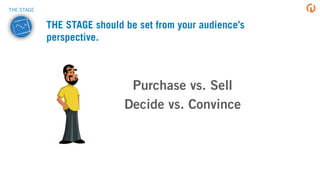
THE STAGE should be set from your audience’s
perspective.
Purchase vs. Sell
Decide vs. Convince
THE STAGE
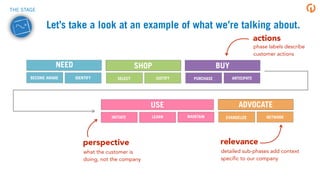
Let’s take a look at an example of what we’re talking about.
NEED SHOP BUY
BECOME AWARE IDENTIFY SELECT JUSTIFY PURCHASE ANTICIPATE
USE
INITIATE LEARN MAINTAIN
ADVOCATE
EVANGELIZE NETWORK
perspective
what the customer is
doing, not the company
actions
phase labels describe
customer actions
relevance
detailed sub-phases add context
specific to our company
THE STAGE
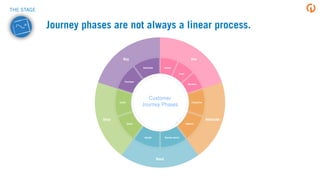
Customer
Journey Phases
Shop
Buy Use
Advocate
Become AwareIdentify
Select
Justify
Purchase
Anticipate Initiate
Learn
Maintain
Evangelize
Network
Need
Journey phases are not always a linear process.
THE STAGE
Identify the customer
journey phases for
Fabian’s Motorsports
customers.
GROUP EXERCISE
THE STAGE
GROUP EXERCISE
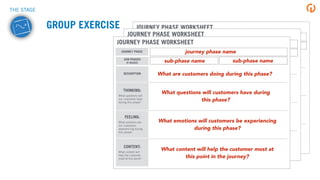
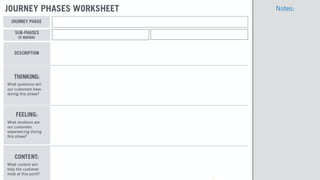
journey phase name
sub-phase name sub-phase name
What are customers doing during this phase?
What questions will customers have during
this phase?
What emotions will customers be experiencing
during this phase?
What content will help the customer most at
this point in the journey?
THE STAGE
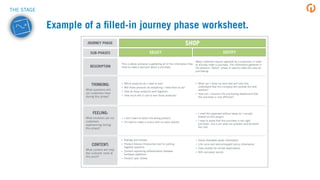
Example of a filled-in journey phase worksheet.
THE STAGE
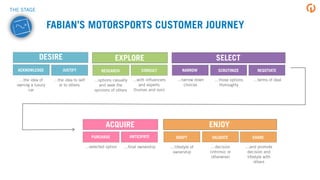
EXAMPLE FABIAN’S MOTORSPORTS CUSTOMER JOURNEY
DESIRE EXPLORE SELECT
ACKNOWLEDGE JUSTIFY RESEARCH CONSULT NARROW SCRUTINIZE
ACQUIRE
PURCHASE ANTICIPATE
ENJOY
ADOPT
…the idea of
owning a luxury
car
…the idea to self
or to others
…options casually
and seek the
opinions of others
…with influencers
and experts
(human and non)
…narrow down
choices
NEGOTIATE
…those options
thoroughly
…terms of deal
…selected option
VALIDATE
…final ownership
SHARE
…lifestyle of
ownership
…decision
(intrinsic or
otherwise)
…and promote
decision and
lifestyle with
others
THE STAGE
THE SCENES
I.E. SCENARIO PLANNING
THE SCENES are the common actions of your audience.
Descriptions of actions your audience is
currently taking — the specific steps —

will help you better understand
motivation and mindset, and therefore
help you craft better experiences.
THE SCENES
SCENARIOS should be based in reality.
What common actions are revealed through

web, email or social analytics?
What repeating questions or requests
are being fielded by your sales staff?
THE SCENES
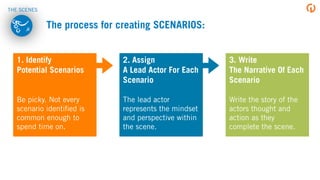
The process for creating SCENARIOS:
1. Identify
Potential Scenarios
Be picky. Not every
scenario identified is
common enough to
spend time on.
2. Assign
A Lead Actor For Each
Scenario
The lead actor
represents the mindset
and perspective within
the scene.
3. Write
The Narrative Of Each
Scenario
Write the story of the
actors thought and
action as they
complete the scene.
THE SCENES
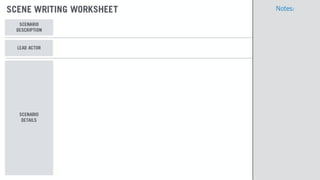
Identify 3 “Scenes” of
potential customers of
Fabian’s MotorSports
GROUP EXERCISE: PART I
THE SCENES
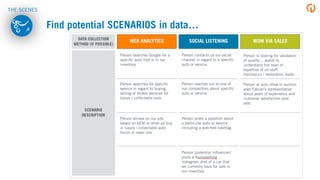
Find potential SCENARIOS in data…
THE SCENES
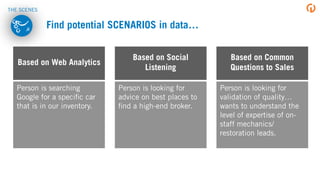
Find potential SCENARIOS in data…
Based on Web Analytics
Based on Social
Listening
Based on Common
Questions to Sales
Person is searching
Google for a specific car
that is in our inventory.
Person is looking for
advice on best places to
find a high-end broker.
Person is looking for
validation of quality…
wants to understand the
level of expertise of on-
staff mechanics/
restoration leads.
THE SCENES
Assign a lead actor and
write the scene for 1 of
those common actions
GROUP EXERCISE: PART II
THE SCENES
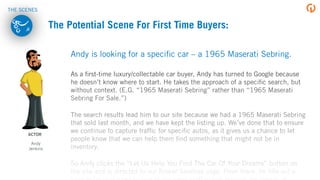
ACTOR
Andy
Jenkins
The Potential Scene For First Time Buyers:
THE SCENES
ACTOR
Andy
Jenkins
The Potential Scene For First Time Buyers:
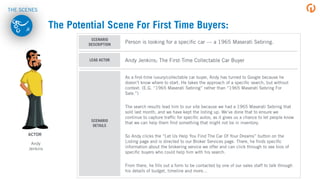
Andy is looking for a specific car – a 1965 Maserati Sebring.
As a first-time luxury/collectable car buyer, Andy has turned to Google because
he doesn’t know where to start. He takes the approach of a specific search, but
without context. (E.G. “1965 Maserati Sebring” rather than “1965 Maserati
Sebring For Sale.”)
The search results lead him to our site because we had a 1965 Maserati Sebring
that sold last month, and we have kept the listing up. We’ve done that to ensure
we continue to capture traffic for specific autos, as it gives us a chance to let
people know that we can help them find something that might not be in
inventory.
So Andy clicks the “Let Us Help You Find The Car Of Your Dreams” button on
the site and is directed to our Broker Services page. From there, he fills out a
THE SCENES
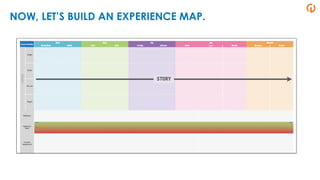
NOW, LET’S BUILD AN EXPERIENCE MAP.
CUSTOMER EXPERIENCE METRICS
Customer Lifetime Value is a great way to
measure Customer Experience delivery.
CLV should be used to help you understand
how much to spend to acquire new
customers and more generally, how well your
spend is retaining existing customers.
THE METRICS
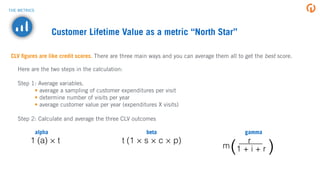
CLV figures are like credit scores. There are three main ways and you can average them all to get the best score.
1 (a) × t t (1 × s × c × p)
(1 + i + r )
alpha beta gamma
m
r
Here are the two steps in the calculation:
Step 1: Average variables.
• average a sampling of customer expenditures per visit
• determine number of visits per year
• average customer value per year (expenditures X visits)
Step 2: Calculate and average the three CLV outcomes
Customer Lifetime Value as a metric “North Star”
=
THE METRICS
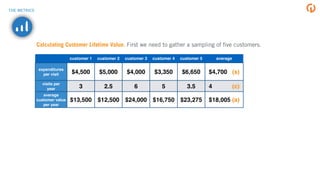
customer 1 customer 2 customer 3 customer 4 customer 5 average
expenditures
per visit $4,500 $5,000 $4,000 $3,350 $6,650 $4,700 (s)
visits per
year 3 2.5 6 5 3.5 4 (c)
average
customer value
per year
$13,500 $12,500 $24,000 $16,750 $23,275 $18,005 (a)
Calculating Customer Lifetime Value. First we need to gather a sampling of five customers.
=
THE METRICS
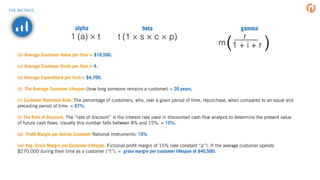
1 (a) × t t (1 × s × c × p)
(1 + i + r )
alpha beta gamma
m
r
(a) Average Customer Value per Year = $18,500.
(c) Average Customer Visits per Year = 4.
(s) Average Expenditure per Visit = $4,700.
(t) The Average Customer Lifespan (how long someone remains a customer) = 20 years.
(r) Customer Retention Rate. The percentage of customers, who, over a given period of time, repurchase, when compared to an equal and
preceding period of time. = 67%.
(i) The Rate of Discount. The “rate of discount” is the interest rate used in discounted cash flow analysis to determine the present value
of future cash flows. Usually this number falls between 8% and 15%. = 15%.
(p) Profit Margin per Online Customer National Instruments: 15%
(m) Avg. Gross Margin per Customer Lifespan. Fictional profit margin of 15% (see constant “p”). If the average customer spends
$270,000 during their time as a customer (“t”), = gross margin per customer lifespan of $40,500.
=
THE METRICS
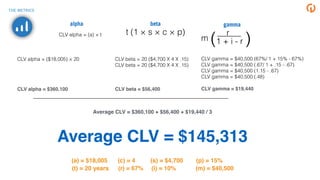
CLV alpha = (a) × t t (1 × s × c × p)
(1 + i - r )
alpha beta gamma
m
r
CLV alpha = ($18,005) × 20
CLV alpha = $360,100
CLV beta = 20 ($4,700 X 4 X .15)
CLV beta = $56,400
(i) = 10%(r) = 67%(t) = 20 years
(a) = $18,005 (c) = 4 (s) = $4,700
(m) = $40,500
(p) = 15%
CLV gamma = $40,500 (67%/ 1 + 15% - 67%)
CLV gamma = $40,500 (.67/ 1 + .15 - .67)
CLV gamma = $40,500 (1.15 - .67)
CLV gamma = $40,500 (.48)
CLV gamma = $19,440
Average CLV = $360,100 + $56,400 + $19,440 / 3
Average CLV = $145,313
=
THE METRICS
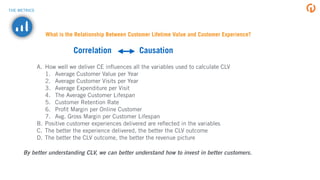
What is the Relationship Between Customer Lifetime Value and Customer Experience?
A. How well we deliver CE influences all the variables used to calculate CLV
1. Average Customer Value per Year
2. Average Customer Visits per Year
3. Average Expenditure per Visit
4. The Average Customer Lifespan
5. Customer Retention Rate
6. Profit Margin per Online Customer
7. Avg. Gross Margin per Customer Lifespan
B. Positive customer experiences delivered are reflected in the variables
C. The better the experience delivered, the better the CLV outcome
D. The better the CLV outcome, the better the revenue picture
Correlation Causation
By better understanding CLV, we can better understand how to invest in better customers.
=
THE METRICS
CX FRAMEWORK WORKSHEETS
Notes:
Notes:
Notes:
Notes:
Thanks for checking out the CX Framework!

How to Build a Customer Experience Framework

  • 1.
    BUILDING A CUSTOMER EXPERIENCEFRAMEWORK 2015 HIGH FIVE CONFERENCE WORKSHOP: Worksheets included
  • 2.
    KATE WILLIAMSON WELCOME
 WE’RE ABUNCH OF CX JUNKIES FROM CENTERLINE DIGITAL @CENTERLINE DIGITAL CAIT VLASTAKIS SMITH JOHN LANE STEVEN KEITH @kateawilliamson @johnvlane @caitvsmith @stevenkeith
  • 3.
    WHAT IS ACUSTOMER EXPERIENCE FRAMEWORK? A fancy name for a set of tools designed to help you create viable customer experience maps 1 A way to make sure that that our deliverable is telling a true story 2 A method for ensuring our thinking maintains a customer-centric focus 3
  • 4.
    THERE ARE THREETHINGS WE MUST EXPLORE TO HONE OUR UNDERSTANDING AND SHAPE OUR TOOLS. OUR AUDIENCE 1 OUR CUSTOMER JOURNEY 2 OUR USER STORIES 3
  • 5.
    THINK OF ITLIKE A PLAY. THE CAST THE STAGE THE SCENES OUR AUDIENCE 1 OUR CUSTOMER JOURNEY 2 OUR USER SCENARIOS 3 THESE WORK TOGETHER TO CREATE THE BUILDING BLOCKS OF OUR CX MAP
  • 6.
    CUSTOMER EXPERIENCE MAP THESE AREALL INPUTS INTO OUR CUSTOMER EXPERIENCE MAP. CAST STAGE SCENES where and how our customers interact with our brand the group of actors that play the role of our customers roles context goals what our customers are actually trying to achieve Illustration adapted from: David Bessenhoffer & Matt Wilczynski
  • 7.
    HOW DO THESETOOLS PLAY INTO EXPERIENCE MAPS? CONSIDER DECIDE PURCHASE the stage the actor the scene the person having the experience the story of that experience the foundational journey stages on which we map the experience ADVOCATE
  • 8.
    BOTTOM LINE: WE NEEDTHESE BUILDING BLOCKS IN PLACE IN ORDER FOR OUR CUSTOMER EXPERIENCE MAPS TO BE VIABLE, AND IN ORDER TO ESTABLISH THE RIGHT METRICS.
  • 9.
  • 10.
  • 11.
    THE CAST isyour audience. The cast is not only your buyers, it is comprised of anyone who has an 
 impact on the customer experience. THE CAST
  • 12.
    Identify “The Cast”of Fabian’s MotorSports GROUP EXERCISE: PART I THE CAST
  • 13.
    Let’s segment thecast by our “lead actor” and supporting actors. THE CAST
  • 14.
    Our Lead Actorfor today’s workshop: First-time luxury car buyer ANDY JENKINS THE CAST
  • 15.
    Build empathy andunderstanding of your Lead Actor by understanding his traits, behaviors, needs and pain points. DEMOGRAPHICS: PSYCHOGRAPHICS: Answers: 
 “Who?” Answers: “How do they think?” “How do they behave?” “What keeps them up at night?” “What motivates them?” Good Gold THE CAST
  • 16.
    Complete the Actor Profile GROUPEXERCISE: PART II THE CAST
  • 17.
    GROUP EXERCISE: PARTII LEAD ACTOR What does he want to achieve? What key personality attributes should we consider? What are his thoughts and sentiments toward 
 the car buying experience? What are his biggest needs/ worries/anxieties? THE CAST
  • 18.
    GROUP EXERCISE: PARTII LEAD ACTOR Confidently knows what he likes and dislikes in a luxury vehicle STRONG PREFERENCES Considers research “fun;” values other people’s reviews and insights THOROUGH Carefully thinks things through before making a big decision; numbers-driven ANALYTICAL To own his dream car: a 1965 Maserati Sebring To negotiate the purchase price within his luxury budget To have the car within his possession by Spring • First time purchasing a vehicle at the luxury car price point; feels green to the process; Not a collector, but would like to be treated like one. • Wants the car buying experience to feel personalized, since this is his first (and likely only) luxury purchase • Can’t find a single source of information to compare prices and information • Doesn’t have expert-level auto knowledge • Is unsure about who to trust ANDY JENKINS THE CAST
  • 19.
    THE STAGE I.E. YOURCUSTOMER JOURNEY PHASES
  • 20.
    THE STAGE isa comprehensive customer journey. Laying a foundational model of what phases our customers go through during their relationship with us gives us
 a way to categorize behaviors and needs at certain points in time. THE STAGE
  • 21.
    Provides a foundationfor all possibilities of customer journeys and accommodates all possible scenes Shows a comprehensive view of all potential customer interactions with Fabian’s Motorsports Gives us a tool for aligning customer needs across touch points, allowing us to identify gaps and friction in specific customer journeys THE STAGE gives our stories a place to land. THE STAGE
  • 22.
    THE STAGE shouldbe set from your audience’s perspective. Purchase vs. Sell Decide vs. Convince THE STAGE
  • 23.
    Let’s take alook at an example of what we’re talking about. NEED SHOP BUY BECOME AWARE IDENTIFY SELECT JUSTIFY PURCHASE ANTICIPATE USE INITIATE LEARN MAINTAIN ADVOCATE EVANGELIZE NETWORK perspective what the customer is doing, not the company actions phase labels describe customer actions relevance detailed sub-phases add context specific to our company THE STAGE
  • 24.
    Customer Journey Phases Shop Buy Use Advocate BecomeAwareIdentify Select Justify Purchase Anticipate Initiate Learn Maintain Evangelize Network Need Journey phases are not always a linear process. THE STAGE
  • 25.
    Identify the customer journeyphases for Fabian’s Motorsports customers. GROUP EXERCISE THE STAGE
  • 26.
    GROUP EXERCISE journey phasename sub-phase name sub-phase name What are customers doing during this phase? What questions will customers have during this phase? What emotions will customers be experiencing during this phase? What content will help the customer most at this point in the journey? THE STAGE
  • 27.
    Example of afilled-in journey phase worksheet. THE STAGE
  • 28.
    EXAMPLE FABIAN’S MOTORSPORTSCUSTOMER JOURNEY DESIRE EXPLORE SELECT ACKNOWLEDGE JUSTIFY RESEARCH CONSULT NARROW SCRUTINIZE ACQUIRE PURCHASE ANTICIPATE ENJOY ADOPT …the idea of owning a luxury car …the idea to self or to others …options casually and seek the opinions of others …with influencers and experts (human and non) …narrow down choices NEGOTIATE …those options thoroughly …terms of deal …selected option VALIDATE …final ownership SHARE …lifestyle of ownership …decision (intrinsic or otherwise) …and promote decision and lifestyle with others THE STAGE
  • 29.
  • 30.
    THE SCENES arethe common actions of your audience. Descriptions of actions your audience is currently taking — the specific steps —
 will help you better understand motivation and mindset, and therefore help you craft better experiences. THE SCENES
  • 31.
    SCENARIOS should bebased in reality. What common actions are revealed through
 web, email or social analytics? What repeating questions or requests are being fielded by your sales staff? THE SCENES
  • 32.
    The process forcreating SCENARIOS: 1. Identify Potential Scenarios Be picky. Not every scenario identified is common enough to spend time on. 2. Assign A Lead Actor For Each Scenario The lead actor represents the mindset and perspective within the scene. 3. Write The Narrative Of Each Scenario Write the story of the actors thought and action as they complete the scene. THE SCENES
  • 33.
    Identify 3 “Scenes”of potential customers of Fabian’s MotorSports GROUP EXERCISE: PART I THE SCENES
  • 34.
    Find potential SCENARIOSin data… THE SCENES
  • 35.
    Find potential SCENARIOSin data… Based on Web Analytics Based on Social Listening Based on Common Questions to Sales Person is searching Google for a specific car that is in our inventory. Person is looking for advice on best places to find a high-end broker. Person is looking for validation of quality… wants to understand the level of expertise of on- staff mechanics/ restoration leads. THE SCENES
  • 36.
    Assign a leadactor and write the scene for 1 of those common actions GROUP EXERCISE: PART II THE SCENES
  • 37.
    ACTOR Andy Jenkins The Potential SceneFor First Time Buyers: THE SCENES
  • 38.
    ACTOR Andy Jenkins The Potential SceneFor First Time Buyers: Andy is looking for a specific car – a 1965 Maserati Sebring. As a first-time luxury/collectable car buyer, Andy has turned to Google because he doesn’t know where to start. He takes the approach of a specific search, but without context. (E.G. “1965 Maserati Sebring” rather than “1965 Maserati Sebring For Sale.”) The search results lead him to our site because we had a 1965 Maserati Sebring that sold last month, and we have kept the listing up. We’ve done that to ensure we continue to capture traffic for specific autos, as it gives us a chance to let people know that we can help them find something that might not be in inventory. So Andy clicks the “Let Us Help You Find The Car Of Your Dreams” button on the site and is directed to our Broker Services page. From there, he fills out a THE SCENES
  • 39.
    NOW, LET’S BUILDAN EXPERIENCE MAP.
  • 40.
  • 41.
    Customer Lifetime Valueis a great way to measure Customer Experience delivery. CLV should be used to help you understand how much to spend to acquire new customers and more generally, how well your spend is retaining existing customers. THE METRICS
  • 42.
    CLV figures arelike credit scores. There are three main ways and you can average them all to get the best score. 1 (a) × t t (1 × s × c × p) (1 + i + r ) alpha beta gamma m r Here are the two steps in the calculation: Step 1: Average variables. • average a sampling of customer expenditures per visit • determine number of visits per year • average customer value per year (expenditures X visits) Step 2: Calculate and average the three CLV outcomes Customer Lifetime Value as a metric “North Star” = THE METRICS
  • 43.
    customer 1 customer2 customer 3 customer 4 customer 5 average expenditures per visit $4,500 $5,000 $4,000 $3,350 $6,650 $4,700 (s) visits per year 3 2.5 6 5 3.5 4 (c) average customer value per year $13,500 $12,500 $24,000 $16,750 $23,275 $18,005 (a) Calculating Customer Lifetime Value. First we need to gather a sampling of five customers. = THE METRICS
  • 44.
    1 (a) ×t t (1 × s × c × p) (1 + i + r ) alpha beta gamma m r (a) Average Customer Value per Year = $18,500. (c) Average Customer Visits per Year = 4. (s) Average Expenditure per Visit = $4,700. (t) The Average Customer Lifespan (how long someone remains a customer) = 20 years. (r) Customer Retention Rate. The percentage of customers, who, over a given period of time, repurchase, when compared to an equal and preceding period of time. = 67%. (i) The Rate of Discount. The “rate of discount” is the interest rate used in discounted cash flow analysis to determine the present value of future cash flows. Usually this number falls between 8% and 15%. = 15%. (p) Profit Margin per Online Customer National Instruments: 15% (m) Avg. Gross Margin per Customer Lifespan. Fictional profit margin of 15% (see constant “p”). If the average customer spends $270,000 during their time as a customer (“t”), = gross margin per customer lifespan of $40,500. = THE METRICS
  • 45.
    CLV alpha =(a) × t t (1 × s × c × p) (1 + i - r ) alpha beta gamma m r CLV alpha = ($18,005) × 20 CLV alpha = $360,100 CLV beta = 20 ($4,700 X 4 X .15) CLV beta = 20 ($4,700 X 4 X .15) CLV beta = $56,400 (i) = 10%(r) = 67%(t) = 20 years (a) = $18,005 (c) = 4 (s) = $4,700 (m) = $40,500 (p) = 15% CLV gamma = $40,500 (67%/ 1 + 15% - 67%) CLV gamma = $40,500 (.67/ 1 + .15 - .67) CLV gamma = $40,500 (1.15 - .67) CLV gamma = $40,500 (.48) CLV gamma = $19,440 Average CLV = $360,100 + $56,400 + $19,440 / 3 Average CLV = $145,313 = THE METRICS
  • 46.
    What is theRelationship Between Customer Lifetime Value and Customer Experience? A. How well we deliver CE influences all the variables used to calculate CLV 1. Average Customer Value per Year 2. Average Customer Visits per Year 3. Average Expenditure per Visit 4. The Average Customer Lifespan 5. Customer Retention Rate 6. Profit Margin per Online Customer 7. Avg. Gross Margin per Customer Lifespan B. Positive customer experiences delivered are reflected in the variables C. The better the experience delivered, the better the CLV outcome D. The better the CLV outcome, the better the revenue picture Correlation Causation By better understanding CLV, we can better understand how to invest in better customers. = THE METRICS
  • 47.
  • 48.
  • 49.
  • 50.
  • 51.
  • 52.
    Thanks for checkingout the CX Framework!