#iak10


UX design, service design & design thinking
             A common story ?


                                             Sylvain Cottong, founding partner
                             Economist by education, design thinker by practice
                                                                                @sly
                                                        sylvain@integratedplace.com
                                                           www.integratedplace.com
The world

  Ø Abundancy in developed countries vs. poverty in developing or
    underdeveloped countries

  Ø Rising inequality & poverty in developed countries (social problems,
    vanishing social cohesion)

  Ø Over population in developing countries vs. shrinking population in
    developed countries

  Ø Environmental threats & global warming

  Ø Mass migration

  Ø Health sector problems

  Ø Technolgical (r)evolution & rising complexity (exponential evolution since
    1800 , so increasingly speeding up…analogy with Moore’s law)
The world


  Ø Emergence of the Internet: Thousands of new possibilities for
    services & experiences; mass-customization of products &
    services

  Ø Emancipation of the user voice (power of social media) &
    rising expectations for transparency, efficiency, quality & great
    experiences also for non-digital products & services.

    Mass-cocreation.

  Ø Globalization (already before the Internet but much more
    since)
The world


  …..and recently:

  Ø the financial crisis

  Ø followed by the economic crises

  Ø and now by the Euro & public debt crises……….
What does that mean ?

  •   All things combined, it looks like we are in the middle of a global cultural
      crisis, a crisis of values & behaviour

  •   We face pressing ecomnomic, social, technological, environmental &
      cultural challenges

  •   Everything is constantly changing, uncertainty & change are the most
      stable factors today.

  •   (Open) innovation & constantly adapting to new constraints becomes a
      critical factor for survival for companies, organizations, states &
      governments, the world as a whole...
What does that mean ?


  •   But life & business must go on, design thinking can thus be seen as a
      management paradigm, made up of a state of mind and a set of
      methodologies that tries to adress this new reality

  •   We move away from the purely analytical, efficiency driven, “always
      more” & reckless way of doing to a more human centered, intuitive,
      transparent, responsible & sustainable way of doing business, politics,
      leisure...etc

  •   Management paradigms & theories were always changing in human
      history, and are a result of the “ruling culture” to which they adapt.
Experience design

  •   Today, it is actually the whole experience provided by and associated with
      a product, website, service, policy...etc (and the corresponding brand) that
      is rated by customers and that drives their purchase and/or voting
      behaviour.

  •   Experiences must be effective, efficient, valuable & feasable from a
      producer’s point of vue and useful, usable, desirable, credible, enjoyable
      (and findable; hello IA’s ;-) ) from the customer’s point of vue.

  •   Where “desirable” & “credible” also determines the cultural acceptance
      of an experience

  •   Design thinking & related experience design methods help to develop
      great experiences that are culturally accepted & desired and economcially
      viable
Design thinking process

                          Ø Non-linear process
  Understand & define
  │                       Ø Think visually, Tell stories, Use role-plays
  Observe & research
                          Ø Experiment, improvise, be intuitive, take
  │                         risks, fail a lot and early
  Ideate & Cocreate       Ø Create multidisciplinary expert teams
  │
                          Ø Trust & optimism
  Choose
  │                       Ø Empathy
  Prototype and test      Ø Take a different view on things, think
  │                         what might be instead of only trying to
                            improve things within existing
  Implement & learn         frameworks
Service design & UX design


  • IA & UX for the Web, as our community understands it, considers
    the experience provided by one channel, the Web and it’s digital,
    mostly screen interface.

  • Service design considers the experience provided by all the
    touchpoints together. Multi-channel experience design:

     –   face-to-face,
     –   physical environments,
     –   traditional communication & sales channels,
     –   call-centers...etc
     –   and the Web in all its forms (mobile, computer...etc)

  • They are both interaction designs
Service design & UX design


  • Most Websites are services, so they can also be considered by the
    Service Design point of vue and associated tools & methods.

    Almost everybody today is a service provider. Services stand for
    nearly 70% of our GDP’s.

  • Service ecologies have become much more complex since the
    Internet as a lot more things are possible.

    But at the same time it has become much more difficult &
    challenging to design the services and experiences that people
    really need, want & use.
Service design & UX design


  • Some more expansive definitions of UX design:

     Ø User experience encompasses all aspects of the end-user's interaction
       with the company, its services, and its products.
       - Nielsen Norman Group

     Ø The design of anything, independent of medium or across media, with
       human experience as an explicit outcome and human engagement as
       an explicit goal. - Jesse James Garrett

     Ø I'm interested in "experience design" because it's the most
       imperialistic of all design disciplines to date. I mean, 'design' can be
       about pretty much anything, but 'experience' design -- come on, what
       ISN'T an experience? - Bruce Sterling
Service design & UX design

  •   UX for the Web and Service design (or experience design as a broader
      definition for a service) both follow the design thinking process.

  •   They actually share in common the design research & ideation tools and
      methods: Interviews, Personas, Ethnographic studies, Mental models,
      Empathy maps, context mapping & other generative techniques....etc

  •   But they have their own media specific prototyping & modelling tools
       – UX for the Web: wireframes, flowcharts, content inventories, card sorting, navigation
         schemes, tagging systems....etc
       – Service design: Customer journey maps, service blueprints, role plays, storyboards

  •   Even these media specific modelling tools tend to get more and more
      merged & shared between the 2 disciplines

  •   User experience design is experience design as much as Service Design is.
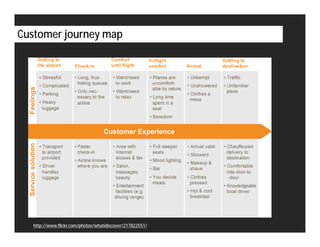
Customer journey map


   http://www.flickr.com/photos/whatidiscover/217822551/
Customer journey map
Service blueprint


     http://www.flickr.com/photos/brandonschauer/3363169836/
Service prototyping


   http://www.servicedesigntools.org/sites/default/files/res_images/STORYBOARD_03_0.jpg
Service prototyping


    http://paulthurston.co.uk
A point on design research


   http://www.maketools.com/pdfs/Contextmapping_SleeswijkVisseretal_05.pdf
Ubiquitious Service Design


  •   In a recent, seminal article by Peter Morville on “Ubiquitious Service
      Design”, facing the emerging mobile Internet, augmented reality &
      Internet of things world he states:


      “It's an era in which information blurs the boundaries,
      enabling multi-channel, cross-platform, trans-media, physico-
      digital user experiences. To succeed, we'll need teams that are
      multi-disciplinary and individuals who can help us think
      visually.”

      http://semanticstudios.com/publications/semantics/000633.php
Design as a business strategy


  •   Design for service & innovation is a very practical approach to
      implementing a wider, design-led business strategy.

      Design can be used as a creative and accessible form of business planning
      to align strategy, brand, communications & physical environments around
      propositions that enhance customers’ experiences.

  •   Roger Martin: “The most successful businesses in the years to come will
      balance analytical mastery and intuitive originality in a dynamic interplay
      that I call design thinking. Design thinking is the form of thought that
      enables forward movement of knowledge, and the firms that master it will
      gain a nearly inexhaustible, long-term business advantage.”

      http://www.businessweek.com/innovate/content/oct2009/id20091014_072850.htm
The design of business


   http://www.rotman.utoronto.ca/rogermartin/designofbusiness.pdf
Business model innovation


   http://alexosterwalder.com/
The Bauhaus Building in Dessau, designed by Walter Gropius


Bauhaus was a school in Germany that combined crafts and the fine arts, and was
famous for the approach to design that it publicized and taught. It operated from 1919
to 1933. ("House of Building" or "Building School").

The school existed in three German cities (Weimar from 1919 to 1925, Dessau from
1925 to 1932 and Berlin from 1932 to 1933), under three different architect-
directors: Walter Gropius from 1919 to 1928, Hannes Meyer from 1928 to 1930
and Ludwig Mies van der Rohe from 1930 until 1933, when the school was closed by its
own leadership under pressure from the Nazi.
http://en.wikipedia.org/wiki/Bauhaus


 …the Bauhaus was the most influential
art, craft and design school of the
century. They are definitely more than
just design.
http://mootee.typepad.com/innovation_playground/2009/08/bauhaus-is-not-just-a-design-movement-it-is-a-business-philosophy-too.html1
…is design thinking a movement (in business)
       that is equivalent to Bauhaus ?

   How do we take advantage of mass co-
  creation and social connectivity to create
new business models that are designed to be
   sustainable, simple and empathetic?...
Since 1937, László Moholy-Nagy
      continued the Bauhaus
 movement at the “New Bauhaus”
in Chicago which later became the
Chicago Institute of Design, which
     today is one of the most
 renowned Design Schools in the
  world teaching Design Thinking
    methods amongst others.
Thank you !


  • Your questions ?

  •   Sylvain Cottong
  •   sylvain@integratedplace.com
  •   www.twitter.com/sly
  •   www.integratedplace.com

User experience design, service design & design thinking : A common story ?

  • 1.
    #iak10 UX design, servicedesign & design thinking A common story ? Sylvain Cottong, founding partner Economist by education, design thinker by practice @sly sylvain@integratedplace.com www.integratedplace.com
  • 2.
    The world Ø Abundancy in developed countries vs. poverty in developing or underdeveloped countries Ø Rising inequality & poverty in developed countries (social problems, vanishing social cohesion) Ø Over population in developing countries vs. shrinking population in developed countries Ø Environmental threats & global warming Ø Mass migration Ø Health sector problems Ø Technolgical (r)evolution & rising complexity (exponential evolution since 1800 , so increasingly speeding up…analogy with Moore’s law)
  • 3.
    The world Ø Emergence of the Internet: Thousands of new possibilities for services & experiences; mass-customization of products & services Ø Emancipation of the user voice (power of social media) & rising expectations for transparency, efficiency, quality & great experiences also for non-digital products & services. Mass-cocreation. Ø Globalization (already before the Internet but much more since)
  • 4.
    The world …..and recently: Ø the financial crisis Ø followed by the economic crises Ø and now by the Euro & public debt crises……….
  • 5.
    What does thatmean ? • All things combined, it looks like we are in the middle of a global cultural crisis, a crisis of values & behaviour • We face pressing ecomnomic, social, technological, environmental & cultural challenges • Everything is constantly changing, uncertainty & change are the most stable factors today. • (Open) innovation & constantly adapting to new constraints becomes a critical factor for survival for companies, organizations, states & governments, the world as a whole...
  • 6.
    What does thatmean ? • But life & business must go on, design thinking can thus be seen as a management paradigm, made up of a state of mind and a set of methodologies that tries to adress this new reality • We move away from the purely analytical, efficiency driven, “always more” & reckless way of doing to a more human centered, intuitive, transparent, responsible & sustainable way of doing business, politics, leisure...etc • Management paradigms & theories were always changing in human history, and are a result of the “ruling culture” to which they adapt.
  • 7.
    Experience design • Today, it is actually the whole experience provided by and associated with a product, website, service, policy...etc (and the corresponding brand) that is rated by customers and that drives their purchase and/or voting behaviour. • Experiences must be effective, efficient, valuable & feasable from a producer’s point of vue and useful, usable, desirable, credible, enjoyable (and findable; hello IA’s ;-) ) from the customer’s point of vue. • Where “desirable” & “credible” also determines the cultural acceptance of an experience • Design thinking & related experience design methods help to develop great experiences that are culturally accepted & desired and economcially viable
  • 8.
    Design thinking process Ø Non-linear process Understand & define │ Ø Think visually, Tell stories, Use role-plays Observe & research Ø Experiment, improvise, be intuitive, take │ risks, fail a lot and early Ideate & Cocreate Ø Create multidisciplinary expert teams │ Ø Trust & optimism Choose │ Ø Empathy Prototype and test Ø Take a different view on things, think │ what might be instead of only trying to improve things within existing Implement & learn frameworks
  • 9.
    Service design &UX design • IA & UX for the Web, as our community understands it, considers the experience provided by one channel, the Web and it’s digital, mostly screen interface. • Service design considers the experience provided by all the touchpoints together. Multi-channel experience design: – face-to-face, – physical environments, – traditional communication & sales channels, – call-centers...etc – and the Web in all its forms (mobile, computer...etc) • They are both interaction designs
  • 10.
    Service design &UX design • Most Websites are services, so they can also be considered by the Service Design point of vue and associated tools & methods. Almost everybody today is a service provider. Services stand for nearly 70% of our GDP’s. • Service ecologies have become much more complex since the Internet as a lot more things are possible. But at the same time it has become much more difficult & challenging to design the services and experiences that people really need, want & use.
  • 11.
    Service design &UX design • Some more expansive definitions of UX design: Ø User experience encompasses all aspects of the end-user's interaction with the company, its services, and its products. - Nielsen Norman Group Ø The design of anything, independent of medium or across media, with human experience as an explicit outcome and human engagement as an explicit goal. - Jesse James Garrett Ø I'm interested in "experience design" because it's the most imperialistic of all design disciplines to date. I mean, 'design' can be about pretty much anything, but 'experience' design -- come on, what ISN'T an experience? - Bruce Sterling
  • 12.
    Service design &UX design • UX for the Web and Service design (or experience design as a broader definition for a service) both follow the design thinking process. • They actually share in common the design research & ideation tools and methods: Interviews, Personas, Ethnographic studies, Mental models, Empathy maps, context mapping & other generative techniques....etc • But they have their own media specific prototyping & modelling tools – UX for the Web: wireframes, flowcharts, content inventories, card sorting, navigation schemes, tagging systems....etc – Service design: Customer journey maps, service blueprints, role plays, storyboards • Even these media specific modelling tools tend to get more and more merged & shared between the 2 disciplines • User experience design is experience design as much as Service Design is.
  • 13.
    Customer journey map http://www.flickr.com/photos/whatidiscover/217822551/
  • 14.
  • 15.
    Service blueprint http://www.flickr.com/photos/brandonschauer/3363169836/
  • 16.
    Service prototyping http://www.servicedesigntools.org/sites/default/files/res_images/STORYBOARD_03_0.jpg
  • 17.
    Service prototyping http://paulthurston.co.uk
  • 18.
    A point ondesign research http://www.maketools.com/pdfs/Contextmapping_SleeswijkVisseretal_05.pdf
  • 19.
    Ubiquitious Service Design • In a recent, seminal article by Peter Morville on “Ubiquitious Service Design”, facing the emerging mobile Internet, augmented reality & Internet of things world he states: “It's an era in which information blurs the boundaries, enabling multi-channel, cross-platform, trans-media, physico- digital user experiences. To succeed, we'll need teams that are multi-disciplinary and individuals who can help us think visually.” http://semanticstudios.com/publications/semantics/000633.php
  • 20.
    Design as abusiness strategy • Design for service & innovation is a very practical approach to implementing a wider, design-led business strategy. Design can be used as a creative and accessible form of business planning to align strategy, brand, communications & physical environments around propositions that enhance customers’ experiences. • Roger Martin: “The most successful businesses in the years to come will balance analytical mastery and intuitive originality in a dynamic interplay that I call design thinking. Design thinking is the form of thought that enables forward movement of knowledge, and the firms that master it will gain a nearly inexhaustible, long-term business advantage.” http://www.businessweek.com/innovate/content/oct2009/id20091014_072850.htm
  • 21.
    The design ofbusiness http://www.rotman.utoronto.ca/rogermartin/designofbusiness.pdf
  • 22.
    Business model innovation http://alexosterwalder.com/
  • 23.
    The Bauhaus Buildingin Dessau, designed by Walter Gropius Bauhaus was a school in Germany that combined crafts and the fine arts, and was famous for the approach to design that it publicized and taught. It operated from 1919 to 1933. ("House of Building" or "Building School"). The school existed in three German cities (Weimar from 1919 to 1925, Dessau from 1925 to 1932 and Berlin from 1932 to 1933), under three different architect- directors: Walter Gropius from 1919 to 1928, Hannes Meyer from 1928 to 1930 and Ludwig Mies van der Rohe from 1930 until 1933, when the school was closed by its own leadership under pressure from the Nazi. http://en.wikipedia.org/wiki/Bauhaus …the Bauhaus was the most influential art, craft and design school of the century. They are definitely more than just design. http://mootee.typepad.com/innovation_playground/2009/08/bauhaus-is-not-just-a-design-movement-it-is-a-business-philosophy-too.html1
  • 25.
    …is design thinkinga movement (in business) that is equivalent to Bauhaus ? How do we take advantage of mass co- creation and social connectivity to create new business models that are designed to be sustainable, simple and empathetic?...
  • 26.
    Since 1937, LászlóMoholy-Nagy continued the Bauhaus movement at the “New Bauhaus” in Chicago which later became the Chicago Institute of Design, which today is one of the most renowned Design Schools in the world teaching Design Thinking methods amongst others.
  • 27.
    Thank you ! • Your questions ? • Sylvain Cottong • sylvain@integratedplace.com • www.twitter.com/sly • www.integratedplace.com