Visual
Impairment
Definition & type
Visual
Impairment
1
12/19/2022
10:56
AM
Ambuj Kushawaha
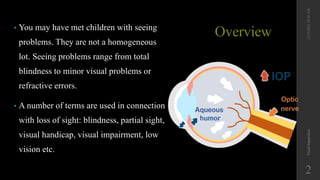
Overview
• You may have met children with seeing
problems. They are not a homogeneous
lot. Seeing problems range from total
blindness to minor visual problems or
refractive errors.
• A number of terms are used in connection
with loss of sight: blindness, partial sight,
visual handicap, visual impairment, low
vision etc.
Visual
Impairment
2
12/19/2022
10:56
AM
Continue
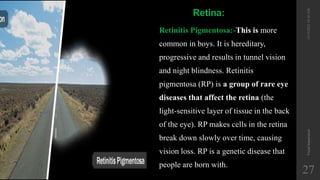
• Present educational thinking is
moving away from the whole
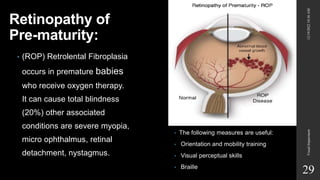
concept of labelling children.
The emphasis is on the
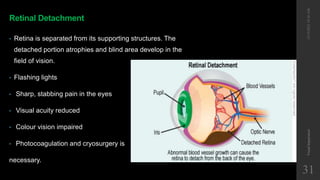
individual needs of children
and on the aspects related to
their development & learning.
Visual
Impairment
3
12/19/2022
10:56
AM
Introduction
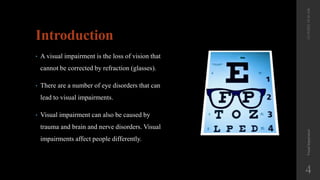
• A visual impairment is the loss of vision that
cannot be corrected by refraction (glasses).
• There are a number of eye disorders that can
lead to visual impairments.
• Visual impairment can also be caused by
trauma and brain and nerve disorders. Visual
impairments affect people differently.
Visual
Impairment
4
12/19/2022
10:56
AM
The Eye-
 The eye & brain work together to form
images & the things we see. We have
two eyeballs.
 Each eyeball is about 2.5cms. in
diameter and is lodged within the
socket called orbit between the orbital
wall & the eyeball.
 The eye is the apparatus for seeing a general knowledge of the eye & how
it works is useful in helping to understand impaired vision
Visual
Impairment
5
The Structurer of Eyes
12/19/2022
10:56
AM
Eye……..
Eyelids
The conjunctive
Cornea
Sclera
Anterior Chamber
Iris
Ciliary Body
Vitreous Humour
Retina
Visual
Impairment
6
12/19/2022
10:56
AM
Continue
• Eyelids: These are movable folds of skin which protect the eye
from injury and excessive light. The eyebrows and eyelashes also
participate in the protective role.
• The conjunctiva: It is a continuous sheet of tissue. To allow
free movements of the eyeball, the conjunctiva is carried above &
below into folds.
• Cornea: Cornea is a crystal clear structure in front surface of the
eye. It carries the light rays to the retina in the back of the eye. Send
in the light in eyes.
Visual
Impairment
7
12/19/2022
10:56
AM
• Sclera: Sclera is the white of the eye which joins the cornea at the
limbos. It is tough and helps to maintain the shape of the eye and
supports the delicate structures within the eye.
• Anterior Chamber: This is behind the cornea and in front of the iris and
lens. A clear aqueous fluid secreted by the processes of the ciliary body flows
constant through the pupil into the anterior chamber & maintains constant
pressure within the eyeball.
• Iris: The black disc behind the cornea is called iris. It is an extremely
delicate, constantly moving diaphragm with a circular opening in middle.
It contains pigments, which give color to the eyes. These pigments
control the amount of light entering retina.
• Pupil: Send the Light in Lens.
12/19/2022
10:56
AM
Visual
Impairment
8
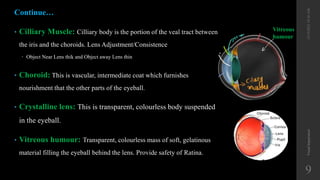
• Cilliary Muscle: Cilliary body is the portion of the veal tract between
the iris and the choroids. Lens Adjustment/Consistence
 Object Near Lens thik and Object away Lens thin
• Choroid: This is vascular, intermediate coat which furnishes
nourishment that the other parts of the eyeball.
• Crystalline lens: This is transparent, colourless body suspended
in the eyeball.
• Vitreous humour: Transparent, colourless mass of soft, gelatinous
material filling the eyeball behind the lens. Provide safety of Ratina.
Visual
Impairment
9
12/19/2022
10:56
AM
Vitreous
humour
Continue…
12/19/2022
10:56
AM
Visual
Impairment
10
• Retina: This is the innermost coat of the eye, formed of light sensitive nerve element.
The most specialized part of the retina is ‘macula’ which lies just lateral to the optic disc.
It provides acute central vision used in reading or in threading a needle.
• Macula / Yellow Spot: Middle Part of Retina (best and Clean Image)
• Fovea Centrioles: Middle part of macula (Much best and Clear image)
• Blind Spot: Optic nerve connect in the retina in this part light not reached
• Optic- Nerve: it sends the image of retina to the Brain
 Cones Cell
 Rod Cell
How We See:
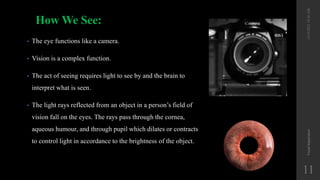
• The eye functions like a camera.
• Vision is a complex function.
• The act of seeing requires light to see by and the brain to
interpret what is seen.
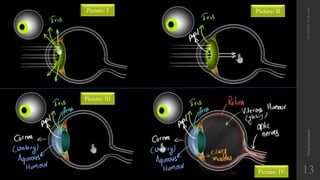
• The light rays reflected from an object in a person’s field of
vision fall on the eyes. The rays pass through the cornea,
aqueous humour, and through pupil which dilates or contracts
to control light in accordance to the brightness of the object.
12/19/2022
10:56
AM
Visual
Impairment
11
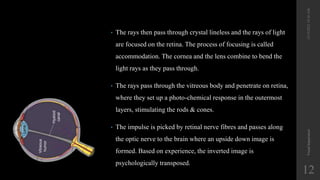
• The rays then pass through crystal lineless and the rays of light
are focused on the retina. The process of focusing is called
accommodation. The cornea and the lens combine to bend the
light rays as they pass through.
• The rays pass through the vitreous body and penetrate on retina,
where they set up a photo-chemical response in the outermost
layers, stimulating the rods & cones.
• The impulse is picked by retinal nerve fibres and passes along
the optic nerve to the brain where an upside down image is
formed. Based on experience, the inverted image is
psychologically transposed.
12/19/2022
10:56
AM
Visual
Impairment
12
12/19/2022
10:56
AM
Visual
Impairment
13
Picture: I
Picture: IV
Picture: III
Picture: II
Definition of Blindness and Low Vision
12/19/2022
10:56
AM
Visual
Impairment
14
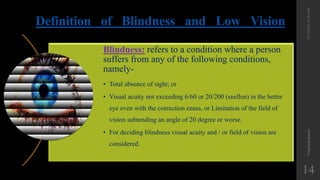
Blindness: refers to a condition where a person
suffers from any of the following conditions,
namely-
• Total absence of sight; or
• Visual acuity not exceeding 6/60 or 20/200 (snellen) in the better
eye even with the correction enses, or Limitation of the field of
vision subtending an angle of 20 degree or worse.
• For deciding blindness visual acuity and / or field of vision are
considered.
Definition of Low Vision
• “Person with low vision,” means
a person with impairment of
visual functioning even after
treatment or standard refractive
correction but who uses or is
potentially capable of using
vision for the planning or
execution of a task with
appropriate assistive device.
PWD Act, 1995
12/19/2022
10:56
AM
Visual
Impairment
15
“A person with low vision is one who has impairment
of visual functioning even after treatment and/or
standard refractive correction, and has a visual acuity
of less than 6/18 to light perception or a visual field of
less than 10 degrees.”
W.H.O.
According to RPwD 2016
Blindness Low Vision
12/19/2022
10:56
AM
Visual
Impairment
16
• Total Absence of Sight
• Less then 3/60 or 10/200
(Snellen) in Better eyes
with possible correction
• Field Vision 10 degree.
• Exceeding 6/18 or less
then 20/60 up to 3/60 or
up to 10/200 (Snellen)
• Field Vision 40 up to 10
degree.
Type of visual impairment
• Myopia
• Hypermetropia
• Astigmatism
• Colour Blindness
• Retinopathy of Prematurity
• Macular D Generation:
• Glaucoma
• Diabetic Retinopathy
• Cataract
12/19/2022
10:56
AM
Visual
Impairment
17
Myopia
• Myopia, also known as nearsightedness.
• Myopia affects your distance vision.
• Can see objects of near but not far away
• Cause : size of eye ball is too longer
• You can see objects that are near well, but
have trouble viewing objects that are far,
such as grocery store aisle markers or
road signs. Now myopia is on the rise.
Find out why and what you can do.
12/19/2022
10:56
AM
Visual
Impairment
18
Hypermetropia
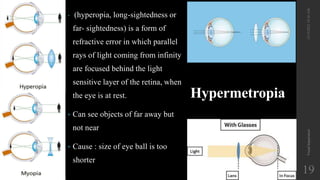
• (hyperopia, long-sightedness or
far- sightedness) is a form of
refractive error in which parallel
rays of light coming from infinity
are focused behind the light
sensitive layer of the retina, when
the eye is at rest.
• Can see objects of far away but
not near
• Cause : size of eye ball is too
shorter
12/19/2022
10:56
AM
Visual
Impairment
19
Astigmatism
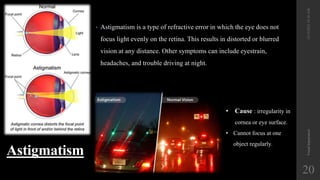
• Astigmatism is a type of refractive error in which the eye does not
focus light evenly on the retina. This results in distorted or blurred
vision at any distance. Other symptoms can include eyestrain,
headaches, and trouble driving at night.
Visual
Impairment
20
12/19/2022
10:56
AM
• Cause : irregularity in
cornea or eye surface.
• Cannot focus at one
object regularly.
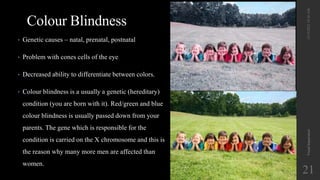
Colour Blindness
• Genetic causes – natal, prenatal, postnatal
• Problem with cones cells of the eye
• Decreased ability to differentiate between colors.
• Colour blindness is a usually a genetic (hereditary)
condition (you are born with it). Red/green and blue
colour blindness is usually passed down from your
parents. The gene which is responsible for the
condition is carried on the X chromosome and this is
the reason why many more men are affected than
women.
12/19/2022
10:56
AM
Visual
Impairment
21
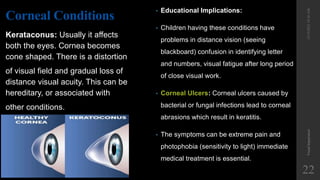
Corneal Conditions
• Educational Implications:
• Children having these conditions have
problems in distance vision (seeing
blackboard) confusion in identifying letter
and numbers, visual fatigue after long period
of close visual work.
• Corneal Ulcers: Corneal ulcers caused by
bacterial or fungal infections lead to corneal
abrasions which result in keratitis.
• The symptoms can be extreme pain and
photophobia (sensitivity to light) immediate
medical treatment is essential.
Kerataconus: Usually it affects
both the eyes. Cornea becomes
cone shaped. There is a distortion
of visual field and gradual loss of
distance visual acuity. This can be
hereditary, or associated with
other conditions.
12/19/2022
10:56
AM
Visual
Impairment
22
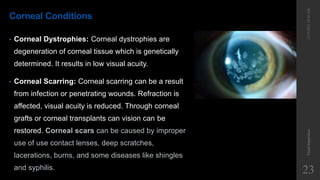
Corneal Conditions
• Corneal Dystrophies: Corneal dystrophies are
degeneration of corneal tissue which is genetically
determined. It results in low visual acuity.
• Corneal Scarring: Corneal scarring can be a result
from infection or penetrating wounds. Refraction is
affected, visual acuity is reduced. Through corneal
grafts or corneal transplants can vision can be
restored. Corneal scars can be caused by improper
use of use contact lenses, deep scratches,
lacerations, burns, and some diseases like shingles
and syphilis.
12/19/2022
10:56
AM
Visual
Impairment
23
Aqueous Humour
• Glaucoma: In glaucoma there is
increased intraocular pressure. This
high pressure damages tissues of the
eye. It results in loss of visual acuity
and visual field. Two types of Glaucoma
are found: - Adult and congenital
(Bupthalmos) Cornea becomes hazy
and opaque. Cornea is pushed forward
to give a bubble- like effect.
• This requires surgery as soon as
possible. The eye looks abnormal.
12/19/2022
10:56
AM
Visual
Impairment
24
Iris:
• Aniridia: This is a congenital, inherited condition. Iris fails to develop
partially or completely. It affects both the eyes. Aniridia is an eye
disorder characterized by a complete or partial absence of the
colored part of the eye (the iris)
• Iritis: Iritis (i-RYE-tis) is swelling and irritation (inflammation) in
the colored ring around your eye's pupil (iris). Another name for
iritis is anterior uveitis..
• Coloboma of iris: This gives pupil a keyhole appearance. The cause is
that iris is not formed completely during prenatal period. This results in
photosensitivity and loss of visual acuity. Coloboma of the iris is a hole
or defect of the iris of the eye. Most colobomas are present since birth
(congenital).
12/19/2022
10:56
AM
Visual
Impairment
25
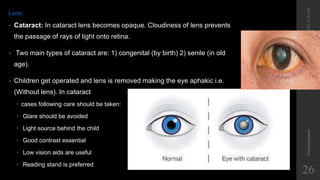
Lens:
• Cataract: In cataract lens becomes opaque. Cloudiness of lens prevents
the passage of rays of light onto retina.
• Two main types of cataract are: 1) congenital (by birth) 2) senile (in old
age).
• Children get operated and lens is removed making the eye aphakic i.e.
(Without lens). In cataract
 cases following care should be taken:
 Glare should be avoided
 Light source behind the child
 Good contrast essential
 Low vision aids are useful
 Reading stand is preferred
12/19/2022
10:56
AM
Visual
Impairment
26
12/19/2022
10:56
AM
Visual
Impairment
27
Retina:
Retinitis Pigmentosa:-This is more
common in boys. It is hereditary,
progressive and results in tunnel vision
and night blindness. Retinitis
pigmentosa (RP) is a group of rare eye
diseases that affect the retina (the
light-sensitive layer of tissue in the back
of the eye). RP makes cells in the retina
break down slowly over time, causing
vision loss. RP is a genetic disease that
people are born with.
• Symptoms of Retinitis
Pigmentosa:
 1. Photophobia
 2. Visual field problems
 3. Problems in tracking, scanning
(Reading)
 4. Problems in gross motor skills
 5. Problems in adapting from bright to
dull light
• The following measures are
useful:
 1. CCTV may be useful
 2. Good contrast is essential
 Well lit, glare-free environment
should be provided
 4. Use of smallest print possible
 5. Braille
 6. Mobility training.
12/19/2022
10:56
AM
Visual
Impairment
28
Retinopathy of
Pre-maturity:
• (ROP) Retrolental Fibroplasia
occurs in premature babies
who receive oxygen therapy.
It can cause total blindness
(20%) other associated
conditions are severe myopia,
micro ophthalmus, retinal
detachment, nystagmus.
• The following measures are useful:
• Orientation and mobility training
• Visual perceptual skills
• Braille
12/19/2022
10:56
AM
Visual
Impairment
29
Diabetes Mellitus:
• High blood-sugar level affects the body including eyes. The blood
vessels on the retina may hemorrhage and it may spread into
vitreous.
 Complaint of flashing light
 Visual acuity is reduced
 May lose colour vision
 Field maybe affected
 Laser beam surgery may retard to progression.
12/19/2022
10:56
AM
Visual
Impairment
30
Retinal Detachment
• Retina is separated from its supporting structures. The
detached portion atrophies and blind area develop in the
field of vision.
• Flashing lights
• Sharp, stabbing pain in the eyes
• Visual acuity reduced
• Colour vision impaired
• Photocoagulation and cryosurgery is
necessary.
12/19/2022
10:56
AM
Visual
Impairment
31
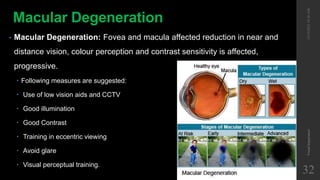
Macular Degeneration
• Macular Degeneration: Fovea and macula affected reduction in near and
distance vision, colour perception and contrast sensitivity is affected,
progressive.
 Following measures are suggested:
 Use of low vision aids and CCTV
 Good illumination
 Good Contrast
 Training in eccentric viewing
 Avoid glare
 Visual perceptual training.
12/19/2022
10:56
AM
Visual
Impairment
32
Optic Nerve:
• Optic Atrophy: It is degeneration of the optic
nerve. The optic nerve transmits messages
from the retina to visual cortex of the brain
range of visual processes can get affected
in OA. Vision fluctuations are seen.
Contrast sensitivity is affected. Central as
well as peripheral field are affected. The
person has difficulties in adapting to
reduced illumination. Glare and lighting
conditions are important. Low vision aids
are useful.
Eye Movements
• Six extrinsic muscles of each
eye work in coordination to turn
and rotate each eyeball up,
down, to the side and towards
the nose. Each muscle has a
primary function in turning the
globe of the eye in various
directions.
12/19/2022
10:56
AM
Visual
Impairment
33
Challenges of Visual Impairment in the Classroom
• Fewer opportunities to acquire information
• visually ( i.e. maps ,art)
• Learning Difficulties
• - may read very slowly –fall behind
• - difficult to meet the demands of general
• education classroom
• Social difficulties
• - can’t catch non-verbal cues from others
• - inability to judge distance ( i.e. stand too
• close when socializing)
12/19/2022
10:56
AM
Visual
Impairment
34
Identification of Visual Impairments
• Complaints of headache
• Blinks eye frequently
• Holds objects close to his eyes
• Rub eyes excessively
• The pupils of the eyes are of different sizes
• Seem very sensitive to light
• Becomes inattentive during reading sessions
• Watering of eyes
• Takes false steps while walking
12/19/2022
10:56
AM
Visual
Impairment
35
Causes of Visual Impairments
• Transfer of genes associated from the parents
• Carelessness adopted by pregnant mothers
• Mishaps and incidents
• Unfavorable conditions .i.e. starvation, malnutrition etc
• Eye infections and eye diseases
• Evil effects of fatal disease
• Improper postures adopted at work places
• Reading, writing and working in defective and
• improper lights
12/19/2022
10:56
AM
Visual
Impairment
36
12/19/2022
10:56
AM
Visual
Impairment
37
Thankyou

Visual Impairment

  • 1.
  • 2.
    Overview • You mayhave met children with seeing problems. They are not a homogeneous lot. Seeing problems range from total blindness to minor visual problems or refractive errors. • A number of terms are used in connection with loss of sight: blindness, partial sight, visual handicap, visual impairment, low vision etc. Visual Impairment 2 12/19/2022 10:56 AM
  • 3.
    Continue • Present educationalthinking is moving away from the whole concept of labelling children. The emphasis is on the individual needs of children and on the aspects related to their development & learning. Visual Impairment 3 12/19/2022 10:56 AM
  • 4.
    Introduction • A visualimpairment is the loss of vision that cannot be corrected by refraction (glasses). • There are a number of eye disorders that can lead to visual impairments. • Visual impairment can also be caused by trauma and brain and nerve disorders. Visual impairments affect people differently. Visual Impairment 4 12/19/2022 10:56 AM
  • 5.
    The Eye-  Theeye & brain work together to form images & the things we see. We have two eyeballs.  Each eyeball is about 2.5cms. in diameter and is lodged within the socket called orbit between the orbital wall & the eyeball.  The eye is the apparatus for seeing a general knowledge of the eye & how it works is useful in helping to understand impaired vision Visual Impairment 5 The Structurer of Eyes 12/19/2022 10:56 AM
  • 6.
    Eye…….. Eyelids The conjunctive Cornea Sclera Anterior Chamber Iris CiliaryBody Vitreous Humour Retina Visual Impairment 6 12/19/2022 10:56 AM
  • 7.
    Continue • Eyelids: Theseare movable folds of skin which protect the eye from injury and excessive light. The eyebrows and eyelashes also participate in the protective role. • The conjunctiva: It is a continuous sheet of tissue. To allow free movements of the eyeball, the conjunctiva is carried above & below into folds. • Cornea: Cornea is a crystal clear structure in front surface of the eye. It carries the light rays to the retina in the back of the eye. Send in the light in eyes. Visual Impairment 7 12/19/2022 10:56 AM
  • 8.
    • Sclera: Sclerais the white of the eye which joins the cornea at the limbos. It is tough and helps to maintain the shape of the eye and supports the delicate structures within the eye. • Anterior Chamber: This is behind the cornea and in front of the iris and lens. A clear aqueous fluid secreted by the processes of the ciliary body flows constant through the pupil into the anterior chamber & maintains constant pressure within the eyeball. • Iris: The black disc behind the cornea is called iris. It is an extremely delicate, constantly moving diaphragm with a circular opening in middle. It contains pigments, which give color to the eyes. These pigments control the amount of light entering retina. • Pupil: Send the Light in Lens. 12/19/2022 10:56 AM Visual Impairment 8
  • 9.
    • Cilliary Muscle:Cilliary body is the portion of the veal tract between the iris and the choroids. Lens Adjustment/Consistence  Object Near Lens thik and Object away Lens thin • Choroid: This is vascular, intermediate coat which furnishes nourishment that the other parts of the eyeball. • Crystalline lens: This is transparent, colourless body suspended in the eyeball. • Vitreous humour: Transparent, colourless mass of soft, gelatinous material filling the eyeball behind the lens. Provide safety of Ratina. Visual Impairment 9 12/19/2022 10:56 AM Vitreous humour Continue…
  • 10.
    12/19/2022 10:56 AM Visual Impairment 10 • Retina: Thisis the innermost coat of the eye, formed of light sensitive nerve element. The most specialized part of the retina is ‘macula’ which lies just lateral to the optic disc. It provides acute central vision used in reading or in threading a needle. • Macula / Yellow Spot: Middle Part of Retina (best and Clean Image) • Fovea Centrioles: Middle part of macula (Much best and Clear image) • Blind Spot: Optic nerve connect in the retina in this part light not reached • Optic- Nerve: it sends the image of retina to the Brain  Cones Cell  Rod Cell
  • 11.
    How We See: •The eye functions like a camera. • Vision is a complex function. • The act of seeing requires light to see by and the brain to interpret what is seen. • The light rays reflected from an object in a person’s field of vision fall on the eyes. The rays pass through the cornea, aqueous humour, and through pupil which dilates or contracts to control light in accordance to the brightness of the object. 12/19/2022 10:56 AM Visual Impairment 11
  • 12.
    • The raysthen pass through crystal lineless and the rays of light are focused on the retina. The process of focusing is called accommodation. The cornea and the lens combine to bend the light rays as they pass through. • The rays pass through the vitreous body and penetrate on retina, where they set up a photo-chemical response in the outermost layers, stimulating the rods & cones. • The impulse is picked by retinal nerve fibres and passes along the optic nerve to the brain where an upside down image is formed. Based on experience, the inverted image is psychologically transposed. 12/19/2022 10:56 AM Visual Impairment 12
  • 13.
  • 14.
    Definition of Blindnessand Low Vision 12/19/2022 10:56 AM Visual Impairment 14 Blindness: refers to a condition where a person suffers from any of the following conditions, namely- • Total absence of sight; or • Visual acuity not exceeding 6/60 or 20/200 (snellen) in the better eye even with the correction enses, or Limitation of the field of vision subtending an angle of 20 degree or worse. • For deciding blindness visual acuity and / or field of vision are considered.
  • 15.
    Definition of LowVision • “Person with low vision,” means a person with impairment of visual functioning even after treatment or standard refractive correction but who uses or is potentially capable of using vision for the planning or execution of a task with appropriate assistive device. PWD Act, 1995 12/19/2022 10:56 AM Visual Impairment 15 “A person with low vision is one who has impairment of visual functioning even after treatment and/or standard refractive correction, and has a visual acuity of less than 6/18 to light perception or a visual field of less than 10 degrees.” W.H.O.
  • 16.
    According to RPwD2016 Blindness Low Vision 12/19/2022 10:56 AM Visual Impairment 16 • Total Absence of Sight • Less then 3/60 or 10/200 (Snellen) in Better eyes with possible correction • Field Vision 10 degree. • Exceeding 6/18 or less then 20/60 up to 3/60 or up to 10/200 (Snellen) • Field Vision 40 up to 10 degree.
  • 17.
    Type of visualimpairment • Myopia • Hypermetropia • Astigmatism • Colour Blindness • Retinopathy of Prematurity • Macular D Generation: • Glaucoma • Diabetic Retinopathy • Cataract 12/19/2022 10:56 AM Visual Impairment 17
  • 18.
    Myopia • Myopia, alsoknown as nearsightedness. • Myopia affects your distance vision. • Can see objects of near but not far away • Cause : size of eye ball is too longer • You can see objects that are near well, but have trouble viewing objects that are far, such as grocery store aisle markers or road signs. Now myopia is on the rise. Find out why and what you can do. 12/19/2022 10:56 AM Visual Impairment 18
  • 19.
    Hypermetropia • (hyperopia, long-sightednessor far- sightedness) is a form of refractive error in which parallel rays of light coming from infinity are focused behind the light sensitive layer of the retina, when the eye is at rest. • Can see objects of far away but not near • Cause : size of eye ball is too shorter 12/19/2022 10:56 AM Visual Impairment 19
  • 20.
    Astigmatism • Astigmatism isa type of refractive error in which the eye does not focus light evenly on the retina. This results in distorted or blurred vision at any distance. Other symptoms can include eyestrain, headaches, and trouble driving at night. Visual Impairment 20 12/19/2022 10:56 AM • Cause : irregularity in cornea or eye surface. • Cannot focus at one object regularly.
  • 21.
    Colour Blindness • Geneticcauses – natal, prenatal, postnatal • Problem with cones cells of the eye • Decreased ability to differentiate between colors. • Colour blindness is a usually a genetic (hereditary) condition (you are born with it). Red/green and blue colour blindness is usually passed down from your parents. The gene which is responsible for the condition is carried on the X chromosome and this is the reason why many more men are affected than women. 12/19/2022 10:56 AM Visual Impairment 21
  • 22.
    Corneal Conditions • EducationalImplications: • Children having these conditions have problems in distance vision (seeing blackboard) confusion in identifying letter and numbers, visual fatigue after long period of close visual work. • Corneal Ulcers: Corneal ulcers caused by bacterial or fungal infections lead to corneal abrasions which result in keratitis. • The symptoms can be extreme pain and photophobia (sensitivity to light) immediate medical treatment is essential. Kerataconus: Usually it affects both the eyes. Cornea becomes cone shaped. There is a distortion of visual field and gradual loss of distance visual acuity. This can be hereditary, or associated with other conditions. 12/19/2022 10:56 AM Visual Impairment 22
  • 23.
    Corneal Conditions • CornealDystrophies: Corneal dystrophies are degeneration of corneal tissue which is genetically determined. It results in low visual acuity. • Corneal Scarring: Corneal scarring can be a result from infection or penetrating wounds. Refraction is affected, visual acuity is reduced. Through corneal grafts or corneal transplants can vision can be restored. Corneal scars can be caused by improper use of use contact lenses, deep scratches, lacerations, burns, and some diseases like shingles and syphilis. 12/19/2022 10:56 AM Visual Impairment 23
  • 24.
    Aqueous Humour • Glaucoma:In glaucoma there is increased intraocular pressure. This high pressure damages tissues of the eye. It results in loss of visual acuity and visual field. Two types of Glaucoma are found: - Adult and congenital (Bupthalmos) Cornea becomes hazy and opaque. Cornea is pushed forward to give a bubble- like effect. • This requires surgery as soon as possible. The eye looks abnormal. 12/19/2022 10:56 AM Visual Impairment 24
  • 25.
    Iris: • Aniridia: Thisis a congenital, inherited condition. Iris fails to develop partially or completely. It affects both the eyes. Aniridia is an eye disorder characterized by a complete or partial absence of the colored part of the eye (the iris) • Iritis: Iritis (i-RYE-tis) is swelling and irritation (inflammation) in the colored ring around your eye's pupil (iris). Another name for iritis is anterior uveitis.. • Coloboma of iris: This gives pupil a keyhole appearance. The cause is that iris is not formed completely during prenatal period. This results in photosensitivity and loss of visual acuity. Coloboma of the iris is a hole or defect of the iris of the eye. Most colobomas are present since birth (congenital). 12/19/2022 10:56 AM Visual Impairment 25
  • 26.
    Lens: • Cataract: Incataract lens becomes opaque. Cloudiness of lens prevents the passage of rays of light onto retina. • Two main types of cataract are: 1) congenital (by birth) 2) senile (in old age). • Children get operated and lens is removed making the eye aphakic i.e. (Without lens). In cataract  cases following care should be taken:  Glare should be avoided  Light source behind the child  Good contrast essential  Low vision aids are useful  Reading stand is preferred 12/19/2022 10:56 AM Visual Impairment 26
  • 27.
    12/19/2022 10:56 AM Visual Impairment 27 Retina: Retinitis Pigmentosa:-This ismore common in boys. It is hereditary, progressive and results in tunnel vision and night blindness. Retinitis pigmentosa (RP) is a group of rare eye diseases that affect the retina (the light-sensitive layer of tissue in the back of the eye). RP makes cells in the retina break down slowly over time, causing vision loss. RP is a genetic disease that people are born with.
  • 28.
    • Symptoms ofRetinitis Pigmentosa:  1. Photophobia  2. Visual field problems  3. Problems in tracking, scanning (Reading)  4. Problems in gross motor skills  5. Problems in adapting from bright to dull light • The following measures are useful:  1. CCTV may be useful  2. Good contrast is essential  Well lit, glare-free environment should be provided  4. Use of smallest print possible  5. Braille  6. Mobility training. 12/19/2022 10:56 AM Visual Impairment 28
  • 29.
    Retinopathy of Pre-maturity: • (ROP)Retrolental Fibroplasia occurs in premature babies who receive oxygen therapy. It can cause total blindness (20%) other associated conditions are severe myopia, micro ophthalmus, retinal detachment, nystagmus. • The following measures are useful: • Orientation and mobility training • Visual perceptual skills • Braille 12/19/2022 10:56 AM Visual Impairment 29
  • 30.
    Diabetes Mellitus: • Highblood-sugar level affects the body including eyes. The blood vessels on the retina may hemorrhage and it may spread into vitreous.  Complaint of flashing light  Visual acuity is reduced  May lose colour vision  Field maybe affected  Laser beam surgery may retard to progression. 12/19/2022 10:56 AM Visual Impairment 30
  • 31.
    Retinal Detachment • Retinais separated from its supporting structures. The detached portion atrophies and blind area develop in the field of vision. • Flashing lights • Sharp, stabbing pain in the eyes • Visual acuity reduced • Colour vision impaired • Photocoagulation and cryosurgery is necessary. 12/19/2022 10:56 AM Visual Impairment 31
  • 32.
    Macular Degeneration • MacularDegeneration: Fovea and macula affected reduction in near and distance vision, colour perception and contrast sensitivity is affected, progressive.  Following measures are suggested:  Use of low vision aids and CCTV  Good illumination  Good Contrast  Training in eccentric viewing  Avoid glare  Visual perceptual training. 12/19/2022 10:56 AM Visual Impairment 32
  • 33.
    Optic Nerve: • OpticAtrophy: It is degeneration of the optic nerve. The optic nerve transmits messages from the retina to visual cortex of the brain range of visual processes can get affected in OA. Vision fluctuations are seen. Contrast sensitivity is affected. Central as well as peripheral field are affected. The person has difficulties in adapting to reduced illumination. Glare and lighting conditions are important. Low vision aids are useful. Eye Movements • Six extrinsic muscles of each eye work in coordination to turn and rotate each eyeball up, down, to the side and towards the nose. Each muscle has a primary function in turning the globe of the eye in various directions. 12/19/2022 10:56 AM Visual Impairment 33
  • 34.
    Challenges of VisualImpairment in the Classroom • Fewer opportunities to acquire information • visually ( i.e. maps ,art) • Learning Difficulties • - may read very slowly –fall behind • - difficult to meet the demands of general • education classroom • Social difficulties • - can’t catch non-verbal cues from others • - inability to judge distance ( i.e. stand too • close when socializing) 12/19/2022 10:56 AM Visual Impairment 34
  • 35.
    Identification of VisualImpairments • Complaints of headache • Blinks eye frequently • Holds objects close to his eyes • Rub eyes excessively • The pupils of the eyes are of different sizes • Seem very sensitive to light • Becomes inattentive during reading sessions • Watering of eyes • Takes false steps while walking 12/19/2022 10:56 AM Visual Impairment 35
  • 36.
    Causes of VisualImpairments • Transfer of genes associated from the parents • Carelessness adopted by pregnant mothers • Mishaps and incidents • Unfavorable conditions .i.e. starvation, malnutrition etc • Eye infections and eye diseases • Evil effects of fatal disease • Improper postures adopted at work places • Reading, writing and working in defective and • improper lights 12/19/2022 10:56 AM Visual Impairment 36
  • 37.

Editor's Notes

  • #7 एक्वास हयुरस, वेतरस ह्युरस फोविया सेंत्रलिसेस
  • #11 MACULA - FOVEA CENTRIOLS, OPTIC NURVES – CONES CELL(Daltonism) - ROD CELL- HELP OT SEE NIGHT Vitamin (A)